Magazine Section
pp. 59-60 · Read in the full issue
YOU GET THE ITCH SO YOU CLIMB
To The Top Of A Volcano
From JOHN ECCLES in Panguna
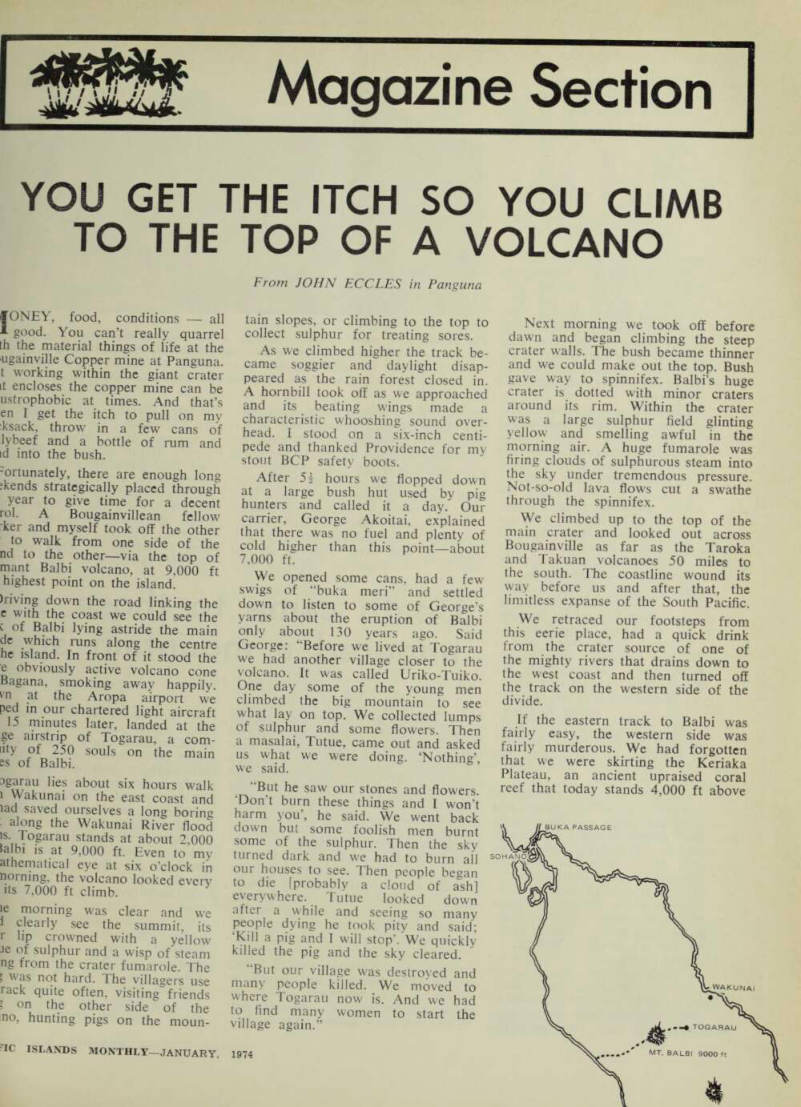
fONEY, food, conditions all 1 good. You can’t really quarrel th the material things of life at the ugainville Copper mine at Panguna. t working within the giant crater it encloses the copper mine can be ustrophobic at times. And that’s en I get the itch to pull on my :ksack, throw in a few cans of lybeef and a bottle of rum and id into the bush. fortunately, there are enough long ;kends strategically placed through year to give time for a decent rol. A Bougainvillean fellow ker and myself took off the other to walk from one side of the nd to the other—via the top of mant Balbi volcano, at 9.000 ft highest point on the island. ffiving down the road linking the c with the coast we could see the \ of Ba lbi lying astride the main dc which runs along the centre he island. In front of it stood the e obviously active volcano cone Bagana, smoking away happily. m at the Aropa airport we ped in our chartered light aircraft 15 minutes later, landed at the ge airstrip of Togarau, a com nty of 250 souls on the main ss of Balbi.
Jgarau lies about six hours walk i Wakunai on the east coast and lad saved ourselves a long boring along the Wakunai River flood is. Togarau stands at about 2,000 lalbi is at 9,000 ft. Even to my athematical eye at six o’clock in norning, the volcano looked everv its 7,000 ft climb. ie morning was clear and we I clearly see the summit, its r lip crowned with a yellow ie of sulphur and a wisp of steam ng from the crater fumarole. The 5 was not hard. The villagers use rack quite often, visiting friends » on the other side of the no, hunting pigs on the moun
tain slopes, or climbing to the top to collect sulphur for treating sores.
As we climbed higher the track be came soggier and daylight disap peared as the rain forest closed in.
A hornbill took off as we approached and its beating wings made a characteristic whooshing sound over head. I stood on a six-inch centi pede and thanked Providence for my stout BCP safety boots.
After hours we flopped down at a large bush hut used by pig hunters and called it a day. Our carrier, George Akoitai, explained that there was no fuel and plenty of cold higher than this point—about 7,000 ft.
We opened some cans, had a few swigs of “buka meri” and settled down to listen to some of George’s yarns about the eruption of Balbi only about 130 years ago. Said George: “Before we lived at Togarau we had another village closer to the volcano. It was called Uriko-Tuiko.
One day some of the young men climbed the big mountain to see what lay on top. We collected lumps of sulphur and some flowers. Then a masalai, Tutue, came out and asked us what we were doing. ‘Nothing’, we said.
“But he saw our stones and flowers. ‘Don’t burn these things and I won’t harm you’, he said. We went back down but some foolish men burnt some of the sulphur. Then the sky turned dark and we had to burn all our houses to see. Then people began to die [probably a cloud of ash] everywhere. Tutue looked down after a while and seeing so many people dying he took pity and said; ‘Kill a pig and I will stop’. We quickly killed the pig and the sky cleared.
“But our village was destroyed and many people killed. We moved to where Togarau now is. And we had to find many women to start the village again.”
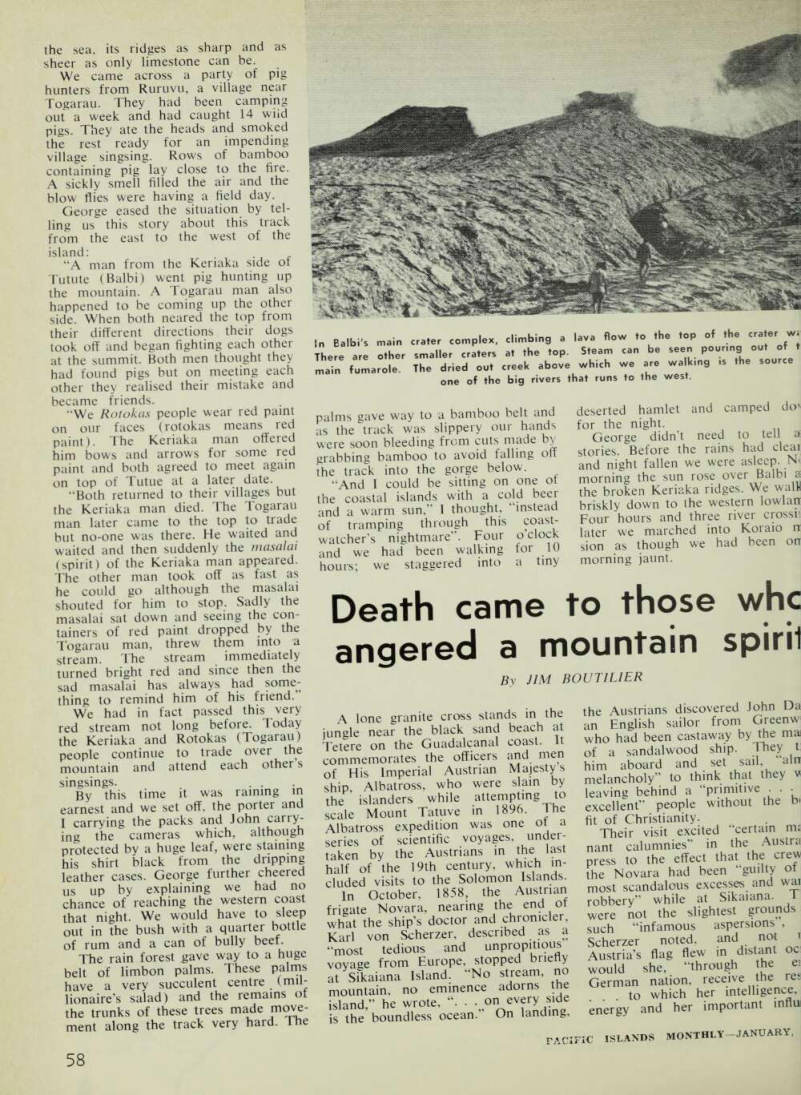
Next morning we took off before dawn and began climbing the steep crater walls. The bush became thinner and we could make out the top. Bush gave way to spinnifex. Balbi’s huge crater is dotted with minor craters around its rim. Within the crater was a large sulphur field glinting yellow and smelling awful in the morning air. A huge fumarole was firing clouds of sulphurous steam into the sky under tremendous pressure.
Not-so-old lava flows cut a swathe through the spinnifex.
We climbed up to the top of the main crater and looked out across Bougainville as far as the Taroka and Takuan volcanoes 50 miles to the south. The coastline wound its way before us and after that, the limitless expanse of the South Pacific.
We retraced our footsteps from this eerie place, had a quick drink from the crater source of one of the mighty rivers that drains down to the west coast and then turned off the track on the western side of the divide.
If the eastern track to Balbi was fairly easy, the western side was fairly murderous. We had forgotten that we were skirting the Keriaka Plateau, an ancient upraised coral reef that today stands 4,000 ft above
the sea, its ridges as sharp and as sheer as only limestone can be.
We came across a party of pig hunters from Ruruvu, a village near Togarau. They had been camping out a week and had caught 14 wild pigs. They ate the heads and smoked the rest ready for an impending village singsing. Rows of bamboo containing pig lay close to the fire.
A sickly smell filled the air and the blow flies were having a field day.
George eased the situation by tel ling us this story about this track from the east to the west of the island: “A man from the Keriaka side of Tutute (Balbi) went pig hunting up the mountain. A Togarau man also happened to be coming up the other side. When both neared the top from their different directions their dogs took off and began fighting each other at the summit. Both men thought they had found pigs but on meeting each other they realised their mistake and became friends.
“We Rotokas people wear red paint on our faces (rotokas means red paint). The Keriaka man offered him bows and arrows for some red paint and both agreed to meet again on top of Tutue at a later date.
“Both returned to their villages but the Keriaka man died. The Togarau man later came to the top to trade but no-one was there. He waited and waited and then suddenly the masalai (spirit) of the Keriaka man appeared.
The other man took off as fast as he could go although the masalai shouted for him to stop. Sadly the masalai sat down and seeing the con tainers of red paint dropped by the Togarau man, threw them into a stream. The stream immediately turned bright red and since then the sad masalai has always had some thing to remind him of his friend.
We had in fact passed this very red stream not long before. Today the Keriaka and Rotokas (Togarau) people continue to trade over the mountain and attend each other s singsings. . .
By this time it was raining m earnest and we set off. the porter and I carrying the packs and John carry ing the cameras which, although protected by a huge leaf, were staining his shirt black from the dripping leather cases. George further cheered us up by explaining we had no chance of reaching the western coast that night. We would have to sleep out in the bush with a quarter bottle of rum and a can of bully beef.
The rain forest gave way to a huge belt of limbon palms. These palms have a very succulent centre (mil lionaire’s salad) and the remains of the trunks of these trees made move ment along the track very hard. Ihe
palms gave way to a bamboo belt and as the track was slippery our hands were soon bleeding from cuts made by grabbing bamboo to avoid falling off the track into the gorge below.
“And I could be sitting on one ot the coastal islands with a cold beer and a warm sun," I thought, ‘ instead of tramping through this coast watcher’s nightmare’ . Four o clock and we had been walking tor 10 hours; we staggered into a tiny
deserted hamlet and camped dov for the night.
George didn’t need to tell a stories. Before the rains had clear and night fallen we were asleep. Nil morning the sun rose over Balbi a the broken Keriaka ridges. We walH briskly down to the western lowlan Four hours and three river crossiu later we marched into Koraio nr sion as though we had been on morning jaunt.
In Balbi's main crater complex, climbing a lava flow to the top of the crater w[?] There are other smaller craters at the top. Steam can be seen pouring out of t[?] main fumarole. The dried out creek above which we are walking is the source one of the big rivers that runs to the west.