Sex Talk Is Taboo And The Babies
pp. 47-49 · Read in the full issue


Keep On Coming In The Solomons
From a Honiara correspondent
If your country had a population doubling every 20 years, would you be worried? Some people in the Solo mon Islands are, although the govern ment, so far, has done nothing to encourage any slowing of this pro cess.
The reasons are not uncommon. It is simply that custom in many parts of the Solomons makes sex something not to be spoken of between man and wife. In fact, in some languages there are no words for a person’s private parts which need to be discussed if any attempt at family planning is to be made.
As in many places, the opportunity for Solomon Islanders to choose whether they’ll take part in family planning is coming from outsiders.
A New Zealander, Mrs Betty Smith, arrived in the Solomons with her husband last May, having given up volunteer work in family planning.
She had been most deeply involved in Sarawak where there had been a big and successful campaign in the 19605.
While at the Honiara market, she was distressed at the condition of so many mothers—not starving spectres with pot-bellied youngsters clinging to them for sustenance such as might be seen in desperately needy countries. The Solomons is far from being short of food.
But she did see the inevitable de terioration and premature aging of mothers who were having babies too quickly, and usually too often. She saw the children suffering from mal nutrition with the poor food they received from worn-down mothers whose breast milk was not what it would be were the mothers fit and able to recover physically between babies.
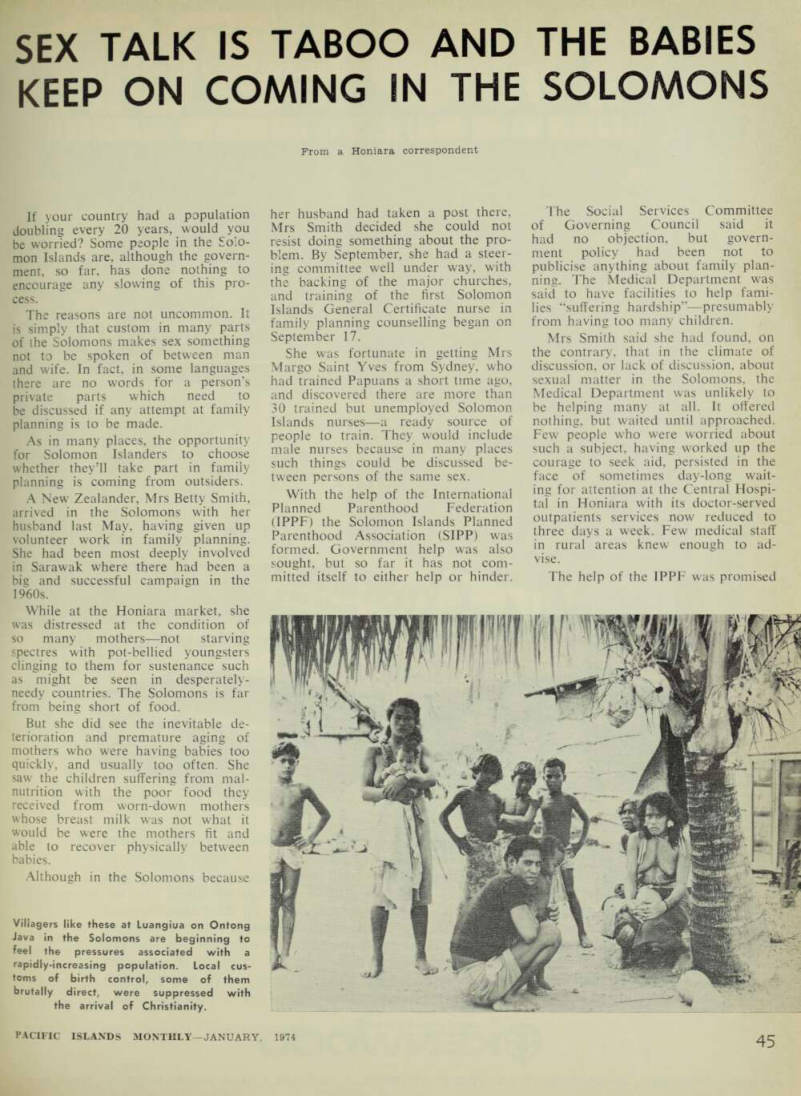
Although in the Solomons because Villagers like these at Luangiua on Ontong Java in the Solomons are beginning to feel the pressures associated with a rapidly-increasing population. Local cus toms of birth control, some of them brutally direct, were suppressed with the arrival of Christianity.
her husband had taken a post there, Mrs Smith decided she could not resist doing something about the pro blem. By September, she had a steer ing committee well under way, with the backing of the major churches, and training of the first Solomon Islands General Certificate nurse in family planning counselling began on
September 17.
She was fortunate in getting Mrs Margo Saint Yves from Sydney, who had trained Papuans a short time ago, and discovered there are more than 30 trained but unemployed Solomon Islands nurses—a ready source of people to train. They would include male nurses because in many places such things could be discussed be tween persons of the same sex.
With the help of the International Planned Parenthood Federation (IPPF) the Solomon Islands Planned Parenthood Association (SIPP) was formed. Government help was also sought, but so far it has not com mitted itself to either help or hinder.
The Social Services Committee of Governing Council said it had no objection, but govern ment policy had been not to publicise anything about family plan ning. The Medical Department was said to have facilities to help fami lies “suffering hardship"—presumably from having too many children.
Mrs Smith said she had found, on the contrary, that in the climate of discussion, or lack of discussion, about sexual matter in the Solomons, the Medical Department was unlikely to be helping many at all. It offered nothing, but waited until approached.
Few people who were worried about such a subject, having worked up the courage to seek aid, persisted in the face of sometimes day-long wait ing for attention at the Central Hospi tal in Honiara with its doctor-served outpatients services now reduced to three days a week. Few medical staff in rural areas knew enough to ad vise.
The help of the IPPF was promised
Sobering statistics
by its Medical Administrator for the Pacific Islands, Dr Asi Faletoese, of Western Samoa, who came to Honiara for a few days in September to lend Mrs Smith moral support and advise and to speak at a public meeting at which he promised IPPF financing as soon as a programme was completed for tackling the Solomons’ particular needs.
Despite the statistical projection that the Solomon Islands’ population will be four times as big in 40 years as its present population of 179,000, the SIPP is setting out first to im prove the health of mother and children by encouraging spacing of births.
Beginning there, it hopes to pro vide medical and welfare advice to help parents have fewer and heal thier children, to provide sex edu cation to anyone in the Solomon Islands when requested to prevent un wanted pregnancies, and generally to bring about a happier family life.
The committee working with Mrs Smith so far includes Mr Tucker from the United Church, Dean Palmer of the Anglican Church, three Solo mon Island women and three expat riate women.
The public meeting at which Dr Asi spoke was also addressed by Mr Tony Hughes, who was a leading figure in the GEIC’s development planning of recent years, and is now senior adviser to the Solomons Local Government Committee Chairman.
Mr Hughes told how the much more serious population pressure of the GEIC had made family planning number one priority, and how it had been so successful, partly because there was only a small population of 60,000.
Mr Hughes was talking in a coun try which has only a few smaller is lands feeling any large measure of pressure for land. But the statistics of only a few weeks before showing that the population of Honiara’s population had grown by more than half inside 3i years was sobering, even if much of that growth was from immigration from the rural areas. Honiara has grown from 11,191 in February 1970 to 17,090 in July this year, an increase of nearly 55 per cent.
The population as a whole had grown 11 per cent in the same time, from 161,000 to 179,000.
Birth and population control are by no means unknown among
numerous language groups in the Solomons. In some places, such as the weather coast of Guadalcanal, birth control in the face of a re lative land shortage has been carried out by abstinence from sexual in tercourse for a year or more after a birth, and herbally-induced abortions are traditional.
On one or two tiny islands, once the population reached a certain point, a communal decision would be made to send the excess people elsewhere. There has been a certain amount of immigration from small
islands or those with limited fertility to bigger groups although now there is population pressure building on these bigger, if still small, groups at times, such as in the Russell Islands where Tikopian and Bellonese people have settled.
The Polynesian outliers particularly —Ontong Java, Rennel and Bellona, Tikopia and Anuta, Sikaiana —are feeling the pressures of improved health combined with Christianity which broke down occasionally brut ally direct, but rational methods of population control.