Clerics Call
p. 45 · Read in the full issue
N. Hebrides
For Change
From a Vila correspondent
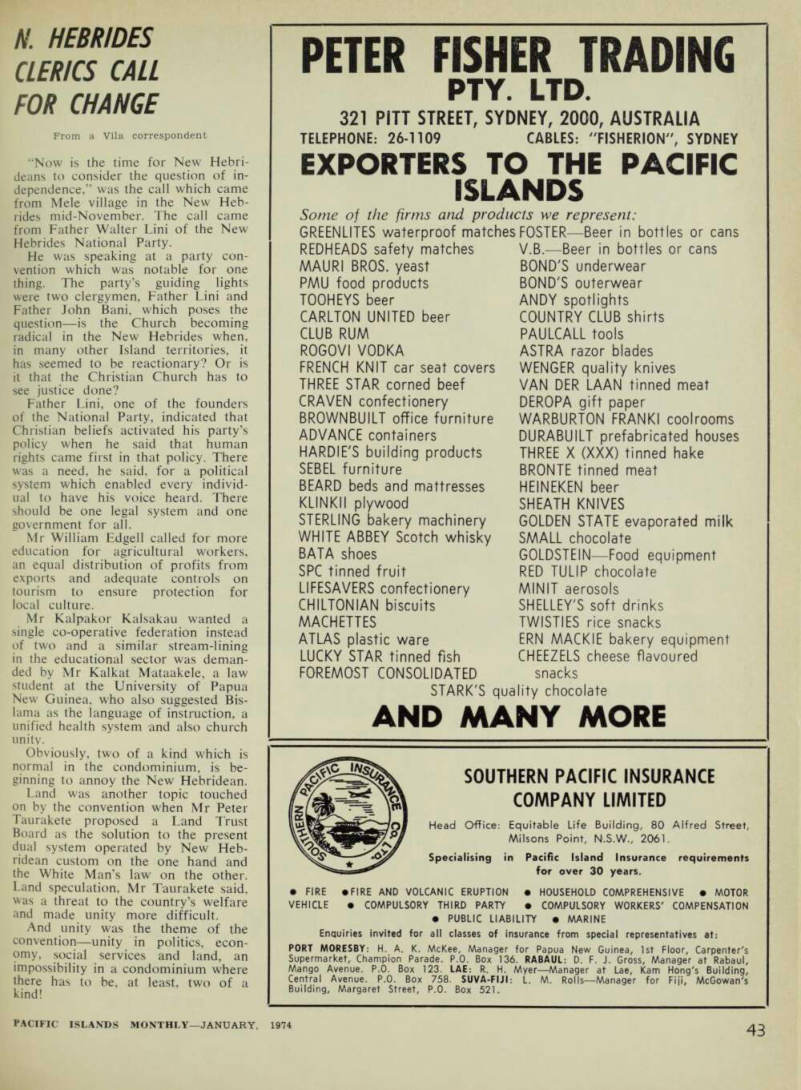
“Now is the time for New Hebri deans to consider the question of in dependence,” was the call which came from Mele village in the New Heb rides mid-November. The call came from Father Walter Lini of the New Hebrides National Party.
He was speaking at a party con vention which was notable for one thing. The party’s guiding lights were two clergymen, Father Lini and Father John Bani, which poses the question—is the Church becoming radical in the New Hebrides when, in many other Island territories, it has seemed to be reactionary? Or is it that the Christian Church has to see justice done?
Father Lini, one of the founders of the National Party, indicated that Christian beliefs activated his party’s policy when he said that human rights came first in that policy. There was a need, he said, for a political system which enabled every individ ual to have his voice heard. There should be one legal system and one government for all.
Mr William Edgell called for more education for agricultural workers, an equal distribution of profits from exports and adequate controls on tourism to ensure protection for local culture.
Mr Kalpakor Kalsakau wanted a single co-operative federation instead of two and a similar stream-lining in the educational sector was deman ded by Mr Kalkat Mataakele, a law student at the University of Papua New Guinea, who also suggested Bis lama as the language of instruction, a unified health system and also church unity.
Obviously, two of a kind which is normal in the condominium, is be ginning to annoy the New Hebridean.
Land was another topic touched on by the convention when Mr Peter Taurakete proposed a Land Trust Board as the solution to the present dual system operated by New Heb ridean custom on the one hand and the White Man’s law on the other.
Land speculation, Mr Taurakete said, was a threat to the country’s welfare and made unity more difficult.
And unity was the theme of the convention—unity in politics, econ omy, social services and land, an impossibility in a condominium where there has to be, at least, two of a kind!