At The Seashore
p. 62 · Read in the full issue
Short Story
By Tili Peseta
4 FAINT salty breeze blows the thin lavalava against Pili’s legs as he steps out of the brush on to the rocks. Tbe familiar musty smell of mud, slaked with the derelict of infernal crawling invertebrates of the seashore makes him catch his breath once then accommodating his sense to the smell, Pili inhales deeply. He has to be selective in the gulps of air he takes in. Pili squats on the rocks to wait.
The seashore is a peculiar and mysterious place. The smell of deep rotting seaweeds can be foremost once, then it recedes and one is conscious of the slightly warm air, a fleeting shadow across the grave; an illusion. It is the smell old people associate with death. This is the smell Pili is extremely conscious of as he waits. A slight thrill of apprehension starts up Pili’s a feelmg of expectation, a fearful expec-
eyes ,search the honzon tatner s canoe.
It i s midday, the time when the a j r j s neither cool nor hot, a transit i ona i stage when the atmosphere seems a blend of shadow and light.
Legends tell that at midday, the ghosts pull up their boats on the shore after a night, a day, or a lifet j me 0 f fishing. Who knows how the dead measure time?
Now as p d i squats on the rocks, a stm and silent fi gure alone with the ghosts of his ancestors, he wills hims lf to become one with his forefathers in the shade . To speak to the dead has been the dedication of his Hfe Now he moving forms, dlusions of ligh t reflected from off the sea and off the dark rocks A shaft of diffused light thickens the atmospher e here and there, and now his body seems to be static, a puny vegetable, useless and ■non-funct oral
and^restrfetfons^of 1 this Sable
beyond the horizon, the intercour of space and matter, the meetn place of the dead t 0 t h e human fori but the acme of life to the soul coui terpart j-[ e sees the canoe that fills wn the catc h of all times, the nouns ment that seem s unconsumed. I sees the Hght-prowed canoe that skir tbe sea effortlessly on a waterw that is smooth and fluid. He sos above, higher and higher. . • But then, out of the tence a voice caught i rec linii a B ust ,9 f wave disturbs Pih s reverie, A an d t land with the voice cal 8 shadow beckoning to the i\\u the an sone canoe passe; a g • k \ lone woma]n . head in sympathy a Tome Little does j S Pili is happy.
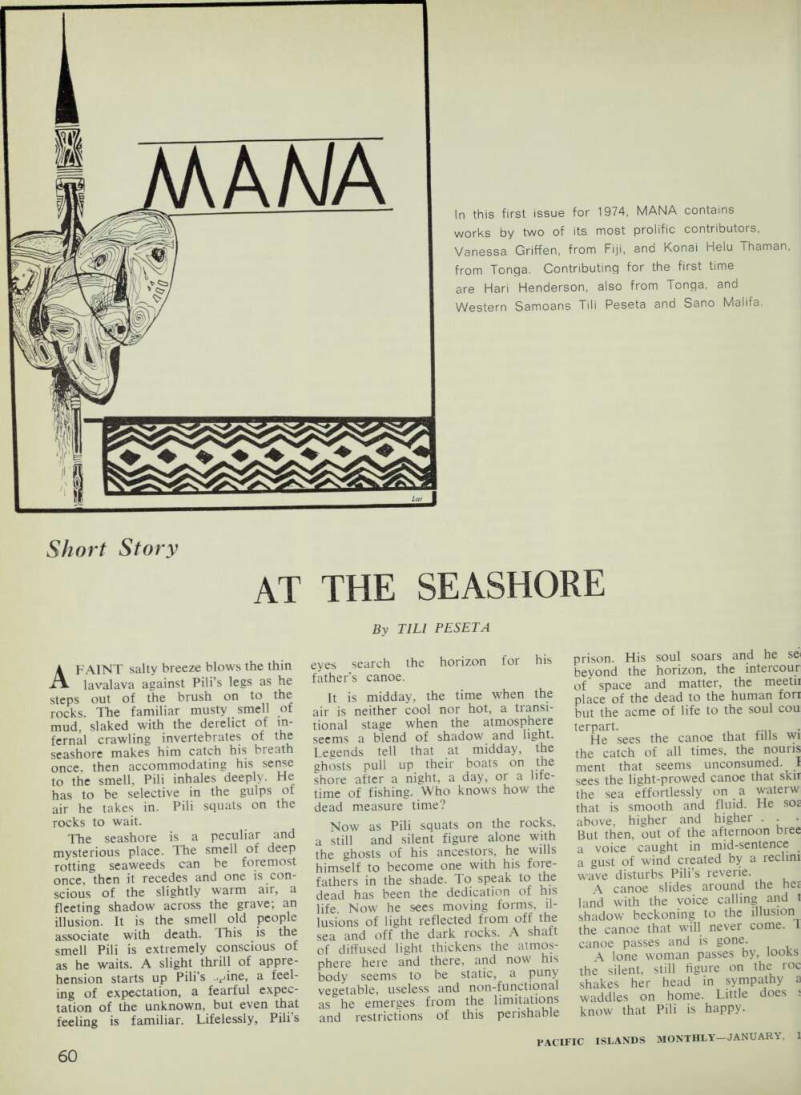
In this first issue for 1974, MANA contains works by two of its most prolific contributors, Vanessa Griffen, from Fiji, and Konai Helu Thaman, from Tonga. Contributing for the first time are Hari Henderson, also from Tonga, and Western Samoans Tili Peseta and Sano Malifa.