Politicians to appoint PNG's
pp. 19-21 · Read in the full issue

top public servants?
From a Port Moresby correspondent
The national convention of the Pangu Pati has outlined far-reaching new policies for the party, which could affect the direction in which self-governing Papua New Guinea heads.
The Pangu Pati is Mr Michael Somare’s party, and is the main plank of the present PNG coalition headed by Mr Somare. The coalition also comprises the Peoples Progress Party, the National Party, the Mataungan Association, as well as independents.
About 100 delegates from most districts attended the convention in Port Moresby. They elected as new national president, Mr Moi Avei, and as vice-president Mr Somare’s close adviser and one of the architects of the Pangu Pati, Tony Voutas, Other members of the executive are Pangu ministers, the Speaker of the House, Mr Barry Holloway, and district leaders of Pangu branches throughout PNG.
If implemented, some of the new policies would mean creation of political patronage in the public service.
Politics
The convention decided that the party’s new policies should be guided by the following broad aims: • That public servants may take active part in political party activities at all levels; • That departmental and divisional heads must be political appoint ments; • That District Commissioners should be appointed on a political basis; • That a political body, totally independent of the Public Service Board, should carry out a com plete review of the organisational structure of the public service, with a view to reform.
Commenting on these resolutions, Mr Avei, said that the convention recognised that re-organisation of the public service was essential to im plement the government aims, and
it was “becoming obvious that there must be substantial politicisation of the public service.”
Local government
Mr Avei said that the main aim of the new policy on local govern ment, education and business develop ment was to recognise and involve the strengths and traditions existing in the village communities of PNG in these areas. New policy would be that: • The party recognise that there had always been traditional systems of local government, village welfare and education in village life and that these should be incorporated into policy in these fields; • The government should give full support to all organisations which represented PNG aspirations at a local level, which wished to com mence forms of business or other development; • Children should attend schooling from an earlier age, five to six years, and that their education should continue to form two level or equivalent of a form two level, and that it should properly prepare them for a useful and meaningful role in the community; • There should be no selection examinations at a standard six level; • That the national education policy should re-orientate itself to these aims and should include such traditional activities, including crafts and other social activities, as fishing, hunting etc, to properly prepare New Guinean children for adult life within a PNG community; • Parents should be encouraged to take a greater interest in and involvement with the education of their children.
Foreign investment
Mr Avei said that the foreign investment policy must be geared to implement government aims of a rapidly increasing involvement of New Guineans in all forms of econo mic enterprise. The following policies were laid down by the convention:
One name, one country
• All production stages of primary industries should come under the control of New Guineans; • Preference must be given to New Guinean entrepreneurs who wished to buy out businesses being sold by expatriate companies; • The government must lay down a timetable of periods during which foreign investment will be welcome in individual business sectors. After these periods ex pire, no further foreign invest ment should be allowed in these fields and legitimate efforts should be made to buy out all exist ing foreign investment in those categories; • Joint venture enterprises are wel come provided that the expatriate element “phases out” its equity within 15 to 25 years, so that the enterprise is totally New Guinean. Part of profits of the venture should be used to in crease the PNG equity. However, if the PNG element is in a position to acquire total equity before 15 years then it should have this option; 0 Where there is large foreign owned investment in secondary industries, wholly New Guinean enterprises should supply all relevant servicing industries; • All new foreign investment must establish an increasing PNG shareholding as a condition of its entry into the country; • In all resource industries the com pany must provide the people of PNG a percentage of free shareholding.
National unity
Mr Avei said that the convention had re-affirmed the Pangu policy of national unity. The convention adopted the following policies: • A new single name for the country; 0 Re-affirmation of the Pangu policy—one name, one country, one people; 0 Emphasis should be laid by the government on development of the so far neglected districts; • More power should be given by the central government to dis tricts.
In summing up, Mr Avei said that in the past, there had been far too much talk about the principles of self reliance and equality, and not enough initiative to put these aims into action.
“This development and implemen tation must utilise the strengths of our village communities,” he said. “We cannot hope to do this by using the foreign institutions which have been brought here from outside, unless these institutions are in a supplemen tary role.
“In other words, we must revitalise our development programme, basing it on our own strengths, and in corporating imported ideas, only as they can be modified to achieve our aims.”
Opposition reaction
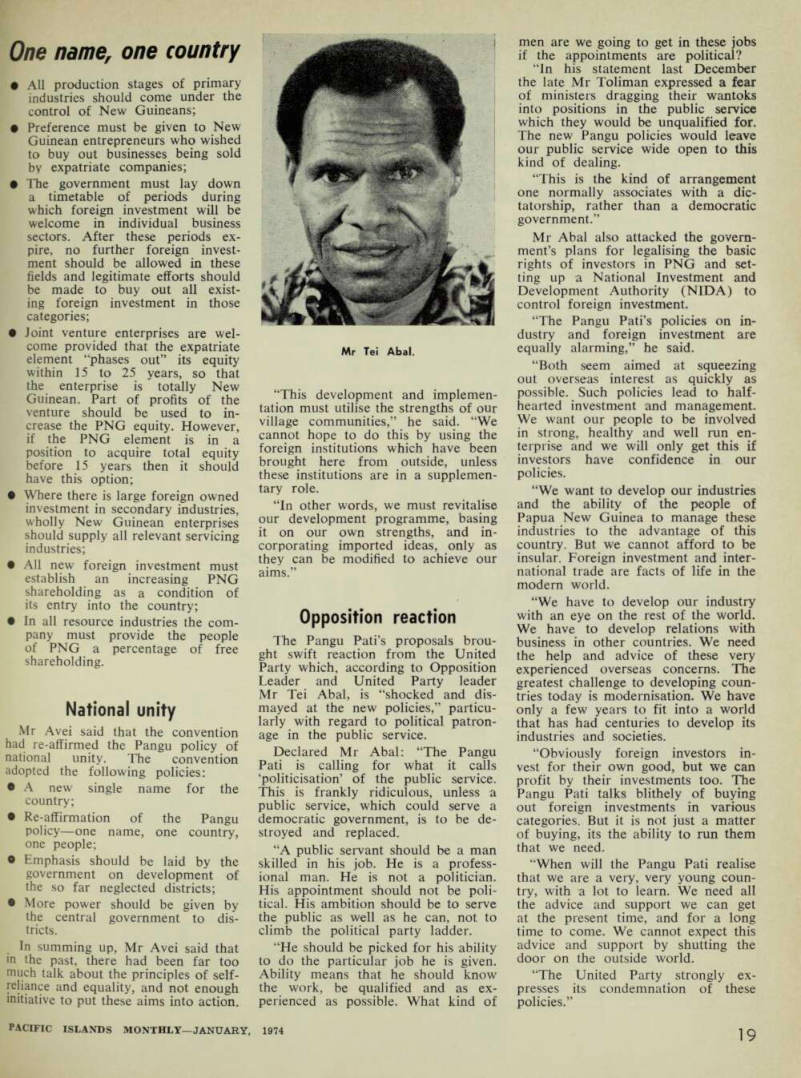
The Pangu Pati’s proposals brou ght swift reaction from the United Party which, according to Opposition Leader and United Party leader Mr Tei Abal, is “shocked and dis mayed at the new policies,” particu larly with regard to political patron age in the public service.
Declared Mr Abal: “The Pangu Pati is calling for what it calls ‘politicisation’ of the public service.
This is frankly ridiculous, unless a public service, which could serve a democratic government, is to be de stroyed and replaced.
“A public servant should be a man skilled in his job. He is a profess ional man. He is not a politician.
His appointment should not be poli tical. His ambition should be to serve the public as well as he can, not to climb the political party ladder.
“He should be picked for his ability to do the particular job he is given.
Ability means that he should know the work, be qualified and as ex perienced as possible. What kind of
men are we going to get in these jobs if the appointments are political?
“In his statement last December the late Mr Tollman expressed a fear of ministers dragging their wantoks into positions in the public service which they would be unqualified for.
The new Pangu policies would leave our public service wide open to this kind of dealing.
“This is the kind of arrangement one normally associates with a dic tatorship, rather than a democratic government.”
Mr Abal also attacked the govern ment’s plans for legalising the basic rights of investors in PNG and set ting up a National Investment and Development Authority (NIDA) to control foreign investment.
“The Pangu Pati’s policies on in dustry and foreign investment are equally alarming,” he said.
“Both seem aimed at squeezing out overseas interest as quickly as possible. Such policies lead to half hearted investment and management.
We want our people to be involved in strong, healthy and well run en terprise and we will only get this if investors have confidence in our policies.
“We want to develop our industries and the ability of the people of Papua New Guinea to manage these industries to the advantage of this country. But we cannot afford to be insular. Foreign investment and inter national trade are facts of life in the modem world.
“We have to develop our industry with an eye on the rest of the world.
We have to develop relations with business in other countries. We need the help and advice of these very experienced overseas concerns. The greatest challenge to developing coun tries today is modernisation. We have only a few years to fit into a world that has had centuries to develop its industries and societies.
“Obviously foreign investors in vest for their own good, but we can profit by their investments too. The Pangu Pati talks blithely of buying out foreign investments in various categories. But it is not just a matter of buying, its the ability to run them that we need.
“When will the Pangu Pati realise that we are a very, very young coun try, with a lot to learn. We need all the advice and support we can get at the present time, and for a long time to come. We cannot expect this advice and support by shutting the door on the outside world.
“The United Party strongly ex presses its condemnation of these policies.”
Mr Tei Abal.