Tropicalities
pp. 14-17 · Read in the full issue

The Lucky
Countrymen
PNG’s Minister for Trade and In dustry, Mr John Poe, summed it up for students in an address to the Tus bab High School in November. He said they would become the future leaders of the country not because they were more intelligent, or be cause they h.?.d any special talent for leadership, but because they were chosen to be given a better education just at the time when leaders were needed. “You are lucky,” he said.
Mr Poe, who is 41 and a Papuan who taught with the Catholic Mission at Yule Island for five years, said that traditionally leadership in PNG did not depend on education, but upon character, intelligence and ex perience.
“It had to be earned by hard work, loyalty and service to our clan and village,” he said. “It was not given away to young, inexperienced men and women, but was accorded only to those who had proved they had already acquired maturity and wis dom. However, these changing times have confused many of my gener ation and of yours.
“Many of those of our people who have not been lucky enough to re ceive a formal education feel they are not qualified to be leaders in modern Papua New Guinea. There fore they tend to stand back and leave the leadership to you and me. So whether we like it or not, whether we are the best ones for the job or not, leadership is given to us, just as education has been given to us. We are the lucky ones ...”
Thar’s gold in
them thar huts!
Genuine antiques from the Islands, ceremonial masks, clubs, witchdoctor garb, head-dresses, idols and what have-you are rocketing in price in the collectors’ markets in Sydney and other centres outside the Islands— all because the supply has dried up with the belated discovery by the
Islanders that they’ve been sitting on a goldmine over the years. Cere monial gear, which has usually been destroyed after being sanctified through association with tribal rites, is now being preserved and offered to the dealer.
But, places like Papua New Guinea, which have banned the export of such treasures, are blocking supplies.
Dealers, however, are finding that there is a rich source already in Australia, brought years ago from the Islands by district officers and others when they have retired.
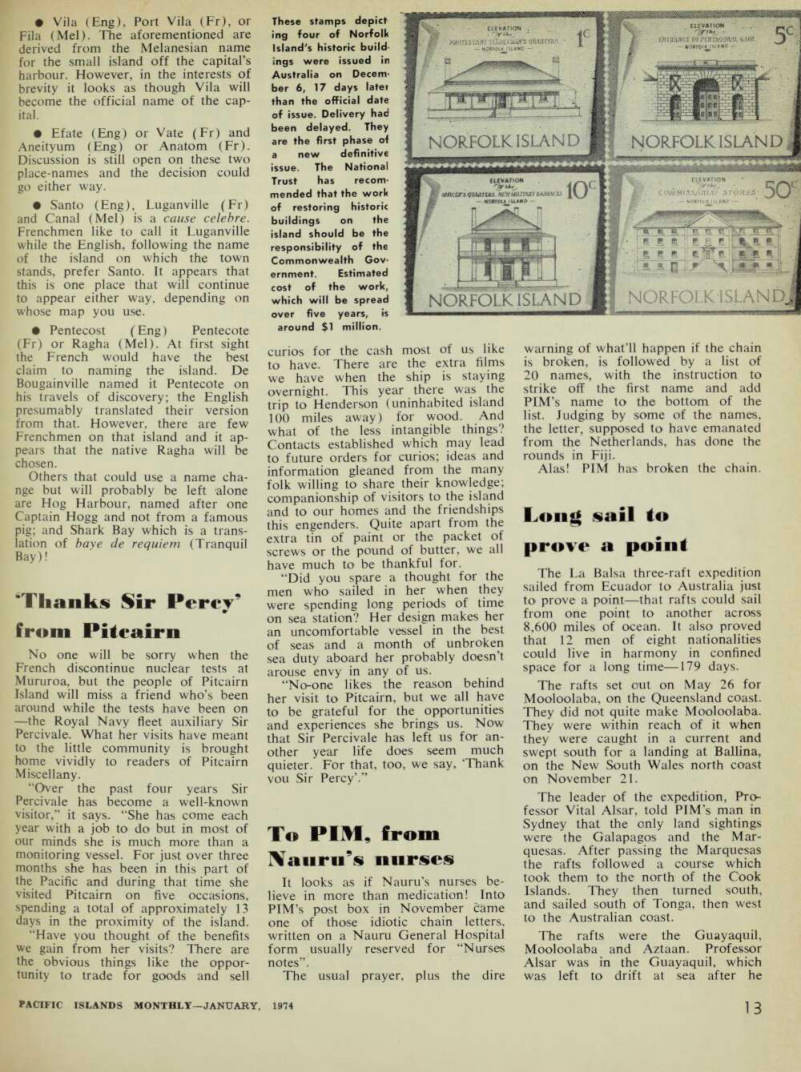
One such treasure, a Tongan war club, pictured here, arrived in Aust ralia in the early 1800 s. It is esti-
mated to be about 150 years old and, as can be seen, is ornamented with intricate carvings, of Tongan myth ology, no doubt. There are turtles, porpoises, sharks, a man diving and many, meaningless marks, obviously for decorative purposes.
The market price when new isn’t known, but when its owner Laurie Marshall of Tapa Gallery in William Street, in Sydney’s Paddington, offer ed it for sale he got a return worth a block of building land which, these days, isn’t going for peanuts.
The club is of the same vintage as the one which cracked the skull of Captain James Cook on a Hawaiian beach. Yes, that was a Tongan club and only a few months ago was in the London market sup ported by a certificate, reputedly signed by Joseph Banks, testifying that it was the very weapon which battered the life out of the Pacific explorer. Laurie Marshall, who knows about such things, said he was sure that, if Cook had been able to choose which Tongan club took his life, he’d have picked the one pictured here in PIM, Of course, there may be hundreds of clubs labelled as the club which killed Cook just as there are in Eng land hundreds of beds which Good Queen Bess slept in. PIM heard of the museum keeper who produced a battle-axe and said it was the one used by Robert the Bruce of Scotland.
When it was pointed out that it look ed rather new, he replied, “Well, it’s had two new heads and three new handles!”
Cutting down
the pandemonium
Place names in the New Heb rides are likely to be standardised in the near future. The French and British Condominium administrations are co-operating in a programme to eradicate an embarrassing number of ambiguities on the New Hebrides map.
When a standardised list of place names has been agreed upon, with the active co-operation of the Melanesian community, the programme will be presented to the Advisory Council for
approval.
Some of the names at issue; • Malekula (Eng) or Mallicolo (Fr) and Erromanga (Eng) or Erro mango (Fr) are likely to be stand ardised by a little horse-trading. The French ( according to the Coconut Radio) will accept Malekula if they can keep Erromango.
Tongan war club, 150 years old and worth what anyone will pay!
• Vila (Eng), Port Vila (Fr), or Fila (Mel). The aforementioned are derived from the Melanesian name for the small island off the capital’s harbour. However, in the interests of brevity it looks as though Vila will become the official name of the cap ital. • Efate (Eng) or Vate (Fr) and Aneityum (Eng) or Anatom (Fr).
Discussion is still open on these two place-names and the decision could go either way. • Santo (Eng), Luganville (Fr) and Canal (Mel) is a cause celebre.
Frenchmen like to call it Luganville while the English, following the name of the island on which the town stands, prefer Santo. It appears that this is one place that will continue to appear either way, depending on whose map you use. • Pentecost (Eng) Pentecote (Fr) or Ragha (Mel). At first sight the French would have the best claim to naming the island. De Bougainville named it Pentecote on his travels of discovery; the English presumably translated their version from that. However, there are few Frenchmen on that island and it ap pears that the native Ragha will be chosen.
Others that could use a name cha nge but will probably be left alone are Hog Harbour, named after one Captain Hogg and not from a famous pig; and Shark Bay which is a trans lation of baye de requiem (Tranquil Bay)!
‘Thanks Sir Per cj 9
from Piteairn
No one will be sorry when the French discontinue nuclear tests at Mururoa, but the people of Pitcairn Island will miss a friend who’s been around while the tests have been on —the Royal Navy fleet auxiliary Sir Percivale. What her visits have meant to the little community is brought home vividly to readers of Pitcairn
Miscellany.
“Over the past four years Sir Percivale has become a well-known visitor,” it says. “She has come each year with a job to do but in most of our minds she is much more than a monitoring vessel. For just over three months she has been in this part of the Pacific and during that time she visited Pitcairn on five occasions, spending a total of approximately 13 days in the proximity of the island.
“Have you thought of the benefits we gain from her visits? There are the obvious things like the oppor tunity to trade for goods and sell
curios for the cash most of us like to have. There are the extra films we have when the ship is staying overnight. This year there was the trip to Henderson (uninhabited island 100 miles away) for wood. And what of the less intangible things?
Contacts established which may lead to future orders for curios; ideas and information gleaned from the many folk willing to share their knowledge; companionship of visitors to the island and to our homes and the friendships this engenders. Quite apart from the extra tin of paint or the packet of screws or the pound of butter, we all have much to be thankful for.
“Did you spare a thought for the men who sailed in her when they were spending long periods of time on sea station? Her design makes her an uncomfortable vessel in the best of seas and a month of unbroken sea duty aboard her probably doesn’t arouse envy in any of us.
“No-one likes the reason behind her visit to Pitcairn, but we all have to be grateful for the opportunities and experiences she brings us. Now that Sir Percivale has left us for an other year life does seem much quieter. For that, too, we say, ‘Thank vou Sir Percy’.”
To PIM, from
Nauru’s nurses
It looks as if Nauru’s nurses be lieve in more than medication! Into PlM’s post box in November came one of those idiotic chain letters, written on a Nauru General Hospital form usually reserved for “Nurses notes”.
The usual prayer, plus the dire
warning of what’ll happen if the chain is broken, is followed by a list of 20 names, with the instruction to strike off the first name and add PlM’s name to the bottom of the list. Judging by some of the names, the letter, supposed to have emanated from the Netherlands, has done the rounds in Fiji.
Alas! PIM has broken the chain.
Long sail to
prove a point
The La Balsa three-raft expedition sailed from Ecuador to Australia just to prove a point—that rafts could sail from one point to another across 8,600 miles of ocean. It also proved that 12 men of eight nationalities could live in harmony in confined space for a long time—l 79 days.
The rafts set out on May 26 for Mooloolaba, on the Queensland coast.
They did not quite make Mooloolaba.
They were within reach of it when they were caught in a current and swept south for a landing at Ballina, on the New South Wales north coast on November 21.
The leader of the expedition, Pro fessor Vital Alsar, told PI M's man in Sydney that the only land sightings were the Galapagos and the Mar quesas. After passing the Marquesas the rafts followed a course which took them to the north of the Cook Islands. They then turned south, and sailed south of Tonga, then west to the Australian coast.
The rafts were the Guayaquil, Mooloolaba and Aztaan. Professor Alsar was in the Guayaquil, which was left to drift at sea after he
These stamps depict ing four of Norfolk Island's historic build ings were issued in Australia on Decem ber 6, 17 days later than the official date of issue. Delivery had been delayed. They are the first phase of a new definitive issue. The National Trust has recom mended that the work of restoring historic buildings on the island should be the responsibility of the Commonwealth Gov ernment. Estimated cost of the work, which will be spread over five years, is around $1 million.
and three of his companions were lifted from it by a Royal Australian Navy ship, the Labuan, off the Aus tralian coast. The Mooloolaba and the Aztaan were left at Ballina.
Sometimes the rafts sailed close to gether, almost at arm’s length. Some times they were several miles apart.
When passing south of Tonga the Mooloolaba disappeared and did not reappear for eight days. But that was only a slightly worrying incident for by that time all the men had full confidence in each other and their rafts.
The rafts passed eight ships. Apart from that their only company was sharks, which always seemed to be present, and a few whales. TTie men supplemented their rations with fish, which they caught almost daily, and they caught rainwater for drinking and ablutions.
The professor, who said he wouldn’t repeat the trip, intended to return to New Mexico, where he now lives, to build rafts for sale, an occu pation he has followed for nine years.
Before going to New Mexico he was professor of business administration at San Tander University in Spain.
The eight nationalities in the expe dition were Spanish, French, American, Ecuadorian, Mexican, Chilean, French Canadian and English Canadian. Among them were geologists, engineers, students and a businessman.
Late in November the men spent a few days sightseeing in Sydney before deciding on their next moves. During a tour of the Opera House, Professor Alsar insisted that he and his com panions sing Spanish songs in the 2,700-seat concert hall to a small audience of journalists, photographers and Opera House staff.
The bishop a
real sky pilot
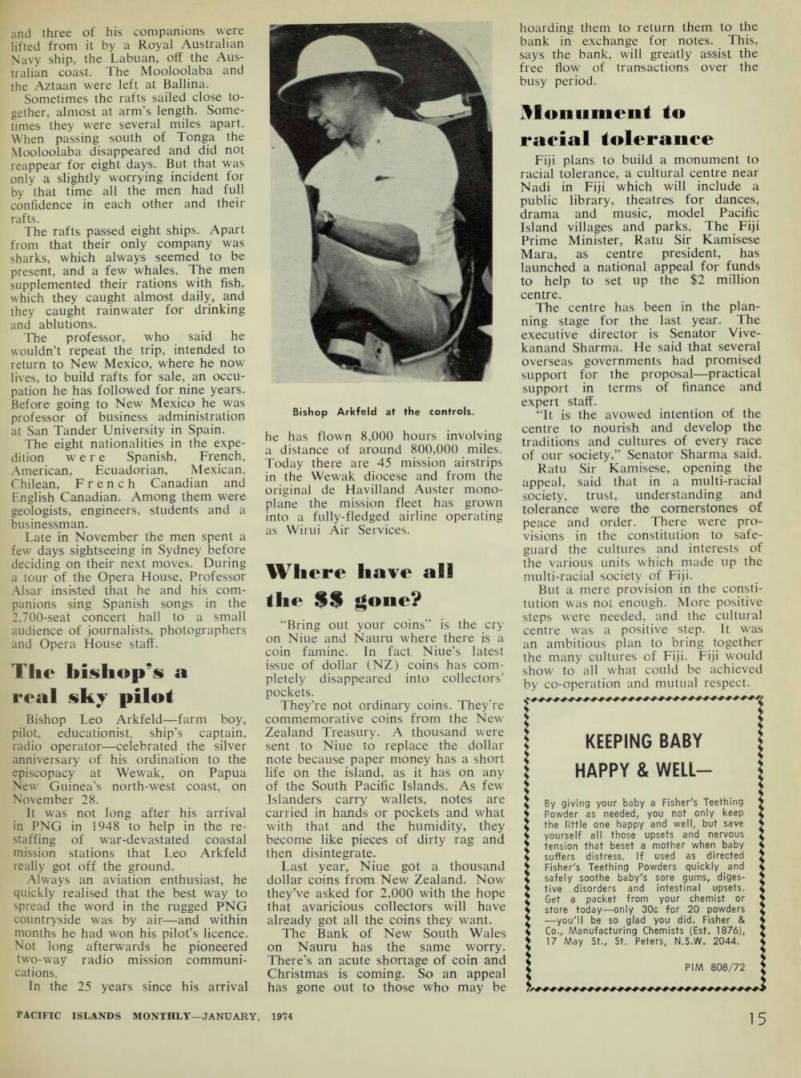
Bishop Leo Arkfeld—farm boy, pilot, educationist, ship’s captain, radio operator—celebrated the silver anniversary of his ordination to the episcopacy at Wewak, on Papua New Guinea’s north-west coast, on November 28.
It was not long after his arrival in PNG in 1948 to help in the re staffing of war-devastated coastal mission stations that Leo Arkfeld really got off the ground.
Always an aviation enthusiast, he quickly realised that the best way to spread the word in the rugged PNG countryside was by air—and within months he had won his pilot’s licence.
Not long afterwards he pioneered two-way radio mission communi cations.
In the 25 years since his arrival
he has flown 8,000 hours involving a distance of around 800,000 miles.
Today there are 45 mission airstrips in the Wewak diocese and from the original de Havilland Auster mono plane the mission fleet has grown into a fully-fledged airline operating as Wirui Air Services.
Where have all
the $$ gone?
“Bring out your coins” is the cry on Niue and Nauru where there is a coin famine. In fact Niue’s latest issue of dollar (NZ) coins has com pletely disappeared into collectors’ pockets.
They’re not ordinary coins. They're commemorative coins from the New Zealand Treasury. A thousand were sent to Niue to replace the dollar note because paper money has a short life on the island, as it has on any of the South Pacific Islands. As few Islanders carry wallets, notes are carried in hands or pockets and what with that and the humidity, they become like pieces of dirty rag and then disintegrate.
Last year, Niue got a thousand dollar coins from New Zealand. Now they’ve asked for 2,000 with the hope that avaricious collectors will have already got all the coins they want.
The Bank of New South Wales on Nauru has the same worry.
There’s an acute shortage of coin and Christmas is coming. So an appeal has gone out to those who may be
hoarding them to return them to the bank in exchange for notes. This, says the bank, will greatly assist the free flow of transactions over the busy period.
Monument to
racial tolerance
Fiji plans to build a monument to racial tolerance, a cultural centre near Nadi in Fiji which will include a public library, theatres for dances, drama and music, model Pacific Island villages and parks. The Fiji Prime Minister, Ratu Sir Kamisese Mara, as centre president, has launched a national appeal for funds to help to set up the $2 million centre.
The centre has been in the plan ning stage for the last year, pie executive director is Senator Vive kanand Sharma. He said that several overseas governments had promised support for the proposal—practical support in terms of finance and expert staff.
“It is the avowed intention of the centre to nourish and develop the traditions and cultures of every race of our society,” Senator Sharma said.
Ratu Sir Kamisese, opening the appeal, said that in a multi-racial society, trust, understanding and tolerance were the cornerstones of peace and order. There were pro visions in the constitution to safe guard the cultures and interests of the various units which made up the multi-racial society of Fiji.
But a mere provision in the consti tution was not enough. More positive steps were needed, and the cultural centre was a positive step. It was an ambitious plan to bring together the many cultures of Fiji. Fiji would show to all what could be achieved by co-operation and mutual respect.
Bishop Arkfeld at the controls.