Micronesian status talks collapse over
pp. 23-25 · Read in the full issue

the pot of gold at rainbow's end
From a Washington correspondent
The seventh round of talks on Micronesia’s future status, which opened in Washington (DC) on November 13, closed abruptly, but without rancour, in the second week.
Senator Lazarus Salii and his team from the Congress of Micronesia’s Joint Committee on Future Status, and President Nixon’s personal ambassador Mr Franklin Haydn Williams heading the United States delegation called it a day when they deadlocked. They couldn’t bridge a $4O million gap between what the Micronesians want in future US aid and what the United States is prepared to give.
The islanders wanted $lOO million a year—later cut to $BO million.
Ambassador Williams offered only half that. And neither side would budge. The United States contingent was prepared to shelve that problem for the time being and tackle some of the other portions of the draft compact of free association, but Senator Salii laid the whole future of the talks on the line.
“We cannot usefully proceed with the discussions of the remaining sections of a compact of free association until this gap is substantially narrowed,” he said.
There was all round disappointment. Before the talks opened, it was known it would be a long haul. Some even thought the talks wouldn’t start because of the Palauan land problem, but the two teams, with the support
of five Palauans, who had been in vited to give their views on American proposals for the return of the land, soared over that hurdle. The United States agreed to return the land im
mediately the^
fitle holders through the P a l au legis lature about the US need for some of the land for defence purposes .
The Palauans, after obtaining a few concessions, mainly dealing with hand-over and land administration procedures, agreed to the proposals.
Everybody, Senator Salii included, was optimistic about a successful and speedy ending to the talks. “Now that the land question is out of the way, he said .. . there no reason that this task (the drafting the compact) cannot be completed in a short period of time, But they quickly discovered that 40 million American greenbacks were reason enough to put a spoke in the wheel.
For several days behind closed doors, the two sides argued about how much money would be needed to run Micronesia after the Americans relinquished the trusteeship job.
The Micronesians, at first, stuck to their guns fired 18 months ago in the talks at Koror when they asked for an overall figure of $lOO million annually for the first 10 years plus the spending on existing federal pro grammes earmarked for the territory, America, apparently, was silent over this until the seventh round of
talks had begun when they produced a figure of between $4O million and $4l million a year for the six dis tricts of Micronesia plus the cost of the federal aviation administration and the postal and weather bureau services.
That shook the Micronesians who, when the United States’ team refused to budge, drew their horns in to the extent of $2O million along with a “significant diminution in the federal programme.”
There was no significant reaction from the home team so the Micro nesians presented alternatives which contained a neat piece of blackmail.
The Micronesians said, in effect, “The payment you propose is totally inadequate to justify the degree of continuing association between us. If you don’t pay what we ask then we must revalue the nature of our asso ciation and contemplate a significant curtailment in the degree of authority to be delegated to the United States in foreign affairs and defence.”
In the existing compact, full auth ority is given to the United States “over all matters which relate to de fence in Micronesia”, and this inclu des “rights and uses in the lands and waters” and the “exclusion of any other country from the right to con duct military activities or establish military facilities,” the suggestion being that anything less than the orig inal compact would give the Micro nesians the right to invite other pow ers to establish bases in the territory.
The Americans couldn’t possibly wear that one.
Another turn of the screw sug gested that the Micronesians, without the payments demanded, couldn’t afford the intimacy of a continuing relationship which would be close and lasting but which restricted Micronesia’s ability to attract invest ment from other countries and the creation of profitable trade relation ships with other countries. Maybe, they had Japan in mind. The inference was obvious—Pay what we ask for
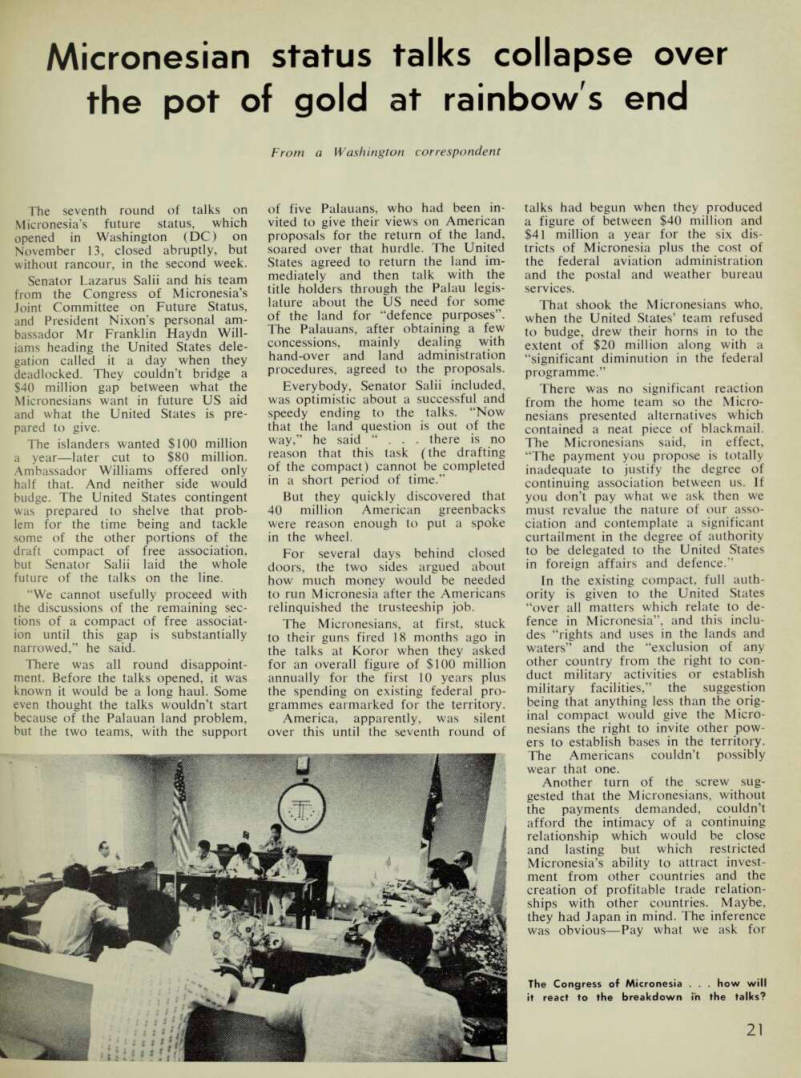
The Congress of Micronesia . . . how will it react to the breakdown in the talks?
or we invite other countries to the
party.”
The Micronesians said they were prepared to continue negotiations “on the assumption of a lower level of financial support” but it would have to be recognised that the status to be developed “would be one of far looser association than that which we have thus far envisaged.”
To give the Americans full rights over defence matters and over mili tary land would be giving too much for too little return, the Micronesians argued, and then asked the United States to present a new proposal be fore the Joint Committee had to re port to the next session of the Con gress of Micronesia which opens on January 13.
“In the absence of some proposal from you which affords such pro mise, it will be the responsibility of the committee to advise Congress that talks on free association have proved to be unproductive, and that some other course should now be considered,” was the Micronesians’ final shaft.
Ambassador Williams was obvious ly a disappointed man when he re plied for the United States.
He had hoped, he said, that they could have shelved the financial problems and got down to agreeing on the remainder of the compact, but failure to do so, he conceded, was due to “honest conceptual differ ences.”
It was obvious that the ambass ador was fighting a rearguard action when he revealed that, although the
Joint Committee had agreed that in the transition period before the end of the trusteeship, Micronesia’s ex penses would be lower than at pre sent, America was prepared to finance them at the current level and pay a fair market value for the use of public land.
Then came a surprise. That money, he said, added up to $43 million, a figure considerably higher, pro portionately, than the figure of $4O million to $4l million quoted by the Joint Committee for the six districts because it was for only five districts.
Which looks as if the Joint Com mittee was being pressed, at a price, to agree to separate status for the Marianas. And that total did not in clude for major projects which the United States intended to complete before the trusteeship ended.
The American offer, the ambass ador pointed out, provided for steady forward progress in government ser vices and a gradual movement to wards greater economic self-suffic iency and economic independence.
But the Joint Committee’s figure of Sioo million for six districts would lead Micronesia to greater depend ency and away from its stated goal of self-sufficiency.
“We feel that the figures you pre sented and the justification are un convincing,” he said, and then did a little screw turning himself by add ing, “The willingness of the US to commit itself to continuing financial support to a future Micronesia would depend on the nature of the relation ship. You have recognised that what you might expect under alternative forms of future association are very different things indeed. At one end of the scale is commonwealth or membership of the American family with all its obligations and benefits including the widest range of fed eral programmes and services. At the other end is independence with no US financial obligations,”
But the ambassador softened to wards the end of his speech and left the door open with, ”1 hope that we will keep in touch oyer the next weeks. Our objectives will not change.
We will continue to seek a proper way to end our trusteeship over the TTPI in a manner consistent with our legal obligations and our moral commit ment to the people of Micronesia.”
Earlier in the piece Senator Salii, breathing the air of optimism engen dered when the land obstacle was so quickly hurdled, said Washington’s weather was a bit too cold for their warm blood and they could be assur ed the Joint Committee was prepared to wind up the session in the shortest possible time.
It looks as if the Micronesians will have to endure more icy winds be fore the compact is completed.
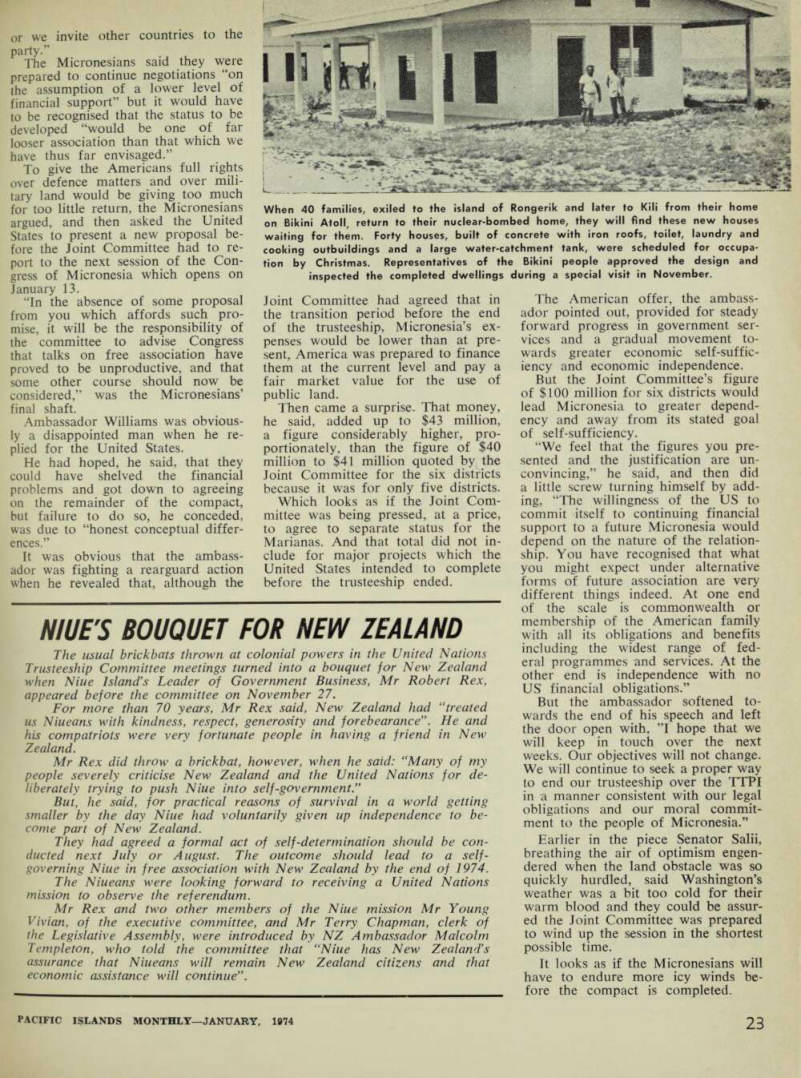
When 40 families, exiled to the island of Rongerik and later to Kili from their home on Bikini Atoll, return to their nuclear-bombed home, they will find these new houses waiting for them. Forty houses, built of concrete with iron roofs, toilet, laundry and cooking outbuildings and a large water-catchment tank, were scheduled for occupa tion by Christmas. Representatives of the Bikini people approved the design and inspected the completed dwellings during a special visit in November.