Papua
pp. 40-42 · Read in the full issue
Footnotes
1 was about five years old my elder sister took me to Sunday School with her and, having dumped me unceremoniously in the kindergarten room, departed, leaving me to sink or swim.
I looked around me. On the walls were a number of brightly coloured pictures. One in particular caught my eye. It depicted a Papuan house, built on spindly posts at the water’s edge with the tide lapping round them. In front of the house, sitting on the beach, was a grass skirted Papuan girl watching over a baby in a string bag suspended from a projecting floor joist.
I fell in love at first sight, both with the picture and with the girl.
Twenty years later, after an education inter rupted by a stint of service as a British infan try private in northern France, followed by three years teaching in a Quaker boarding school in the north of England, I found myself sitting in the office of one of the secretaries
of the London Missionary So ciety, a stone’s throw from Westminster Abbey.
“Well”, he said, “we can offer you a teaching post either in Samoa or in Papua. Have you any preference?”
“Papua”, I said firmly.
That was just 50 years ago this month.
Eight months later I stood on the spot where, in 1884, Commodore Erskine had declared what was iater to become the Australian Territory of Papua, to be a British Protectorate. With my ministerial senior colleague I looked down the hill to where between four and five hundred children were milling around and gradually sor ting themselves out into a series of more or less straight lines. We went down the hill, and after hymn and prayer the infant classes hived off to a grass-thatched schoolroom nearby, with their Australian teacher and her Papuan helpers.
Gesturing towards those who were left, my colleague said, “The rest are yours”.
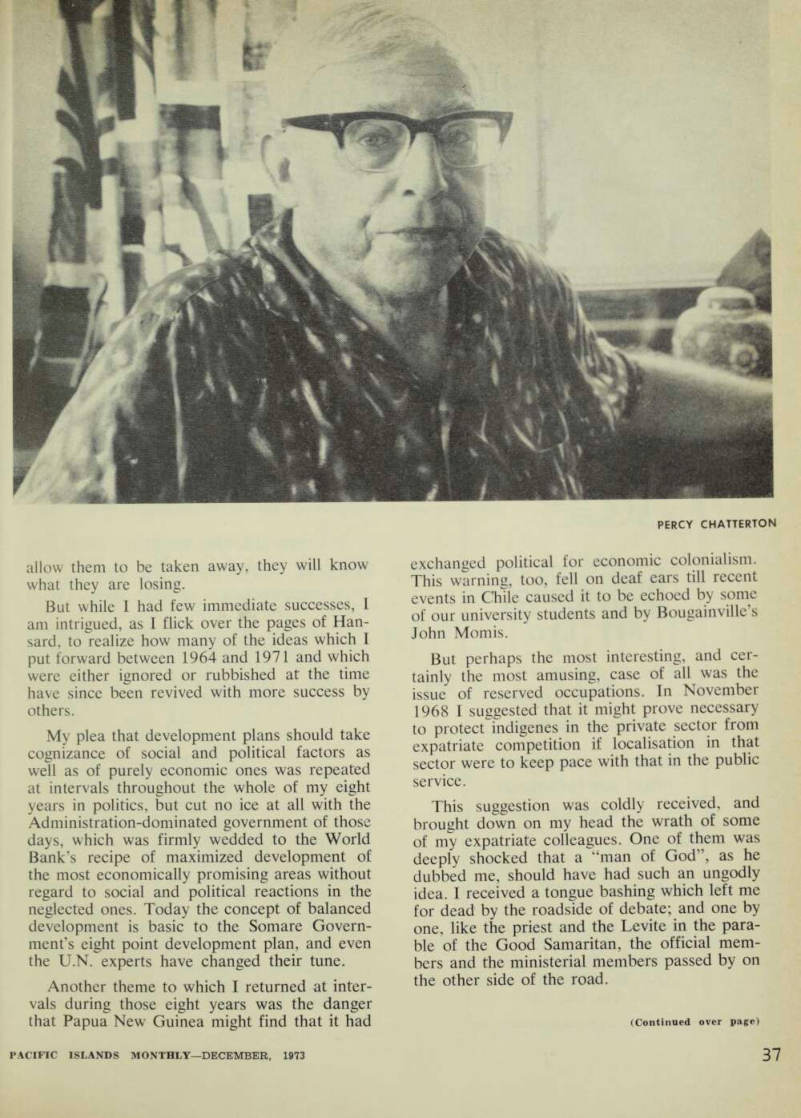
Percy Chatterton
Contributes
His Final
Footnotes
Thank you Papua
“Where are the classrooms?” I asked.
“There aren’t any”, he replied, and departed.
My induction course was over.
I spent the next 40 years as a member of a missionary team which was struggling with diminishing resources and through years of depression and war and their aftermath to maintain the far flung work begun by optimis tic missionary pioneers in the spacious, affluent heyday of 19th century English Noncon formity, But our weakness turned out to be our
strength. Due to our poverty and our chronic shortage of overseas staff, we were willy nilly “localising” well ahead of the field, and my closing years of mission service saw the es tablishment of a fully self governing indigenous church, the Papua Ekalesia, on the foundations laid by the L.M.S. over a period of 80 years.
In 1964 1 reached the age limit for L.M.S. missionaries, and retired from mission service.
But fortunately, or perhaps un fortunately, there is no age limit for politicians, and in that same year I became a member of Papua New Guinea’s House of Assembly. I remained an M.H.A. for two four-year terms, retiring for a second time in 1972.
I hated electioneering, but enjoyed being in the House, though looking back I realize that 1 expended most of my energy there in fighting for lost causes. My one substantial win was the passage of the Human Rights Bill in 1971.
Just how many of the rights set out in that ordinance will survive remains to be seen, but at least it ensures that if the people of Papua New Guinea decide to throw them away, or
allow them to be taken away, they will know what they are losing.
But while I had few immediate successes, I am intrigued, as I flick over the pages of Han sard, to realize how many of the ideas which I put forward between 1964 and 1971 and which were either ignored or rubbished at the time have since been revived with more success by others.
My plea that development plans should take cognizance of social and political factors as well as of purely economic ones was repeated at intervals throughout the whole of my eight years in politics, but cut no ice at all with the Administration-dominated government of those days, which was firmly wedded to the World Bank’s recipe of maximized development of the most economically promising areas without regard to social and political reactions in the neglected ones. Today the concept of balanced development is basic to the Somare Govern ment’s eight point development plan, and even the U.N. experts have changed their tune.
Another theme to which I returned at inter vals during those eight years was the danger that Papua New Guinea might find that it had
exchanged political for economic colonialism.
This warning, too, fell on deaf ears till recent events in Chile caused it to be echoed by some of our university students and by Bougainville’s John Momis.
But perhaps the most interesting, and cer tainly the most amusing, case of all was the issue of reserved occupations. In November 1968 I suggested that it might prove necessary to protect indigenes in the private sector from expatriate competition if localisation in that sector were to keep pace with that in the public service.
This suggestion was coldly received, and brought down on my head the wrath of some of my expatriate colleagues. One of them was deeply shocked that a “man of God”, as he dubbed me, should have had such an ungodly idea. I received a tongue bashing which left me for dead by the roadside of debate; and one by one, like the priest and the Levite in the para ble of the Good Samaritan, the official mem bers and the ministerial members passed by on the other side of the road.
(Continued over page)
Percy Chatterton
Three years later, in September 1971, the government brought down its Employment (Training and Regulation) Bill, which cleared the way for doing just what I had suggested on a larger scale than I had ever envisaged. It was passed without serious opposition, and today the list of reserved occupations runs into hundreds.
I am hopeful of seeing two other proposals of mine revived.
One is my proposal for the appointment of an Ombudsman, defeated at the time it was made by a cynical appeal to the cupidity of members whose vision did not extend beyond the need for more roads and bridges in their electorates. The other is my suggestion that the City of Port Moresby should be excised from the Central District and designated the National Capital District. Such a change would be to the benefit both of Port Moresby and of the rural areas of the Central District, whose people’s
interests are at present very much over-shadow ed by the interests of the city. now the time has come for my third re tirement, this time as a PIM columnist. 1 want more time to enjoy the view from my front verandah; and I think that the time has come when the kind of things which I have enjoyed saying in this column will have to be said by Paguineans or not at all.
It’s probably just a matter of genes, or hor mones or something, but I have a tempera mental liking for small things and simple people.
I like small cars which don’t hog the road, small radios which don’t blast the ear drums, small nations which don’t become arrogant, small villages in which people don’t become anonymous, and small churches which don’t lose the simplicity of the Man of Nazareth.
I detest ostentation, pomposity, and self assertiveness.
I deplore the cult of bigness. The dinosaur died of it; and it may yet turn out to be homo sapiens’ terminal illness.
In these days I seem to be odd man out. The Papua I came to and learned to love has been swallowed up in dinosaurian Papua New Guinea.
The Papua Ekalesia, the church which grew out of the work of the L.M.S. in Papua and the structure of which I helped to shape, has been swallowed up in the dinosaurian United Church of Papua, New Guinea and the Solo mon Islands. And all around me erstwhile friends and colleagues are busily engaged in dinosaurian activities like “nation building” and “creating a national identity”. I neither con demn nor applaud these activities. All I have to say about them is that they are not my cup of tea.
Odd man out? Well, not quite perhaps. There are still folk out in the villages, and even in the shanty settlements of the towns, who think as I do that the compiler of the Book of Proverbs knew what he was talking about when he said, “Better a dish of vegetables with love than the best beef served with hatred”. But their num bers are diminishing all the time; they’re being hooked by dinosaurianism.
Anyway I can’t complain. I’ve been very, very lucky. I’ve spent my working life among the kind of things and people I like best—small things and simple people.
Thank you, Papua, for all you have done for me. Thank you even more for what you have done to me.