The Editor's Mailbag
pp. 33-39 · Read in the full issue

New Gods For Old
I would like to make some comment on the article by Felise Va’a “New Gods for Old in Western Samoa” (PIM, Sept, p 37). He coneludes this by saying that “W Samoa is trying to perpetuate 19th century values at the risk of losing the present and possibly the future.” He seems to feel universal suffrage and modernising Samoa’s economy along Western urban industrial lines are the answer and that if this happens Samoa’s culture will still digest it.
I strongly disagree; Samoan culture and political system is designed for a rural agricultural village way of life. At present, small and relatively poor though we are, we Samoans enjoy a quality of life and an atmosphere of peace, harmony and respect for law that it would be hard to find its equal anywhere else in the world.
The world is full of small or not so small “developing” countries, who are trying to solve their economic problems by pathetic imitations of the rich Western countries. They run behind them begging and never catching up. They are only 10th rate imitations. We must accept reality; that we are living in a world where the rich nations get richer and the poor get poorer. The race is to the swift and the battle to the strong.
I am the only Samoan student at the University of Papua New Guinea in Port Moresby. This modern city, full of big stores, wide, paved roads,
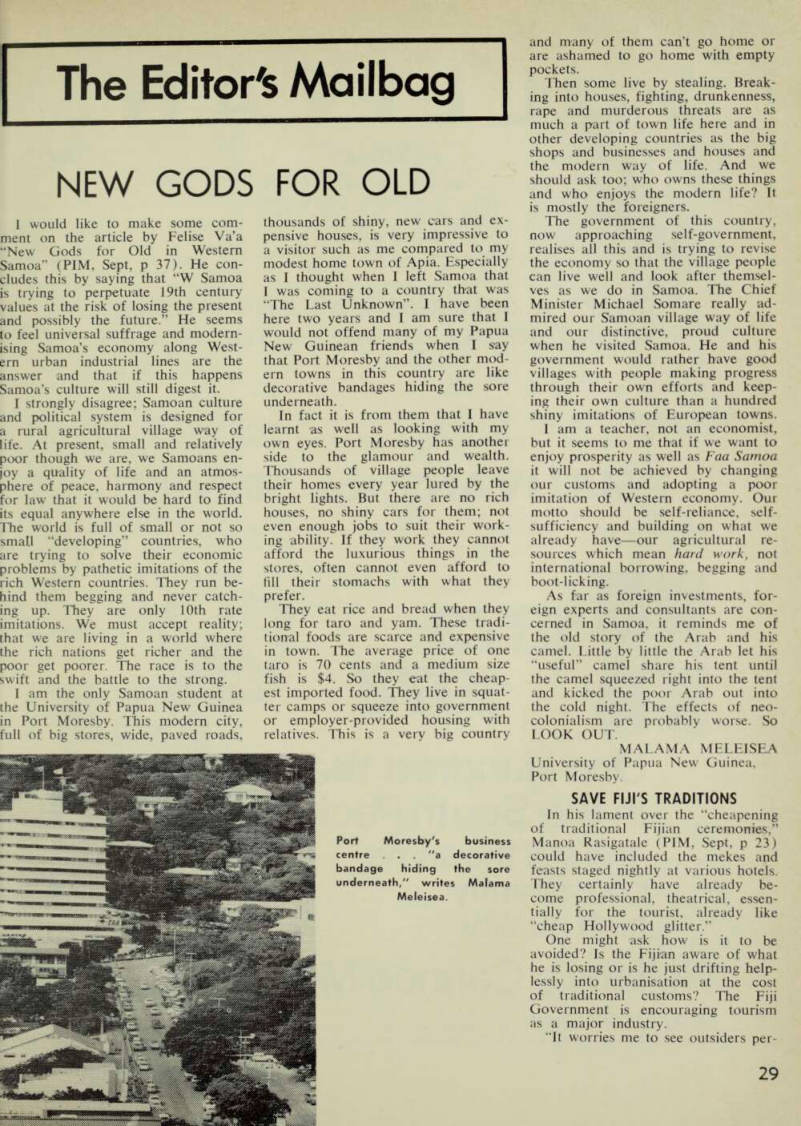
thousands of shiny, new cars and ex pensive houses, is very impressive to a visitor such as me compared to my modest home town of Apia. Especially as I thought when I left Samoa that 1 was coming to a country that was “The Last Unknown”. I have been here two years and I am sure that I would not offend many of my Papua New Guinean friends when I say that Port Moresby and the other mod ern towns in this country are like decorative bandages hiding the sore underneath, In fact it is from them that I have learnt as well as looking with my own eyes. Port Moresby has another side to the glamour and wealth, Thousands of village people leave their homes every year lured by the bright lights. But there are no rich houses, no shiny cars for them; not even enough jobs to suit their work ing ability. If they work they cannot afford the luxurious things in the stores, often cannot even afford to fill their stomachs with what they prefer.
They eat rice and bread when they long for taro and yam. These tradi tional foods are scarce and expensive in town. The average price of one taro is 70 cents and a medium size fish is $4. So they eat the cheap est imported food. They live in squat ter camps or squeeze into government or employer-provided housing with relatives. This is a very big country
and many of them can’t go home or are ashamed to go home with empty pockets.
Then some live by stealing. Break ing into houses, fighting, drunkenness, rape and murderous threats are as much a part of town life here and in other developing countries as the big shops and businesses and houses and the modern way of life. And we should ask too; who owns these things and who enjoys the modern life? It is mostly the foreigners.
The government of this country, now approaching self-government, realises all this and is trying to revise the economy so that the village people can live well and look after themsel ves as we do in Samoa. The Chief Minister Michael Somare really ad mired our Samoan village way of life and our distinctive, proud culture when he visited Samoa. He and his government would rather have good villages with people making progress through their own efforts and keep ing their own culture than a hundred shiny imitations of European towns.
I am a teacher, not an economist, but it seems to me that if we want to enjoy prosperity as well as Faa Samoa it will not be achieved by changing our customs and adopting a poor imitation of Western economy. Our motto should be self-reliance, self sufficiency and building on what we already have—our agricultural re sources which mean hard work, not international borrowing, begging and boot-licking.
As far as foreign investments, for eign experts and consultants are con cerned in Samoa, it reminds me of the old story of the Arab and his camel. Little by little the Arab let his “useful” camel share his tent until the camel squeezed right into the tent and kicked the poor Arab out into the cold night. The effects of neo colonialism are probably worse. So
Look Out.
Malama Meleisea
University of Papua New Guinea, Port Moresby.
Save Fiji's Traditions
In his lament over the “cheapening of traditional Fijian ceremonies,”
Manoa Rasigatale (PIM, Sept, p 23) could have included the mekes and feasts staged nightly at various hotels.
They certainly have already be come professional, theatrical, essen tially for the tourist, already like “cheap Hollywood glitter.”
One might ask how is it to be avoided? Is the Fijian aware of what he is losing or is he just drifting help lessly into urbanisation at the cost of traditional customs? The Fiji Government is encouraging tourism as a major industry.
“It worries me to see outsiders per
Port Moresby's business centre ... "a decorative bandage hiding the sore underneath," writes Malama Meleisea.
forming with the firewalkers. Soon any Tom, Dick or Harry will be tak ing part,” says Manoa Rasigatale. It is to be deplored but couldn’t it be overcome by a ruling that visitors are asked not to try to take part in the ceremony? They look idiots when they do anyway.
Visitors should always wait to be asked. As one who has been to Fiji on holidays five times in four years, I have joined in ceremonies, visited bures in the villages, sat on the floor and dined, kava and all, but never without first seeking permission or being invited. I dress like the Fijian, not without first finding out if it was the right thing, and I try to talk their language. When in Fiji be as the Fijian.
In his natural state the Fijian is one of the lovely people. But trans port him to a big city and he becomes a little tarnished, a bit too much like us. Even the Marama discard their traditional graceful skirt, wear slacks and lose that lilting walk which is so much a characteristic of them.
Manoa Rasigatale deserves all sup port in his crusade. Places like Viti Levu probably are already too steeped in tourism for salvation but it is fer vently hoped some of the more re mote areas won’t be infected and will remain as national Fijian. May Manoa Rasigatale’s zeal bear fruit— he has a disciple in me.
Fiji Lover
Vaucluse, NSW.
In Defence Of Papua New
Guinea's Tourist Industry
I have read with interest, and a certain amount of amusement, the story written by Mrs Tudor on the state of Papua New Guinea’s tourist industry (PIM, Oct). It is good to see that Mrs Tudor’s style of writing, spiced with her unique wit, has not altered since those early years in the Sepik goldfields.
However, I am distressed to see your magazine, which I have always considered an asset to peoples of the Pacific, and the governments of de veloping countries, printing so little of what is constructive and accurate.
The Tourist Board of Papua New Guinea has had to face in the past a certain amount of what I would consider unavoidable neglect, rather than indifference by the government.
The neglect has been due, I feel, to concern for the other “economic strings” to this country’s “bow”. Un til recently, as Mrs Tudor is no doubt
aware, primary industries have been in a depressed state. As the majority of our population lives in rural areas, and relies on these industries for sur vival, it is obvious where govern mental attention has had to be cen tred.
I wonder at the question she poses in her article, that is, “Why develop tourism when it can never be No 1?”
I ask, what would have happened to that famous car rental firm “who tried harder”, if they had not? Surely their present success is a testimony to the matter of being earnest, no matter what the initial position. It is ludicrous for Mrs Tudor or anyone to suggest that Papua New Guinea should rely on its existing industries, or should not try to raise monies in any way it can.
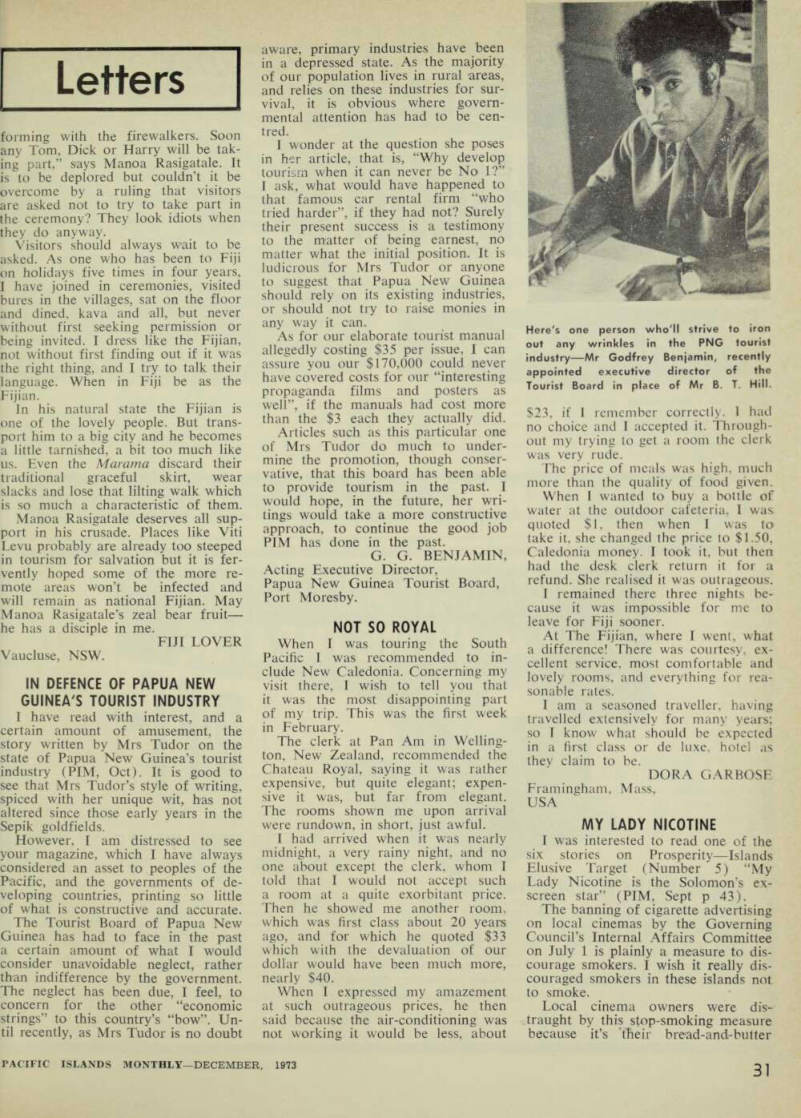
As for our elaborate tourist manual allegedly costing $35 per issue, I can assure you our $170,000 could never have covered costs for our “interesting propaganda films and posters as well”, if the manuals had cost more than the $3 each they actually did.
Articles such as this particular one of Mrs Tudor do much to under mine the promotion, though conser vative, that this board has been able to provide tourism in the past. I would hope, in the future, her wri tings would take a more constructive approach, to continue the good job PIM has done in the past.
G. G. Benjamin,
Acting Executive Director, Papua New Guinea Tourist Board, Port Moresby.
Not So Royal
When I was touring the South Pacific I was recommended to in clude New Caledonia. Concerning my visit there, I wish to tell you that it was the most disappointing part of my trip. This was the first week in February.
The clerk at Pan Am in Welling ton, New Zealand, recommended the Chateau Royal, saying it was rather expensive, but quite elegant; expen sive it was, but far from elegant.
The rooms shown me upon arrival were rundown, in short, just awful.
I had arrived when it was nearly midnight, a very rainy night, and no one about except the clerk, whom I told that I would not accept such a room at a quite exorbitant price.
Then he showed me another room, which was first class about 20 years ago, and for which he quoted $33 which with the devaluation of our dollar would have been much more, nearly $4O.
When I expressed my amazement at such outrageous prices, he then said because the air-conditioning was not working it would be less, about
$23, if I remember correctly. 1 had no choice and I accepted it. Through out my trying to get a room the clerk was very rude.
The price of meals was high, much more than the quality of food given.
When I wanted to buy a bottle of water at the outdoor cafeteria, 1 was quoted $l, then when I was to take it, she changed the price to $1.50, Caledonia money. I took it, but then had the desk clerk return it for a refund. She realised it was outrageous.
I remained there three nights be cause it was impossible for me to leave for Fiji sooner.
At The Fijian, where I went, what a difference! There was courtesy, ex cellent service, most comfortable and lovely rooms, and everything for rea sonable rates.
I am a seasoned traveller, having travelled extensively for many years; so I know what should be expected in a first class or de luxe, hotel as they claim to be.
Dora Garbose
Framingham, Mass,
Usa
My Lady Nicotine
I was interested to read one of the six stories on Prosperity—lslands Elusive Target (Number 5) “My Lady Nicotine is the Solomon's ex screen star” (PIM, Sept p 43).
The banning of cigarette advertising on local cinemas by the Governing Council’s Internal Affairs Committee on July 1 is plainly a measure to dis courage smokers. I wish it really dis couraged smokers in these islands not to smoke.
Local cinema owners were dis traught by this stop-smoking measure because it’s their bread-and-butter
Here's one person who'll strive to iron out any wrinkles in the PNG tourist industry—Mr Godfrey Benjamin, recently appointed executive director of the Tourist Board in place of Mr B. T. Hill.
jut they silently agreed in response o the voice of the Governing Coun ts Internal Affairs Committee.
While I have no objection to the Dan on cigarette advertising in cine lias, I think the committee is tackling he wrong man rather than the one with the ball.
While cigarette advertising through cinemas is banned shop owners and nanufacturers smile behind counters jelling their cigarettes and tobaccos.
Banning cigarette advertising in ocal cinemas is like banning matches o prevent a smoker lighting his cig arette, but that tobacco roll can still dc fired from any other source. You Dan cigarette advertising in cinemas Dut I can still get my cigarettes from ilmost every local shop and shop own ers get theirs from manufacturers without any objection or difficulties.
The aims of the Internal Affairs Committee of the Govco, as one can imagine, are to stop smokers or dis :ourage them from smoking or is Lis an attempt to reduce the high cost of living? If these aims had to dc achieved then tackle the main source, the cigarette and tobacco manufacturers which are the cause if cigarette advertising with glossy, wide-screen inducements in glorious technicolor in local cinemas and in more-advanced countries in the Pacific.
It’s like a disease, you won’t get real good results in curing it if you concentrate your treatment only on signs and symptoms unless you start /our treatment on the cause.
Also to me, there is no difference between trying to discourage and stop smokers hooked on overseas cigarettes and the setting-up of the locally re gistered company the Solomon Island Tobacco Company. Therefore, let Mr Black Twisted Tobacco and his “very thin-roll-your-owns-ready-rubbed” be advertised in cinemas instead of the attractive Lady Rothmans King Size because Mr Black Twisted Tobacco is now a very popular substitute among those who are hooked.
J. Tema.
Honiara.
Trouble In Noumea
In the September PIM (p 9, last paragraph) a subject appeared thanks to your Noumea correspondent which deserves my clarification.
The Frenchman of Vietnamese origin who threw the Molotov cock tail was mentally ill, having been in stitutionalised in the past for this
reason. Regarding the same type of attack against a Noumea store of which the city’s mayor is the director, your correspondent should have made the point that this was the act
of drunken, irresponsible people.
The way in which you presented these two incidents, without having said specifically that they were not political acts, seems a grave lack of attention on your part which could lead to a misunderstanding of the real facts.
Daniel Tardieu,
Newspaper Director.
Papeete, Tahiti. • Our Noumea correspondent’s reply: The Governor of the Colony of New Caledonia, a public servant appointed by President Pompidou, is the island chief executive on the poli tical administrative level. In fact, he enjoys the same powers as the Pre mier of the State of New South Wales. The Ballande store director, a Pompidou supporter, is Mayor of Noumea and member of the Terri torial Assembly. Any acts involving such personalities have political impli cations.
Gilbertese Spelling
With due respect to our budding minister Maunaa Itaia, (PIM, Nov, p 42), we (Gilbertese) should be very careful in following the so-called “original” ideas as to how to write our language. There is no traditional way of writing Gilbertese, hence it can be argued that there is really no original way of writing it. The art of writing needless to remind our bud ding minister at the PTC, came from other cultures. “Therefore both Maunaa’s “original” Gilbertese spell ing and Mrs Vivienne Hayward’s way of spelling are both together Euro pean in a sense. (Letters, PIM, Aug, p 23, Nov, p 42.) Dr Hiram Bingham, who made it possible for us to write Gilbertese, must have come (he or his progeni tors) from Europe or America. I have no complaints whatsoever of Dr Bingham’s very commendable effort in putting the Gilbertese language in print. What I disagree with is the mocking spirit with which Mr Maunaa Itaia attacked Mrs Vivienne’s way of spelling, implying her way may be European(?) whereas his way of spell ing (which is in fact the Bingham way) is correct, because it is “ori ginal” and may not be European, whereas in fact both ways of spelling are European (in the sense that their originators are Europeans) and there fore both are not traditionally original.
We Gilbertese should devise our own (if we can) way of spelling that
should be understandable by us. We must not be lured into believing (as Maunaa implies) that the only way to write Gilbertese sensibly is the so called “original” way (Bingham’s). I say this because all methods have a flow, and I don’t believe for a mo ment that the original way of spelling has solved all our problems as far as making the written word reflect as near as possible the sound of the spoken word.
Take the word mane which Maunaa used in his letter as an example to show this: mane spelt like that means money. Mane with an apostrophe means man. Now the trouble begins, because mane spelt exactly like the first mane (which means money) but differently pronounced means quite a different thing. It means tattered or worn out, eg Te mane ni Kunnikai meaning a tattered or worn out piece of cloth. Now this kind of written/ pronunciation problem is not taken care of by the Bingham way of spell ing.
I’m inclined to believe myself (as Mrs Vivienne seems to believe) that we should leave the words written simply as they are, without loading them with double vowels and conso nants and apostrophes, and let the Gilbertese pronounce them accord ing to the meaning of the words in the sentences. (Added to this, indi vidual scattered 16 islands' accents must be kept as showing where one comes from). Other advanced lang uages have done this (filling the problem gap of course by education) and they are remarkably all right.
For example in English when we see this sentence “I have read that book” we pronounce read as red, but if we see this sentence “I want to read Sir Arthur Grimble’s books”, we pro nounce read as if it is spelt reed.
Any better method of course will be welcome, but here we must make sure that at least the linguistic talent wherefrom we get this new method is at least of a high academic credi bility. Doubtful academics who write fake poetry based on other peoples talents are hardly the right source.
Ieruru Karotu
Dept of Agriculture,
Geic.
What Kind Of University?
The University of the South Pacific can’t survive without foreign aid. At the moment, it has Australian, Ameri can, British, Canadian and New Zeal and aid, not forgetting United Nations aid.
All these aid-givers have different ideas of a university for the South Pacific.
Since the birth of USP in 1968, no body seems to know what the role of
a university in a developing country should be.
Academics think that as long as it is a university, there should be per sonnel of high academic calibre — who normally live in a cloud. Stu dents should be free to pursue their own academic interests, and never mind what they do.
In the end, Arts students work as managers and Science students be come public servants.
USP should never have been allow ed to run second degrees. What could a MA student do in a country like the Ellice Islands where 5,000 people live and the only crop that grows is coco nut? What kind of a job is suited to a MSc student whose theory is up to world standard but who has in sufficient laboratory training?
India has a million unemployed graduates. What a difference it would make if India had had a million extra know-how farmers?
The recently proposed Diploma in Marine Biology, aided by the Can adian Government, makes better sense in a place such as the South Pacific.
In the last two or three years, Brit ish Overseas Development aid, and Australia and the United Nations have given a good hand on training in public administration and manage ment. This training in the eyes of the academics is not something to be proud of in a university; nevertheless, it has met a real need.
So far nobody has ever thought of doing something on forestry which is one of the things Fiji and several other countries need. Tourism should be the next on the list now that the South Pacific has become the world tourist dreamland.
Does it mean that USP students have no right to do what they want?
On the contrary, USP students can do what they want provided they can meet their own costs of fees and lodgings, otherwise, governments pay out enormous sums of money and still can't get the trained manpower that is needed.
One can understand the Fiji Min ister of Education, Mr lone Naisara’s threat to withhold funds to USP, un less USP produces the right men; “Then, somehow we will find the money,” he said.
Since the beginning of 1973, accord ing to UNISPAC, USP students from Fiji holding overseas scholar ships would be bonded to work for a number of years.
This seems to be a move in the right direction if the governments are going to benefit from this univer
sity.
Even all-mighty USSR can’t afford to let their Jewish graduates go to Israel without imposing a refund on
each graduate before they leave.
However, students who are involved in the bonding are not happy. Accord ing to UNISPAC, “It is not un reasonable to ask a student on schol arship to work for his or her govern ment after graduation, but it is un reasonable to spring a bond on a stu dent after the scholarship has already been held for some years.”
This is indeed a problem, but let’s hope that there will be an under standing soon, otherwise it will be very sad if USP produces a group of ‘disloyal’ public servants.
Grace Banks
University of the South Pacific, Suva.
Army's Role In Rotuma
Your article entitled “Rotuma: fascinating outpost” (PIM, Sept, p 47) was read with great interest in the New Zealand Army, as our en gineers played a large part in re building houses on the island after Hurricane Bebe.
I enclose the newspaper clippings covering this effort and will ensure that any news of further reconstruct ion projects in the Pacific Basin is passed on to you.
J. R. Webb (Capt)
Public Relations Officer (Army) Defence Headquarters, Wellington, NZ.