the Pacific Islands'
pp. 29-32 · Read in the full issue

'We have no cake in the Pacific Islands'
The aspirations, the frustrations of the small Pacific Island nations in their efforts to build their economies in face of the rivalries and self interest exercised by the established powers are expressed with clarity in this significant address by the Secretary to the Government of Tonga, Mr Dan Tufui, to a Pacific maritime conference at Waitangi, New Zealand, at the end of October. For a report on the results of the conference, see p. 77.
I trust that by the time this con ference ends, there will be a better understanding and a more enlighten ed appreciation of the many and varied problems that confront us— particularly our problems. And by our problems, I mean the shipping problems that beset the under-de veloped countries in our region.
Developed countries like New Zeal land and Australia have similar pro blems, too, but if you will bear with me, I want to dwell for a little while on, and emphasise, the seriousness of the problems that we face, because the satisfactory solutions to these problems have far greater implications for the Islands than they have for our developed neighbours.
Countries throughout the world are constantly striving to develop their own natural resources to the full and to establish and promote hitherto strange and unfamiliar, as well as familiar industries, in order to im prove the standards of economic be ing of their peoples, and to have a more equitable share in the abun dance that nature provides and hu man ingenuity and knowledge supp lement. Some countries have already achieved all these. Others, like ours, are still struggling towards them.
Some have achieved them through independent and unaided effort.
Others needed constant and massive dosages of external assistance. While others still have this assistance built into their internal network through ties of history and common origin.
But somewhere in the course of development, and on the success of achieving an excellent measure of parity between labour and manage ment, those involved seem to have forgotten, or to have lost sight of the fact, that they have brothers in other countries who have just begun or about to begin, the long process of trying to build an economy that is more attuned to the mood and as
pirations of the second half of the 20th century.
In addition, the workers in the Islands are starting off with a major handicap that is not generally known nor fully appreciated by their fellow workers in NZ. The struggle for a more equitable share of the economic cake demands that there be a cake.
There is no cake. We don’t even know what it looks like, let alone what it tastes like.
We have the lu-feke, the palusami, the rourou and the like, and taste as they do in their own right, they are not of the economic stuff of which the second half of this century is made of. And, believe me, they are a far cry from the economic cakes baked in NZ.
The Tonga delegation to this meet ing consists of representatives of shipowners, seamen, stevedores, water side workers, farm labourers, produce growers, street sweepers, fishermen, bakers, shop assistants, stewards, con struction workers, cricketers, rugby players, spectators, clerks, students, pupils, street walkers, and so on. You may doubt that we have come to the right meeting. Indeed, we have come to the right place, because we re present not only the actual workers —the ones with jobs—but also the greater majority of our people who are potential workers—the ones who want jobs, but who can’t get them because there are none to be given them.
Our delegation represents all. Po tential management and actual labour are one and together in the pursuit of job opportunities. In a country like Tonga whose total national bud get is not much more than $3 million, it cannot be otherwise. Hence we are all labourers and manual workers in the Islands. We are still on our hands and knees scraping for the ingredients of knowledge, expertise and finance to promote the industries that will
bring the management that will know how to bake the 20th century cake.
And one of the cakes that we would like to bake is shipping. We have a natural affinity with water. We are constantly reminded not to drive our horse-and-cart too fast lest we end up in the drink—so small is the bit of dirt we stand on. We therefore look to the sea and its promise.
But no matter how often we try, no matter how hard we try, we don’t even get a smile of encouragement from our fellow workers in NZ. In fact, they have positively frowned on our attempts, and our initial efforts have been met with direct opposition, and seemingly insurmountable ob structions. The way is littered with the emaciated bodies of our starved and frustrated hopes of self-help. Why has this been so? Because, as it ap pears to us, the workers in the Islands have dared to try to help themselves.
The opposition has been expressed in terms of trespassing on traditional shipping routes reserved for NZ owned ships; the opposition has been expressed in terms of cross-trading; the opposition has been expressed in terms of preservation of job oppor tunities for our fellow workers in NZ and for the improvement of the conditions and terms of employment.
I wonder, Mr Chairman and gentle men, if the labour movement in NZ and the ordinary rank and file, fully
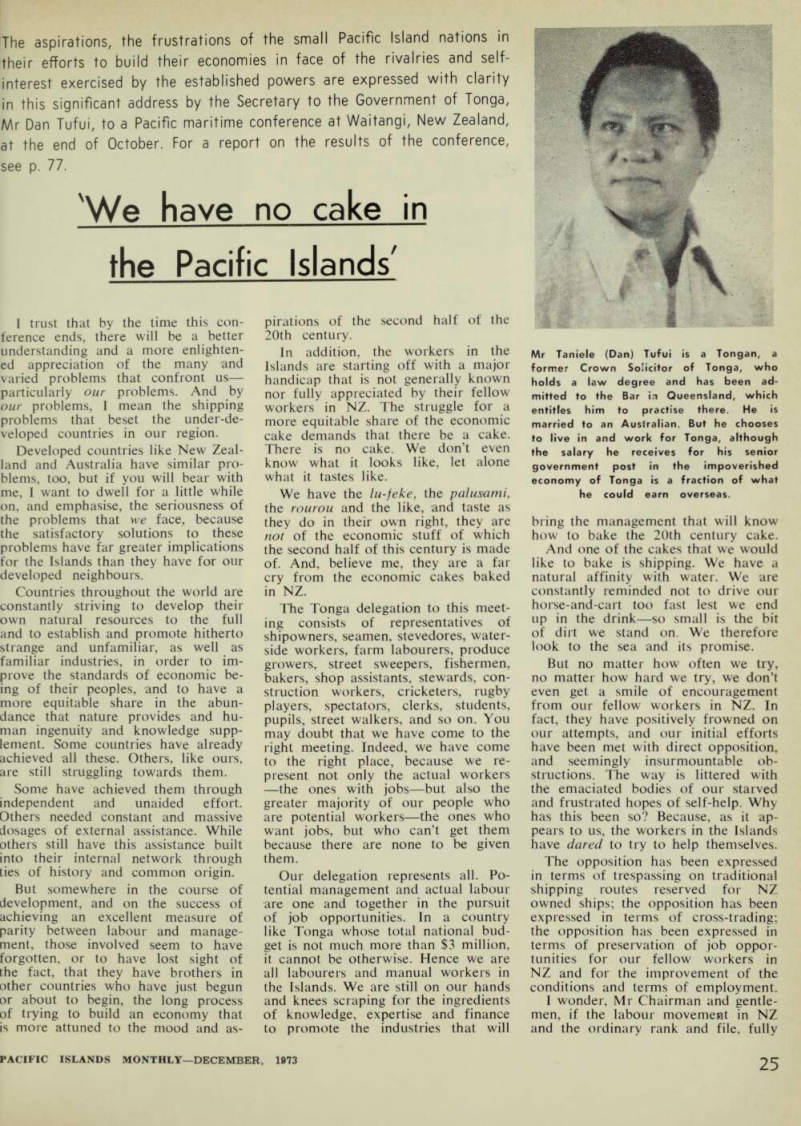
Mr Taniele (Dan) Tufui is a Tongan, a former Crown Solicitor of Tonga, who holds a law degree and has been ad mitted to the Bar in Queensland, which entitles him to practise there. He is married to an Australian. But he chooses to live in and work for Tonga, although the salary he receives for his senior government post in the impoverished economy of Tonga is a fraction of what he could earn overseas.
Brutal kick in teeth
appreciate what these mean to their fellow workers in the Islands? As I have said, the whole of the Islands is a labour movement and we are part of the rank and file of that move ment—but with this very significant difference—there is no employment in the Islands.
In 1966, which was when we had our last census (we have not had one since because we can’t afford one) Tonga had a total population of 77,429 of which only 18,998 or about 24.7 per cent were economically active, leaving 58,431 or 75.3 per cent of the population not economically active. Why? Because there was no where for that 75.3 per cent to be employed—there were no job oppor tunities for that 75.3 per cent.
The situation has not improved much, if at all, over the last seven years. Our initial, humble effort to create job opportunities for even a very small portion of that 75.3 per cent of the population, by having an Island-owned and Island-crewed ship to trade between NZ and the Islands, was met with a brutal kick in the teeth for our trouble, by no less than our fellow workers in NZ!
Whether this was done purposely to deny job opportunities to their fellow potential seamen in the Islands or through lack of understanding of the non-employment situation in the Islands, we do not know.
We do know that it is a meaningless exercise for labour in Tonga to mount
a campaign against a non-existing
management for the improvement of the terms and conditions of non-em ployment. The worker in the Islands first needs to be given the opportunity to work before he can improve the conditions under which he works!
Job opportunities for NZ seamen in NZ-owned ships represent but a tiny fraction of the total job oppor tunities available to workers generally in NZ. But to the 75.3 per cent of the total population of Tonga, an opportunity to be employed as a seaman in an Island-owned ship either means he has a job or he con tinues to have no job at all.
To demand that a ship owned and crewed by the Islands be run and manned on New Zealand Seamen’s Union terms and conditions of em ployment before it can be allowed, by the NZ labour movement, to ply in trade between NZ and the Islands, is like pitching the mighty All Blacks against a team of pygmy Eskimos at Eden Park at 12 noon in the height of summer.
And to further demand that the same Islands ship must not cross-trade between NZ and the Islands or sail
the so-called traditional shipping routes, and yet give free rein to a similar NZ ship to do so, is like requiring the Eskimos to field their team with their ankles tied together —and, what’s more, expecting the Eskimos to win! What a victory for the All Blacks to be proud of!
Mr Chairman, these last few re marks may seem somewhat frivolous.
They are not intended to be so. For a competition to be fair, parity or near equality in all things is essential, otherwise the situation quickly de teriorates into a complete farce. There may be parity in political status be tween NZ and the Islands, but at that the similarity abruptly ends. We need parity in job opportunities. We need parity in technical skill. We need parity in industrialisation. We need parity in mechanisation. We need parity in technological know-how.
We need parity in management. We need parity in finance. We need parity in production.
We need, in other words Mr Chair man and gentlemen, parity in econ omic strength before the labour move ment in NZ can fairly force us to play their game.
If our needs matter to anyone in NZ—and I know that the Govern ment of New Zealand and many many people in NZ do care —then we appeal to you, especially to the work ers of NZ, to give us a “fair go”.
We are not asking you to stop sailing between NZ and the Islands.
All we are saying is: “Don't deny us the right to do the same.” We are not asking that NZ seamen in NZ ships be paid less than New Zealand can afford. All we are saying is: “Let us do likewise and pay our sea men at the rate our economy can afford.” We are not trying to stop NZ shipowners altogether from carrying our imports and exports. We just want to carry a fair proportion of them. We do not want your seamen to be without work. We just want our people without work to be seamen.
If labour in NZ continues to per sist in placing unreasonable obstruct ions in our effort to help ourselves, as it has only too well, then do not wonder that we, in the Islands, view the resistance offered the joint ship ping venture by Nauru and Tonga as a deliberate attempt to quash the effort of Islands workers to improve their lot, as a deliberate attempt to perpetuate colonial trade policies of yesterday whereby the Islands, inclu ding NZ, were once looked upon as no more than a backyard garden of raw material for the industrialisation of other countries.
The sad episode of the Islands ship
(continued over next page)
An indelible blemish
Enna G will leave an indelible blemish on the good record of the labour movement in NZ, not because it achieved what it set out to do, but that in achieving it, the NZ workers, without fully realising it, lashed out blindly and violently, and caught their fellow workers in the Islands full flush in the face.
We were, and still are, disappoin ted. But we temper our disappoint ment with the reflection that had the workers in NZ, the officials as well as the ordinary rank and file, realised that in the Islands, particularly in my own country, shipowners, seamen, stevedores, and wharfies and all other workers, potential or actual, all pull in the same direction, the workers here would have given us a helping hand and a “fair go,” instead of knocking us down unkindly.
I earnestly urge delegates, and appeal to my fellow workers here in NZ, and in particular to the repre sentatives of the workers in the unions, to remember that unless we allow one another in equal measure the rights and privileges we each claim for ourselves, the future prospects of NZ Pacific Islands shipping, will be bright, as they have always been, for New Zealand alone.
I am sure Mr Chairman, that we were not invited to this historic place simply to be told that the lopsided conflict was to continue. If the middle eastern countries can agree to stop shooting at each other, I am sure that we, in our own Pacific way, can do much better. I would hope that by the time we have all left this place, a new treaty of Waitangi will have been signed to cease all further hostilities, so that we can get on with the job of reconstruction. • Cottage industries using local products such as kapok and limes were important to Tonga, King Tau faahau Tupou IV said when he opened the Niuatoputapu agricultural show. The people of Niuatoputapu sold kapok cheaply or even gave it away. It was then used by others for making quilts, etc, which sold at good prices. The king said lime juice could also be made locally and exported, to the benefit of Niuatoputapu.
At the Vavau show, the king stressed the importance of vanilla development as a supporting crop for coconuts, and urged produce growers to expand production of all food crops to cater for an increased demand from the tourist industry.
“We must cater for hotel require ments and avoid the necessity for imports,” he said.