Islanders flex the muscles
pp. 43-45 · Read in the full issue
for Commonwealth Games
By a staff reporter
With the Commonwealth Games — in Christchurch (NZ) in January— almost on their doorstep some of the Islands’ sporting organisations are hoping to send large contingents to the Games. Both Fiji and Western Samoa are into double figures.
The Western Samoa Amateur Sports Federation hopes to send 32 competitors. They don’t expect many gold medals but are pretty sure they’ll get a share of medals of some kind.
The federation, headed by Tufuga Atoa, former Public Service Com missioner, firmly believed that only those who were likely to gain medals in the games should be sent.
But other sporting bodies like the weightlifting and athletic associations believed otherwise, maintaining that all that was needed were reasonably high standards and a chance to gain valuable experience.
The federation, to its credit, has tended to go along with those asso ciations’ views on participation and has, therefore, permitted a few more athletes to be sent.
The teams will be: Weightlifting, six competitors and two officials; boxing, eleven competitors, and five officials; athletics, two athletes and one official; bowls, seven competi tors.
The boxers and the weightlifters have the best chances of gaining medals. Paul Wallwork, who will lead the weightlifters, is one of the top weightlifters in his class in Australia, and was twice South Pacific Games gold medallist. Paul will be leaving for New Zealand soon for some warm-up competitions.
Samoa’s reputation in boxing is known throughout the region. It has had more than its share of gold medals in boxing in past South Paci-
fic Games and many of New Zeal and’s top professional (and amateur) boxers have been and are Samoans.
The two athletes to be sent will both be marathon runners, and though they may not be up to world-standard they are likely to perform well. The standard of the
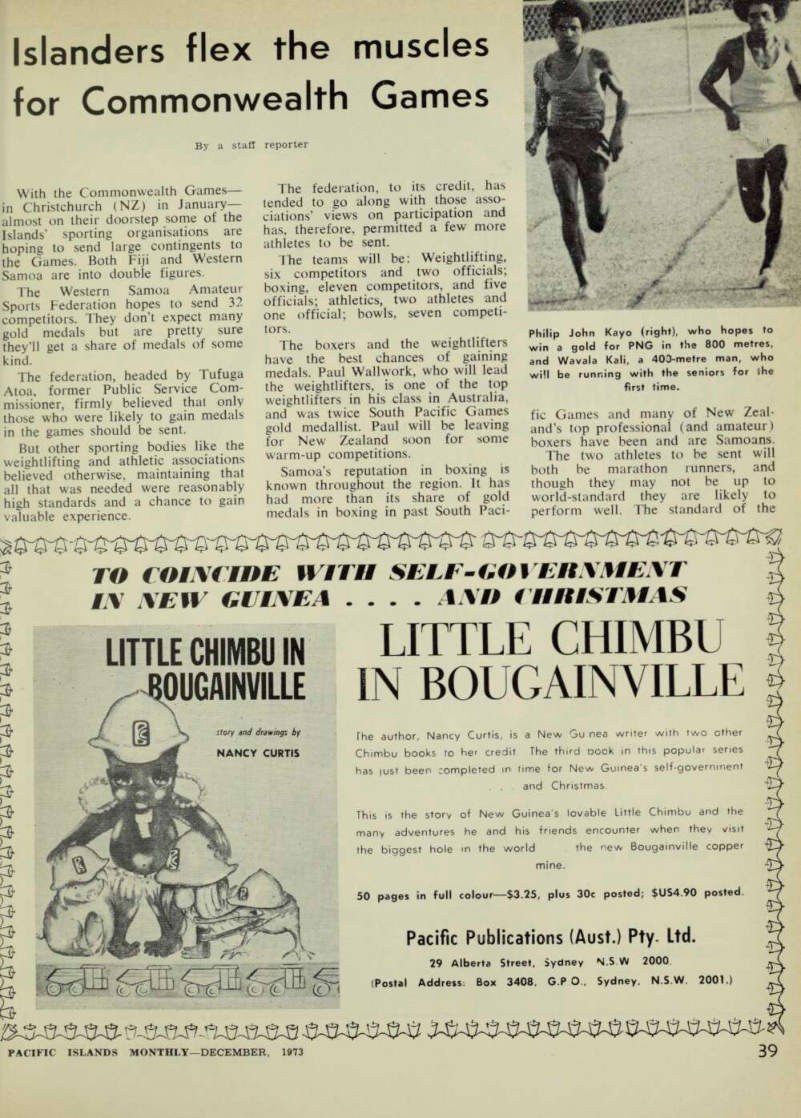
Philip John Kayo (right), who hopes to win a gold for PNG in the 800 metres, and Wavala Kali, a 400-metre man, who will be running with the seniors for the first time.
New Guineans After The Gold
bowling is not known, but the bowlers are confident.
Five Papua New Guinean track athletes have been selected. They are Philip John Kayo, 27, Wavala Kali, 19, Wallace Hofagao, 19, Iroa Pamoa, 19 and Vivian Ore, 17, writes Michael Joyce in Port Moresby.
Kayo has most international ex perience having won gold medals in the 800 metres at Tahiti (1971) and the 5000 metres at Port Moresby (1969). The Papua New Guinea AAU realistically set selection stan dards at the potential to get past the first heat at Christchurch but Kayo, a determined competitor, is training three times a day and has his sights set on a gold in the 800 metres.
Wavala Kali, a Port Moresby Teachers’ College student, has just moved up to the senior ranks and refuses to discuss the tough task in front of him in the 400 metres. He has improved tremendously since he took third place in the Australian junior 400 metres in March and now shows much of the fitness and polish of the outstanding Fijian runners Saimoni Tamani and Samu Yavala.
Wallace Hofagao, the national cross country champion, has the for midable task of taking on Kenyan world steeplechase record holder Jipcho in the 1500 metres at Christ church and will also go for the 800 metres with Philip John Kayo whom he narrowly beat in that event in the Papua New Guinea titles in Lae in September, Wallace is very national istic and is willing to suffer many miles of training a day in Lae’s steamy heat for the honour of repre senting his country. He has made two trips to Australia this year where he gained a good idea of commonwealth middle distance standards.
Iroa Pamoa will go for the 110 metres hurdles and the 400 metres hurdles. He has great determination and is a good hurdler but has to gain a lot of fitness before the games.
Vivian Ore, the baby of the team, has the most formidable task of all.
He will run in the 10,000 metres and the marathon. Like the rest of the team he has outstanding dedication and determination, but few would give him much of a chance against Britain’s world record holder for the 10,000 metres David Bedford. Vivian styles himself on Ethiopia’s great marathon runner Abebe Bikila and he is currently running over 100 miles a week over Port Moresby’s barren hills. Selectors had long term aims
in mind in giving him his first taste of world-class competition at Christ church The ' track team will spend five weeks in Australia immediately before the Games and their sharpening up will end at the New South Wales Championships on Sydney’s new tar tan track.
Papua New Guinea is likely to be represented at six of the nine sports contested at Christchurch but with
expatriates dominating the “affluent” sports like shooting and bowls the interest of Papua New Guineans will centre on the performance of their ‘rack team. Sports observers in Papua New Guinea are unanimous hat he country s small track team will be the best prepared and the most determined ever to l eave these shores, Fiji will have a team of 57, made up of 48 participants and nine offi cials. There will be 18 athletes, with two officials, seven bowlers and one official, 11 boxers and two officials, eight swimmers and two officials and four weightlifters and two officials.