Down by the Riverside:
pp. 96-97 · Read in the full issue

Pubs and Laughing Voices
By William Inglis
When friends come for the first time to Richmond, I usually take them on a guided tour—a not-too arduous walk round, for in any metropolitan area, there can’t be many pleasanter places to live.
It’s so near to London: “VIII miles from Hyde Park Comer” says an old milestone. Visitors to London should escape there for a while.
They will find “countryside”, a stretch of river with a seaside at mosphere, and an old town with many fine buildings, a long history of royalty and riches, an attractive old theatre, an international range of restaurants, and one of the finest views in England.
First there is the Green, a few minutes’ walk turning left outside the railway station. The immediate impression is of a village green criss crossed with paths. In the centre is the cricket square. If the sun is shin ing, deckchairs will be out, and there may be a match in progress.
A second longer look at the Green’s tall terraces, its trees and its spacious ness, and it becomes too stately for a village. You can feel yourself in the 18th century among the Queen Anne and Georgian houses. Just off the Green are lanes which are a magnet for lovers of antiques and bric-a-brac.
In the south-east comer, pleasant and leafy, is the Little Green, facing the splendidly ornate Richmond Theatre. The original “Theatre on the Green” was built in the north-east corner around 1765 and the present one—recently equipped with comfor table new seating—in 1899.
Sometimes it has the excitement of a pre-London try-out. After the show, round the corner in the Cobwebs you can often rub shoulders at the bar with people you have just seen on the stage.
On the west side of the green is the imposing and elegant Maids of Honour Row, built in George I’s time for ladies of the Court. Next to it is all that remains of the Old Palace, built by the first Tudor, Henry VII, around 1500. In those days
the Green was part of the Palace grounds, a scene of pageants, revels and jousting.
An archway facing the Green still bears the time-worn arms of Henry VII. Behind it a peaceful courtyard leads out to Old Palace Lane, where once-humble cottages are now much sought-after residences. Down the lane is the Thames. Turning left along the towpath is an inspiring view of the handsome, five-arched, 18th cen tury Richmond Bridge with the Ter race Gardens and Richmond Hill heaped handsomely behind it.
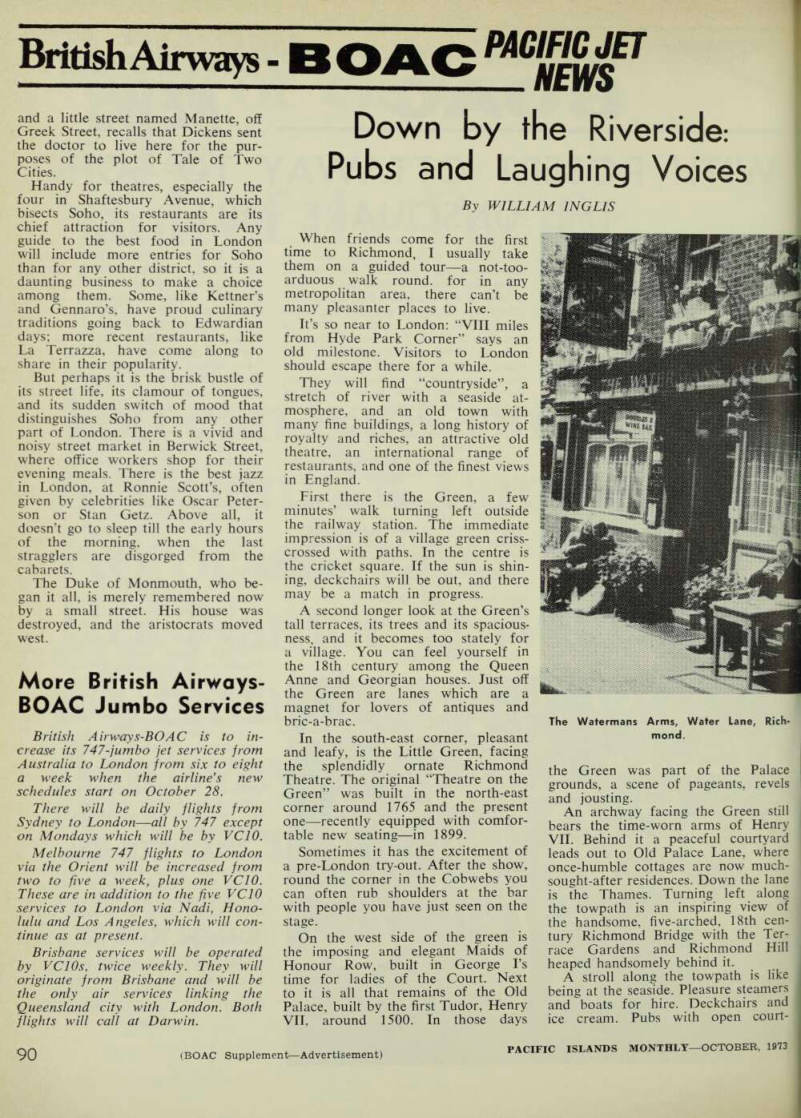
A stroll along the towpath is like being at the seaside. Pleasure steamers and boats for hire. Deckchairs and ice cream. Pubs with open court
The Watermans Arms, Water Lane, Rich mond.
yards and laughing voices. Much ado about very little as the world and his wife and family escape from the big city.
Underground trains from the centre of London take just over half an hour, and fast trains from Waterloo main line station only 15 minutes. But if there is time to spare, the happiest way to do the journey is to take the 2i-hour pleasure steamer trip from Westminster Bridge.
The journey from Westminster takes in the winding Boat Race course from Putney to Mortlake where brawny young men from Oxford and Cam bridge meet every year in lung-burst ing challenge.
Up the river from Richmond to Hampton Court, by Teddington Lock and Kingston, is a restful vista of gardens sloping gently to the river side, creeks almost hidden by weep ing willows and craft to match all pockets bobbing gently at their private moorings.
Beyond the landing stage grassy stretches of riverside invite soporific sunbathing, and, on the other side af the towpath, a passage under Petersham Road leads to the Terrace Gardens, where the colourful culti vation and the splendour of the views seem to ease the climb to Richmond Hill. Many stop at a tearoom halfway jp.
The Terrace at the top is a broad iromenade offering the famous and nuch-painted view of the Thames as t sweeps majestically round a tree aden bend. On a clear day you can iee six counties, they say though I lave never tried to count them.
From the “seaside” to the “country wide ’ Richmond Park, a vast green ;xpanse first enclosed by Charles I is a hunting ground, still a royal lark, with red and fallow deer run ling free in its 2,358 acres. Fourteen niles of its roads are open to motor raffic (speed limit 30 mph), but he Bailiff of the Royal Parks has teadfastly refused to open up the :entral roads. So the park has large ireas where people can walk in )eace away from their cares, and iven when it is invaded at weekends, hey can still find solitude.