News
pp. 95-96 · Read in the full issue
British Airways
Boac
Pacific Jet
News
With Robert Ottaway To Soho,
The Unsquare Mile
(BOAC Supplement—Advertisement)
Soho has a raffish reputation, largely because it is so obviously de voted to the pleasures of eating, drinking, and entertainment—and a square mile appealing to the senses does not give it much hope of respec tability. But it is a unique part of Lon don with a romantic history, and an illustration of one of Britain’s better characteristics—its tolerant welcome for foreigners.
It has been reckoned that you can find representatives of more than a hundred different races working or living in Soho, and perhaps its most typical shop is a newsagent in Old Compton Street where you buy news papers of five continents.
Traditionally, Soho is the area bounded by Oxford Street in the north Coventry Street in the south, Regent Street to the west, and Charing Cross Road to the east. But in recent de :ades its restaurants have spread to ;he north of Oxford Street—and they nclude such famous ones as the Creek White Tower and the French itoile.
Yet however you define it, the ofi
centre heart is Soho Square, and it is here that the district’s life began, when the Duke of Monmouth built himself a mansion in 1681 and estab lished the area as one of the most fashionable in London and a favourite address for ambassadors.
It had been a place of fields and trees, undeveloped until this late date because it was a recreational retreat for the lords who lived in grand houses in the Strand.
That rural past, highly surprising when you look at its modern neon, is remembered in its name—for ‘Soho’ was the cry when you wanted to call off the hounds after a day’s
hunting.
Its European connections began very soon after. When the Edict of Nantes was revoked in 1685, a stream of French Protestants sped to safety across the English Channel and settled in Soho. It was the first of many small migrations, all of which may have helped to give this part of London its cosmopolitan stamp. Karl Marx lodged in Dean Street, brooding over its sins. Theo-
dore, King of Corsica, dislodged from his throne, came and died in poverty, earning an epitaph from Horace Walpole. Poles, Hungarians, Italians, Swiss, Spaniards—all have arrived to add to the medley of accents and the variety of cuisines. The most con centrated group are the Chinese, who have turned Gerrard Street into Lon don’s Chinatown, a shopping place for the community.
Although Soho’s character owes very little to any outstanding archi tecture—its best church, St Anne’s, was gutted by bombing in World War II —there are many hints of past elegance. In the south-east corner of Golden Square, once crammed with noble houses but now the home of the woollen cloth trade, there is a solitary carved doorway of the 18th century. And the statue in its centre is of George 11, togged out like a Roman.
Earlier houses come in a terraced row in Broadwick Street, and there are two good survivors on either side of Soho Square. In the square, where it joins Greek Street, is probably the district’s finest single building, the House of St Barnabas, a charity that helps London’s destitute and home less. It occupies a mid-18th-century mansion, with carved woodwork and intricate plasterwork.
And Soho is haunted by literary and artistic memories. Because it has an ease of social contact and a free dom from convention, it has always attracted poets and scholars. At one time, Soho Square was the scene of the scientific get-togethers of the Royal Institution.
John Dryden, poet, lived in Ger rard Street. Canaletto came from Venice to paint London, and took rooms in Beak Street. Thomas Sheraton evolved his furniture in War dour Street, now the business centre of the film industry, and William Hazlitt, critic, came to live in Frith Street.
Blue plaques on the wall mark the houses where the famous have slept.
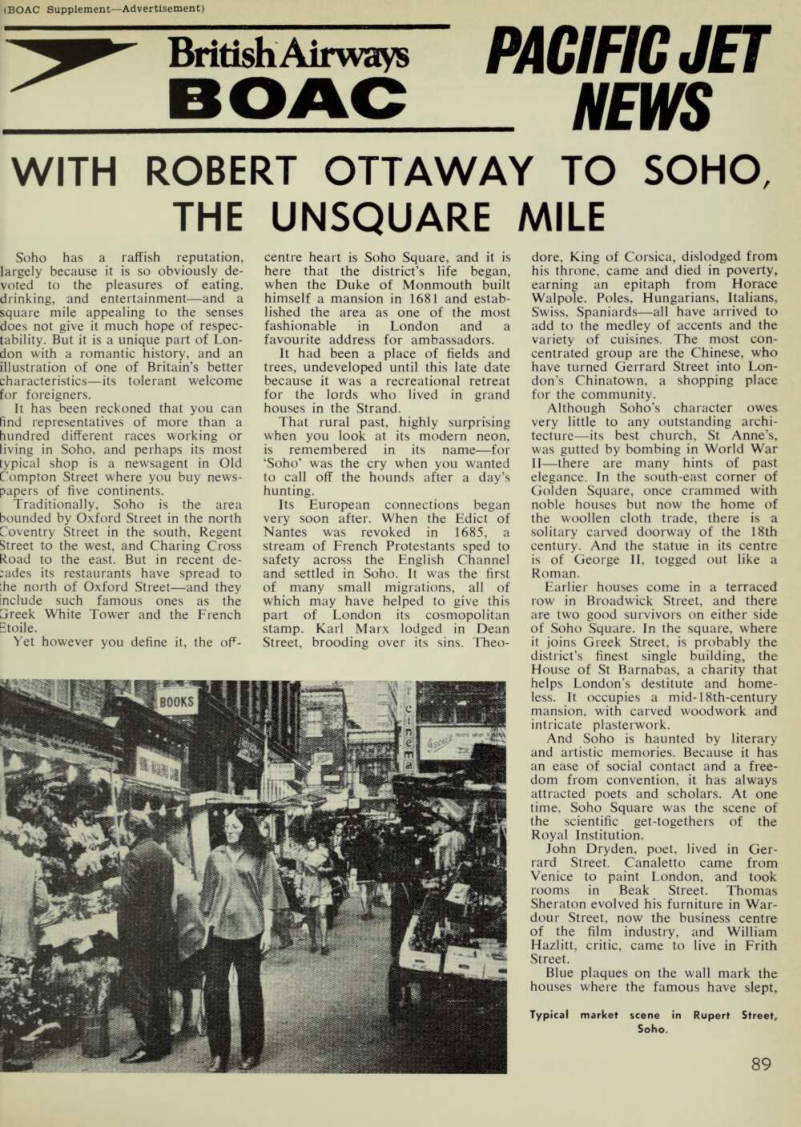
Typical market scene in Rupert Street, Soho.
and a little street named Manette, off Greek Street, recalls that Dickens sent the doctor to live here for the pur poses of the plot of Tale of Two Cities.
Handy for theatres, especially the four in Shaftesbury Avenue, which bisects Soho, its restaurants are its chief attraction for visitors. Any guide to the best food in London will include more entries for Soho than for any other district, so it is a daunting business to make a choice among them. Some, like Kettner’s and Gennaro’s, have proud culinary traditions going back to Edwardian days; more recent restaurants, like La Terrazza, have come along to share in their popularity.
But perhaps it is the brisk bustle of its street life, its clamour of tongues, and its sudden switch of mood that distinguishes Soho from any other part of London. There is a vivid and noisy street market in Berwick Street, where office workers shop for their evening meals. There is the best jazz in London, at Ronnie Scott’s, often given by celebrities like Oscar Peter son or Stan Getz. Above all, it doesn’t go to sleep till the early hours of the morning, when the last stragglers are disgorged from the cabarets.
The Duke of Monmouth, who be gan it all, is merely remembered now by a small street. His house was destroyed, and the aristocrats moved west.
More British Airwoys-
BOAC Jumbo Services
British Airways-BOAC is to in crease its 747-jumbo jet services from Australia to London from six to eight a week when the airline’s new schedules start on October 28.
There will be daily flights from Sydney to London—all by 747 except on Mondays which will be by VC 10.
Melbourne 747 flights to London via the Orient will be increased from two to five a week, plus one VCIO.
These are in addition to the five VCIO services to London via Nadi, Hono lulu and Los Angeles, which will con tinue as at present.
Brisbane services will be operated by VC 10s, twice weekly. They will originate from Brisbane and will be the only air services linking the Queensland city with London. Both flights will call at Darwin.
(BOAC Supplement—Advertisement)