The man who lived before his time
pp. 53-55 · Read in the full issue

By Peter Corris
Timothy George was one of the any hundreds of children born of elanesian parents in Queensland in e 19th century—in the days of the aeensland labour trade. His father, )limcane, was recruited from an and in the Langa Langa lagoon off e west coast of Malaita by the aeensland schooner Fearless in the id-1880s.
He served three years in Queens rid and returned on the same vessel find that the woman it had pre ausly been arranged for him to arry had married another man ring his absence. Disappointed, he jned on again for another term in aeensland. There he married a )man from South Malaita, and mothy George, born in the Burnett strict around 1892, was one of the ree children of the marriage.
Tolimcane and his family were jmbers of the Queensland Kanaka ission, the evangelical organisation unded by Florence Young (sister the proprietors of the Fairy mead gar Company) at Bundaberg for s purpose of christianising the anders.
The mission had great success long the indentured Melanesians,
The author, a Research Fellow at the ANU’s Research School of Pacific Studies, met Timothy George in the Solomons in 1968 in the course of field work for his thesis on the history of Solomon Islands labour migra tion for which he gained a PhD.
particularly among the Malaitans.
Tolimcane became a teacher in the mission and he must have realised the value of education for Timothy George (then known as George Mahratta, the last word being a common corruption of Malaita) at tended three schools in the Burnett district and three in the Isis district, according to the movements of the
family.
Although eligible to remain in Queensland, as one who had lived there for more than 20 years and who had children born and educated there, Tolimcane elected to return to Malaita in 1906 or 1907 along with the thousands of islanders being deported at that time under the provisions of the Commonwealth’s White Australia
legislation.
According to Timothy George, his father was then operating a small sugar cane farm near Bundaberg, running a few head of stock, employ ing several labourers, had a little money saved and was ‘well along’.
Tolimcane foresook this prosperity to work as a missionary for the South Sea Evangelical Mission on Malaita.
As both Tolimcane, who was known as Thomas in Queensland, and his wife Makeni (Maggie) were literate and well-versed in the scrip tures, they were welcome to the SSEM which had taken firm root on Malaita through the agency of christianised islanders returning home through the 1890 s and had consoli dated its position in the aftermath of the mass repatriation of 1906-8.
The family settled in South Malaita, though not at the first place they selected because the ‘big man’ of the area was resolutely pagan and forced Tolimcane to leave. Timothy George, who had no island name but acquired the ‘Timothy’ from a mis sionary to distinguish him from the numerous other Georges, began at tendance at the SSEM school at One Pusu on the west coast of Malaita.
Finding that he was expected to
■jach rather than be taught, he left ne school after six months. With jbout 10 years of Queensland school ng behind him, Timothy George read md wrote English with fluency and vas a sound arithmetician, but he was mxious for more education and it was disappointment to him for the rest [f his life that he was unable to Ibtain it. He spent the following iears in a variety of occupations, iccasionally in offices, but mainly at ea.
He worked aboard SSEM and vlalayta Company vessels and on Hose of Levers Pacific Plantations ,td where he eventually reached a •osition of responsibility. In these ears he travelled extensively through ut the Solomons and beyond—to Australia and New Zealand in 1913 riiere he witnessed dock strikes and nay have picked up some pointers on idustrial action.
In the 19305, Timothy George was village headman on South Malaita, very influential and somewhat eared man, who performed various ervices for the administration and be SSEM. But he was dissatisfied /ith his lot, feeling that he had been enied the chance to make the best ses of his abilities.
He resented his status as a native riiich brought lower wages and in erior conditions of work than those if white men whose equal he felt ilmself to be. It amused him to come board a ship and (keeping out of ight) address the ‘masta’ in his luent, cultivated English and then ob erve the surprise on the European’s ace at finding that the speaker was lot of his own kind.
His education, acquaintance with he administration, experience of the rider world and personal discontent nent, made it inevitable that he /ould be a participant in the March ig Rule Movement which developed m Malaita in the aftermath of World Var 11. The real nature of the move nent, its base in Malaitan society, ts organisation and aims have so ar been only partly studied. Timothy jeorge became the Marching Rule hief for the Areare district of South dalaita and, eventually, the nominal lead chief. He expressed two strands if the movement’s programme (and icrhaps the most important ones to lim) in a letter to me in 1968: “The MR were against ‘cheap abour and against being bullied and 11-treated and beaten by Europeans :tc etc, bad accommodation when vorking either on land or sea. The >rder given by the Head Chiefs of V.re are to all other sub-districts vere to make or build big villages md not live scattered anywhere or
everywhere thru the bush, but to have villages along and around the coast.”
While there is evidence that March ing Rule had some roots in traditional Malaitan legends and cults, it was clearly an anti-colonialist political movement in the mind of Timothy George.
Along with other Marching Rule
leaders, Timothy George was im prisoned in 1947 and served three years, but he was later installed again as a village headman and took an active part in the affairs of the South Sea Evangelical Church, as the SSEM was re-named following the ‘localisa tion’ of its structure.
He remained an anomaly all his life, a misfit as an educated, articulate Solomon Islander at a time when the colonial administration provided no proper outlet for energies and abilities such as his.
He saw to it, however, that his children’s lives would not be characterised by frustration as his own had been—as a result of their receiving the best education available in the Solomons, several of his de scendants now occupy responsible educative and administrative posts.
Timothy George died in April, 1969. He had been a part of the three most important forces in recent Malaitan history—the labour trade, the development of an indigenous island church and the Marching Rule Movement.
His courtesy and assistance to historians and anthropologist who travelled to Ro’cne village, South Malaita, were extended generously, and deserve more recognition than mere acknowledgement in the pre faces to their books. When a history of the Solomon Islands comes to be written, Timothy George will deserve notice as an outstanding Malaita man who lived before his time.
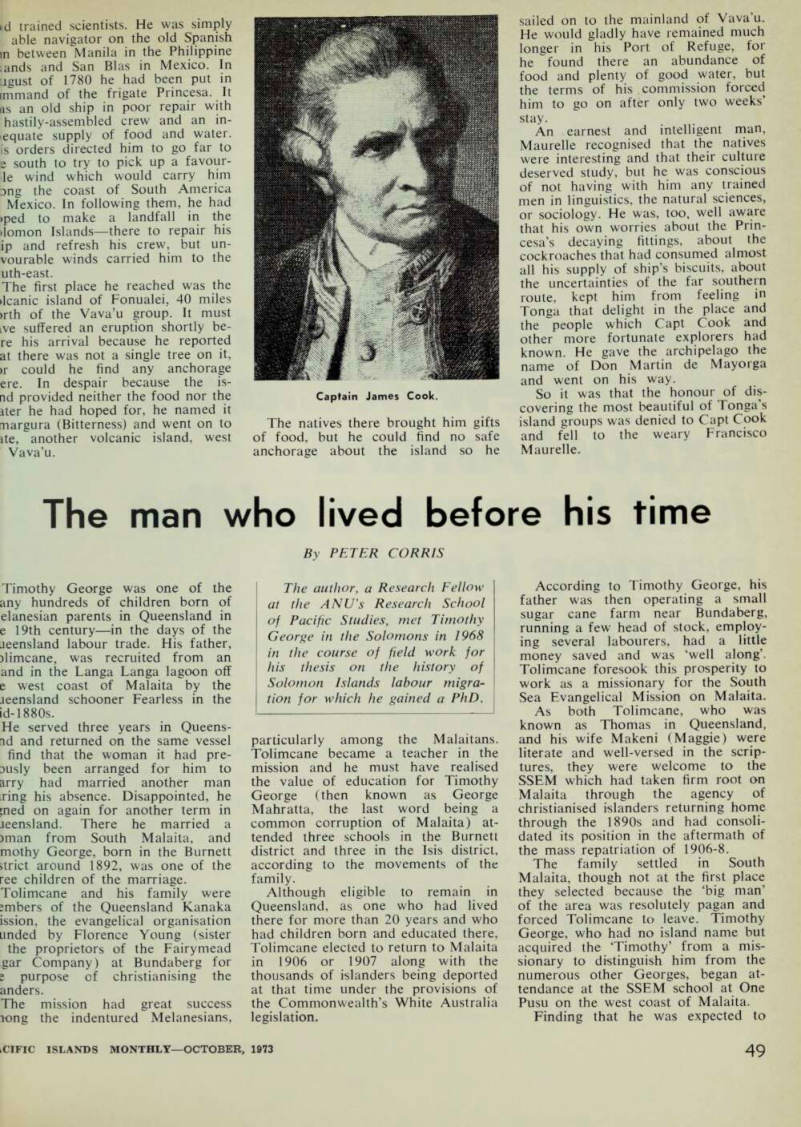
This picture of Timothy George was taken about a year before his death in 1969.
With him are his wife and youngest daughter.
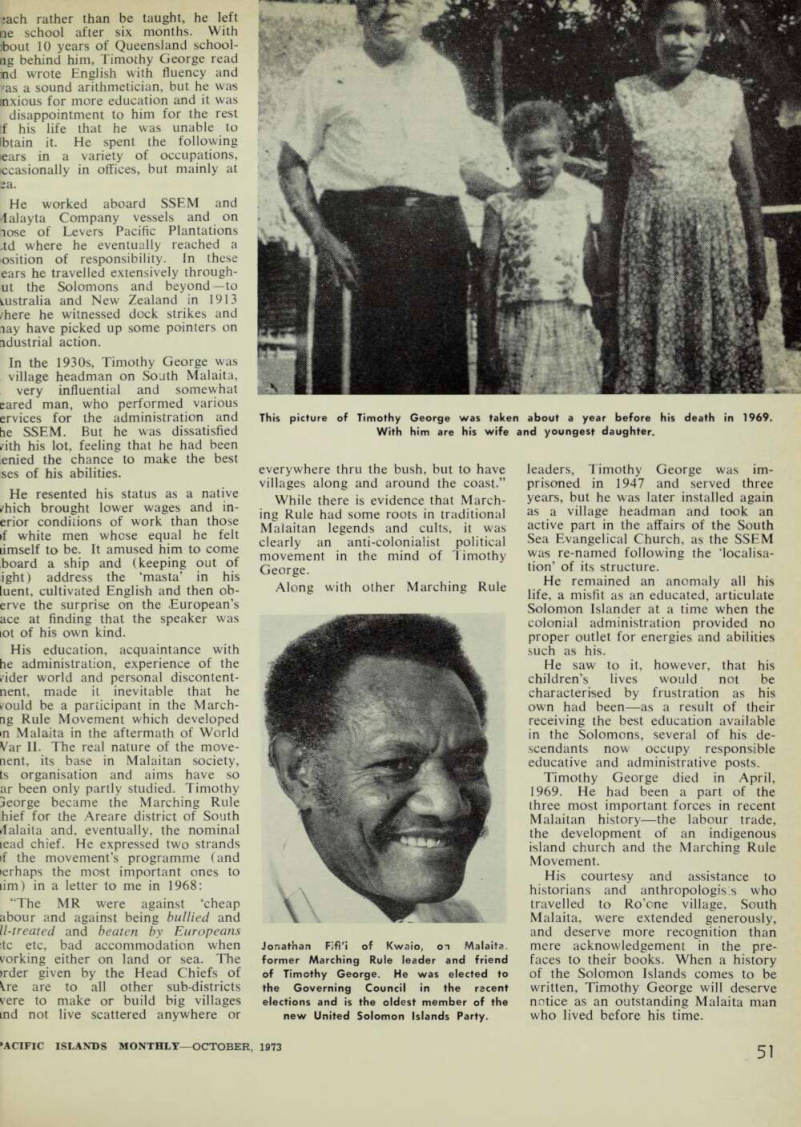
Jonathan Fifi'i of Kwaio, on Malaita. former Marching Rule leader and friend of Timothy George. He was elected to the Governing Council in the recent elections and is the oldest member of the new United Solomon Islands Party.