Yesterday
p. 56 · Read in the full issue
Fiji had some tough times in the 19505, what with the pick of the Fijian men being away fighting terrorists in the Malayan jungle, and visitations which insurance men call Acts of God— hurricanes, floods and even earth quakes. The bad hurricane of 1952 was followed the year after by an earth quake which claimed eight lives.
PIM of October 20 years ago featured the earthquake, or one result of it, right on the front cover. An intrepid businessman, whose name wasn't given, saw from one of the rear windows of the Bank of NSW a giant tidal wave racing towards Suva in the wake of a terrifying earth tremor. Instead of racing for safety as 99 per cent of the populace did, he grabbed a camera and took a remarkable picture of the huge wave crashing over the reef.
It made PlM's October cover. The reef partially broke the force of the wave but it was still strong enough to sweep across Victoria Parade to the east and damage docks and shipping to the west.
Suva which showed it could "take it" from both hurricane and earthquake, and make a remarkable recovery, was about to become a city. The Fiji Governor, Sir Ronald Garvey, told Fiji's newly constituted Legislative Council at its first meeting after the 1953 elections, that Suva would become a city as soon as the necessary proclamation could be prepared. He paid a tribute to those who had kept essential ser vices going after both disasters, and had kept the public informed of the actual facts. It was not reported what the governor's reaction was when, 24 hours after his announcement, five Indian members of the Suva Council staged a walk-out saying the Mayor, Mr D. M. N. McFarlane, had insulted them and the whole Indian community by describing their opposition to a motion ordering demolition of sub-standard property as "foolish".
Bishop John Rogers, a New Zealander, now Roman Catholic Bishop of Rarotonga, 20 years ago was appointed Vicar Apostolic of Tonga, succeeding Bishop
Blanc. Fathers Rogers, SM, as he then was, was posted to Tonga in 1941.
Papua New Guinea in the 1953-54 Australian Budget, was granted a little more than million ($l3 million).
Twenty years later, through growth and inflation this was up to a whopping $178,527,000, plus $36,239,000, which is the value of assets which will be handed over when PNG achieves self government, something undreamed of in that not-so-long-ago.
The Joyita mystery was still more than two years away when the ship became a mail boat for Canton Island, then the refuelling point for aircraft between Nadi and Honolulu. The US Post Office refused Pan American Airways per mission to carry mail stamped at surface mail rates for Canton, creating quite a problem to get that class of mail to and from the island. Arrangements were made for Captain "Dusty" Miller, who ran a fishing business at Canton to carry surface mail south at regular intervals in the Joyita.
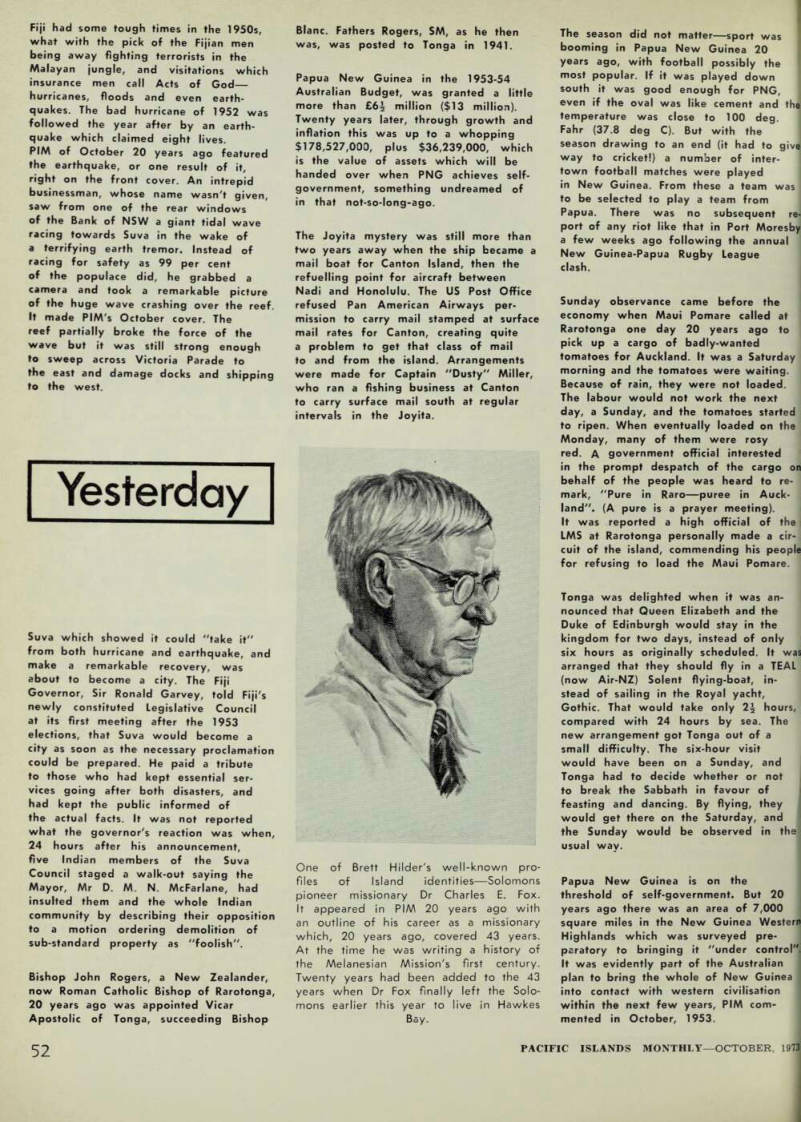
One of Brett Hilder's well-known pro files of Island identities —Solomons pioneer missionary Dr Charles E. Fox.
It appeared in PIM 20 years ago with an outline of his career as a missionary which, 20 years ago, covered 43 years.
At the time he was writing a history of the Melanesian Mission's first century.
Twenty years had been added to the 43 years when Dr Fox finally left the Solo mons earlier this year to live in Hawkes Bay.
The season did not matter—sport was booming in Papua New Guinea 20 years ago, with football possibly the most popular. If it was played down south it was good enough for PNG, even if the oval was like cement and the temperature was close to 100 deg.
Fahr (37.8 deg C). But with the season drawing to an end (it had to give way to cricket!) a number of inter town football matches were played in New Guinea. From these a team was to be selected to play a team from Papua. There was no subsequent re port of any riot like that in Port Moresby a few weeks ago following the annual New Guinea-Papua Rugby League clash.
Sunday observance came before the economy when Maui Pomare called at Rarotonga one day 20 years ago to pick up a cargo of badly-wanted tomatoes for Auckland. It was a Saturday morning and the tomatoes were waiting.
Because of rain, they were not loaded.
The labour would not work the next day, a Sunday, and the tomatoes started to ripen. When eventually loaded on the Monday, many of them were rosy red. A government official interested in the prompt despatch of the cargo oi behalf of the people was heard to re mark, "Pure in Raro —puree in Auck land". (A pure is a prayer meeting).
It was reported a high official of the LMS at Rarotonga personally made a cir cuit of the island, commending his peopk for refusing to load the Maui Pomare.
Tonga was delighted when it was an nounced that Queen Elizabeth and the Duke of Edinburgh would stay in the kingdom for two days, instead of only six hours as originally scheduled. It wa arranged that they should fly in a TEAL (now Air-NZ) Solent flying-boat, in stead of sailing in the Royal yacht, Gothic. That would take only hours, compared with 24 hours by sea. The new arrangement got Tonga out of a small difficulty. The six-hour visit would have been on a Sunday, and Tonga had to decide whether or not to break the Sabbath in favour of feasting and dancing. By flying, they would get there on the Saturday, and the Sunday would be observed in the usual way.
Papua New Guinea is on the threshold of self-government. But 20 years ago there was an area of 7,000 square miles in the New Guinea Westen Highlands which was surveyed pre paratory to bringing it "under control"
It was evidently part of the Australian plan to bring the whole of New Guinea into contact with western civilisation within the next few years, PIM com mented in October, 1953.