Magazine Section
pp. 51-53 · Read in the full issue

CAPTAIN COOK MET A LIAR SO VAVA'U
'Fell' To A Weary Spaniard
While Captain James Cook, the great navigator and explorer, was in the Tongan Group in 1777 he ssed out on two things which could have changed the whole course of Pacific history. Because of a lie he led to add the Vava'u Group to his impressive list of discoveries. Because the liar, a Tongan chief, could it agree with others over a plot to murder him, Captain Cook lived on to make more discoveries.
From PATRICIA MATHESON in Vava’u
HOWARD the end of May, 1777, the great Pacific explorer, Captain mes Cook, was in the Ha’apai group the Tongan islands. He had com ;ted most of the surveys from which i charts were to be made, had irned much of the natural history of i islands and of the culture and stoms of the natives and was ready r fresh sights.
By his side was Finau, a high chief 10 ever since he had met Cook d professed the greatest friendship r him. That the friendship was mething less than genuine is proved the fact that only a few days fore Finau had joined with other iefs in a conspiracy to assassinate ; captain and his officers.
The plan fell through because the iefs disagreed among themselves out the most propitious time of the y to make the attack and Cook, 10 fondly called Tonga, “The Fri dly Islands”, never heard of it. lamelessly Finau continued to smile i his English friend, but perhaps, ter all, his conscience smote him d he felt a need to get away for time. At any rate, he told Cook, a w days after the abortive attempt agree on a murder plan, that he is going to make a trip to Vava’u lich lay two days’ sail to the north Ha’apai. He would, he said, bring ck a fresh supply of hogs and some the highly-prized red feathers of e frigate bird.
Cook heard his proposal with such terest that he felt a desire to ac mpany him. In his Journal he wrote, thought this a good opportunity get some knowledge of Vava’u id proposed to him to go thither ith the ships, but he seemed not to iprove of this and by way of divert g me from it, told me there was sither harbour nor anchorage about
it. 1 therefore consented to wait his return where I was and he immedi ately set out.”
Anyone who has ever been to Vava’u will realise at once the im mensity of Finau’s lie. The long, land-locked main harbour contains dozens of good anchorages and the shallow waters of Neiafu tahi which in these days of steam are no longer used, were deep enough to provide safe anchorage for any number of sailing ships. In addition, most of the outer islands would have pro vided adequate shelter.
Was Finau, indeed, suffering from shame caused by a guilty conscience or was he merely the first of a long line of Vava’uans who wanted to protect their home islands from an invasion by tourists? No one will
ever know, but whatever its cause, his falsehood kept the great navigator from adding Vava’u to the list of his discoveries.
For four years after Cook’s desire to see it was thwarted, the archipelago of Vava’u was safe from the out side world. Then on March 5, 1781, the Spaniard, Francisco Maurelle, an chored off the west coast of the main island at a place he thankfully named Port of Refuge. As if to refute Finau’s lie, he wrote of it, “There cannot be a more secure place of shelter in all weather: let the winds blow ever so hard, the sea would remain unruffled, and even a hurricane would spend its fury in vain.”
Unlike Capt Cook, Maurelle was no explorer with well-equipped ships
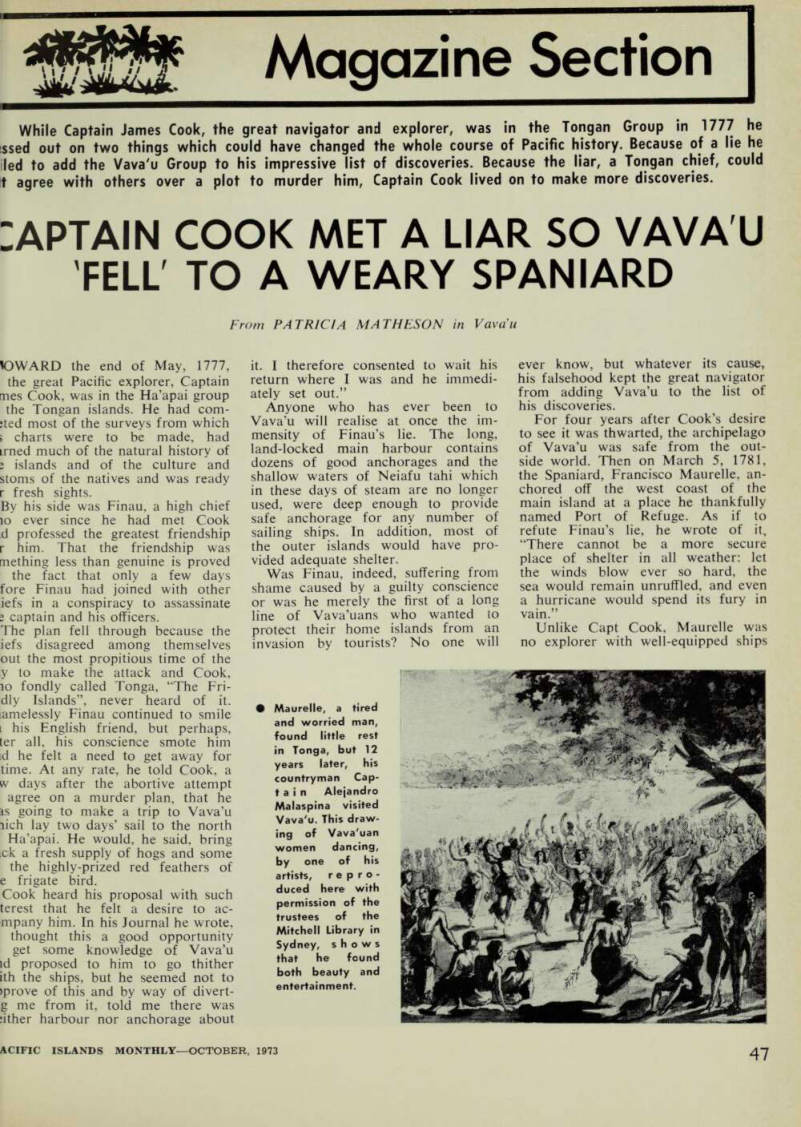
• Maurelle, a tired and worried man, found little rest in Tonga, but 12 years later, his countryman Cap
tain Alejandro
Malaspina visited Vava'u. This draw ing of Vava'uan women dancing, by one of his artists, repro duced here with permission of the trustees of the Mitchell Library in Sydney, shows that he found both beauty and entertainment.
• d trained scientists. He was simply able navigator on the old Spanish in between Manila in the Philippine ands and San Bias in Mexico. In agust of 1780 he had been put in immand of the frigate Princesa. It as an old ship in poor repair with hastily-assembled crew and an in equate supply of food and water, is orders directed him to go far to e south to try to pick up a favour le wind which would carry him ang the coast of South America Mexico. In following them, he had »ped to make a landfall in the domon Islands—there to repair his ip and refresh his crew, but un vourable winds carried him to the uth-east.
The first place he reached was the ilcanic island of Fonualei, 40 miles ►rth of the Vava’u group. It must ,ve suffered an eruption shortly he re his arrival because he reported at there was not a single tree on it, ►r could he find any anchorage ere. In despair because the is nd provided neither the food nor the iter he had hoped for, he named it nargura (Bitterness) and went on to ite, another volcanic island, west Vava’u.
The natives there brought him gifts of food, but he could find no safe anchorage about the island so he
sailed on to the mainland of Vava’u.
He would gladly have remained much longer in his Port of Refuge, for he found there an abundance of food and plenty of good water, but the terms of his commission forced him to go on after only two weeks’ stay.
An earnest and intelligent man, Maurelle recognised that the natives were interesting and that their culture deserved study, but he was conscious of not having with him any trained men in linguistics, the natural sciences, or sociology. He was, too, well aware that his own worries about the Prin cesa’s decaying fittings, about the cockroaches that had consumed almost all his supply of ship’s biscuits, about the uncertainties of the far southern route, kept him from feeling in Tonga that delight in the place and the people which Capt Cook and other more fortunate explorers had known. He gave the archipelago the name of Don Martin de Mayorga and went on his way.
So it was that the honour of dis covering the most beautiful of Tonga s island groups was denied to Capt Cook and fell to the weary Francisco Maurelle.
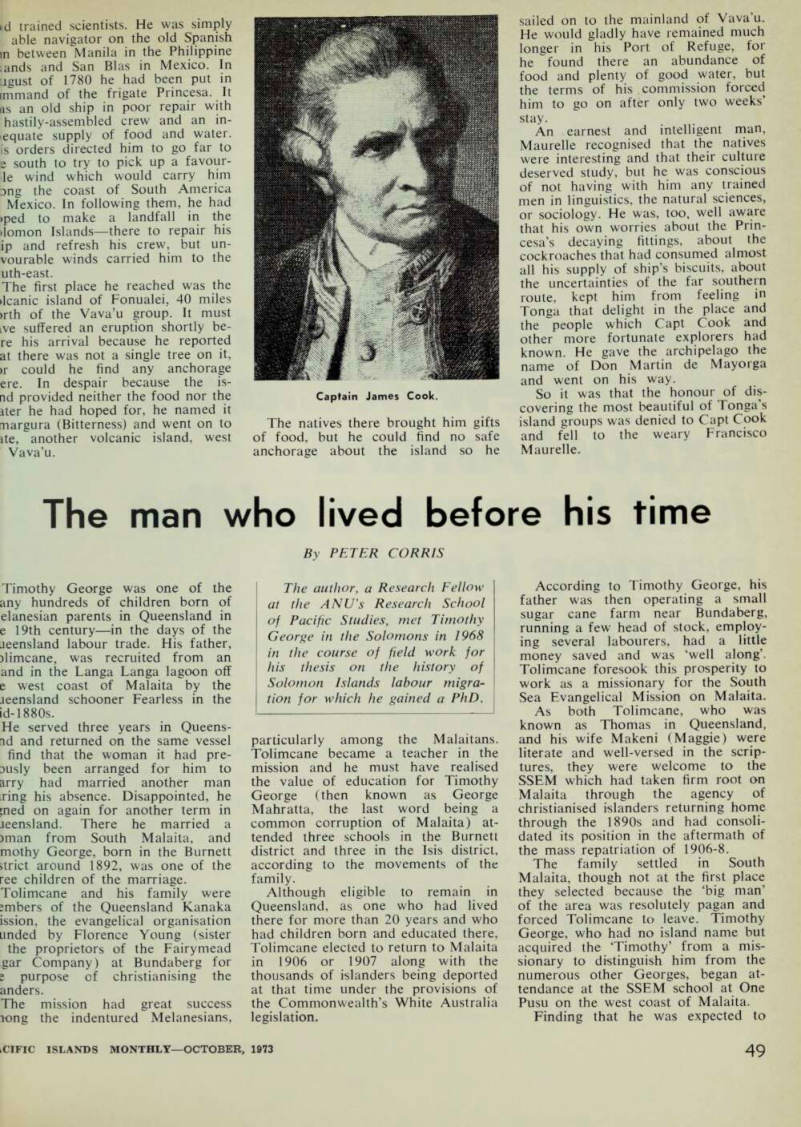
Captain James Cook.