The Editor's Mailbag
pp. 41-49 · Read in the full issue

[?]Ongans In The 'Big Smoke'
One wonders what my friend John mder hopes to achieve by the rather eeping and wholesale criticism uch he makes of the conduct of •ngans in Sydney (PIM, Aug, p 31). hile many of the things he says may ve happened with Tongans in Syd y we suggest that while the be viour of a few may be open to ticism this would be typical of a Dss-section of any minority group ing in Australia.
To identify the cases of misconduct d write openly about them is not ing to help the situation. It would t be difficult to outline cases of mgans who live happily in the com mity here and to point out that ire are many who are making a od contribution to the welfare of . These have made many friends re who appreciate what the Tongans ing with their friendly disposition d their joyous outlook on life nerally.
There have been a few fights and me over-drinking but these have en the exception rather than the le and indeed such things have ppened with some Australians who ve travelled in the Pacific areas, e would not want to judge Australia these incidents nor lift them t of their context, nor magnify them I believe John Slender has done this case.
One of the ways to help Tongans Australia is to get near to them and Ip them as friends rather than stand I and berate them as critics. This ay sometimes not be easy but it not impossible and we should have understanding of the problems d difficulties which they have in aking adjustments from their culture ours, remembering always as the od book says “people who are well i not need a doctor but only those ao are sick”.
In general, we in Australia, neither e people nor the governments, do ry much to assist those coming to from the Pacific to be at home in our immunity. The Church tries to help, le Rev John Langi, a Rotuman of e Fiji Methodist Conference, has ;en appointed to work in Sydney as e guide, philosopher and friend of
the people from the South Pacific.
The Tongans have strongly supported his work. This was brought home to us when a Tongan Misanale the tradi tional thanksgiving service was held in Wesley Chapel in Sydney on a recent Sunday. In little over an hour the Tongans contributed over 52,000 towards their pastor’s work.
As one saw these Tongans in the chapel, heard their magnificent singing and shared the spontaneous joy of their worship, one wished that some thing of their spirit could be im parted to the Christian Church in Australia.
While I believe that John Slender has over-emphasised the problem cases in the matter of misconduct I believe that his article may cause those Ton gans in Sydney who have been un ruly to have a good look at themselves for the good name of Tonga and especially of those Tongans living in Australia.
John Slender has also made some constructive suggestions which we would support. Those who come to Australia on a visitor’s permit should return on the expiration of the per mit and this should be clearly un derstood by all concerned.
The Tongan Government too should take care to give exit permits only to
those who come here pledged to good behaviour. The Australian Govern ment should be ready to act in re turning to Tonga those who break the laws which they on entering promise to uphold.
One of the biggest needs in Aust ralia is for a Pacific Centre where Tongans and others from the South Pacific can get the care and counsel that they so often need. The Board of Missions of the Methodist Church of Australasia is considering establish ing such a centre for this purpose and the board would hope for the co operation of the churches and the government on what is a very im portant project.
With the strengthening of ties be tween Australia and the Pacific com munities more and more people will be coming to Australia for training and as visitors. Provision should be made for these Pacific Islanders, not only to be hospitably received, (more and more Australians are com ing to know what hospitality means in the Pacific) but also to help them in the inevitable problems of adjust ment which will arise.
Cecil F. Cribble (Rev)
Methodist Overseas Missions, Sydney.
Certainly John Slender’s article creates a controversy and if people are as sensitive as 1 am, it disturbs many patriotic feelings. The article perhaps represents a true and fair view of the Tongans’ way of life in big cities, yet it also paints a nasty pic ture of them, as Slender himself sug gests.
Honestly, after reading the article I have forgotten all the good things that it said about the Tongans, only the bad things still dwell in my mind. It im plies that no matter how good Tongans are, they’d only be involved in the picture that Slender has drawn.
Is not that pathetic?
Due to my narrow-mindedness, I would say that Slender’s article is a well-written, artistic piece of lam pooning, supplementary to last year’s
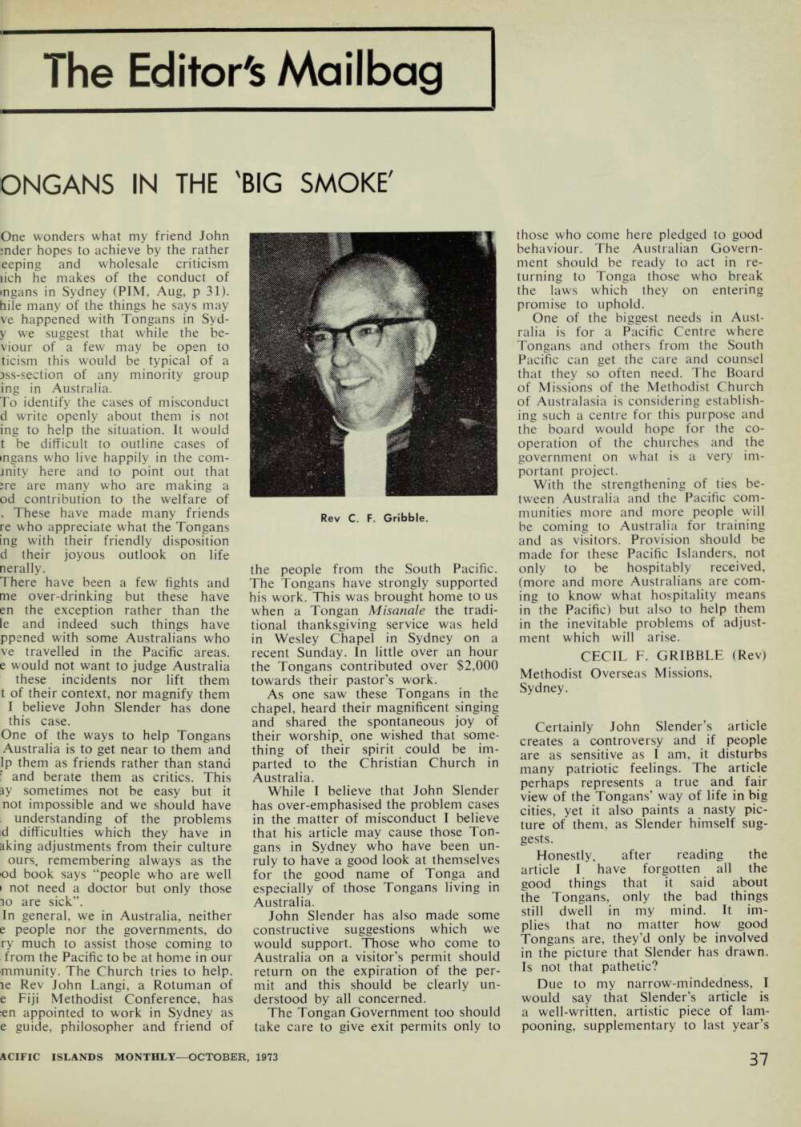
Rev C. F. Gribble.
Letters
•tide in NZ Truth which claimed lat Tongans live like pigs. The article provocative and a menace to Ton ans’ contact and affiliation with peo e of other countries. I may be wrong ut Tongans, to many who have ;ad Slender’s article, will now be ssociated with stowaways, drinkers, ealers and street-rowdies.
Definitely, the article has no con ructive effects. If it was written with itentions of unearthing problems, icn certainly there were other aven es for doing so rather than this üblic exposure which led to people :offing at many innocent Tongans, » myself. Also, these problems are orld-wide pitfalls as one type of thnic group, culture, country etc, iffers from the other. Let those ho are free from these problems ast the first stones at the Tongans. 1 wonder how the Aussies, especi lly my dark brothers from the In :rior, would fare in New York, aris or Tokyo? You don’t have to e Tongan to have problems with owawaying, drinking, communi ition and sex. The prosaic lives that lany people have experienced led lem to their search for something ore fascinating and flamboyant. May e that’s why this ill-defined group f Tongans in Sydney end up this 'ay. Its a problem of adaptation and are cultural shock. Maybe that’s why ippies cut themselves off from society i many parts of the world. Maybe lat’s why many Aussies attempt to art new lives in other countries.
I cannot help thinking that Slender as deliberately tried to establish a ad ethos for the Tongans. What /er he tried to show in his article j’d only find people commiserating so e has smothered any good reputation lat has been built up in the past. I’m ire I’m not the sole adjudicator ho agrees with this.
I want to elucidate that I’m not :pudiating the things presented in the rticle as most of them seem plau ble. I only question its salutary Tects, its constructivity and its ex ediency. The article, in my view, •eates consternation and repugnancy, ome people must learn to under and, not to judge.
Fatai, (ie Mrs Slender) congratu itions on your appointment as re resentative for Tonga Visitors Bureau. 3hn, I hereby appoint you as the sw Tongans’ Criminal Record Keeper i the Sydney branch. ‘Ofa atu.
Lisiate 'A ‘Akolo
Wellington, NZ.
As a regular reader of PIM I came across an article about Tongan people in Sydney by Mr Slender.
After I arrived in Sydney as a tourist I met quite a few Tongan educated people, hard working and kind. Their hospitality is great and very helpful and makes me feel at home while in this country.
How the individual behaves and where he chooses a home is entirely his own business. (It’s a free country in case Mr Slender doesn’t know.) The faults mentioned by Mr Slender of stowaways, workers and students are not uncommon anywhere in the world.
He also forgot to mention that his
wife entered Australia as a tourist.
When her permit had almost expired, not wanting to return to Tonga, she wanted to study nursing, so, with the help of the church authorities, she commenced nursing at Waverley District Hospital.
Honestly, Mr Slender must have known different Tongans from those I’ve met but, as they say, “Birds of a feather flock together”.
My advice to Mr Slender is to mind his own business.
Uatesoni Lapu’Aho.
Homebush, Sydney.
• Mrs Slender came to Sydney to work for the church after meeting its representatives in Papua New Guinea.
1 their suggestion, she took and pas d a nursing aid course state final 'animation with distinction. Then she St Mr Slender, returned to Tonga to i d out her parents’ reaction to her arriage. They approved and she re rned to Sydney where her husband’s 9rk is. Her actions were never diet ed by a desire to live in Australia.
Sex In The Trobriands
I am most grateful to critic Peter vingston for the good reception he s given my paintings reproduced in t book Islands of Love (PIM July).
Some verification I feel is warranted ncerning his statements about the ff describing the Trobriand Islands.
Some time ago, while work l on paintings for a book Papua New Guinea leg ds I was able to profit from ter’s thorough knowledge of the puan Gulf Districts. I now feel that believes customs in Melanesia uldn’t be as different as I have scribed.
Although the Trobriands are in e the ethnic boundaries of Melane , the Trobriander is only as much danesian as, for example the peo -5 of the Mortlock or Tasman Is ids. To compare the highly-refined dal structure of the Trobriander th the customs of the Goaribari mot stand a test According to F. E. Williams, pro tution was socially approved in the rari Delta and the Goaribari were own to have conducted expeditions neighouring tribes for the purpose prostituting their wifes for shell laments. Nothing the like applies to ; Trobriand Islands, where free sex l expression can only be resorted by the unmarried. Sexual favours mot be bought: a transaction of >acco or a handful of betelnuts must considered a token of friendship the sign of intention as this could said of the European who presents girl with flowers or chocolates, t is to answer Peter’s question in ;ard to the sexual aspect of two deties “Why the Trobriands and t the Goaribari?”, that I must plain not having been influenced my choice by the sexual behaviour the Trobriander. But had I rea led according to this factor I would o have “picked” on the Trobriander. dinowski’s statements on these is ids do still largely apply, while, I have learned during a stay at okolo, the discriptions of F. E. illiams on the sexual life in the ilf District, have drastically been
altered through far reaching Mission influence.
Peter wrote further: “Sex in the Trobriand Islands is no different from anywhere else” and, “I am sure that Kurt Pfund is well aware, that women who do not use any known contraceptive methods, have intercourse with many lovers, but do not conceive until they marry are found, not only in the Trobriands, but in many parts of Melanesia and investigators from Malinowski on wards have given some very simple explanations for this fact.”
Even the Tahitians or the Knabibu Indians of the Upper Orinoko would not have sexual intercourse as fre quently as is the case with the un married Trobriander. The act in it self is different to that in other parts of the world.
Most certainly, I am not aware that there exists any other society in Melanesia apart from that in the Trobriands, where it is the rule that unmarried women do not con ceive, except for places where a strict tambu on sexual licence before mar riage is observed. It follows that I also have never heard of some very simple explanations for this fact.
Malinowski had no answer to what he called “a phenomenon”. In 1937, Dr Fritz Kahn described the discovery of antibodies produced by the female of species towards the male sperm (Unser Geschlechtsleben, Keller & Co, A. G. Lucerne). I understand studies are still conducted on this matter, especially in Japan and I was informed by the specialist on the subject at the Medical Faculty in Port Moresby, that this concept has never been applied to any society in PNG as being crucial to its way of life.
Finally, the crux of the matter is that Islands of Love is a book of my paintings on the Trobriand Is lands, including a reference to what I learned while living and working for several months in the village of Kaibola.
My explanation of “the pheno menon” has never before been quoted and I have done so in the hope it may induce scientific enquiry and bio chemical research into this matter be fore what Malinowski first described
becomes history.
May I add, as a postscript, that I make a strong point in Islands of Love of the fact that the white man who seeks unrestricted sexual bliss in the Trobriands may be sadly disappointed. For obvious reasons, the letter as it is could result in visitors to the islands who would be little appreciated.
Kurt Pfund
Boroko, PNG.
That 'Western Myth'
Percy Chatterton’s Footnotes (PIM, Aug, p 28) were most appropriate.
It would certainly not be my aim to try to justify all and every action carried out under the name of Chris tianity, either in PNG in the last 100 years or the world in the last 2,000 years. But it certainly is illogical or ignorant to endorse the opinion, common in PNG, that Christianity is some form of Western myth or cult.
Perhaps an intelligent discussion be tween Papua New Guineans and Westerners may help both with their problems. The Bible message is con tained in real life events, but in an Eastern setting. It's hard for Aust ralians to understand this setting, as we don’t have clan and tribal or ganisations, intricate land tenure pat terns and defined marriage alliances.
Bride price payments, garden magic, animal sacrifices, sacred objects and carvings, ceremonial initiations, plural wives, harvest celebrations and many other things commonly referred to in the Bible, are practically unknown to Australians.
Until an old man in a Papua New Guinean village had spent hours telling me his lineage back for 11 generations and shown me how this linked up with his land ownership and clan organisation, I thought genealogies were just long lists of names. It’s because we haven’t under stood such lists of names in the Bible or been able to appreciate the background in which the biblical mes sage is set, that many Europeans do have trouble understanding or inter preting the Bible.
It is not coincidence that Papua New Guineans are needed to help our understanding of Christianity.
As often requested by the Chief Minister, we need to work together to solve our problems.
Bruce R. French
Kerevat, East New Britain.
Drinking In Png
One could not help but notice the peaceful behaviour of 120,000 High landers at the “dry” Mt Hagen show in contrast with the riotous behaviour of a much smaller number of fighting Tolais and Highlanders in Kokopo, at the Tavern, on the same weekend.
This stark contrast of behaviour has led our students and staff to send the following telegram to Chief Minister Michael Somare urging much stiffer laws regulating drinking in Papua New Guinea:
Students And Staff Of Sonoma College
Congratulate You And Your Government
And Highland People On Peace And
TY AT MT HAGEN SHOW. WE BELIEVE
U-Avai Lability Of Alcoholic Liquor
Itributed Much To Peace Of This
Bering. It Is Significant That Kokopo
TS AND FIGHTING BEGAN AT THE TAVERN.
Believe Tight National Restrictions
Liquor Sales Could Have Prevented
Y Situation Which Has Already Taken
> Lives And Caused Much Bloodshed
Fering Anct Fear. Alcohol Is A
Ognised Cause Of Violence And Law
Sness. Sonoma College Students
Ently Surveyed 2283 Papua New
Neans On Gazelle Peninsula, 64 Per
IT SAID THAT ALL LIQUOR SALES SHOULD P, 91 PER CENT SAID THERE IS TOO MUCH NKING AND 53 PER CENT HAD AT SOME- E BEEN HURT BY SOMEONE WHO WAS
Ink. We Believe That The Temporary
AL BAN ON LIQUOR SALES MAY HELP
Urgently Request Government To
Irageously Curtail Nation-Wide Liquor
ES. . . .
Phe telegram refers to some figures tained in a random survey of 2,283 ligenes in the Gazelle peninsula, fuller tabulation of the result of 5 survey appears below: )1% of those questioned believed that there is too much drink
ing.
10% stated that there should be greater restriction on the sale of liquor. 54% said that liquor sales should be stopped altogether. >3% stated that they had at some time been injured by some one who was drunk. >2% said that someone else in their family had been injured by someone who was drunk. 50% reported being short of food, clothing, etc, at some time because money had been spent on drink instead of providing more necessary items.
K. D. Morgan
dal Science Dept, loma Adventist College, kopo, PNG.
Golden Courtesy
’ have studied the account (PIM, g, p 10) of the funeral of Ratu Edward Cakobau with interest and ireciation slightly tinctured with satisfaction. fhere is meat here for the archivist, 1 meat, too, certainly, for the icral reader. But I’m less sure that i could describe that article as a dial for drooping spirits. What ?ody seems to have bothered to ntion was the extraordinary cour / of Ratu Sir Edward shining round i like a golden light.
Tow very well do I remember my
last encounter with this elevated gentleman! ‘Elevated’ in many more senses than one. Absolutely by chance I happened to learn one afternoon earlier this year that the acting Prime Minister was in Savusavu, and had just left the township boundaries, and was on his way back to the airport.
Decorum seemed to indicate that as a member of the small local Advisory Council (struggle with rural development) I should be seen among those assembled to bid farewell to the great man.
I drove over to the airport, stopping the car a discreet distance away. The acting Prime Minister was certainly
there. Ratu Sir Edward stood out like a mountain among a collection of anthills. A little sheepish and self conscious I advanced towards him with the intention, so soon as civilities had been exchanged, of retreating at high speed into the background. But this was not to be.
Ratu Sir Edward noticed me at once: came forward and shook me warmly by the hand. Ratu Sir Edward, filled with enthusiasm, seemed to be all over me. So I heard how ‘Sir, the government means to take a strong line over Nadi airport’ and, too, how ‘Sir, the government in tends to adopt fresh tactics.’ He went on to explain that ‘Sir, the government
II plans for something else’ while d ‘Sir, we are proposing to go ;;ad with some other course.’ Mark j, it was ‘Sir, this’ and ‘also, Sir, t’ the whole time till after about quarter of an hour, with a genial ve of the arm, he placed his lengthy 1 distinguished person inside the craft and flew off.
Comparing that incident with peo ’s verbal expressions today, I nder whether the reason so many med doubly sad at the loss of Ratu Edward was a vague kind of feel ; that they might be attending two lerals. Together with the one taking ice before their eyes, a second rial, I suspect, could have been mrring. So far as Fiji is concerned, I Ratu Sir Edward carry with him o the grave the use of that short rd ‘Sir’?
M. E. Basden (Rev)
/usavu, Fiji.
Into The Wahgi
After tramping around the New linea Highlands for a couple of irs before the Administration had ;n become aware of their existence, >ssing the country from north to ith down the Purari River, dis /ering and reporting the existence the Wahgi-Hagen Valley to the [ministration in 1933, I note we are w relegated to being LED into the igen area in 1933 (ref PIM, Aug, 53, article on Fr Ross by “A Port jresby Correspondent”).
But for Jim Taylor’s personal thusiasm and interest when he was tioned in Kainantu, in all pro bility the discovery and potential the Highlands would have been lored by the Administration for irs.
But —Jim never LED us anywhere, d he has NEVER claimed to have ne so. He was always an en isiastic and congenial member of “ New Guinea Goldfields-Admini ation joint 1933 expedition into ; Wahgi-Hagen area.
I would suggest that your Port aresby correspondent checks the :ts in his sloppy reporting—and sps the record straight!
Michael J. Leahy.
nag, PNG. • Apologies to pioneer Leahy for sloppy use of words. We note with tisfaction that his own use of words as direct as ever.