Rescuing
p. 59 · Read in the full issue
A Famous
Mat-Mat
By R. W. Robson
Papua New Guinea, plunging— prematurely, in my opinion— into self-government and inde pendence, may lose its sense of direction and timing. I hope it will not lose its sense of history.
Wise statesmen, charting their nation’s future, find much to guide them in the significant records of their past. PNG, still striving for some sort of national unity, hasn’t much history to guide it, as yet.
What does exist in the shape of tangible records should be pre served, for the sake of generations to come.
I make these ponderous com ments because, when I visited New Britain recently, I learned that the Kuradui mat-mat, some 16 miles south of Rabaul, had been taken over by the ever-encroaching jungle, and its location lost and almost forgotten. That mat-mat was the family burial-ground of R. H. R. Parkinson, New Guinea’s pioneer planter and a famous scientist, who was buried there in 1907.
Soon after World War 11, I helped some public-spirited Rabaul citizens—especially Mr C.
H. Meen, the Rabaul photo grapher, Mr Fred Archer, and Mr Max Hayes—to re-locate and par tially restore the mat-mats of Mrs Emma Forsayth Kolbe (Queen Emma) and her famous brother in-law, Parkinson, on the former plantations of Gunantambu and Kuradui respectively. As I showed in my book, Queen Emma of New Guinea, the inscriptions and dates on those old headstones give back ground to some of New Guinea’s fascinating early history, from about 1880 up to World War I.
The new road to Kokopo goes near the Queen Emma mat-mat, and the present owners of Mala pau plantation have kept the old cemetery clear of wild growth, and maintained a set of concrete steps up to the top of the little hill on which it is located.
But the Parkinson mat-mat, which we located and described after a bush-fire had cleared away an overwhelming growth of kunai,
had again disappeared. The land thereabouts was all under heavy tropical undergrowth and it had been sub-divided and sold.
Fortunately, the area of the Parkinson burial-ground had passed into the possession of Mr Bill Lawrence, of the Dowling bookselling enterprise in Rabaul.
When he learned that the mat-mat was probably on his land, he searched through the jungle and found it.
In June, Bill took a party of us out to his land—which he plans eventually to turn into a profit able plantation—and he and his attractive Melanesian wife led us along a narrow path, through thick jungle, to a spot on a hill side.
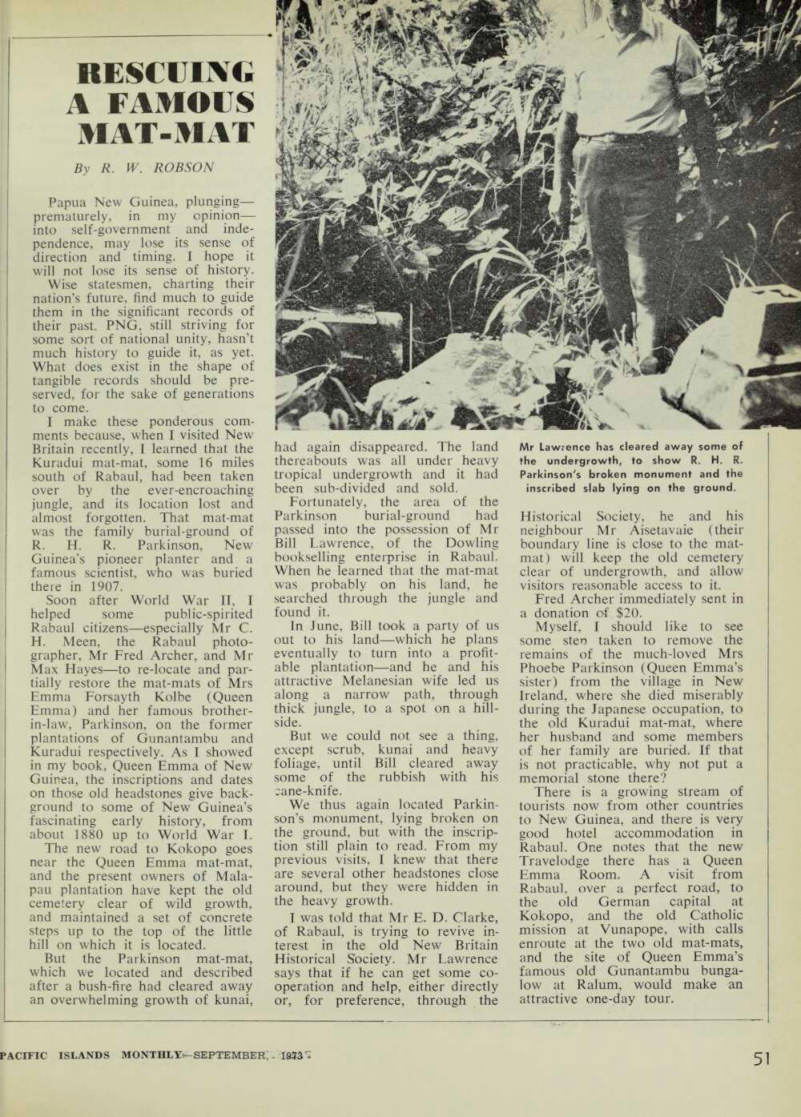
But we could not see a thing, except scrub, kunai and heavy foliage, until Bill cleared away some of the rubbish with his ::ane-knife.
We thus again located Parkin son’s monument, lying broken on the ground, but with the inscrip tion still plain to read. From my previous visits, I knew that there are several other headstones close around, but they were hidden in the heavy growth.
I was told that Mr E. D. Clarke, of Rabaul, is trying to revive in terest in the old New Britain Historical Society. Mr Lawrence says that if he can get some co operation and help, either directly or, for preference, through the
Historical Society, he and his neighbour Mr Aisetavaie (their boundary line is close to the mat mat) will keep the old cemetery clear of undergrowth, and allow visitors reasonable access to it.
Fred Archer immediately sent in a donation of S2O.
Myself, I should like to see some sten taken to remove the remains of the much-loved Mrs Phoebe Parkinson (Queen Emma’s sister) from the village in New Ireland, where she died miserably during the Japanese occupation, to the old Kuradui mat-mat, where her husband and some members of her family are buried. If that is not practicable, why not put a memorial stone there?
There is a growing stream of tourists now from other countries to New Guinea, and there is very good hotel accommodation in Rabaul. One notes that the new Travelodge there has a Queen Emma Room. A visit from Rabaul, over a perfect road, to the old German capital at Kokopo, and the old Catholic mission at Vunapope, with calls enroute at the two old mat-mats, and the site of Queen Emma’s famous old Gunantambu bunga low at Ralum, would make an attractive one-day tour.
Mr Lawrence has cleared away some of the undergrowth, to show R. H. R.
Parkinson's broken monument and the inscribed slab lying on the ground.