Pacific Islands Monthly

News Magazine Of The South Pacific
September, 1973
Australia, N.Z., Western Samoa 60C
P.N.G., FIJI, COOKS, TONGA, G.E.1.C., 8.5.1. P., N. HEBRIDES 50c
Nauru, Niue, Norfolk 50C
American Samoa 70C Hawaii, Micronesia $L.Oo
NEW CALEDONIA AND FRENCH POLYNESIA 100 CFP
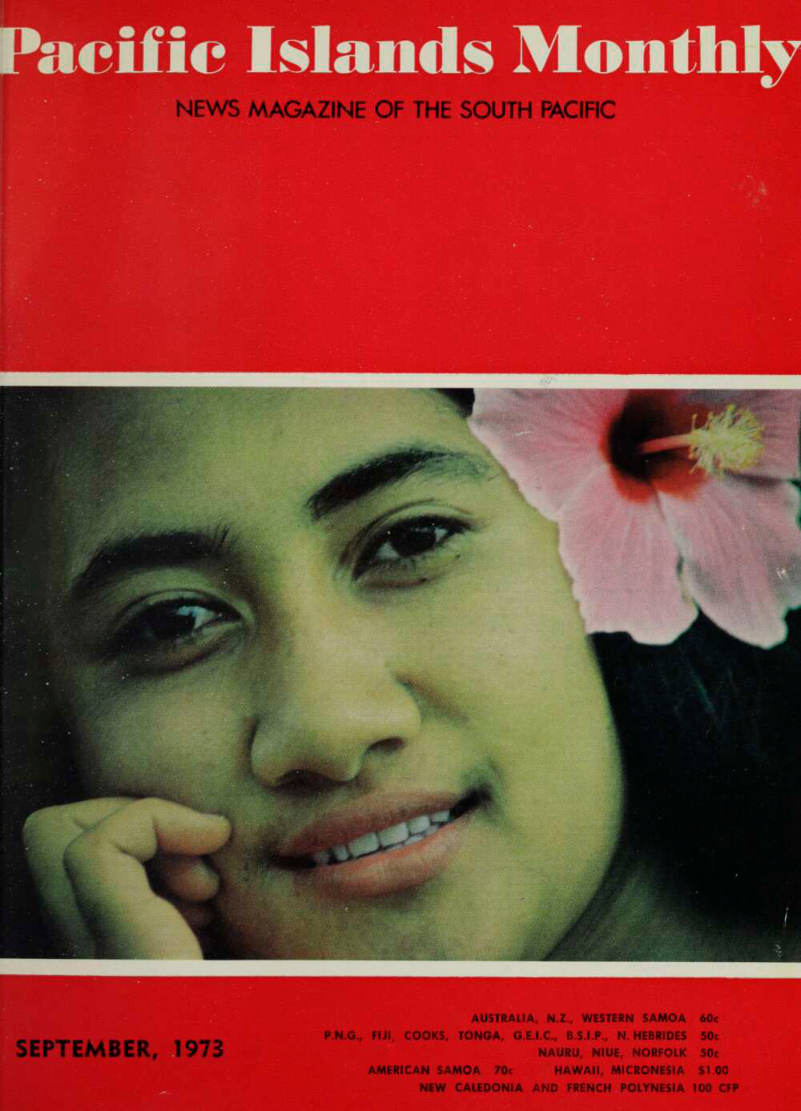
Our Cover
Last month’s cover was of the beast, a carving, done in Tonga, of a monkey’s head. This month, it’s the beauty Miss Sela Kalaiita, who also lives in Tonga, in Nukualofa. This cover, like last month’s, comes from the camera of English photographer Steve Vidler.
Advertisements & other items, p. 2 (1 item)
MazdaBoB
O.H.Cam
Power
X % You’ll get more family fun out of the Mazda 808.
Simply because we’ve put more into it.
Now, family motoring and fun motoring aren’t contradictions any longer.
They’re both part of a package in the Mazda 808.
The fun begins when you relax in the roomy comfort of front bucket seats; when the family finds ample leg space, head space, shoulder space - the 808 is the widest and longest 1300 cc Mazda we’ve ever built. And take along all you’ll need for fun when you get there - trunk space is generous because the spare tire fits under the trunk bed.
Driving the Mazda 808 is as much fun as being driven in it. Hear the happy purr of the sprightly 1300 cc engine with its sporty overhead camshaft, and you’ll realize that you have a stablemate of the renowned Mazda rotaries. Rely on the positive dual circuit brakes* with discs up front. Whiz through the four gears of the floor-mounted stick shift, or leave the shifting entirely to our reliable automatic (optional).
Cruise for hours at highway speeds or turn off into bumpy country roads - either way you’ll appreciate the stable handling of the coil-andshock-absorber front suspension and the bias-mounted rear shock absorbers.
When we say that we’ve put more into the Mazda 808, we mean: carpeting**, child-proof door locks, door armrests, padded sun visors, flow-through ventilation, lockable fuel filler door, all as standard equipment. The windshield is made of laminated safety glass. The semimonocoque body with front and rear sub-frames is designed for safe controlled collapse under impact.
Test drive the Mazda 808 at your nearest Mazda dealer’s. But be sure to bring the family along. •Left-hand drive models only.
“Except in standard model sedan
OSmzoA
C 1973 TOYO KOGYO CO., LTD
nerican Samoa/MAX HALECK, INC. Pago Pago, American Samoa 96920 Fiji Islands/N IRAN JANS AUTOPORT LTD. G.P.O. Box 450, Suva Tel: 22691 w Caledonia/SOCIETE RIVIERE ET BERNANOS 41 Rue de Sebastopol, Noumea New Guinea/PNG MOTORS LTD. P.O. Box 1394, Boroko, Papua Tel
In This Issue
Eneral
>uth Pacific Conference 3 uam Games 11 lots lost and farewelled 13 Z steps up Islands aid 45 le Enna G stalemate 79 iportance of the coconut 99 ew "Polynesian Triangle" fares 100
Merican Samoa
eight charge increase stalled . 83
Dok Islands
wn flag 13
anning for tourist invasion 99 Jl ian actor in Sydney (pic) 11 jputy Prime Minister 16 ack magic 21 ewalking abused 23 Jw project to save food 41
- aid for forestry development 45
>tuma: fascinating outpost ... 47 jw gas tanker 79 achines to handle cargo 82 sw law-enforcement boats 83 ttle against inflation 97 portance of the coconut 99 >P salaries 11l
French Polynesia
James Boyack's Tahiti Letter 6 Boatbuilding on Wallis 83
Gilbert And Ellice Islands
Governor's arrival 15 Containers reach the Gilberts 82
Lord Howe Island
New fishing ship 45
Nauru
President as USP Chancellor 16 Enna G stalemate 79
New Caledonia
Paris loan refused 9 Airline's fare offer 10 Assembly's heated debate 29 Japanese to operate tuna fleet 83
New Hebrides
Lost pilot found 13 Illegal crayfish export 100
Niue
First hotel 97
Papua New Guinea
Josephine Abaijah interviewed 4 Peace moves 5
Land ownership 10 Percy Chatterton's Footnotes 26 Economic position examined 41 New chair for PNG University 43 Rescuing a famous mat-mat 51 The role of artistic people 71 Help for private enterprise 99
Solomon Islands
New political party 8 Cigarette advertising ban 43 Report on economy 99
Tonga
Protection for Minerva 15 Coconut's importance 99
United States Trust Territory
Ecumenism on Kusiae 14 Generation gap on Truk 15 New dock for Ponape 82
Western Samoa
New traditions replacing old 37 Sail! and economic survival 37 NZ aid programme 45 Controlling prices 98
iPARTMENTS: Up Front with the Editor, ii; Tropicalities, 13; People, 16; Editor's ailbag, 31; Magazine section, 47; Yesterday, 52; AAANA, 61; Books, 71; From the ands Press, 77; Pacific shipping, 79; Cruising yachts, 85; Business and develop ed, 97; Produce, 101; Shipping and airways information, 103; Deaths of Islands people, 109; In a Nutshell, 115; Advertisers' index, 116.
Pacific Islands
Monthly
FOUNDED BY R. W. ROBSON IN 1930
Published Monthly By
Pacific Publications (Aust.) Pty. Ltd.,
29 Alberta St.. Sydney, N.S.W., 2000.
Postal Address: G.P.O. BOX 3408, SYDNEY,
N.S.W., 2001.
Telegraphic Address: PACPUB, Sydney.
Telex 25168.
Telephones: 61-9197, 61-7101, 61-4369.
onsulting Directors; R. W. Robson, Judy Tudor.
Chief Executives: Manager: Selwyn Hughes.
Publisher: Stuart Inder.
Director of Advertising: W. A. Gasnier
Pacific Islands Monthly
Editor: Stuart Inder.
Assistant Editor; John Carter.
Advertising Manager; W. A. Gasnier.
Circulation Manager; Barry Badger.
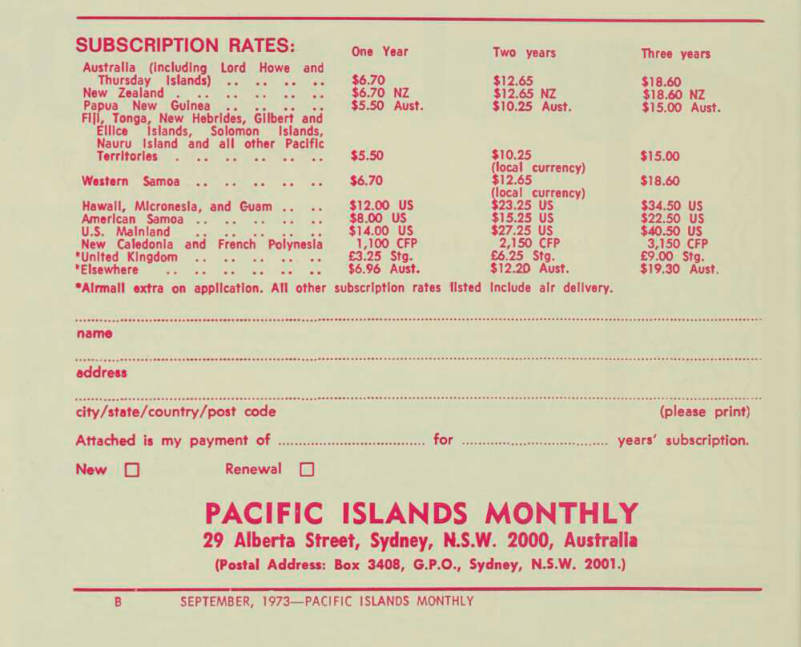
Subscription Rates:
"Pacific Islands Monthly" is airfreighted to all subscribers and agents in the Pacific Islands and the U.S.A.; copies to other areas go by surface mail.
Australia (incl. Lord Howe and Thursday Is.): $6.70 Aust., Papua New Guinea: $5.50 Aust.; Fiji, Tonga, New Hebrides, Gilbert & Ellice Islands, Solomon Islands, Nauru Island and all other Pacific territories: $5.50 (local currency); Western Samoa: $6.70 (local currency); New Zealand: $6.70 NZ; Hawaii, Micronesia and Guam: $12.00 US; US Mainland: $14.00 US, New Caledonia and French Polynesia: 1,100 CFP; United Kingdom: £3.25; Elsewhere: $6.96.
Representatives
Fiji: A. F. Woods, Imex (Pacific) Limited, Suite 2A, Victoria Arcade, Suva, Fiji. P.O. Box 3117, Lami, SUVA. Telephone; 22-502. Telex: 2124. f o pud New Guinea: LAE, P.O. Box 227; MBAUL, Mr. Steve Simpson, P.O. Box 433 (c/- Rabaul Photographic. Tel.: 2677.) french Polynesia: Distribution—Hachette Paci- Hque, 10 Ave Bruat, Papeete New Zealand: Pacific Publications, C.P.O. Box 2229, Auckland. 379-494. Representative: John Spedding, Civic House, 291 Queen St., Auckland, Tel.: 379-494 United Kingdom: I. B. Graham, Park House, 22 Park Street, Croydon, CR9 3NP. Tel . 01-6884177.
Overseas Newspapers (Agencies) Ltd., Cromwell House, Fuiwood Place, London, W.C.I. Tel.: 01-242-0661. Cables: WESNEWS, London, DS4.
Japan: Advertising—Universal Media Corpora tion, C.P.O. Box 46, Tokyo. Tel.: 666-3036.
Victoria: Advertising Pacific Publications (Aust.) Pty. Ltd., 33 Lonsdale Street, Melbourne, Vic. 3006. Telephone: 662-3263.
Queensland: Advertising—Beale Media Services, 232 St. Paul's Terrace, Fortitude Valley, Qld., 4006. Tel.: 52-5827.
Hawaii and US. Mainland only; Mrs. W. A.
McGrath, 225 Queen Street, 178, Honolulu, 96813 Send change of address notices. Form 3579 and new subscriptions to P.O. Box 2193, Honolulu, Hawaii, U.S.A. 96805).
Second class postage paid at Honolulu, Hawaii.
Copyrigh* (C), 1973,
Pacific Publications (Aust.) Pty. Ltd.
September, 1973 Vol. 44, No. 9
Up Front

with the Editor
Papua New Guinea is in ferment.
If it wasn’t, we’d have cause to worry! With formal self-government only a few months away (it comes in December) and independence to follow soon after, that vast conglome rate of islands and mountains would have to be inhabited by deaf, dumb and blind if parts of it were not now considerably uncertain and appre hensive.
With Australia’s withdrawal there is to be a new ball game, but the teams aren’t finally selected and no body is sure of the rules. And even with the rules decided, in a country of 700 languages we are bound to have a communication problem.
Miss Josephine Abaijah’s Papuan independence movement is a symptom of the present ferment.
As a Papuan, Miss Abaijah doesn’t want to be dominated by New Guineans when Papua New Guinea goes forward to independence as one state, and she is not prepared to give union a try. She doesn’t support Papuan membership even of a system of Papua New Guinea states in a loose kind of federalism. Better that Papua should have complete indepen dence, she says, although she is not clear on the details of independence and appears not to hold out hope that the present Australian Government would have sympathy for such a de mand anyway.
That’s the gist of Miss Abaijah’s views as expressed in the interview on P 4.
Her attitude is neither new nor re cent. Papuan resentment against New Guineans (those with what Miss Abaijah slightingly refers to as a “kanaka language”) has manifested it self over the years, but Miss Abaijah happens to be particularly colourful, particularly vocal, and at a particu larly sensitive period, and her revolu tionary (and I believe sincere) zeal is bound to capture headlines.
What none of us knows, including Miss Abaijah, is just how large or how significant is her support.
I don’t support Miss Abaijah. I believe her tactics are fomenting
race hatred, and that way lies tragedy. She is not the first in Paput New Guinea to espouse a secessior movement and Papua’s situation i; not so desperate that there need b( talk of revolution. if Papuans really feel as strongly as Miss Abaijah says they do, then must surely be room for serious dis cussion with the government in ar effort to find a solution.
Meanwhile, exaggerations such a: “cur girls are stoned every day the} go to work” (presumably by Nev Guineans) are not going to relieve tensions. New Guineans in For Moresby might argue that man} Papuans are prone to treat Nev Guineans as inferior—but there is nc joy for anyone in encouraging those kinds of racial exchanges. Papuan; and New Guineans in fact rub alonj together pretty well, and what i; needed are further reminders of the things they share in common, no their differences.
But I’m preaching now. Mis; Abaijah, being sincere, is going tc have to do it her way, even though I can see no way that Papua car achieve independence of the kinc Miss Abaijah has in mind. (Which is not the same thing a< saying that it can’t be done. Hammei Deßoburt led the Nauruans to inde pendence in what looked equally im
possible circumstances.)
Myself, I support the pragmatic attitude of those experienced colonial ists, the British, who believe that once political borders have been drawr it is best to keep them intact unti independence, unless a majority of al the people within those borders democratically opt for a division meanwhile. What the state decides to do about its borders after inde pendence is another matter.
And myself, I support one possible solution to Papua’s troubles put for ward by Percy Chatterton to PNG’s Constitutional Planning Committee ir August, because I think it’s a plan that has a practical chance.
He proposes a Papua-New Guinea Community with, initially, five pro
winces Papua, The Highlands, [Coastal New Guinea, New Guinea ilslands, and Bougainville. The Southern Highlanders could choose between being included in the Papua ;or The Highlands provinces, and the 'Northern District people would shoose between Papua or Coastal New Guinea.
Each province would have a Pro vincial Assembly, elected by common roll, with the electorates substantially Ithe same as those in the present Ihcuse.
There would be a High Council of the Community on which all provinces would be equally repre sented by members chosen by the Provincial Assembly—say four from each province.
The High Council would specialise in vital government matters such as fiscal and economic policy and all external affairs, leaving the As semblies to take the main work load of parish pump matters —in fact on all matters not specifically reserved for the High Council.
Each province would have its own lower court and police force, and possibly its own public service.
Collection and expenditure of revenue would solely be a matter for the High Council, which would dis tribute money to the provinces in accordance with a formula prescribed in the constitution. The High Council would also operate a Common Market and control the armed forces, and maintain a Supreme Court and a Court of Appeal.
The number of provinces could be increased, or new ones admitted, only by unanimous agreement of the pro vinces. A province could secede only after consultation with the High Council and a referendum within the province.
Percy Chatterton sees additional provinces being formed from outside the present PNG borders—possibly the Solomons or the New Hebrides might want to ioin, in which case it :ould become the Melanesian Com munity.
But from what 1 hear, there is not much hope of the constitutional com mittee going along with it, as there is a fear that if units are allowed to become too strong in themselves, there is less chance of there being a united nation. There seems to have been widespread support for the re tention of the present 18 districts as middle tier of government.
Nevertheless, it’s all worth serious study by the Miss Abaijahs of the ;erritory who predict bloodshed as the onlv alternative to a unitary Papua New Guinea.
Stuart Inder
Advertisements & other items, pp. 5-8 (2 items)
Iii
*ACIFIC ISLANDS MONTHLY—SEPTEMBER, 1973
Milk
One of the good things
to share
Smooth, creamy, delicious Cadbury Dairy Milk Chocolate. Nothing else has the same great taste. Look for the famous purple wrapper and say “I want Cadbury”.
Biggest selling block chocolate in Australia and New Zealand. > A
DAIRY
MILK
CS2BA
A.
' ; H ;■ m I
I J I
y •<1 8 S PK ii «ca £,
xHt
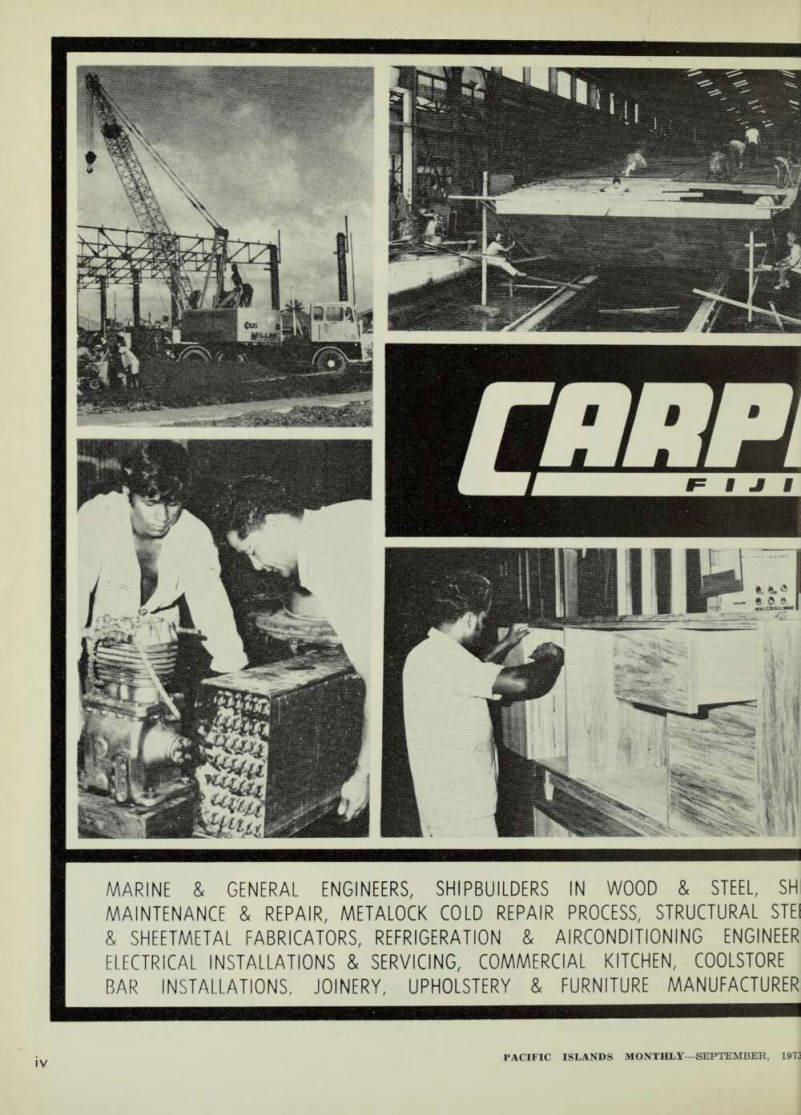
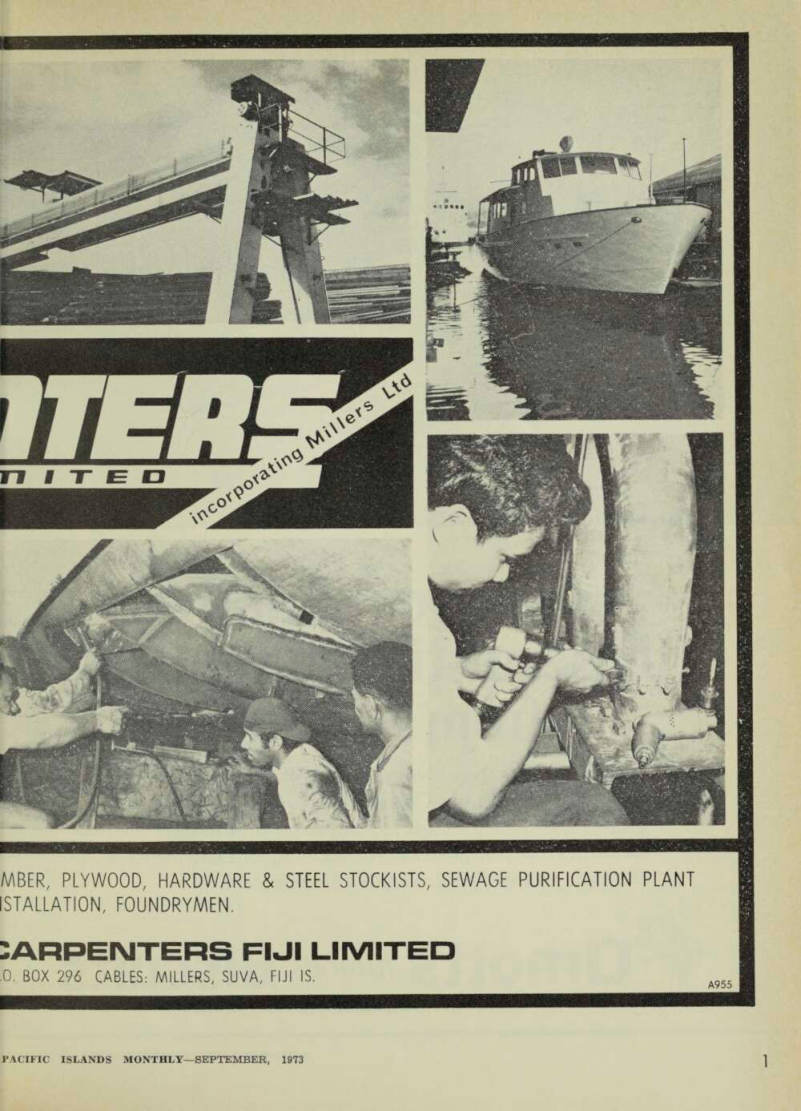
MARINE & GENERAL ENGINEERS, SHIPBUILDERS IN WOOD & STEEL, SHI MAINTENANCE & REPAIR, METALOCK COLD REPAIR PROCESS, STRUCTURAL STEI & SHEETMETAL FABRICATORS, REFRIGERATION & AIRCONDITIONING ENGINEER ELECTRICAL INSTALLATIONS & SERVICING, COMMERCIAL KITCHEN, COOLSTORE BAR INSTALLATIONS, JOINERY, UPHOLSTERY & FURNITURE MANUFACTURER
MBER, PLYWOOD, HARDWARE & STEEL STOCKISTS, SEWAGE PURIFICATION PLANT
ISTALLATION, FOUNDRYMEN.
CARPENTERS FIJI LIMITED
.0. BOX 296 CABLES: MILLERS, SUVA, FIJI IS.
A 955
mm rtf as 1 'mm.
Mi Sfe *p* HBi ■ mm m mm •v m j»: ->- M Si ifepiis 64*
Give your family
these all-time favourites
from Arnott’s
Everybody likes them! Nourishing Milk Arrowroot... tasty Nice... delicious Coconut Bar... the egg-and-butter goodness of Scotch Finger... they’re all-time family favourites from the great big Arnott’s range. Taste them!
The triple-wrapped packs keep the biscuits fresh.
Qrnott's/™* Biscuits
There is no Substitute for Quality
Pacific Islands Monthly
Confrontation Looms
At Guam Conference
THE 13th South Pacific Conference opens at Guam on September 11th —under the mushroom cloud of the French nuclear tests and with a few prickly propositions on the agenda which could create a massive split in the organisation which is already creaking at its foundations.
The way France blackmailed the conference last year over the con tributions increase hasn’t been forgotten by the Australians who promised—in the corridors at Apia and not publicly at the conference — that they wouldn’t tolerate an encore from the French at the 1973 con ference.
And it looks as if they and their Labour comrades across the Tasman have thrown down the gauntlet to the French by promising to add $250,000 each to their contribution this year for certain specified projects.
It’s safe to say the French don’t like the move and may, perhaps, oppose it at Guam. If they do, there’s no telling what the Australian reaction will be.
There’s a change of government in both Australia and New Zealand and that change has brought a more militant spirit to the two teams going to Guam. They both believe that the SPC needs a much greater injection of both money and imagina tion and they’re hardly likely to tolerate any Gallic stonewalling, especially as both Australia and New Zealand, not to mention the Island governments, are spoiling for a fight over the nuclear tests.
Leading the Australian team will be Senator Donald Robert Willesee, the Special Minister of State, who’s not one to mince words. He isn’t likely to start the ball rolling but, if some one else does, he’ll join in. His speech, which is one of several usually given by the metropolitans, could be the hottest ever heard at a Conference.
France is hardly likely to applaud the extra money which the ANZ group has promised to give the SPC because France has always been suspicious of Australia’s role in the South Pacific. She will see this generous gesture as an attempt to “buy” influence and popularity in the Islands and so increase the strength of its presence.
Another proposition to be put by the Australians, and already favour ably received by the Islanders, is likely to be opposed by the French and, to a lesser extent, by the UK and US contingents. The proposition is to change some of the SPC’s features because, say the Australians in a paper which will be tabled at Guam, “Australia has for some time been concerned about the influence and effectiveness of the South Pacific Commission”.
It lists six “difficulties” affecting the commission’s work including inadequate financial resources, an antiquated constitution and organisa tional structure and a work pro gramme with too few projects having an important regional value.
Added to those present difficulties are some which are pending— duplication of the work of the SP Forum and the Bureau for Economic Co-operation, the weakening of Aus tralia’s membership basis when PNG becomes independent, leaving only Norfolk Island, and the necessity to rebuild the SPC headquarters within the next five to seven years.
The paper gives three alternatives which, it said, the SPC was faced with in the next five to 10 years—to wither away through a combination of neglect and indifference; it could be drastically restructured, which would include formal amendments of the Canberra Agreement to remove individual governments’ veto power and a merger of the commission and conference sessions, or a midway course could be devised which would attempt, by convention, to change certain features until its future and that of the Forum are clearer.
Australia favoured the last alterna tive, warning that the SPC would decline rapidly if it continued on its present course.
“There appears to be slackening of Island interest and doubts about the SPC’s future have been expressed by conference delegates,” the paper said.
The second alternative was prefer able in the sense that it could result in a rewriting of the Canberra Agreement but Australia did not think that course was acceptable to all members.
It proposed, therefore: • That the SPC as from 1975 be financed on a part-voluntary basis, and • That, from 1975 onwards there should be a de facto merger of the commission and conference sessions.
Australia also proposed that the commission’s administrative services should be financed on the present basis of fixed percentage shares among commission governments but that the work programme and services should be financed on a voluntary basis.
A merger of conference and com mission would cut down the “unduly long time now given the session and conference sitting separately” and would involve all members more fully in the operation of the whole organisation, increasing their interest and feeling of participation. It would also reduce any resentment of con ference members at having their re commendations subject to the ap proval of a body largely comprised of the metropolitan powers.
Australia will lay the paper on the table and ask that members con sider it over the next year and then deal with it at the 1974 Conference.
New Zealand is expected to back Australia on this but the United Kingdom and the United States are definitely lukewarm. France would almost certainly oppose it because it would take the veto and final con trol out of the hands of the metro politan powers.
Australia, however, is ready and willing for all members of the SPC, metropolitan and Island territories, to be equal members, believing that Island interests should be paramount.
What the Islands want, Australia is prepared to go along with.
‘They’re Just trying
to dump us!'
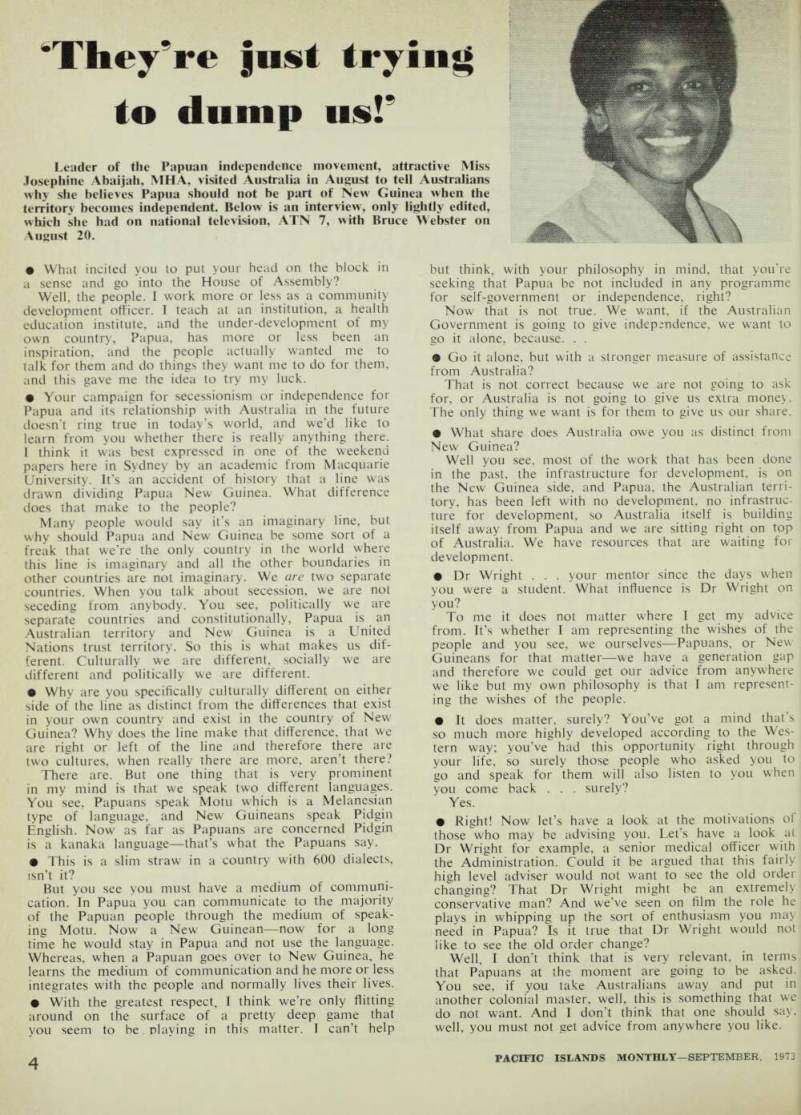
Leader of the Papuan independence movement, attractive Miss Josephine Abaijah, MHA, visited Australia in August to tell Australians why she believes Papua should not be part of New Guinea when the territory becomes independent. Below is an interview, only lightly edited, which she had on national television, ATN 7, with Bruce Webster on August 20.
• What incited you to put your head on the block in a sense and go into the House of Assembly?
Well, the people. I work more or less as a community development officer. I teach at an institution, a health education institute, and the under-development of my own country, Papua, has more or less been an inspiration, and the people actually wanted me to talk for them and do things they want me to do for them, and this gave me the idea to try my luck. • Your campaign for secessionism or independence for Papua and its relationship with Australia in the future doesn’t ring true in today’s world, and we’d like to learn from you whether there is really anything there.
I think it was best expressed in one of the weekend papers here in Sydney by an academic from Macquarie University. It’s an accident of history that a line was drawn dividing Papua New Guinea. What difference does that make to the people?
Many people would say it’s an imaginary line, but why should Papua and New Guinea be some sort of a freak that we’re the only country in the world where this line is imaginary and all the other boundaries in other countries are not imaginary. We are two separate countries. When you talk about secession, we are not seceding from anybody. You see, politically we are separate countries and constitutionally, Papua is an Australian territory and New Guinea is a United Nations trust territory. So this is what makes us dif ferent. Culturally we are different, socially we are different and politically we are different. • Why are you specifically culturally different on either side of the line as distinct from the differences that exist in your own country and exist in the country of New Guinea? Why does the line make that difference, that we are right or left of the line and therefore there are two cultures, when really there are more, aren’t there?
There are. But one thing that is very prominent in my mind is that we speak two different languages.
You see, Papuans speak Motu which is a Melanesian type of language, and New Guineans speak Pidgin English. Now as far as Papuans are concerned Pidgin is a kanaka language—that’s what the Papuans say. • This is a slim straw in a country with 600 dialects, isn’t it?
But you see you must have a medium of communi cation. In Papua you can communicate to the majority of the Papuan people through the medium of speak ing Motu. Now a New Guinean—now for a long time he would stay in Papua and not use the language.
Whereas, when a Papuan goes over to New Guinea, he learns the medium of communication and he more or less integrates with the people and normally lives their lives. • With the greatest respect, I think we’re only flitting around on the surface of a pretty deep game that you seem to be, playing in this matter. I can’t help
but think, with your philosophy in mind, that you’re seeking that Papua be not included in any programme for self-government or independence, right?
Now that is not true. We want, if the Australian Government is going to give independence, we want to go it alone, because. , . 9 Go it alone, but with a stronger measure of assistance from Australia?
That is not correct because we are not going to ask for, or Australia is not going to give us extra money.
The only thing we want is for them to give us our share. • What share does Australia owe you as distinct from New Guinea?
Well you see, most of the work that has been done in the past, the infrastructure for development, is on the New Guinea side, and Papua, the Australian terri tory, has been left with no development, no infrastruc ture for development, so Australia itself is building itself away from Papua and we are sitting right on top of Australia. We have resources that are waiting for development. • Dr Wright . . . your mentor since the days when you were a student. What influence is Dr Wright on you?
To me it does not matter where I get my advice from. It’s whether I am representing the wishes of the people and you see, we ourselves —Papuans, or New Guineans for that matter —we have a generation gap and therefore we could get our advice from anywhere we like but my own philosophy is that I am represent ing the wishes of the people. • It does matter, surely? You’ve got a mind that’s so much more highly developed according to the Wes tern way; you’ve had this opportunity right through your life, so surely those people who asked you to go and speak for them will also listen to you when you come back . . . surely?
Yes. • Right! Now let’s have a look at the motivations of those who may be advising you. Let’s have a look at Dr Wright for example, a senior medical officer with the Administration. Could it be argued that this fairly high level adviser would not want to see the old order changing? That Dr Wright might be an extremely conservative man? And we’ve seen on film the role he plays in whipping up the sort of enthusiasm you may need in Papua? Is it true that Dr Wright would not like to see the old order change?
Well, I don’t think that is very relevant, in terms that Papuans at the moment are going to be asked.
You see, if you take Australians away and put in another colonial master, well, this is something that we do not want. And I don’t think that one should say. well, you must not get advice from anywhere you like.
'Our lives in danger'
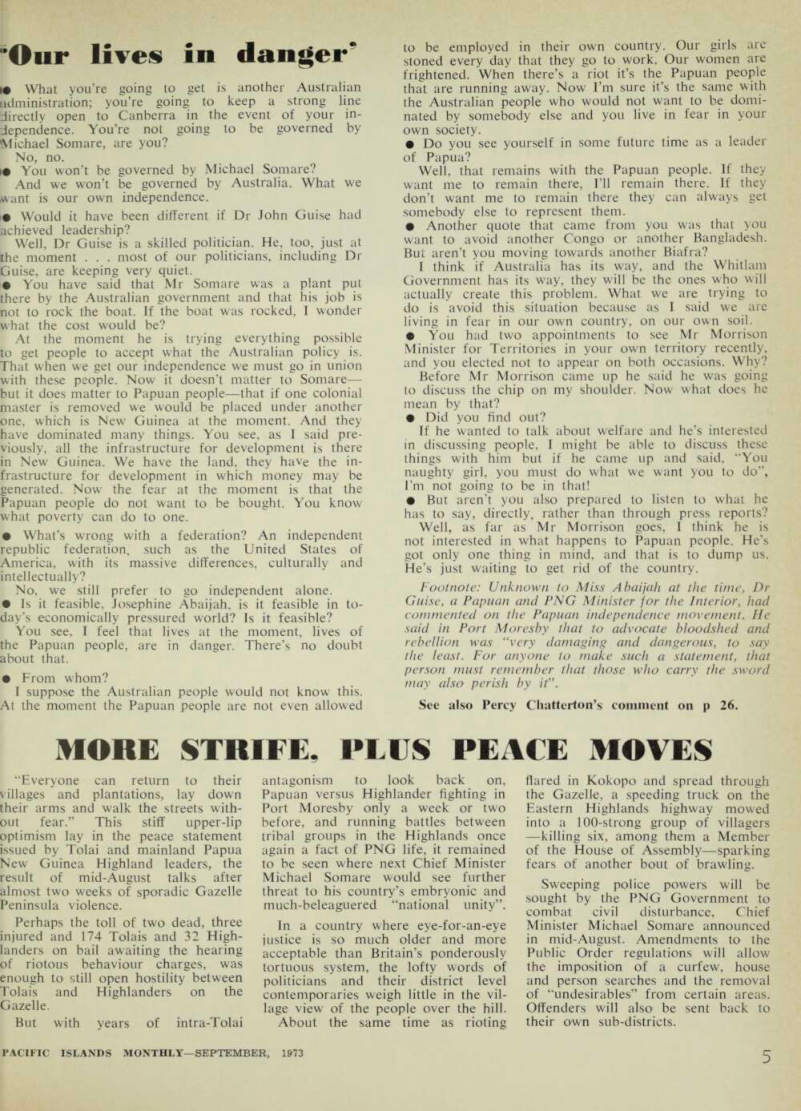
)• What you’re going to get is another Australian administration; you’re going to keep a strong line directly open to Canberra in the event of your in dependence. You’re not going to be governed by Michael Somare, are you?
No, no. i« You won’t be governed by Michael Somare?
And we won’t be governed by Australia. What we want is our own independence. • Would it have been different if Dr John Guise had achieved leadership?
Well, Dr Guise is a skilled politician. He. too, just at the moment . . . most of our politicians, including Dr Guise, are keeping very quiet. • You have said that Mr Somare was a plant put there by the Australian government and that his job is not to rock the boat. If the boat was rocked, I wonder what the cost would be?
At the moment he is trying everything possible to get people to accept what the Australian policy is.
That when we get our independence we must go in union with these people. Now it doesn’t matter to Somare — but it does matter to Papuan people—that if one colonial master is removed we would be placed under another one, which is New Guinea at the moment. And they have dominated many things. You see, as I said pre viously, all the infrastructure for development is there in New Guinea. We have the land, they have the in frastructure for development in which money may be generated. Now the fear at the moment is that the Papuan people do not want to be bought. You know what poverty can do to one. • What’s wrong with a federation? An independent republic federation, such as the United States of America, with its massive differences, culturally and intellectually?
No, we still prefer to go independent alone. • Is it feasible, Josephine Abaijah, is it feasible in to day’s economically pressured world? Is it feasible?
You see, I feel that lives at the moment, lives of the Papuan people, are in danger. There’s no doubt about that. • From whom?
I suppose the Australian people would not know this.
At the moment the Papuan people are not even allowed
to be employed in their own country. Our girls are stoned every day that they go to work. Our women are frightened. When there’s a riot it’s the Papuan people that are running away. Now I’m sure it’s the same with the Australian people who would not want to be domi nated by somebody else and you live in fear in your own society. • Do you see yourself in some future time as a leader
of Papua?
Well, that remains with the Papuan people. If they want me to remain there, I’ll remain there. If they don’t want me to remain there they can always get somebody else to represent them. • Another quote that came from you was that you want to avoid another Congo or another Bangladesh.
But aren’t you moving towards another Biafra?
I think if Australia has its way, and the Whitlam Government has its way, they will be the ones who will actually create this problem. What we are trying to do is avoid this situation because as I said we are living in fear in our own country, on our own soil. • You had two appointments to see Mr Morrison Minister for Territories in your own territory recently, and you elected not to appear on both occasions. Why?
Before Mr Morrison came up he said he was going to discuss the chip on my shoulder. Now what does he mean by that? • Did you find out?
If he wanted to talk about welfare and he’s interested in discussing people, I might be able to discuss these things with him but if he came up and said, “You naughty girl, you must do what we want you to do”, I’m not going to be in that! • But aren’t you also prepared to listen to what he has to say, directly, rather than through press reports?
Well, as far as Mr Morrison goes, I think he is not interested in what happens to Papuan people. He’s got only one thing in mind, and that is to dump us.
He’s just waiting to get rid of the country.
Footnote: Unknown to Miss Abaijah at the time, Dr Guise, a Papuan and PNG Minister for the Interior, had commented on the Papuan independence movement. He said in Port Moresby that to advocate bloodshed and rebellion was “very damaging and dangerous, to say the least. For anyone to make such a statement, that person must remember that those who carry the sword may also perish by it”.
See also Percy Chatterton’s comment on p 26.
More Strife, Pees Peace Moves
“Everyone can return to their villages and plantations, lay down their arms and walk the streets with out fear.” This stiff upper-lip optimism lay in the peace statement issued by Tolai and mainland Papua New Guinea Highland leaders, the result of mid-August talks after almost two weeks of sporadic Gazelle Peninsula violence.
Perhaps the toll of two dead, three injured and 174 Tolais and 32 High landers on bail awaiting the hearing of riotous behaviour charges, was enough to still open hostility between Tolais and Highlanders on the Gazelle.
But with years of intra-Tolai
antagonism to look back on, Papuan versus Highlander fighting in Port Moresby only a week or two before, and running battles between tribal groups in the Highlands once again a fact of PNG life, it remained to be seen where next Chief Minister Michael Somare would see further threat to his country’s embryonic and much-beleaguered “national unity”.
In a country where eye-for-an-eye justice is so much older and more acceptable than Britain’s ponderously tortuous system, the lofty words of politicians and their district level contemporaries weigh little in the vil lage view of the people over the hill.
About the same time as rioting
flared in Kokopo and spread through the Gazelle, a speeding truck on the Eastern Highlands highway mowed into a 100-strong group of villagers —killing six, among them a Member of the House of Assembly—sparking fears of another bout of brawling.
Sweeping police powers will be sought by the PNG Government to combat civil disturbance, Chief Minister Michael Somare announced in mid-August. Amendments to the Public Order regulations will allow the imposition of a curfew, house and person searches and the removal of “undesirables” from certain areas.
Offenders will also be sent back to their own sub-districts.
these days
Tahiti bombs the mind these days
From JAMES BOYACK in Papeete.
11/fORE has happened in Tahiti during the past two months than I can remember. More has hap pened to me. Here 1 am a simple old journalist, and if you could have slipped into my clothes during these past weeks, you would be sharing with me right now a nostalgia for the straight-forwardness of an airport controller’s job at JFK Airport.
On the left side of my all-night desk, probably 20,000 words of press telegrams. In my head, a plethora of details. I don’t want to write about the 78 people who were killed when a Pan Am 707 jet dropped into the ocean upon takeoff at the end of the Tahiti runway one day after France exploded her first atomic bomb. I have no interest in the bodies which burst on the plane’s contact with the water. I abhor the idea of a woman across the aisle from the one survivor looking straight ahead oblivious of an imminent instan taneous death.
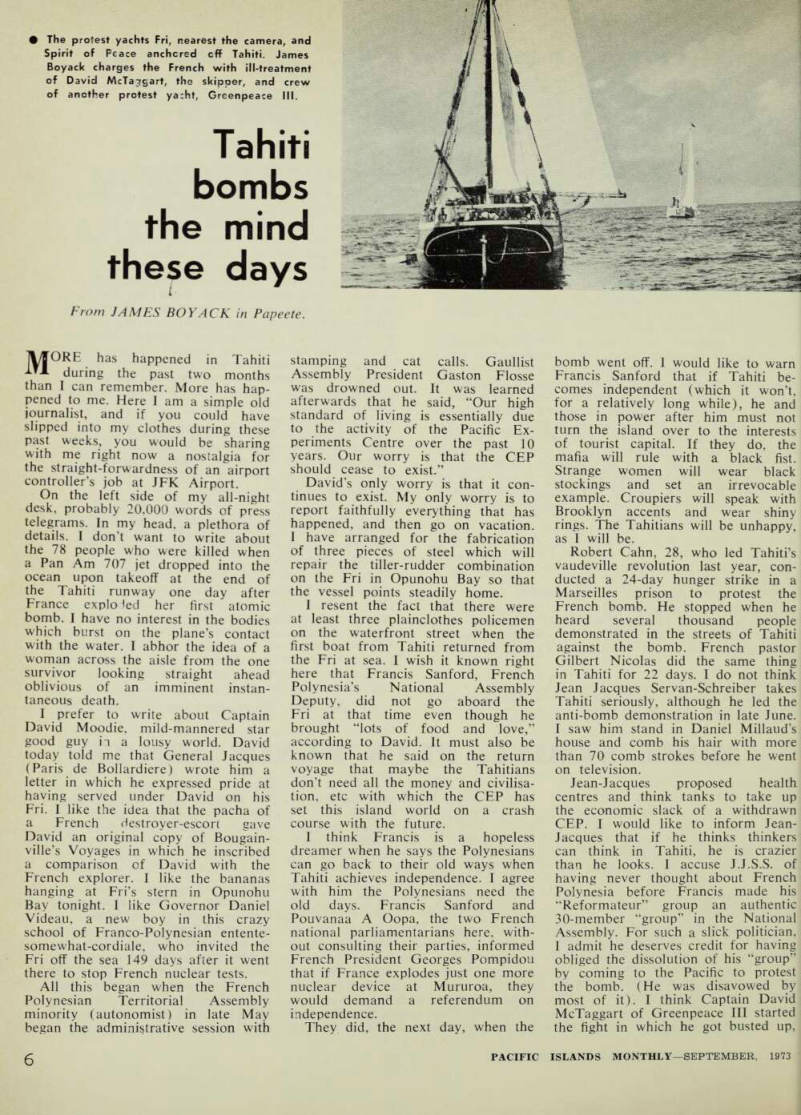
I prefer to write about Captain David Moodie, mild-mannered star good guy in a lousy world. David today told me that General Jacques (Paris de Bollardiere) wrote him a letter in which he expressed pride at haying served under David on his Fri. I like the idea that the pacha of a French destroyer-escort gave David an original copy of Bougain ville’s Voyages in which he inscribed a comparison of David with the French explorer. I like the bananas hanging at Fri’s stern in Opunohu Bay tonight. I like Governor Daniel Videau, a new boy in this crazy school of Franco-Polynesian entente somewhat-cordiale, who invited the Fri off the sea 149 days after it went there to stop French nuclear tests.
All this began when the French Polynesian Territorial Assembly minority (autonomist) in late May began the administrative session with
stamping and cat calls. Gaullist Assembly President Gaston Flosse was drowned out. It was learned afterwards that he said, “Our high standard of living is essentially due to the activity of the Pacific Ex periments Centre over the past 10 years. Our worry is that the CEP should cease to exist.”
David’s only worry is that it con tinues to exist. My only worry is to report faithfully everything that has happened, and then go on vacation.
I have arranged for the fabrication of three pieces of steel which will repair the tiller-rudder combination on the Fri in Opunohu Bay so that the vessel points steadily home.
I resent the fact that there were at least three plainclothes policemen on the waterfront street when the first boat from Tahiti returned from the Fri at sea. I wish it known right here that Francis Sanford, French Polynesia’s National Assembly Deputy, did not go aboard the Fri at that time even though he brought “lots of food and love,” according to David. It must also be known that he said on the return voyage that maybe the Tahitians don’t need all the money and civilisa tion, etc with which the CEP has set this island world on a crash course with the future.
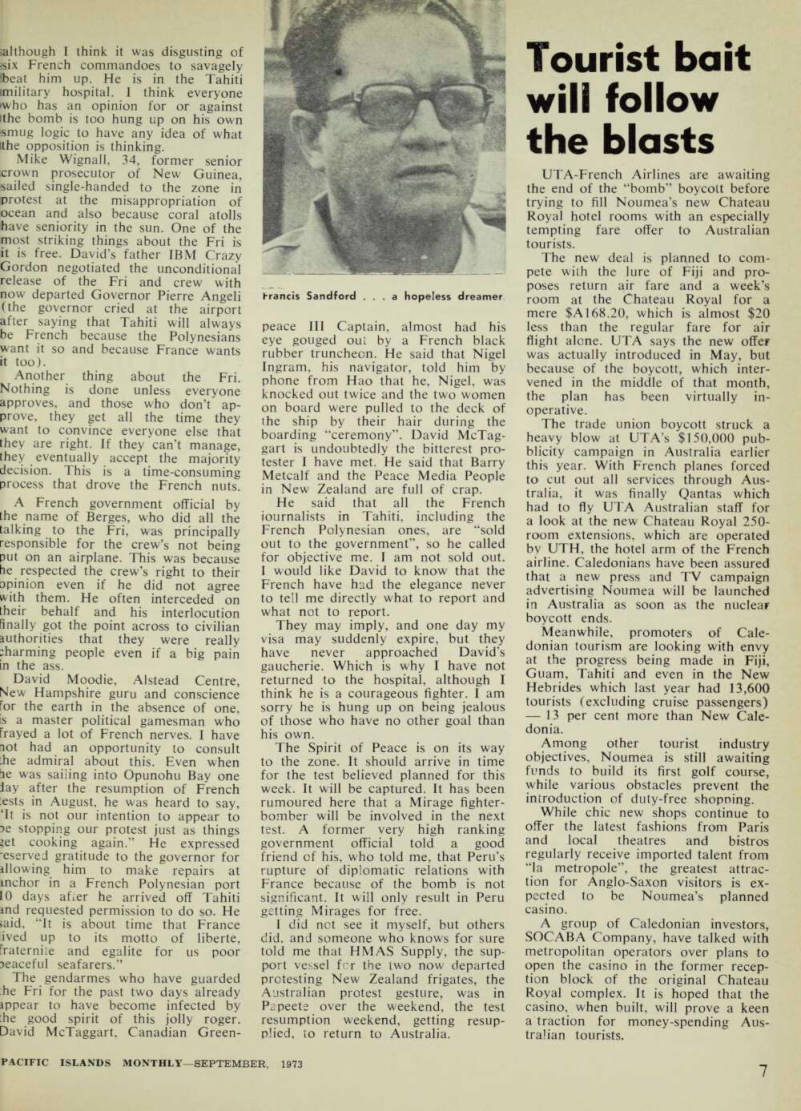
I think Francis is a hopeless dreamer when he says the Polynesians can go back to their old ways when Tahiti achieves independence. I agree with him the Polynesians need the old days. Francis Sanford and Pouvanaa A Oopa, the two French national parliamentarians here, with out consulting their parties, informed French President Georges Pompidou that if France explodes just one more nuclear device at Mururoa, they would demand a referendum on independence.
They did, the next day, when the
bomb went off. I would like to warn Francis Sanford that if Tahiti be comes independent (which it won’t, for a relatively long while), he and those in power after him must not turn the island over to the interests of tourist capital. If they do, the mafia will rule with a black fist.
Strange women will wear black stockings and set an irrevocable example. Croupiers will speak with Brooklyn accents and wear shiny rings. The Tahitians will be unhappy, as I will be.
Robert Cahn, 28, who led Tahiti’s vaudeville revolution last year, con ducted a 24-day hunger strike in a Marseilles prison to protest the French bomb. He stopped when he heard several thousand people demonstrated in the streets of Tahiti against the bomb. French pastor Gilbert Nicolas did the same thing in Tahiti for 22 days. I do not think Jean Jacques Servan-Schreiber takes Tahiti seriously, although he led the anti-bomb demonstration in late June.
I saw him stand in Daniel Millaud’s house and comb his hair with more than 70 comb strokes before he went on television.
Jean-Jacques proposed health centres and think tanks to take up the economic slack of a withdrawn CEP. I would like to inform Jean- Jacques that if he thinks thinkers can think in Tahiti, he is crazier than he looks. I accuse J.J.S.S. of having never thought about French Polynesia before Francis made his “Reformateur” group an authentic 30-member “group” in the National Assembly. For such a slick politician, I admit he deserves credit for having obliged the dissolution of his “group” by coming to the Pacific to protest the bomb. (He was disavowed by most of it). I think Captain David McTaggart of Greenpeace 111 started the fight in which he got busted up,
The protest yachts Fri, nearest the camera, and Spirit of Peace anchored off Tahiti. James Boyack charges the French with ill-treatment of David McTaggart, the skipper, and crew of another protest yacht, Greenpeace III.
ialthough I think it was disgusting of six French commandoes to savagely Ibeat him up. He is in the Tahiti imilitary hospital. I think everyone iwho has an opinion for or against Ithe bomb is too hung up on his own smug logic to have any idea of what Ithe opposition is thinking, Mike Wignall, 34, former senior crown prosecutor of New Guinea, sailed single-handed to the zone in protest at the misappropriation of ocean and also because coral atolls have seniority in the sun. One of the most striking things about the Fri is it is free. David’s father IBM Crazy Gordon negotiated the unconditional release of the Fri and crew with now departed Governor Pierre Angeli (the governor cried at the airport after saying that Tahiti will always be French because the Polynesians want it so and because France wants it too).
Another thing about the Fri.
Nothing is done unless everyone approves, and those who don’t ap prove, they get all the time they want to convince everyone else that they are right. If they can’t manage, they eventually accept the majority decision. This is a time-consuming process that drove the French nuts.
A French government official by the name of Berges, who did all the talking to the Fri, was principally responsible for the crew’s not being put on an airplane. This was because he respected the crew’s right to their opinion even if he did not agree with them. He often interceded on their behalf and his interlocution finally got the point across to civilian authorities that they were really pharming people even if a big pain in the ass.
David Moodie, Alstead Centre, New Hampshire guru and conscience for the earth in the absence of one, is a master political gamesman who frayed a lot of French nerves. I have lot had an opportunity to consult :he admiral about this. Even when he was sailing into Opunohu Bay one lay after the resumption of French ;ests in August, he was heard to say, ‘lt is not our intention to appear to le stopping our protest just as things ?et cooking again.” lie expressed ■eserved gratitude to the governor for allowing him to make repairs at anchor in a French Polynesian port 10 days after he arrived off Tahiti and requested permission to do so. He »aid, “It is about time that France ived up to its motto of liberte, fraterniie and egalite for us poor icaceful seafarers.”
The gendarmes who have guarded :he Fri for the past two days already appear to have become infected by [he good spirit of this jolly roger.
David McTaggart, Canadian Green-
peace 111 Captain, almost had his eye gouged out by a French black rubber truncheon. He said that Nigel Ingram, his navigator, told him by phone from Hao that he, Nigel, was knocked out twice and the two women on board were pulled to the deck of the ship by their hair during the boarding “ceremony”. David McTag gart is undoubtedly the bitterest pro tester I have met. He said that Barry Metcalf and the Peace Media People in New Zealand are full of crap.
He said that all the French journalists in Tahiti, including the French Polynesian ones, are “sold out to the government”, so he called for objective me. I am not sold out.
I would like David to know that the French have had the elegance never to tell me directly what to report and what not to report.
They may imply, and one day my visa may suddenly expire, but they have never approached David’s gaucherie. Which is why 1 have not returned to the hospital, although I think he is a courageous fighter. I am sorry he is hung up on being jealous of those who have no other goal than his own.
The Spirit of Peace is on its way to the zone. It should arrive in time for the test believed planned for this week. It will be captured. It has been rumoured here that a Mirage fighter bomber will be involved in the next test. A former very high ranking government official told a good friend of his, who told me, that Peru’s rupture of diplomatic relations with France because of the bomb is not significant. It will only result in Peru getting Mirages for free.
I did not see it myself, but others did, and someone who knows for sure told me that HMAS Supply, the sup port vessel for the two now departed protesting New Zealand frigates, the Australian protest gesture, was in Papeete over the weekend, the test resumption weekend, getting resup plied, to return to Australia.
Frands Sandford ... a hopeless dreamer
will follow
Tourist bait will follow the blasts
UTA-French Airlines are awaiting the end of the “bomb” boycott before trying to fill Noumea’s new Chateau Royal hotel rooms with an especially tempting fare offer to Australian tourists.
The new deal is planned to com pete with the lure of Fiji and pro poses return air fare and a week’s room at the Chateau Royal for a mere $A 168.20, which is almost $2O less than the regular fare for air flight alone. UTA says the new offer was actually introduced in May, but because of the boycott, which inter vened in the middle of that month, the plan has been virtually in operative.
The trade union boycott struck a heavy blow at UTA’s $150,000 pub licity campaign in Australia earlier this year. With French planes forced to cut out all services through Aus tralia, it was finally Qantas which had to fly UTA Australian staff for a look at the new Chateau Royal 250room extensions, which are operated by UTH, the hotel arm of the French airline. Caledonians have been assured that a new press and TV campaign advertising Noumea will be launched in Australia as soon as the nuclear boycott ends.
Meanwhile, promoters of Cale donian tourism are looking with envy at the progress being made in Fiji, Guam, Tahiti and even in the New Hebrides which last year had 13,600 tourists (excluding cruise passengers) 13 per cent more than New Cale donia.
Among other tourist industry objectives, Noumea is still awaiting funds to build its first golf course, while various obstacles prevent the introduction of duty-free shopning.
While chic new shops continue to offer the latest fashions from Paris and local theatres and bistros regularly receive imported talent from “la metropole”, the greatest attrac tion for Anglo-Saxon visitors is ex pected to be Noumea’s planned casino.
A group of Caledonian investors, SOCABA Company, have talked with metropolitan operators over plans to open the casino in the former recep tion block of the original Chateau Royal complex. It is hoped that the casino, when built, will prove a keen a traction for money-spending Aus tralian tourists.
Flexible Idealists In The Solomons
From a Honiara correspondent
The Solomons has an important new political party, formed out of many of the successful candidates elected to the new Governing Council.
It’s the United Solomon Islands Party (distinct from the now apparently de funct Solomons United National Party), and it could bring to power next year under the new constitution a young, idealistic group.
The basic aims of the new party have survived the first meeting of the Governing Council in July, and it looks like being a flexible party which is seeking a way to govern virtually by consensus, yet working within the framework of a cabinet system.
That’s the theory, anyway.
The big question now, following the latest council meeting, is the name of the dominant leader who will emerge from the enlarged legislature of 24 elected members. This is the man who next year is likely to be Chief Minister in the new Solomons.
There is a real choice. He may not even come from the USIP.
Chairman of the new party is a “late joiner”, deep thinker and eloquent speaker Benedict Kinika, 35, member for East Makira, formerly warden and a lecturer at the Honiara Technical Institute. Deputy leader is Dr Gideon Zoleveke, 51, a Fiji graduate medical officer who was nearing retirement age in his job as the senior Public Health Education officer when he was elected. He represents Choiseul Island and is a controversial choice.
USIP secretary is the youngest member of the legislature, former Government Information Officer, Ashley Wickham,. 25, member for Honiara, which is the largest electo
rate and the only truly urban one in the BSIP.
Party membership includes five Malaita members—Philip Solodia, former labour inspector for the government; former Marching Rule leader Jonathan Fifi’i, from Kwaio, who is the oldest member; Emilio Li’i Ouou, from Small Malaita, who opted out of the Catholic priesthood like Solodia; Jerial Ausuta, of Northwest Malaita, who left the police force as a senior inspector; and Father Leslie Fugui, from east Malaita, an Anglican priest and educationist.
Others are former Central District medical officer, Dr Francis Kikolo from East Ysabel and Savo; Andrew
Kukuti, from Vella la Vella and Shortlands, who is rather inadequately described as a carpenter; one of the only two Solomon Islander dental officers in the protectorate, George Ngumi of Gizo; the Fiji-Indian builder Moses Razak, from Gela; Waita Ben, second youngest member at 26 and former Forestry Depart ment officer, from East Guadalcanal; and Australian, Bill Page, of Roviana and Rendova, an almost mystical, gentle refugee from Western society.
Among those in the running for Chief Minister (nobody is openly seeking power) are Philip Solodia and Solomon Mamaloni, the 31-year-old firebrand of the last council, who is both humble and vain, penetrating and yet blind. But Mamaloni is a quick learner and an engaging per sonality, and popular for his vigorous tackling of local government issues.
Kinika’s election as leader by open vote at a caucus meeting of USIP on July 30 is seen as a compromise, but a good one. Solodia may have stepped aside to avert any resentment against his quick rise, but he’s not out of the running. Nor can one discount the chance of Chairman of Social Services, Willie Betu, from West Ysabel. Thus it’s possibly a four-horse race among Solodia, Mamaloni, Betu and Kinika.
Only two days before the party was formed, the council members had voted on the report of the Special Select Committee on Constitutional Development (which was in fact all the 17 elected and three ex-officio members of the last Governing Council).
In the long debate, the house often divided between the six old members
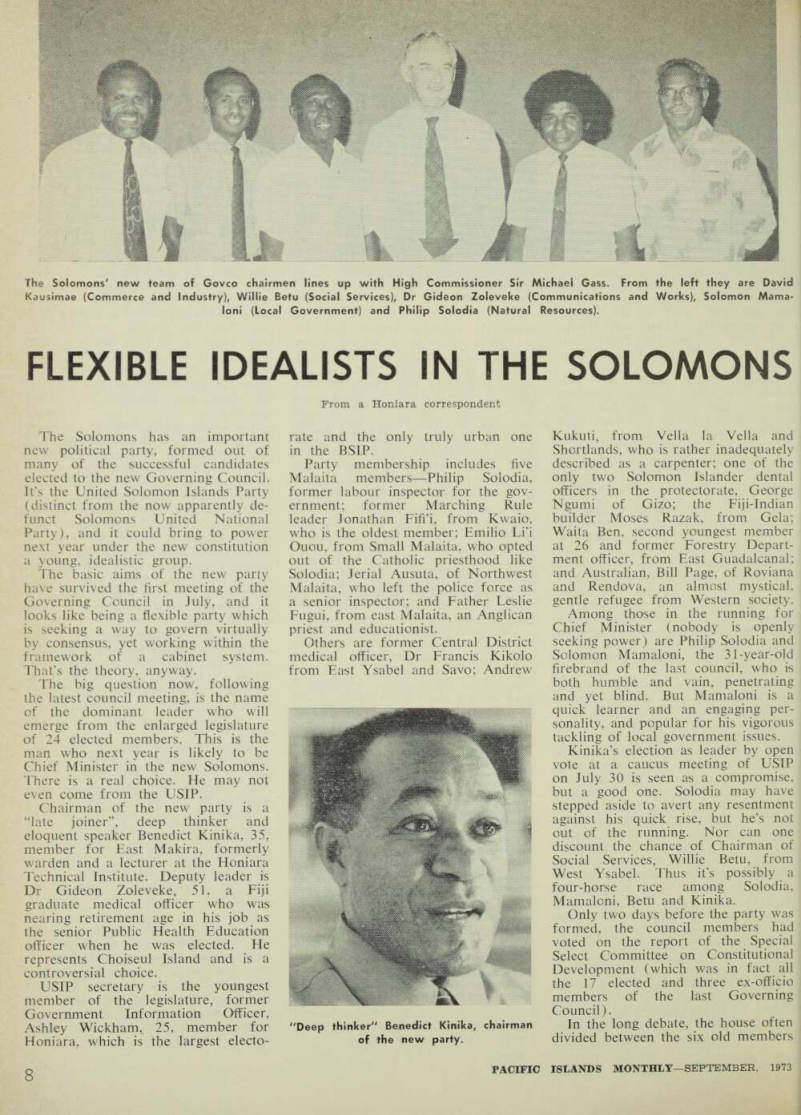
The Solomons' new team of Govco chairmen lines up with High Commissioner Sir Michael Gass. From the left they are David Kausimae (Commerce and Industry), Willie Betu (Social Services), Dr Gideon Zoleveke (Communications and Works), Solomon Mama loni (Local Government) and Philip Solodia (Natural Resources).
"Deep thinker" Benedict Kinika, chairman of the new party.
defending “their” report and the new members. It then became apparent that those members who now form the USIP wanted a say in the choice of Chief Minister. They suggested he be appointed by outright vote (and not, as the Select Committee recom mended, by the High Commissioner), but the Chief Secretary, Mr Tom Russell, came up with a compromise motion, that elected members would elect the Chief Minister “in such a manner as may be prescribed by regulations made by the High Commissioner after consulting with the Governing Council, and de signed to ensure that the mem ber elected commands the support of the majority of the Legislative Assembly”.
It was also apparent from that meeting that the USIP wants self government as soon as it can get it, but prefers to hold off independence for some years while the poorer dis tricts catch up with development.
That’s not a firm policy statement — yet.
A bill to legislate on the new con stitution is now likely to come before Governing Council at the first meet ing next year, about February. In the meantime, it’s obvious that there is a new spirit in the Governing Council, and a much-needed sense of urgency.
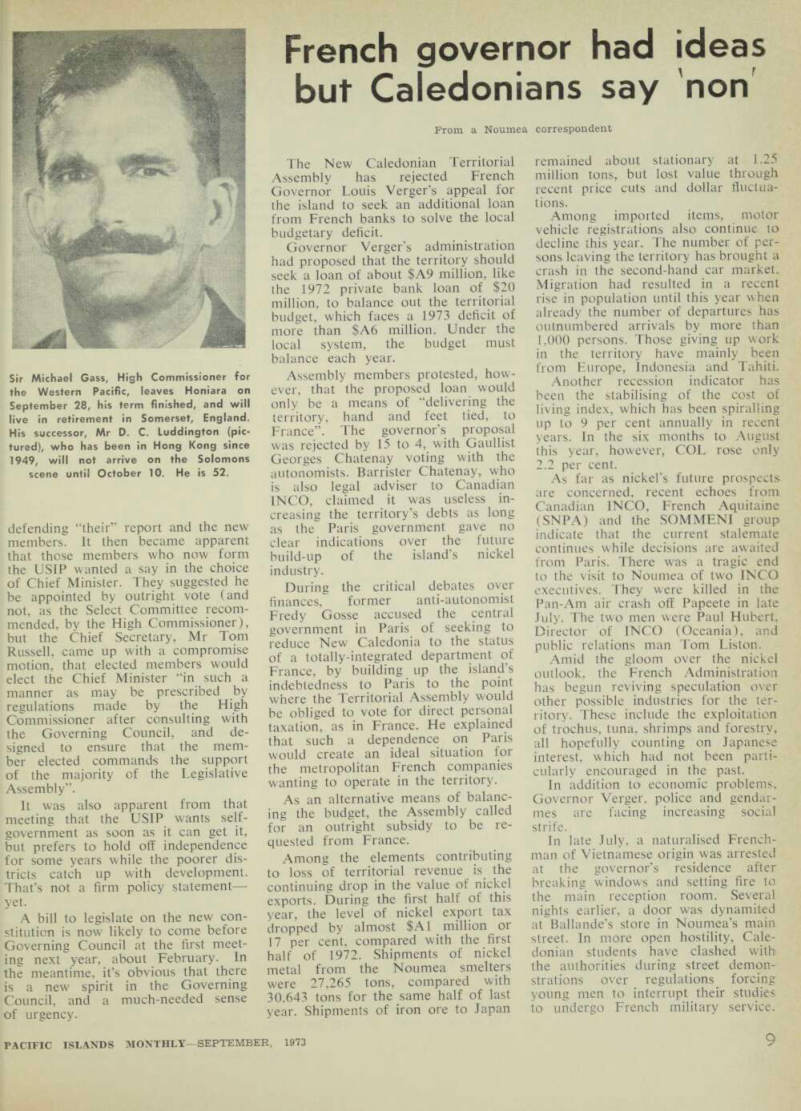
Sir Michael Gass, High Commissioner for the Western Pacific, leaves Honiara on September 28, his term finished, and will live in retirement in Somerset, England.
His successor, Mr D. C. Luddington (pic tured), who has been in Hong Kong since 1949, will not arrive on the Solomons scene until October 10. He is 52.
French governor had ideas
but Caledonians say non
From a Noumea correspondent
The New Caledonian Territorial Assembly has rejected French Governor Louis Verger’s appeal for the island to seek an additional loan from French banks to solve the local budgetary deficit.
Governor Verger’s administration had proposed that the territory should seek a loan of about SA9 million, like the 1972 private bank loan of S2O million, to balance out the territorial budget, which faces a 1973 deficit of more than SA6 million. Under the local system, the budget must balance each year.
Assembly members protested, how ever, that the proposed loan would only be a means of “delivering the territory, hand and feet tied, to France”. The governor’s proposal was rejected by 15 to 4, with Gaullist Georges Chatenay voting with the autonomists. Barrister Chatenay, who is also legal adviser to Canadian INCO, claimed it was useless in creasing the territory’s debts as long as the Paris government gave no clear indications over the future build-up of the island’s nickel industry.
During the critical debates over finances, former anti-autonomist Fredy Gosse accused the central government in Paris of seeking to reduce New Caledonia to the status of a totally-integrated department of France, by building up the island’s indebtedness to Paris to the point where the Territorial Assembly would be obliged to vote for direct personal taxation, as in France. He explained that such a dependence on Paris would create an ideal situation for the metropolitan French companies wanting to operate in the territory.
As an alternative means of balanc ing the budget, the Assembly called for an outright subsidy to be re quested from France.
Among the elements contributing to loss of territorial revenue is the continuing drop in the value of nickel exports. During the first half of this year, the level of nickel export tax dropped by almost SAI million or 17 per cent, compared with the first half of 1972. Shipments of nickel metal from the Noumea smelters were 27,265 tons, compared with 30.643 tons for the same half of last year. Shipments of iron ore to Japan
remained about stationary at 1.25 million tons, but lost value through recent price cuts and dollar fluctua tions.
Among imported items, motor vehicle registrations also continue to decline this year. The number of per sons leaving the territory has brought a crash in the second-hand car market.
Migration had resulted in a recent rise in population until this year when already the number of departures has outnumbered arrivals by more than 1.000 persons. Those giving up work in the territory have mainly been from Europe, Indonesia and Tahiti.
Another recession indicator has been the stabilising of the cost of living index, which has been spiralling up to 9 per cent annually in recent years. In the six months to August this year, however, COL rose only 2,2 per cent.
As far as nickel’s future prospects are concerned, recent echoes from Canadian INCO, French Aquitaine (SNPA) and the SOMMENI group indicate that the current stalemate continues while decisions are awaited from Paris. There was a tragic end to the visit to Noumea of two INCO executives. They were killed in the Pan-Am air crash off Papeete in late July. The two men were Paul Hubert, Director of INCO (Oceania), and public relations man Tom Liston.
Amid the gloom over the nickel outlook, the French Administration has begun reviving speculation over other possible industries for the ter ritory. These include the exploitation of trochus, tuna, shrimps and forestry, all hopefully counting on Japanese interest, which had not been parti cularly encouraged in the past.
In addition to economic problems.
Governor Verger, police and gendar mes are facing increasing social strife.
In late July, a naturalised French man of Vietnamese origin was arrested at the governor’s residence after breaking windows and setting fire to the main reception room. Several nights earlier, a door was dynamited at Ballande’s store in Noumea’s main street. In more open hostility, Cale donian students have clashed with the authorities during street demon strations over regulations forcing young men to interrupt their studies to undergo French military service.
New Guineans Plan Dramatic
Changes In Land Ownership
From a Port Moresby correspondent
In Port Moresby in August a Commission of Inquiry into PNG Land Matters issued an interim report "to draw attention now to the urgent need for new policies on alienated land".
The commission will complete its main report in September, but its interim recommendations are far-reaching. It proposes among other things that all rural freehold should be converted to government leasehold; that undeveloped rural freehold and leasehold land should be taken from present holders and
redistributed to people in need; that all new leases should be for a maximum of 60 years for citizens and 40 years for non-citizens; that in areas where the return of undeveloped alienated land is not sufficient to relieve local land shortages, developed land nearby should be acquired, with compensation to landholders limited to unexhausted improvements only.
Following is the introduction to the interim report, in which the commissioners explain why they made these proposals:
The interim report is concerned with the 1.4 million hectares that have been alienated from the custo mary rightholders by government purchase, compulsory acquisition, confiscation, and “waste and vacant” or “ownerless” declaration. It is not concerned with customary land that has been the subject of land tenure conversion orders; nor is it concerned with forestry leases. The introduction to the report says: Approximately 160,000 hectares of the alienated land has passed in free hold, and approximately 340,000 hectares in leasehold to private in terests—mostly missions, individual planters and plantation companies.
The remaining 0.9 million hectares are still held by the Administration, most of it undeveloped.
In all districts we have visited we have received a great many requests that alienated land be restored to the descendants of the clans who origin ally held rights in them. The reasons given are: (a) Clans are short of land for subsistence or commercial agri culture; (b) The “waste and vacant” or “ownerless” declarations were im proper; (c) The clan leaders were tricked into selling the land for small amounts of trade goods or money at a value far below the economic value of the land; (d) In many cases the land has never been developed.
We did not accept these claims automatically, since the demand for return of land is clearly a popular outcry at the moment, which many are taking the opportunity of joining.
Nevertheless, we believe that real and sometimes long-standing grievances exist.
As a general problem the question of shortage of land due to alienation should not be exaggerated. Alienated lands comprise only 2.8 per cent of the total land area of Papua New Guinea, and some of it is used by government and missions for roads, schools, hospitals and other public facilities. But in some districts land alienation has been particularly serious.
In the Gazelle Peninsula, one of the most heavily populated areas of the country, 43 per cent of the land north of a line from the mouth of Warongoi River to the Warongoi Re settlement Area and then round the northern boundary of UAL 82 to the western boundary of Vunapaladig on Ataliklikun Bay has been alienated.
On the Duke of York Islands approxi mately 2,642 hectares out of 6,452 have been alienated.
In these examples the land includes much more good arable land than the unalienated does; and although some clans in such areas are not short of land, others have lost nearly all their land, and now hold only limited land rights from neighbouring islands. For example, on Enuk Island off Kavieng, all 800 hectares of the Enuk villagers’ traditional land has been alienated with only 18 hectares set aside as reserves.
In all districts we have visited, Papua New Guineans have expressed a keen interest in commercial agri culture, and in some areas, though not generally, they have been frustrated by land shortage. Whether alienation really has caused land shortage de pends upon many factors. We could not examine every case, but we are satisfied from several cases we did examine that in a number of places people are short of land even for sub sistence purposes.
The rapid increase in population is worsening the situation. Many wit nesses who are not land-short now are afraid their communities will be land short in 10 or 20 years time. We believe these fears are often justified.
With regard to “waste and vacant” or “ownerless” declarations, the original investigations were often very limited. In some cases there were villages on the land. In other cases it was hunting and gathering land or contained “pies masalai”. Areas such as the Bulolo and Ycdda Valleys were fought over and, although none of the fighting clans were able to keep permanent settlements on the land, all of them make overlapping claims
to it. We consider that it was im proper of the colonial powers to have taken these lands without compen sating someone for the loss of rights there.
The question of early purchases for trade goods or small payment is more complicated. In some cases consider able amounts of trade goods were paid, which may have had as much real value as the three cents an acre paid in the 1930’s or one dollar an acre paid in the 1950’5. Owing to inflation and the rising price of land all of these payments now seem small and we do not consider this a suf ficient reason by itself for making additional payments now or returning the land. 5 Nor is an error in boundary mark ing, or the fact that one section of the traditional rightholders missed out on the payment, a sufficient reason for upsetting the title, paying huge compensation or engaging in expen sive legal actions.
The real need is for a simple mach inery to find where land selling has really made people short of land and assist them.
Particularly where it has not been developed, alienated land is causing considerable ill-feeling. Although complaints are in many cases exaggerated they are also in many cases very real. There are poor villages on the edge of prosperous towns that have grown up on the villagers’ traditional land; there are densely populated islands of sub sistence villagers amid vast planta tions holding very few people; stock or bulldozers suddenly appear on villagers’ hunting and gathering land which had been purchased up to 60 years ago but never before developed.
Past attempts by officials such as Governor Hahl or Judge Phillips to create reserves for land-short people have been completely overtaken by the population explosion and the in terest in commercial agriculture.
Furthermore, laws like the New Guinea Land Titles Restoration
Ordinance have prevented the people from recovering more land.
We feel that law and administra tion must be made more flexible so that complaints can be promptly dealt with and, where necessary, land re stored to land-short people. This is our first main aim.
We believe that the return of some land is urgently needed in order to create the conditions for good rela tions between races, between sections of the Papua New Guinea people and between the people and their govern ment. Frustration from the lack of response to repeated requests by local people for the return of land has in some areas produced an ugly situ ation of tension and distrust and led to direct action in the form of squat ting movements on land claimed, occasional harrassment of plantation management and quarrelling between groups of local claimants.
Furthermore, in the absence of a clear-cut policy, expatriates are un certain of their future. In this situ ation, with its potential for violence, continued delay would be irrespon sible.
Most complainants hold the colonial powers responsible for the situation but some criticise the Papua New Guinea Government for slow ness in finding a remedy and greater concern for overseas investors than for land-short Papua New Guineans.
We do not believe that it is neces-
sary to recover all alienated land from expatriate hands. But we do believe that Papua New Guinean land needs must be promptly met, and an end put to the system that has allowed a small number of expat riates to acquire title to large areas of the best land and leave much of it undeveloped.
We have recommended policies to achieve this and provide for a system which will permit people of any race to take land rights while preserving good relations between them and the local people. This is our second main purpose.
We also believe, however, that policy towards alienated land must do more than remedy grievances caused by European colonisation. The needs of the new nation and problems about relations between sections and classes of Papua New Guinean people are already much more important than the problem of tidying up relations with Europeans. For this reason we believe government should not lose sight of the value of the alienated lands as a national asset.
Alienated lands can be used to in crease production and national in come. Some districts are short of land and need to find room for their growing population. We need to
permit mobility among our enterpris
ing people who can find outlets for their creative energies on alienated lands if these are made available to them. Inter-clan mixing and a sense of belonging to the wider national community can be fostered if people from various districts are also able to take up rights in empty areas of alienated land.
For these reasons we believe that the concept of using land must there fore be stressed—that the holders of title to alienated land must make good use of it or give way to those with greater need and ability to use it.
These reasons of public interest modify a simple policy of returning alienated land to the descendants of traditional rightholders.
We also wish to limit in Papua New Guinea the western concept of land as a marketable commodity to be bought and sold or speculated like manufactured goods. In and near urban areas of Australia the practice of speculating in land has greatly inflated the value of land and enabled people to profit not from productive industry, but by trading on public need for land.
We prefer to maintain the tra ditional concept of land as a com munity heritage, available for use by those of the community (by which we mean the wider national com munity) who need it. It should not be taken into absolute possession by individuals. Rents charged for the use of alienated land should also go to the government, on behalf of the community, not to private individuals.
In summary the four main aims which underlie our recommendations on alienated lands are: • To return land to land-short Papua New Guineans. • To provide a system of land holding which will promote good race relations. • To treat land as a national re source and emphasise the need to use it properly. • To discourage speculation in land.
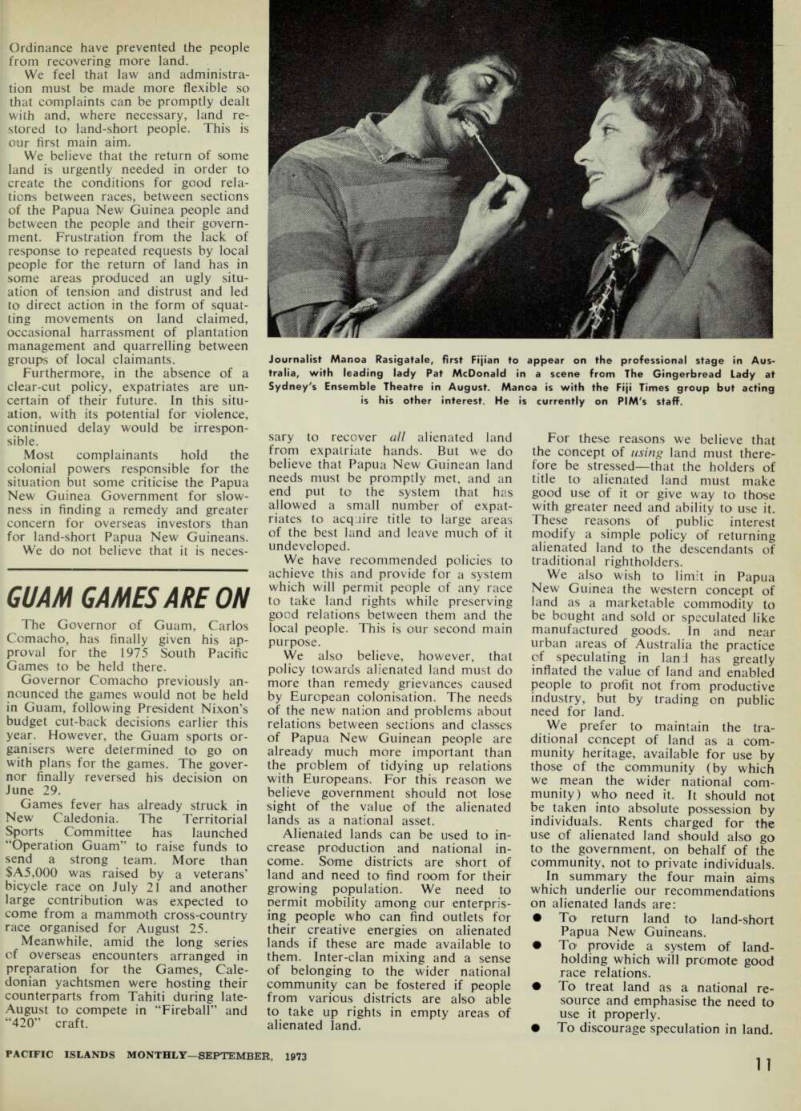
Journalist Manoa Rasigatale, first Fijian to appear on the professional stage in Aus tralia, with leading lady Pat McDonald in a scene from The Gingerbread Lady at Sydney's Ensemble Theatre in August. Manoa is with the Fiji Times group but acting is his other interest. He is currently on PIM'S staff.
Guam Games Are On
The Governor of Guam, Carlos Comacho, has finally given his ap proval for the 1975 South Pacific Games to be held there.
Governor Comacho previously an nounced the games would not be held in Guam, following President Nixon’s budget cut-back decisions earlier this year. However, the Guam sports or ganisers were determined to go on with plans for the games. The gover nor finally reversed his decision on June 29.
Games fever has already struck in New Caledonia. The Territorial Sports Committee has launched “Operation Guam” to raise funds to send a strong team. More than $A5,000 was raised by a veterans’ bicycle race on July 21 and another large contribution was expected to come from a mammoth cross-country race organised for August 25.
Meanwhile, amid the long series of overseas encounters arranged in preparation for the Games, Cale donian yachtsmen were hosting their counterparts from Tahiti during late- August to compete in “Fireball” and “420” craft.
Advertisements & other items, p. 18 (1 item)
G ooA<ood morning’. 8 ""*/
:°0(/
Good morning-
Lr °V c ' morning! rn;
G ooA<ood morning’. 8 ""*/
r You’ll get just as many good mornings out of the new-look Weet-Bix pack as you got out of the old one.
And a hearty helping of 100% whole grain Weet-Bix natural wheat goodness.
So you see, nothing important has changed.
SANITARIUM HEALTH FOOD CO., SYDNEY, AUSTRALIA.
7082
Tropicalities

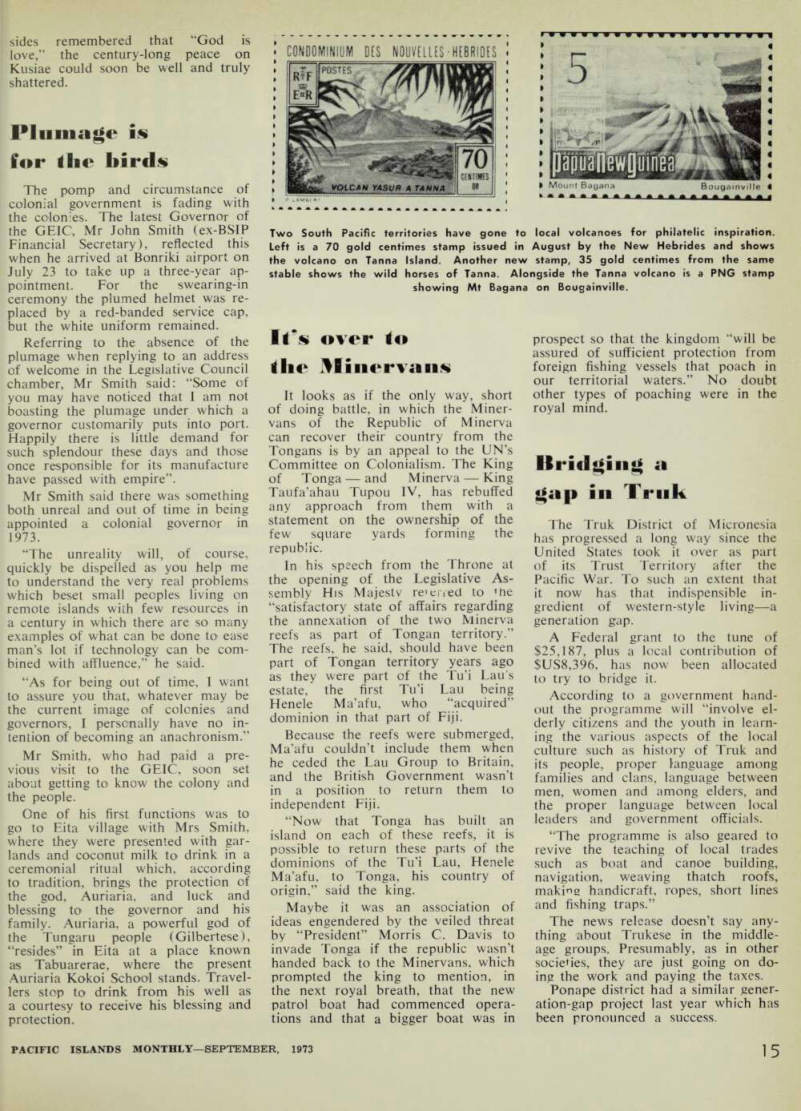
Gold Stars
Over Cooks
A green ensign with 15 gold stars in a circle on the fly is to be the new Cook Islands flag. Selected from 120 entries in a government-organised competition, it was chosen at a meet ing convened by Premier Albert Henry and attended by all members of the cabinet, the flag design com mittee and the competition judging panel.
The green background represents the “nation, the vitality of the land and the people and the evergreen and lasting growth of the Cook Islands.” The gold represents the “friendliness of Cook Islanders and their hope, faith, dedication, love and happiness.” The stars are “symbols of heaven, faith in God and the power that has guided Cook Islanders throughout their history.”
The circle symbolises “unity and strength of purpose and the mould ing of 15 islands into one united people.”
Australians are expected to be able to see the flag flown officially in Australia at the opening of the
Sydney Opera House next month when the Cook Islands National Arts Theatre Company will be per forming.
This time there’s no one to stop the Cooks designing their own flag— as there was just after the turn of the century when the New Zealand Governor rejected a flag designed nine years previously.
In 1892 a Federal Flag Bill was tabled in the Cook Islands Parliament but not assented to. The idea behind the bill was to have the flag—three horizontal strips of equal width (red, white and red), the Union Jack “quartered in the hoist and occupying a quarter of the flag” and a white oval shield in the centre of the Union flag containing a black coconut palm—flown at sea by ships owned by the Cook Islands.
The Union flag was to have still been flown in public places in the Cooks. However, after annexation by New Zealand in 1901—when the Union flag was replaced by the New Zealand flag—the governor rejected the “Federation flag for marine use.”
Another flag of three horizontal stripes—scarlet, white and scarlet, said to represent Te Au O Tonga.
Puaikura and Takitumu, the three main land divisions of Rarotonga—is still to be seen in the Cook Island Library and Museum in Avarua, Rarotonga.
Finding a
In*l flyer
Jim Hazelton, veteran ferry pilot of more than 30 trans-Pacific light aircraft crossings was lost—at 9,000 feet. The radio compass in his Piper was malfunctioning, heavy cloud lay below him, possibly concealing the peaks of the New Hebrides, and light was failing fast.
On the Tarawa-Vila leg of his San Francisco-Sydney journey, Hazel ton radioed Vila to tell of his pre dicament. With little more than the strength of Hazelton’s radio signal to guide them, Captain McKern and Chief Engineer Warren Stewart took off from Vila in an Air Melanesiae Norman Islander. Noting the moon’s position in relation to each aircraft and describing cloud formations, the two pilots worked steadily toward each other. At last, 70 miles out to sea from Vila they spotted each other—and Jim Hazelton was able to follow the Norman Islander home for an after-dark but safe landing.
... ami iamvellinsj
another
English pilot Douglas Pearson holds a unique distinction in the history of the French nuclear testing pro gramme at Mururoa atoll. He was the first foreign pilot to visit the eventual testing grounds in the late 19505, flying French military personnel and supplies to the atoll.
In 1966, the year France began testing, French President Charles de Gaulle visited Tahiti and Pearson flew the escort plane for De Gaulle’s trip to Mururoa. The genial, bearded Englishman who recently retired after 15 years of flying in French Poly nesia, came to Tahiti in 1958 solely because his World War II and post war flying experience filled an urgent need in French Polynesia for a “flying boat” pilot.
He became chief pilot (1962) for the local RAI (Reseau Aerien Inter insulaire) airline, which today is Air Polynesie.
Even after the flying boats were retired in 1970, Pearson continued flying for RAI and Air Polynesie. By the time he made his last flight for
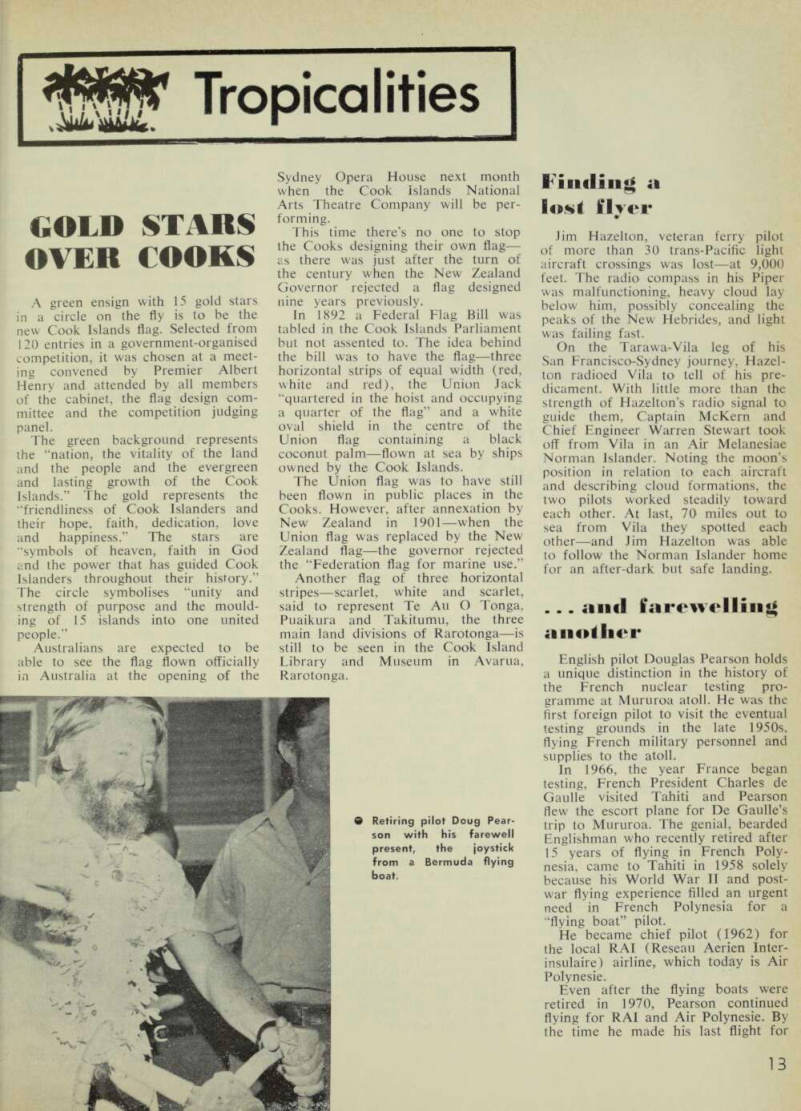
Retiring pilot Doug Pear son with his farewell present, the joystick from a Bermuda flying boat.
Air Polynesie last September, he had logged 9,000 flying hours in French Polynesia.
From the time that he began his 30-year career with the Royal Air Force during the war to that last flight in French Polynesia, Pearson had logged 19,600 hours of flying time—l3,ooo hours in flying boats.
Now, aged 51, he has been forced to give up flying. He was unable to get his pilot’s licence renewed earlier this year because of health reasons, and has returned home to Whitley Bay in Northumberland.
Before he left Tahiti, Governor Pierre Angeli pinned a medal on him for his services in the territory and his friends gave him the steering mechanism from a Bermuda flying boat.
Ecumenism!
WliaCs that?
Is it to be peace or prerogative on Kusiae Island, the only major popu lation area in Micronesia where liquor is not available?
A religious leader (Congrega tional), Paul Sigrah, told the Joint Committee on Future Status that “for more than 100 years there has been but one religion in Kusiae. Please help us to keep other religions out.”
The Reverend Harrison George said: “. . . Why allow other churches when Kusiae has been peaceful for more than 100 years under one church? The introduction of any other new religion will bring con flict.”
It seems that already there has been some conflict in recent times on Kusiae with the coming (and in one case, rapid going) of Jehovah’s Witnesses and Seventh-day Advent ists. The conversion of one member of a prominent family on Kusiae to Kingdom Hall beliefs has split the family into two factions. And the Seventh-day Adventists have been told that a medical and dental clinic they wanted to set up was not re quired.
But it’s not all going the Con gregationalist way. Ekpap Silk, chair man of the Future Status committee, pointing out that legally “freedom of religion is protected under both Micronesian and US law,” said: “We are in no position to violate this fundamental human right.”
Congressman Ekpap’s remarks were not what the Congregationalists wanted to hear. And with the arrival on the same ship as the committee members of another Seventh-day Adventist it seemed that unless both
sides remembered that “God is love,” the century-long peace on Kusiae could soon be well and truly shattered.
Plumage is
for the birds
The pomp and circumstance of colonial government is fading with the colonies. The latest Governor of the GEIC, Mr John Smith (ex-BSIP Financial Secretary), reflected this when he arrived at Bonriki airport on July 23 to take up a three-year ap pointment. For the swearing-in ceremony the plumed helmet was re placed by a red-banded service cap, but the white uniform remained.
Referring to the absence of the plumage when replying to an address of welcome in the Legislative Council chamber, Mr Smith said: “Some of you may have noticed that I am not boasting the plumage under which a governor customarily puts into port.
Happily there is little demand for such splendour these days and those once responsible for its manufacture have passed with empire”.
Mr Smith said there was something both unreal and out of time in being appointed a colonial governor in 1973.
“The unreality will, of course, quickly be dispelled as you help me to understand the very real problems which beset small peoples living on remote islands with few resources in a century in which there are so many examples of what can be done to ease man’s lot if technology can be com bined with affluence,” he said.
“As for being out of time, I want to assure you that, whatever may be the current image of colonies and governors, I personally have no in tention of becoming an anachronism.”
Mr Smith, who had paid a pre vious visit to the GEIC, soon set about getting to know the colony and the people.
One of his first functions was to go to Eita village with Mrs Smith, where they were presented with gar lands and coconut milk to drink in a ceremonial ritual which, according to tradition, brings the protection of the god, Auriaria, and luck and blessing to the governor and his family. Auriaria, a powerful god of the Tungaru people (Gilbertese), “resides” in Eita at a place known as Tabuarerae, where the present Auriaria Kokoi School stands. Travel lers stop to drink from his well as a courtesy to receive his blessing and protection.
It's over io
i lie Miiiervans
It looks as if the only way, short of doing battle, in which the Miner vans of the Republic of Minerva can recover their country from the Tongans is by an appeal to the UN’s Committee on Colonialism. The King of Tonga and Minerva King Taufa’ahau Tupou IV, has rebuffed any approach from them with a statement on the ownership of the few square yards forming the republic.
In his speech from the Throne at the opening of the Legislative As sembly His Majesty rescued to <he “satisfactory state of affairs regarding the annexation of the two Minerva reefs as part of Tongan territory.”
The reefs, he said, should have been part of Tongan territory years ago as they were part of the Tu’i Lau’s estate, the first Tu’i Lau being Henele Ma’afu, who “acquired” dominion in that part of Fiji.
Because the reefs were submerged, Ma’afu couldn’t include them when he ceded the Lau Group to Britain, and the British Government wasn’t in a position to return them to independent Fiji.
“Now that Tonga has built an island on each of these reefs, it is possible to return these parts of the dominions of the Tu’i Lau, Henele Ma’afu, to Tonga, his country of origin,” said the king.
Maybe it was an association of ideas engendered by the veiled threat by “President” Morris C. Davis to invade Tonga if the republic wasn’t handed back to the Minervans, which prompted the king to mention, in the next royal breath, that the new patrol boat had commenced opera tions and that a bigger boat was in
prospect so that the kingdom “will be assured of sufficient protection from foreign fishing vessels that poach in our territorial waters.” No doubt other types of poaching were in the royal mind.
Ilriclging a
gap in Truk
The Truk District of Micronesia has progressed a long way since the United States took it over as part of its Trust Territory after the Pacific War. To such an extent that it now has that indispensible in gredient of western-style living—a generation gap.
A Federal grant to the tune of $25,187, plus a local contribution of SUSS,396, has now been allocated to try to bridge it.
According to a government hand out the programme will “involve el derly citizens and the youth in learn ing the various aspects of the local culture such as history of Truk and its people, proper language among families and clans, language between men, women and among elders, and the proper language between local leaders and government officials.
“The programme is also geared to revive the teaching of local trades such as boat and canoe building, navigation, weaving thatch roofs, making handicraft, ropes, short lines and fishing traps.”
The news release doesn’t say any thing about Trukese in the middle age groups. Presumably, as in other societies, they are just going on do ing the work and paying the taxes.
Ponape district had a similar gener ation-gap project last year which has been pronounced a success.
Two South Pacific territories have gone to local volcanoes for philatelic inspiration.
Left is a 70 gold centimes stamp issued in August by the New Hebrides and shows the volcano on Tanna Island. Another new stamp, 35 gold centimes from the same stable shows the wild horses of Tanna. Alongside the Tanna volcano is a PNG stamp showing Mt Bagana on Bougainville.
Advertisements & other items, p. 20 (1 item)
Modern Science can do
Wonders for Your Skin
The beauty of your skin really begins down under the surface, where the tiny oil and moisture glands maintain a fine balance by releasing just the right amounts of natural fluids to nurture the complexion and keep it soft, supple and always with a youthful, radiant glow.
Early in life, nature supplies these vital secretions in abundance. But with the passing years they slow down, and the complexion thirsts for oil and moisture to supplement the dwindling natural supplies. Without them the skin will soon lose its plumpness and resilience as tiny lines and other tell tale signs of age make a premature appearance.
Beauty secrets revealed Cosmetic chemists formulated a tropically moist oil blend with the remarkable ability to assist nature, by supplying never failing quantities of vital oil and moisture to the skin.
This important scientific breakthrough is helping women all over the world achieve and maintain a youthfully smooth and radiant complexion. The unique beautifying fluid is available from pharmacies here as Oil of Ulan. It quickly penetrates into the surface layer of the skin and merges readily with the natural fluids, achieving the level necessary to maintain a soft, naturally beautiful complexion.
To keep your complexion smooth and radiant, generously apply a film of Oil of Ulan over your face and neck every day. It is helpful to every type of complexion because as well as maintaining a balanced level of vital oils and moisture it also sets up an invisible film on the skin surface to protect against harsh weather elements and the dehydrating effects of artificial air-conditioning. Used as you would a make-up base, Oil of Ulan moist oil blend not only beautifies and helps protect the skin against wrinkle dryness, but ensures that your make-up smooths on easily and stays soft and matt. Stroked on again at night, paying special attention to the neck and chinline Oil of Ulan will nurture the skin all through the night while you sleep.
Skin care experts advise Every time you laugh, squint, grimace or smile, you stretch the delicate skin around your eyes. Therefore this area is particularly prone to lines and wrinkle dryness and needs the gentle care of Oil of Ulan. This moist oil blend should be gently fingerprinted on, in an anti-clockwise motion starting from beneath the eyes and extended onto the temples. Oil of Ulan gently penetrates and helps restore the delicate oil and moisture balance which keeps the skin soft and beautifully smooth.
People
9 Ratu Penaia Ganilau has been appointed Deputy Prime Minister of Fiji, succeeding the late Ratu Sir Edward Cakobau. Ratu Penaia re tains his portfolio as Minister for Communications, Works and Tourism.
Ratu Penaia was Acting Prime Minister while Ratu Sir Kamisese Mara was overseas in July and August. Ratu Mara has taken over the portfolio of Home Affairs, pre viously held by Ratu Sir Edward. • Mr W. Vance Hall has succeeded Mr Robert W. Skiff, as Charge d’Affaires of the American Embassy in Fiji. Before going to Fiji he was in the office of Australia, New Zealand and Fiji affairs in Washing ton. Mr Skiff, who went to Fiji in 1970, will go to the American Em bassy in Bangkok. • Mr Wayne Anthony Wilson, for the past three years a stipendiary magistrate in Hong Kong, has be come a full-time stipendiary magis
trate in Western Samoa. Before going to Hong Kong, Mr Wilson practised as a barrister and solicitor in Christchurch, New Zealand. His wife, who has an Arts degree, is a qualified secondary school teacher They have two young children. • Mr John Mika has been ap pointed sales representative in New Zealand for Polynesian Airlines. He was educated at Chanel College, Western Samoa, and has been em ployed by Polynesian Airlines for the last six years. He went to New Zealand in 1971 for medical reasons and returned to Apia in 1972 as operations administration supervisor.
He will work from the Polynesian Airlines’ office in Caltex House, Auckland. ® Two men with 92i years’ service between them in the PNG Health Department in PNG, retired at the end of June—Messrs S. H. Christian and Kalafa Emei. Mr Christian joined the department in 1922 as a medical assistant. After World War II much of his work covered malaria surveys, and in time he became a world-wide authority on the biology of the types of anopheles mosquitoes found in PNG. He was responsible for setting up the Malaria
Control School at Minj in 1952, and he became principal of the National Malaria Training School when it moved to Kundiawa in 1964. Mr Emei started work in the department as a hospital orderly in Port Moresby on January 1, 1932. He served in a number of areas. He was a storeman at Base Medical Stores, Port Moresby, when he retired. • Mr Fred Reymond, of Suva, has been appointed an Islands sales repre sentative of Consolidated Chemicals Ltd, Auckland marine products manufacturers. He will promote and sell the firm’s Epiglass lines in Fiji, Tonga, Samoa, the New Hebrides and the BSIP. Mr Reymond, 36, is a prominent Fiji yachtsman, the current Fiji javelin class champion.
He sailed into eighth place in the South Pacific javelin championships against Australians and New Zea landers. He is also open squash champion of Fiji. • President Hammer Deßoburt, of Nauru, has succeeded King Taufa’ahau Tupou IV of Tonga as Chancellor of the University of the South Pacific.
He will make his first official visit to the university at Suva in December to confer degrees and award diplomas and certificates at the university’s third graduation ceremony.
Advertisements & other items, pp. 22-26 (1 item)
Amazing Home Theatre
PROJECTS ANY FLAT IMAGE (4" wide or less)
UP TO 6 FEET WIDE '“'OS'S'"'"
Actual photo of this high quality projector— Size 12" x 8"
FULL GUARANTEE WITH EVERY PROJECTOR
Now , . . project a modest 4" wide illustration —and enlarge it monumentally up to 324 times its original picture area . . . breathtakingly sharp and clear! A Z\“ x 3" illustration enlarges to 35" x 30" if screen is 6\ ft away from projector—larger picture if screen is further away. No films or negatives required. Projects anything flat—magazine or book pages, photos, diagrams, draw- -1 FOR ONLY $l9 pos? and C pack)
FOR ONLY
(post free) ings, charts, coins, snapshots, postcards, stamps, etc. in crisp black-and-white or beautiful true-to-life color! Has adjustable professional-type lenses. Great fun for all ages—educational—safe— and simple to operate. But hurry! Special prices for limited time only! Agents who can stock a minimum of 6 of these projectors are required in all areas. Enquiries welcome.
TO: R. HALL, 19 MARK STREET, NEW FARM, BRISBANE, QUEENSLAND, 4005.
Please rush to me □ I Home Theatre Projector (I enclose $19.90) □ 2 Home Theatre Projectors (I enclose $37).
NAME ADDRESS
PIM 9/73
The best tobacco
money can buy
KING
SIZE
FILTER
TIPPiD
ROTHMANS-FAMOUS FOR QUALITY SINCE 1890
She never
sleeps.
The Coral Chief and her three sister ships are working 24 hours a day, seven days a week. They
never sleep. They never
can. With side-port unit-loading, their time in Port barely gives their crews time to see more than the wharf.
If your cargo is bound for our corner of the Pacific, send it by the ships that never sleep— the four Chiefs of the New Guinea Australia Line. ‘New Guinea Chief’, ‘lsland Chief’, ‘Coral Chief’, ‘Papuan Chief’.
New Guinea Australia Line Pty. Ltd., Registered Office Port Moresby, Papua New Guinea.
General Agents: PORT MORESBY —Steamships Trading Co. Ltd.
SYDNEY—John Swire & Sons Pty. Ltd.
Agents: SYDNEY —Interocean Swire Pty. Ltd.
BRISBANE —Wills, Gilchrist & Sanderson Pty. Ltd.
PAPUA NEW GUlNEA—Steamships Trading Co. Ltd. (for “New Guinea Chief” at Rabaul and “Island Chief” at Kavieng—Burns Philp (N.G.) Ltd.).
MEMBER OF THE SWIRE GROUP.
r * Ju m \ i I I sor s* 12 ft 81 I
SHO^
P 5 ' (Nt3 , v
So Superior It's Sensational!
Discover the easy, delicious way famous chefs use to enhance the flavor of meat, poultry, fish . . . casseroles, stews and gravies.
There's no substitute for "vintage flavor"
Kikkoman the preferred soy sauce.
mIKIKKOMAN shoyu co., ltd.
Nihonbashi, Tokyo 103, Japan
Up i
Milo makes the difference.
MILO
flavoured Milo too! /-■ the South Pacific Games
NLS24B7
his spell and
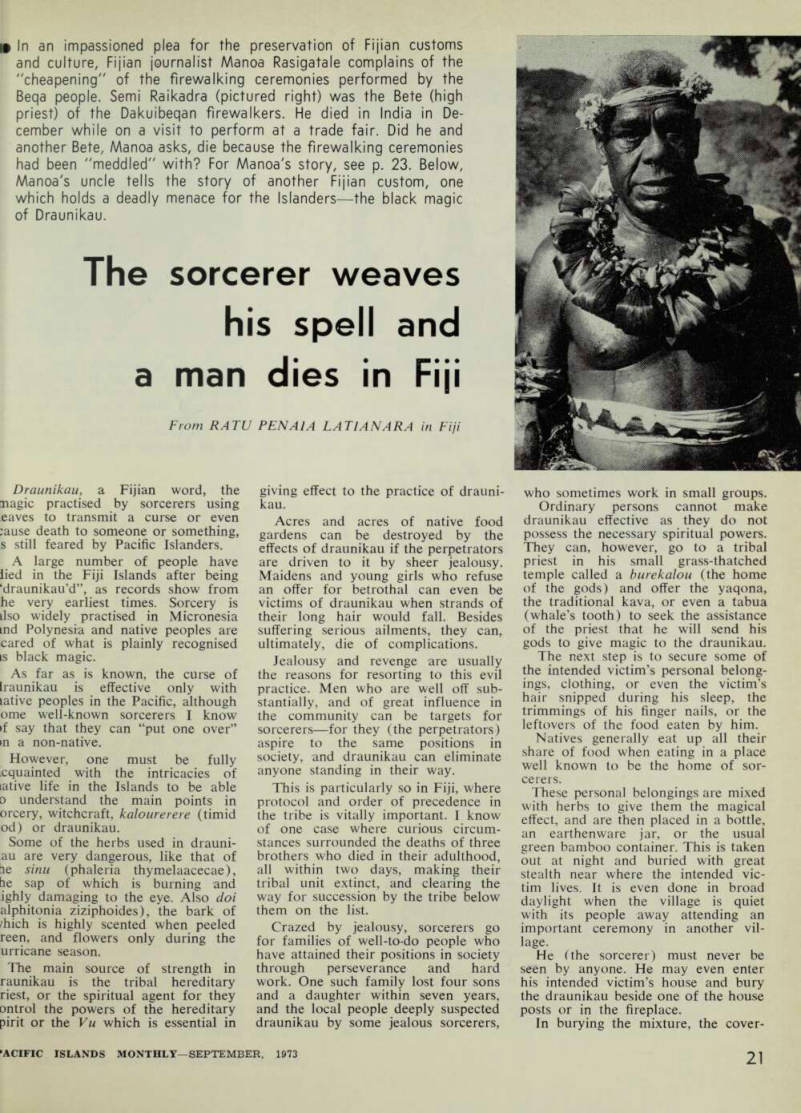
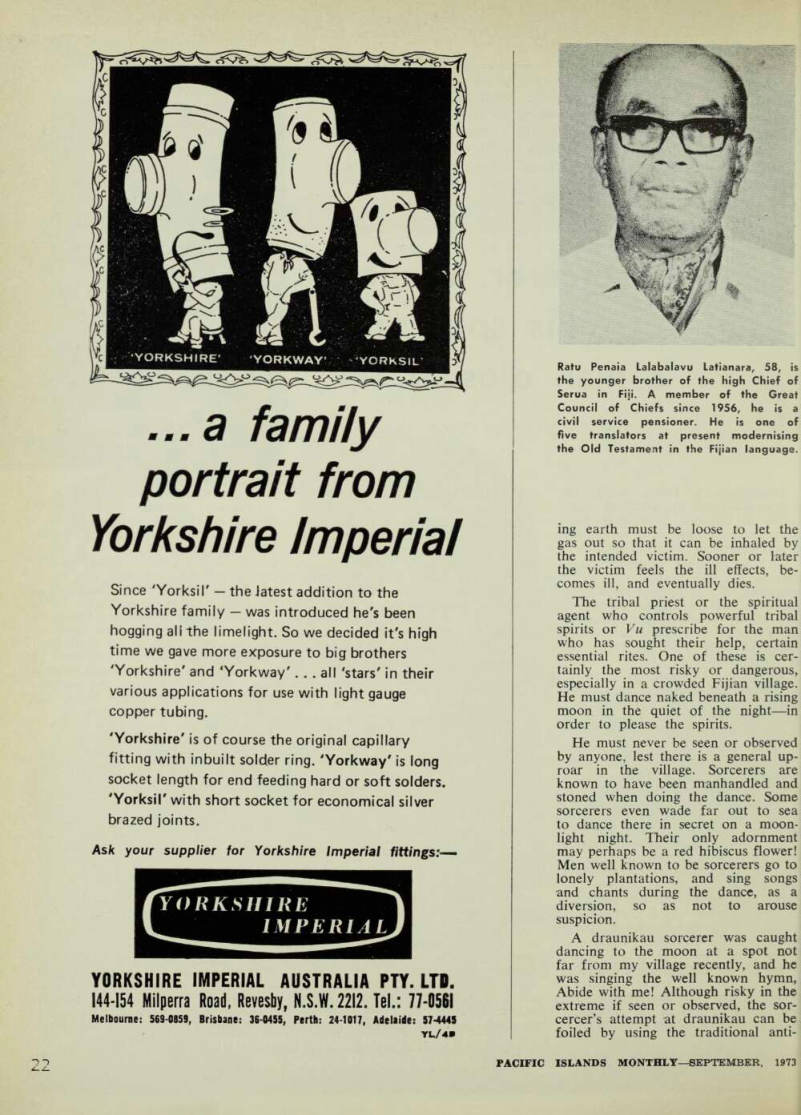
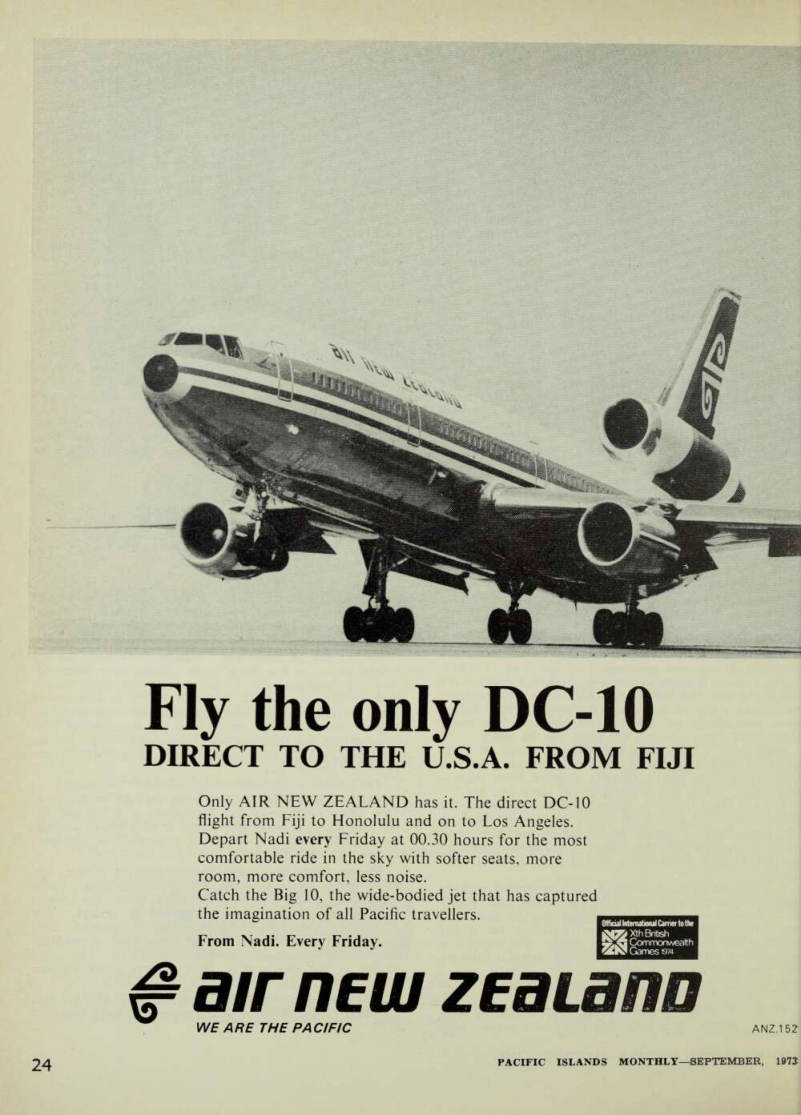
The sorcerer weaves his spell and a man dies in Fiji
it In an impassioned plea for the preservation of Fijian customs and culture, Fijian journalist Manoa Rasigatale complains of the “cheapening" of the firewalking ceremonies performed by the Beqa people. Semi Raikadra (pictured right) was the Bete (high priest) of the Dakuibeqan firewalkers. He died in India in De cember while on a visit to perform at a trade fair. Did he and another Bete, Manoa asks, die because the firewalking ceremonies had been “meddled" with? For Manoa's story, see p. 23. Below, Manoa's uncle tells the story of another Fijian custom, one which holds a deadly menace for the Islanders—the black magic of Draunikau.
From Ratu Penaia Latianara In Fiji
Draunikau, a Fijian word, the magic practised by sorcerers using eaves to transmit a curse or even :ause death to someone or something, s still feared by Pacific Islanders.
A large number of people have lied in the Fiji Islands after being ‘draunikau’d”, as records show from he very earliest times. Sorcery is ilso widely practised in Micronesia ind Polynesia and native peoples are cared of what is plainly recognised is black magic.
As far as is known, the curse of Iraunikau is effective only with lative peoples in the Pacific, although ome well-known sorcerers I know >f say that they can “put one over” ►n a non-native.
However, one must be fully cquainted with the intricacies of lative life in the Islands to be able o understand the main points in orcery, witchcraft, kalourerere (timid od) or draunikau.
Some of the herbs used in drauni au are very dangerous, like that of ie sinu (phaleria thymelaacecae), tie sap of which is burning and ighly damaging to the eye. Also doi alphitonia ziziphoides), the bark of diich is highly scented when peeled reen, and flowers only during the urricane season.
The main source of strength in raunikau is the tribal hereditary riest, or the spiritual agent for they ontrol the powers of the hereditary pirit or the Vu which is essential in
giving effect to the practice of drauni kau.
Acres and acres of native food gardens can be destroyed by the effects of draunikau if the perpetrators are driven to it by sheer jealousy.
Maidens and young girls who refuse an offer for betrothal can even be victims of draunikau when strands of their long hair would fall. Besides suffering serious ailments, they can, ultimately, die of complications.
Jealousy and revenge are usually the reasons for resorting to this evil practice. Men who are well off sub stantially, and of great influence in the community can be targets for sorcerers—for they (the perpetrators) aspire to the same positions in society, and draunikau can eliminate anyone standing in their way.
This is particularly so in Fiji, where protocol and order of precedence in the tribe is vitally important. I know of one case where curious circum stances surrounded the deaths of three brothers who died in their adulthood, all within two days, making their tribal unit extinct, and clearing the way for succession by the tribe below them on the list.
Crazed by jealousy, sorcerers go for families of well-to-do people who have attained their positions in society through perseverance and hard work. One such family lost four sons and a daughter within seven years, and the local people deeply suspected draunikau by some jealous sorcerers,
who sometimes work in small groups.
Ordinary persons cannot make draunikau effective as they do not possess the necessary spiritual powers.
They can, however, go to a tribal priest in his small grass-thatched temple called a burekalou (the home of the gods) and offer the yaqona, the traditional kava, or even a tabua (whale’s tooth) to seek the assistance of the priest that he will send his gods to give magic to the draunikau.
The next step is to secure some of the intended victim’s personal belong ings, clothing, or even the victim’s hair snipped during his sleep, the trimmings of his finger nails, or the leftovers of the food eaten by him.
Natives generally eat up all their share of food when eating in a place well known to be the home of sor cerers.
These personal belongings are mixed with herbs to give them the magical effect, and are then placed in a bottle, an earthenware jar, or the usual green bamboo container. This is taken out at night and buried with great stealth near where the intended vic tim lives. It is even done in broad daylight when the village is quiet with its people away attending an important ceremony in another vil lage.
He (the sorcerer) must never be seen by anyone. He may even enter his intended victim’s house and bury the draunikau beside one of the house posts or in the fireplace.
In burying the mixture, the cover-
ing earth must be loose to let the gas out so that it can be inhaled by the intended victim. Sooner or later the victim feels the ill effects, be comes ill, and eventually dies.
The tribal priest or the spiritual agent who controls powerful tribal spirits or Vu prescribe for the man who has sought their help, certain essential rites. One of these is cer tainly the most risky or dangerous, especially in a crowded Fijian village.
He must dance naked beneath a rising moon in the quiet of the night—in order to please the spirits.
He must never be seen or observed by anyone, lest there is a general up roar in the village. Sorcerers are known to have been manhandled and stoned when doing the dance. Some sorcerers even wade far out to sea to dance there in secret on a moon light night. Their only adornment may perhaps be a red hibiscus flower!
Men well known to be sorcerers go to lonely plantations, and sing songs and chants during the dance, as a diversion, so as not to arouse suspicion.
A draunikau sorcerer was caught dancing to the moon at a spot not far from my village recently, and he was singing the well known hymn, Abide with me! Although risky in the extreme if seen or observed, the sor cercer’s attempt at draunikau can be foiled by using the traditional anti
Ratu Penaia Lalabalavu Latianara, 58, is the younger brother of the high Chief of Serua in Fiji. A member of the Great Council of Chiefs since 1956, he is a civil service pensioner. He is one of five translators at present modernising the Old Testament in the Fijian language.
[?]The Sorcerer Spears The Corpse
Hote supplied by a tribal priest before It is too late. But dancing to the moon is an essential rite to quicken Ihe effects of the draunikau and is leasing to the tribal gods. The second essential rite is the prepara ion of kava which is poured outside nt night, with a wish that so-and-so will die!
Sorcery and witchcraft in some r orm or another were practised widely u Fiji in the past, but existing ordinances and regulations forbid this jvil practice. However, jealousy, the :oul competitive spirit, and hatred lie hard among native people.
The sorcerer often pays a visit to lis sick victim—who is not the least iware that his enemy is right before lim! Alas, the visiting sorcerer has ;he palm of his right hand rubbed with a quickening potion—ready for i chance handshake with his victim!
But sometimes, the victim’s relatives may have consulted a witch-doctor or xibal priest and so prevent the sor cerer from paying a visit.
When the victim dies, it is ab
solutely essential for the sorcerer or some near kin to him to puncture the corpse within four nights after death.
This is sometimes done when the body is “lying in”, for the sorcerer may have told his wife to go and pay her respects to the deceased. Thus, she will be allowed to remain inside the tapa curtain with the other women in mourning. During the crying, wail ing, and milling around the body, a needle in a black handkerchief is pressed against the body by the sor cerer’s wife—letting out the drauni kau air or gas. This must be done within four nights, or the sorcerer dies also. If the attempt to puncture the body with the needle fails, the sorcerer must brave the traditional native fears of a cemetery, and go at night straight to his victim’s grave, armed with a spear, or a long, sharp implement, or even a crowbar, which he drives hard into the grave until he is sure that he has pierced the corpse, and so let out the draunikau gas. Islanders often visit their rela tive’s grave daily after burial, and
an ugly spear mark on it will cer tainly convince them that their relative has died of draunikau magic.
They also watch for fresh feet marks around the grave.
Spearing the corpse in the grave is certainly a very fearful business, for the victim’s relatives may have been forewarned by a witch-doctor, and may be holding an all-night vigil in the cemetery. If the sorcerer or someone is seen in suspicious circum stances around the grave at night, the general rule is to pounce on him and prevent the spearing of the grave.
In the early twenties in northern Viti Levu, a man was seriously assaulted by a dead man’s relatives just as he was about to spear the grave and the body. Being near a government station, the men who carried out the assault were imme diately hauled up before the Stipendiary Magistrate (Mr Arthur Alban Wright). He acquitted them as the assaulted man admitted in court that he was a sorcerer. He was even sentenced to six months gaol. But, fortunately for him, he had asked his cousin to spear the grave for him, and this was done while the men were
celebrating their acquittal for assault with a big kava drinking bout.
I, myself, have seen five graves punctured or holed by the sorcerers.
In some instances, the sorcerer him self volunteers to be one of the grave-diggers, thus ensuring that the grave is of the right depth for his evil deed.
Of course, there are antidotes to all these evils, for the victim’s rela tions may have consulted the tribal priest who warns them that someone has cast the evil spell of draunikau on their deceased relative. Or, if the victim is still alive though very sick, an antidote is applied, which soon nullifies the evil and its harmful effects.
If this occurs the draunikau sor cerer immediately chooses another victim to replace the former—for the magic works both ways and can affect the sorcerer’s own relations if this is not done. The brightly coloured leaves of plants and shrubs planted around a Fijian house are not just home decor, but they are useful in warding off evil spirits. The Fijian via mila (Alocasia indica) is one of them.
One method of nullifying the effects of puncturing a victim’s body by a sorcerer is to put two green
mummy apples or papaw, one under each armpit of the deceased. If this is done the sorcerer sees his demise as a sure thing—when the mummy apples rot inside the grave.
Draunikau and other forms of witchcraft are practised in nearly all the island groups in the Pacific, in New Guinea, in the Gilbert and Ellice Islands, in the New Hebrides, and last, but not least, in the Solomons, where a plant called ria is used by sor cerers for making love charms to make a person love another. The plant was introduced to Fiji by labourers from the Solomon Islands at the turn of the last century. The ria is dreaded by Fijian women for its magical influence in instilling love, especially between unmatched couples.
Belief in the effectiveness of draunikau makes it highly potent. I can safely say that the evil has not been stamped out completely in Fiji, even though Christianity has been here for nearly 140 years. The laws and regulations that forbid draunikau and other forms of sorcery are still in force in Fiji, and there is no evi dence that these evil practices are on the wane, so as to warrant their repeal. It is my earnest prayer that they remain in the ordinances of Fiji for a long time to come.
Advertisements & other items, pp. 27-28 (2 items)
21
ACIFIC ISLANDS MONTHLY—SEPTEMBER, 1973
...a family
9 ft 9 fi
portrait from
Yorkshire Imperial
Since 'Yorksil' the iatest addition to the Yorkshire family was introduced he's been hogging ali the limelight. So we decided it's high time we gave more exposure to big brothers 'Yorkshire' and 'Yorkway'... all 'stars' in their various applications for use with light gauge copper tubing.
'Yorkshire' is of course the original capillary fitting with inbuilt solder ring. 'Yorkway' is long socket length for end feeding hard or soft solders.
'Yorksil' with short socket for economical silver brazed joints.
Ask your supplier for Yorkshire Imperial fittings :■—
YORKSHIRE
IMPERIAL
YORKSHIRE IMPERIAL AUSTRALIA PTY. LTD.
144-154 Milperra Road, Revesby, N.5.W.2212. Tel.: 77-0561 Melbourne: 569-0859, Brisbane: 36-0455, Perth: 24-1017, Adelaide: 57-4449 YU/4»
My Fiji—Stop Playing With Fire
By Manoa Rasigatale
As a young Fijian looking in from the outside—l have )een away for many months—l ask: “Where is my ovely Fiji that I used to know and adore for her ritual jaditional customs?”
This question came to me as I saw more and more ;xamples in the Fiji newspapers of the way in which Fijian culture is being cheapened. One that really hurts ne is the way the firewalkers from Beqa now perform icarly every day of the week. I strongly believe that if lome measure is not taken it will become like cheap iollywood glitter—which will soon lose its lustre.
Sometimes I cry to myself when I think of those )eautiful islands in the South Pacific which have lost heir culture—or had it vulgarly stripped from them— md I ask: “Isa, is Fiji going to be the same one day?”
It’s not clear if Fiji is doing enough to preserve her Fijian culture. I just don’t know. But to get back to he firewalking, it really hurts me to see how it is )eing performed all over the place like an ordinary :oncert when it should be a sacred and respected cere nony.
It would be so much better if they performed perhaps >nly a couple of times a month and retained the dignity he ceremony once had. Not so long ago this ceremony vas rare—usually by special arrangement on a big iccasion and not for the general public. But today it is professional entertainment. You must make a booking ike you would at any theatre.
Is this the way to maintain sacred traditions? I don’t hink so.
It also worries me to see outsiders performing with he Beqa people. It is becoming just like a game. Soon
any Tom, Dick and Harry will be taking part in the ceremony. The Beqa people should keep it to them selves. The appetite people have for mysterious rituals— like firewalking—will fade if it is shown too often.
Behind the scenes show business is already having a bad effect on the Beqa tribes. There have been dif ferences between the Dakuibeqans and the Naceva people. It was difficult to find out the real cause of their discontent but village politics and jealousies ob viously were involved as well as the question of who was getting the most money from firewalking. Is this quarrelling to be one of the results of performing too often for the public?
The money involved is considerable compared to what the average Bcqan has been used to in the past.
One Suva hotel pays the firewalkers a $360 flat fee for one show; a Nadi hotel pays $5OO a show; another pays $6OO, $250 for which is regarded as transport and accommodation costs.
Money obviously is having a disturbing effect. But some people feel that even worse is happening. There is a story going around Fiji today about the deaths of the two leaders of the firewalking groups. The Dakuibeqan Bete (high priest), Semi Raikadra, died in India on December 15 while on a visit to perform at the Third Asian International Trade Fair. The other leader, of the Rukua tribe, died in Suva a few months earlier.
Many people believe they died because the ritual and tradition of the firewalking ceremony had been meddled with.
Advertisements & other items, pp. 29-31 (2 items)
23
ACIFIC ISLANDS MONTHLY—SEPTEMBER, 1973
Fly the only DC-10
DIRECT TO THE U.S.A. FROM FIJI
5"
Only AIR NEW ZEALAND has it. The direct DC-10 flight from Fiji to Honolulu and on to Los Angeles.
Depart Nadi every Friday at 00.30 hours for the most comfortable ride in the sky with softer seats, more room, more comfort, less noise.
Catch the Big 10, the wide-bodied jet that has captured the imagination of all Pacific travellers.
From Nadi. Every Friday.
Official International Carrier to the MJKi Xth British &MR Commonwealth Games 1974
air new zeaiana
WE ARE THE PACIFIC
SOLVE YOUR ISLAND BUILDING PROBLEMS
with the GEORGE HUDSON "THERMA-PANEL SYSTEM
The complete building system with virtually no limit to the range of design, purpose and size. Hospitals, offices, schools, shops, homes, any commercial or in-
dustrial buildings.
Simple easy erection— no need for skilled labour. • Regd. Trade Name.
For detailed brochure contact:
A. RIETTE (EXPORT) PTY. LIMITED
300 GEORGE STREET, SYDNEY 2000. Cables: Ramaritime, Sydney.
SOLE PACIFIC AGENT
Draunikau In
Parliament
Magic, black and white, de moniacal possession and all the other manifestations of the netherworld are scoffed at in most countries today, though there’s a resurgence of the practice of the Black Arts in Britain and a few other places by people searching for “ kicks”, but in Fiji belief in the occult, and especially in draunikau, is very real.
There are laws banning all occult practices, real or faked.
When these laws were tightened around the mid-19605, Fiji’s Legislative Council held a full debate on witchcraft. During the debate, one member, Mr R. H.
Yarrow of the Vatukoula gold mines, electrified the House with several illustrations of the work ing of draunikau around north west Viti Levu, where it was, and still is, active. He quoted several instances of the deaths of victims of draunikau, offered evidence and was deadly serious about the whole thing.
Footnotes
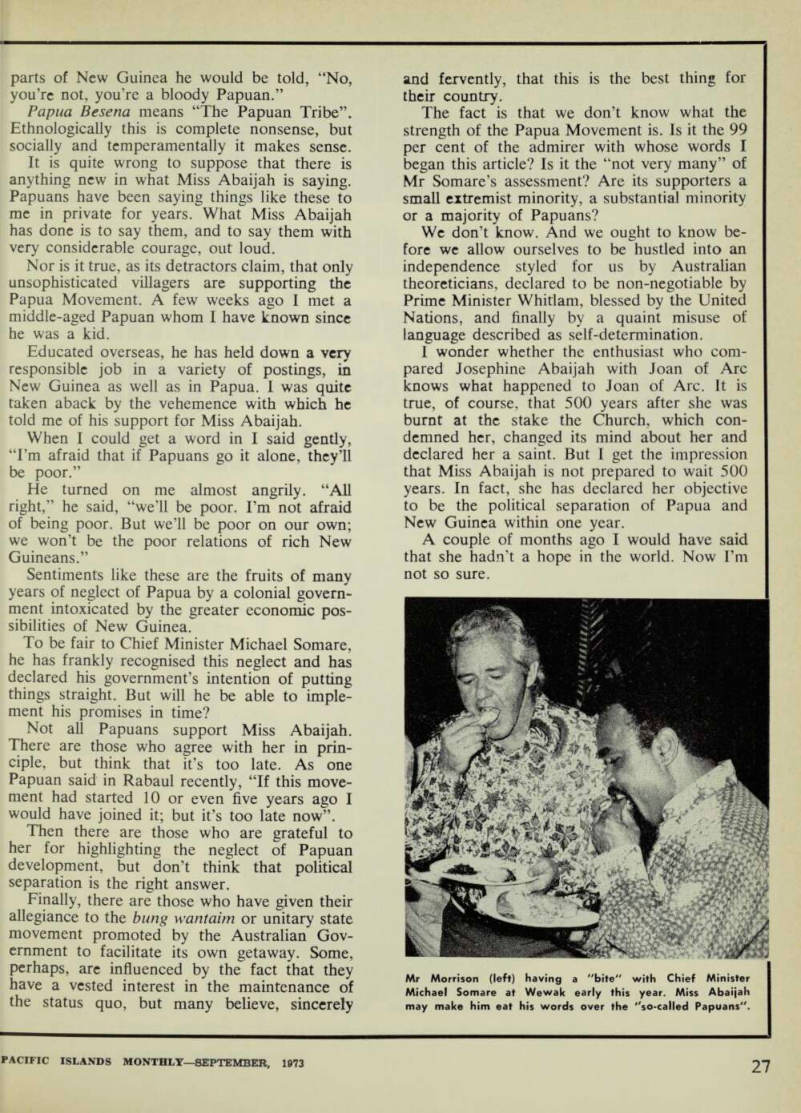
“ JOSEPHINE of Papua is like Joan of Arc ** of France. She shall have all our support from 99 per cent of the Papuans”. So wrote a contributor to the Letters to the Editor page of Papua New Guinea’s Post-Courier news paper.
Then, bursting into verse, he continued, “Josephine, Josephine, Let your spirit guide us through, Come lead your Papuans to freedom, Josephine we are calling you.”
“1 even have the music for it”, he adds. I think it is unlikely that we shall hear this one over the ABC, and I am quite certain we shall not hear it over the Administration radio net work.
At the other end of the scale, there is the recommendation that Miss Josephine Abaijah, MHA, should go back to her village, get mar ried and have 12 children. Yet another
correspondent proposes that she should be deported to Mururoa Atoll, though whether as a punishment or to calibrate her megaton rating is not quite clear.
And so it goes on, in issue after issue of our national news paper, running the full gamut of praise and abuse.
Miss Abaijah and her Papua Besena (Papua for the Papuans) Movement have cer
tainly started something which has got both our own and the Australian governments wor ried; and was probably one of a complex of factors which touched off a riot in Port Moresby in July, following a Papua v New Guinea rugby football match.
The really ironic thing about all this is that it was a decision by an Australian government 70 years ago which started it all off. When Australia took over the former British colony of New Guinea early this century it decided to call the place Papua, instead of making the more obvious choice of changing the name
With Percy Chatterton
in Port Moresby
Josephine of Arc in a hurry
from British New Guinea to Australian New Guinea. “Papua for the Papuans” is a first rate slogan. I doubt if even the dynamic Miss Abai jah could make much of Australian New Guinea for the Australian New Guineans.
Recently External Territories Minister Mor rison referred sneeringly to “so-called Papuans”. So called by whom? So called by Mr Morrison’s Australia.
Of course, there’s more to it than that. The name Australia has an emotional content for dinkum Aussies, and even for a long expatri ated pommie like myself there is magic in the
name England. We cannot be surprised, nor have we any right to be contemptuous, if the name Papua has in 70 years acquired an emotional content for those whose homeland it is.
A perceptive Papuan jour nalist, Pauline Bona, has sug gested that Papuans think of themselves as Papuans in a way in which the people of larger and more diverse New Guinea
don’t think of themselves as New Guineans.
The smaller size and more compact character of Papua has something to do with it, but perhaps even more formative was the long reign and personal impact of its pre-war Lieu tenant-Governor, Sir Hubert Murray.
The clearest indication that this sense of identity is real is to be found in the fact that New Guineans recognise, and often resent it.
“I was born in Papua, but I regard myself as a New Guinean,” declared one young Papuan in Port Moresby a couple of years ago. Per haps he does, but if he were to say so in some
parts of New Guinea he would be told, “No, you’re not, you’re a bloody Papuan.”
Papua Besena means “The Papuan Tribe”.
Ethnologically this is complete nonsense, but socially and temperamentally it makes sense.
It is quite wrong to suppose that there is anything new in what Miss Abaijah is saying.
Papuans have been saying things like these to me in private for years. What Miss Abaijah has done is to say them, and to say them with very considerable courage, out loud.
Nor is it true, as its detractors claim, that only unsophisticated villagers are supporting the Papua Movement. A few weeks ago I met a middle-aged Papuan whom I have known since he was a kid.
Educated overseas, he has held down a very responsible job in a variety of postings, in New Guinea as well as in Papua. I was quite taken aback by the vehemence with which he told me of his support for Miss Abaijah.
When I could get a word in I said gently, “I’m afraid that if Papuans go it alone, they’ll be poor.”
He turned on me almost angrily. “All right,” he said, “we’ll be poor. I’m not afraid of being poor. But we’ll be poor on our own; we won’t be the poor relations of rich New Guineans.”
Sentiments like these are the fruits of many years of neglect of Papua by a colonial govern ment intoxicated by the greater economic pos sibilities of New Guinea.
To be fair to Chief Minister Michael Somare, he has frankly recognised this neglect and has declared his government’s intention of putting things straight. But will he be able to imple ment his promises in time?
Not all Papuans support Miss Abaijah.
There are those who agree with her in prin ciple, but think that it’s too late. As one Papuan said in Rabaul recently, “If this move ment had started 10 or even five years ago I would have joined it; but it’s too late now”.
Then there are those who are grateful to her for highlighting the neglect of Papuan development, but don’t think that political separation is the right answer.
Finally, there are those who have given their allegiance to the bung wantaim or unitary state movement promoted by the Australian Gov ernment to facilitate its own getaway. Some, perhaps, arc influenced by the fact that they have a vested interest in the maintenance of the status quo, but many believe, sincerely
and fervently, that this is the best thing for their country.
The fact is that we don’t know what the strength of the Papua Movement is. Is it the 99 per cent of the admirer with whose words I began this article? Is it the “not very many” of Mr Somare’s assessment? Are its supporters a small extremist minority, a substantial minority or a majority of Papuans?
We don’t know. And we ought to know be fore we allow ourselves to be hustled into an independence styled for us by Australian theoreticians, declared to be non-negotiable by Prime Minister Whitlam, blessed by the United Nations, and finally by a quaint misuse of language described as self-determination. 1 wonder whether the enthusiast who com pared Josephine Abaijah with Joan of Arc knows what happened to Joan of Arc. It is true, of course, that 500 years after she was burnt at the stake the Church, which con demned her, changed its mind about her and declared her a saint. But I get the impression that Miss Abaijah is not prepared to wait 500 years. In fact, she has declared her objective to be the political separation of Papua and New Guinea within one year.
A couple of months ago I would have said that she hadn’t a hope in the world. Now I’m not so sure.
Mr Morrison (left) having a "bite" with Chief Minister Michael Somare at Wewak early this year. Miss Abaiiah may make him eat his words over the "so-called Papuans".
Advertisements & other items, p. 34 (1 item)
MF2I blade keeps levelling
These MF distributors
can show you how the
and grading costs low
No special operating skill is required with this versatile implement. You’ll be amazed at the way the MF2I handles general dirt moving, road building, ditching, back-filling, levelling, cleaning and dozens of other jobs. The MF2I quickly attaches to an MF 135 tractor and depth controlled by the tractors’ hydraulics. Pitch and angle 5. w % of the blade are adjustable from the tractor seat and blade can be completely reversed for back-filling.
Make a full 6 foot or 8 foot cut with blade extensions.
Grader wheel, side plate and scarifier kits available.
MP Massey Ferguson
Autonomy Of
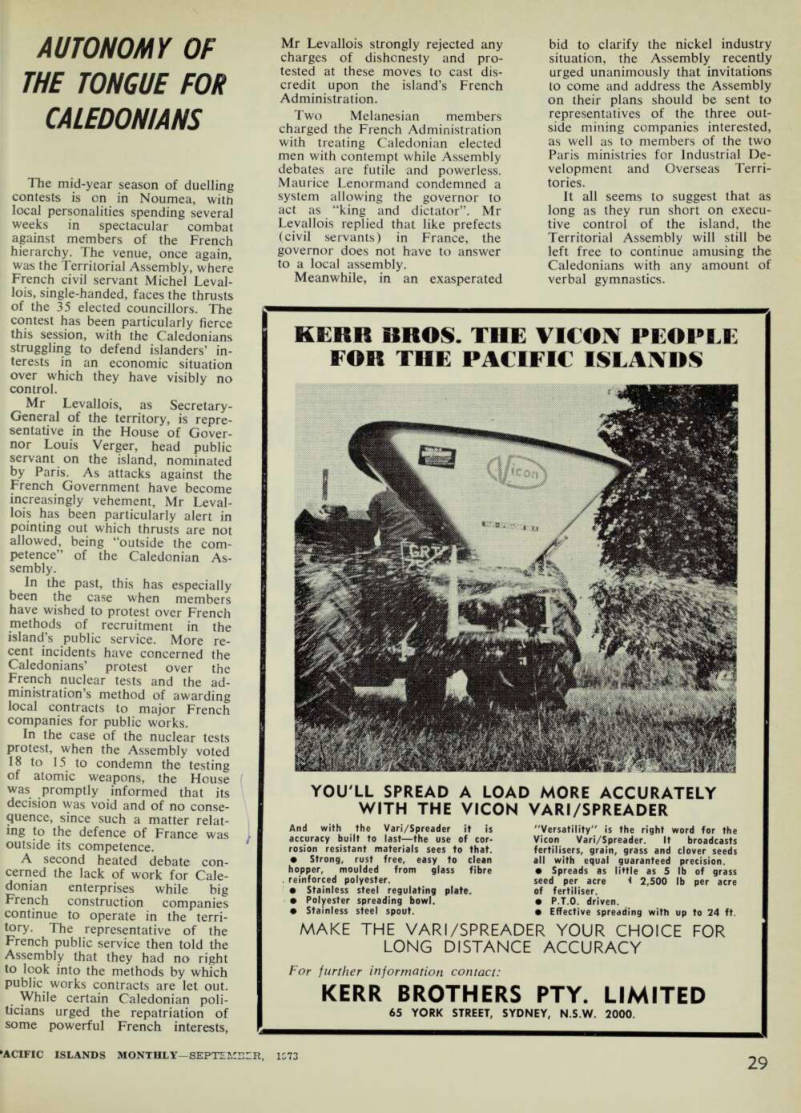
The Tongue For
Caledonians
The mid-year season of duelling contests is on in Noumea, witn local personalities spending several weeks in spectacular combat against members of the French hierarchy. The venue, once again, was the Territorial Assembly, where French civil servant Michel Leval lois, single-handed, faces the thrusts of the 35 elected councillors. The contest has been particularly fierce this session, with the Caledonians struggling to defend islanders’ in terests in an economic situation over which they have visibly no control.
Mr Levallois, as Secretary- General of the territory, is repre sentative in the House of Gover nor Louis Verger, head public servant on the island, nominated by Paris. As attacks against the French Government have become increasingly vehement, Mr Leval lois has been particularly alert in pointing out which thrusts are not allowed, being “outside the com petence” of the Caledonian As sembly.
In the past, this has especially been the case when members have wished to protest over French methods of recruitment in the island’s public service. More re cent incidents have concerned the Caledonians’ protest over the French nuclear tests and the ad ministration’s method of awarding local contracts to major French companies for public works.
In the case of the nuclear tests protest, when the Assembly voted 18 to 15 to condemn the testing of atomic weapons, the House was promptly informed that its decision was void and of no conse quence, since such a matter relat ing to the defence of France was outside its competence.
A second heated debate con cerned the lack of work for Cale donian enterprises while big French construction companies continue to operate in the terri tory. The representative of the French public service then told the Assembly that they had no right to look into the methods by which public works contracts are let out.
While certain Caledonian poli ticians urged the repatriation of some powerful French interests,
Mr Levallois strongly rejected any charges of dishonesty and protested at these moves to cast discredit upon the island’s French Administration.
Two Melanesian members charged the French Administration with treating Caledonian elected men with contempt while Assembly debates are futile and powerless.
Maurice Lenormand condemned a system allowing the governor to act as “king and dictator”. Mr Levallois replied that like prefects (civil servants) in France, the governor does not have to answer to a local assembly.
Meanwhile, in an exasperated
bid to clarify the nickel industry situation, the Assembly recently urged unanimously that invitations to come and address the Assembly on their plans should be sent to representatives of the three out side mining companies interested, as well as to members of the two Paris ministries for Industrial De velopment and Overseas Terri tories.
It all seems to suggest that as long as they run short on execu tive control of the island, the Territorial Assembly will still be left free to continue amusing the Caledonians with any amount of verbal gymnastics.
Advertisements & other items, pp. 35-36 (2 items)
29
*ACIFIC ISLANDS MONTHLY—SEPTEI.'ELR, 1C73
Kerr Brothers Pty. Limited
KERR BROS. THE VICON PEOPLE
FOR THE PACIFIC ISLANDS
m
YOU'LL SPREAD A LOAD MORE ACCURATELY
WITH THE VICON VARI/SPREADER
And with the Vari/Spreader it is accuracy built to last—the use of corrosion resistant materials sees to that. • Strong, rust free, easy to clean hopper, moulded from glass fibre reinforced polyester. • Stainless steel regulating plate. • Polyester spreading bowl. • Stainless steel spout.
"Versatility" is the right word for the Vicon Vari/Spreader. It broadcasts fertilisers, grain, grass and clover seeds all with equal guaranteed precision. • Spreads as little as 5 lb of grass seed per acre i 2,500 lb per acre of fertiliser. • P.T.O. driven. • Effective spreading with up to 24 ft.
MAKE THE VARI/SPREADER YOUR CHOICE FOR
LONG DISTANCE ACCURACY
For further information contact:
KERR BROTHERS PTY. LIMITED
65 YORK STREET, SYDNEY, NS W. 2000.
Bank of Hawaii is the bank of the Pacific.
You can bank on it... in Guam S&Tamuning t Koror Yap Jf Saipan Roi Namur JL Kwajalein JltPonape
MidwayJS* Tahiti*-2&»-
2* American Samoa.
All in all, we have 70 branches throughout Hawaii and the Pacific offering full banking services. May we help you?
Bank of Hawaii the bank of the Pacific® * affiliate of Banque de Tahiti
The Editor's Mailbag

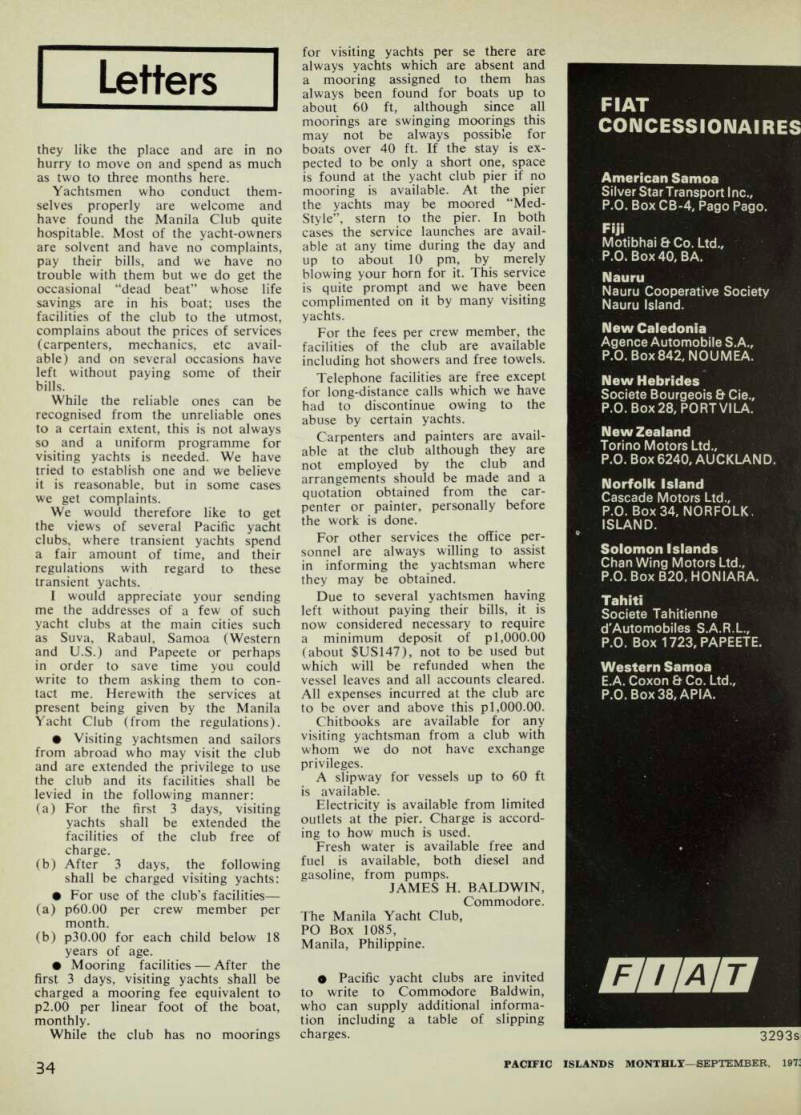
The 'Green'
Letters
I was interested in the feature in the June PIM on the “Green” letters (P 57, 59).
The photo and caption (p 59) — this looks like a Papuan south-coast lakatoi. As far as I know (not certain) the Orokaiva (including the Mambare people) did not even use double canoes, just singles with outrigger (ie unlike the Kerema singles).
Re Maisina (p 59); your directions might be wrong as the present day Maisina people (or at least those called Maisina today) live south of Tufi and not West of the Musa.
Mambare raiders certainly came as far as Tufi, and beyond:- “Wanigela people were besieged by a squadron of war canoes full of Mambare people and were in danger of defeat until assisted by the Maisina people (Uwe and Uiaku etc). This must have been in about the 1850- 1880 period I guess, but indicates that there was wide-ranging social contact (not to mention physical con tact) along the coast.” (From a letter, (20/5/73) to me from another former BASF em ployee in the ND; his information about the siege came from Sister Roberts who has been at Wanigela with the Anglican Mission since about 1948, and he would have been given it in 1966).
Langdon states that Green has been given little attention in reference books about PNG; I suppose that this might be true. However, it must be remembered that his was only a short career in PNG, just over four years overall, and less than three in the government service. He also suffered from the handicap that he didn’t survive to write his own book (eg Monckton, Humphries, Beaver—though the last named was posthumous).
However, he has many mentions in the literature, quite apart from those in the PNG ARs. I seem to recall Monckton describing Green as “quite the best officer the Papuan service ever had, he spoke the lan guage like a native”. It may be that Monckton was influenced by the man ner of Green’s death, but MacGregor also praised him, and both- Waiko and Barereba say he spoke Binandere.
There is an essay “How my grand fathers killed Mr J. Green” by S. (Stephen) Targo (also Barereba);
listed in Waiko’s biblio as such, it appeared in South Pacific in 1959 and in Australian Territories in 1961.
The author is now MHA for Sobe in the PNG House of Assembly.
John Waiko also had a version published in the JPNGS (1970, I think); it was called “A Payback Murder: the Green Bloodbath”, or something like that. Green was also mentioned in his paper on cargo cults in the 1972 Niugini Reader, an Australian Union of Students publi cation.
Lett in his 1943 book Papuan Gold mentions him as Waiko has re ferred to him in his 1970 paper’s bibliography.
The story of his death is often mentioned by whites in the Northern District and seems to have become one of the native legends over quite a wide area. I would think that in the Popondetta/loma area it would be the most famous of all white/black contact stories.
Both Tago and Waiko state that Green was eaten; this is quite dif ferent to Lett’s and other white versions of the story, including PIM.
Possibly the most famous part of the story (native version), at least for whites, is that part dealing with the eating of Green’s boots (the man who got the legs thought the boots were also part of Green’s body).
John R. Horne
Lithgow, NSW.
Mr Horne’s letter was referred to Mr Langdon, whose reply reads: I was glad to see that you had found the article of interest and I much appreciate your comments. The photograph of the lakatoi used with the article was not chosen by me, and you may well be right that Mambare people did not use such craft.
My statement that Green had been given little attention in reference books on Papua New Guinea was meant to imply general reference works such as encyclopaedias, bio graphies, and histories, rather than travel books, reminiscences and such like.
In the Encyclopaedia of Papua New Guinea, for example, there is no entry on Green, although he is fleetingly mentioned in a couple of other articles. He is scarcely men tioned in Roger Joyce’s biography of Sir William MacGregor; and he is
not mentioned at all in Gavin Souter’s New Guinea: The Last Unknown.
I was aware that there are references to him in such books as those by Monckton. In fact, 1 obtained some of the details for my article from those sources.
I wonder if the Papuan accounts of his being eaten, boots and all, are not apocryphal—and based on the Fijian story about the Rev Thomas Baker, who is said to have been disposed of in that manner.
I am grateful to you for your references to the article by Stephen Tago, ‘How My grandfathers killed Mr I. Green’. I knew when I wrote my article that there was an essay with that title, but could not lay my hands on it.
R. A. Langdon,
Executive Officer.
The Research School of Pacific Studies, ANU, Canberra,
Polynesian Boards
Who owns the two Polynesian carved boards which were part of the South Pacific Festival of Arts in 1972?
Please contact Isobel Whippy, at the Fiji Museum.
Isobel Whippy,
Museum Education Officer.
Fiji Museum, Box 2023, Suva.
Norfolk Objection
Norfolk Island, approximately 800 miles east of Australia, is one of the most beautiful islands in the Pacific.
It is a territory—a distinct and separate settlement—administered by Australia.
This small island, only 5-miles by 3-miles with a population of about 1,500, is proud of its connection with the Crown and the fact that we have a direct link with Her Majesty through her only representative, the Governor-General of Australia.
The island has adequate finance to live within its own revenue, raised from tourism, philatelic sales and indirect taxation. The island is a customer of Australia to the tune of approximately s2m per annum.
Residents, tourists and visiting politicians are frequently concerned at the encroaching pollution as else where in the world.
As I have said, Australia is charged with administering Norfolk Island
tfior the “peace, order and good government” of Norfolk Island with the advice of the Norfolk Island Council.
Our Governor-General delegates Jthis responsibility to Minister lEnderby.
In pretence of “good government” ifor Norfolk Island, Australia is frying to wish upon us her off-shore quarantine station.
Our council had no mandate from Ithe people to accept this proposal.
Consequently, on November 8, 1972, a compulsory referendum was held and this showed a large majority were against the proposal. Those “for” the proposition failed by 22 per cent.
In spite of this, a parliamentary commission has appeared on the scene to test independently the validity of the arguments. Through our press and public meetings the pros and cons have been amply thrashed out. So far as the majority is concerned, they consider the question settled, and are amazed, to say the least, when Minister Enderby states “it is the view of the Capital Territory that the committee should consider the case for a quarantine station on Norfolk Island on its merits and the committee’s thinking should not be determined by a referendum”.
We are left wondering for whose good government this is intended— Australia or Norfolk Island?
The opinion of the residents has been clearly stated in the most democratic fashion—by referendum.
Australia signed the Universal Declaration of Human Rights in 1948 which states in Article 21, Section 3—“ the will of the people shall be the basis of the authority of government”.
Again, in the Charter of the United Nations in Article 73 iealing with Territories, Section (a) ‘to ensure . . . their just treatment md their protection against abuses”.
Now a very upset community hears hat Minister Enderby states the iemocratic opinion of the people must >e disregarded.
What sort of “good government” s this?
The majority do not want this jollution nor the loss of Norfolk island’s identity to become known is Australia’s quarantine station.
We are a small community up igainst this powerful outside treat nent and seek those who will take ip our cause as a matter of basic >rinciple. Our hope is that parliament md the Senate will at least recognise he will of the people so clearly ex pressed in our referendum. I believe
it is a legal fact that we still have the right as a territory, to petition Her Majesty and appeal to the Privy Council—but surely this should not be necessary?
W. N. Selby Newbald.
Norfolk Island.
Geic Museum
We are starting a project to establish a museum in the Gilbert Islands, on Tarawa.
I am getting together some interested people here on Tarawa, and we have been promised some support from the government. We propose to preserve items of ancient Gilbertese culture, war relics, natural history etc.
Over the years a great number of interesting items have been collected and taken away from these islands by private collectors and overseas museums. The Colony Museum is appealing to people with these arti facts, war souvenirs, etc to donate or lend them to the museum.
Anyone with any information should contact the museum through me.
P. Mcquarrie.
PO Box 466, Tarawa,
Geic.
Lament From Cooks
The Cook Islands News, Raro tonga’s only newspaper, was about to come to an end late June. The News in no way rivals or resembles The Fiji Times or the Tonga Chronicle; in fact it was probably the worst 12 to 15 page newspaper published in the South Pacific, with very poor printing done on 9 x 12 paper stapled together, with almost no pictures and relatively little local news.
Even though a poor quality paper, it did have some local interest while under its past editor. Although the editor was not a previous newspaper man he strived to get local interest stories, like interviews with new comers on their background and future plans, encouraging locals to contribute news and articles for the paper.
In fact he once gave the churches a fair go to explain each of their religions. But, through a dispute regarding the paper with a high-up
government official he was sacked last March.
Since then the paper has gone from bad to worse in size and quality.
About June 1 it was rumoured that the directors of the CIBNC were concerned with the high cost of printing the paper and were con sidering doing away with it altogether.
However, the paper got a reprieve and was allowed to continue but was reduced to from six to eight pages, mostly made up of advertisements, sports and “classifieds” with very little room left for anything else.
The paper’s staff has tried hard, requesting newer and better equip ment, more and better trained help but to no avail.
It seems that the government is not concerned with the immediate improvement of the paper, at least not this year. So all in all the Cook Island News still remains one of the worst (six to eight page) newspapers in the South Pacific.
Frustrated Reader.
Rarotonga, Cook Islands.
Americana Hotels
Our thanks for featuring the Americana Beachcomber on the cover of PIM July. Our thanks for your coverage of developments within the growing Americana chain.
I might note that we are striving to establish the Americana name of Pago Pago as well. The hotel’s name, contrary to what the PIM cover caption says, is Pago Pago Ameri cana. Intercontinental was dropped when we assumed operation of the property. But thanks again for your help.
George J. Ledwith.
Director of Communications, Americana Hotels, Third Avenue, New York.
Bad-Mannered Yachties
I have been a reader of your magazine for some years and being a yachtsman myself I have been interested in the cruising yachts sec tion.
I have recently been elected Com modore of the Manila Yacht Club and we have a problem which I would like to resolve, possibly through your assistance.
A considerable number of visiting yachts pass thru Manila usually on their way from Hong Kong or Taipei, to the US or westward, around the world. Most of these yachts spend only a few days to about two weeks but some find that
they like the place and are in no hurry to move on and spend as much as two to three months here.
Yachtsmen who conduct them selves properly are welcome and have found the Manila Club quite hospitable. Most of the yacht-owners are solvent and have no complaints, pay their bills, and we have no trouble with them but we do get the occasional “dead beat” whose life savings are in his boat; uses the facilities of the club to the utmost, complains about the prices of services (carpenters, mechanics, etc avail able) and on several occasions have left without paying some of their bills.
While the reliable ones can be recognised from the unreliable ones to a certain extent, this is not always so and a uniform programme for visiting yachts is needed. We have tried to establish one and we believe it is reasonable, but in some cases we get complaints.
We would therefore like to get the views of several Pacific yacht clubs, where transient yachts spend a fair amount of time, and their regulations with regard to these transient yachts.
I would appreciate your sending me the addresses of a few of such yacht clubs at the main cities such as Suva, Rabaul, Samoa (Western and U.S.) and Papeete or perhaps in order to save time you could write to them asking them to con tact me. Herewith the services at present being given by the Manila Yacht Club (from the regulations). • Visiting yachtsmen and sailors from abroad who may visit the club and are extended the privilege to use the club and its facilities shall be levied in the following manner: (a) For the first 3 days, visiting yachts shall be extended the facilities of the club free of charge. (b) After 3 days, the following shall be charged visiting yachts: • For use of the club’s facilities— (a) p 60.00 per crew member per month. (b) p 30.00 for each child below 18 years of age. • Mooring facilities After the first 3 days, visiting yachts shall be charged a mooring fee equivalent to p 2.00 per linear foot of the boat, monthly.
While the club has no moorings
for visiting yachts per se there are always yachts which are absent and a mooring assigned to them has always been found for boats up to about 60 ft, although since all moorings are swinging moorings this may not be always possible for boats over 40 ft. If the stay is ex pected to be only a short one, space is found at the yacht club pier if no mooring is available. At the pier the yachts may be moored “Med- Style”, stern to the pier. In both cases the service launches are avail able at any time during the day and up to about 10 pm, by merely blowing your horn for it. This service is quite prompt and we have been complimented on it by many visiting yachts.
For the fees per crew member, the facilities of the club are available including hot showers and free towels.
Telephone facilities are free except for long-distance calls which we have had to discontinue owing to the abuse by certain yachts.
Carpenters and painters are avail able at the club although they are not employed by the club and arrangements should be made and a quotation obtained from the car penter or painter, personally before the work is done.
For other services the office per sonnel are always willing to assist in informing the yachtsman where they may be obtained.
Due to several yachtsmen having left without paying their bills, it is now considered necessary to require a minimum deposit of pi, 000.00 (about SUSI 47), not to be used but which will be refunded when the vessel leaves and all accounts cleared.
All expenses incurred at the club are to be over and above this pi,000.00.
Chitbooks are available for any visiting yachtsman from a club with whom we do not have exchange privileges.
A slipway for vessels up to 60 ft is available.
Electricity is available from limited outlets at the pier. Charge is accord ing to how much is used.
Fresh water is available free and fuel is available, both diesel and gasoline, from pumps.
James H. Baldwin,
Commodore.
The Manila Yacht Club, PO Box 1085, Manila, Philippine. 9 Pacific yacht clubs are invited to write to Commodore Baldwin, who can supply additional informa tion including a table of slipping charges.
Advertisements & other items, pp. 38-44 (3 items)
tropic or temperate climate —Fibreglass Refrigerated
Save hundreds of dollars
on Australians most efficient
WALK IN, ALUMINIUM
COOLROOMS AND
FREEZE ROOMS
Hundreds already installed! The most economical supplementary coolrooms for bottles and food, providing the largest slorage capacity of any comparable coolrooms of the same exte.ior dimensions. Five sizes —from 90-360 cu. ft. capacity; 16 models offering normal temp., two temp., deep freeze, or for pastry and ice storage applications. White vinyl interior, embossed rustproof aluminium exterior. • SUPPLIED IN EASY-TO-ERECT, DO-IT-YOURSELF KIT FORM • PETROL AND PETROL-ELECTRIC MODELS ARE AVAILABLE FOR AREAS WHERE POWER IS LIMITED OR NON-EXISTENT Available from: AUSTRALIAN NEW CALEDONIA EXPORTS (SILVER & BARDA), 363 George St., Sydney, 2000 and Branches.
BRECKWOLDT & CO., 276 Pitt St., Sydney, 2000 and Branches.
PETER FISHER TRADING PTY. LTD., 321 Pitt St., Sydney, 2000.
HAGEMEYER (A'SIA), 59 Anzac Pde., Kensington, 2033 and Branches.
Manufactured by:
WARBURTON FRANK!
KERR BROS, 65 York St., Sydney, 2000.
NELSON & ROBERTSON PTY. LTD., 197 Clarence St., Sydney 2000.
RABAUL TRADING CO. PTY. LTD., P.O. Box 219, Rabaul and Branches ROY GALLIAAORE & ASSOCIATES, P.O. Box 179, Vila, New Hebrides.
C. SULLIVAN (EXPORT) PTY. LTD., 60 Margaret St., Sydney, 2000 and Branches.
W. S. TAIT & CO. PTY. LTD., 31 Macquarie Place, Sydney, 2000 and Branches. 199 Parramatta Road, Cnr. Skarratt Street, Auburn, N.S.W. 2144, Australia. Phone: 648-1711.
Powered by Kelvinator.
Five-year warranty on compressor. Early d livery.
tropic or temperate climate —Fibreglass Refrigerated
units by George & Ashton exceed all requirements George and Ashton moulded fibreglass refrigerated units are unaffected by rust, rot, fatigue, weathering or corrosion. No joints to harbour vermin, so cleaning is easy. Used for any type of vehicle or as static storage units. Any size units can be supplied assembled or in prefabricated sections for easy shipping and erection on site.
Approved by N.Z. Depts of Health and Agriculture.
GEORGE &
ASHTON II
P.O, Box 2056, South Dunedin, New Zealand.
Phones 54-108, 54-109 George & Ashton (P. 1.) Ltd, Box 296, Suva, Fiji.
Phone 26-249.
FIJI NUTTS
i««fSiaTl6o The Fiji Meats unit illustrated is the second supplied to this Company
FIAT
CONCESSIONAIRES
American Samoa Silver Star Transport Inc., P.O. Box CB-4, Pago Pago.
Fiji Motibhai &Co. Ltd.,
P.0.80x 40, BA.
Nauru Nauru Cooperative Society Nauru Island.
New Caledonia Agence Automobile S.A.,
P.0.80x842, NOUMEA.
New Hebrides Societe Bourgeois & Cie.,
P.0.80x 28, PORT VILA.
New Zealand Torino Motors Ltd.,
P.O. 80x6240, AUCKLAND.
Norfolk Island Cascade Motors Ltd.,
P.O. Box 34, NORFOLK.
ISLAND.
Solomon Islands Chan Wing Motors Ltd.,
P.0.80x 820, HONIARA.
Tahiti Societe Tahitienne d'Automobiles S.A.R.L.,
P.O. Box 1723, PAPEETE.
Western Samoa E.A. Coxon & Co. Ltd.,
P.O. Box 38, APIA.
m «r.
The new 124 Sport Coupe shows its breeding. The lines are unmistakably Italian. The finish is magnificent. The interior is luxurious and seats four in comfort. The powerful new 1800 cc twin OHC engine is engineered in the finest European tradition. It will take you effortlessly up to top speed with the safety of power assisted disc brakes all round. It’s not everybody’s car. But for the few who still like to feel their driving ... it’s a revelation.
The return
of the well-bred sports car.
The newßat 124 r
sport coupe 1800
m
aaaa
Dig,drill,blast
a trench-
-650 miles long.
Hardie's are making history on theTailem Bend to Keith pipeline. 1,500 million gallons of water each year. That’s how much water will be pumped from the Murray River to supply farmland and townships in the upper south eastern area of South Australia. The scheme, which was completed in January, 1973, by the Engineering and Water Supply Department of South Australia, cost over $12.88 million and must rate as one of the largest of its kind ever attempted in Australia. 650 miles of pipeline were laid to complete the scheme — comprising 86 miles of large diameter high head steel trunk main and 560 miles of Hardie’s Fibrolite pipe for the branch mains.
The scheme was a formidable challenge for both man and machine and many obstacles had to be o.vercome. Hardie’s has prepared an illustrated, technical article on the scheme —how it was conceived, enlarged, developed into its final form.
And the unusual amount of drilling and blasting that was required to lay the pipeline. For your free copy write to: Publications Department, James Hardie & Coy. Pty. Limited, Box 3935, G.P.0., Sydney 2001.
Sydney, Melbourne, Hobart, Brisbane, Townsville, Rockhamp Adelaide, Darwin, Perth. Auckland.
OS Hardie’s: pipelines for the really big jobs. 29169 JH7
Pacific
Islands
Monthly
MAGAZINE*'
keeps you informed on Pacific happenings
The Pacific is PIM!
For more than 40 years PIM has been reporting on events in the Pacific. Social and political changes, economic development, historical background, regular columnists and commentators, personalities and travel.
You’ll read:— • A big magazine section • Extracts from the Islands Press • Fascinating historical articles • Island creative writers • Tropicalities • Shipping and cruising yachts • News of sport • Letters from readers • Shipping, airways' schedules • Business and development news • Regular big picture section • Plus all the latest Pacific news and views Become a part of PlM’s Pacific and subscribe now.
Rates and subscription form overleaf.
SUBSCRIPTION RATES:
Australia (Including Lord Howe and Thursday Islands) $6.70 New Zealand $6.70 NZ Papua New Guinea $5.50 Aust.
Fi|l, Tonga, New Hebrides, Gilbert and Ellice Islands, Solomon Islands, Nauru Island and all other Pacific Territories $5.50 Western Samoa $6.70 Hawaii, Micronesia, and Guam .. .. $12.00 US American Samoa $B.OO US U.S. Mainland $14.00 US New Caledonia and French Polynesia 1,100 CFP ‘United Kingdom £3.25 Stg. •Elsewhere $6.96 Aust.
Two years $12.65 $12.65 NZ $10.25 Aust. $10.25 (local currency) $12.65 (local currency) $23.25 US $15.25 US $27.25 US
2,150 CFP
£6.25 Stg. $12.20 Aust.
'Airmail extra on application. All other subscription rates listed Include air delivery.
Three years $18.60 $18.60 NZ $15.00 Aust. $15.00 $18.60 $34.50 US $22.50 US $40.50 US
3,150 CFP
£9.00 Stg. $19.30 Aust. name address city/state/country/post code (please print) Attached is my payment of for years' subscription.
New □ Renewal □
PACIFIC ISLANDS MONTHLY
29 Alberta Street, Sydney, N.S.W. 2000, Australia (Postal Address; Box 3408, G.P.0., Sydney, N.S.W. 2001.)
B SEPTEMBER, 1973—PACIFIC ISLANDS MONTHLY
Letters
33
ACIFIC ISLANDS MONTHLY—SEPTEMBER, IC7
Letters
(2) And a future which
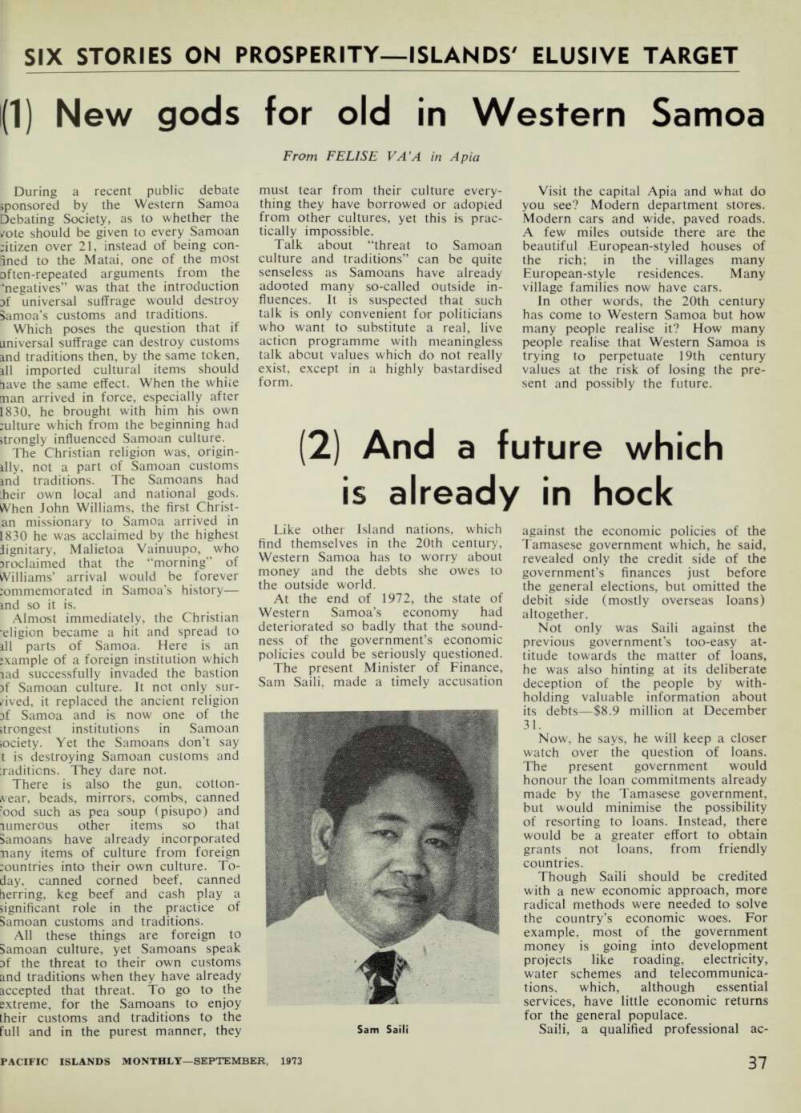

Six Stories On Prosperity—Islands' Elusive Target
(1) New gods for old in Western Samoa
From FELISE VA’A in Apia
During a recent public debate sponsored by the Western Samoa Debating Society, as to whether the vr>te should be given to every Samoan citizen over 21, instead of being con fined to the Matai, one of the most often-repeated arguments from the ‘negatives” was that the introduction of universal suffrage would destroy Samoa’s customs and traditions.
Which poses the question that if universal suffrage can destroy customs and traditions then, by the same token, all imported cultural items should have the same effect. When the white man arrived in force, especially after 1830, he brought with him his own culture which from the beginning had strongly influenced Samoan culture.
The Christian religion was, origin ally, not a part of Samoan customs and traditions. The Samoans had ;heir own local and national gods.
When John Williams, the first Christ an missionary to Samoa arrived in 1830 he was acclaimed by the highest Jignitary, Malietoa Vainuupo, who aroclaimed that the “morning” of Williams’ arrival would be forever commemorated in Samoa’s history— and so it is.
Almost immediately, the Christian •eligion became a hit and spread to all parts of Samoa. Here is an example of a foreign institution which lad successfully invaded the bastion )f Samoan culture. It not only sur /ived, it replaced the ancient religion af Samoa and is now one of the strongest institutions in Samoan society. Yet the Samoans don’t say t is destroying Samoan customs and traditions. They dare not.
There is also the gun, cotton vear, beads, mirrors, combs, canned food such as pea soup (pisupo) and lumerous other items so that Samoans have already incorporated nany items of culture from foreign countries into their own culture. To day, canned corned beef, canned tierring, keg beef and cash play a significant role in the practice of Samoan customs and traditions.
All these things are foreign to Samoan culture, yet Samoans speak Df the threat to their own customs and traditions when they have already accepted that threat. To go to the extreme, for the Samoans to enjoy their customs and traditions to the full and in the purest manner, they
must tear from their culture every thing they have borrowed or adopted from other cultures, yet this is prac tically impossible.
Talk about “threat to Samoan culture and traditions” can be quite senseless as Samoans have already adooted many so-called outside in fluences. It is suspected that such talk is only convenient for politicians who want to substitute a real, live action programme with meaningless talk about values which do not really exist, except in a highly bastardised form.
Visit the capital Apia and what do you see? Modern department stores, Modern cars and wide, paved roads, A few miles outside there are the beautiful European-styled houses of the rich; in the villages many European-style residences. Many village families now have cars, In other words, the 20th century has come to Western Samoa but how many people realise it? How many people realise that Western Samoa is trying to perpetuate 19th century values at the risk of losing the pre sent and possibly the future.
(2) And a future which is already in hock
Like other Island nations, which find themselves in the 20th century, Western Samoa has to worry about money and the debts she owes to the outside world.
At the end of 1972, the state of Western Samoa’s economy had deteriorated so badly that the sound ness of the government’s economic policies could be seriously questioned.
The present Minister of Finance, Sam Saili, made a timely accusation
against the economic policies of the Tamasese government which, he said, revealed only the credit side of the government’s finances just before the general elections, but omitted the debit side (mostly overseas loans) altogether.
Not only was Saili against the previous government’s too-easy at titude towards the matter of loans, he was also hinting at its deliberate deception of the people by with holding valuable information about its debts—sB.9 million at December 31.
Now, he says, he will keep a closer watch over the question of loans.
The present government would honour the loan commitments already made by the Tamasese government, but would minimise the possibility of resorting to loans. Instead, there would be a greater effort to obtain grants not loans, from friendly countries.
Though Saili should be credited with a new economic approach, more radical methods were needed to solve the country’s economic woes. For example, most of the government money is going into development projects like reading, electricity, water schemes and telecommunica tions, which, although essential services, have little economic returns for the general populace.
Saili, a qualified professional ac
Sam Saili
:ountant, has observed this too and i unique among his contemporaries ti that he has pushed for rapid ndustrialisation to provide employ ment for the masses of unemployed, md to help offset the frightening decreases in agricultural exports.
However, he is prepared to protect he industries already established.
Generally speaking, Saili is on the light track of what is needed to ♦ring some commonsense into the ;overnment’s economic plans. The luestion is, how far will he be pre tared to go in his industrialisation icheme and to what extent will he be imited by other factors such as ;abinet and parliament?
The previous manager of the Bank if Western Samoa, Warwick Lan ;aster, has already pointed to the vorsening state of the economy, elling local Rotarians recently that Western Samoa had a record trade leficit of $9.6 million in 1972 as igainst $5.1 million in 1971. When he value of two aircraft and one ;hip was added to the customs figures here was a total deficit of 512,181,600.
The record trade deficit was caused jy a 24.79 per cent drop in export ■eceipts and a 35.67 per cent increase n imports. But this was not all for luring 1972 there was an overall valance of payments deficit of $1.5 million, the first balance of payments leficit since 1967.
These figures do not augur well for a developing nation like Western Samoa. In fact, forecasts for the future are dim.
In 1952, agricultural exports amounted to $3,477,444 for 65,590 :ases of bananas worth $111,636, 17,037 tons of copra worth $2,173,284 and 2,448 tons of cocoa worth 51.192,524. In 1958 total exports :ame to a record $5,746,312 com prising 884,555 cases of bananas worth $2,014,378, 10,777 tons of :opra worth $1,237,318 and 4,209 :ons of cocoa worth $2,494,616. But n 1972 export figures had dropped Iramatically to $2,475,643 comprising M,334 cases of bananas, 18,632 tons Df copra worth $1,377,850 and 1,912 [ons of cocoa worth $896,376.
In 1958 the population totalled SO,OOO compared with 150,000 now, >o that there was a much higher per :apita income in 1958 than now.
The picture, according to govern ment experts, has grown worse, Banana, copra and cocoa production are well below estimated figures for export. Western Samoa faces two alternatives. One, either rapid industrialisation or two, a return to a blissful existence of native ignorance. These are the choices that Western Samoa must decide on now.
(3) Recession or levelling off?
Balance sheet for PNG
With independence coming to Papua New Guinea more than a decade after it came to Western Samoa, the country is already taking a close look at its economic position, determined to make a good start.
What does it see?
While official statistics point to a downturn in the economy of Papua New Guinea, it may be a sign of levelling off rather than a recession.
PNG has enjoyed rapid growth in the last 10 years. Now, says the Minister for Internal Finance, Mr Julius Chan, the territory will have to gear the economy to a more realistic level.
Private investment spending de clined about one-third in 1971-72 and is not expected to pick up again in the short term, says the Quarterly Statistical Bulletin, issued by the
IReserve Bank of Australia in Port Moresby.
Other pointers are fewer vehicle registrations, a fall in private fixed deposits in banks and a 14 per cent drop in savings banks deposits. How lever, capital expenditure on new plant and equipment, which increased (throughout 1971-72, has continued to irise. So has the value of new (building approvals.
Budgeted government revenue, in ispite of higher taxes and other revenue measures, is expected to rise (by only 11 per cent to $223 million, largely through a smaller than usual increase in direct taxation receipts.
This followed the slow-down in the economy, the end of special Com monwealth assistance for the Bougain ville copper project at Arawa, the famine in the Highlands, and some increased wage awards.
In the primary industries there is room for guarded optimism. The cocoa crop will be lower, but as world production for the year Sep tember, 1972-October, 1973, is ex pected to be down, while world demand is expected to rise, higher prices should compensate for the lower output.
The suspension of world coffee quotas should have a very favourable effect on Papua New Guinea as prices are rising on the export market.
Copra production in 1972 was down, while world demand is ex pected to rise, higher prices should compensate for the lower output.
The suspension of world quotas should have a very favourable effect on Papua New Guinea as prices are rising on the export market.
Copra production in 1972 was down by 5 per cent compared with 1971. Exports in the 11 months to November 30, 1972 —about 5 per cent less than for the first 11 months of 1971—were valued at $6.8 million, a little more than half the value of the 1971 copra export earnings. The copra market may be recovering generally, but it looks like a long, slow process in present conditions.
The rubber market is a little un certain, with a possibility of a further improvement in prices if the supply and demand trends of 1972 are sus tained.
Tea exports for the first five months of 1972-73 (940 tons) were 60 per cent higher than for the cor responding period of 1971-72, sugges ing a further large increase in pro duction for the current year. The average auction price paid in London for PNG tea in mid-June was 41.79 pence per kilo, or 34.31 c per lb—7 per cent below the mid-June 1972 price.
(4) Fiji project will stop food rot
Fiji got off to a good start when in dependence came in October, 1970, but there’s still a demand for outside help like that given by Australian Catholic Relief, for instance, which has funded an invention by a Roman Catholic priest. It has footed a $6,850 bill for a project which preserves and processes tapioca, breadfruit, bananas and taro.
The project is at Naililili, 15 miles from Suva on the Rewa lower delta.
Explaining the need for the food processing factory, Father Paul Coquereau said humidity resulting from annual floods and hurricanes caused almost total destruction of locally-grown foods in Rewa. Tapioca, for instance, turned black a couple of days after being dug—alternatively it rotted on the ground. The same held good for dalo, while breadfruit did not survive the rains for more than a day or so.
He discovered that all could be preserved for a couple of months if kept in airtight plastic bags but more
important still he found that the pro ducts could be dehydrated and milled into flour, opening up the concrete possibility of a Rewa delta flour in dustry which could revolutionise the district’s economy.
A highly resourceful man, Father Coquereau is a third generation mem ber of a F;*nch family of inventors.
He has already developed pilot machinery capable of drying, peeling and grating various root crops.
In his application for the grant, he said he had plans for encouraging families in the area to build drying ovens and to buy hand mills so that families could store food for their own use.
But, because people will have, for the first time, the incentive to produce more food to be processed and mar keted, he is planning a central pro cessing plant.
A large hot air drying oven, a peel ing machine and a grating machine— designed by Father Coquereau and built on the spot—are already in operation. The building of a large storage shed to keep the dehydrated food away from rats and floods has already been paid for.
What is needed now is a large building to shelter the already existing equipment and other equipment to come. He plans a building, 50 feet by 40 feet and 24 feet high with a con-
crete floor five feet above ground level to ensure protection against flood damage. Space below the floor will contain airtight rooms to hold the green roots awaiting processing.
Father Coquereau said this central mill will be able to utilise all the products of the area.
It looks something like a moon buggy— but it's the brainchild of Father Paul Coquereau. It's a most ingenious machine for skinning tapioca, before the chopping and grinding process he devised at Naililili Mission in Fiji.
(5) My Lady Nicotine is the Solomons' ex-screen star
A ban on the advertising of dgarettes in Solomon Islands cinemas oegan on July 1, which amounted to i total ban on cigarette advertising in the limited local media.
For some time cigarette manufacurers have concentrated all their advertising guns on the cinemas, ising the glossy wide-screen inducements in glorious technicolor seen n the more “advanced” countries of ;he Pacific. There’s an occasional roster on a bus in Honiara, but dial’s about it.
The government radio doesn’t KS pendent" 0 Kakamor" 8 ' monthly journal so far has not attracted anv cisarette advertising
“gh it y adven?ses the übiquiton!
Queensland beer, XXXX.
The Governing Council’s Internal Affairs Committee decided to ban the cinema advertising, rather in the same way other governments around the world have restricted or banned television advertising, and for the same reasons—so as not to encourage young people to smoke. Local cinemas are distraught, but helplessly acquiescing.
It’s only a few years ago that the government encouraged W. D. and H. O. Wills of Australia with pioneer
status and tax concessions to begin manufacturing the potent twist tobacco in Honiara as an import replacement, through a lo( r ail y‘ registered company, Solomon Islands Tobacco Company, The same incentives are not being offered to Wills to begin local manufacture of cigarettes which was discussed last year between the company and government. The weed has not got a great hold on the Solomons’ 175,000 population, even in the towns, at least partly because of t e sti ow wage s ruc^ charge* Vr cigarettes. Tw.st roHed *A used to ’ call racehorses ( y V erv owns, ready rubbed), V popular substitutes among those who are hooked.
Therefore, a big enough mar et for local manufacture would seem o rely on finding export markets in t Pacific for a Honiara-based mdus ry.
As well, the rate of excise is sti very open question, and one t e government does not seem to be in a hurry to answer, Xhe last Solomons government had a somewhat puritanical approach to such of mankind’s vices. It remains to be seen what the new government will do.
(6) NZ steps up aid to the Islands
From a Wellington correspondent
New Zealand is helping an extensive orestry development scheme on Viti -evu, Fiji. This project will be nanced under New Zealand’s •ilateral aid programme in the •acific, and New Zealand will also Tovide skilled personnel to establish ;. The New Zealand grant will mount to $300,000 and in addition p this, the New Zealand Forest lervice will help with surveying, nd vehicle and plant maintenance.
New Zealand-made pre-cut houses or staff are already going up. The ursery is well established with Caribbean pine seedlings grown from eeds imported from Guatemala. The )rasa-Lololo area is already partly lanted and new roads are being ushed into the two further blocks etween Lautoka and Ba and between Jadi and the Sigatoka River.
New Zealand’s experience in large cale afforestation made the Kiwis logical choice to carry out the lability study on the prospect of a hip export industry for Fiji, and fter the New Zealand Forest Service lade a favourable recommendation ic Fiji Government decided to go head with a scheme to plant 50,000 cres by the end of 1978. It also ecided to go along with the decision f its own Forestry Department to reduce saw logs. In Fiji’s climate, apid growth makes saw logs a ery attractive economic proposition daich can logically lead to later reduction of veneers and chips.
With the departure of the UK as major economic force in Fiji, it )oks as if New Zealand may be ble to fill the economic aid and schnical assistance gap to some ex ;nt. New Zealanders feel they have good practical understanding of the eeds of Island territories and they re certainly jacking up their Pacific iid Programme. The next three years 411 see them spending $NZ27,000,000 i Pacific aid compared to Australia’s A 15,000,000 for the same period.
The amount of aid offered and s timing depend a lot on the ter itories’ capacity to digest it and Iso on the skills available to put aid rejects into practice.
At the moment New Zealand aid i helping to rebuild Apia Hospital i Western Samoa, where agricultural
development is also being given a boost by Kiwi agricultural equipment, fencing and breeding stock. A feasibility study by Enex, the New Zealand consortium of engineering, architec tural and manufacturing skills, is looking into the construction of a new abattoir in Suva. And the same group is working on new ferry terminals between Upolu and Savaii in Western Samoa.
With all these projects the Island governments involved have primary responsibility; all decisions as to how, when and where the available funds are spent are made in consultation between the New Zealand Govern-
ment and the recipient country. This is a no-strings-attached aid pro gramme, and a nice example of Pacific co-operation, • Lord Howe Island may soon be supplying fish to the frozen market, A new fishing ship, the Lord Howe Island Trader, 65 tons, will catch fish off the island, refrigerate the catch and take it to Sydney and Melbourne markets. The Lord Howe Island Trader will probably seek cargo for the return journey. It will be able to cover the distance between the island and Australia in 48 hours. The owner of the ship is Mr Gower Wilson.
Advertisements & other items, pp. 46-50 (1 item)
S. E. Tatham
1
& CO. PTY. LTD.
SOME OF THE FIRMS
WE REPRESENT ARE:
ASKEW HOUSE, 364 LONSDALE ST.,
MELBOURNE, 3001, AUSTRALIA.
G.P.O. BOX 8—
CABLES "SET",
TELEPHONE: 601125
(Singapore Asia Rubber Works Rubber Shoes) Frappier (French Brandy) Huvet (French Brandy) Indika (Belgium Dairy Produce) Durobor S.A. (Belgium Glassware) Miroiterie Gen. de Belgiqe S.A. (Louvre glass and mirrors) City Engineers (U.K. Bicycles) F.H.I. Japan (Subaru Cars) Kraggs (Wines, Spirits, Ciders) Sunshine Biscuits Sunrise (Confectionery) Flamenco (Instant Coffee & Tea) Quaker Products (Oats, Jets) AAarchants (Canned Soft Drinks, Cordials) Hancocks (Spaghetti, Cereals) Melbourne Canning (Jams) Water Wheel (Flour, Sharps, Wheat) Amatil (Twisties, Twirlies) Edward Zorn (Margarine, Cooking Fats) Allens (Confectionery) Red Tulip (Fine Chocolates) Robert Timms (New Guinea Gold Instant Coffees and Teas) Highness (Canned Vegetables, Fruit S.P.C (Canned Fruit) S.P.C. (Abalone) Wing Lee (See You Sauce) Magnet (Mattresses) Essteel (Cookware) Warner-Drayton (Fans) Mitchell's (Abrasives) Tilbury & Lewis (Sports Trophies & Silverplate) Regent (Swiss watches) Lega Marcasite (Jewellery) Austramax (Pressure Lanterns) Preservene (Soap Products) Lawn Chair; Tubco (Garden Furniture) Sunrise Lusterton (S.S. Sinks, Plumbers Supplies) Electronic Industries (Electrical Household Appliances) Jex (Steelwool) Arnbro (Folding Beds) James Miller (Blankets) Elmaco (Plastics —Electrical B.X. (Plastics) Stegbar (Wooden Louvres) Franklite (Light Fittings) J.J. Cash (Embroidered Labels) Disston (Saws) Supa-Swift (Motor Mowers, Tractors) 1 £
BUYERS FOR THE
PACIFIC ISLANDS
Fittings) Juices)
DIRECT ENQUIRIES WELCOMED
PAPUA NEW GUINEA: S. E. TATHAM (P.N.G.) PTY. LTD.,
LAE: MALEKULA STREET (P.O. BOX 1562).
PORT MORESBY: CNR. GOROA AND MUNAHU STREETS
(P.O. BOX 6733, BOROKO).
FUJ: S. E. TATHAM (FIJI) LTD.,
LAUTOKA: P.O. BOX 366.
SUVA; G.P.O. BOX 671.
GORDON
YOUR GUARANTEE
FOR SERVICE
SINCE 1924
T. 2.
n
i?iV
pi i'
120 i ke«p m Mty efcm.rtttio*. i
■Hw Al lAIOCAII
STOWT. NSW
KEEP SLIM , TRIM
and HEALTHY . . .
take FORD PILLS
Ford Pills and the Ford Pill diet chart help you to lose that extra weight.
Ford Pills are a mild laxative containing the gentlest of ingredients to rid your body of excess fluids and toxins.
AVAILABLE FROM CHEMISTS AND
STORES EVERYWHERE.
a/ BRITISH MEDICAL LABORATORIES,
BML 115-125 Turrella Street, Turrella, N.S.W. 2205, Australia.
5
TUNING
li rn riv • \r' • 'i'A% RM \ o
Comparisons Prove
A
KENWOOD Best
H 1
Ilf,
r*- KR-5340 KR-6340 For audiophiles who feel this is the 2channel stereo receiver era —but want to be ready for 4-channel —we recommend our latest two-four receivers. They are the KR-5340 and KR-6340. They offer the most superb 2-channel reproduction characteristics with no loss of rear speaker amplifier power. Each has a BTL system that is compatible for two-four channel use. To enjoy SQ or RM merely turn the appropriate switch, and for total CD-4 sound reproduction plug in our KCD-2 disc de-modulator (except on the KR- -5340). These are stereo receivers that are ideal for the present or the future. For 2-channel or 4-channel stereo remember KENWOOD'S "two-four" and you will be prepared for either. the sound approach to quality
fKEIMWOOD
or minute information, write to: P-SECTION, TRIO ELECTRONICS, INC. 6-17, 3-chome, Aobadai. Meguro-ku. Tokyo. Japan
s u
MELBOURNE
AUCKLAND
LLI V A
SYDNEY
C. SULLIVAN (EXPORT) PTY. LTD.,
4TH FLOOR, KEMBLA BUILDING,
60 MARGARET STREET. SYDNEY
(G.P.O. BOX 3373).
CABLES AND TELEGRAMS: “CHASULL".
N S
BRISBANE
LONDON
OFFERS A COMPREHENSIVE AND EFFICIENT
BUYING SERVICE TO THE PACIFIC ISLANDS
OFFICES AT:
PORT MORESBY • LAE • RABAUL • KIETA • MOUNT HAGEN • BULUMA • SUVA • LAUTOKA • NOUMEA • HONIARA • PORT VILA
SULLIVANS for SERVICE
Ti
THE FINEST COUNTRY MADE
ICE CREAM IN THE SOUTH PACIFIC
BULK ICECREAM
In assorted flavours and fruited
STROLLAWAY SUNDAES
Assorted flavours in large round cartons
HOME PACKS
In pints, quarts and 3 pints.
Assorted flavours and fruited.
JOLLI LOLLIES
Assorted flavours: Iced lollies in Polythene
CHILLYCHUNKS STICK LINES
Assorted Ice lollies, Milk Ices and Fruit Juices Chocolate coated. In assorted flavours m 18 ?973 R.&W HELLABY LTD. Slid.
But Its A Star Challenge In Png
W. D. & H. O. Wills (Aust) Ltd is showing its confidence in the future of Papua New Guinea with a contribution of $60,000 over the next three years towards setting up a chair of administrative studies at the University of Papua New Guinea. The university, at present, offers some courses in administration in the Department of Political Studies.
The university will now be able to offer more in that field, to plan an integrated programme of political and administrative studies, and to explore ways of co-ordinating the university’s work more closely with training at the Administrative College of Papua New Guinea.
Mr J. D. Angus, manager of the South Pacific region of W. D. & H. O. Wills, said that in spite of what appeared to be a somewhat volatile situation in Papua New Guinea at present, his firm continued to have faith in its future. In addition to the endowment, which the company felt filled a very real need, Wills (PNG) Ltd had just completed extensions to the Madang manufacturing plant, involving a capital expenditure of more than $lOO,OOO.
Less than 10 of Wills staff of over 400 are expatriates, and we are making encouraging progress with the training of locals to fill all but the most senior positions,” Mr Angus said. ‘‘All in all, involvement with PNG at this vital period in its history brings with it a sense of excitement and stirring challenge.”
Advertisements & other items, pp. 51-54 (2 items)
naco
Why Naco
Louvre
Windows won
the Good
Design Award
□ Sunsash Louvre Windows conform to Australian CAS3 (1970) and U.S. Standard A. 134.1 (1968) Residential Window Code requirements in terms of water penetration, airfiltration, structural sufficiency and stiffness requirements. □ Proven features —Trouble-free operation becausetheheavy gauge paired operating bars are protected within the channels.
Double riveted assembly provides life-long strength and reliability.
Precision hotforged special alloy bearings ensure that there is no friction between clips and channels.
PILLAR NACO PTY LIMITED
BOX 715 G.P.O.
BRISBANE, 4001
AUSTRALIA
naco
OOOD'fVEAR
C 8
CROSS PLY TYRE
G 8 offers you improved wet-
skid protection smoother
handling and quieter softer
ride. Three choices:
G 8 Custom G 8
Super Cushion G 8
8 M
asac
K w t us
OOODfVEAR
0800
RADIAL PLY TYRE
You get extra tyre toughness,
longer tread life and more
fuel economy from Goodyear
GBOO, Custom GBOO Rib or
GBOO Grand Prix.
Boroko Motors Ltd.
P.O. Box 1259 Boroko. Port Moresby
Papua. NEW GUINEA
Solomon Motors Ltd.
P.O. Box 20, Mendana Avenue. Honiara Guadalcanal. SOLOMON ISLANDS Societe Generate d'Automobiles B.P, 554 Noumea
NEW CALEDONIA
Coral Island Traders P O. Box 296 Suva
FIJI
Guam Tire & Supply Co.
P.O. Box 1486 Agana
GUAM
SOHECO
B.P. 208 Port Vila
NEW HEBRIDES
Morris Hedstrom Ltd.
Apia
WESTERN SAMOA
Haleck Service Center P.O. Box 1138 Pago Pago
AMERICAN SAMOA 96920
Service Mobil B.P. 306 Papeete
TAHITI
Santo Engineers Santo
NEW HEBRIDES
Morris Hedstrom Ltd.
Nukualofa
TONGA
0640
PETER FISHER TRADIHG
PTY. LTD.
321 PITT STREET, SYDNEY, 2000, AUSTRALIA
TELEPHONE: 26-1109 CABLES: "FISHERION", SYDNEY
EXPORTERS TO THE PACIFIC
ISLANDS
Some of the firms and products we represent: GREENLITES waterproof matches LUCKY STAR tinned fish REDHEADS safety matches RENA vegetables in glass jars
MAURI BROS, yeast FOREMOST FOODS CO.
PMU food products TOOHEYS beer
CARLTON UNITED beer
CLUB RUM
ROGOVI VODKA
FRENCH KNIT car seat covers THREE STAR corned beef CRAVEN confectionery BROWNBUILT office furniture ADVANCE containers HARDIE'S building products SEBEL furniture BEARD beds and mattresses HUNTER DOUGLAS furniture KLINKII plywood STERLING bakery machinery WHITE ABBEY Scotch whisky BATA shoes SRC tinned fruit LIFESAVERS confectionery CHILTONIAN biscuits
MACHETTES
ATLAS plastic ware POLARIS stainless steel ware FOSTER —Beer in bottles or cans V.B.—Beer in bottles or cans BOND'S underwear BOND'S outerwear ANDY spotlights COUNTRY CLUB shirts FILLETTA tinned fish PAULCALL tools ASTRA razor blades WENGER quality knives GLYNGORE tinned fish VAN DER LAAN tinned meat DEROPA gift paper WARBURTON FRANKI coolrooms DURABUILT prefabricated houses THREE X (XXX) tinned hake BRONTE tinned meat HEINEKEN beer
SHEATH KNIVES
GOLDEN STATE evaporated milk SMALL chocolate TULIP chocolate
AND MANY MORE
Whatever did you do
on a diet before?”
Now you have Limmits, the perfect formula dietary food, all ready to eat as a controlled 300 calorie meal. Limmits provide vitamins and minerals and a sense of satisfaction. Enjoy a Limmits lunch and it will keep you going until dinner, without snacking.
Limmits help limit your weight because it’s the delicious square meal diet in a feast of flavours..
With more than a dozen different flavours in Limmits, you’ll find a favourite. Limmit’s goodness makes good dieting sense. Isn’t it time you changed your dieting life? With Limmits.
IMMITS
the delicious square meal diet
391
45
iCIFIC ISLANDS MONTHLY—BBPTEMBBR. 1§73
Magazine Section
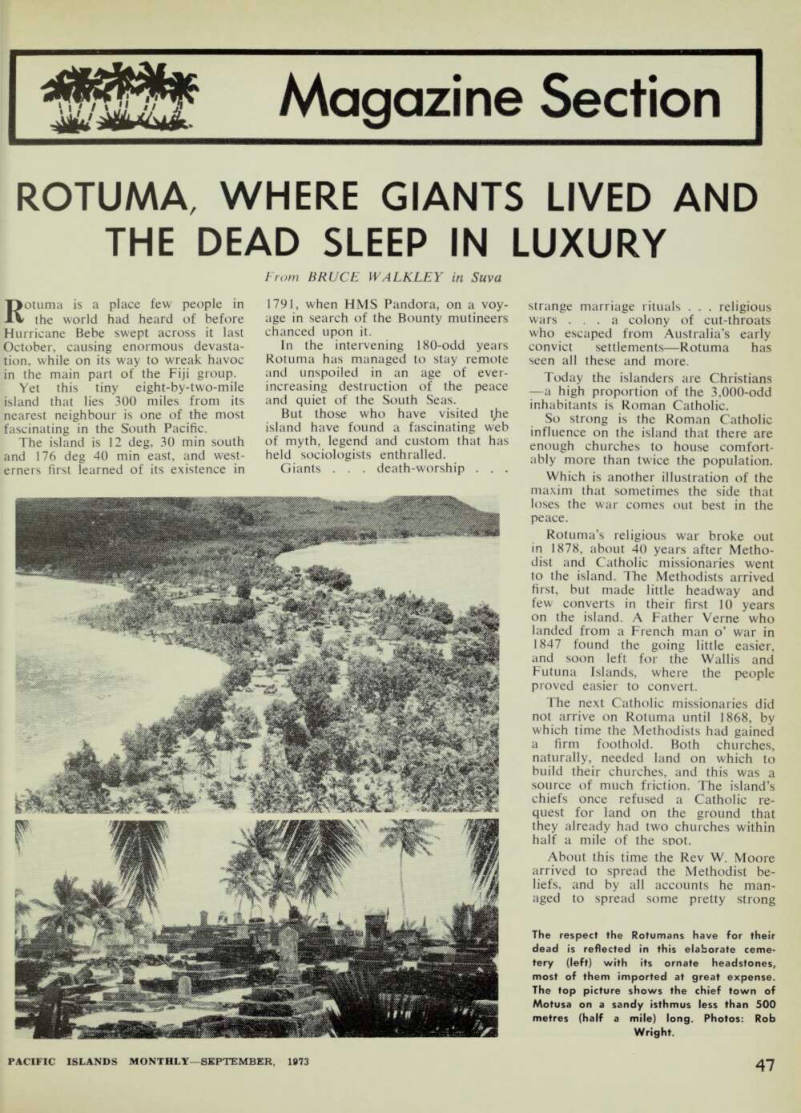

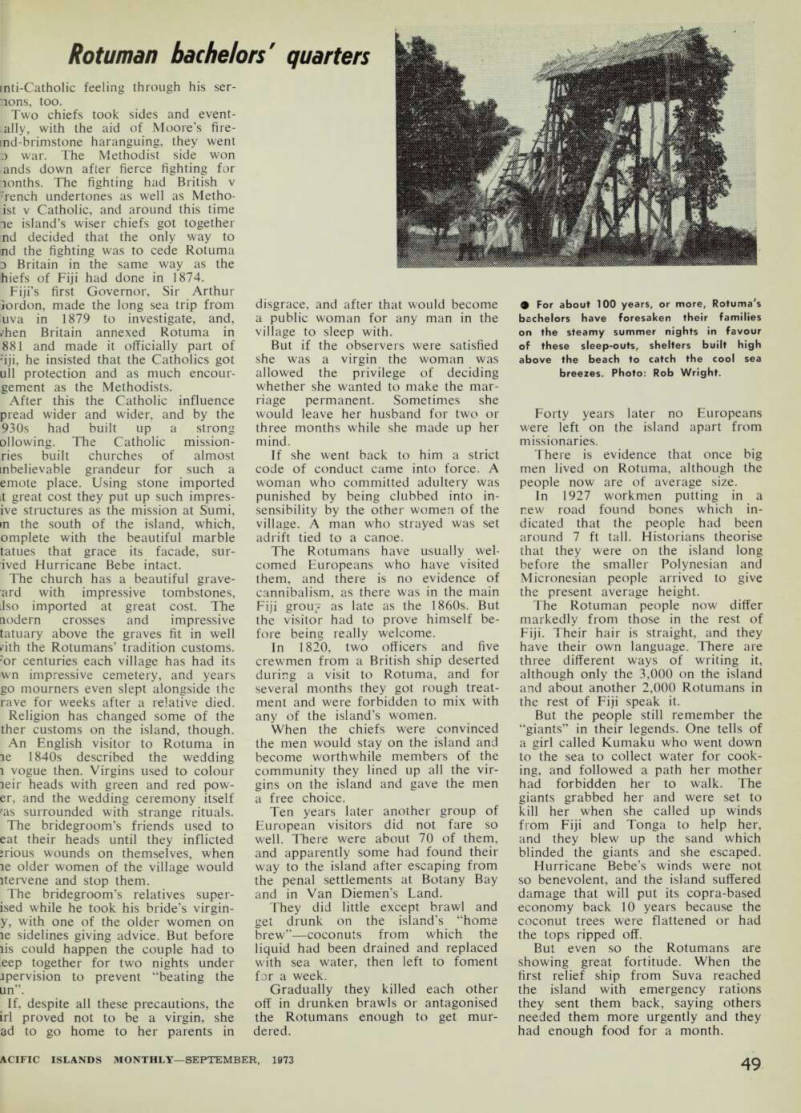
Rotuma, Where Giants Lived And
The Dead Sleep In Luxury
From BRUCE WALKLEY in Suva
Rotuma is a place few people in the world had heard of before Hurricane Bebe swept across it last October, causing enormous devasta tion, while on its way to wreak havoc in the main part of the Fiji group.
Yet this tiny eight-by-two-mile island that lies 300 miles from its nearest neighbour is one of the most fascinating in the South Pacific.
The island is 12 deg, 30 min south and 176 deg 40 min east, and west erners first learned of its existence in
1791, when HMS Pandora, on a voy age in search of the Bounty mutineers chanced upon it.
In the intervening 180-odd years Rotuma has managed to stay remote and unspoiled in an age of ever increasing destruction of the peace and quiet of the South Seas.
But those who have visited tjie island have found a fascinating web of myth, legend and custom that has held sociologists enthralled.
Giants . . . death-worship . . .
strange marriage rituals . . . religious wars ... a colony of cut-throats who escaped from Australia’s early convict settlements—Rotuma has seen all these and more.
Today the islanders are Christians —a high proportion of the 3,000-odd inhabitants is Roman Catholic.
So strong is the Roman Catholic influence on the island that there are enough churches to house comfort ably more than twice the population.
Which is another illustration of the maxim that sometimes the side that loses the war comes out best in the peace.
Rotuma’s religious war broke out in 1878, about 40 years after Metho dist and Catholic missionaries went to the island. The Methodists arrived first, but made little headway and few converts in their first 10 years on the island. A Father Verne who landed from a French man o’ war in 1847 found the going little easier, and soon left for the Wallis and Futuna Islands, where the people proved easier to convert.
The next Catholic missionaries did not arrive on Rotuma until 1868, by which time the Methodists had gained a firm foothold. Both churches, naturally, needed land on which to build their churches, and this was a source of much friction. The island’s chiefs once refused a Catholic re quest for land on the ground that they already had two churches within half a mile of the spot.
About this time the Rev W. Moore arrived to spread the Methodist be liefs, and by all accounts he man aged to spread some pretty strong
The respect the Rotumans have for their dead is reflected in this elaborate ceme tery (left) with its ornate headstones, most of them imported at great expense.
The top picture shows the chief town of Motusa on a sandy isthmus less than 500 metres (half a mile) long. Photos: Rob Wright.
Rotuman bachelors' quarters
inti-Catholic feeling through his ser nons, too.
Two chiefs took sides and event ally, with the aid of Moore’s fire md-brimstone haranguing, they went ;o war. The Methodist side won ands down after fierce fighting for lonths. The fighting had British v 'Tench undertones as well as Metho ds! v Catholic, and around this time le island’s wiser chiefs got together nd decided that the only way to md the fighting was to cede Rotuma 0 Britain in the same way as the hiefs of Fiji had done in 1874.
Fiji’s first Governor, Sir Arthur jordon, made the long sea trip from diva in 1879 to investigate, and, /hen Britain annexed Rotuma in 881 and made it officially part of 7 iji, he insisted that the Catholics got ull protection and as much encour gement as the Methodists.
After this the Catholic influence pread wider and wider, and by the 930 s had built up a strong ollowing. The Catholic mission ries built churches of almost inbelievable grandeur for such a emote place. Using stone imported it great cost they put up such impres ive structures as the mission at Sumi, »n the south of the island, which, omplete with the beautiful marble tatues that grace its facade, sur ived Hurricane Bebe intact.
The church has a beautiful grave ard with impressive tombstones, ilso imported at great cost. The lodern crosses and impressive tatuary above the graves fit in well /ith the Rotumans’ tradition customs. r or centuries each village has had its wn impressive cemetery, and years go mourners even slept alongside the rave for weeks after a relative died.
Religion has changed some of the ther customs on the island, though.
An English visitor to Rotuma in le 1840 s described the wedding 1 vogue then. Virgins used to colour leir heads with green and red pow er, and the wedding ceremony itself '■as surrounded with strange rituals.
The bridegroom’s friends used to eat their heads until they inflicted ;rious wounds on themselves, when le older women of the village would itervene and stop them.
The bridegroom’s relatives super ised while he took his bride’s virgin y, with one of the older women on le sidelines giving advice. But before lis could happen the couple had to eep together for two nights under ipervision to prevent “beating the un”.
If, despite all these precautions, the irl proved not to be a virgin, she ad to go home to her parents in
disgrace, and after that would become a public woman for any man in the village to sleep with.
But if the observers were satisfied she was a virgin the woman was allowed the privilege of deciding whether she wanted to make the mar riage permanent. Sometimes she would leave her husband for two or three months while she made up her mind.
If she went back to him a strict code of conduct came into force. A woman who committed adultery was punished by being clubbed into in sensibility by the other women of the village. A man who strayed was set adrift tied to a canoe.
The Rotumans have usually wel comed Europeans who have visited them, and there is no evidence of cannibalism, as there was in the main Fiji grou;- as late as the 1860 s. But the visitor had to prove himself be fore being really welcome.
In 1820, two officers and five crewmen from a British ship deserted during a visit to Rotuma, and for several months they got rough treat ment and were forbidden to mix with any of the island’s women.
When the chiefs were convinced the men would stay on the island and become worthwhile members of the community they lined up all the vir gins on the island and gave the men a free choice.
Ten years later another group of European visitors did not fare so well. There were about 70 of them, and apparently some had found their way to the island after escaping from the penal settlements at Botany Bay and in Van Diemen’s Land.
They did little except brawl and get drunk on the island’s “home brew”—coconuts from which the liquid had been drained and replaced with sea water, then left to foment for a week.
Gradually they killed each other off in drunken brawls or antagonised the Rotumans enough to get mur dered.
Forty years later no Europeans were left on the island apart from missionaries.
There is evidence that once big men lived on Rotuma, although the people now are of average size.
In 1927 workmen putting in a new road found bones which in dicated that the people had been around 7 ft tall. Historians theorise that they were on the island long before the smaller Polynesian and Micronesian people arrived to give the present average height.
The Rotuman people now differ markedly from those in the rest of Fiji. Their hair is straight, and they have their own language. There are three different ways of writing it, although only the 3,000 on the island and about another 2,000 Rotumans in the rest of Fiji speak it.
But the people still remember the “giants” in their legends. One tells of a girl called Kumaku who went down to the sea to collect water for cook ing, and followed a path her mother had forbidden her to walk. The giants grabbed her and were set to kill her when she called up winds from Fiji and Tonga to help her, and they blew up the sand which blinded the giants and she escaped.
Hurricane Bebe’s winds were not so benevolent, and the island suffered damage that will put its copra-based economy back 10 years because the coconut trees were flattened or had the tops ripped off.
But even so the Rotumans are showing great fortitude. When the first relief ship from Suva reached the island with emergency rations they sent them back, saying others needed them more urgently and they had enough food for a month.
For about 100 years, or more, Rotuma's bachelors have foresaken their families on the steamy summer nights in favour of these sleep-outs, shelters built high above the beach to catch the cool sea breezes. Photo: Rob Wright.
Advertisements & other items, pp. 56-58 (2 items)
Mixmaster Mixer
3 times better than any
other mixer ■ Designed especially for family food preparation. 12-speed mixfinder dial indicates the correct speed for each mixing action. Complete with 2 heat-resistant bowls and juice extractor. Sunbeam’s exclusive 3-way beating action — extra large, contained beaters, and automatic bowl movement — gives perfect aeration and more even mixing. It can handle everything from beating one egg to mixing a large fruit cake.
C*A y A lit specialists in
EXPORT QUALITY
SHOWERSCREENS
Made with • Sliding Doors • Folding Doors • Pivot Doors • Fixed Panels > k
‘SANDY’ ADJUSTABLE
ALUMINIUM VENTILATING
LOUVRE WINDOWS m—m
w
SANDY’ ALUMINIUM
GLAZING BAR FOR
ECONOMICAL SIDEWALL
GLAZING
ALUMINIUM SHOPFRONTS,
ENTRANCES AND WINDOW WALLS
JAAAES SANDY & COY.
637 GARDENERS ROAD, MASCOT, N.S.W., 2020, AUSTRALIA.
49
ACIFIC ISLANDS MONTHLY—SEPTEMBER, 1973
Rescuing
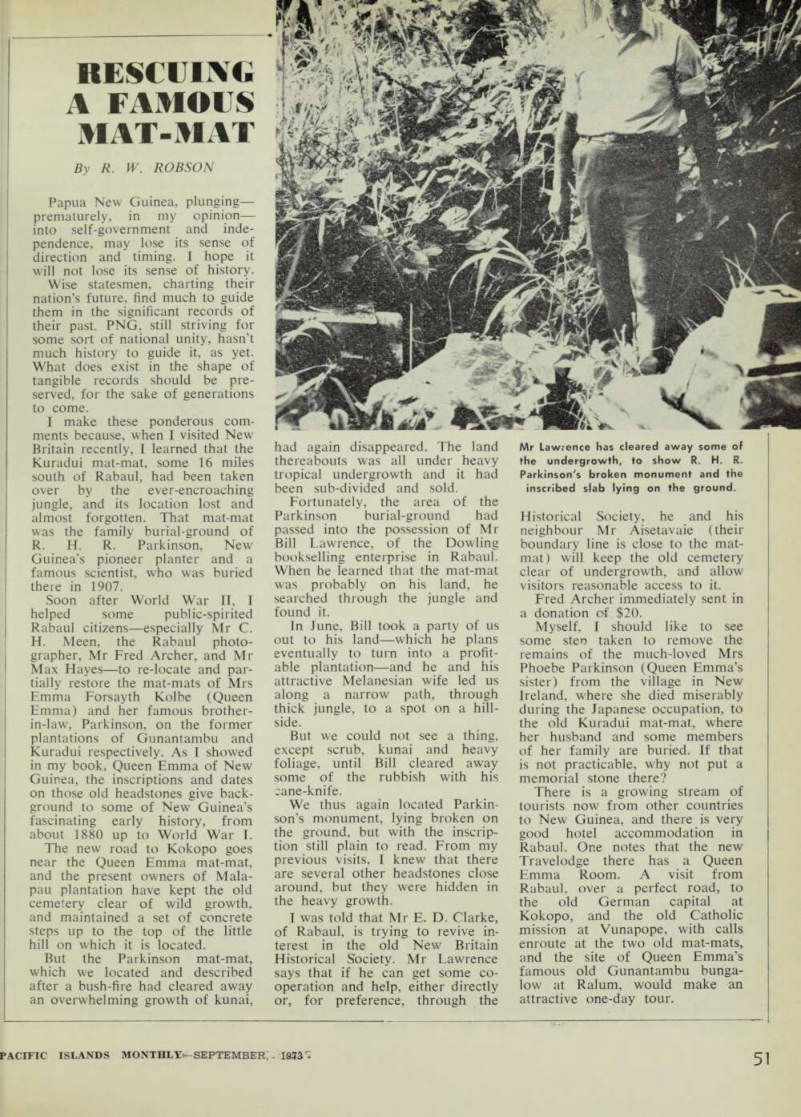
A Famous
Mat-Mat
By R. W. Robson
Papua New Guinea, plunging— prematurely, in my opinion— into self-government and inde pendence, may lose its sense of direction and timing. I hope it will not lose its sense of history.
Wise statesmen, charting their nation’s future, find much to guide them in the significant records of their past. PNG, still striving for some sort of national unity, hasn’t much history to guide it, as yet.
What does exist in the shape of tangible records should be pre served, for the sake of generations to come.
I make these ponderous com ments because, when I visited New Britain recently, I learned that the Kuradui mat-mat, some 16 miles south of Rabaul, had been taken over by the ever-encroaching jungle, and its location lost and almost forgotten. That mat-mat was the family burial-ground of R. H. R. Parkinson, New Guinea’s pioneer planter and a famous scientist, who was buried there in 1907.
Soon after World War 11, I helped some public-spirited Rabaul citizens—especially Mr C.
H. Meen, the Rabaul photo grapher, Mr Fred Archer, and Mr Max Hayes—to re-locate and par tially restore the mat-mats of Mrs Emma Forsayth Kolbe (Queen Emma) and her famous brother in-law, Parkinson, on the former plantations of Gunantambu and Kuradui respectively. As I showed in my book, Queen Emma of New Guinea, the inscriptions and dates on those old headstones give back ground to some of New Guinea’s fascinating early history, from about 1880 up to World War I.
The new road to Kokopo goes near the Queen Emma mat-mat, and the present owners of Mala pau plantation have kept the old cemetery clear of wild growth, and maintained a set of concrete steps up to the top of the little hill on which it is located.
But the Parkinson mat-mat, which we located and described after a bush-fire had cleared away an overwhelming growth of kunai,
had again disappeared. The land thereabouts was all under heavy tropical undergrowth and it had been sub-divided and sold.
Fortunately, the area of the Parkinson burial-ground had passed into the possession of Mr Bill Lawrence, of the Dowling bookselling enterprise in Rabaul.
When he learned that the mat-mat was probably on his land, he searched through the jungle and found it.
In June, Bill took a party of us out to his land—which he plans eventually to turn into a profit able plantation—and he and his attractive Melanesian wife led us along a narrow path, through thick jungle, to a spot on a hill side.
But we could not see a thing, except scrub, kunai and heavy foliage, until Bill cleared away some of the rubbish with his ::ane-knife.
We thus again located Parkin son’s monument, lying broken on the ground, but with the inscrip tion still plain to read. From my previous visits, I knew that there are several other headstones close around, but they were hidden in the heavy growth.
I was told that Mr E. D. Clarke, of Rabaul, is trying to revive in terest in the old New Britain Historical Society. Mr Lawrence says that if he can get some co operation and help, either directly or, for preference, through the
Historical Society, he and his neighbour Mr Aisetavaie (their boundary line is close to the mat mat) will keep the old cemetery clear of undergrowth, and allow visitors reasonable access to it.
Fred Archer immediately sent in a donation of S2O.
Myself, I should like to see some sten taken to remove the remains of the much-loved Mrs Phoebe Parkinson (Queen Emma’s sister) from the village in New Ireland, where she died miserably during the Japanese occupation, to the old Kuradui mat-mat, where her husband and some members of her family are buried. If that is not practicable, why not put a memorial stone there?
There is a growing stream of tourists now from other countries to New Guinea, and there is very good hotel accommodation in Rabaul. One notes that the new Travelodge there has a Queen Emma Room. A visit from Rabaul, over a perfect road, to the old German capital at Kokopo, and the old Catholic mission at Vunapope, with calls enroute at the two old mat-mats, and the site of Queen Emma’s famous old Gunantambu bunga low at Ralum, would make an attractive one-day tour.
Mr Lawrence has cleared away some of the undergrowth, to show R. H. R.
Parkinson's broken monument and the inscribed slab lying on the ground.
Yesterday
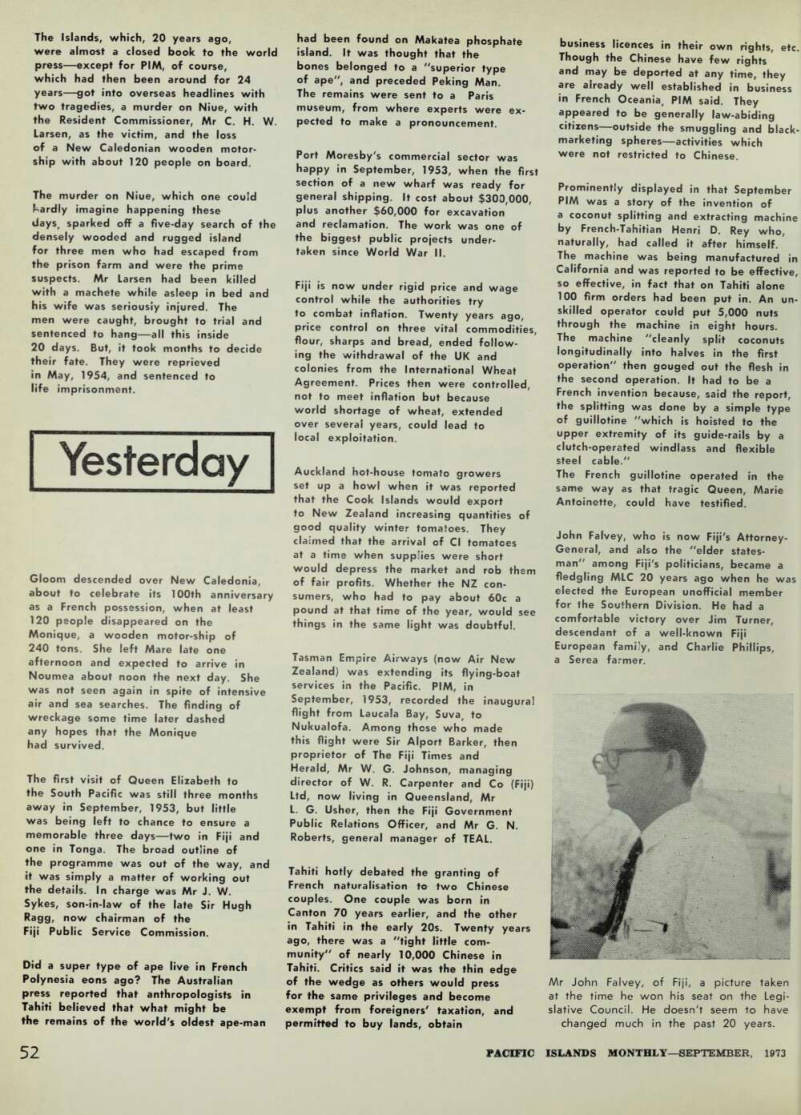
The Islands, which, 20 years ago, were almost a closed book to the world press —except for PIM, of course, which had then been around for 24 years —got into overseas headlines with two tragedies, a murder on Niue, with the Resident Commissioner, Mr C. H. W.
Larsen, as the victim, and the loss of a New Caledonian wooden motor ship with about 120 people on board.
The murder on Niue, which one could hardly imagine happening these days, sparked off a five-day search of the densely wooded and rugged island for three men who had escaped from the prison farm and were the prime suspects. Mr Larsen had been killed with a machete while asleep in bed and his wife was seriously injured. The men were caught, brought to trial and sentenced to hang—all this inside 20 days. But, it took months to decide their fate. They were reprieved in May, 1954, and sentenced to life imprisonment.
Gloom descended over New Caledonia, about to celebrate its 100th anniversary as a French possession, when at least 120 people disappeared on the Monique, a wooden motor-ship of 240 tons. She left Mare late one afternoon and expected to arrive in Noumea about noon the next day. She was not seen again in spite of intensive air and sea searches. The finding of wreckage some time later dashed any hopes that the Monique had survived.
The first visit of Queen Elizabeth to the South Pacific was still three months away in September, 1953, but little was being left to chance to ensure a memorable three days— two in Fiji and one in Tonga. The broad outline of the programme was out of the way, and it was simply a matter of working out the details. In charge was Mr J. W.
Sykes, son-in-law of the late Sir Hugh Ragg, now chairman of the Fiji Public Service Commission.
Did a super type of ape live in French Polynesia eons ago? The Australian press reported that anthropologists in Tahiti believed that what might be the remains of the world's oldest ape-man
had been found on Makatea phosphate island. It was thought that the bones belonged to a "superior type of ape", and preceded Peking Man.
The remains were sent to a Paris museum, from where experts were ex pected to make a pronouncement.
Port Moresby's commercial sector was happy in September, 1953, when the first section of a new wharf was ready for general shipping. It cost about $300,000, plus another $60,000 for excavation and reclamation. The work was one of the biggest public projects under taken since World War 11.
Fiji is now under rigid price and wage control while the authorities try to combat inflation. Twenty years ago, price control on three vital commodities, flour, sharps and bread, ended follow ing the withdrawal of the UK and colonies from the International Wheat Agreement. Prices then were controlled, not to meet inflation but because world shortage of wheat, extended over several years, could lead to local exploitation.
Auckland hot-house tomato growers set up a howl when it was reported that the Cook Islands would export to New Zealand increasing quantities of good quality winter tomatoes. They claimed that the arrival of Cl tomatoes at a time when supplies were short would depress the market and rob them of fair profits. Whether the NZ con sumers, who had to pay about 60c a pound at that time of the year, would see things in the same light was doubtful.
Tasman Empire Airways (now Air New Zealand) was extending its flying-boat services in the Pacific. PIM, in September, 1953, recorded the inaugural flight from Laucala Bay, Suva, to Nukualofa. Among those who made this flight were Sir Alport Barker, then proprietor of The Fiji Times and Herald, Mr W. G. Johnson, managing director of W. R. Carpenter and Co (Fiji) Ltd, now living in Queensland, Mr L. G. Usher, then the Fiji Government Public Relations Officer, and Mr G. N.
Roberts, general manager of TEAL.
Tahiti hotly debated the granting of French naturalisation to two Chinese couples. One couple was born in Canton 70 years earlier, and the other in Tahiti in the early 20s. Twenty years ago, there was a "tight little com munity" of nearly 10,000 Chinese in Tahiti. Critics said it was the thin edge of the wedge as others would press for the same privileges and become exempt from foreigners' taxation, and permitted to buy lands, obtain
business licences in their own rights, etc.
Though the Chinese have few rights and may be deported at any time, they are already well established in business in French Oceania, RIM said. They appeared to be generally law-abiding citizens—outside the smuggling and black marketing spheres—activities which were not restricted to Chinese.
Prominently displayed in that September RIM was a story of the invention of a coconut splitting and extracting machine by French-Tahitian Henri D. Rey who, naturally, had called it after himself.
The machine was being manufactured in California and was reported to be effective, so effective, in fact that on Tahiti alone 100 firm orders had been put in. An un skilled operator could put 5,000 nuts through the machine in eight hours.
The machine "cleanly split coconuts longitudinally into halves in the first operation" then gouged out the flesh in the second operation. It had to be a French invention because, said the report, the splitting was done by a simple type of guillotine "which is hoisted to the upper extremity of its guide-rails by a clutch-operated windlass and flexible steel cable."
The French guillotine operated in the same way as that tragic Queen, Marie Antoinette, could have testified.
John Falvey, who is now Fiji's Attorney- General, and also the "elder states man" among Fiji's politicians, became a fledgling MLC 20 years ago when he was elected the European unofficial member for the Southern Division. He had a comfortable victory over Jim Turner, descendant of a well-known Fiji European family, and Charlie Phillips, a Serea farmer.
Mr John Falvey, of Fiji, a picture taken at the time he won his seat on the Legi slative Council. He doesn't seem to have changed much in the past 20 years.
Advertisements & other items, pp. 61-68 (1 item)
for extra freshness
Come up to Kool
jt. •sj! >: xc ■ it ' lH
KQDi
/ m 3. #* :. n* 1 t; li n m P 5 m U597-8/71
Great stereo sound
starts right here*
By buying one of Sansui’s famous stereo amplifiers, you can select exactly the right power, price and performance necessary for your own listening area.
You needn’t over-buy or under-buy in stereo talk to your nearest Sansui dealer who will be happy to help you with selection.
AU-999 70/70 Watts, Distortion (max.); 0.4% AU-888 50/50 Watts, Distortion (max.): 0.4% I i| AU-666 45/45 Watts, Distortion (max.): 0.5 '• * « s % o- - AU-505 35/35 Watts, Distortion (max.): 0.5% AU-101 18/18 Watts, Distortion (max.): 0.8% m : m m % (• t • 0 AU-555A 33/33 Watts, Distortion (max.): 0.5% Fiji: PRABHU BROTHERS LTD., P.O. Box 183, Nadi. Tel: 70183 Papua/New Guinea: OCEANIA INDENT AGENCY. P.O. Box 5518, Boroko, Port Moresby. Tel: 56406 New Caledonia: MICHEL MERCIER, Angle Des Rues Alma-Sebastopol, B.P. 1123, Noumea. Tel; 59-11 et 40-78 Norfolk Island: MILTONS DEPARTMENT STORES LTD. P.O. Box 146, Norfolk Island 2899.
Tahiti: SERVONNAT, Rue des Polius, Tahitiens Pateete. Tel: 03-29
Sctn^uA
SANSUI ELECTRIC CO., LTD., 14-1, 2-chome, Izumi, Suginami-ku, Tokyo 168, Japan
1 wlU* mm r ■ >/•-, .. *. ■ - ' " * #* - •** '■ •Av*.**^*-.;-.**- '•-“M" "-.-I
MftWSiKr
.JS&7?pt
<r & 3t s ■ *':
SES«
9 • « • f *3 l a " r ••* * * r ' , ***&&& ‘' . 4. V- . •-. „• ■'• '**.'' * I**-’' -• ;• ; ..- *,, ■ V 'M-"'
V ••:^.i..,*V<^*»»HV;
\ >ls£3 *jSj[ >-'"-=4 2 a '
AA%#fe ; - *• w
, **■* »-u .'■' u The flag we’ve flown for a hundred years.
Two paddle steamers on the Yangtse River in 1873 marked the beginning of the China Navigation Company. Today, the same Flag flies above eighteen modern motor ships plying an extensive network of cargo routes between Papua New Guinea and Pacific Island ports (as far East as Tahiti) and Japan, New Zealand, Australia
and Thailand.
For 100 years, the flag of the China Navigation Company has meant experience, reliability and speed across the sea. Today, it’s flying as strong as ever.
For further details and all enquiries there are Agents .it the following ports: Papua New Guinea: Steamships I radmgCo. Ltd.. I ort Moresby, Samarai, Lae Madang, Rah,ui 1. Kieta Burns Fhilp (New Guinea] Ltd.. Wewak. Kavieng. Fiji: Morns Hedstrom Ltd.. Suva. Lautoka. Western Samoa: Morns Hedstmm Ltd., Apia, Tonga: Morris Hedstrom Ltd.. Nukualofa and VavaTi. Tahiti: Ktablissements Donald, Tahiti. Papeete. New Caledonia: Ltabhssements Ballande Noumea. 8.5.1. P.; British Solomons Trading Co. Ltd., Honiara. New Hebrides: Les Comptoirs Francais des Nouvelles-Hebndes, \ i la and Santo. AUSTRALIA—Sydney: Interocean Swire Ftv. Ltd. Melbourne: Interocean Australia Services Ptv. Ltd. Brisbane; Wills. Cilchnst & Sanderson Pty. Ltd. NEW ZEALAND— P &O. (N.Z.) Ltd Auckland, Wellington. Christchurch. Dunedin, Bluff, Napier. Japan: Swire McKinnon, Tokyo, Yokohama. Osaka, Kobe and Nagoya. Eastern Managers: Butterfield & Swire, 9 Connaught Rd., Central, Hong Kong.
ON co JOHN SWIRE & SONS PTY. LTD. General Agents in Australia, 8 Spring Street, Sydney, Phone: 27 9351.
THE CHINA NAVIGATION CO LTD
MEMBER OF THE SWIRE GROUP.
IS 008
’V . .
' f, v- it v" * ''v*' vi •'* * • » - * • t ** v - ■' . ' *, v ,*‘ ..«" - , , *. . • ►■( * .• I 4 .fr «, \ * T. .‘ • ... ‘ v •v; / ’ .** ■ jtv » v ' • ■ - * • . -vj -' -v i*> * * * * *'.■».*»» «■>.-■ ■ ,r- ' - v -« v * * >. •■* • * ♦ * ’!*■■»> ■ > > ,' '' , ♦ v * t ' A : '* ’
V v ■X ■ •*. % * • ■ -., ♦ v •» * V
1 f 1 r.. "v* -
* * / *. * i . * ‘ - •'•■ : •
I ‘f". J'
V \ ■ ' s*i ; V ■* S - 4®
and Cruiser
) YOT A
Dyna IMUlniii. Cl
Get through
v with a Toyota
When the going gets roughest, depend on Toyota to get you through everytime.
Road conditions, water,extremes of heat and cold-nothing, but nothing stops Toyota from coming through for you with the biggest loads faster and more economically.
World-famous for the engineering excellence of its automobiles, Toyota also makes a complete line of rugged, versatile commercial vehicles designed to keep costs down, profits rising.
The Toyota Land Cruiser defies all obstacles to get the job done.
The Dyna and Stout trucks come through better in the light and medium pickup categories, while the Hi-Ace makes an excellent all-purpose vehicle.
For the big jobs, Toyota offers the heavy-duty truck - to keep profits rising load after load. And for the big family, Toyota offers two roomy station wagons - the trusty Toyota 1000 and the luxurious Corolla.
Make it a point to see your nearest Toyota dealer soon. When you do, ask him to prove how Toyota can keep coming through for you again and again.
TOYOTA Stout TOYOTA Land Cruiser
TOYOTA 1000
TOYOTA Truck
TOYOTA
■■l I * BT (hi r;r
TOYOTA Hi Ace
TOYOTA Corolla PAPUA NEW GUINEA: ELA MOTORS LIMITED. Scratchley Rd., Badili, Papua U.S. TRUST TERRITORY: MICROL CORPORATION, P.O. Box 267, Saipan FIJI ISLANDS: AUTOMOTIVE SUPPLIES CO., LTD., G.P.O. Box 355, Suva AMERICAN SAMOA: BURNS PHILP (SOUTH SEA) CO., LTD ,Pago Pago WESTERN SAMOA: BURNS PHILP (SOUTH SEA) LTD., P.O. Box 188, Apia GUAM: RICKY's AUTO CO., P.O. Box 1458, Agana NEW HEBRIDES: NEW HEBRIDES MOTORS LTD., P.O. Box 18, Vila SOLOMON ISLANDS: ZEPHYR SERVICE STATION PTY LTD., P.O. Box 174, Honiara NEW CALEDONIA: SOCIETE D'IMPORTATION AUTOMOBILE DU PACIFIC, B.P. 438, Noumea TAHITI: ETABLISSEMENTS E.A. MARTIN & FILS, B.P. 61 Papeete COOK ISLANDS: COOK ISLANDS TRADING CORPORATION LTD., P.O. Box 92, Rarotonga
r o a 9 n IS
®QfIE
■ : 000 * • h .- ': ■: ■: : ■ • ■
ysi&
i
mefNsm
25 KGKfr
*1 1 I MH iii ■ 1 S* ." A§ £ * ■> - 4 sm i ■■■
the most important ingredient
BREAD FLOURS:
CAKE FLOURS:
BISCUIT FLOURS:
SPECIALITY FLOURS:
® MAINTOP—high protein bread Hour • ANCHOR—bakers flour • 50/50 MEAL —brown bread • MEDlUM—cake and pastry • SPONGE —sponge cakes • SPECIAL CAKE—madeira and cup cakes • STRONG—cracker biscuits • MEDIUM —Shortbreads • SOFT—sweet biscuits • RYE flour • RYE meal • KIBBLED RYE • SHARPS— roti and chapati flour • 100% STONE GROUND
WHOLEMEAL
GILLESPIE BROS. PTY. LTD.
HEAD OFFICE: BRISBANE OFFICE:
52 UNION ST., PYRMONT, SYDNEY, N.S.W. CABLE ADDRESS; ALBION, BRISBANE, QUEENSLAND. (G.P.O. BOX 2518, SYDNEY, 2001.) "GILLESPIE", (P.O. BOX 8, ALBION, BRISBANE, 4010.) PHONE; 660-4933. SYDNEY AND BRISBANE. PHONE; 6-1121.
The fun things in life.
Suzuki takes you close-up.
What makes Suzuki bikes the popular choice of fun-loving people 1 everywhere? A tradition of excellence. In the performance that characterizes going with a Suzuki. In the engineering that has made and continues to make Suzuki a choice of Grand Prix and pleasure-day champions. And in safety.
There’s no more sure, nor safer —nor more pleasurable way to get close-up to the fun in life. The same holds true for our other products. Rough-terrain, 4-wheel drive vehicles and outboard motors. On land and water, quality uncompromised when it’s Suzuki. $
SUZUKI
SUZUKI MOTOR CO., LTD
P.O. Box 116, Hamamatsu 430, Japan - • * GUAM ISLAND CYCLERY • PONAPE LEO ETSCHEIT • YAP YAP COOPERATIVE ASSOCIATION - TARAWA GILBERT & ELLICE ISLANDS DEVELOPMENT AU- THORITY • NAURU CAPELLE & PARTNER • FIJI MOTIBHAI & CO.. LTD. • TONGA MORRIS HEDSTROM LTD. • NIUE BURNS PHILP (SOUTH SEA) COMPANY, LTD. • WESTERN SAMOA TRANS PACIFIC DEVELOPMENT CO.. LTD. • NEW GUINEA 8. PAPUA TUTT BRYANT PACIFIC LTD. • BRITISH SOLOMON CHAN WING MOTORS LTD. • NEW HEBRIDES HENRI LEROUX • NEW CALEDONIA SUPERCAL • TAHITI ETS. EMILE A. MARTIN & FILLS • NORFOLK MARTIN’S AGENCIES LTD.
t & vV ir i. ofo .:, ?V H o * 56P k up \K ,v;/: So ? % w
Maa/A
Contributors in this month’s MANA are Nathalia Buamai and Monica Yadiwalya, both of New Britain, Kenneth Fakamuria, of Futuna, with a custom story from the New Hebrides, Claire Blatter and B. S. Deo, both from Fiji, and Tongan writer Konai Helu Thaman, an MA student in the USA who has already published in MANA.
It’s a double-headed interview this issue as Marjorie Crocombe talks with two Tongan musicians, Peni Tutu’ila Malupo and Semisi Ma'u.
Fiji Villagers And Birth Control
By B. S. Deo
FPHE importance of haying a -*■ manageable-sized family is better realised by the urban dwellers in Fiji.
It’s more an economic consideration for them than anything else. But the government’s attempt to control the rapid increase of birth rate in the rural areas has not been very successful. The country dwellers seem to have a very indifferent attitude towards family planning.
To wish that destiny might be kind is one matter; to seek actively the prevention of birth is another for the villagers—be they Indians or Fijians-the two major ethnic Soups in Fiji. 8 p Ihe idea of birth control has been so fascinating that I decided to do some research on it. Recently, an Indian woman m a village told me, it the soul of a dead person wishes to be reborn into your family, it u-°!i d a s i n t 0 Prevent its birth. We will pay for such acts in our next life. Children which God wishes to give you, must be allowed to be born. I suppose her ideas well illustrate the comparatively fewer
cases of abortion we see in villages than in the urban areas. Urban girls in Fiji—they love to have sex with all precautions against conception.
But once they become pregnant by any error, they hate to pass through their complete gestation period. Thus the crime of abortion, committed increasingly by the urban dwellers, has become a political issue today.
Any pregnancy should result in su<^ sf f confinement—this is the £° ICe a ? y r '? U . age community in FlJ u • rh ! bell< r f l n J reincarnation is a bas ?f tei J e VP Indian . culture. But m l plte of * hls a ma J ont y of tbe mothers would welcome some morally suitable relief from the imminent arrival of the next baby. rpHE attitudes of men towards A family size and birth control are not modified by the burden of child-bearing and child-care. Villagers want more children, especially sons “Children mean prosperity”. Not even once, in my extensive discussion with village men, was there a mention of the difficulties of child-care in the villages. In each case, I found
that the husband has no concern and no part to play with these difficulties, He accepts child-care as the natural function of his wife. The personal trials and burdens of parenthood are almost wholly the mother’s. The husband is only concerned about being the proud father of a large family, and being a “more potent” male compared with those men who have fewer children. In the case of impotent husbands their wives always desire “more masculine” males. Thus, the larger a rural father’s family the greater is his dignity and in the villa 8 e - Through children, especially sons, the villager gains status as a man and is assured that his responsibilities will be inherited by others and that he himself will have security in old age. The wife has no avenue of escape from the increasing demands made upon her by the growing family The fathers work only slightly harder to provide for a larger family. Un fortunately, this tendency is more marked among the native Fijians who have easy access to more land On a very small scale the pressure of land
shortage is awakening some of the Indian farmers these days.
The husband’s sexual authority is the most important single element for an understanding ot tertility. lime and again the word “property” ap pears describing the wife, or in pro miscuous sex relations. Once a woman is given in marriage, she is expected to stick to her husband. How trying her married life may be, is irrelevant.
To speak frankly, some husbands seem obsessed with sex. Their wives are commodities for sexual satisfac tion rather than real partners in life.
It isn’t presumptuous of us to believe that the villagers have a com paratively greater inclination towards sexual pleasures probably because they lack any other attractive re creational facility in the country.
WHEN charged with the animal instincts the villagers easily overlook the importance of con traception. No doubt, the village
women get impregnated more often than their urban counterparts. Newly married village couples teel than contraceptive devices will hinder their complete satisfaction in sex. The result—an average of five or more children are added to the couple within a decade of their married life.
Tt • tW remote areas girls are fre tl married soon § after nubertv
girl feL
fnlrtu tv In
n c • t t , ’ - th onH v,ll^ H es P ro I es , 8 F th ti g n f ‘ ir l * y • . rhilH o e en g .
Only a substantial minority of village women today are trying to reduce frequency of their pregnancies.
Lack of technical knowledge is perhaps no greater a handicap than the unsympathetic attitude of the dominant males. It seems fair to con-
elude that if the village women were
provided with simple contraceptive
techniques which were made con sistent with moral precepts, and if the techniques were used without the husband’s knowledge, the more young mothers of several children would use them.
However, the secret use of con traceptive devices is less probable, An actlve Famil y Planning Campaign is tr y in § t 0 reduce the birth-rate in the country. Unfortunately, the cam paign is less successful in rural areas wh?re most people are still un educated and very unyielding to any change in personal life, It is always difficult to tell what a villager feels about the govern ment’s attempts to control the present birth-rate. Recently, some village boys told me that condoms pro vided good baits for their fishing hooks in streams and rivers. I wish condoms were originally designed for catching fish.
The First Coconut
By Kenneth Fakamuria
ONCE on the island of Futuna there lived a man and his wife and their 10 children. They lived in a little village near the coast.
One day the father told his children to go fishing on the reef so they set off. When they reached the reef they started fishing but suddenly it began to pour with rain so they gave up and went home, all except for one girl, who was frightened of the rain and ran inside a cave to take shelter.
As she was sitting there in the cave listening to the waves breaking and splashing, she suddenly felt that there was someone with her in the cave. Who could it be? She looked around but she could see no one.
Then she leapt to her feet ready to run, and as she looked around again she saw a monstrous sea-snake, grotesquely striped with black and white, with an ugly skin and a body as thick as the trunk of a coconut tree.
At first she could not believe her eyes but after a moment of hesitation, she came to herself and was terrified. Yet what could she do? She could not escape from the horrible creature which approached and slithered round her.
At last she gave herself up for lost, expecting every moment to be swallowed. Instead she heard a strange noise, and looking up, she saw that this frightening creature was speaking with its mouth wide open like a door, but with a high voice like the voice of a young man. As she listened this creature told her that they should get married. You can imagine how upset she felt but there was nothing she could do, so she nodded her head and said nothing.
THE two of them got married and lived together for some years. One strange thing about the snake was that in the evenings it changed and took the form of a young man but during the day it was a snake again.
This made the wife more fond of her strange husband and they lived together happily until they had a son.
One day the wife decided it would be a good idea for her to go back and visit her friends and relations in her own village so she went and told them to prepare to receive her and her husband. The people of the village, men, women and children, set to work and cleaned up the village until not the slightest piece of rubbish could be seen lying about.
The next morning the three of them set out, the wife and son walking in front while the snake dragged itself heavily along behind them. As they approached the village, they could hear the noise of the drums throb bing, getting louder and louder and louder. A strange sense of doom and foreboding came to the snake and he knew what was going to happen. He said to his wife, “If the village people kill me and cut me into pieces, take my head and plant it.” His wife kept his words to herself and pondered on them as they walked along.
At last they arrived and there was a tense silence as the villagers gazed at the strange trio, the beautiful woman and her little child and the huge monstrous sea-snake coiled at their feet. They were confused and disturbed by what they saw for they had not expected to see the snake. They determined to kill it. They set upon it and cut it to pieces. Before they could throw away the head though, the wife came and took it and planted it near her house. On the fifth day she saw a small shoot sticking cut of the ground.
Every day she visited this shoot until it grew into a tall coconut palm and bore fruit. When these fell down she took them and used their milk for pudding.
One day she gave a piece of pudding to her little son and he took it to eat when he went to play with the other boys. When they saw the pudding, they all wanted to taste it but, finding it so sweet, they ate it so greedily that they bit the little boy’s hand. Crying bitterly, he ran back to his mother, and she in anger, climbed to the top of the coconut tree, picked the nuts and threw them to all the other islands. That is why today, you will find coconuts growing not only on Futuna but on all the islands of the New Hebrides.
Arts Council In Guam Is
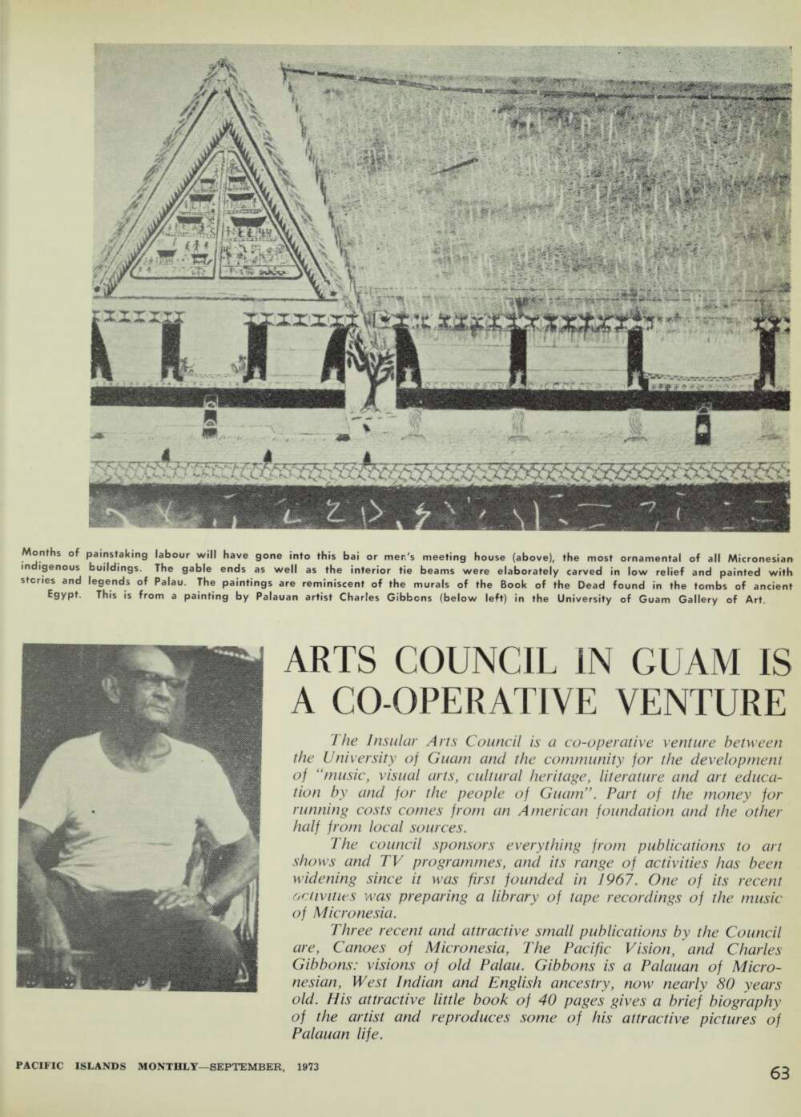
A Co-Operative Venture
The Insular Arts Council is a co-operative venture between the University of Guam and the community for the development of “music, visual arts, cultural heritage, literature and art educa tion by and for the people of Guam”. Part of the money for running costs comes from an American foundation and the other half from local sources.
The council sponsors everything from publications to art shows and TV programmes, and its range of activities has been widening since it was first founded in 1967. One of its recent activities was preparing a library of tape recordings of the music of Micronesia.
Three recent and attractive small publications by the Council are, Canoes of Micronesia, The Pacific Vision, and Charles Gibbons: visions of old Palau. Gibbons is a Palauan of Micro nesian, West Indian and English ancestry, now nearly 80 years old. His attractive little book of 40 pages gives a brief biography of the artist and reproduces some of his attractive pictures of Palauan life.
Months of painstaking labour will have gone into this bai or men's meeting house (above), the most ornamental of all Micronesian indigenous buildings. The gable ends as well as the interior tie beams were elaborately carved in low relief and painted with stones and legends of Palau. The paintings are reminiscent of the murals of the Book of the Dead found in the tombs of ancient Egypt. This is from a painting by Palauan artist Charles Gibbons (below left) in the University of Guam Gallery of Art.
The Magic Of The Red Paint
Two stories from New Guinea
By Nath Alia Bumamai
During the early hours of the morning, 1 could hear my elder brother already out of bed, combing his hair and humming a happy tune at the same time. From his excite ment I gathered he had already been down to the beach. This was very unusual for him to be up and dressed so early in the morning.
I had always accompanied my brother wherever he went, but for the last couple of days 1 had been ignored, and he was going out alone and returning home late at night.
He had asked me to trim his hair and he looked quite smart with his new hair style. I was thinking to my self that these days he seemed un usually excited, and I was becoming suspicious.
“Wake up and find my basket,” he called. 1 was taken aback by surprise and fear gripped me, because lately he seemed to have changed and very quickly could become angry with me.
Now he was shaking me violently.
“Where is my basket?” he de manded. He pushed me outside but I had difficulty in seeing as the morning light was dim and I was still suffering from the shock of the violent shaking he gave me. We were both outside searching for the basket.
I found it at last and handed it over to him and he became quiet again.
“What’s so important about the basket that you have to wake me in the early morning like this?”
“You’re getting older now and you should know something about our village people and their customs— how they do magic for certain things under certain circumstances. Waking early this morning is very important to me because what I have in this basket has regulations to be followed and will help get a wife. You see, during the last few days, when I was away, I met two men. When I saw them first they were doing some thing strange, so I squatted on the ground to get a closer view of them.
I could see the two girls working very hard in their garden under the heat of the tropical sun. It occurred to me, that these men might be do ing something to attract the girls’ attention. After a long time, when
the girls were resting, one of the men gave a loud, shrill cry. The girls turned and looked in the direction from which the sound came. Suddenly the boys jumped out and shook their heads at them. The girls were frightened and ran away.
“When the boys turned around I could see they were laughing and enjoying themselves, and I noticed that their faces were all red. I knew at once this might be the secret of the young men, ‘The red paint magic’.
I called the men, and by their voices I could tell they were very happy. I talked with them for some time then they asked me to come with them for the night to see if their magic worked.
That same night the two girls came and they all talked late into the
night.
“After the next night I decided I wanted to try the magic myself, so
one of the men gave me some of his magic powder with instructions to keep it in his basket. He also told me to wake up early in the morning before anybody else, then wash and dress quickly. To prepare the magic paint he told me to mix a little water with the powder and at the same time say some magic words over it and call the name of the girl I want for my wife. Then I am to rub some of the paint on both of my cheeks, and this is what you see me doing now.
“Go to the beach, my brother, and get some fish for us, for tonight through the magic of the red paint, you’ll have a sister-in-law with you.”
That same evening, I was only too glad to sit down and watch, while Hera, my sister-in-law, did our cook ing and washing for us. (An original story based on the custom of the “Red Paint Magic”).
Ragi The Mountain Boy
By Monica Yadiwalya
Once there lived in a dark round house in an isolated mountain village, a boy named Ragi with his poor mother, Sikwa. Sikwa was a widow whose husband was killed during a village fight some years earlier. Every night, and often during the day, Sikwa would light a fire in the house to light up and warm the room. There were no windows in the house because the air at night was too cold, and even during the day it was very cold. In the night, Sikwa often closed the door to keep the room warm so that she and her son could go to sleep.
One night while Ragi and his mother were eating their supper they heard a strange noise outside the house. They were both terrified. Ragi turned to his mother with fear and asked her if she had any idea who was outside. Sikwa turned to Ragi with tears rolling down her cheeks
and said, “Don’t be afraid, Ragi. It might be our distant neighbours want ing some help.”
Then the door was flung wide open and a man stood there with spears in his hands. Ragi was so frightened that he began to cry. The stranger asked Sikwa if she had ever known a man named Kabubu. When she heard the name “Kabubu” she became very excited. The stranger soon realised that Sikwa had been Kabubu’s wife. She began to tell him the story of how Kabubu had been the village chief and her husband, and how he was killed during a vil lage fight, When the stranger heard all this he was very sorry for the boy and his mother, because he was the one who had actually killed Sikwa’s hus band. He had been searching for Kabubu’s relatives for some years as he had realised that he had unjustly
killed Kabubu and wanted to make amends.
After Kabubu’s death Ragi and his mother lost all their possessions, their native money and gardens and event ually had to leave the village which made all the village people very sad, but they could do nothing to help.
Ragi and Sikwa were now very poor and could only grow potatoes on their small piece of land.
After hearing all these details about Kabubu and his family, the stranger returned to his home. He told his clan about the family isolated from the rest of their clan on a desolate mountain side. The people of Mala, the stranger’s village, were very sad when they heard this and gave the stranger food and other good things to take to Ragi and his mother. They were soon very friendly with each other and were accepted into the stranger's tribe. Later, Ragi married a beautiful young girl from this tribe and they lived very happily together.
After his marriage Ragi took the place of his father in the village and eventually became a very important man. Later, his wife, Doka, gave birth to twin sons. One was called Kewala and the other Bunebume after the beautiful birds that lived in the forest.
The parents loved their sons very much but their joy was turned to sorrow when an enemy from the neighbouring village who hated Ragi and his father before him, worked sorcery on the children and they died.
Ragi and his wife were broken hearted, but they did not believe in seeking revenge for the death of their children, so they lived alone for the rest of their lives mourning the death of their sons.
Mana Contributions
MANA is a vehicle for Pacific Islands' writers and artists to publish their work. Its editorial committee comprises Islanders from Western Samoa, Tonga, Fiji, New Hebrides, the Solomons, American Samoa and the Gilbert Islands. Material for publication must be sent direct to MANA's editor, Marjorie Crocombe, South Pacific Creative Arts Society, Box 5083, Suva.
Arts Festival on film
By Claire Slatter
TO have captured the magnificence of the first South Pacific Festival of Arts held in May, 1972 in Suva would be beyond the power of any film, given the best director and photographers so let us not cast too dim a shadow on the film-makers’ expertise and vision on this score.
Yet one would have hoped, having participated in so fulfilling a week of cultural activities, displays and association, that those in whose hands the media lay, might have captured and transmitted, even in part, something more than the mere activity; something of the atmosphere, the pride and glory of the entire fortnight as expressed by both parti cipants and audience—might have been recorded on film; a film which would continue to invoke a spirit of pride and confidence, amongst Pacific peoples, in their own cultural heri tages, the material manifestations of which were displayed during the Festival. In the light of these ex pectations the film was a disappoint ment.
But perhaps it is unfair to judge the film against these expectations; any success or indeed failure must surely be measured against certain defined aims and goals. It appears evident that the aims of the film-makers were entirely different from the ex pectations this writer holds; against those aims the film may well be as sessed more favourably even as a tremendous success.
Made for the Government of Fiji by Pacific Hotels and Development Limited, the film is all too obviously tourist-oriented. That Fiji dominates the scene is no mere coincidence— the unique opportunity that the Festival presented for further pro moting the tourist industry in Fiji was not lost on the film-makers who made capital of the event in their own interests. Too late, the heavy tourist-orientation of the Festival was realised by the organisers, of whose motives we have little doubt. That Mr Victor Carell the principal organiser of the Festival, wrote the script for this film then was unfortunate.
On the merits of the actual filming, as such, there were several very good shots of the various activities that occurred during the Festival, including delightful foci on particular performers or spectators: a Gilbertese
child who errs in a performance with an extra clap and blushes with em barrassment; a Samoan doing a hilarious solo act, detracting attention away from the main group of dancers; a Fijian staring in puzzlement and awe at talented Aborigines perform ing a Corroboree; a lively bus scene. These scenes make a study in purpose of the film and bring the viewer’s mind reeling back to the crude reality of commercialism. There are scenes which are suspiciously faked—private performances for the cameras alone like the action song of the Cook Islanders on the grounds of the university campus; the Maoris’ action song and haka, the drama of the Solomon Islanders and the Fijian lali-beater. These were not captur ing the Festival as it was shared by the Pacific peoples. The film also gave unnecessary and lengthy cover age of the “New Caledonian” drama so called—in actuality, a classical European drama which was of no relevance to the South Pacific Festival except in the Frenchisation of the Pacific colonies. The inclusion of this drama in both the Festival and in the film was an insult to the peoples of the Pacific, If the Pacific Islander leaves the theatre satisfied, it is in the experience of having a beautiful memory partly refreshed and in the naive delight of seeing familiar faces and places on the screen; perhaps, with a keen sense of perception, he is also pain fully aware of the future commer cialisation of his cultural heritage, the seeds of which have already been sown.
Fund for Melanesian
writers
Six thousand dollars has been set aside to promote publication of the writings of Solomon Islanders and New Guineans. The donors are a London - based organisation, the Agency for Christian Literature De velopment. They assist publications on any topic, not only religious sub jects.
The fund is to pay publication costs, and the organisers then take over the selling through book shops and other outlets. The organisation is handled by D.O.M. Press, Honiara.
Three Tongan
Poems
By Konai Helu Thaman
Tongan writer Konai Helu Thaman, in the two poems on the right, speaks of her experiences in America—as she did in The Encounter (August MANA). Below she remembers a Tongan picture show.
The cinema
“ HOLIUTI” . . . the glaring letters Sprawl across the unpainted walls; The laughter and noise Of children half naked In body and mind Waiting, anticipating The hideous eyes of guns And blood The lens bringing these Closer to their young Innocent eyes.
Inside they giggle and tickle One another Embarrassed at the embracing, The long drawn-out kisses Rehearsed many times But the children do not know; Words, what do they mean?
The sounds of guns and sirens Make sense . . .
Well done! “Malie!”
Deafening shouts annoy Europeans who sit upstairs Drinking Cokes, frowning at The ignorant natives And fanning themselves impatiently.
The show is over There is a faint murmur, “Ti ’eni”; There is a rush for the only exit The children, half asleep Hurry home to the warmth of Their soft tattered tapa Under which they will dream Of rich palangis and brave cowboys And will wake, laden with the wounds Of Time.
A longing
Cars. Noise. Sirens.
People never stop to chat Or even say “hello”, Where are they all hurrying?
This thing says “Expire”
Wonder what it means.
“Great Sales” a sign says And above it another spells “Woolworths”.
I walk in, and “Clearance” is everywhere.
I buy some things, I cannot remember now Except that a lady with a painted face Gives me some blue stamps.
“I have no letters to post” I say But she ignores me And gives me my change.
I reach out to open the door But it opens before I can touch it — They work miracles here in America.
There are cars everywhere I cannot find my friend . . .
Maybe she is gone forever What colour is it, I can't remember; God, please get me home There are lots of people here No one sees me.
Hey people, I am lost; I am here We are all here And we aren’t.
A working relative
I always expect too much From people I know.
But how can you remain calm and unaffected When your husband is sleeping At the back of my friend’s car Every night?
Tomorrow he will pass the same road And will not notice it; Daily he makes his trip On an endless Freeway, Groping for treasured bills To build you that new fale palangi; The stale sweat on his tired brow Cools his homesick fears.
He is too busy now; He forgets to remember his time is up; The authorities catch up with him And on to L.A. International they take him.
But along the way he remembers That new dress you had asked for; The other women will have new overseas dresses too; But it’s too late now, my friend.
He will never return to the Golden Land.
Two Voices Of Tonga
Pacific Personalities
MARJORIE CROCOMBE interviews two prominent Tongan musicians
PENI TUTU'ILA MALUPO: Poet, composer and choreographer
\I.C. Peni, you went to Rarotonga some years ago.
Why did you go there?
P.T.M. I have always wanted to go there and my dreams came true. I wanted to see the differences between Rarotongan and Tongan dances.
M.C. What differences did you find?
P.T.M. It’s the movement. Rarotongan dancing is very fast, especially in the shaking of the body, but in Tonga the dances are slow like the leaves waving in the wind.
M.C. You have been composing Tongan songs for many years. When did you start?
P.T.M. It was back in 1931 when I was eighteen years old that I began to compose love songs. Since then 1 have written about 200 songs altogether.
M.C. Who taught you to compose?
P.T.M. My mother. She was a composer for many years and she herself learnt from her father and her uncle.
I learnt from them how to put tunes to the words of my own poems. I wrote a lot of music for my beloved Queen Salote.
M.C. What system do you use when you write your music?
P.T.M. I use the Tongan system. The first teacher who came to Tonga in 1866 taught the people to write their music. I use the Tongan system which uses numbers instead of the tonic solfa system—for example, number 3 stands for the term "Doh” in tonic solfa; number 4 is “Ray”; number 5 is "Me” and number 6 stands for “Fah” and so on. This is used by Tongan composers quite a lot today.
M.C. You are also well-known as a poet in Tonga, P.T.M. Yes. My main work is writing poetry and I give them to people who ask me to write for them. Some times a group will ask me to come and write a poem for them. I keep a copy of all my poems in a book in my house. It’s like a football match, you know. You get the ball and you pass it out to the first five-eighth.
In my home the first five-eighth is my son or my daughter; or I pass it out to the second five-eighth, and that’s my grand-daughter, you see. So it was with my father, my mother and my mother’s father. They were all composers. I hope my son or daughter will be com posers too.
M.C. Where do you get your ideas for your poems and songs?
P.T.M. When I see something as I walk along, say, at the market, on the road or anywhere I note it in my head and when I get home I write it down. Many things come into my mind and I write them all down in poetry.
It is very easy for me to write poetry. The poem that I wrote for a poetry session on Peacesat took a little time to do.
M.C. So you write poetry and music and you also work out the actions to various dances that you teach your groups?
P.T.M. We have different kinds of dances. At this time of the year there are groups practising for concerts and they ask me to come and write poems and music for them and I also work out the actions for these dances.
Then they ask me to announce their items at concerts.
In December every year we have a singing festival here in Nukualofa and I am kept busy writing music for that too. I have my own choirs in different parts of Tonga; in Ha’apai, Vava’u and Tongatapu. Apart from working with them I also run a programme of Tongan songs called "Tongan Carnival”. I play Tongan and other music from Pacific Islands.
M.C. What are you working on now?
P.T.M. The same things—poetry and music. I’ll go on writing till I die! , . . and SEMIS! MA'U: Guitarist M.C. Semisi, you are conducting guitar classes in some of the high schools here and you also hold a talent quest every week in Nukualofa. How did you come to have this interest in music?
S.M. When I was young I always heard my father play the flute and the guitar. Also, 1 learnt from my brothers how to make a ukulele from a tin, a piece of wood and nylon strings. At one time, too, in 1960 my brother, Manoa, organised my brothers into a band but we had not one electric instrument then, just a banjo, mandolin and a guitar and we played in the villages about Christ mas time. So it seems that my environment influenced my life and interest in music.
M.C. You went away from Tonga to learn music. Where did you go?
S.M. I went to Wellington for three months and while 1 was there I was very sad because the environment in New Zealand gives them the chance to develop their music but in Tonga it is very hard for music to develop because of our customs. When people play in a band in Tonga for a party or something like that, people pay with food instead of money. It is not enough, be cause instruments are very expensive to buy. Now we run dances to earn money.
M.C. What music classes did you attend in Wellington?
S.M. I found a teacher, Ten Doran. He’s a guitarist.
He said I would have to study for exams from Trinity College, London, and I would have to have a teacher.
That’s my problem here in Tonga—l don’t have a teacher for the practical work so I just learn by my self. I try to follow the music notation, then I transfer
it to the Tongan notation system. 1 try to show that the Tongan system of notation is sometimes a little quicker than the alphabet. The Tongan system is based on the number system and you cannot get confused. I tried to learn the classical guitar in New Zealand. It is easier to transfer from the classical to the modern guitar.
M.C. You had a short stay in New Zealand. Why did you return so soon?
S.M. I wasn’t allowed to stay by the Immigration Depart ment because I went there as a visitor and not as a student.
M.C. What happened when you came back to Tonga?
S.M. There was some misunderstanding between my family and the people. My brothers sent me to New Zealand to earn money to buy instruments. But, 1 couldn’t work for a month and when I started in the
second month my money went into paying all my bills for the flat, food and my teachers. I had three teachers—a pianist and two guitarists—so I spent all my money in New Zealand. When I came back 1 told my brothers I’d like to tell the people how far behind we are in our music in Tonga. But I believe we can have a sort of development like they have in New Zealand and Australia because here in Tonga we have more time to practise and so there is a chance to develop our music more quickly.
M.C. How did you come to be teaching music in some of the high schools in Tonga?
S.M. Music is life. It’s my aim to encourage music in Tonga. I try to meet the headmasters of the high schools and ask them to let me take classes. I want to start some sort of revolution like the Beatles did in Britain; they made a revolution in music. I believe they had the right chance, the right environment and the right time, so they were able to develop their music.
But it is very hard to do this in Tonga because of our customs.
M.C. Do you want to create new forms of music then?
S.M. It doesn’t really matter for me but what I want to do is encourage the young people. You know, when I was young we didn’t have much music at school and that made me sad. That’s why I took off from school.
About a year ago I started a weekly talent quest but some people call it talent “rigours”. I teach the kids to play to a lot of people from the stage so they get the ex perience and not become afraid.
M.C. How many come to your talent quest?
S.M. Too many now. There are about 400 young people every Friday afternoon. At the beginning there were only about 58. People called me “Foolish Guy”. I was very happy they called me that because they showed they recognised me and I try to put what I believe into action. That’s why I hang around the schools. When 1 went to Tonga High School 1 sent posters there and signed my name. Someone put an arrow from my name and wrote “Marijuana” and “Fakasesele”, meaning “Foolish”. I laughed because I was happy the students came to see the “Fakasesele”—the foolish guy, and the foolish kids. I use a large hall in town for the talent quest.
M.C. Do they let you know they are going to perform?
S.M. I try to get them to let me know they are per forming. There are many people in Tonga with musical talents but the problem is they have no instruments like the guitar, drums, and amplifier. I don’t always play for them but if a performer comes up and asks me to play and I can’t then I ask someone to help out. My main aim is to help them. They play lots of songs but it is hard for them to know the difference between pop music, rock-‘n’-roll music or the blues. I have found many Tongan kids who can compose songs.
In Tonga when we talk about music, people only think of such composers as Peni Tutu’ila Malupo and others who have been composing for a long time but there are many young people with talent now.
M.C. Do your brothers help in your talent quest?
S.M. My brothers are still afraid in case something goes wrong. They still doubt what I do. I use their in struments during the show.
M.C. What do you hope to do in the future?
S.M. To go back to Wellington and learn more music so I can help the young people of Tonga with their music. If I can’t go overseas myself then I’ll try to run programmes to earn money to send some of our talented young Tongan musicians overseas.
Tonga, blessed land
By Peni Tutu’Ila Malupo
Tonga is the equal of flower garden Languorous odours and pervading scents, That caress the dewy, emerald foliage, And hide in every solitary corner.
Its happiness is unique; Its ways many and various, Diversified as colours of a flower That pulses the living air with joy.
Its atmosphere is entirely overwhelming O’erbrim’d with passion and nostalgia.
Tonga is not of global fame, For her image is a tiny dot, A garland of isles loosely strung.
Her kingly line is still continuous; And ruled by law constitutional, Founded on the democratic principle.
She is unknown for economic power But her culture is truly unparalleled For wedded to the Christian faith She is our pride and dignity On this we glory, on this we triumph Tonga the land of Queen Salote.
Tonga is our home that gladdens our hearts.
She is not rich, but our love's hers.
Nature has not blessed her with hills or mounts, But the love of our heart is her mountain high.
Our friendly love is proverbial, Supported by loyalty and founded on happiness, Our neighbourly love is contagious.
It’s a godly mount that geography cannot encompass, And impossible to be surmounted.
For generations we have prided in her, The mount that springs from heart and will That is Friendly Isles the Land of the Blessed.
Advertisements & other items, pp. 77-78 (1 item)
ShortcaHel
Tasle the rea '
•sSSSSSSr
' to BROCKHOff ggg*U
I *JS3£ si ‘* m -
g OZ.NtT 1 *< (i-n t. > -ola^ 3 u
There’s value, variety and quality in
BROCKHOFF BISCUITS
5546/8x6 1 /4
We tried to find
couple of words
describe our
new
catalogue...
but we
could
only
find
one... a to I :
essen
The IBC/ESCA Engineering Guide and Reference 800k —only $5.00 per copy (plus postage) —the largest and most comprehensive reference book ever available in Australia. 1868 pages, fully indexed, covering Automotive Supply (including a High Performance Equipment Section), Industrial Fasteners, Tools of Trade, Engineering Supplies, Electrical Section, Machinery, Wire Rope, Steel and Tubing, Abrasives, Pumping, Irrigation and Water Conditioning Equipment and Builders and Plumbers’ Supplies. Packed with technical information of all types.
on sale now only ss.°° m
(Plus postage—Surface Mail 65c. Airmail $2.50) / 3
ESCA.
C JT Please send me □ copies of the IBC/ESCA Engineering Guide and Reference Book at $5.00 each. Plus postage. (Protected for mailing by heavy duty carton.) I enclose Cheque/Money Order for $ Name Address
A MUST FOR PURCHASING OFFICERS,TRADESMEN,GRAZIERS^'
FARMERS AND ALL HOME HANDYMEN ,
AN ADSOLUTE MUST FOR INDUSTRY OF ANY DESCRIPTION.
MONEY CHEERFULLY REFUNDED IF NOT COMPLETELY SATISFIED.
POST COUPON TO IBC/ESCA LTD., STATION RD, YEERONGPILLY, BRISBANE, OLD. 4105, AUSTRALIA.
Books, Reviews, Writers

The Artistic Ones May Save The
Future For Papua New Guinea
By Olaf Ruhen
Perhaps I’m over-optimistic, but 1 don't share the frequently expressed fears of those who predict all kinds of tragedy for the emergent inde pendent Papua New Guinea. At least part of this confidence is based on the way these artistic people have adjusted to new media, involving the use of new tools.
My interest naturally turns on the writers; perhaps never before has a country thrown up so much of promise in the literary field so soon after first introduction to the printed word.
When I first saw New Guinea, about a quarter-century ago, no Papuan or New Guinean had put his thoughts into published print. About five years after that, Percy Cochrane (holiday ing in Greece as I write this) dis covered a Mekeo in Amo Amo vil lage writing poetry.
This was Allan Natachee who, though his schooling had stopped at Standard Five about 20 years before in a Yule Island mission school, had found himself committed to writing, partly from love of the medium itself, partly because, being deeply enamoured of the legends of his tribe, he wanted to see them trans lated to English which, of course, is their only chance of achieving any acceptance outside his own race.
This is a problem facing all the Islanders: to reach a public of any size they will have to write in Eng lish. Pidgin offers a partial and un satisfactory solution; to fulfil all its functions literature must be appre ciated beyond the boundaries of the land in which it has its origin. More over, none of the native languages, now or at any time in the future, offers a reading public big enough to support any author financially.
Allan Natachee was born Avaisa Pinongo, and collected the alias which he uses constantly from one of the teaching sisters at his school. She gave him the Amerindian Apache part because he was as restless, in her opinion, as an Indian child. Under Cochrane’s guidance he had a poem
published in the Australian magazine Oceania, a journal devoted to the study of Pacific people and edited by anthropologist Professor A. P. Elkin.
The poem had, therefore, some special pleading for it above its poetic content, but Allan has gone ahead to publication in a variety of magazines as far afield as the Philippines, where a body styled United Poets Laureate International has proclaimed him Poet Laureate of Papua and issued him with a laurel-leaf crown in silver metal, as well as a few certificates.
And in 1970, Vincent Eri’s novel The Crocodile had much more going for it than the circumstance of it being the first by any indigene of the big island; or, indeed, I think, of all Melanesia.
For some time I’ve been aware of the increasing quality of the stories published in Papua New Guinea Writing and Kovave, and I was de lighted to be invited to conduct a two weeks’ course in creative writing with some of these very promising writers as students.
Richard Pape, author of a dozen or more novels including the best seller Boldness Be My Friend, first broached the matter in Port Moresby in the latter half of 1972. He was Principal Publications Officer in the Department of Information and Ex tension Services, and we had some correspondence on what I considered a most exciting subject, but I thought it had been shelved until one day in May I had an official request to con duct the course over two weeks in June and July.
New Zealand-born author Olaf Ruhen, who lives in Sydney, is well known as a Pacific writer and lecturer. He has many books to his credit, including fiction and short stories. In this report he com ments on the Papua New Guinea writing scene.
The Australian Council for the Arts and the English Department of the University of Papua New Guinea were both co-operating.
I was very conscious of the honour, for though the university offers a course in creative writing, this would be the first school of its kind in the country.
By coincidence of receiving another invitation on the same day, I went to Port Moresby almost directly from New York where I’d been in volved with the presentation of an exhibition of Papua New Guinea art at the Fashion Institute of Tech nology to a genuinely enthusiastic student body some 3,000 strong.
My class of about 14 —the number rose at times to 17, dropped one or two afternoons to 12—included eight or nine from the university and others from the Goroka Teachers’ College and the Holy Spirit Seminary.
Nearly all had had work published.
Jack Lahui, marked as the next head of the department’s Literature Bureau, took the course and helped with administration as well. Roger Boschman, a Canadian whose place Lahui will assume, smoothed out problems and made opportunities for me to meet other writers outside the course.
One rather memorable evening Sogeri High School presented a musical, modified from Russell Soaba’s excellent play, Scattered by the Wind, and I was able to meet still another group of playwrights there.
But the 14 students 1 had were outstanding, and I make the judg ment after conducting more than a score of similar schools in three States of Australia, and for a variety of educational bodies.
John Wills Kaniku, whose play writing talent has given him intro ductions to the universities of both Melbourne and Sydney, has been producing plays in his own country in 15 different language groups, in most of which he introduced the villagers to Western-type theatre. His school-
ing began with Kwato Mission, he has that quick, bright Milne Bay per sonality, and he has long been a man to watch.
So has Joe Saruva, born at Kokoda, and educated in part at Mitcham High School in Victoria.
Youngest of the group, 17-year-old Alois Jerewai from a coconut village on the Sepik, has a quick mind and already a large production of stories.
The first he submitted to the depart ment’s quarterly had an instant acceptance.
Peter Kama-Kerpi and Ben Umba came from the Chimbu. Ben won a short story contest in 1971; Peter of all the group seemed quickest at grasping principles and demonstrating that grasp by example in the small amount of writing we were able to accomplish in the busy fortnight.
Thin, good-looking, inky-black, Michael Tomun from Bougainville was another who impressed; and Tau Peruka, a bright, restless lad from the Central District. Gapi lamo came from Hood Point; as with the others of his village his looks seem to identify him with Polynesian ancestry. Allain Jaria came from Goilala, Livingstone Sorisori from Popondetta, August Kituai from Madang—they were drawn from all parts of the island, and from varied backgrounds. Their interests mainly centred on two subjects; problems of transition, and their inheritance of legend.
I was sorry that none of the emer gent women writers was in the course.
But we were honoured in that Mar jorie Crocombe, visiting New Guinea with her husband on the Lands Com mission, and displaying an interest on behalf of the University of the South Pacific in Fiji, spared time from her busy life to attend a few of the classes as an observer.
Perhaps, too, it might have been well for writers of other nationalities to have joined the group; though of this I am not sure, because of a Melanesian initial reluctance to em bark on criticism. A thoughtful criticism of others is the first step towards the self-criticism without which creative writing cannot im prove.
Because of an emergency in the sit ting House of Assembly, the Minister for Information, Mr Paulus Arek, had to delegate delivery of his prepared
speech at the farewell function; though he arrived in person a little later. But it seems fair to quote him: “Writers such as yourselves can do much to enlighten and guide our people. You can assist in promoting a sense of identification throughout the land. You can contribute much towards the social and economic development of New Guinea. Language . . . is the greatest tool of civilisation.
“As a Papua New Guinean I am particularly pleased to see more and more stories, legends and poems be ing written with a distinctive Papua New Guinea touch. Much of this material deals with our traditional social structures, spiritual ties and rituals, customs, local colour and history. The development of this type of literature is, I am convinced, a great force for unification in our land.”
Advertisements & other items, p. 80 (1 item)
multi-purpose building board...
Wunderflex is the true
W m V You can use versatile Wunderflex asbestos fibre board anywhere. Outside. Inside. For the whole house. For walls, ceilings, extensions, eaves, gables, garages. Painted or unpainted, in combination with almost any building materials. Because Wunderflex bends a little, it practically eliminates on-site breakages. It handles easily. It’s simple to cut and nail. It doesn’t need pre-wetting.
Wunderflex is a fire-resistant, weatherproof and vermirv proof sheet with all corners correctly right-angled and edges neatly arrised for V-jointing ... 3 ft. by 1 ft. right up to a jumbo 10 ft. by 4ft MADE IN AUSTRALIA. MARKETED BY C.S.R. BUILDING MATERIALS EXPORT SALES: 4 O’CONNELL STREET, SYDNEY, AUSTRALIA 2000
AVAILABLE FROM
Papua and New Guinea:
Steamships Trading Company Ltd.
Norfolk Island:
Irvine's Building Supply Centre
Wunderflex
building products that have a
beautiful place in your plans
" ■ E3238A
in Pacific colonisation
There was some virtue in Pacific colonisation
Dr Ward in the opening sentence of his introduction to Man In The Pacific Islands says, “The Pacific Islanders are regaining the right of self-government taken from them during the nineteenth century” This gives the impression that it was only during the nineteenth century that anything like this had happened in the Pacific, but one of his contri butors goes on to show that this was not so, and some contributors show that, contrary to once popular opinion both in the Pacific and out of it, the period of colonisation had some virtues.
Many reading Man In The Pacific Islands may perhaps know of researchers whose findings might have been included in the volume, but regrettable though it is that the book is so short, I think it must be agreed that Dr Ward has done a remarkable job in assembling the amount of learning and valuable research that is contained in the book.
To ask for more is to ask for too much. It would, however, I think, be difficult to think of anyone whose contribution to our knowledge of the Pacific, within the scope of this book, has not been quoted by one or other of the 10 contributors to Man In The Pacific Islands.
The book starts with the pre-history of the Pacific, about which it is astonishing that we have so much information, right to the present un certainty. It is a necessary addition to the library of anyone interested in or studying the Pacific. It is not the answer, nor is it intended to be, to all the problems which confront the Pacific peoples at this time. The actions of the past will no doubt be hardly distinguishable from those of the future when the future has been the past. As a list of bibliography, the book is invaluable, and each contributor has given credit to many
who have made no more than a small, but valued, contribution to our knowledge of the Pacific.
Since I have spent most of my life in the Pacific, perhaps it is lack of reading about other places that makes me ask, “Has any other area of the world had the advantage of so many authorities giving their at tention to it?” I think, among other things, Man In The Pacific Islands demonstrates that whatever else we invaders may have done in the Pacific, at least our best men of learning have attention to its prob
lems.-
Peter Livingston.
(MAN IN THE PACIFIC. Edited by R. Gerard Ward. Oxford University Press. $16.30).
Advertisements & other items, pp. 81-82 (1 item)
881, Adelaide, South Australia
Day by day, millions of people all over the world repeat the words of the Lord's Prayer: "Thy kingdom come, thy will be done on earth, as it is in heaven". It is a sad thought that nearly all those who say this prayer will get a shock like an earthquake when the prayer is answered by the literal return of Christ to rule as King of the world.
Write to A.C.B.M., G.P.O. Box
5001, for a FREE BOOKLET
"Christ on Earth Again—signs
that His coming is near".
m i *** * M Clae shells a little light on the generator problem There really isn’t very much point investing in a generator capable of running a hospital if all you want to operate is a hatchery!
CLAE has a complete range of mighty Detroit and Bedford Generator Sets priced to suit any pocket —geared to suit every purpose. Electric power systems for the electronic age.
Generators to provide instant power for light, heat, cooking, labor-saving, profit-producing industrial and agricultural equipment.
Efficiency to provide the power you need at the lowest possible operating costs.
Dependability. Rugged construction and a simple, time-proven, basic design result in a degree of dependability unapproached in the field by any other of their kind.
Simple Maintenance. Design is easy for service technicians to understand. Fewer components require adjustment. All components readily accessible.
Protection for the Future. Designed to utilize commercially available Generator Set equipment to prevent obsolescence.
Consult with Clae, and let them solve your problems of power. im
THE POWER MDTDR'VATDRS
m 10455
Around The
World The
Hard Way
Chichester and Rose did it with one stop and Knox-Johnson circumnavi gated the globe non-stop. When almost across his outward track, Bernd Moisettier, in typical French fashion decided to try another lap but called a halt at Tahiti.
There were no more worlds to con quer; or so it seemed to Chay Blyth, an adventurous Scottish ex-com mando, who with fellow serviceman John Ridgeway, had already rowed the Atlantic. Previous solo globe trotters had all sailed west to east about, taking advantage of the Roar ing Forties like the great clipper ships of yesteryear. This fact did not escape Mr Blyth—why not sail around the world the other way, east to west, the “wrong way”.
So began the adventure which is described in the title of Chay Blyth’s book as The Impossible Voyage. If not exactly a thriller, the book does give a fair insight into human re actions to situations bordering on catastrophic, keeping in mind Mr Blyth’s commando training in sur vival.
A lot of the book is based on notations from log and diary, which while keeping times and dates etc accurate, do tend to get a little dry after a few pages. On the plus side, Chay Blyth reveals himself as a very human Scotsman, with little quota tions from Robbie Burns and cele brations of haggis (canned) and Drambuie when a significant meridian is crossed.
For a modest paperback The Im possible Voyage is well illustrated with colour and black and white, but the painting on the cover is the most descriptive, showing Blyth’s yacht British Steel battling waves of immense proportions.
Why did he do it? A simple answer to this question is nowhere to be found. J. R. L. Anderson in the prologue says it’s a human trait called the Ulysses factor, something which could equally be interpreted by some as the Ulysses complex; rather like the Hillary complex, because it’s there. —John Collins.
I The Impossible Voyage, By Chay
Blyth, Pan Books. $1.50.)
• Unless otherwise stated, prices given for books are in Australian currency.
Pick of the paperbacks
Chinese Horoscopes, By Paula
Delsol. Western horoscopes are based on the sun; Chinese horoscopes are based on the moon. In this book you are no longer Pisces or Scorpio, but Tiger or Snake, Rooster or Rat accord ing to the year and not the month of your birth. Miss Delsol presents it all with a light touch. (Pan $1.40).
The Margaret Powell Cookery
BOOK, by Margaret Powell, the one time English housemaid who made her fame by writing a series of books (all available in Pan) on her below-stairs experiences. This is a no nonsense cook book and Margaret says that she's tried out all the 500 re cipes in it. (Pan $1.20).
I'M OK—YOU'RE OK, by Thomas A.
Harris. "Climb out of the cellar of your mind . . .", says the introduction to this runaway best seller in America, originally published as The Book of Choice. It's psychiatry made clear, mainly because Dr Harris defines his terms and avoids the usual medical jargon. There's commonsense and in sight in this pocket guide to living with yourself and it deserves its success. (Pan $1.95).
THE MASK OF THE ANDES, and NORTH FROM THURSDAY, are reprints of two successful novels by Australian Jon Cleary, the first set among the Boli vian Indians, and the second among the New Guinea Highlanders. North from Thursday is primarily a story of New Guinea's patrol officers, in novel form.
Both are good yarns. (Fontana, $1.20 each).
Pacific Islands Portraits, Edited
by J. W. Davidson and Deryck Scarr.
A larger paperback, but a paperback nonetheless, is this revised version of the hard cover first published in
1970, in which various writers tell the stories of 12 people or groups who have made their impact in the Pacific Islands. There are stories of labour recruiters, beachcombers, missionaries, and Islands leaders (including the first Cakobau, AAa'afu and King George Tupou I Tonga). An index and re ferences. Another book of portraits is said to be in the making. (Australian National University Press, $3.50).
How Computers Affect Manage
MENT, by Rosemary Stewart, is a con cise, readable guide for management on how to make use of computers. It is for those who are thinking of buying their first computer, as well as for those who have one. Well in dexed. Dr Stewart is a management expert. (Pan Management Series, $2.30).
Jesus Christ Superstar, Is The Au
thorised version of how the music and lyrics came to be written by young Englishmen Andrew Webber and Tim Rice and how Superstar became a recording and stage hit. It is no dull biography, but a graphic collection of interviews, comment and criticism presented in a way that will blow your mind. (Pan, $1.95).
Pan/Ballantine Illustrated His
TORY OF WORLD WAR 11. Selling for $1.65 each, new titles are always being added to this series of well-illustrated, large format paperbacks, on various campaigns and weapons, Curs and Theirs. The series includes books on New Guinea, Guadalcanal, and New Georgia (this last written by D. C.
Horton, former Solomons Coast watcher); latest titles are Germany's Panzer Division, The Winter War, (Russia Against Finland), Merrill's Marauders, and The Lancaster Bomber (how it was developed and what it achieved).
Traditional New Guinea Art
The Madang Teachers’ College has produced a book of drawings called Traditional Art and Craft, containing drawings of artifacts from the New Guinea Islands, the Morobe, Gulf and Sepik Districts and Irian Jaya.
The 66-page book was printed by Kristen Pres Incorporated of Madang and was illustrated by the lecturer in art and craft at the Madang Teachers’
College, Mr R. Christensen.
The cover design of the book depicts a Bougainville Dance Shield.
Traditional Art and Craft was produced mainly to help children in
schools throughout Papua New Guinea to learn about their own culture, • Former deputy director of Educa tion in the Cook Islands, Dr Bill wbo now . Lecturer in Education at Macquarie University, Sydney, is later this year bringing out a A b °°* ln T- Pen B uin „ senes called Australia in Figures. This is a book ot graphics showing all sorts of statistics, such as road fatalities, population, immigration, trade, but in a form which allows comparisons, and a quick understanding of trends.
Advertisements & other items, pp. 84-88 (3 items)
Partners in progress
Wild Distomats DI3 and DIIO
Two highly efficient surveying systems in combination with Wild 77 A. Tl 6 and T 2 theodolites Wild DI 3 IR reduction tacheometer with fully automatic distance measurement, for short-range work up to 300 m.
Displays horizontal distance and difference in height after tapping in the vertical angle. The solution for complex survey tasks in developed areas.
Ideal for urban surveys, engineering projects, setting out, irrigation, land consolidation, cadastral surveys, detail work, contouring, volumes studies, etc. n wmmssn v Wild DllO IR tacheometer tried and tested by thousands of satisfied users.
Distance runs in automatically and display follows up reflector movement for setting out. Range up to 2000 m.
Perfect instrument for control surveys, precise traversing, trigonometrical heighting, photogrammetry control determination. Also suitable for polar coordinate method for precise fixation and even for detail and contour surveys.
Versatile, general-purpose instrument for practically every type of task within the 2 km range. m \ \l
WILD (AUSTRALIA) PTY. LTD.
45 Epping Road, North Ryde, N.S.W. 11 Buchanan Street, West End, Brisbane, Qld. 5 Errol Street, East Prahran, Victoria, BRIAN BELL & CO. PTY. LTD., BOROKO, P.N.G.
a picture of one of the last
unspoiled areas in the world
THE SOLOMON ISLANDS
Janet Kent All you wanted to know about the Solomon Islands, and couldn’t find until now. Janet Kent tells the Solomons story . . . the people, the geography, the history, World War II and its aftermath ... in this 221-page book which includes 19 pages of illustrations and maps. She brings the Solomons up to date, and adds a chapter on Horiara Holidays—where to stay and what to do. Published by Wren Publishing, but available to PIM readers at a special price.
Full details and Order Form overleaf.
"THE SOLOMON ISLANDS" sells in Australia and Overseas for $8.95 Aust., posted; U.S.A., $12.00 U.S., posted.
Please send copy(ies) "The Solomon Islands" to:— name address
city/state/country/post code
for which payment of is enclosed.
Pacific Publications (Aust.) Pty. Ltd.,
29 Alberta Street, Sydney, N.S.W. 2000. (Postal address: Box 3408, G.P.0., Sydney, N.S.W. 2001) When ordering ask for our Pacific book catalogue D
SEPTEMBER, 1973—PACIFIC ISLANDS MONTHLY
From the
Islands Press
From the Atoll Pioneer, GEIC: About 30 ft of the water hose which supplies the pig pens at Yemakin, Betio, has been stolen. An official from the Betio Town Council said the hose had been cut off with a sharp instrument and it is believed to be the work of vandals. Meantime, the council is building more pig pens for the public.
From the News Bulletin, Pago Pago:
A lot of people in American Samoa apparently have so much money, they don't need any more. The Disbursing Office says it is holding income tax refunds for nearly 300 persons, who haven't bothered to pick them up. A complete list is posted on the bulletin board on the main floor of the administration building.
From a letter by N. Grant-Cook in Arawa Bulletin, Bougainville, about the company store: Improvements would stop us from bitching; store prices do differ but it is the waste that makes one huge gangrenous sore. We don't tell the BCR that we throw out rather than face the humility of returning goods. We talk about the com pany behind its back. We can only get help by self-help and I'd better start packing if this kind of talk gets husbands sacked. Not content to sit back, I am ashamed and dis appointed that a positive step by the company to bring financial and management participation by Papuan New Guineans should be frustrated by the incompetence of Europeans.
From Radio Group News, New Hebrides:
An old woman from Tavolavola village on Aoba, the wife of Mr Selwyn Bitis was believed to be 92 years old when she was baptised at the end of last month. Report from Mr Basil Toa says more than 250 people gathered to watch her baptism service which was conducted by Father Wilfred, of Tavolavola Anglican church. The old woman, formerly known as Meta, a custom name given to her at her birth, was christened Fanny. After the service, the people joined in a feast with over 200 taros and kumala which went with five pigs, then followed by custom dances.
From the Samoa Times:
It's amazing just how a good example can be followed so quickly. Not very long ago only the Mothers' Centre had a dice table. Now one can have a choice of three just opposite Emelio's. Another table (but only for those who can afford high stakes) is available at the golf course. No wonder the Samoans had that saying: "If mother crab goes sideways, the crabby offspring are sure to follow."
From a letter by M. 'A-Tonga in Tonga Chronicle: At the moment there is a similar frightful weapon that Australia is discharging and this I feel must be brought to the knowledge and attention of the Australians' Leaders.
This weapon is APARTHEID or colour-problems. This is proved by their accepting European immigrants who themselves had committed various offences, even murder.
The Australian would prefer a white convict to a coloured gentleman with good character.
From the Pitcairn Miscellany, about a spell of wet weather: On the other hand the housewives' washing didn’t get dry and roads were a tacky mess for a time although the continuing rain soon washed most of the loose mud away. Rain on Pitcairn Island does not mean we simply turn on our windscreen wipers; rather, wheeled transport comes to a halt and everyone walks. The combination of heat and moisture encourages mildew. At school, the children find the blackboard lessons, prepared the previous evening, have disappeared overnight— to reappear magically as the temperature rises and evaporation occurs during the morning.
From the Tonga Chronicle: Mr Graham said that to New Zealanders, happiness is to cast the cares of the world aside and lie in warmth under a coconut tree. To Tongans, however, Mr Graham said, happiness is an opportunity to enter the rat race in El Dorado of the South Pacific— New Zealand.
From a letter on corporal punishment by Thomas L Bernard in The Fiji Times: As usual the YWCA is against any form of corporal punishment meted out to these louts, but does not mind the violence and crimes committed by them. The innocent public are suffering yet the YWCA thinks soothing words should be used, rather than a good whack on the backsides.
Extract from a letter by J. J. McDermott in the GEIC's Atoll Pioneer: Last week we witnessed probably the most effective and best organised event these Islands have ever seen. I refer, of course, to the strike of the GEIDA workers. The “Establishment” no doubt were shocked but the strike was yet another sign along with motor bikes and social problems that the Gilbert and Ellice Islands are joining the 20th Century. . . The matter was entirely organised by local people, there was no guidance or advice from expatriates and its paralysing effectiveness should suggest to the admini stration and politicians alike that the Gilbertese and Ellice people are better able to do things for them selves than they are given credit for. . .
Report in the Arawa Bulletin: The US Government has written to the Buin Local Council with a view to obtaining a few parts from a Japanese fighter shot down in the area during the war. The Americans are particularly interested in Admiral Yamamoto's aircraft which crashed near Buin in 1943 killing the Japanese naval chief. The Buin Council President Mr Aloysius Noga said that although the council had a rule about the non exportation of war relics, they had consented to the American request. Mr Noga said the council was planning to collect World War 11 relics for a museum the Council had planned but that the Americans would be allowed to remove some smaller sections from Admiral Yamamoto's aircraft.
Marine
You get your choice
of 13 models.
Cat Diesels range from 85 HP for small craft and auxiliary needs up to the big 1125-HP Vl6. Paired with a generator, they fill auxiliary needs up to 875 KW.
All share Caterpillar dependability plus high parts interchangeability among engine families.
Ask your Cat Dealer to help you match your exact needs. ft mm A
MARINE
CAT MARINE SPECIFICATIONS
m * TA Turbocharged Aftercooled * * Includes Marine Gear T Turbocharged NOTE: All continuous HP ratings are approved by the American Bureau of Shipping and Lloyd's Registrar of Shipping. For latest information on society approvals, please contact Caterpillar. (Si
CARPENTERS
TRACTOR E EQUIPMENT
PRIVATE
SERVING THE SOUTH PACIFIC ISLANDS
MAIL BAG, SUVA. PHONE: 24051-4.
TELEX: CARPTRAC FJ2190.
VOUR
CATERPILLAR
DEALER
CABLES: CARPTRAC, SUVA.
AB5O
Pacific Shipping
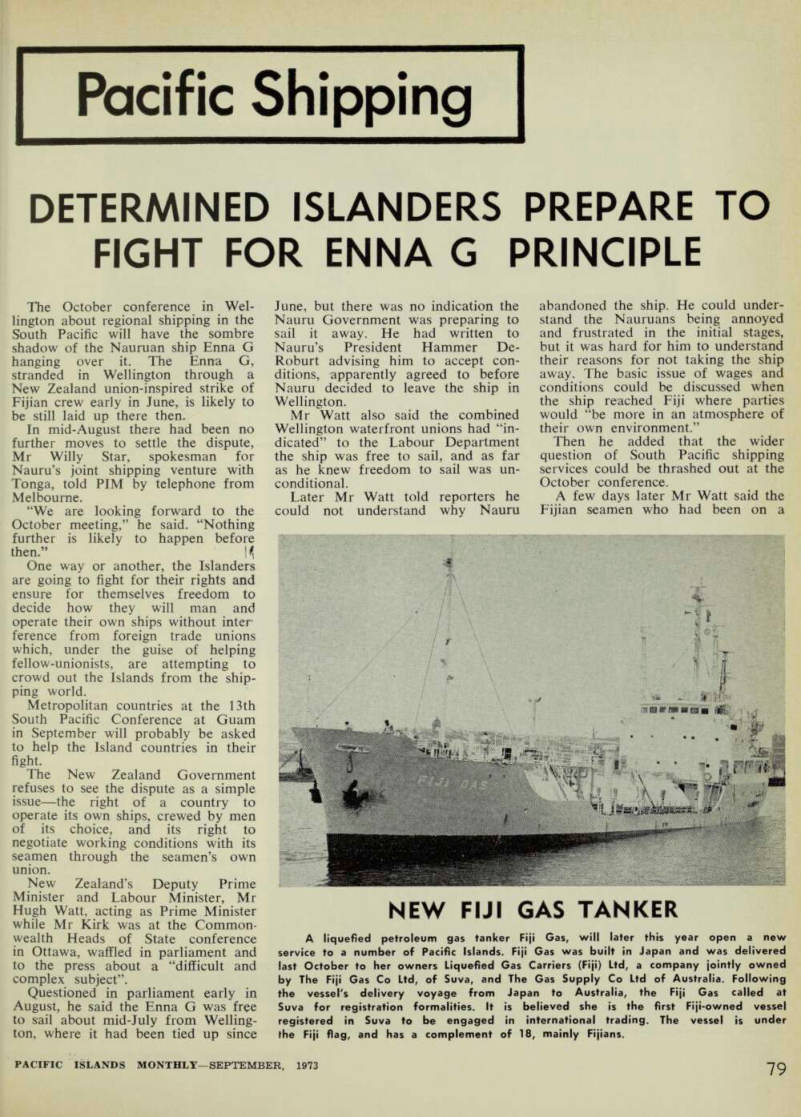
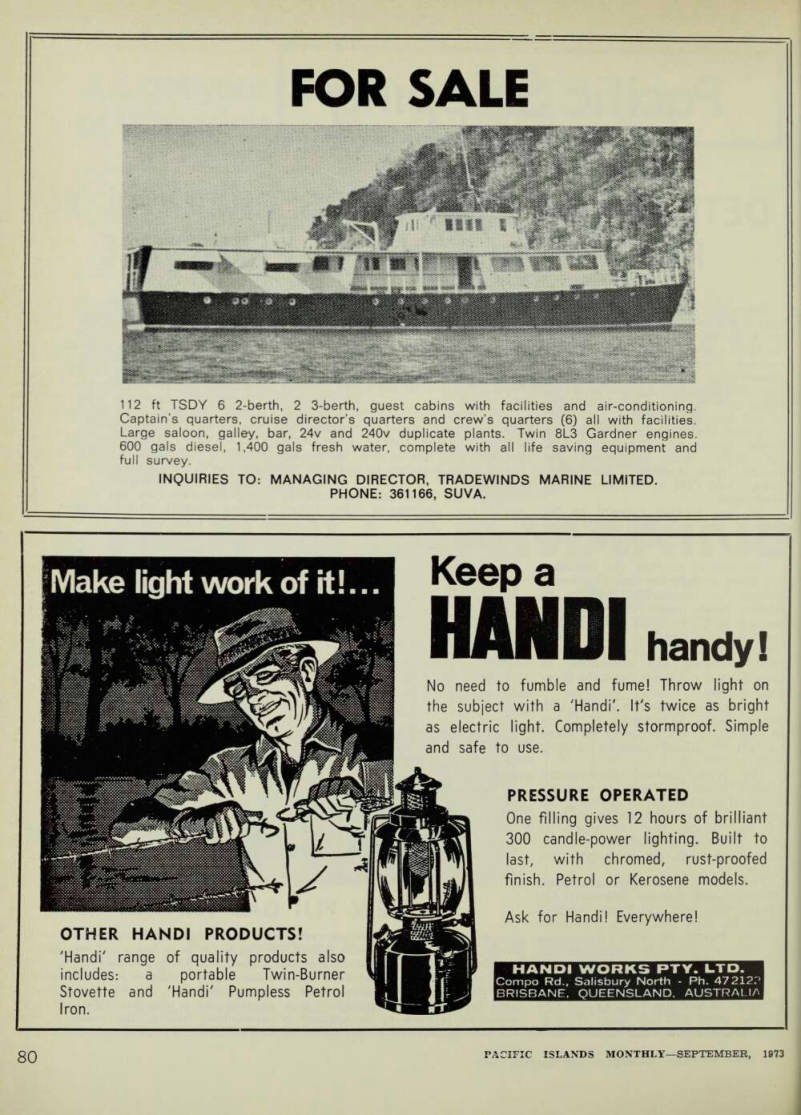
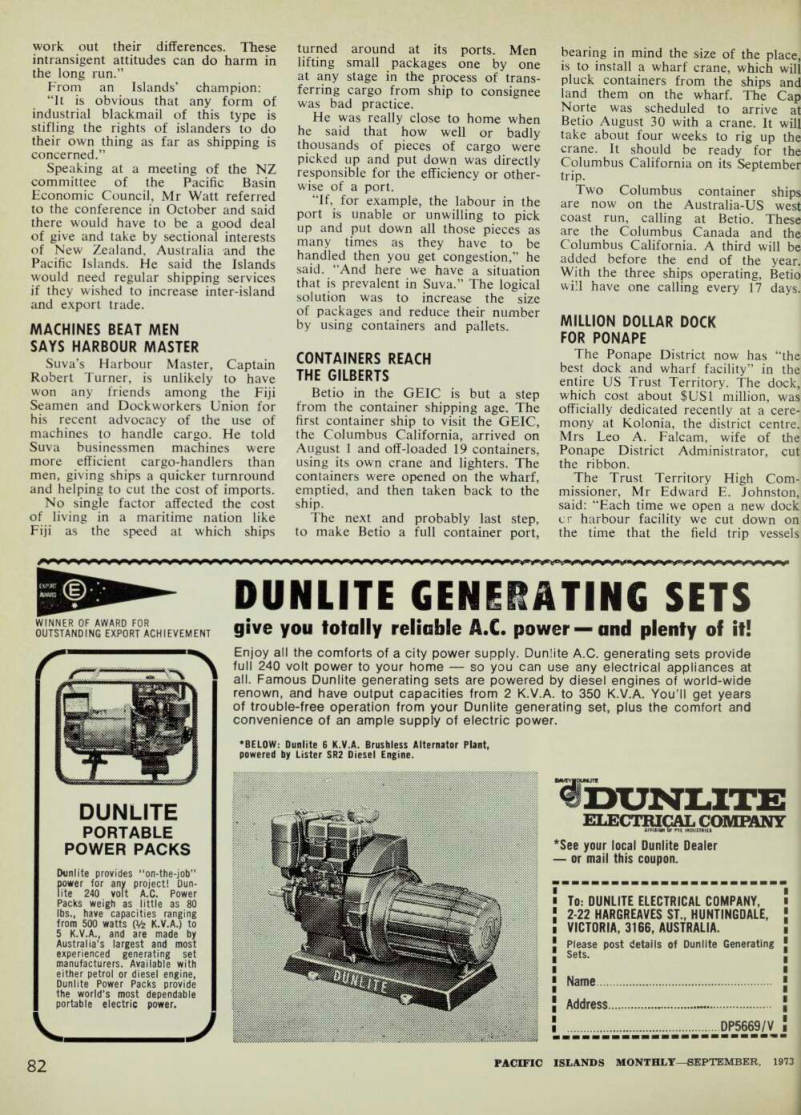
Determined Islanders Prepare To
Fight For Enna G Principle
The October conference in Wel lington about regional shipping in the South Pacific will have the sombre shadow of the Nauruan ship Enna G hanging over it. The Enna G, stranded in Wellington through a New Zealand union-inspired strike of Fijian crew early in June, is likely to be still laid up there then.
In mid-August there had been no further moves to settle the dispute, Mr Willy Star, spokesman for Nauru’s joint shipping venture with Tonga, told PIM by telephone from Melbourne, “We are looking forward to the October meeting,” he said. “Nothing further is likely to happen before then.”
One way or another, the Islanders are going to fight for their rights and ensure for themselves freedom to decide how they will man and operate their own ships without inter ference from foreign trade unions which, under the guise of helping fellow-unionists, are attempting to crowd out the Islands from the ship ping world.
Metropolitan countries at the 13th South Pacific Conference at Guam in September will probably be asked to help the Island countries in their fight.
The New Zealand Government refuses to see the dispute as a simple issue—the right of a country to operate its own ships, crewed by men of its choice, and its right to negotiate working conditions with its seamen through the seamen’s own union.
New Zealand’s Deputy Prime Minister and Labour Minister, Mr Hugh Watt, acting as Prime Minister while Mr Kirk was at the Common wealth Heads of State conference in Ottawa, waffled in parliament and to the press about a “difficult and complex subject”.
Questioned in parliament early in August, he said the Enna G was free to sail about mid-July from Welling ton, where it had been tied up since
June, but there was no indication the Nauru Government was preparing to sail it away. He had written to Nauru’s President Hammer De- Roburt advising him to accept con ditions, apparently agreed to before Nauru decided to leave the ship in Wellington.
Mr Watt also said the combined Wellington waterfront unions had “in dicated” to the Labour Department the ship was free to sail, and as far as he knew freedom to sail was un conditional.
Later Mr Watt told reporters he could not understand why Nauru
abandoned the ship. He could under stand the Nauruans being annoyed and frustrated in the initial stages, but it was hard for him to understand their reasons for not taking the ship away. The basic issue of wages and conditions could be discussed when the ship reached Fiji where parties would “be more in an atmosphere of their own environment.”
Then he added that the wider question of South Pacific shipping services could be thrashed out at the October conference.
A few days later Mr Watt said the Fijian seamen who had been on a
New Fiji Gas Tanker
A liquefied petroleum gas tanker Fiji Gas, will later this year open a new service to a number of Pacific Islands. Fiji Gas was built in Japan and was delivered last October to her owners Liquefied Gas Carriers (Fiji) Ltd, a company jointly owned by The Fiji Gas Co Ltd, of Suva, and The Gas Supply Co Ltd of Australia. Following the vessel's delivery voyage from Japan to Australia, the Fiji Gas called at Suva for registration formalities. It is believed she is the first Fiji-owned vessel registered in Suva to be engaged in international trading. The vessel is under the Fiji flag, and has a complement of 18, mainly Fijians.
series of temporary permits would have to go home. Five of the original 23 involved in the dispute returned earlier.
He did not know what would hap pen, or how the ship would sail with out replacements for the Fijians. He also said he was dismayed President Deßoburt had now withdrawn his agreement to re-engage the Fijian sea men on the Enna G.
The Dominion newspaper in Wel lington saw the matter in a much clearer light than Mr Watt. Late in July, in an editorial, the newspaper said the blacklisted Enna G was a memorial to crass industrial stupidity.
It was also a hazard on which the NZ Government’s bravely expressed hopes of supplying leadership in the South Pacific were likely to founder.
It was all very well for the Minister of Labour to espouse the cause of co-operative regional shipping as a means of advancing the lives of the peoples of the region, and to pro mote a maritime conference in October to plan for it.
“The Enna G mocks the govern ment’s intentions,” the newspaper said. “The sad saga of the vessel, Mr Watt suggested, “brought to the attention of the New Zealand public a ‘difficult and complex issue’.
Frankly, citizens never found the matter so complicated that one ounce of reasonableness on the part of the New Zealand Seamen’s Union could not have fixed it. The affair remains a classic case of industrial brawnman ship. It will do irreparable harm to the government’s ambition to appear as a friend, adviser and champion of the South Pacific—rather than the bully boy”.
Twenty-six Tongan members of the crew went home about the end of July. Four remained in Wellington as part of the skeleton crew of the Enna G. In Tonga they were paid money due to them. They said they were disappointed when the Fijians walked off because they considered they were getting very good payment and treatment.
Captain C. Hill-Willis, of the Pacific Navigation Co, said Tonga’s role in the service which Enna G was to provide was to man the ship. The Pacific Navigation Co also was to act as agents in Tonga and to be responsible for routine maintenance and repairs while the ship was in Tonga.
Tonga would have benefited financially from the venture. How ever, he was not unduly unperturbed because President Deßoburt had promised to employ the Tongan crew on other Nauru ships.
In Australia, shipping company officials, asked to comment on the right of a small Pacific country to
operate its own ships, had this to say about the Enna G dispute; “I don’t think the Australian mari time unions would go along with what the New Zealand unions are doing. The waterside workers here are most helpful towards some of these developing Island places, pro vided the vessels they operate are owned by the particular country and trading in that area. The New Zealand unions seem to think they have the right to operate any vessel out cf New Zealand, no matter who owns it.”
Another said: “Is that small island nation really going about running a
sh pping line on a proper basis or is it just using its money indiscriminately?
Per capita it is one of the richest countries in the world and therefore runs operations in a 19th century attitude. It adopts a very intransigent li ,e and does not worry about cash.
Personally, I think it is an unneces sary and vicious attitude on the part c f the New Zealand union, but when dealing with this sort of people I think there is some justification. It is a case where two completely immovable objects are standing on a point of principle and sound com mercial sense gets thrown out the window. Both sides have to try to
work out their differences. These intransigent attitudes can do harm in the long run.”
From an Islands’ champion: “It is obvious that any form of industrial blackmail of this type is stifling the rights of islanders to do their own thing as far as shipping is concerned,”
Speaking at a meeting of the NZ committee of the Pacific Basin Economic Council, Mr Watt referred to the conference in October and said there would have to be a good deal of give and take by sectional interests of New Zealand, Australia and the Pacific Islands. He said the Islands would need regular shipping services if they wished to increase inter-island and export trade.
Machines Beat Men
Says Harbour Master
Suva’s Harbour Master, Captain Robert Turner, is unlikely to have won any friends among the Fiji Seamen and Dockworkers Union for his recent advocacy of the use of machines to handle cargo. He told Suva businessmen machines were more efficient cargo-handlers than men, giving ships a quicker turnround and helping to cut the cost of imports.
No single factor affected the cost of living in a maritime nation like Fiji as the speed at which ships
turned around at its ports. Men lifting small packages one by one at any stage in the process of trans ferring cargo from ship to consignee was bad practice.
He was really close to home when he said that how well or badly thousands of pieces of cargo were picked up and put down was directly responsible for the efficiency or other wise of a port.
“If, for example, the labour in the port is unable or unwilling to pick up and put down all those pieces as many times as they have to be handled then you get congestion,” he said. “And here we have a situation that is prevalent in Suva.” The logical solution was to increase the size of packages and reduce their number by using containers and pallets.
Containers Reach
The Gilberts
Betio in the GEIC is but a step from the container shipping age. The first container ship to visit the GEIC, the Columbus California, arrived on August 1 and off-loaded 19 containers, using its own crane and lighters. The containers were opened on the wharf, emptied, and then taken back to the ship.
The next and probably last step, to make Betio a full container port,
bearing in mind the size of the place, is to install a wharf crane, which will pluck containers from the ships and land them on the wharf. The Cap Norte was scheduled to arrive at Betio August 30 with a crane. It will take about four weeks to rig up the crane. It should be ready for the Columbus California on its September trip.
Two Columbus container ships are now on the Australia-US west coast run, calling at Betio. These are the Columbus Canada and the Columbus California. A third will be added before the end of the year.
With the three ships operating, Betio will have one calling every 17 days.
Million Dollar Dock
For Ponape
The Ponape District now has “the best dock and wharf facility” in the entire US Trust Territory. The dock, which cost about SUSI million, was officially dedicated recently at a cere mony at Kolonia, the district centre.
Mrs Leo A. Falcam, wife of the Ponape District Administrator, cut the ribbon.
The Trust Territory High Com missioner, Mr Edward E. Johnston, said: “Each time we open a new dock cr harbour facility we cut down on the time that the field trip vessels
need to load and unload. This helps the delivery of surface cargo through out the entire Trust Territory. We will not be completely happy until there is a dock of this nature in every one of our six districts of Micronesia.”
The dock was built by the Ponape Transportation Authority.
Advertisements & other items, pp. 90-92 (1 item)
HANOI handy!
FOR SALE
11111 m
III!
m m iw ■E ■ . 112 ft TSDY 6 2-berth, 2 3-berth, guest cabins with facilities and air-conditioning.
Captain’s quarters, cruise director’s quarters and crew’s quarters (6) all with facilities.
Large saloon, galley, bar, 24v and 240 v duplicate plants. Twin BL3 Gardner engines. 600 gals diesel, 1,400 gals fresh water, complete with all life saving equipment and full survey.
INQUIRIES TO: MANAGING DIRECTOR, TRADEWINDS MARINE LIMITED.
PHONE: 361166, SUVA.
Make light work of it!.
OTHER HANOI PRODUCTS!
'Handi' range of quality products also includes: a portable Twin-Burner Stovette and 'Handi' Pumpless Petrol ron.
Keep a
HANOI handy!
No need to fumble and fume! Throw light on the subject with a 'Handi'. It's twice as bright as electric light. Completely stormproof. Simple and safe to use.
PRESSURE OPERATED
One filling gives 12 hours of brilliant 300 candle-power lighting. Built to last, with chromed, rust-proofed finish. Petrol or Kerosene models.
Ask for Handi! Everywhere!
HANOI WORKS PTY, LTD.
Compo Rd., Salisbury North - Ph. 47 212?
BRISBANE. QUEENSLAND. AUSTRALIA
NEW VERSATILITY...
FROM FURUNO
FRS-24
A highly reliable compact solid state radar for small craft.
Simple installation and maintenance. 7" PR I scope. With magnifying lens. 6 ranges (1/2 24n. miles). Automatic synchronization of display sweep and antenna rotation with no waveguide run between. Operates on DC 12, 24, 32 or 110 V. Low power consumption 160 W. 3 • The future today with FURUNO's electronics technology. 0
FURUNO ELECTRIC CO.. LTD.
9-52, Ashihara-cho, Nishinomiya City, Japan
CABLE: FURUNO NISHINOMIYA, TELEX: 5644-498
DUNIITE GENERATING SETS
OUTSTAND IEVEM ENT give you totally reliable A.C. power and plenty of it!
DUNLITE
PORTABLE
POWER PACKS
Dunlite provides “on-the-job” power for any project! Duniite 240 volt A.C. Power Packs weigh as little as 80 lbs., have capacities ranging from 500 watts (Vz K.V.A.) to 5 K.V.A., and are made by Australia’s largest and most experienced generating set manufacturers. Available with either petrol or diesel engine, Dunlite Power Packs provide the world’s most dependable portable electric power. j Enjoy all the comforts of a city power supply. Dunlite A.C. generating sets provide full 240 volt power to your home so you can use any electrical appliances at all. Famous Dunlite generating sets are powered by diesel engines of world-wide renown, and have output capacities from 2 K.V.A. to 350 K.V.A. You’ll get years of trouble-free operation from your Dunlite generating set, plus the comfort and convenience of an ample supply of electric power. *BELOW: Dunlite 6 K.V.A. Brushless Alternator Plant, powered by Lister SR2 Diesel Engine. .w i ew^vepuNUTt
ELECTRICAL COMPANY
oivuim ip hi inoustnie* *See your local Dunlite Dealer or mail this coupon.
To: DUNLITE ELECTRICAL COMPANY,
2-22 HARGREAVES ST., HUNTINGDALE,
VICTORIA, 3166, AUSTRALIA.
Please post details of Dunlite Generating Sets.
Name Address
DP5669/V
Shipping Briefs
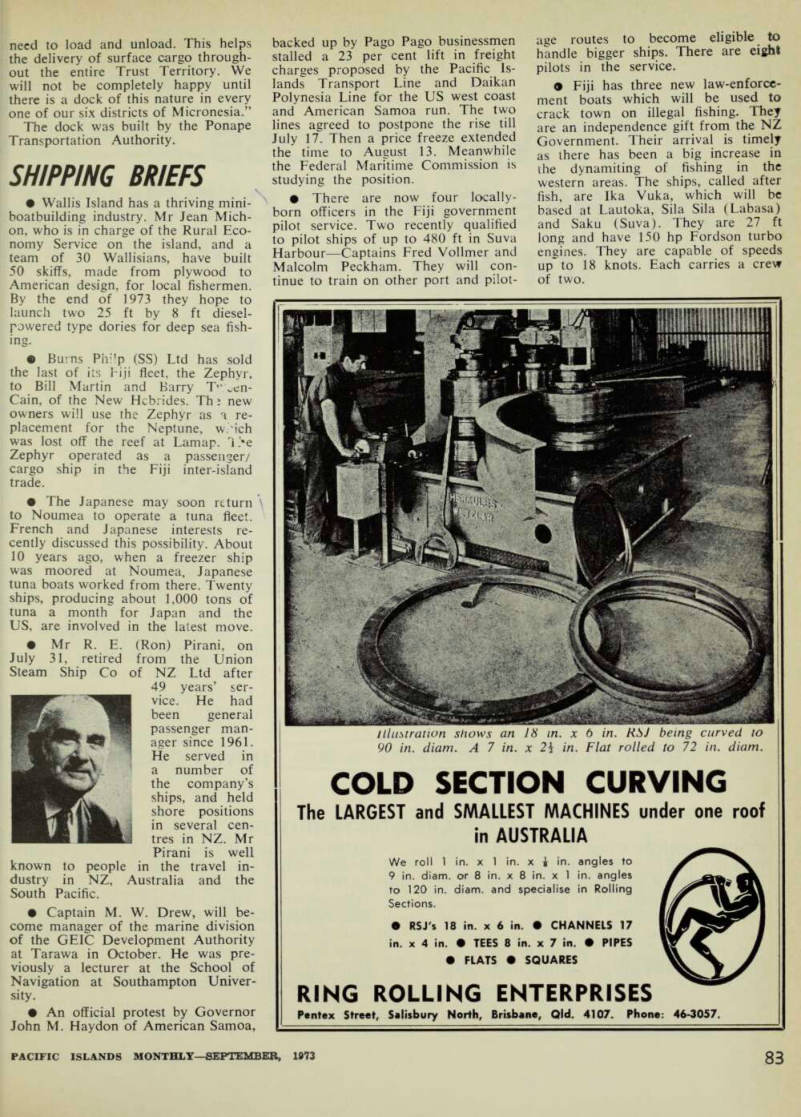
• Wallis Island has a thriving mini boatbuilding industry. Mr Jean Mich on, who is in charge of the Rural Eco nomy Service on the island, and a team of 30 Wallisians, have built 50 skiffs, made from plywood to American design, for local fishermen.
By the end of 1973 they hope to launch two 25 ft by 8 ft diesel powered type dories for deep sea fish ing. 9 Burns Philp (SS) Ltd has sold the last of its Fiji fleet, the Zephyr, to Bill Martin and Barry Cain, of the New Hebrides. Th; new owners will use the Zephyr as a re placement for the Neptune, w.'ich was lost off the reef at Lamap. l>e Zephyr operated as a passenger/ cargo ship in the Fiji inter-island trade. • The Japanese may soon return to Noumea to operate a tuna fleet.
French and Japanese interests re cently discussed this possibility. About 10 years ago, when a freezer ship was moored at Noumea, Japanese tuna boats worked from there. Twenty ships, producing about 1,000 tons of tuna a month for Japan and the US, are involved in the latest move. • Mr R. E. (Ron) Pirani, on July 31, retired from the Union Steam Ship Co of NZ Ltd after
49 years’ ser vice. He had
been general
passenger man ager since 1961.
He served in a number of the company’s ships, and held
shore positions
in several cen tres in NZ. Mr Pirani is well
known to people in the travel in dustry in NZ, Australia and the South Pacific. • Captain M. W. Drew, will be come manager of the marine division of the GEIC Development Authority at Tarawa in October. He was pre viously a lecturer at the School of Navigation at Southampton Univer sity. • An official protest by Governor John M. Haydon of American Samoa,
backed up by Pago Pago businessmen stalled a 23 per cent lift in freight charges proposed by the Pacific Is lands Transport Line and Daikan Polynesia Line for the US west coast and American Samoa run. The two lines agreed to postpone the rise till July 17. Then a price freeze extended the time to August 13. Meanwhile the Federal Maritime Commission is studying the position. • There are now four locally born officers in the Fiji government pilot service. Two recently qualified to pilot ships of up to 480 ft in Suva Harbour —Captains Fred Vollmer and Malcolm Peckham. They will con tinue to train on other port and pilot
age routes to become eligible to handle bigger ships. There are eight pilots in the service. 9 Fiji has three new law-enforce ment boats which will be used to crack town on illegal fishing. They are an independence gift from the NZ Government. Their arrival is timely as there has been a big increase in the dynamiting of fishing in the western areas. The ships, called after fish, are Ika Vuka, which will be based at Lautoka, Sila Sila (Labasa) and Saku (Suva). They are 27 ft long and have 150 hp Fordson turbo engines. They are capable of speeds up” to 18 knots. Each carries a crew of two.
Advertisements & other items, pp. 93-94 (1 item)
Cold Section Curving
illustration shows an 18 in. x 6 in. RSJ being curved to 90 in. diam. A 7 in. x 2\ in. Flat rolled to 72 in. diam.
The LARGEST and SMALLEST MACHINES under one roof
in AUSTRALIA
We roll 1 in. x 1 in. x i in. angles to 9 in. diam. or 8 in. x 8 in. x 1 in. angles to 120 in. diam. and specialise in Rolling Sections. • RSJ's 18 in. x 6 in. • CHANNELS 17 in. x 4 in. 9 TEES 8 in. x 7 in. 9 PIPES
• FLATS • SQUARES
RING ROLLING ENTERPRISES
Pcntex Street, Salisbury North, Brisbane, Qld. 4107. Phone: 46-3057. s
I E PIGLASS
Why choose
Epiglass marine products
for your boat?
Epiglass gives you the biggest range of marine glues, fillers, preservatives, resins, skinning systems and paints going. The biggest,.. and the best.
Laboratory tested - and proven in the water on thousands and thousands of boats! That's why you can buy Epiglass products with complete confidence.
If it’s Epiglass, it will outlast all others. Just ask the man who uses Epiglass!
PACIFIC AREA DISTRIBUTORS
COOK ISLANDS Cook Is. Trading Corp. Ltd NORFOLK ISLAND Irvine Bid,Supply Centre FIJI Burns Philp (SS) Co. Ltd PAGO PAGO Max Haleck Inc.
NEW GUINEA Bougainville Marine Pty Ltd Kieta TAHITI Tahiti Sport from 7ft to73ft I epiglass power or sail Consolidated Chemicals Limited, Auckland.
Burns Philp (NG) Ltd Madang Elvee Trading - Pty Ltd Rabaul Faulkner & Tait (NG) Pty Ltd Lae S.A. Heath & Co Pty Ltd Pt Moresby NEW HEBRIDES Burns Philp (NH) Ltd NOUMEA Guy Limousin Pacific Yachting TONGA Riechelmann Bros.
WESTERN SAMOA Burns Philp (SS) Co. Ltd E. A. Coxon Ltd Gold Star Transport Co. Ltd Morris Hedstrom Ltd SOLOMON ISLANDS George Yee Fai Ltd 598
Cruising
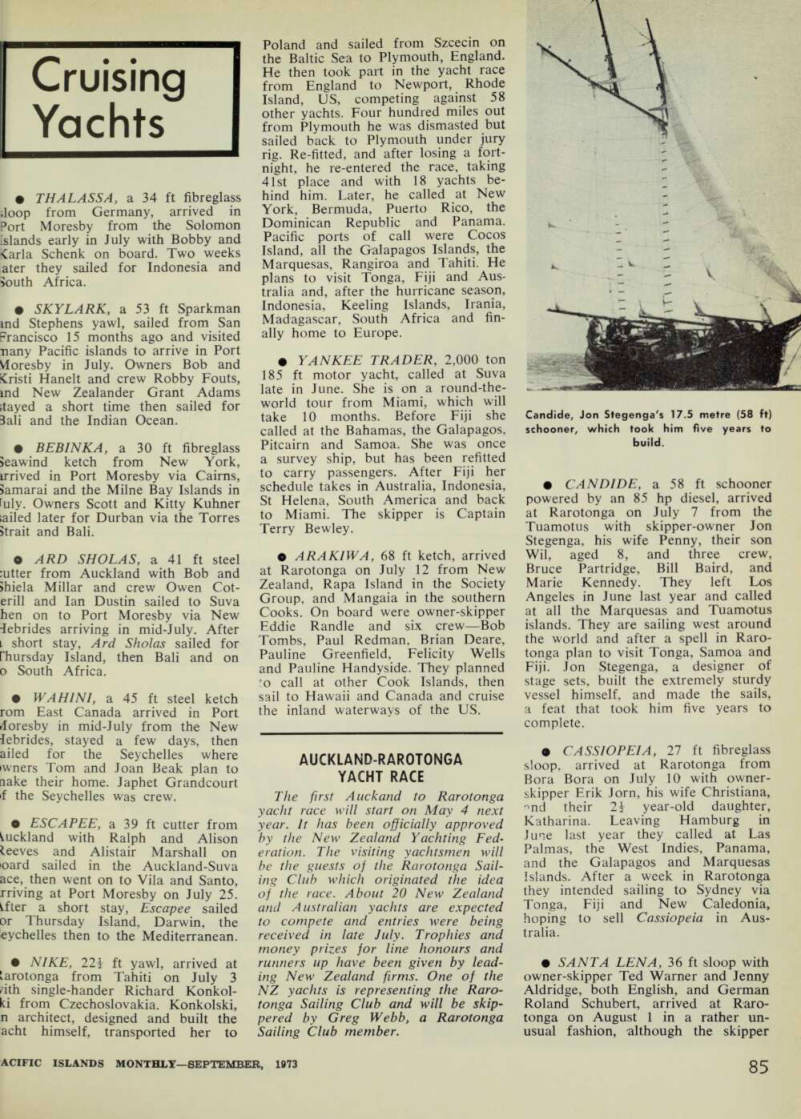
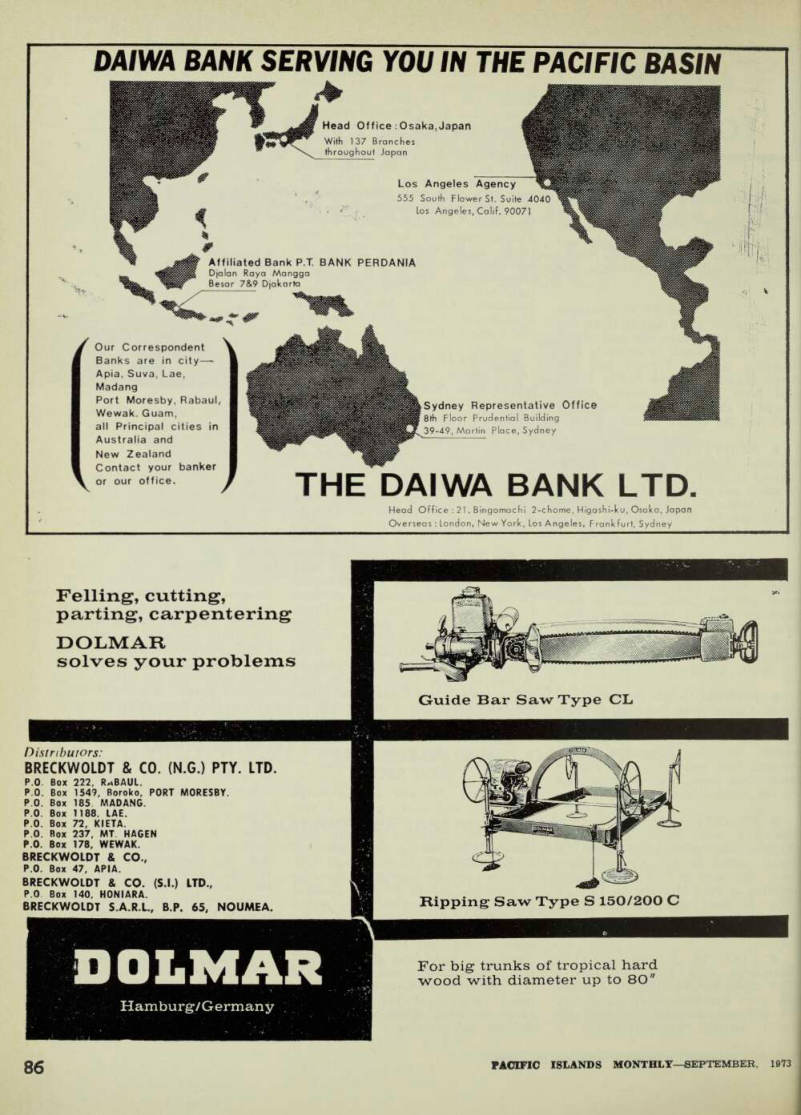
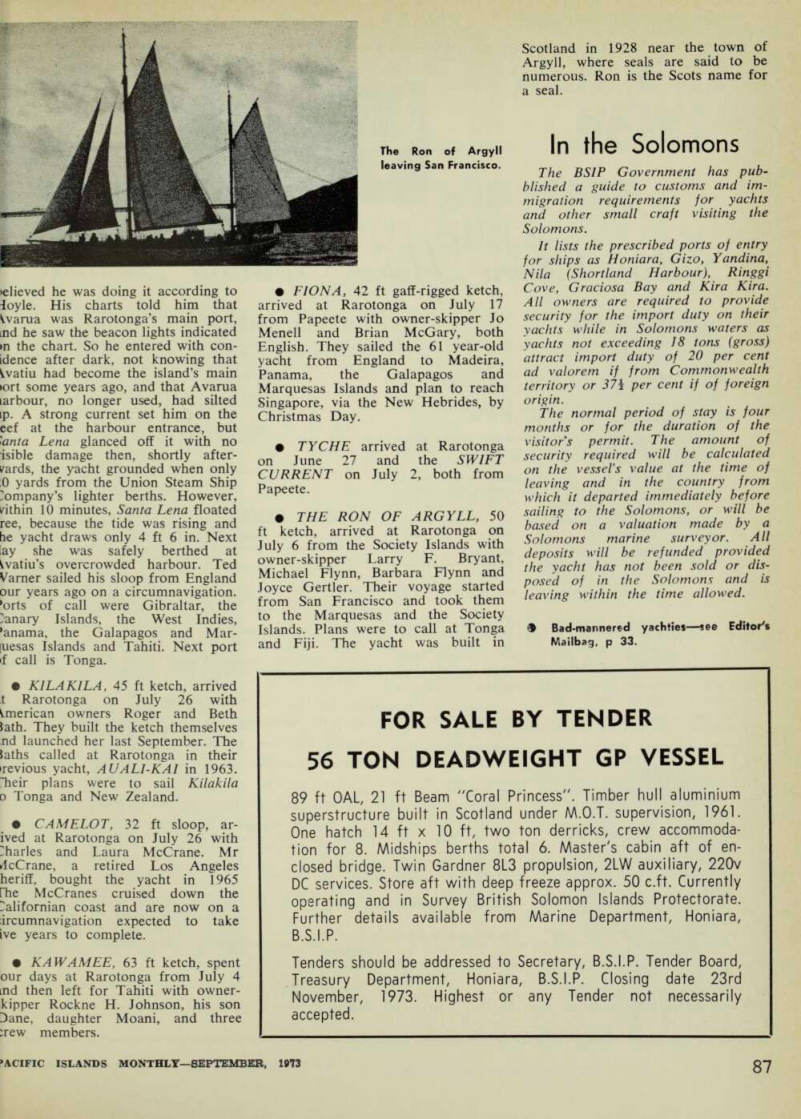
Yachts
• THALASSA, a 34 ft fibreglass ♦loop from Germany, arrived in Port Moresby from the Solomon Islands early in July with Bobby and £arla Schenk on board. Two weeks ater they sailed for Indonesia and South Africa. • SKYLARK, a 53 ft Sparkman ind Stephens yawl, sailed from San Francisco 15 months ago and visited iiany Pacific islands to arrive in Port Vloresby in July. Owners Bob and Kristi Hanelt and crew Robby Fouts, md New Zealander Grant Adams stayed a short time then sailed for 3ali and the Indian Ocean. • BEBINKA, a 30 ft fibreglass seawind ketch from New York, irrived in Port Moresby via Cairns, Samarai and the Milne Bay Islands in hily. Owners Scott and Kitty Kuhner sailed later for Durban via the Torres Strait and Bali.
O ARD SHOE AS, a 41 ft steel sutter from Auckland with Bob and Jhiela Millar and crew Owen Cot erill and lan Dustin sailed to Suva hen on to Port Moresby via New Hebrides arriving in mid-July, After i short stay, Ard Sholas sailed for fhursday Island, then Bali and on o South Africa. • WAHINI, a 45 ft steel ketch rom East Canada arrived in Port Moresby in mid-July from the New lebrides, stayed a few days, then ailed for the Seychelles where owners Tom and Joan Beak plan to lake their home. Japhet Grandcourt tf the Seychelles was crew.
O ESCAPEE, a 39 ft cutter from Auckland with Ralph and Alison leeves and Alistair Marshall on card sailed in the Auckland-Suva ace, then went on to Vila and Santo, rriving at Port Moresby on July 25. tfter a short stay, Escapee sailed or Thursday Island, Darwin, the eychelles then to the Mediterranean. • NIKE, 22\ ft yawl, arrived at tarotonga from Tahiti on July 3 dth single-hander Richard Konkol ki from Czechoslovakia. Konkolski, n architect, designed and built the acht himself, transported her to
Poland and sailed from Szcecin on the Baltic Sea to Plymouth, England.
He then took part in the yacht race from England to Newport, Rhode Island, US, competing against 58 other yachts. Four hundred miles out from Plymouth he was dismasted but sailed back to Plymouth under jury rig. Re-fitted, and after losing a fort night, he re-entered the race, taking 41st place and with 18 yachts be hind him. Later, he called at New York, Bermuda, Puerto Rico, the Dominican Republic and Panama.
Pacific ports of call were Cocos Island, all the Galapagos Islands, the Marquesas, Rangiroa and Tahiti. He plans to visit Tonga, Fiji and Aus tralia and, after the hurricane season, Indonesia, Keeling Islands, Irania, Madagascar, South Africa and fin ally home to Europe.
• Yankee Trader , 2,000 Ton
185 ft motor yacht, called at Suva late in June. She is on a round-the world tour from Miami, which will take 10 months. Before Fiji she called at the Bahamas, the Galapagos, Pitcairn and Samoa. She was once a survey ship, but has been refitted to carry passengers. After Fiji her schedule takes in Australia, Indonesia, St Helena, South America and back to Miami. The skipper is Captain Terry Bewley.
O ARAKIWA, 68 ft ketch, arrived at Rarotonga on July 12 from New Zealand, Rapa Island in the Society Group, and Mangaia in the southern Cooks. On board were owner-skipper Eddie Randle and six crew—Bob Tombs, Paul Redman, Brian Deare, Pauline Greenfield, Felicity Wells and Pauline Handyside. They planned to call at other Cook Islands, then sail to Hawaii and Canada and cruise the inland waterways of the US.
• CANDIDE, a 58 ft schooner powered by an 85 hp diesel, arrived at Rarotonga on July 7 from the Tuamotus with skipper-owner Jon Stegenga, his wife Penny, their son Wil, aged 8, and three crew, Bruce Partridge, Bill Baird, and Marie Kennedy. They left Los Angeles in June last year and called at all the Marquesas and Tuamotus islands. They are sailing west around the world and after a spell in Raro tonga plan to visit Tonga, Samoa and Fiji. Jon Stegenga, a designer of stage sets, built the extremely sturdy vessel himself, and made the sails, a feat that took him five years to complete. • CASSIOPEIA. 27 ft fibreglass sloop, arrived at Rarotonga from Bora Bora on July 10 with owner skipper Erik Jorn, his wife Christiana, their 2i year-old daughter, Katharina. Leaving Hamburg in June last year they called at Las Palmas, the West Indies, Panama, and the Galapagos and Marquesas Islands. After a week in Rarotonga they intended sailing to Sydney via Tonga, Fiji and New Caledonia, hoping to sell Cassiopeia in Aus tralia. • SANTA LENA. 36 ft sloop with owner-skipper Ted Warner and Jenny Aldridge, both English, and German Roland Schubert, arrived at Raro tonga on August 1 in a rather un usual fashion, although the skipper
Candide, Jon Stegenga's 17.5 metre (58 ft) schooner, which took him five years to build.
>elieved he was doing it according to ioyle. His charts told him that Avarua was Rarotonga’s main port, md he saw the beacon lights indicated m the chart. So he entered with con idence after dark, not knowing that Watiu had become the island’s main >ort some years ago, and that Avarua larbour, no longer used, had silted ip. A strong current set him on the eef at the harbour entrance, but 'anta Lena glanced off it with no isible damage then, shortly after wards, the yacht grounded when only :0 yards from the Union Steam Ship Company’s lighter berths. However, within 10 minutes, Santa Lena floated ree, because the tide was rising and he yacht draws only 4 ft 6 in. Next lay she was safely berthed at Watiu’s overcrowded harbour. Ted Varner sailed his sloop from England our years ago on a circumnavigation, •orts of call were Gibraltar, the Canary Islands, the West Indies, •anama, the Galapagos and Mar [uesas Islands and Tahiti. Next port if call is Tonga. • KILAKILA, 45 ft ketch, arrived t Rarotonga on July 26 with American owners Roger and Beth lath. They built the ketch themselves nd launched her last September. The laths called at Rarotonga in their •revious yacht, AUALI-KAI in 1963.
Tieir plans were to sail Kilakila o Tonga and New Zealand. • CAMELOT, 32 ft sloop, ar ived at Rarotonga on July 26 with Charles and Laura McCrane. Mr dcCrane, a retired Los Angeles heriff, bought the yacht in 1965 fhe McCranes cruised down the Californian coast and are now on a ircumnavigation expected to take Ive years to complete. • KAWAMEE, 63 ft ketch, spent our days at Rarotonga from July 4 md then left for Tahiti with owner kipper Rockne H. Johnson, his son Dane, daughter Moani, and three :rew members.
• FIONA, 42 ft gaff-rigged ketch, arrived at Rarotonga on July 17 from Papeete with owner-skipper Jo Menell and Brian McGary, both English. They sailed the 61 year-old yacht from England to Madeira, Panama, the Galapagos and Marquesas Islands and plan to reach Singapore, via the New Hebrides, by Christmas Day. • TYCHE arrived at Rarotonga on June 27 and the SWIFT CURRENT on July 2, both from Papeete.
• The Ron Of Argyll, 50
ft ketch, arrived at Rarotonga on July 6 from the Society Islands with owner-skipper Larry F. Bryant, Michael Flynn, Barbara Flynn and Joyce Gertler. Their voyage started from San Francisco and took them to the Marquesas and the Society Islands. Plans were to call at Tonga and Fiji. The yacht was built in
Scotland in 1928 near the town of Argyll, where seals are said to be numerous. Ron is the Scots name for a seal.
In the Solomons
The BSIP Government has pub lished a guide to customs and im migration requirements for yachts and other small craft visiting the Solomons.
It lists the prescribed ports of entry for ships as Honiara, Gizo, Yandina, Nila (Short land Harbour), Ringgi Cove, Graciosa Bay and Kira Kira.
All owners are required to provide security for the import duty on their yachts while in Solomons waters as yachts not exceeding 18 tons (gross) attract import duty of 20 per cent ad valorem if from Commonwealth territory or 37i per cent if of foreign origin.
The normal period of stay is four months or for the duration of the visitor's permit. The amount of security required will be calculated on the vessel’s value at the time of leaving and in the country from which it departed immediately before sailing to the Solomons, or will be based on a valuation made by a Solomons marine surveyor. All deposits will be refunded provided the yacht has not been sold or dis posed of in the Solomons and is leaving within the time allowed. £ Bad-mannered yachties—see Editors Mailbag, p 33.
The Ron of Argyll leaving San Francisco.
Auckland-Raroionga
Yacht Race
The first Auckand to Rarotonga yacht race will start on May 4 next year. It has been officially approved by the New Zealand Yachting Fed eration. The visiting yachtsmen will be the guests of the Rarotonga Sail ing Club which originated the idea of the race. About 20 New Zealand and Australian yachts are expected to compete and entries were being received in late July. Trophies and money prizes for line honours and runners up have been given by lead ing New Zealand firms. One of the NZ yachts is representing the Raro tonga Sailing Club and will be skip pered by Greg Webb, a Rarotonga Sailing Club member.
Advertisements & other items, pp. 95-97 (3 items)
85
ACIFIC ISLANDS MONTHLY—SEPTEMBER, 1973
Dolmar
DAIWA BANK SERVING YOU IN THE PACIFIC BASIN Head Office : Osaka,Japan With 137 Branches throughout Japan Los Angeles Agency 555 South Flower St. Suite 4040 Los Angeles, Calif. 90071 Affiliated Bank P.T BANK PERDANIA Djalan Raya Mangga Besar 7&9 Djakarta
( Our Correspondent \
Banks are in city— Apia, Suva, Lae, Madang Port Moresby, Rabaul, Wewak. Guam, all Principal cities in Australia and New Zealand Contact your banker or our office.
THE DAIWA BANK LTD
Head Office ; 21. Bingomachi 2-chome, Higashi-ku, Osaka, Japan Overseas : London, New York, Los Angeles, Frankfurt, Sydney
Felling, cutting,
parting, carpentering
DOLMAR
solves your problems Distributors:
BRECKWOLDT & CO. (N.G.) PTY. LTD.
P.O. Box 222, RmBAUL.
P.O. Box 1549, Boroko, PORT MORESBY.
P,O. Box 185 MADANG.
P.O. Box 1188, LAE.
P.O. Box 72, KIETA.
P.O. Box 237, MT HAGEN
P.O. Box 178, WEWAK.
BRECKWOLDT & CO.,
P.O. Box 47, APIA.
BRECKWOLDT & CO. (5.1.) LTD.,
P.O Box 140, HONIARA.
BRECKWOLDT S.A.R.L., B.P. 65, NOUMEA.
DOLMAR
Hamburg/Germany Guide Bar Saw Type CL Hipping Saw Type S 150/200 C For big trunks of tropical hard wood with diameter up to 80"
FOR SALE BY TENDER
56 TON DEADWEIGHT GP VESSEL
89 ft OAL, 21 ft Beam "Coral Princess". Timber hull aluminium superstructure built in Scotland under AA.O.T. supervision, 1961.
One hatch 14 ft x 10 ft, two ton derricks, crew accommodation for 8. Midships berths total 6. Master's cabin aft of enclosed bridge. Twin Gardner BL3 propulsion, 2LW auxiliary, 220 v DC services. Store aft with deep freeze approx. 50 c.ft. Currently operating and in Survey British Solomon Islands Protectorate.
Further details available from Marine Department, Honiara, 8.5.1. P.
Tenders should be addressed to Secretary, 8.5.1. P. Tender Board, Treasury Department, Honiara, 8.5.1. P. Closing date 23rd November, 1973. Highest or any Tender not necessarily accepted.
87
*ACIFIC ISLANDS MONTHLY—SEPTEMBER, 1973
Sydney Opera Sdouse
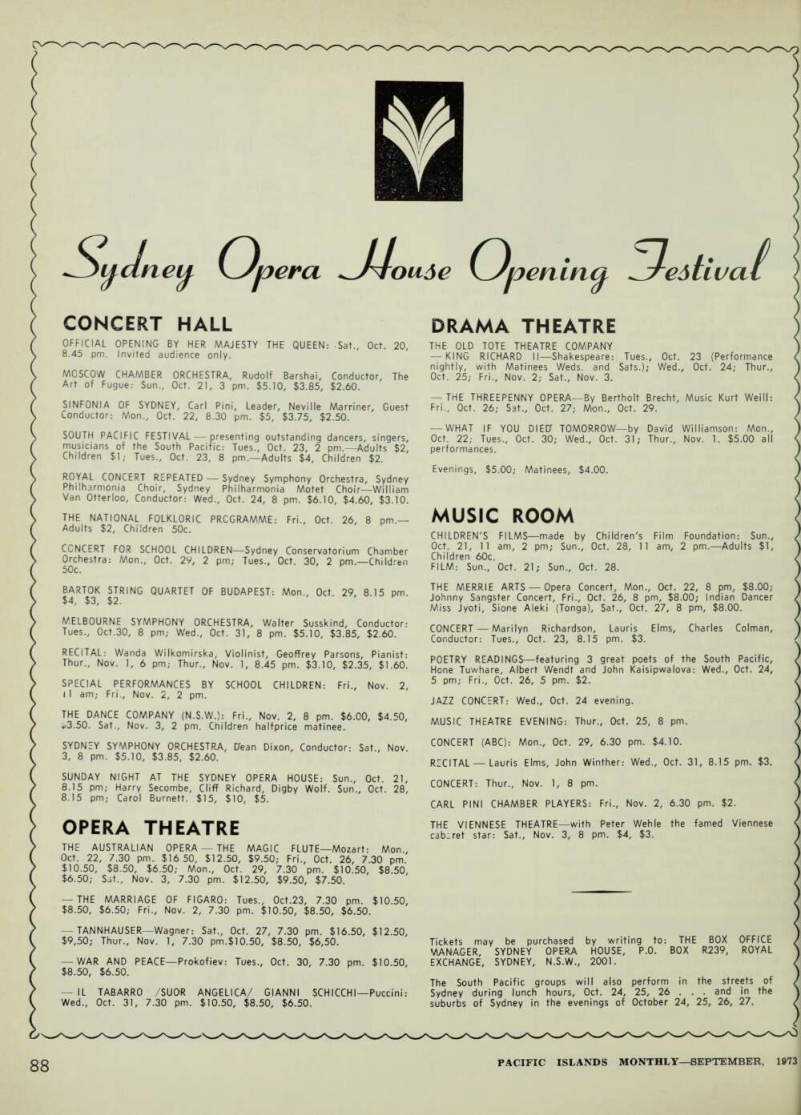
Concert Hall
OFFICIAL OPENING BY HER MAJESTY THE QUEEN: .Sat., Oct. 20, 8.45 pm. Invited audience only.
MOSCOW CHAMBER ORCHESTRA, Rudolf Barshai, Conductor, The Art of Fugue: Sun., Oct. 21, 3 pm. $5.10, $3.85, $2.60.
SINFONIA OF SYDNEY, Carl Pini, Leader, Neville Marriner, Guest Conductor: Mon., Oct. 22, 8.30 pm. $5, $3.75, $2.50.
SOUTH PACIFIC FESTIVAL presenting outstanding dancers, singers, musicians of the South Pacific: Tues., Oct. 23, 2 pm.—Adults $2, Children $1; Tues., Oct. 23, 8 pm.—Adults $4, Children $2.
ROYAL CONCERT REPEATED Sydney Symphony Orchestra, Sydney Philharmonia Choir, Sydney Philharmonia Motet Choir —William Van Otterloo, Conductor: Wed., Oct. 24, 8 pm. $6.10, $4.60, $3.10.
THE NATIONAL FOLKLORIC PROGRAMME: Fri., Oct. 26, 8 pm.— Adults $2, Children 50c.
CONCERT FOR SCHOOL CHILDREN—Sydney Conservatorium Chamber Orchestra: Mon., Oct. 29, 2 pm; Tues., Oct. 30, 2 pm.—Children 50c.
BARTOK STRING QUARTET OF BUDAPEST: Mon., Oct. 29, 8.15 pm. $4, $3, $2.
MELBOURNE SYMPHONY ORCHESTRA, Walter Susskind, Conductor: Tues., 0ct.30, 8 pm; Wed., Oct. 31, 8 pm. $5.10, $3.85, $2.60.
RECITAL: Wanda Wilkomirska, Violinist, Geoffrey Parsons, Pianist: Thur., Nov. 1, 6 pm ; Thur., Nov. 1, 8.45 pm. $3.10, $2.35, $1.60.
SPECIAL PERFORMANCES BY SCHOOL CHILDREN: Fri., Nov. 2, ll am; Fri., Nov. 2, 2 pm.
THE DANCE COMPANY (N.S.W.): Fri., Nov. 2, 8 pm. $6.00, $4.50, Sat., Nov. 3, 2 pm. Children halfprice matinee.
SYDNEY SYMPHONY ORCHESTRA, Dean Dixon, Conductor; Sat., Nov. 3, 8 pm. $5.10, $3.85, $2.60.
SUNDAY NIGHT AT THE SYDNEY OPERA HOUSE: Sun., Oct. 21, 8.15 pm; Harry Secombe, Cliff Richard, Digby Wolf. Sun., Oct. 28, 8.15 pm ; Carol Burnett. $l5, $lO, $5.
Opera Theatre
THE AUSTRALIAN OPERA THE MAGIC FLUTE—Mozart; Mon., Oct. 22, 7.30 pm. $l6 50, $12.50, $9.50; Fri., Oct. 26, 7.30 pm. $10.50, $8.50, $6.50; Mon., Oct. 29, 7.30 pm. $10.50, $8.50 $6.50; Sat., Nov. 3, 7.30 pm. $12.50, $9.50, $7.50.
THE MARRIAGE OF FIGARO: Tues., 0ct.23, 7.30 pm. $10.50, $8.50, $6.50; Fri., Nov. 2, 7.30 pm. $10.50, $8.50, $6.50.
TANNHAUSER—Wagner: Sat., Oct. 27, 7.30 pm. $16.50, $12.50, $9,50; Thur., Nov. 1, 7.30 pm. 510.50, $8.50, $6,50.
WAR AND PEACE—Prokofiev: Tues., Oct. 30, 7.30 pm. $10.50, $8.50, $6.50.
—Il Tabarro /Suor Angelica/ Gianni Schicchi—Puccini:
Wed., Oct. 31, 7.30 pm. $10.50, $8.50, $6.50.
Drama Theatre
The Old Tote Theatre Company
KING RICHARD II —Shakespeare: Tues., Oct. 23 (Performance nightly, with Matinees Weds, and Sats.); Wed., Oct. 24; Thur., Oct. 25; Fri., Nov. 2; Sat., Nov. 3.
THE THREEPENNY OPERA—By Bertholt Brecht, Music Kurt Weill: Fri., Oct. 26; Sat., Oct. 27; Mon., Oct. 29.
WHAT IF YOU DIED 1 TOMORROW—by David Williamson: Mon., Oct. 22; Tues., Oct. 30; Wed., Oct. 31; Thur., Nov. 1. $5.00 all performances.
Evenings, $5.00; Matinees, $4.00.
Music Room
CHILDREN'S FILMS —made by Children's Film Foundation: Sun., Oct. 21, 11 am, 2 pm; Sun., Oct. 28, 11 am, 2 pm.—Adults $l, Children 60c.
FILM: Sun., Oct. 21; Sun., Oct. 28.
THE MERRIE ARTS Opera Concert, Mon., Oct. 22, 8 pm, $8.00; Johnny Sangster Concert, Fri., Oct. 26, 8 pm, $8.00; Indian Dancer Miss Jyoti, Sione Aleki (Tonga), Sat., Oct. 27, 8 pm, $B.OO.
CONCERT Marilyn Richardson, Lauris Elms, Charles Colman, Conductor: Tues., Oct. 23, 8.15 pm. $3.
POETRY READlNGS—featuring 3 great poets of the South Pacific, Hone Tuwhare, Albert Wendt and John Kaisipwalova: Wed., Oct. 24, 5 pm; Fri., Oct. 26, 5 pm. $2.
JAZZ CONCERT: Wed., Oct. 24 evening.
MUSIC THEATRE EVENING: Thur., Oct. 25, 8 pm.
CONCERT (ABC): Mon., Oct. 29, 6.30 pm. $4.10.
RECITAL Lauris Elms, John Winther: Wed., Oct. 31, 8.15 pm. $3.
CONCERT: Thur., Nov. 1, 8 pm.
CARL PINI CHAMBER PLAYERS: Fri., Nov. 2, 6.30 pm. $2.
THE VIENNESE THEATRE —with Peter Wehle the famed Viennese cabaret star: Sat., Nov. 3, 8 pm. $4, $3.
Tickets may be purchased by writing to: THE BOX OFFICE MANAGER, SYDNEY OPERA HOUSE, P.O. BOX R 239, ROYAL
Exchange, Sydney, N.S.W., 2001.
The South Pacific groups will also perform in the streets of Sydney during lunch hours, Oct, 24, 25, 26 . . . and in the suburbs of Sydney in the evenings of October 24, 25, 26, 27.
British Airways PACIFIC JET
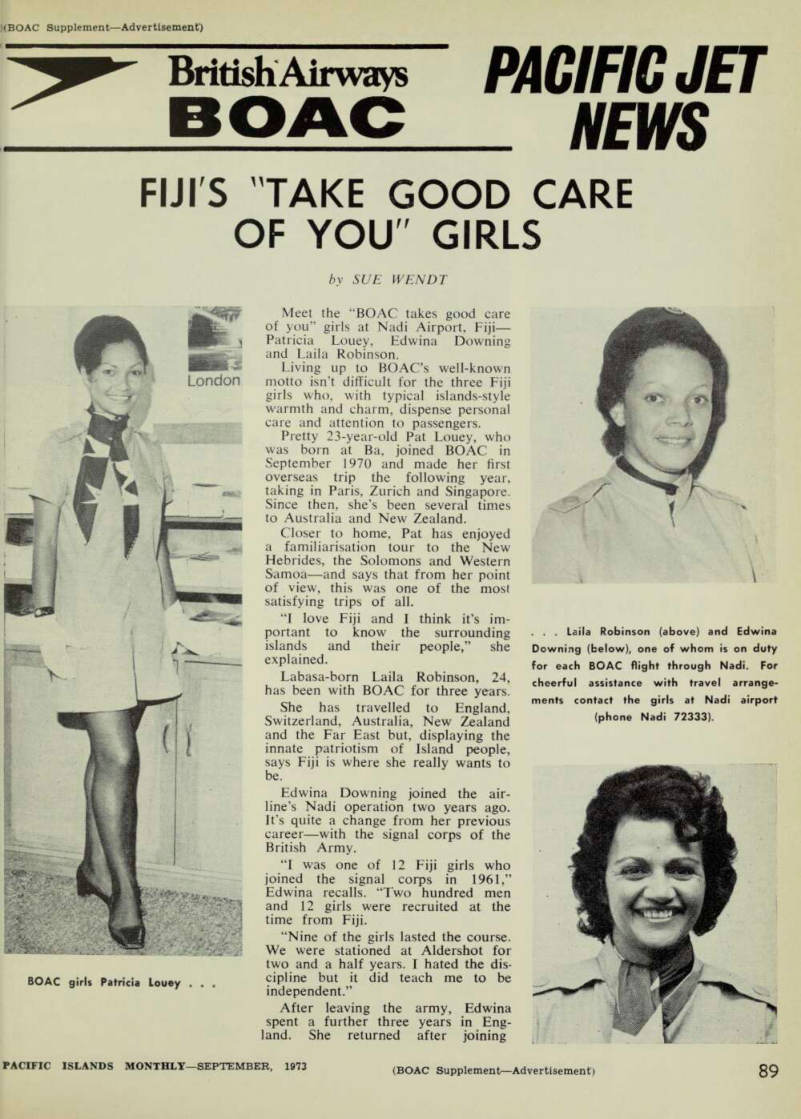
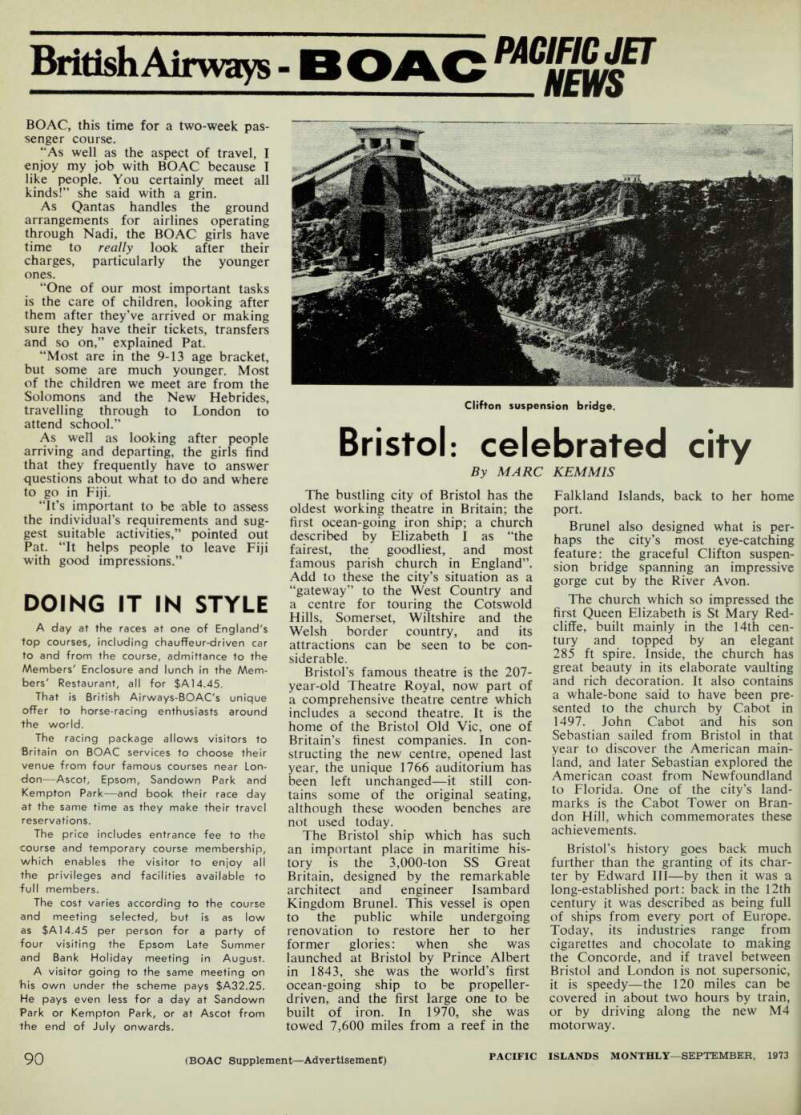
News
Fiji's "Take Good Care
Of You" Girls
i(BOAC Supplement—Advertisement)
By Sue Wendt
Meet the “BOAC takes good care of you” girls at Nadi Airport, Fiji— Patricia Louey, Edwina Downing and Laila Robinson.
Living up to BOAC’s well-known motto isn’t difficult for the three Fiji girls who, with typical islands-style warmth and charm, dispense personal care and attention to passengers.
Pretty 23-year-old Pat Louey, who was born at Ba, joined BOAC in September 1970 and made her first overseas trip the following year, taking in Paris, Zurich and Singapore.
Since then, she’s been several times to Australia and New Zealand.
Closer to home, Pat has enjoyed a familiarisation tour to the New Hebrides, the Solomons and Western Samoa—and says that from her point of view, this was one of the most satisfying trips of all.
“I love Fiji and I think it’s im portant to know the surrounding islands and their people,” she explained.
Labasa-born Laila Robinson, 24, has been with BOAC for three years.
She has travelled to England, Switzerland, Australia, New Zealand and the Far East but, displaying the innate patriotism of Island people, says Fiji is where she really wants to be.
Edwina Downing joined the air line’s Nadi operation two years ago.
It’s quite a change from her previous career—with the signal corps of the British Army.
“I was one of 12 Fiji girls who joined the signal corps in 1961,”
Edwina recalls. “Two hundred men and 12 girls were recruited at the time from Fiji.
“Nine of the girls lasted the course.
We were stationed at Aldershot for two and a half years. I hated the dis cipline but it did teach me to be independent.”
After leaving the army, Edwina spent a further three years in Eng land. She returned after joining
B0OAC girls Patricia Louey . . .
. . . Laila Robinson (above) and Edwina Downing (below), one of whom is on duty for each BOAC flight through Nadi. For cheerful assistance with travel arrange ments contact the girls at Nadi airport (phone Nadi 72333).
BOAC, this time for a two-week pas senger course.
“As well as the aspect of travel, I enjoy my job with BOAC because I like people. You certainly meet all kinds!” she said with a grin.
As Qantas handles the ground arrangements for airlines operating through Nadi, the BOAC girls have time to really look after their
charges, particularly the younger
ones.
“One of our most important tasks is the care of children, looking after them after they’ve arrived or making sure they have their tickets, transfers and so on,” explained Pat.
“Most are in the 9-13 age bracket, but some are much younger. Most of the children we meet are from the Solomons and the New Hebrides, travelling through to London to attend school.”
As well as looking after people
arriving and departing, the girls find
that they frequently have to answer questions about what to do and where to go in Fiji.
“It’s important to be able to assess the individual’s requirements and sug gest suitable activities,” pointed out Pat, “It helps people to leave Fiji with good impressions.”
Doing It In Style
A day at the races at one of England's top courses, including chauffeur-driven car to and from the course, admittance to the Members' Enclosure and lunch in the Mem bers' Restaurant, all for $A14.45.
That is British Airways-BOAC's unique offer to horse-racing enthusiasts around the world.
The racing package allows visitors to Britain on BOAC services to choose their venue from four famous courses near Lon don—Ascot, Epsom, Sandown Park and Kempton Park—and book their race day at the same time as they make their travel reservations.
The price includes entrance fee to the course and temporary course membership, which enables the visitor to enjoy all the privileges and facilities available to full members.
The cost varies according to the course and meeting selected, but is as low as $A14.45 per person for a party of four visiting the Epsom Late Summer and Bank Holiday meeting in August.
A visitor going to the same meeting on bis own under the scheme pays $A32.25.
He pays even less for a day at Sandown Park or Kempton Park, or at Ascot from the end of July onwards.
Bristol: celebrated city
By Marc Kemmis
The bustling city of Bristol has the oldest working theatre in Britain; the first ocean-going iron ship; a church described by Elizabeth I as ‘ the fairest, the goodliest, and most famous parish church in England .
Add to these the city s situation bs 3 “gateway” to the West Country and a centre for touring the Cotswold Hills, Somerset, Wiltshire and the Welsh border country, and its attractions can be seen to be considerable Bristol’s famous theatre is the 207year-old Theatre Royal, now part of a comprehensive theatre centre which includes a second theatre. It is the home of the Bristol Old Vic, one of Britain’s finest companies. In constructing the new centre, opened last year, the unique 1766 auditorium has been left unchanged—it still contains some of the original seating, although these wooden benches are not used today The Bristol ship which has such an important place in maritime history is the 3,000-ton SS Great Britain, designed by the remarkable architect and engineer Isambard Kingdom Brunei. This vessel is open to the public while undergoing renovation to restore her to her former glories: when she was launched at Bristol by Prince Albert in 1843, she was the world’s first ocean-going ship to be propellerdriven, and the first large one to be built of iron. In 1970, she was towed 7,600 miles from a reef in the
Falkland Islands, back to her home port.
Brunei also designed what is per haps the city’s most eye-catching feature: the graceful Clifton suspen sion bridge spanning an impressive gorge cut by the River Avon, ~,. , , , The churchi which so impressed the r Queen Elizabeth is St Mary Red chffe* budt mainly in the 14th cen f an(i . tO PP ed b V a *J elegant 285 ft spire. Inside, the church has § reat P™ u }y in j. ts elaborate vaulting and rich decoration. It also contains a w hale-bone said to have been pre ““gd to the church by Cabot in 1 4 £ 7 - . John ., f abot and . hl . s ? on Sebastian sailed from Bristol in that y ear to discover the American mam land > and later Sebastian explored the American coast from Newfoundland to Florida. One the city s land thJ Cabot Tower on Bran don w mch commemorates these achievements, Bristol’s history goes back much further than the granting of its char ter by Edward lll—by then it was a long-established port: back in the 12th century it was described as being full of ships from every port of Europe, Today, its industries range from cigarettes and chocolate to making the Concorde, and if travel between Bristol and London is not supersonic, it is speedy—the 120 miles can be covered in about two hours by train, or by driving along the new M 4 motorway.
Clifton suspension bridge.
Advertisements & other items, p. 100 (1 item)
British Airways - D OAC
90
PACIFIC ISLANDS MONTHLY—SEPTEMBER, 1973
(BOAC Supplement—Advertisement)
Remarkable, Turbulent
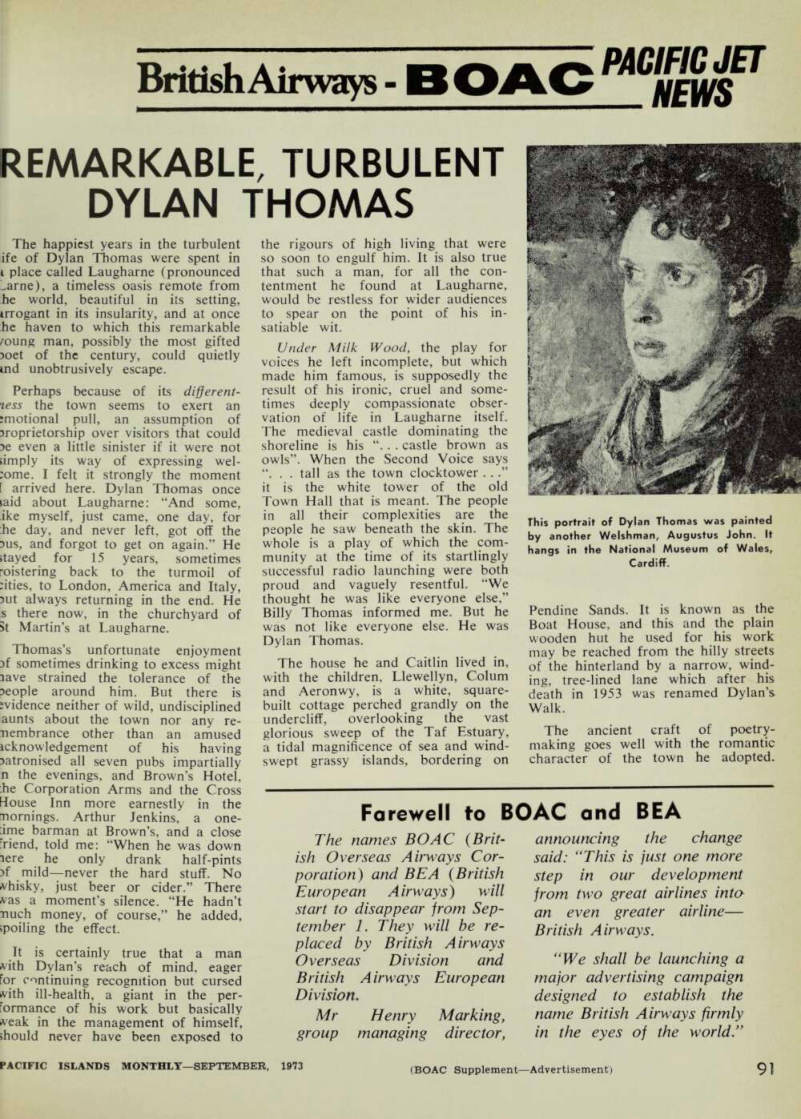
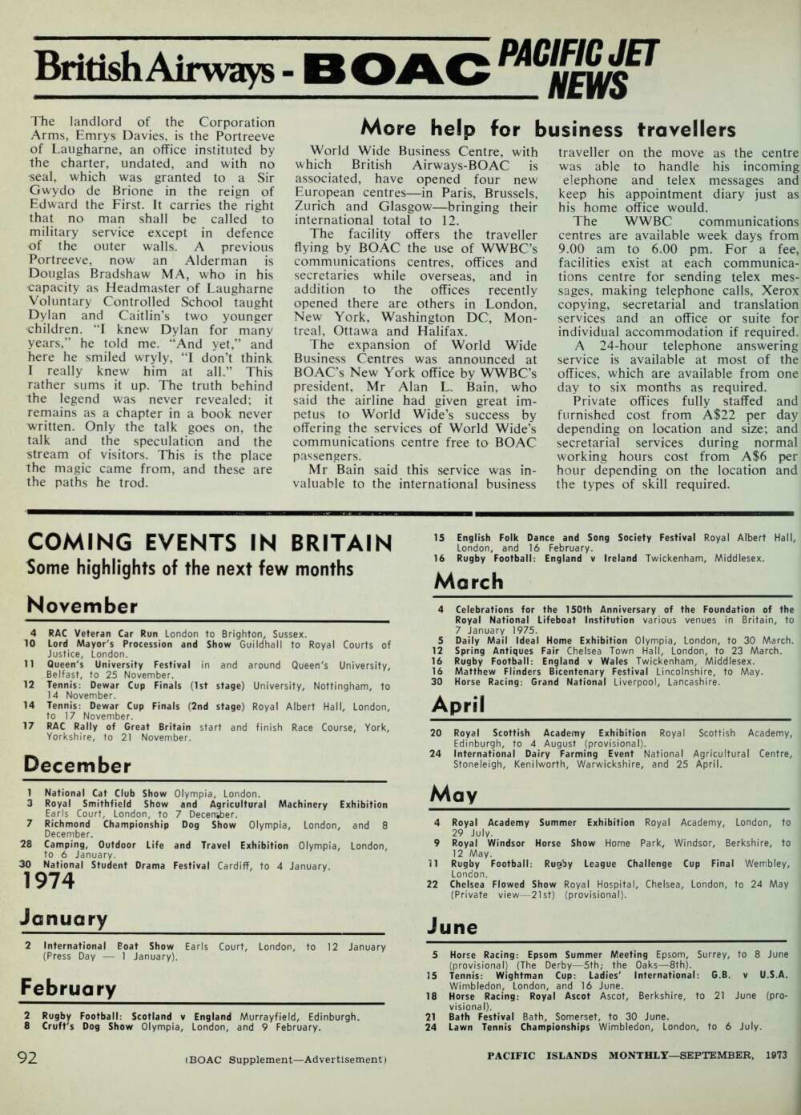
Dylan Thomas
The happiest years in the turbulent ife of Dylan TTomas were spent in i place called Laughame (pronounced L,arne), a timeless oasis remote from he world, beautiful in its setting, urogant in its insularity, and at once he haven to which this remarkable foung man, possibly the most gifted 3oet of the century, could quietly md unobtrusively escape.
Perhaps because of its different tess the town seems to exert an Mnotional pull, an assumption of sroprietorship over visitors that could 5e even a little sinister if it were not simply its way of expressing wel come. I felt it strongly the moment [ arrived here. Dylan Thomas once said about Laughame: “And some, ike myself, just came, one day, for :he day, and never left, got off the 3us, and forgot to get on again.” He stayed for 15 years, sometimes roistering back to the turmoil of cities, to London, America and Italy, sut always returning in the end. He s there now, in the churchyard of 5t Martin’s at Laughame.
Thomas’s unfortunate enjoyment 3f sometimes drinking to excess might lave strained the tolerance of the leople around him. But there is ;vidence neither of wild, undisciplined aunts about the town nor any re nembrance other than an amused acknowledgement of his having latronised all seven pubs impartially n the evenings, and Brown’s Hotel, ;he Corporation Arms and the Cross House Inn more earnestly in the rnornings. Arthur Jenkins, a one :ime barman at Brown’s, and a close Tiend, told me: “When he was down lere he only drank half-pints >f mild—never the hard stuff. No whisky, just beer or cider.” There vas a moment’s silence. “He hadn’t Duch money, of course,” he added, spoiling the effect.
It is certainly true that a man with Dylan’s reach of mind, eager for continuing recognition but cursed with ill-health, a giant in the per formance of his work but basically weak in the management of himself, should never have been exposed to
the rigours of high living that were so soon to engulf him. It is also true that such a man, for all the con tentment he found at Laughame, would be restless for wider audiences to spear on the point of his in satiable wit.
Under Milk Wood , the play for voices he left incomplete, but which made him famous, is supposedly the result of his ironic, cruel and some times deeply compassionate obser vation of life in Laughame itself.
The medieval castle dominating the shoreline is his “.. . castle brown as owls”. When the Second Voice says “. . . tall as the town clocktower . ..” it is the white tower of the old Town Hall that is meant. The people in all their complexities are the people he saw beneath the skin. The whole is a play of which the com munity at the time of its startlingly successful radio launching were both proud and vaguely resentful. “We thought he was like everyone else,”
Billy Thomas informed me. But he was not like everyone else. He was Dylan Thomas.
The house he and Caitlin lived in, with the children, Llewellyn, Colum and Aeronwy, is a white, square built cottage perched grandly on the undercliff, overlooking the vast glorious sweep of the Taf Estuary, a tidal magnificence of sea and wind swept grassy islands, bordering on
Pendine Sands. It is known as the Boat House, and this and the plain wooden hut he used for his work may be reached from the hilly streets of the hinterland by a narrow, wind ing, tree-lined lane which after his death in 1953 was renamed Dylan’s Walk.
The ancient craft of poetry making goes well with the romantic character of the town he adopted.
This portrait of Dylan Thomas was painted by another Welshman, Augustus John. It hangs in the National Museum of Wales, Cardiff.
The landlord of the Corporation Arms, Emrys Davies, is the Portreeve of Laugharne, an office instituted by the charter, undated, and with no •seal, which was granted to a Sir Gwydo de Brione in the reign of Edward the First. It carries the right that no man shall be called to military service except in defence of the outer walls. A previous Portreeve, now an Alderman is Douglas Bradshaw MA, who in his capacity as Headmaster of Laugharne Voluntary Controlled School taught Dylan and Caitlin’s two younger children. “I knew Dylan for many years,” he told me. “And yet,” and here he smiled wryly, “I don’t think I really knew him at all.” This rather sums it up. The truth behind the legend was never revealed; it remains as a chapter in a book never Only the talk goes on, the talk and the speculation and the stream of visitors. This is the place the magic came from, and these are the paths he trod.
Farewell to BOAC and BEA
The names BO AC {Brit ish Overseas Airways Cor poration) and BE A {British European Airways) will start to disappear from Sep tember 1. They will be re placed by British Airways Overseas Division and British Airways European Division.
Mr Henry Marking, group managing director,
announcing the change said: “This is just one more step in our development from two great airlines into an even greater airline — British Airways.
“We shall be launching a major advertising campaign designed to establish the name British Airways firmly in the eyes of the world”
Advertisements & other items, p. 101 (1 item)
British Airways - BO AC MC mSeg Er
91
PACIFIC ISLANDS MONTHLY—SEPTEMBER, 1973
(BOAC Supplement—Advertisement)
More help for business travellers
World Wide Business Centre, with which British Airways-BOAC is associated, have opened four new European centres—in Paris, Brussels, Zurich and Glasgow—bringing their international total to 12.
The facility offers the traveller flying by BOAC the use of WWBC’s communications centres, offices and secretaries while overseas, and in addition to the offices recently opened there are others in London, New York, Washington DC, Mon treal, Ottawa and Halifax.
The expansion of World Wide Business Centres was announced at BOAC’s New York office by WWBC’s president, Mr Alan L. Bain, who said the airline had given great im petus to World Wide’s success by offering the services of World Wide’s communications centre free to BOAC passengers.
Mr Bain said this service was in valuable to the international business
traveller on the move as the centre was able to handle his incoming elephone and telex messages and keep his appointment diary just as his home office would, The WWBC communications centres are available week days from 9.00 am to 6.00 pm. For a fee, facilities exist at each communica tions centre for sending telex mes sages, making telephone calls, Xerox copying, secretarial and translation services and an office or suite for individual accommodation if required, A 24-hour telephone answering service is available at most of the offices, which are available from one day to six months as required, Private offices fully staffed and furnished cost from AS22 per day depending on location and size; and secretarial services during normal working hours cost from As 6 per hour depending on the location and the types of skill required.
Jonuary
Coming Events In Britain
Some highlights of the next few months
November
4 RAC Veteran Car Run London to Brighton, Sussex.
TO Lord Mayor's Procession and Show Guildhall to Royal Courts of Justice, London. 11 Queen's University Festival in and around Queen's University, Belfast, to 25 November.
T 2 Tennis: Dewar Cup Finals (Ist stage) University, Nottingham, to 14 November. 14 Tennis: Dewar Cop Finals (2nd stage) Royal Albert Hall, London, to 17 November. 17 RAC Rally of Great Britain start and finish Race Course, York, Yorkshire, to 21 November.
December
1 National Cat Club Show Olympia, London. 3 Royal Smithfield Show and Agricultural Machinery Exhibition Earls Court, London, to 7 December. 7 Richmond Championship Dog Show Olympia, London, and 8 December. 28 Camping, Outdoor Life and Travel Exhibition Olympia, London, to 6 January. 30 National Student Drama Festival Cardiff, to 4 January. 1974
Jonuary
2 International Boat Show Earls Court, London, to 12 January (Press Day 1 January).
February
2 Rugby Football: Scotland v England Murrayfield, Edinburgh. 8 Cruft's Dog Show Olympia, London, and 9 February.
15 English Folk Dance and Song Society Festival Royal Albert Hall, London, and 16 February. 16 Rugby Football; England v Ireland Twickenham, Middlesex.
March
4 Celebrations for the 150th Anniversary of the Foundation of the Royal National Lifeboat Institution various venues in Britain, to 7 January 1975. 5 Daily Mail Ideal Home Exhibition Olympia, London, to 30 March. 12 Spring Antiques Fair Chelsea Town Hall, London, to 23 March. 16 Rugby Football: England v Wales Twickenham, Middlesex. 16 Matthew Flinders Bicentenary Festival Lincolnshire, to May. 30 Horse Racing: Grand National Liverpool, Lancashire.
April
20 Royal Scottish Academy Exhibition Royal Scottish Academy, Edinburgh, to 4 August (provisional). 24 International Dairy Farming Event National Agricultural Centre, Stoneleigh, Kenilworth, Warwickshire, and 25 April.
May
4 Royal Academy Sommer Exhibition Royal Academy, London, to 29 July. 9 Royal Windsor Horse Show Home Park, Windsor, Berkshire, to 12 May. 11 Rugby Football: Rugby League Challenge Cup Final Wembley, London. 22 Chelsea Flowed Show Royal Hospital, Chelsea, London, to 24 May (Private view—21st) (provisional).
June
5 Horse Racing: Epsom Summer Meeting Epsom, Surrey, to 8 June (provisional) (The Derby—sth; the Oaks—Bth). 15 Tennis: Wightman Cup: Ladies' International: G.B. v U.S.A.
Wimbledon, London, and 16 June. 18 Horse Racing: Royal Ascot Ascot, Berkshire, to 21 June (pro visional). 21 Bath Festival Bath, Somerset, to 30 June. 24 Lawn Tennis Championships Wimbledon, London, to 6 July.
Advertisements & other items, pp. 102-106 (2 items)
British Airways • BO AC PK S££ T
92
PACIFIC ISLANDS MONTHLY—SEPTEMBER, 1973
(BOAC Supplement—Advertisement)
Flo Pioneer
f Notes with the purity of a nightingale’s call or the depth of a bullfrog’s complaint. This magnificent little cassette deck reproduces all, and better, because it has Dolby!" Dolby: An incredibly effective noise reduction system that makes natural sounds leap from the deck, especially with new chromium dioxide tape. It makes everything you record seem super-realistic like looking through a highly polished mirror.
Other sets have Dolby. But other sets don’t have the name Pioneer and extra quality features that go with the name. On the CT-4141 there’s a selector for your special chrome tapes. There’s automatic stop at tape-end in all tape travel functions. And there’s an ultra-smooth ferrite solid head (it just lasts and lasts).
We could go on and on, but your best bet is to flip on the CT-4141 at the nearest Pioneer dealers. © © (• C r o <3 D»Oi\i
flO PIONEER
Brijlal & Company, G.P.O. Box No. 362, Suva, Fiji Islands Tel; 222 58 Astronics Australasia Pty. Ltd. 161-173 Sturt Street, South Melbourne, Victoria 3205 Australia Hagemeyer (Australasia) N.V. P.O. Box No. 90, Lae, New Guinea Tel: 2718 P.O. Box No. 63, Rabaul, New Guinea Tel: 2633 P.O. Box No. 673, Madang, T.P.N.G. Tel; 2445 Box 1428, Boroko, Port Moresby. New Guinea Tel: 5784 Tee Vee Radio Ltd. P.O. Box No. 5029, Auckland, New Zealand Tel: 763-064 Burns Philp (South Sea) Co. Ltd. Norfolk Islands, South Pacific Jacob Enterprises, P.O. Box No. 4, Nauru Island Ets. PERFECT, B.P. 594, Papeete,Tahiti Tel: 20 407 Menard Freres, B.P. 123, Noumea, New Caledonia Tel: 52-22 Transpac Corporation, P.O. Box 1477, Pago Pago, American Samoa 96799 Tel: 2227 * “DOLBY” is a trade mark of DOLBY LABORATORIES INC.
The finest Flours and Sharps
Jn the South Pacific.^^'
aV v
7/l\V N
V *5 \ Seafoam Mills at Brisbane, Toowoomba, Roma, Maryborough, Rockhampton
SEAFOAM FLOUR MILLS
Queensland's largest flour milling organisation a division of
The Queensland Co-op Milling
Assn. Limited
Head office—Box 7, P.O. South Brisbane, Old.
Phone: 44-1681. Cable Address: "Seafoam,"
Brisbane. manufacturers of
High quality products from Queensland
hard wheats
Al! products manufactured to suit your requirements—Enquiries welcome.
SEAFOAM (high protein baker's flour) TOPIC (protein rich)
EXCELSIOR
SILVERSPRAY
(export flours)
SHARPS andMEALS
Minolta SR-1101 minolfa r mmoifa
Hi-MATIC F
rT 101 1
PERFECT PERFECTER PERFECTEST
Minolta has the perfect camera.
It’s called the 16 QT lk Spyfinder” subminiature. Or the electronic exposure Hi-matic F. Or the full system SR-TlOl.
Whatever, wherever, whenever, you want to shoot...
Minolta has the perfect camera.
The SR-TlOl offers perfection in depth. A precision 35mm SLR. the 101 is backed by the Minolta system of over 150 accessories and fine Rokkor Lenses.
With the SR-TlOl you can do anything you want to do perfectly.
The Hi-matic F is perfection with speed. Automatic exposure and automatic flash ensure electronic accuracy at computer speed. Full 35mm format in a palm sized, speedy package.
The 16 QT is perfectly secret.
Shoot anywhere, anytime without being detected or carrying a lot of equipment. Just drop in a film cartridge and shoot.
Attach the “Spyfinder” eye piece and you can even shoot around comers.
The perfect camera...by Minolta.
What we call it depends on how you use it.
Minolta
Minolta Camera Co.. Ltd.. 30, 2-Chome, Azuchi Machi. Higashi-Ku. Osaka, Japan.
The blue beyond. The earth below.
A path between the two. That only youth
Making the endless blue and
bleach-white sands one...
...HONDA.
A young man whose desire to reach the summit of success knows no limits. At work or at play, he thrives on new challenges, new ways to satisfy his zest for the active life. Every day more people are finding themselves in HONDA. Leader in motorcycles. Holder of the title of having y 3 of the world’s market. With sales in more than 15 countries. By offering the right combination of power, performance, and ride in a wide range to suit every individual. It’s all of what it takes to be a world leader in motorcycles
... HONDA!
may
* 50 i m 2s /: u
m y j \yxr
-k : / 'L. i%sr I >
f vi
J World s Largest Motorcycle Manufacturer
' HONJS MOX»R Cp„LTD."TOKYD. .
IA NE W G Ui#apLSte« msh i ps JdWt ng Q o Ltd. P. (ft 80/ ;LANDS:I9gSraI IsLaard M(tforsJ£o B6x 2S6,£uva /-TAB SJERN SAMf&U Mtffor D*«#butdr (Samoa) Ltd. g O'. Box & e fillto 6. Eft / American S/ RITORY: J.C. Tenorio Enterprise P.O. Box 137. Saipan/ sfandst opm ent,'AutlsOrity -G / JOA»A|«rJldleck itia.P. o. |o* 99, %M. Jonos tSd* P.O ox M. Nukualofa / SOLOMON British* Solonf»ns TrpSfrrg Co.. Lidt P.O. Box 94, Honiara / tfEW CALEDO|JI£; “Istabfissgments Bailande, Noumea / TAHITI:,Ets. COMIMPEX PO. /.COOK fSIAND%: Cook islands Trading Corporation Ltd. , P.O. Box 92, Rarotonga / NAURU ISLAND: Nauru Cooperative£ociety ’ v W . . f -' . ■ .r" 1; -' i 4 T f ■ t. * ft*,*
Business and Development
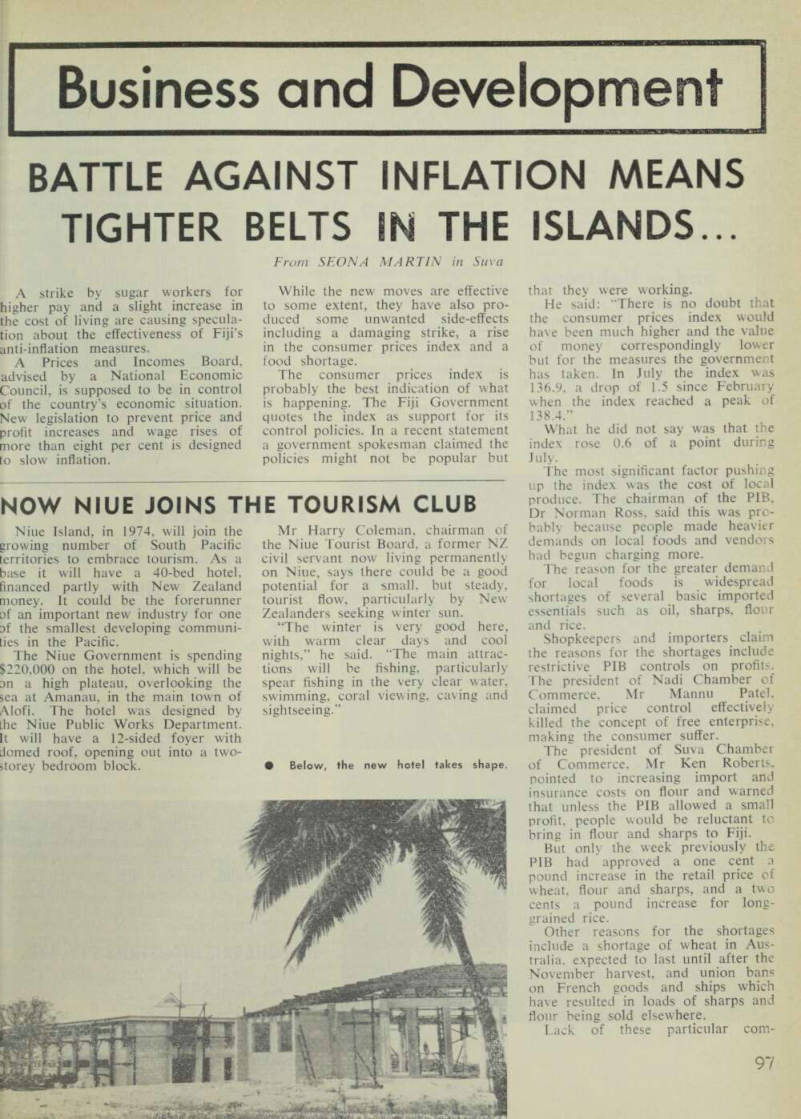
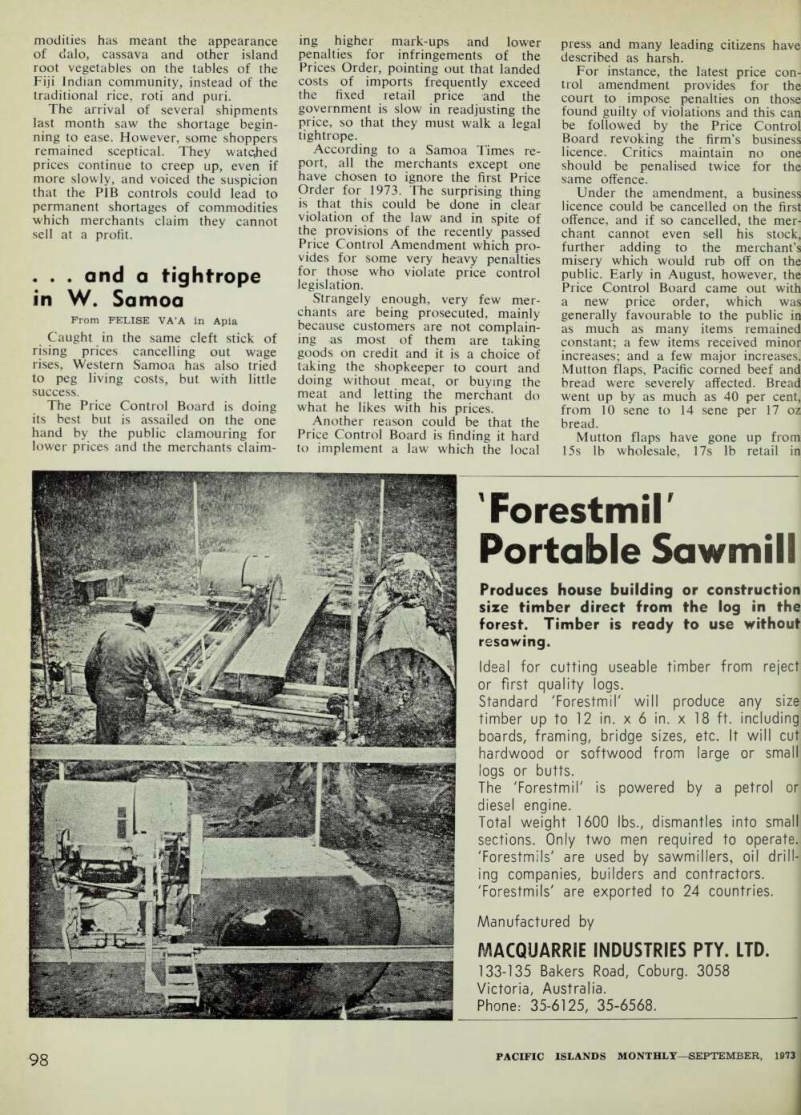
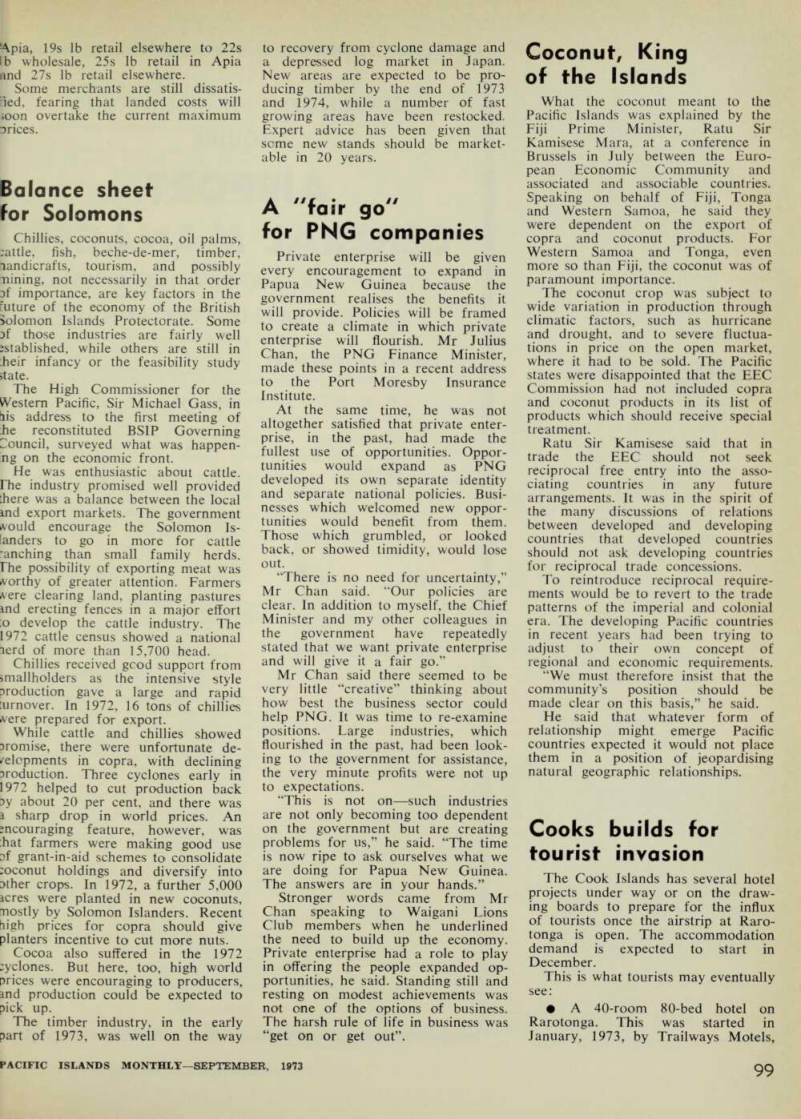
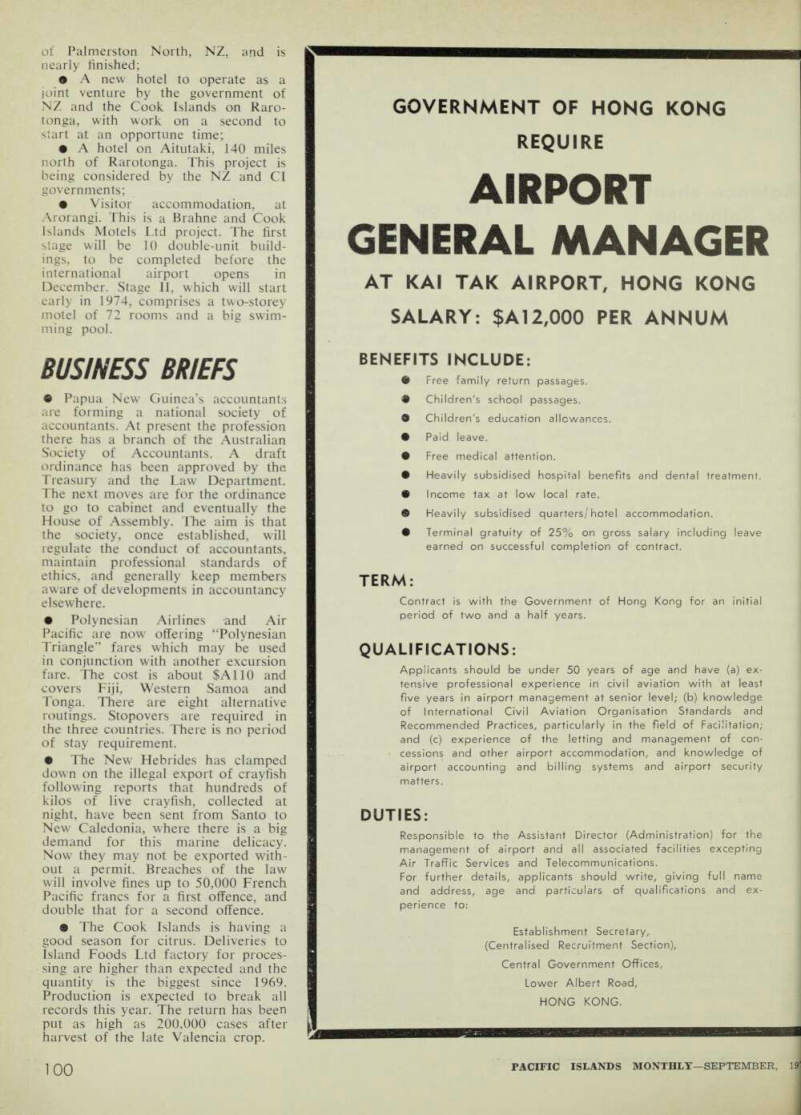
Battle Against Inflation Means
Tighter Belts In The Islands...
From SEONA MARTIN in Suva
A strike by sugar workers f<pr higher pay and a slight increase in the cost of living are causing specula tion about the effectiveness of Fiji’s anti-inflation measures.
A Prices and Incomes Board, advised by a National Economic Council, is supposed to be in control of the country’s economic situation.
New legislation to prevent price and profit increases and wage rises of more than eight per cent is designed to slow inflation.
While the new moves are effective to some extent, they have also pro duced some unwanted side-effects including a damaging strike, a rise in the consumer prices index and a food shortage, The consumer prices index is probably the best indication of what is happening. The Fiji Government quotes the index as support for its control policies. In a recent statement a government spokesman claimed the policies might not be popular but
that they were working.
He said: "There is no doubt that the consumer prices index would have been much higher and the value of money correspondingly lower but for the measures the government has taken. In July the index was 136.9, a drop of 1.5 since February when the index reached a peak of 138.4.”
What he did not say was that the index rose 0.6 of a point during July.
The most significant factor pushing up the index was the cost of local produce. The chairman of the PIB, Dr Norman Ross, said this was pro bably because people made heavier demands on local foods and vendors had begun charging more.
The reason for the greater demand for local foods is widespread shortages of several basic imported essentials such as oil, sharps, flour and rice.
Shopkeepers and importers claim the reasons for the shortages include restrictive PIB controls on profits.
The president of Nadi Chamber of Commerce. Mr Mannu Patel, claimed price control effectively killed the concept of free enterprise, making the consumer suffer.
The president of Suva Chamber of Commerce, Mr Ken Roberts, pointed to increasing import and insurance costs on flour and warned that unless the PIB allowed a small profit, people would be reluctant to bring in flour and sharps to Fiji.
But only the week previously the PIB had approved a one cent a pound increase in the retail price of wheat, flour and sharps, and a two cents a pound increase for long grained rice.
Other reasons for the shortages include a shortage of wheat in Aus tralia. expected to last until after the November harvest, and union bans on French goods and ships which have resulted in loads of sharps and flour being sold elsewhere.
Lack of these particular com
modities has meant the appearance of dalo, cassava and other island root vegetables on the tables of the Fiji Indian community, instead of the traditional rice, roti and puri.
The arrival of several shipments last month saw the shortage begin ning to ease. However, some shoppers remained sceptical. They watched prices continue to creep up, even if more slowly, and voiced the suspicion that the PIB controls could lead to permanent shortages of commodities which merchants claim they cannot sell at a profit. . . . and a tightrope
in W. Samoa
Prom PELISE VA’A in Apia Caught in the same cleft stick of rising prices cancelling out wage rises, Western Samoa has also tried to peg living costs, but with little success.
The Price Control Board is doing its best but is assailed on the one hand by the public clamouring for lower prices and the merchants claim
ing higher mark-ups and lower penalties for infringements of the Prices Order, pointing out that landed costs of imports frequently exceed the fixed retail price and the government is slow in readjusting the price, so that they must walk a legal tightrope.
According to a Samoa Times re port, all the merchants except one have chosen to ignore the first Price Order for 1973. The surprising thing is that this could be done in clear violation of the law and in spite of the provisions of the recently passed Price Control Amendment which pro vides for some very heavy penalties for those who violate price control legislation.
Strangely enough, very few mer chants are being prosecuted, mainly because customers are not complain ing most of them are taking goods on credit and it is a choice of taking the shopkeeper to court and doing without meat, or buying the meat and letting the merchant do what he likes with his prices.
Another reason could be that the Price Control Board is finding it hard to implement a law which the local
press and many leading citizens have described as harsh.
For instance, the latest price con trol amendment provides for the court to impose penalties on those found guilty of violations and this can be followed by the Price Control Board revoking the firm’s business licence. Critics maintain no one should be penalised twice for the same offence.
Under the amendment, a business licence could be cancelled on the first offence, and if so cancelled, the mer chant cannot even sell his stock, further adding to the merchant’s misery which would rub off on the public. Early in August, however, the Price Control Board came out with a new price order, which was generally favourable to the public in as much as many items remained constant; a few items received minor increases; and a few major increases.
Mutton flaps, Pacific corned beef and bread were severely affected. Bread went up by as much as 40 per cent, from 10 sene to 14 sene per 17 oz bread.
Mutton flaps have gone up from 15s lb wholesale, 17s lb retail in
Apia, 19s lb retail elsewhere to 22s tb wholesale, 25s lb retail in Apia and 27s lb retail elsewhere.
Some merchants are still dissatis fied, fearing that landed costs will *oon overtake the current maximum Drices.
Balance sheet
for Solomons
Chillies, coconuts, cocoa, oil palms, :attle, fish, beche-de-mer, timber, handicrafts, tourism, and possibly Timing, not necessarily in that order Df importance, are key factors in the future of the economy of the British Solomon Islands Protectorate. Some Tf those industries are fairly well ;stablished, while others are still in ;heir infancy or the feasibility study >tate.
The High Commissioner for the Western Pacific, Sir Michael Gass, in his address to the first meeting of Jie reconstituted BSIP Governing Council, surveyed what was happen ng on the economic front.
He was enthusiastic about cattle.
The industry promised well provided there was a balance between the local md export markets. The government would encourage the Solomon Is landers to go in more for cattle ■anching than small family herds.
Lhe possibility of exporting meat was worthy of greater attention. Farmers were clearing land, planting pastures md erecting fences in a major effort ;o develop the cattle industry. The 1972 cattle census showed a national ierd of more than 15,700 head.
Chillies received good support from smallholders as the intensive style production gave a large and rapid turnover. In 1972, 16 tons of chillies were prepared for export.
While cattle and chillies showed promise, there were unfortunate de velopments in copra, with declining aroduction. Three cyclones early in 1972 helped to cut production back ?y about 20 per cent, and there was a sharp drop in world prices. An mcouraging feature, however, was Eat farmers were making good use 3f grant-in-aid schemes to consolidate :oconut holdings and diversify into ather crops. In 1972, a further 5,000 acres were planted in new coconuts, mostly by Solomon Islanders. Recent high prices for copra should give planters incentive to cut more nuts.
Cocoa also suffered in the 1972 :yclones. But here, too, high world prices were encouraging to producers, and production could be expected to pick up.
The timber industry, in the early part of 1973, was well on the way
to recovery from cyclone damage and a depressed log market in Japan.
New areas are expected to be pro ducing timber by the end of 1973 and 1974, while a number of fast growing areas have been restocked.
Expert advice has been given that seme new stands should be market able in 20 years.
A "fair go"
tor PNG companies
Private enterprise will be given every encouragement to expand in Papua New Guinea because the government realises the benefits it will provide. Policies will be framed to create a climate in which private enterprise will flourish. Mr Julius Chan, the PNG Finance Minister, made these points in a recent address to the Port Moresby Insurance Institute.
At the same time, he was not altogether satisfied that private enter prise, in the past, had made the fullest use of opportunities. Oppor tunities would expand as PNG developed its own separate identity and separate national policies. Busi nesses which welcomed new oppor tunities would benefit from them.
Those which grumbled, or looked back, or showed timidity, would lose out.
“There is no need for uncertainty,”
Mr Chan said. “Our policies are clear. In addition to myself, the Chief Minister and my other colleagues in the government have repeatedly stated that we want private enterprise and will give it a fair go.”
Mr Chan said there seemed to be very little “creative” thinking about how best the business sector could help PNG. It was time to re-examine positions. Large industries, which flourished in the past, had been look ing to the government for assistance, the very minute profits were not up to expectations.
“This is not on—such industries are not only becoming too dependent on the government but are creating problems for us,” he said. “The time is now ripe to ask ourselves what we are doing for Papua New Guinea.
The answers are in your hands.”
Stronger words came from Mr Chan speaking to Waigani Lions Club members when he underlined the need to build up the economy.
Private enterprise had a role to play in offering the people expanded op portunities, he said. Standing still and resting on modest achievements was not one of the options of business.
The harsh rule of life in business was “get on or get out”.
Coconut, King
of the Islands
What the coconut meant to the Pacific Islands was explained by the Fiji Prime Minister, Ratu Sir Kamisese Mara, at a conference in Brussels in July between the Euro pean Economic Community and associated and associable countries.
Speaking on behalf of Fiji, Tonga and Western Samoa, he said they were dependent on the export of copra and coconut products. For Western Samoa and Tonga, even more so than Fiji, the coconut was of paramount importance.
The coconut crop was subject to wide variation in production through climatic factors, such as hurricane and drought, and to severe fluctua tions in price on the open market, where it had to be sold. The Pacific states were disappointed that the EEC Commission had not included copra and coconut products in its list of products which should receive special treatment.
Ratu Sir Kamisese said that in trade the EEC should not seek reciprocal free entry into the asso ciating countries in any future arrangements. It was in the spirit of the many discussions of relations between developed and developing countries that developed countries should not ask developing countries for reciprocal trade concessions.
To reintroduce reciprocal require ments would be to revert to the trade patterns of the imperial and colonial era. The developing Pacific countries in recent years had been trying to adjust to their own concept of regional and economic requirements.
“We must therefore insist that the community’s position should be made clear on this basis,” he said.
He said that whatever form of relationship might emerge Pacific countries expected it would not place them in a position of jeopardising natural geographic relationships.
Cooks builds for
tourist invasion
The Cook Islands has several hotel projects under way or on the draw ing boards to prepare for the influx of tourists once the airstrip at Raro tonga is open. The accommodation demand is expected to start in December.
This is what tourists may eventually see: • A 40-room 80-bed hotel on Rarotonga. This was started in January, 1973, by Trailways Motels,
of Palmerston North, NZ, and is nearly finished; ® A new hotel to operate as a joint venture by the government of NZ and the Cook Islands on Raro tonga, with work on a second to start at an opportune time; • A hotel on Aitutaki, 140 miles north of Rarotonga. This project is being considered by the NZ and Cl governments; • Visitor accommodation, at Arorangi. This is a Brahne and Cook Islands Motels Ltd project. The first stage will be 10 double-unit build ings, to be completed before the international airport opens in December. Stage 11, which will start early in 1974, comprises a two-storey motel of 72 rooms and a big swim ming pool.
Now Niue Joins The Tourism Club
Niue Island, in 1974. will join the growing number of South Pacific territories to embrace tourism. As a base it will have a 40-bed hotel, financed partly with New Zealand money. It could be the forerunner of an important new industry for one af the smallest developing communi ties in the Pacific.
The Niue Government is spending $220,000 on the hotel, which will be an a high plateau, overlooking the sea at Amanau, in the main town of Alofi. The hotel was designed by the Niue Public Works Department.
It will have a 12-sided foyer with domed roof, opening out into a two storey bedroom block.
Mr Harry Coleman, chairman of the Niue Tourist Board, a former NZ civil servant now living permanently on Niue, says there could be a good potential for a small, but steady, tourist flow, particularly by New Zealanders seeking winter sun.
“The winter is very good here, with warm clear days and cool nights,” he said. "The main attrac tions will be fishing, particularly spear fishing in the very clear water, swimming, coral viewing, caving and sightseeing.”
Below, the new hotel takes shape.
Advertisements & other items, pp. 108-109 (2 items)
Portable Sawmill
m J f m i€ m i*v S i’w - ' 'i: -.
Forestmil
Produces house building or construction size timber direct from the log in the forest. Timber is ready to use without resawing.
Ideal for cutting useable timber from reject or first quality logs.
Standard 'Forestmil' will produce any size timber up to 12 in. x 6 in. x 18 ft. including boards, framing, bridge sizes, etc. It will cut hardwood or softwood from large or small logs or butts.
The 'Forestmil' is powered by a petrol or diesel engine.
Total weight 1600 lbs., dismantles into small sections. Only two men required to operate.
'Forestmils' are used by sawmillers, oil drilling companies, builders and contractors.
'Forestmils' are exported to 24 countries.
Manufactured by
MACQUARRIE INDUSTRIES PTY. LTD.
133-135 Bakers Road, Coburg. 3058 Victoria, Australia.
Phone: 35-6125, 35-6568.
99
ACIFIC ISLANDS MONTHLY—SEPTEMBER, 1973
Business Briefs
® Papua New Guinea’s accountants are forming a national society of accountants. At present the profession there has a branch of the Australian Society of Accountants. A draft ordinance has been approved by the Treasury and the Law Department.
The next moves are for the ordinance to go to cabinet and eventually the House of Assembly. The aim is that the society, once established, will regulate the conduct of accountants, maintain professional standards of ethics, and generally keep members aware of developments in accountancy elsewhere. • Polynesian Airlines and Air Pacific are now offering “Polynesian Triangle” fares which may be used in conjunction with another excursion fare. The cost is about SAIIO and covers Fiji, Western Samoa and Tonga. There are eight alternative routings. Stopovers are required in the three countries. There is no period of stay requirement, • The New Hebrides has clamped down on the illegal export of crayfish following reports that hundreds of kilos of live crayfish, collected at night, have been sent from Santo to New Caledonia, where there is a big demand for this marine delicacy.
Now they may not be exported with out a permit. Breaches of the law will involve fines up to 50,000 French Pacific francs for a first offence, and double that for a second offence. ® The Cook Islands is having a good season for citrus. Deliveries to Island Foods Ltd factory for proces sing are higher than expected and the quantity is the biggest since 1969.
Production is expected to break all records this year. The return has been put as high as 200,000 cases after harvest of the late Valencia crop.
Advertisements & other items, p. 110 (1 item)
General Manager
GOVERNMENT OF HONG KONG
REQUIRE
AIRPORT
GENERAL MANAGER
AT KAI TAK AIRPORT, HONG KONG
SALARY: $A12,000 PER ANNUM
BENEFITS INCLUDE:
® Free family return passages. • Children's school passages. 8 Children's education allowances. • Paid leave. • Free medical attention. • Heavily subsidised hospital benefits and dental treatment. • Income tax at low local rate. @ Heavily subsidised quarters/hotel accommodation. • Terminal gratuity of 25% on gross salary including leave earned on successful completion of contract.
TERM:
Contract is with the Government of Hong Kong for an initial period of two and a half years.
QUALIFICATIONS:
Applicants should be under 50 years of age and have (a) extensive professional experience in civil aviation with at least five years in airport management at senior level; (b) knowledge of International Civil Aviation Organisation Standards and Recommended Practices, particularly in the field of Facilitation; and (c) experience of the letting and management of concessions and other airport accommodation, and knowledge of airport accounting and billing systems and airport security matters.
DUTIES:
Responsible to the Assistant Director (Administration) for the management of airport and all associated facilities excepting Air Traffic Services and Telecommunications.
For further details, applicants should write, giving full name and address, age and particulars of qualifications and experience to; Establishment Secretary, (Centralised Recruitment Section), Central Government Offices, Lower Albert Road,
HONG KONG.
Produce Prices
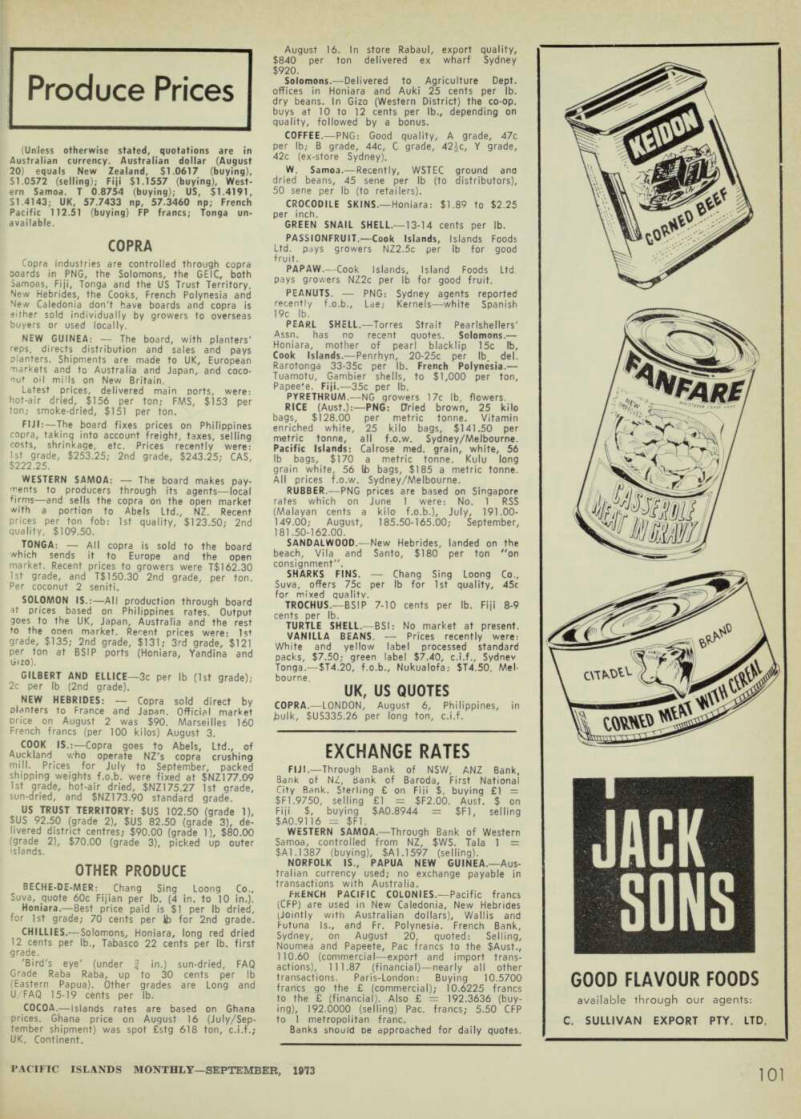
(Unless otherwise stated, quotations are in Australian currency. Australian dollar (August 20) equals New Zealand, $1.0617 (buying), $1.0572 (selling); Fiji $1.1557 (buying), West ern Samoa. T 0.8754 (buying); US, $1.4191, 51.4143, UK, 57.7433 np, 57.3460 np; French Pacific 112.51 (buying) FP francs; Tonga un available.
Copra
Copra industries are controlled through copra ooards in PNG, the Solomons, the GEIC, both Samoas, Fiji, Tonga and the US Trust Territory.
New Hebrides, the Cooks, French Polynesia and New Caledonia don't have boards and copra is either sold individually by growers to overseas buyers or used locally.
NEW GUINEA: The board, with planters' reps, directs distribution and sales and pays planters. Shipments are made to UK, European markets and to Australia and Japan, and coco nut oil mills on New Britain.
Latest prices, delivered main ports, were: hot-air dried, $156 per ton; FMS, $153 per ton; smoke-dried, $l5l per ton.
FIJI:—The board fixes prices on Philippines copra, taking into account freight, taxes, selling costs, shrinkage, etc. Prices recently were: Ist grade, $253.25; 2nd grade, $243.25; CAS, $222.25.
WESTERN SAMOA: The board makes pay ments to producers through its agents—local firms—and sells the copra on the open market with a portion to Abels Ltd., NZ. Recent prices per ton fob: Ist quality, $123.50; 2nd quality, $109.50.
TONGA: All copra is sold to the board which sends it to Europe and the open market. Recent prices to growers were T 5162.30 Ist grade, and T 5150.30 2nd grade, per ton.
Per coconut 2 seniti.
SOLOMON IS.:—All production through board at prices based on Philippines rates. Output goes to the UK, Japan, Australia and the rest to the ooen market. Recent prices were: Ist grade, $135; 2nd grade, $131; 3rd grade, $l2l per ton at BSIP ports (Honiara, Yandina and Gizo).
GILBERT AND ELLICE—3c per lb (Ist grade); 2c per lb (2nd grade).
NEW HEBRIDES: Copra sold direct by planters to France and Japan. Official market price on August 2 was $9O. Marseilles 160 French francs (per 100 kilos) August 3.
COOK IS.:—Copra goes to Abels, Ltd., of Auckland who operate NZ's copra crushing mill. Prices for July to September, packed shipping weights f.o.b. were fixed at $NZ177.09 Ist grade, hot-air dried, $NZ175.27 Ist grade, sun-dried, and $NZ173.90 standard grade.
US TRUST TERRITORY: SUS 102.50 (grade 1), SUS 92.50 (grade 2), SUS 82.50 (grade 3), de livered district centres; $90.00 (grade 1), $BO.OO (grade 2), $70.00 (grade 3), picked up outer islands.
Other Produce
BECHE-DE-MER: Chang Sing Loong Co., Suva, quote 60c Fijian per lb. (4 in. to 10 in.).
Honiara.—Best price paid is $1 per lb dried, for Ist grade; 70 cents per lb for 2nd grade.
CHILLIES.—SoIomons, Honiara, long red dried 12 cents per lb.. Tabasco 22 cents per lb. first grade.
'Bird's eye' (under % in.) sun-dried, FAQ Grade Raba Raba, up to 30 cents per lb (Eastern Papua). Other grades are Long and U/FAQ 15-19 cents per lb.
COCOA.— Islands rates are based on Ghana prices. Ghana price on August 16 (July/Sep tember shipment) was spot £stg 618 ton, c.i.f.; UK, Continent.
August 16. In store Rabaul, export quality, $B4O per ton delivered ex wharf Sydney $920.
Solomons. —Delivered to Agriculture Dept, offices in Honiara and Auki 25 cents per lb. dry beans. In Gizo (Western District) the co-op. buys at 10 to 12 cents per lb., depending on quality, followed by a bonus.
COFFEE.—PNG: Good quality, A grade, 47c per lb; B grade, 44c, C grade, 42£c, Y grade, 42c (ex-store Sydney).
W. Samoa. —Recently, WSTEC ground ana dried beans, 45 sene per lb (to distributors), 50 sene per lb (to retailers).
CROCODILE SKlNS.—Honiara: $1.89 to $2.25 per inch.
GREEN SNAIL SHELL.—I 3-14 cents per lb.
PASSIONFRUIT.—Cook Islands, Islands Foods Ltd. pays growers NZ2.5c per lb for good fruit.
PAPAW.—Cook Islands, Island Foods Ltd pays growers NZ2c per lb for good fruit.
PEANUTS. PNG: Sydney agents reported recently f.0.b., Lae,- Kernels—white Spanish 19c lb.
PEARL SHELL.—Torres Strait Pearlshellers' Assn, has no recent quotes. Solomons.— Honiara, mother of pearl blacklip 15c lb, Cook Islands. —Penrhyn, 20-25 c per lb. del.
Rarotonga 33-35 c per lb. French Polynesia.— Tuamotu, Gambier shells, to $l,OOO per ton, Papeete. Fiji.—3sc per lb.
PYRETHRUM.—NG growers 17c lb, flowers.
RICE (Aust.):—PNG: [Tried brown, 25 kilo bags, $128.00 per metric tonne. Vitamin enriched white, 25 kilo bags, $141.50 per metric tonne, all f.o.w. Sydney/Melbourne.
Pacific Islands; Calrose med. grain, white, 56 lb bags, $l7O a metric tonne. Kulu long grain white, 56 lb bags, $lB5 a metric tonne.
All prices f.o.w. Sydney/Melbourne.
RUBBER.—PNG prices are based on Singapore rates which on June 1 were: No. 1 RSS (Malayan cents a kilo f.0.b.), July, 191.00- 149.00; August, 185.50-165.00; September, 181.50-162.00.
SANDALWOOD.—New Hebrides, landed on the beach, Vila and Santo, $lBO per ton "on consignment".
SHARKS FINS. Chang Sing Loong Co., Suva, offers 75c per lb for Ist quality, 45c for mixed quality.
TROCHUS.—BSIP 7-10 cents per lb. Fiji 8-9 cents per lb.
TURTLE SHELL.—BSI: No market at present.
VANILLA BEANS. Prices recently were: White and yellow label processed standard packs, $7.50; green label $7.40, c.i.f., Sydnev Tonga.—sT4.2o, f.0.b., Nukualofa; $T4.50, Mel bourne.
Uk, Us Quotes
COPRA.—LONDON, August 6, Philippines, in bulk, $U5335.26 per long ton, c.i.f.
Exchange Rates
FIJI. —Through Bank of NSW, ANZ Bank, Bank of NZ, Bank of Baroda, First National City Bank. Sterling £ on Fiji $, buying £1 = $F1.9750, selling £1 = $F2.00. Aust. $ on Fiji $, buying $A0.8944 = SFI, selling
$A0.9116 = Sfi.
WESTERN SAMOA.—Through Bank of Western Samoa, controlled from NZ, SWS. Tala 1 = $A1.1387 (buying), $A1.1597 (selling).
Norfolk Is., Papua New Gulnea.—Aus
tralian currency used; no exchange payable in transactions with Australia.
FkENCH PACIFIC COLONIES.—Pacific francs (CFP) are used in New Caledonia, New Hebrides (Jointly with Australian dollars), Wallis and Futuna Is., and Fr. Polynesia. French Bank, Sydney, on August 20, quoted: Selling, Noumea and Papeete, Pac francs to the sAust., 110.60 (commercial —export and import trans actions), 111.87 (financial) —nearly all other transactions. Paris-London: Buying 10.5700 francs go the £ (commercial); 10.6225 francs to the £ (financial). Also £ = 192.3636 (buy ing), 192.0000 (selling) Pac. francs; 5.50 CFP to 1 metropolitan franc.
Banks should be approached for daily quotes.
Advertisements & other items, pp. 111-112 (1 item)
£
'AR£ [ & ft m
tWHW
GOOD FLAVOUR FOODS
available through our agents:
C. SULLIVAN EXPORT PTY. LTD.
3»» *4 > f ■*-J\
This little flower is your key
to the safe insect killer
One of the safest and most potent insect-killers known to contemporary science is derived from an innocentlooking small white flower, the African Pyrethrum daisy. Pure pyrethrins, as chemists call this substance, is the active ingredient in Pea-Beu insect spray, and the key to its concentrated killing power. Continuing research by the chemists in the laboratories of A.N.I. Chemical Research and by health and environmental authorities throughout the world, confirms that insects do not become immune to pyrethrum. Pea- Beu contains a high concentration of pyrethrins which means that short bursts only are needed to kill flies, mosquitoes and every type of insect pest.
The mosquito—a deadly
trafficker of disease The mosquito’s record as a killer is world recognised. Beside wrecking *9* m so pure it’s safe to spray anywhere your night’s sleep with its irritating whine and inflicting its painful toxic bites, the mosquito passes on many serious diseases, including malaria, hepatitis, dengue and yellow fever, disfiguring elephantiasis and encephalitis. Pea-Beu is recommended to kill every mosquito that enters your home, because it is guaranteed completely effective, yet absolutely safe.
No fears near food Your kitchen and food-cupboards are the favourite places for houseflies, especially when attracted by exposed food as you cook or serve.
Of course you’re reluctant to use pungent insecticides, and fear toxic effects. But never hesitate to use Pea-Beu.
Its active ingredient guarantees it harmless to humans and pets, and thanks to the purity of all its ingredients, it is completely safe to spray anywhere in the home.
Pea-Beu the safe, powerful insecticide
Shipping & Airways Information
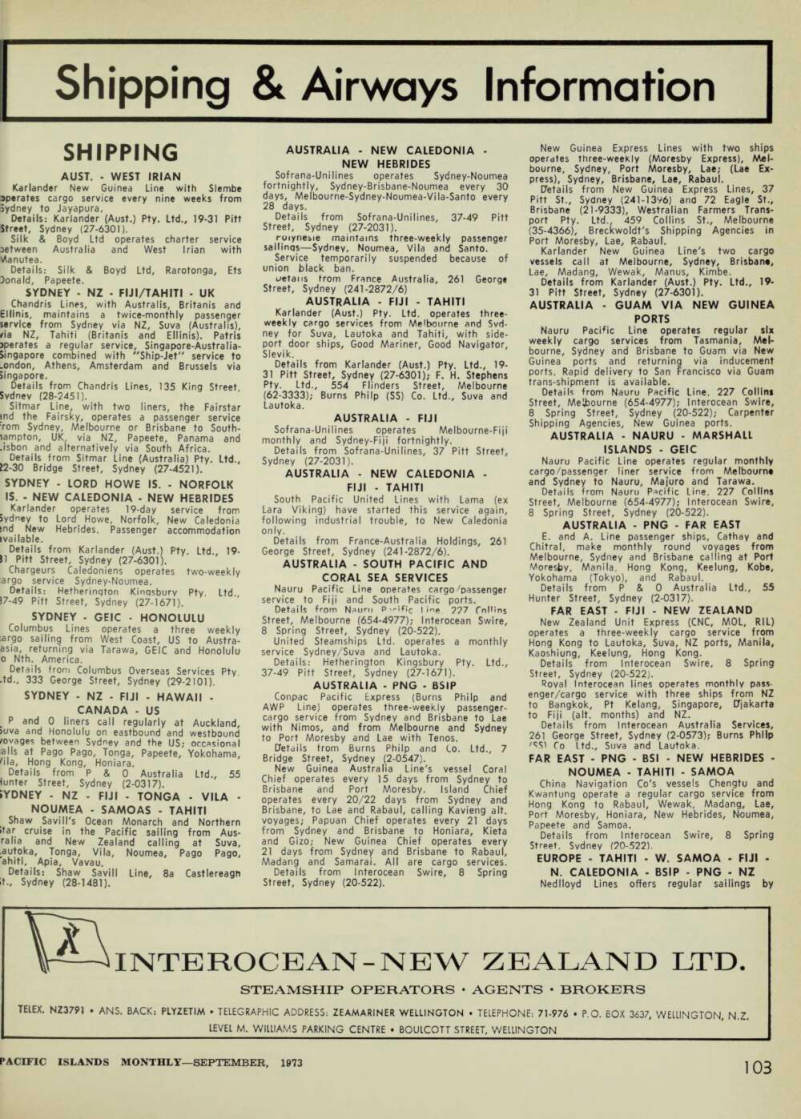
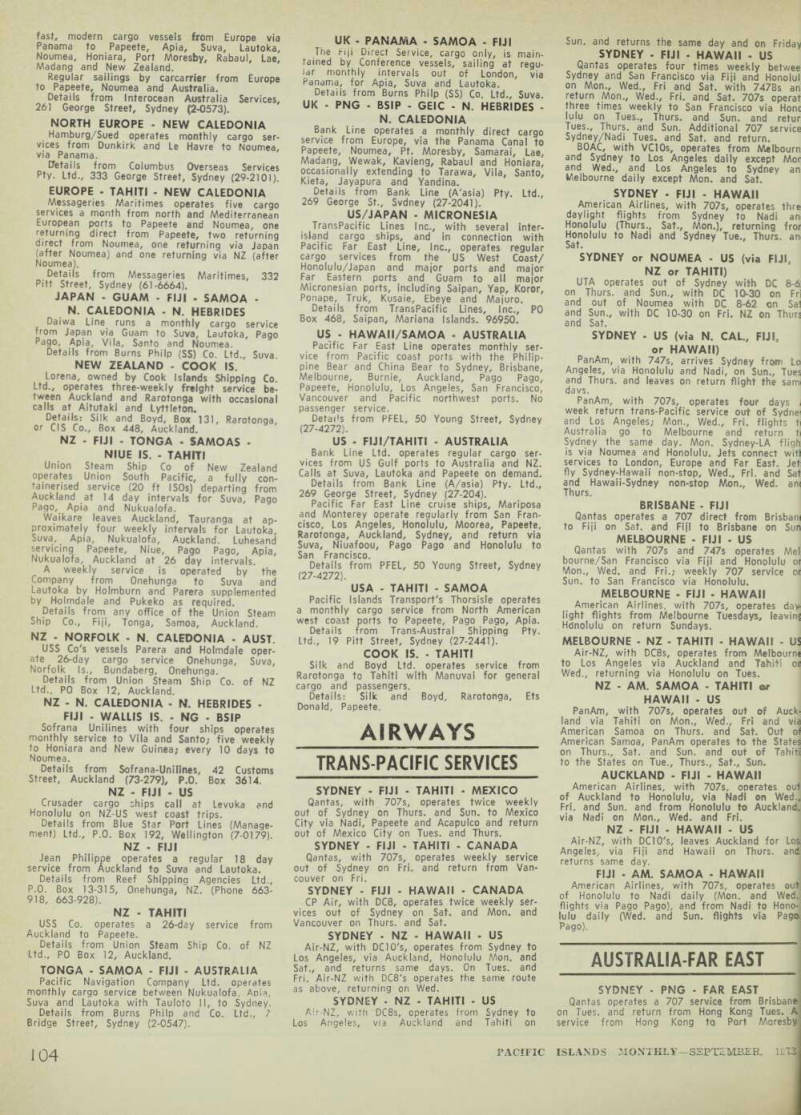
Shipping
Aust. - West Irian
Karlander New Guinea Line with Slembe operates cargo service every nine weeks from Sydney to Jayapura.
Details: Karlander (Aust.) Pty. Ltd., 19-31 Pitt Street, Sydney (27-6301).
Silk & Boyd Ltd operates charter service Detween Australia and West Irian with \Aanutea.
Details: Silk & Boyd Ltd, Rarotonga, Ets Donald, Papeete.
SYDNEY - NZ - FIJI/TAHITI - UK Chandris Lines, with Australis, Britanis and Elllnis, maintains a twice-monthly passenger service from Sydney via NZ, Suva (Australis), ria NZ, Tahiti (Britanis and Ellinis). Patris >perates a regular service, Singapore-Australia- Singapore combined with "Ship-Jet" service to .ondon, Athens, Amsterdam and Brussels via Singapore.
Details from Chandris Lines, 135 King Street Sydney (28-2451).
Sitmar Line, with two liners, the Fairstar ind the Fairsky, operates a passenger service rom Sydney, Melbourne or Brisbane to South ampton, UK, via NZ, Papeete, Panama and .isbon and alternatively via South Africa.
Details from Sitmar Line (Australia) Pty. Ltd., 12-30 Bridge Street, Sydney (27-4521).
SYDNEY - LORD HOWE IS. - NORFOLK IS. - NEW CALEDONIA - NEW HEBRIDES Karlander operates 19-day service from Sydney to Lord Howe, Norfolk, New Caledonia md New Hebrides. Passenger accommodation ivailable.
Details from Karlander (Aust.) Pty. Ltd., 19- 11 Pitt Street, Sydney (27-6301).
Chargeurs Caledoniens operates two-weekly argo service Sydney-Noumea.
Details: Hetherington Kingsbury Pty Ltd 17-49 Pitt Street, Sydney (27-1671).
Sydney - Geic - Honolulu
Columbus Lines operates a three weekly argo sailing from West Coast, US to Austra asia, returning via Tarawa, GEIC and Honolulu 0 Nth. America.
Details from Columbus Overseas Services Pty ■td., 333 George Street, Sydney (29-2101).
SYDNEY - NZ ■ FIJI - HAWAII -
Canada - Us
, P and 0 liners call regularly at Auckland, >uva and Honolulu on eastbound and westbound ravages between Sydney and the US; occasional alls at Pago Pago, Tonga, Papeete, Yokohama, (ila, Hong Kong, Honiara.
Details from P & 0 Australia Ltd., 55 lunter Street, Sydney (2-0317).
SYDNEY - NZ - FIJI - TONGA - VILA -
Noumea - Samoas - Tahiti
Shaw Savill's Ocean Monarch and Northern ►tar cruise in the Pacific sailing from Aus ralia and New Zealand calling at Suva, .autoka, Tonga, Vila, Noumea, Pago Pago, ahiti, Apia, Vavau.
Details: Shaw Savill Line, 8a Castlereagh It., Sydney (28-1481).
Australia - New Caledonia -
New Hebrides
Sofrana-Unilines operates Sydney-Noumea fortnightly, Sydney-Brisbane-Noumea every 30 days, Melbourne-Sydney-Noumea-Vila-Santo every 28 days.
Details from Sofrana-Unilines, 37-49 Pitt Street, Sydney (27-2031). ruiynesie maintains three-weekly passenger sailings—Sydney, Noumea, Vila and Santo.
Service temporarily suspended because of union black ban. uetans from France Australia, 261 George Street, Sydney (241-2872/6)
Australia - Fiji - Tahiti
Karlander (Aust.) Pty. Ltd. operates three weekly cargo services from Melbourne and Syd ney for Suva, Lautoka and Tahiti, with side port door ships. Good Mariner, Good Navigator, Slevik.
Details from Karlander (Aust.) Pty. Ltd., 19- 31 Pitt Street, Sydney (27-6301); F. H. Stephens Pty. Ltd., 554 Flinders Street, Melbourne (62-3333); Burns Philp (SS) Co. Ltd., Suva and Lautoka.
Australia - Fiji
Sofrana-Unilines operates Melbourne-Fiji monthly and Sydney-Fiji fortnightly.
Details from Sofrana-Unilines, 37 Pitt Street, Sydney (27-2031).
Australia - New Caledonia -
Fiji - Tahiti
South Pacific United Lines with Lama (ex Lara Viking) have started this service again, following industrial trouble, to New Caledonia only.
Details from France-Australia Holdings, 261 George Street, Sydney (241-2872/6).
Australia - South Pacific And
Coral Sea Services
Nauru Pacific Line operates cargo/passenger service to Fiji and South Pacific ports.
Details from Nauru line ??7 fnllins Street, Melbourne (654-4977); Interocean Swire, 8 Spring Street, Sydney (20-522).
United Steamships Ltd. operates a monthly service Sydney/Suva and Lautoka.
Details: Hetherington Kingsbury Pty. Ltd., 37-49 Pitt Street, Sydney (27-1671).
Australia - Png - Bsip
Conpac Pacific Express (Burns Philp and AWP Line) operates three-weekly passenger cargo service from Sydney and Brisbane to Lae with Nimos, and from Melbourne and Sydney to Port Moresby and Lae with Tenos.
Details from Burns Philp and Co. Ltd., 7 Bridge Street, Sydney (2-0547).
New Guinea Australia Line's vessel Coral Chief operates every 15 days from Sydney to Brisbane and Port Moresby. Island Chief operates every 20/22 days from Sydney and Brisbane, to Lae and Rabaul, calling Kavieng alt, voyages; Papuan Chief operates every 21 days from Sydney and Brisbane to Honiara, Kieta and Gizo; New Guinea Chief operates every 21 days from Sydney and Brisbane to Rabaul, Madang and Samarai. All are cargo services.
Details from Interocean Swire, 8 Spring Street, Sydney (20-522).
New Guinea Express Lines with two ships operates three-weekly (Moresby Express), Mel bourne, Sydney, Port Moresby, Lae; (Lae Ex press), Sydney, Brisbane, Lae, Rabaul. [retails from New Guinea Express Lines, 37 Pitt St., Sydney (241-1396) and 72 Eagle St., Brisbane (21-9333), Westralian Farmers Trans port Pty. Ltd., 459 Collins St., Melbourne (35-4366), Breckwoldt's Shipping Agencies in Port Moresby, Lae, Rabaul.
Karlander New Guinea Line's two cargo vessels call at Melbourne, Sydney, Brisbane, Lae, Madang, Wewak, Manus, Kimbe.
Details from Karlander (Aust.) Pty. Ltd., 19- SI Pitt Street, Sydney (27-6301).
Australia - Guam Via New Guinea
Ports
Nauru Pacific Line operates regular six weekly cargo services from Tasmania, Mel bourne, Sydney and Brisbane to Guam via New Guinea ports and returning via inducement ports. Rapid delivery to San Francisco via Guam trans-shipment is available.
Details from Nauru Pacific Line, 227 Collins Street, Melbourne (654-4977); Interocean Swire, 8 Spring Street, Sydney (20-522); Carpenter Shipping Agencies, New Guinea ports.
Australia - Nauru - Marshall
Islands - Geic
Nauru Pacific Line operates regular monthly cargo/passenger liner service from Melbourne and Sydney to Nauru, Majuro and Tarawa.
Details from Nauru Pacific Line, 227 Collins Street, Melbourne (654-4977); Interocean Swire, 8 Spring Street, Sydney (20-522).
Australia - Png - Far East
E. and A. Line passenger ships, Cathay and Chitral, make monthly round voyages from Melbourne, Sydney and Brisbane calling at Port Moresby, Manila, Hong Kong, Keelung, Kobe, Yokohama (Tokyo), and Rabaul.
Details from P & 0 Australia Ltd., 55 Hunter Street, Sydney (2-0317).
FAR EAST - FIJI - NEW ZEALAND New Zealand Unit Express (CNC, MOL, RIL) operates a three-weekly cargo service from Hong Kong to Lautoka, Suva, NZ ports, Manila, Kaoshiung, Keelung, Hong Kong.
Details from Interocean Swire, 8 Spring Street, Sydney (20-522).
Royal Interocean lines operates monthly pass enger/cargo service with three ships from NZ to Bangkok, Pt Kelang, Singapore, Djakarta to Fiji (alt. months) and NZ.
Details from Interocean Australia Services, 261 George Street, Sydney (2-0573); Burns Phi Ip 'SSI Co Ltd., Suva and Lautoka.
FAR EAST - PNG ■ BSI - NEW HEBRIDES -
Noumea - Tahiti • Samoa
China Navigation Co's vessels Chengtu and Kwantung operate a regular cargo service from Hong Kong to Rabaul, Wewak, Madang, Lae, Port Moresby, Honiara, New Hebrides, Noumea, Papeete and Samoa.
Details from Interocean Swire, 8 Spring street, Sydney (20-522).
EUROPE ■ TAHITI - W. SAMOA - FIJI - N. CALEDONIA ■ BSIP - PNG - NZ Nedlloyd Lines offers regular sailings by
fast, modern cargo vessels from Europe via Panama to Papeete, Apia, Suva, Lautoka, Noumea, Honiara, Port Moresby, Rabaul, Lae, Madang and New Zealand.
Regular sailings by carcarrier from Europe to Papeete, Noumea and Australia.
Details from Interocean Australia Services, 261 George Street, Sydney (2-0573).
North Europe - New Caledonia
Hamburg/Sued operates monthly cargo ser vices from Dunkirk and Le Havre to Noumea, via Panama. [Tetails from Columbus Overseas Services Pty. Ltd., 333 George Street, Sydney (29-2101).
Europe - Tahiti - New Caledonia
Messageries Maritimes operates five cargo services a month from north and Mediterranean European ports to Papeete and Noumea, one returning direct from Papeete, two returning direct from Noumea, one returning via Japan (after Noumea) and one returning via NZ (after Noumea).
Details from Messageries Maritimes, 332 Pitt Street, Sydney (61-6664).
JAPAN - GUAM - FIJI - SAMOA -
N. Caledonia ■ N. Hebrides
Daiwa Line runs a monthly cargo service from Japan via Guam to Suva, Lautoka, Pago Pago, Apia, Vila, Santo and Noumea.
Details from Burns Philp (SS) Co. Ltd., Suva
New Zealand - Cook Is.
Lorena, owned by Cook Islands Shipping Co.
Ltd., operates three-weekly freight service be tween Auckland and Rarotonga with occasional calls at Aitutaki and Lyttletoru Details: Silk and Boyd, Box 131, Rarotonga, or CIS Co., Box 448, Auckland.
NZ - FIJI - TONGA - SAMOAS -
Niue Is. - Tahiti
Union Steam Ship Co of New Zealand operates Union South Pacific, a fully con tainerised service (20 ft ISOs) departing from Auckland at 14 day intervals for Suva, Pago Pago, Apia and Nukualofa.
Waikare leaves Auckland, Tauranga at ap proximately four weekly intervals for Lautoka, Suva, Apia, Nukualofa, Auckland. Luhesand servicing Papeete, Niue, Pago Pago, Apia, Nukualofa, Auckland at 26 day intervals.
A weekly service is operated by the Company from Onehunga to Suva and Lautoka by Holmburn and Parera supplemented by Holmdale and Pukeko as required.
Details from any office of the Union Steam Ship Co., Fiji, Tonga, Samoa, Auckland.
NZ - NORFOLK - N. CALEDONIA - AUST.
USS Co's vessels Parera and Holmdale oper ate 26-day cargo service Onehunga, Suva, Norfolk Is., Bundaberg, Onehunga.
Details from Union Steam Ship Co. of NZ Ltd., PO Box 12, Auckland.
NZ - N. CALEDONIA - N. HEBRIDES - FIJI - WALLIS IS. - NG - BSIP Sofrana Unilines with four ships operates monthly service to Vila and Santo; five weekly to Honiara and New Guinea; every 10 days to Noumea.
Details from Sofrana-Unillnes, 42 Customs Street, Auckland (73-279), P.O. Box 3614.
Nz - Fiji - Us
Crusader cargo chips call at Levuka and Honolulu on NZ-US west coast trips.
Details from Blue Star Port Lines (Manage ment) Ltd., P.O. Box 192, Wellington (7-0179).
Nz - Fiji
Jean Philippe operates a regular 18 day service from Auckland to Suva and Lautoka.
Details from Reef Shipping Agencies Ltd., P-0. Box 13-315, Onehunga, NZ. (Phone 663- 918, 663-928).
Nz - Tahiti
USS Co. operates a 26-day service from Auckland to Papeete.
Details from Union Steam Ship Co. of NZ Ltd., PO Box 12, Auckland.
TONGA - SAMOA - FIJI - AUSTRALIA Pacific Navigation Company Ltd. operates monthly cargo service between Nukualofa, Aoia, Suva and Lautoka with Tauloto 11, to Sydney.
Details from Burns Philp and Co. Ltd., 7 Bridge Street, Sydney (2-0547).
UK - PANAMA - SAMOA ■ FIJI The Fiji Direct Service, cargo only, is main tained by Conference vessels, sailing at regu lar monthly intervals out of London, via Panama, for Apia, Suva and Lautoka.
Details from Burns Philp (SS) Co. Ltd., Suva.
UK - PNG - BSIP - GEIC ■ N. HEBRIDES ■
N. Caledonia
Bank Line operates a monthly direct cargo service from Europe, via the Panama Canal to Papeete, Noumea, Pt, Moresby, Samarai, Lae, Madang, Wewak, Kavieng, Rabaul and Honiara, occasionally extending to Tarawa, Vila, Santo, Kieta, Jayapura and Yandina.
Details from Bank Line (A'asia) Pty. Ltd., 269 George St., Svdney (27-2041).
Us/Japan - Micronesia
Transpacific Lines Inc,, with several inter island cargo ships, and in connection with Pacific Far East Line, Inc., operates regular cargo services from the US West Coast/ Honolulu/Japan and major ports and major Far Eastern ports and Guam to all major Micronesian ports, including Saipan, Yap, Koror, Ponape, Truk, Kusaie, Ebeye and Majuro.
Details from Transpacific Lines, Inc., PO Box 468, Saipan, Mariana Islands. 96950.
Us - Hawaii/Samoa - Australia
Pacific Far East Line operates monthly ser vice from Pacific coast ports with the Philip pine Bear and China Bear to Sydney, Brisbane, Melbourne, Burnie, Auckland, Pago Pago, Papeete, Honolulu, Los Angeles, San Francisco, Vancouver and Pacific northwest ports. No passenger service.
Detai's from PFEL, 50 Young Street, Sydney (27-4272).
Us - Fiji/Tahiti - Australia
Bank Line Ltd. operates regular cargo ser vices from US Gulf ports to Australia and NZ.
Calls at Suva, Lautoka and Papeete on demand.
Details from Bank Line (A/asia) Pty. Ltd., 269 George Street, Sydney (27-204).
Pacific Far East Line cruise ships, Mariposa and Monterey operate regularly from San Fran cisco, Los Angeles, Honolulu, Moorea, Papeete, Rarotonga, Auckland, Sydney, and return via Suva, Niuafoou, Pago Pago and Honolulu to San Francisco.
Details from PFEL, 50 Young Street, Sydney (27-4272).
Usa - Tahiti - Samoa
Pacific Islands Transport's Thorsisle operates a monthly cargo service from North American west coast ports to Papeete, Pago Pago, Apia.
Details from Trans-Austral Shipping Pty.
Ltd., 19 Pitt Street, Sydney (27-2441).
Cook Is. - Tahiti
Silk and Boyd Ltd. operates service from Rarotonga to Tahiti with Manuvai for general cargo and passengers.
Details: Silk and Boyd, Rarotonga, Ets Donald, Papeete.
Advertisements & other items, p. 113 (2 items)
103
ACIFIC ISLANDS MONTHLY—SEPTEMBER, 1973
Interocean-New Zealand Ltd.
STEAMSHIP OPERATORS • AGENTS • BROKERS
TELEX. NZ3791 • ANS. BACK: PLYZETIM • TELEGRAPHIC ADDRESS: ZEAMARINER WELLINGTON • TELEPHONE: 71-976 • P.O. BOX 3637, WELLINGTON, N.Z, LEVEL M. WILLIAMS PARKING CENTRE • BOULCOTT STREET. WELLINGTON
Airways
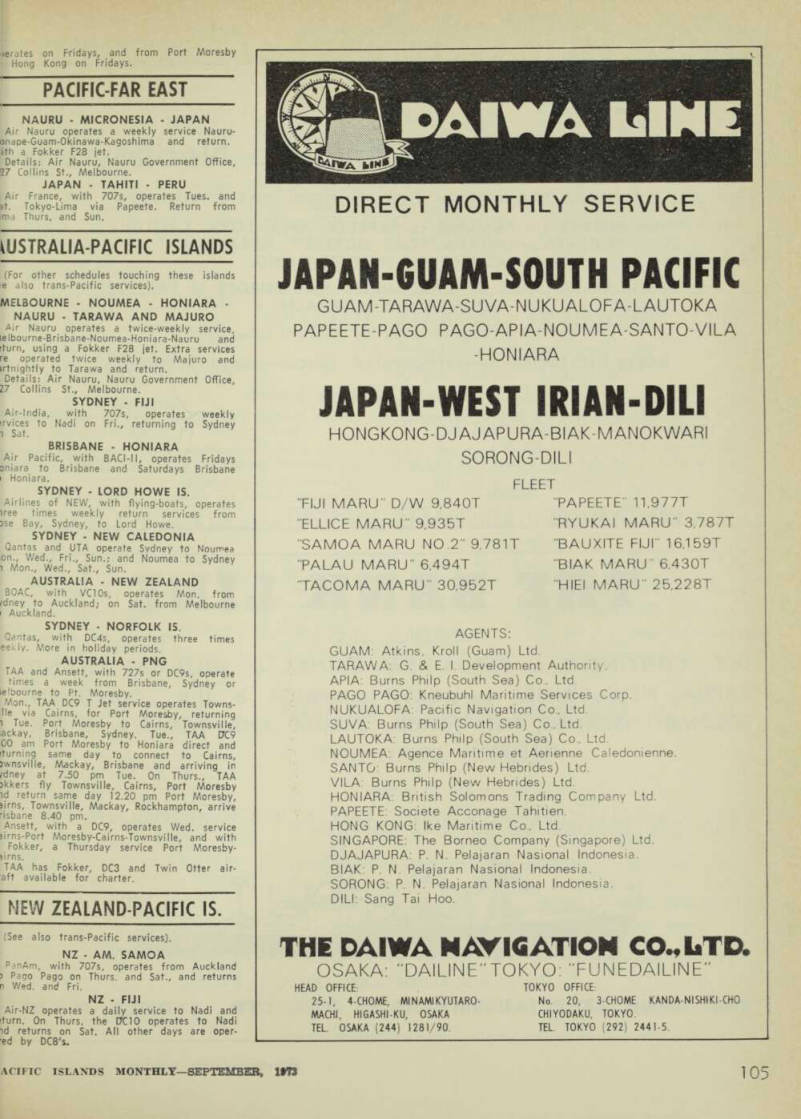
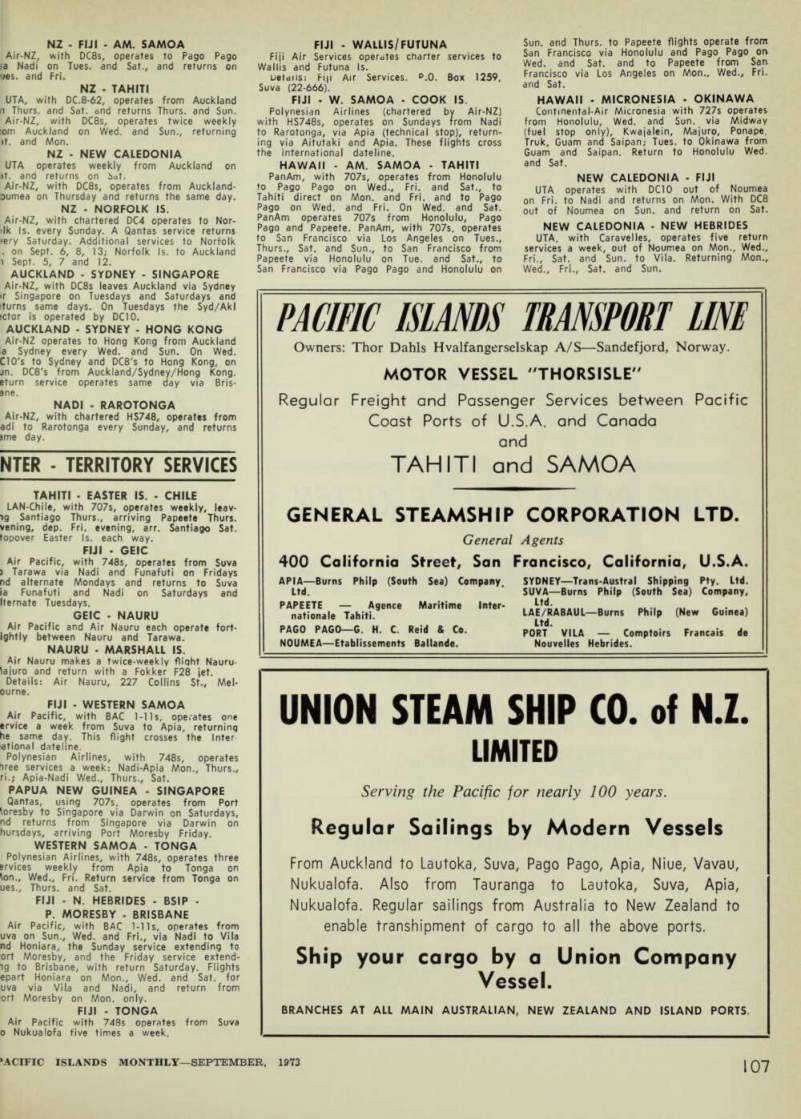
Trans Pacific Services
SYDNEY - FIJI - TAHITI - MEXICO Qantas, with 7075, operates twice weekly out of Sydney on Thurs. and Sun. to Mexico City via Nadi, Papeete and Acapulco and return out of Mexico City on Tues. and Thurs.
SYDNEY - FIJI - TAHITI - CANADA Qantas, with 7075, operates weekly service out of Sydney on Fri. and return from Van couver on Fri.
SYDNEY - FIJI - HAWAII ■ CANADA CP Air, with DCS, operates twice weekly ser vices out of Sydney on Sat. and Mon. and Vancouver on Thurs. and Sat.
SYDNEY - NZ - HAWAII - US Air-NZ, with DClO's, operates from Sydney to Los Angeles, via Auckland, Honolulu Mon. and Sat., and returns same days. On Tues. and Fri. Air-NZ with DCB's operates the same route as above, returning on Wed.
SYDNEY • NZ - TAHITI - US Air-NZ, with DCBs, operates from Sydney to Los Angeles, via Auckland and Tahiti on
Sun. and returns the same day and on Friday SYDNEY - FIJI - HAWAII - US Qantas operates four times weekly betwee Sydney and San Francisco via Fiji and Honolul on Mon., Wed., Fri and Sat. with 7478 s an return Mon., Wed., Fri. and Sat. 707 s operat three times weekly to San Francisco via Hone lulu on Tues., Thurs. and Sun. and retur Tues., Thurs. and Sun. Additional 707 service Sydney/Nadi Tues. and Sat. and return.
BOAC, with VClOs, operates from Melbourn and Sydney to Los Angeles daily except Mor and Wed., and Los Angeles to Sydney an Melbourne daily except Mon. and Sat.
Sydney - Fiji • Hawaii
American Airlines, with 7075, operates thre daylight flights from Sydney to Nadi an Honolulu (Thurs., Sat., Mon.), returning froi Honolulu to Nadi and Sydney Tue., Thurs. an SYDNEY or NOUMEA - US (via FIJI,
Nz Or Tahiti)
UTA operates out of Sydney with DC 8-6 on Thurs. and Sun., with DC 10-30 on Fr and out of Noumea with DC 8-62 on Sal and Sun., with DC 10-30 on Fri. NZ on Thur: and Sat.
SYDNEY - US (via N. CAL, FIJI,
Or Hawaii)
PanAm, with 7475, arrives Sydney frown to Angeles, via Honolulu and Nadi, on Sun., Tue; and Thurs. and leaves on return flight the sam days.
PanAm, with 7075, operates four days week return trans-Pacific service out of Sydne and Los Angeles; Mon., Wed., Fri, flights t Australia go to Melbourne and return t Sydney the same day. Mon, Sydney-LA fligh is via Noumea and Honolulu. Jets connect witi services to London, Europe and Far East. Jet fly Sydney-Hawaii non-stop. Wed., Fri. and Sal and Hawaii-Sydney non-stop Mon., Wed, am Thurs.
Brisbane - Fiji
Qantas operates a 707 direct from Brisbam to Fiji on Sat. and Fiji to Brisbane on Sun
Melbourne - Fiji - Us
Qantas with 707 s and 747 s operates Mel bourne/San Francisco via Fiji and Honolulu oi Mon., Wed. and Fri.; weekly 707 service oi Sun. to San Francisco via Honolulu.
Melbourne - Fiji - Hawaii
American Airlines, with 7075, operates day light flights from Melbourne Tuesdays, leavini Honolulu on return Sundays.
MELBOURNE - NZ - TAHITI - HAWAII - U< Air-NZ, with DCBs, operates from Melbourne to Los Angeles via Auckland and Tahiti 0!
Wed., returning via Honolulu on Tues.
NZ - AM. SAMOA - TAHITI ar
Hawaii - Us
PanAm, with 7075, operates out of Auck land via Tahiti on Mon., Wed., Fri and via American Samoa on Thurs. and Sat. Out ol American Samoa, PanAm operates to the States on Thurs., Sat. and Sun. and out of Tahiti to the States on Tue., Thurs., Sat., Sun.
Auckland - Fiji - Hawaii
American Airlines, with 7075, operates out of Auckland to Honolulu, via Nadi on Wed., Fri. and Sun. and from Honolulu to Auckland, via Nadi on Mon., Wed. and Fri.
NZ - FIJI - HAWAII - US Air-NZ, with DClO's, leaves Auckland for Los Angeles, via Fiji and Hawaii on Thurs. and returns same day.
Fiji ■ Am. Samoa - Hawaii
American Airlines, with 7075, operates out of Honolulu to Nadi daily (Mon. and Wed. flights via Pago Pago), and from Nadi to Hono lulu daily (Wed. and Sun. flights via Pago Pago).
Australia-Far East
Sydney - Png - Far East
Qantas operates a 707 service from Brisbane on Tues. and return from Hong Kong Tues. A service from Hong Kong ta Port Moresby
•erates on Fridays, and from Port Moresby Hong Kong on Fridays.
Pacific-Far East
Nauru - Micronesia - Japan
i Air Nauru operates a weekly service Nauru onape-Guam-Okinawa-Kagoshima and return, ith a Fokker F2B jet.
Details: Air Nauru, Nauru Government Office, !27 Collins St., Melbourne.
Japan - Tahiti ■ Peru
Air France, with 7075, operates Tues. and at. Tokyo-Lima via Papeete. Return from ima Thurs. and Sun.
Australia-Pacific Islands
(For other schedules touching these islands ie also trans-Pacific services).
Melbourne - Noumea - Honiara ■
Nauru - Tarawa And Majuro
Air Nauru operates a twice-weekly service, lelbourne-Brisbane-Noumea-Honiara-Nauru and iturn, using a Fokker F2B jet. Extra services re operated twice weekly to Majuro and irtnightly to Tarawa and return.
Details: Air Nauru, Nauru Government Office, 27 Collins St., Melbourne.
Sydney - Fiji
Air-lndia, with 7075, operates weekly irvices to Nadi on Fri., returning to Sydney i Sat.
Brisbane - Honiara
Air Pacific, with BACI-11, operates Fridays oniara to Brisbane and Saturdays Brisbane i Honiara.
Sydney ■ Lord Howe Is.
Airlines of NEW, with flying-boats, operates tree times weekly return services from 3se Bay, Sydney, to Lord Howe.
Sydney - New Caledonia
Qantas and UTA operate Sydney to Noumea on.. Wed., Fri., Sun.; and Noumea to Sydney l Mon., Wed., Sat., Sun.
Australia - New Zealand
BOAC, with VClOs, operates Mon. from rdney to Auckland; on Sat. from Melbourne i Auckland.
Sydney - Norfolk Is.
Qantas, with DC4s, operates three times eekly. More in holiday periods.
Australia - Png
TAA and Ansett, with 727 s or DC9s, operate times a week from Brisbane, Sydney or lelbourne to Pt. Moresby.
Mon., TAA DC9 T Jet service operates Towns- I le via Cairns, for Port Moresby, returning t Tue. Port Moresby to Cairns, Townsville, ackay, Brisbane, Sydney. Tue., TAA CTC9 00 am Port Moresby to Honiara direct and (turning same day to connect to Cairns, jwnsville, Mackay, Brisbane and arriving in fdney at 7.50 pm Tue. On Thurs., TAA ikkers fly Townsville, Cairns, Port Moresby id return same day 12.20 pm Port Moresby, aims, Townsville, Mackay, Rockhampton, arrive risbane 8.40 pm.
Ansett, with a DC9, operates Wed. service iirns-Port Moresby-Cairns-Townsville, and with Fokker, a Thursday service Port Moresby lirns.
TAA has Fokker, DC3 and Twin Otter air aft available for charter.
Mew Zealand-Pacific Is.
(See also trans-Pacific services).
Nz - Am. Samoa
PanAm, with 7075, operates from Auckland ) Pago Pago on Thurs. and Sat., and returns n Wed. and Fri.
Nz - Fiji
Air-NZ operates a daily service to Nadi and (turn. On Thurs. the DCIO operates to Nadi id returns on Sat. All other days are oper ed by DOS's.
Nz - Fiji - Am. Samoa
Air-NZ, with DCBs, operates to Pago Pago ia Nadi on Tues. and Sat., and returns on ues. and Fri.
Nz - Tahiti
UTA, with DC.B-62, operates from Auckland n Thurs. and Sat. and returns Thurs. and Sun.
Air-NZ, with DCBs, operates twice weekly 10m Auckland on Wed. and Sun., returning it. and Mon.
Nz - New Caledonia
UTA operates weekly from Auckland on it. and returns on Sat.
Air-NZ, with DCBs, operates from Auckland oumea on Thursday and returns the same day.
Nz - Norfolk Is.
Air-NZ, with chartered DC4 operates to Nor »lk Is. every Sunday. A Qantas service returns /ery Saturday. Additional services to Norfolk . on Sept. 6,8, 13; Norfolk Is. to Auckland i Sept. 5, 7 and 12.
Auckland - Sydney ■ Singapore
Air-NZ, with DCBs leaves Auckland via Sydney ir Singapore on Tuesdays and Saturdays and sturns same days. On Tuesdays the Syd/Akl ictor is operated by DCIO.
Auckland - Sydney - Hong Kong
Air-NZ operates to Hong Kong from Auckland a Sydney every Wed. and Sun. On Wed.
ClO's to Sydney and DCB's to Hong Kong, on jn. DCB's from Auckland/Sydney/Hong Kong, eturn service operates same day via Bris ane.
Nadi • Rarotonga
Air-NZ, with chartered HS74B, operates from adi to Rarotonga every Sunday, and returns ime day.
Niter - Territory Services
Tahiti - Easter Is. - Chile
LAN-Chile, with 7075, operates weekly, leav ig Santiago Thurs., arriving Papeete Thurs. vening, dep. Fri. evening, arr. Santiago Sat. topover Easter Is. each way.
Fiji ■ Geic
Air Pacific, with 7485, operates from Suva ) Tarawa via Nadi and Funafuti on Fridays nd alternate Mondays and returns to Suva ia Funafuti and Nadi on Saturdays and Iternate Tuesdays.
Geic - Nauru
Air Pacific and Air Nauru each operate fort ightly between Nauru and Tarawa.
Nauru - Marshall Is.
Air Nauru makes a twice-weekly flight Nauru lajuro and return with a Fokker F2B Jet.
Details: Air Nauru, 227 Collins St., Mel ourne.
Fiji - Western Samoa
Air Pacific, with BAC l-lls, operates one ervice a week from Suva to Apia, returning he same day. This flight crosses the Inter ational dateline.
Polynesian Airlines, with 7485, operates uee services a week: Nadi-Apia Mon., Thurs., ri.; Apia-Nadi Wed., Thurs., Sat.
Papua New Guinea - Singapore
Qantas, using 7075, operates from Port \oresby to Singapore via Darwin on Saturdays, nd returns from Singapore via Darwin on hursdays, arriving Port Moresby Friday.
Western Samoa - Tonga
Polynesian Airlines, with 7485, operates three ervices weekly from Apia to Tonga on lon., Wed., Fri. Return service from Tonga on ues., Thurs. and Sat.
FIJI • N. HEBRIDES - BSIP -
P. Moresby - Brisbane
Air Pacific, with BAC 1-1 Is, operates from uva on Sun., Wed. and Fri., via Nadi to Vila nd Honiara, the Sunday service extending to ort Moresby, and the Friday service extend ig to Brisbane, with return Saturday. Flights epart Honiara on Mon., Wed. and Sat. for uva via Vila and Nadi, and return from ort Moresby on Mon. only.
Fiji - Tonga
Air Pacific with 748 s operates from Suva o Nukualofa five times a week.
Fiji - Wallis/Futuna
Fiji Air Services operates charter services to Wallis and Futuna Is. derails: Fi|i Air Services. p .O. Box 1259, Suva (22-666).
FIJI - W. SAMOA ■ COOK IS.
Polynesian Airlines (chartered by Air-NZ) with HS74Bs, operates on Sundays from Nadi to Rarotonga, via Apia (technical stop), return ing via Aitutaki and Apia. These flights cross the international dateline.
Hawaii - Am. Samoa - Tahiti
PanAm, with 7075, operates from Honolulu to Pago Pago on Wed., Fri. and Sat., to Tahiti direct on Mon. and Fri, and to Pago Pago on Wed. and Fri. On Wed. and Sat.
PanAm operates 707 s from Honolulu, Pago Pago and Papeete. PanAm, with 7075, operates to San Francisco via Los Angeles on Tues., Thurs., Sat. and Sun., to San Francisco from Papeete via Honolulu on Tue. and Sat., to San Francisco via Pago Pago and Honolulu on
Sun. and Thurs. to Papeete flights operate from San Francisco via Honolulu and Pago Pago orv Wed. and Sat. and to Papeete from San Francisco via Los Angeles on Mon.. Wed., Fri. and Sat.
Hawaii - Micronesia - Okinawa
Continental-Air Micronesia with 727 s operates from Honolulu, Wed. and Sun. via Midway (fuel stop only), Kwajalein, Majuro, Ponape, Truk, Guam and Saipan; Tues. to Okinawa from Guam and Saipan. Return to Honolulu Wed. and Sat.
New Caledonia - Fiji
UTA operates with DCIO out of Noumea on Fri. to Nadi and returns on Mon. With DCS out of Noumea on Sun. and return on Sat.
New Caledonia • New Hebrides
UTA, with Caravelles, operates five return services a week, out of Noumea on Mon., Wed., Fri., Sat. and Sun. to Vila. Returning Mon., Wed., Fri., Sat. and Sun.
NEW CAL. - WALLIS IS. - NEW CAL.
UTA, with Caravelles, operates on the first, second and third Tues. of each month from Noumea.
New Guinea - Irian/Jaya
TAA operates DC3s Madang to Jayapura and return alt. Tues.
Merpati DCS Jayapura-Lae alternate Tues days, returning Lae-Jayapura 10 am Wednes days.
Png - Solomons
Air Pacific, with BAC 1-11, operates Sundays Honiara to Port Moresby and Mondays Pori Moresby to Honiara.
TAA operates DC9 and DC3 aircraft three times weekly. Tuesday aircraft leaves Port Moresby 7.00 am for Honiara returning same day for Port Moresby and continues to Cairns, Townsville, Mackay, Brisbane and Sydney. Wed nesday and Saturday aircraft leave Rabaul for Honiara via Buka, Kieta, Munda and Yandina, returning Thursday and Sunday.
TAA Fokker Friendship leaves Port Moresby direct for Kieta Mon., Wed., Fri. and Sat. returning Wed., Fri. and Sat. direct and via Buka, Rabaul and Lae on Tue. and Thurs.
Kieta, Moresby via Rabaul Sunday.
Tahiti - Us
UTA, with DCIO, operates from Papeete on Fri. and Sat., returning same days; and with DCS operates on Thurs. and Sun., returning Tues. and Thurs.
PanAm with 7075, operates to San Francisco, via Los Angeles on Mon., Wed. and Fri.; to San Francisco, via Honolulu on Thurs.
Sat.,- and to San Francisco, via Pago Pago and Honolulu, on Sat. and Thurs.; from San
Francisco via Honolulu and Pago Pago, to Tahiti on Wed. and Sat., and from San Fran cisco, via Los Angeles, to Tahiti on Mon., Wed.
Fri. and Sat.
W. Samoa - Am. Samoa
Polynesian Airlines, with 7485, operates between Apia and Pago Pago (four services, Fri.; three Mon., Tues., Thurs., Sat.; two Wed., Sun.),
Tonga - Niue - W. Samoa
Polynesian Airlines, with 7485, operates weekly service from Tonga to Niue, leaving Thurs., arriving Niue Wed., leave Niue Wed., arrive Apia same day.
Tahiti - Cook Is.
Air Tahiti with Piper Aztec, operates char ter service from Papeete to Rarotonga.
Details from Air Polynesie, P.O. Box 314 Quai Bir Hakeim, Papeete, and UTA offices.
Internal Services
Fiji
Air Pacific, with HS74Bs, BAC 1-1 Is and Herons operates regular services to Labasa, Taveuni, Nadi, Suva and Savusavu.
Fiji Air Services, with Britten-Norman Islander and Beechcraft Baron aircraft, operates services to Castaway and Plantation village resorts (twice daily); The Fijian hotel, Korolevu Beach hotel and the Flagship Beachcomber hotel (twice daily Monday to Saturday); Levuka (twice daily Monday to Saturday); Lakeba (twice weekly, Mondays and Fridays); Vatukola (twice weekly). Charter flights operate to anywhere in the Pacific.
Details: Fiji Air Services, P.O. Box 1259 Suva (telephone 22-666).
French Polynesia
Air Polynesie, with Fokker F 27 Friendship, DC4s, Twin Otters and Islanders, operates to Bora Bora, Huahine, Moorea, Rangiroa, Raiatea, Manihi, Marquesas, Maupiti and Tubuai, Austral Islands.
Details from Air Polynesie, P.O. Box 314 Quai Bir Hakeim, Papeete, and UTA offices.
Air Tahiti, with light aircraft operates shuttle service from Papeete to Moorea and charter service to Raiatea, Bora Bora, Huahine, Rangiroa and Manihi.
Gilbert And Ellice Islands
Air Pacific, with Herons, operates regular services between Tarawa, Butaritari, North Tabiteuea and Abemama.
Guam - Us Trust Territory
Continental-Air Micronesia with 727 s and DC6s operates regular service connecting Hono lulu, Okinawa and Guam with Saipan, Rota, Yap, Palau, Truk, Ponape, Kwajalein and Majuro.
Details from Air Micronesia, Saipan.
Air Pacific Inc. (not connected with the Fiji based Air Pacific) with Piper Navajo and a deHavilland Heron, operates regular services linking Guam, Saipan, Tinian, and Rota, and charter services are available to other Trust Territory islands.
Details, Air Pacific Inc., P.O. Box 7689, Tamuning, Guam, 96911, U.S.A.
Lagoon Aviation Inc. with Grumman Wid geons, operates charter services for the Mar shalls district, based on Majuro.
Papua New Guinea
TAA and Ansett operate throughout Papua New Guinea.
Aerial Tours operates in Central, Western, Gulf and Sepik districts.
T.A.L. (GV) —Territory Airlines Pty Limited operates scheduled services and charter flights from Goroka, Kundiawa, Madang, Wewak, Vanimo, Mt. Hagen, Mendi to Highlands, Sepik and Coastal areas. Talco Territory Travel Ser vice of Papua New Guinea—Twin Otter Tourist flights throughout Papua New Guinea.
Further details from T.A.L,, P.O. Box 108, Goroka, Papua New Guinea.
Macair throughout Papua New Guinea.
Bougainville Air Services operates daily throughout Bougainville. There are now Mon., Wed. and Fri. services Kieta-Buin. Details: Arawa, Phone 956-159; Buka, Phone 16. Box 298, PO, Kieta.
New Caledonia
Air Caledonie, with Twin Otters, and Is landers operates regular services to Houai lou. Isle of Pines, Isle Ouen, Kone, Koumac, Lifou, Mare, Noumea, Ouvea Touho, Mueo, Belep, Tiga.
Details from Air Caledonie, Noumea.
New Hebrides
Air Melanesiae with Britten-Norman Islanders and Trislander operates to Santo, Malekula Norsup and Lamap), Aoba (Walaha and Longana), Pentecost (Lonorore), Erromanga, Tongoa, Aneityum, Tanna and Vila, Direct connections are available to and from Santo for all inter national flights arriving in Vila.
Details trom Air Melanesiae, P.O. Box 72, Vila.
Solomon Islands
Solair, with Beech Barons and Islanders operates to Auki, Avu Avu, Babanakira, Bara koma Bellona Is., Fera Is., Gizo, Honiara, Kira Kira, Marau, Munda, Parasi, Sege, Yandina, Santa Cruz, Mono, Rennell Is., Choiseul Bay, Ballalae and Ringi Cove. details from Solomon Islands Airways Ltd., Box 23, Honiara, BSIP.
Tonga
Tonga Tourist and Development Co, with Britten-Norman Islanders, operates between Fua'amotu, (airport for Nukualofa) and Vava'u Monday to Saturday. From August 1, service will commence between Fua'amotu and Eua.
Aircraft available for charter.
Details from Tonga Tourist and Development Co, PO Box 91, Nukualofa, Tonga. (Cables:
Tonga! R).
Advertisements & other items, pp. 115-118 (3 items)
105
CIFIC ISLANDS MONTHLY—SEPTEMBER, 1»73
Japan-West Irian-Dili
• 7m
DIRECT MONTHLY SERVICE
JAPAN-GUAM-SOUTH PACIFIC
GUAM-TARAWA-SUVA-NUKUALOFA-LAUTOKA
PAPEETE-PAGO PAGO-APIA-NOUMEA-SANTO-VILA
-HONIARA
JAPAN-WEST IRIAN-DILI
HONGKONG-DJAJAPURA-BIAK-MANOKWARI
SORONG-DILI
FLEET
'FIJI MARU" D/W 9.840 T
ELLICE MARU" 9,9357
'SAMOA MARU N 0.2" 9.781 T
'PALAU MARU" 6.494 T
TACOMA MARU" 30.952 T
"PAPEETE" 11,9777
"RYUKAI MARU" 3.787 T
"BAUXITE FIJI" 16.159 T
"BIAK MARU" 6,4307
HIEI MARU" 25,2287
AGENTS:
GUAM: Atkins, Kroll (Guam) Ltd.
TARAWA; G. & E. I. Development Authority.
APIA: Burns Philp (South Sea) Co., Ltd.
PAGO PAGO: Kneubuhl Maritime Services Corp.
NUKUALOFA: Pacific Navigation Co., Ltd.
SUVA: Burns Philp (South Sea) Co., Ltd.
LAUTOKA: Burns Philp (South Sea) Co., Ltd.
NOUMEA: Agence Maritime et Aerienne Caledonienne.
SANTO: Burns Philp (New Hebrides) Ltd.
VILA; Burns Philp (New Hebrides) Ltd.
HONIARA: British Solomons Trading Company Ltd.
PAPEETE: Societe Acconage Tahitien.
HONG KONG; Ike Maritime Co., Ltd.
SINGAPORE; The Borneo Company (Singapore) Ltd.
DJAJAPURA: P. N. Pelajaran Nasional Indonesia.
BIAK; P. N Pelajaran Nasional Indonesia.
SORONG; P. N. Pelajaran Nasional Indonesia.
DILI: Sang Tai Hoo.
THE DAIWA NAVIGATION CO.. LTD.
OSAKA: "DAILINE" TOKYO; "FUNEDAILINE"
HEAD OFFICE:
25-1, 4-CHOME, MIN AMI KYUTARO-
MACHI, HIGASHI-KU, OSAKA
TEL OSAKA (244) 1281/90.
TOKYO OFFICE:
No. 20, 3-CHOME KANDA-NISHIKt-CHO
CHIYODAKU, TOKYO.
TEL TOKYO (292) 2441-5.
nedlioyd Koninklijke Nedlioyd bv
REGULAR SAILINGS BY FAST, MODERN, CARGO VESSELS from EUROPE via PANAMA to PAPEETE, APIA, SUVA, LAUTOKA,
NOUMEA, HONIARA, PORT MORESBY, RABAUL, LAE,
MADANG and NEW ZEALAND.
REGULAR SAILINGS BY CARCARRIER from EUROPE to PAPEETE
NOUMEA and AUSTRALIA.
other ports called at subject to sufficient inducement
heavy-lift facilities—refrigerated space—cargo deeptanks
Ets. Donald Tahiti, Papeete.
Island Transport Ltd.
Lautoka.
For further particulars apply to agents Russell & Somers (Wellington) Island Transport Ltd., Ltd., Wellington, N.Z. Suva.
O. F. Nelson & Co. Ltd., Agence Maritime et Aerienne Caledonienne Apia. S.A. A.M.A.C., Noumea.
Breckwoldt & Co. (5.1.) Ltd., Carpenter Shipping Agencies, Honiara. Port Moresby, Rabaul, Lae, Madang.
Imerocean Swire Pty. Ltd.
Sydney.
THE BANK LINE
MONTHLY SERVICES
U K., CONTINENT to PAPUA-NEW GUINEA & SOLOMON ISLANDS PAPUA, NEW GUINEA to NORTH AMERICA & U.K., CONTINENT SOLOMON ISLANDS, FIJI, TONGA, SAMOA AND TARAWA to U.K.,
CONTINENT
☆ U.S. GULF/AUSTRALASIA VESSELS CALL AT FIJI WHEN REQUIRED &
FOR PARTICULARS APPLY;
TSSE BANK LIME (AUSTRALASIA) PIY, LTD., SYDNEY, N.S.W.
PACIFIC MAMS TRANSPORT LINE
Owners: Thor Dahls Hvalfangerselskap A/S —Sandefjord, Norway.
MOTOR VESSEL "THORSISLE"
Regular Freight and Passenger Services between Pacific
Coast Ports of U.S.A. and Canada
and
TAHITI and SAMOA
GENERAL STEAMSHIP CORPORATION LTD.
General Agents 400 California Street, San Francisco, California, U.S.A.
APlA—Burns Philp (South Sea) Company. SYDNEY—Trans-Austral Shipping Pty. Ltd.
Ltd.
PAPEETE Agence Maritime Inter- SUVA —Burns Philp (South Sea) Company, Ltd. nationale Tahiti.
PAGO PAGO—G, H. C. Reid & Co.
NOUMEA—Etablissements Ballande.
LAE/RABAUL—Burns Philp (New Guinea) Ltd.
PORT VILA Comptoirs Francais de Nouvelles Hebrides.
UNION STEAM SHIP CO. of N.Z.
LIMITED
Serving the Pacific for nearly 100 years.
Regular Sailings by Modern Vessels
From Auckland to Lautoka, Suva, Pago Pago, Apia, Niue, Vavau, Nukualofa. Also from Tauranga to Lautoka, Suva, Apia, Nukualofa. Regular sailings from Australia to New Zealand to enable transhipment of cargo to all the above ports.
Ship your cargo by a Union Company Vessel.
BRANCHES AT ALL MAIN AUSTRALIAN, NEW ZEALAND AND ISLAND PORTS,
MORE PORTS / MORE OFTEN
with
KARLAIUDEi*
KARLANDER NEW GUINEA LINE: Serving; Ft. Moresby, Samarai, Lae, Madang, Rabaul, Wewak, Manus Is., Kieta, Honiara, Yandina, Gizo, Vila, Norfolk Is., and Lord Howe Is.
KARLANDER KANGAROO LINE: Serving: Los Angeles, San Francisco, Auckland, Melbourne, Suva, Lautoka.
AUSTRALIAN TERRITORY LINER SERVICES: Serving; Melbourne,
Sydney, Newcastle, Brisbane, Weipa, Gove, Thursday Is.
Managing Agents
KARLANDER (AUSTRALIA) PTY. LIMITED
19-31 Pitt Street, Sydney
General Agents
Brisbane: F. H. Stephens Pty. Ltd.
Melbourne: F. H. Stephens (Vic.) Pty. Ltd.
Pt. Moresby: Carpenter Shipping Agencies.
Samarai: Burns Philp (N.G.) Ltd.
San Francisco: Transpacific Transportation Co.
Los Angeles: Transpacific Transportation Co.
Madang: B. J. Back Pty. Ltd.
Yandina: Levers Pacific Plantations Co. Ltd.
Santo; Burns Philp (N.H.) Ltd.
Lord Howe Is.: R. Wilson Leanda Lei.
Thursday Is.: Torres Industries Ltd.
Manus Is.: Edgell & Whiteley Ltd.
Rabaul: Rabaul Trading Co. Ltd.
Honiara: E. V. Lawson Pty. Ltd.
Kieta: Breckwoldt & Co. Pty. Ltd.
Lae: N.G.G. Trading Company.
Wewak: Burns Philp (N.G.) Ltd.
Fiji: Burns Philp (S.S.) Ltd.
Gizo: British Solomon Trading Co.
Vila: Burns Philp (N.H.) Ltd.
Norfolk Is.: Burns Philp (S.S.) Ltd.
107
ACIFIC ISLANDS MONTHLY—SEPTEMBER. 1973
Islands People
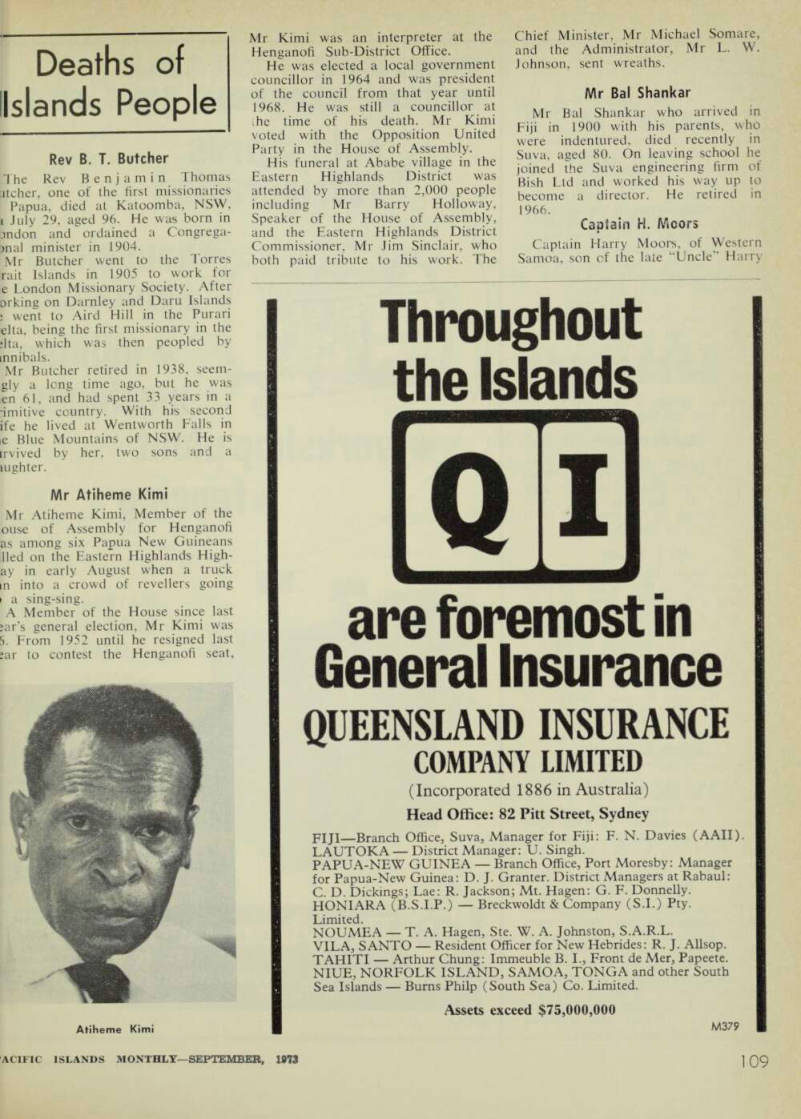
Deaths of Islands People
Rev B. T. Butcher The Rev Benjamin Thomas itcher, one of the first missionaries Papua, died at Katoomba, NSW, i July 29, aged 96. He was born in Dndon and ordained a Congrega- Mial minister in 1904.
Mr Butcher went to the Torres rail Islands in 1905 to work for e London Missionary Society. After orking on Darnley and Daru Islands 5 went to Aird Hill in the Purari elta, being the first missionary in the ;lta, which was then peopled by innibals.
Mr Butcher retired in 1938, seem gly a long time ago, but he was en 61, and had spent 33 years in a 'imitive country. With his second ife he lived at Wentworth Falls in ie Blue Mountains of NSW. He is irvived by her, two sons and a mghter.
Mr Atiheme Kimi Mr Atiheme Kimi, Member of the ouse of Assembly for Henganofi as among six Papua New Guineans illed on the Eastern Highlands High ay in early August when a truck in into a crowd of revellers going » a sing-sing.
A Member of the House since last jar’s general election, Mr Kimi was 5. From 1952 until he resigned last jar to contest the Henganofi seat,
Mr Kimi was an interpreter at the Henganofi Sub-District Office.
He was elected a local government councillor in 1964 and was president of the council from that year until 1968. He was still a councillor at •he time of his death. Mr Kimi voted with the Opposition United Party in the House of Assembly.
His funeral at Ababe village in the Eastern Highlands District was attended by more than 2,000 people including Mr Barry Holloway, Speaker of the House of Assembly, and the Eastern Highlands District Commissioner. Mr Jim Sinclair, who both paid tribute to his work. The
Chief Minister. Mr Michael Somare, and the Administrator, Mr L. W.
Johnson, sent wreaths.
Mr Bal Shankar Mr Bal Shankar who arrived in Fiji in 1900 with his parents, who were indentured, died recently in Suva, aged 80. On leaving school he joined the Suva engineering firm of Bish Ltd and worked his way up to become a director. He retired in 1966.
Captain H. Moors Captain Harry Moors, of Western Samoa, son of the late “Uncle” Harry
Atiheme Kimi
Moors and one of the best-known mariners in the South Pacific, died suddenly on July 30, aged 52. Fitt ingly, he was at the helm of the Misimoa, a ship named after his father and of which he was part owner, when he had a heart attack.
After primary education in Western Samoa and secondary education at Auckland Grammar School, he at tended Fort Trumble, in Connecticut, US, graduating as an ensign. He joined Matson Navigation Co as a third mate, and then moved across to Lykes Lines in 1946 as chief officer. He served in an oceanography research ship for a few years and then with the Central Gulf SS Co.
In World War II he was a deck officer with the US Maritime Mer chant Service. He returned to Western Samoa in 1961 to become harbour master and pilot at Apia.
Cabinet ministers were among the large crowd which attended his funeral.
Captain Moors is survived by his wife, a son and daughter.
Rev R. Hanipale The Rev Rupi Hanipale, pastor of the Congregational Christian Church of Pago Pago, died suddenly on July 25, aged 48. He played an active part in setting up the Boys and Girls Brigade fales in Pago Village.
Mr I. S. Lala Iliesa Samu Lala, a Fijian who served in World War I, died recently at Lami Village, near Suva, aged 78, He was a clerk with Morris Hed strom in Suva till 1916, when he joined the Fiji Labour Corps and went to France. On his return he worked as a clerk with the Union Steam Ship Co of NZ Ltd for 40 years. He then became manager of the Lami Fijian School, retiring in 1972.
Captain T. Fatafehi Captain Tevita Fatafehi, Captain of the King’s Royal Guards in Tonga, died late in July, aged 72. He was educated at Tonga College and then became a policeman. He transferred from the police to the Tonga De fence Force. He leaves a widow and four children.
Dr Joan Tully Islanders concerned with agricul tural training will learn with regret of the death of Dr Joan Tully, of the University of Queensland. Dr Tully, who died suddenly in Brisbane on June 11, was in charge of the post graduate diploma in agricultural ex tension work, a course which she set up more than 10 years ago, involving many Pacific Islands students.
Advertisements & other items, pp. 119-120 (2 items)
109
ACIFIC ISLANDS MONTHLY—SEPTEMBER, 1973
Throughout
the Islands
are foremost in
General Insurance
QUEENSLAND INSURANCE
COMPANY LIMITED
(Incorporated 1886 in Australia)
Head Office: 82 Pitt Street, Sydney FIJI —Branch Office, Suva, Manager for Fiji: F. N. Davies (AAII).
LAUTOKA District Manager: U. Singh.
PAPUA-NEW GUINEA Branch Office, Port Moresby: Manager for Papua-New Guinea: D. J. Granter. District Managers at Rabaul: C. D. Dickmgs; Lae: R. Jackson; Mt. Hagen; G. F. Donnelly.
HONIARA (8.5.1. P.) Breckwoldt & Company (5.1.) Pty.
Limited.
NOUMEA T. A. Hagen, Ste. W. A. Johnston, S.A.R.L.
VILA, SANTO Resident Officer for New Hebrides: R. J. Allsop.
TAHITI Arthur Chung: Immeuble B. L, Front de Mer, Papeete.
NIUE, NORFOLK ISLAND, SAMOA, TONGA and other South Sea Islands Bums Philp (South Sea) Co. Limited.
Assets exceed $75,000,000 M 379
BRAYBON PORTABLE
PETROL ELECTRIC SETS FOR
Jcold stores
refrigeration
appliances
♦ milking
machines,
♦workshop plant
♦fencing
i
I K.V.A
2 K.V.A
7 7 K.V.A.
(240 Volt)
BRAYBON/lISTER
DIESEL ELECTRIC
SETS FOR:
• MOBILE
WORKSHOP
• REFRIGERATED
VAN
• ICE CREAM
DISPENSING
UNITS
• SHIPS AUXILIARY
POWER
9 HOTEL AND
DOMESTIC POWER
Braybon Bros
PTY. LTD.,
2 ROTHWELL AVENUE, CONCORD WEST 2138.
Tel.: 73-3246.
SETS AVAILABLE
FROM 2 K.V.A.
TO 200 K.V.A.
Write for obligation free brochure and c.i.f. price Pacific Islands.
SYDNEY, AUSTRALIA.
Colonial
Ways On
The Campus
Academics at the University of the Duth Pacific in Suva recruited from atside the region are expected soon ' be receiving much higher salaries ;an staff with comparable qualifica ons but recruited from within the 3uth Pacific.
Despite strong protests by the USP ;aff Association, the University ouncil has accepted in principle the ea of metropolitan governments ipplementing the salaries of recruited from outside the :gion.
Some staff members will receive vice as much as staff recruited within ic university region.
The Staff Association, which has majority membership of expatriates, night against this form of discrimina on. It believes it is wrong for the auth Pacific and likely to cause [visions on campus and, possibly, spate of resignations.
The association is just as much isturbed about the way in which le decision was taken. It believes lat the finance ministers of the auth Pacific decided among them :lves to seek supplementation from ictropolitan governments, and then ent ahead with moves in that direc on.
Some time after their decision, atification of “recommendations for ipplementation” came before the cecutive committee of the Univer ty Council which accepted this in rinciple.
The Staff Association said the auncil was supposed to be the scision-making body of the univer ty with the power to decide on :ademic salaries and conditions. But the decisions were to be made by le region’s finance ministers, :ademics would become the only gnificant group of workers without le means to negotiate on salaries nd conditions.
Ng Hotel Walk Out.—Mem
;rs of the PNG Constitutional lanning Committee, in Kainantu in ugust to spread information about ie constitution, walked out of the lainantu Hotel where they had re eved accommodation. After book ig into the hotel they went to the ining room but some of them were ffused admission because they were r earing sandals instead of shoes nd socks. The whole party then talked out. There’s likely to be a squel!
Advertisements & other items, pp. 121-124 (3 items)
111
ACIFIC ISLANDS MONTHLY—SEPTEMBER, 1973
"Service"
to the Pacific Islands
76 Years' Experience
Selling
"SERVICE"
NELSON & ROBERTSON
PTY. LIMITED
(Established 1895)
PLANTATION HOUSE, 197 CLARENCE STREET, SYDNEY
CABLES: "IVAN", SYDNEY, BRISBANE. TELEX: AA22381, SYDNEY.
ISLAND MERCHANTS
SHIPPING AGENTS
TRAVEL AGENTS
INSURANCE AGENTS
REAL ESTATE AGENTS
Branch Office: Nelson & Robertson Pty. Ltd., 303 Adelaide St., Brisbane, Old.
New Guinea Representatives: Rabaul Trading Co. Pty. Ltd., Rabaul Lae Madang Kieta.
SOUTHERN PACIFIC INSURANCE
COMPANY LIMITED
Head Office: Equitable Life Building, 80 Alfred Street, AAilsons Point, N.S.W., 2061.
Specialising in Pacific Island Insurance requirements for over 30 years. • FIRE • FIRE AND VOLCANIC ERUPTION • HOUSEHOLD COMPREHENSIVE • MOTOR VEHICLE • COMPULSORY THIRD PARTY • COMPULSORY WORKERS' COMPENSATION
• PUBLIC LIABILITY • MARINE
Enauiries invited for all classes of insurance from special representatives at: PORT MORESBY: H. A. K. McKee, Manager for Papua New Guinea, Ist Floor, Carpenter's Supermarket, Champion Parade. P.O. Box 136. RABAUL; Mango Avenue. P.O. Box 123.
LAE; R. H. Meyer—Manager at Lae, Kam Hong's Building, Central Avenue. P.O. Box 758.
SUVA-FIJI: L. M. Rolls—Manager for Fiji, McGowan's Building, Margaret Street, P.O.
Box 521. *'s
n §s) LnnJ §s) LnnJ Is! r i §e) LnnJ 1
i For Warm and Friendly
Samoan Hospitality
Apia, Western Samoa Phone: 880. Cable; 'Aggies'.
Tariff includes all meals.
Nestled away in the untouched Kingdom of Tonga is new, luxurious "Port of Refuge" International resort. Here is a unique opportunity for your clients to experience the tranquil and relaxed Tongan atmosphere while they enjoy the picturesque surroundings of the new "Port of Refuge". And only a short flight from Fiji.
Reasonable tariffs from $17.50 with special concessions for children. Agents commission 10 per cent.
Tonga's
Port of Refuge
INTERNATIONAL RESORT U
Uava’u Tonga
Cables: “Refuge” Tonga or “Tongatours” Sydney Phone: Sydney 85-1603 or 221-3799
A
man
iliAriD
Mana Island: 300 acres of lush, tropical vegetation surrounded by miles of palm fringed beach and sheltered lagoons.
Recreation: Snorkelling, scuba, skiing,
spear, bottom and deep sea fishing, swimming excursions. Modest charges.
Accommodation: Resort hotel, secluded accommodation in 60 individual Fijiantype cottages. Self-contained bures with shower, toilet, refrigerator, tea and coffee facilities and exhaust fans.
International Standard Restaurant: Fijian and Continental cuisine. Terrace dancing to Fijian Band. Beach Bars Feast Nights.
Facilities: Island shop, travel agent, hairdresser, child minding and first aid.
Tariff: Single occupancy: $F 18.00 Double occupancy: $F22.00 Triple occupancy; $F26.00 Children under 12: Half Rate Babies in cot: Free Duplex Bure from: $F42.00 Rates subject to change.
Pre paid tours through agents.
Transport: Bus or taxi Nadi to Lautoka (Bus fare 80c). SFB.OO return by fast 90' cruiser Lautoka to Mana Island.
Schedule: Dep. Lautoka 9.30 a.m. Arr.
Mana 11.20 a.m. Dep. Mana 3.30 p.m.
Arr. Lautoka 5.20 p.m. Water Taxi subject to reservations; $F6.00 per person one way, a minimum $F45.00 per trip.
CHECKOUTTIME 11.00 a.m.
CANCELLATION NOTICE - 48 hours.
DEPOSITS Groups and ITX Prepaid.
Individual bookings, one night deposit required.
Bookings: Aust. & N.Z.: C.J. Henry & Associates.
Offices: Mana Island Resort (FIJI) Limitec.
P.O. Box M 94, Sydney Mail Exchange 2012 69.5061 or P.O. Box 610, Lautoka, FIJI 61.210, 61.455 Telegrams and Telex: Mana Island, Lautoka, FIJI Jr/ «j m
beachcomber
hotel
PACIFIC HARBOUR, FIJI
Sophistication in the midst of uninhabited natural beauty.
Nestled snugly in a reef-protected bay on 5 miles of classical palm fringed Deuba beach. Far enough from Fiji's capital, Suva, to forget the worries of city life. Near enough to take in the colour and the Duty Free Bazaars.
Every suite is self-contained and airconditioned. The cuisine is as the service, superb.
PO Box 216, Suva. Telephone; Navua 43.
Telex 2324. Cables: FLAGTELS, Fiji. For reservations or information contact your travel agent.
Turners and Growers
FRESH FRUIT&VEGETABLES
Line Advertisements
Per line, $1.15 Aust., Minimum rate. 4 lines.
r ACHTS AND COMMERCIAL VESSELS
elivered by sea by experienced ex-North itlantic delivery skipper. For safe aovement of your craft, power or sail, :ny size, anywhere, write: “Seadelivery”, lex 458, Rabaul, Papua New Guinea.
ACCOMMODATION Sydney, “Santa Fe”, 1-2 bedroom, fully furnished, luxury apartments to Rent for 3 Months or longer. Balcony, auto laundry, carspace, sauna and game rooms. From $37.00 weekly. 10 Minutes to City. 57 Cook Rd., Centennial Pk., N.S.W., 2021. Tel. 33-4698.
ALL BOOKS AND JOURNALS ON AUST-
RALASIA AND THE PACIFIC BOUGHT
AND SOLD. Catalogues issued and sent free on application. Correspondence invited. Berkelouw, 15-19 Boundary St., Rushcutters Bay, Sydney, 2011. Phone: 31-8215.
BODEN’S BOAT DESIGNS PTT. LTD.,
695 George St., Sydney, 2000. Get your Bodens Boat Designs and Boat Building Book from newsagents everywhere. Posted direct 5A2.20 surface mail.
TRIMARAN TOPAZ, Fiver AA 48 ft. design, luxuriously appointed to suit chartering or cruising, 4 months old, Ford diesel, full electrics including refrigeration, 4 double staterooms with shower and toilet, 2 twin cabins, all gear to sail immediately. Ocean tested. Contact; Yacht Topaz, c/- Tradewinds Hotel, Suva, Fiji.
CARGO/PASSENGER FOR SALE. 75 ft. X
18 ft. x 8 ft., ex Navy GPV, in full survey.
Passenger carrying Qld. coastal waters.
Blackstone diesel, 160 H.P., BV 2 knots, 3 aux. diesels, cargo winch, derrick.
Suitable for copra and passenger carrying. $40,000. Full parts. K. Horbury, C/- Post Office, Townsville, Qld. Australia 4810.
CONCRETE BLOCK MACHINE FOR SALE.
Makes blocks, flags, edgings, screen-blocks, garden stools —up to 8 at once and 96 an hour. SAI2O c.i.f. main ports. Send for leaflets. Forest Farm Research, Londonderry. N.S.W., 2753.
AMERICAN COUPLE, mid-30s, want to relocate in South Pacific. Husband is builder; wife is teacher and interior designer. Can make modest investment.
F. Corser, 105 Main St., Suite 4, Balboa, Calif. U.S.A.. 92661.
FLEETS, 26 ft Thunderbird yacht, profess, bit. 1969, dacron sails, 4 berths, toilet, galley, $4,000. 43 ft trawler, profess, bit. 1965, in survey, 5,000 lbs refrigeration, $29,500. Fleets, Rowe’s Bldg, Edward Street, Brisbane. Cable “Fleets”, Brisbane.
PEN FRIENDS OVERSEAS. Individual world wide postal introduction service!
Plus optional illustrated magazine! Write for details today! Five Continents Co. Ltd., P.O. Box 21219, Henderson, N.Z.
NAMALE PLANTATION
ESCAPE
FROM THE ORDINARY
lere is an idyllic paradise where you can njoy the unspoiled beauty and serenity of working coconut plantation. This privatelywned Pacific retreat has been designed for maximum of 16 people. Gracious surroundrigs, friendly service, relaxed 'Bure' accommoation overlooking the sea with individual alconies and private facilities. Licensed cockail bar. Entire plantation available to groups f 14-16 people. ictivities available include: Deep sea fishing, eef and shell hunting, skin diving, snorkelling, /ater skiing, hiking, turf tennis court, badlinton, horse riding, croquet course and a eautiful tropical garden to relax in. Sports quipment available on a complimentary basis nclude aquascopes, snorkelling and fishing quipment, inflatable rafts, tennis racquets tc. Coastal tours foy boat or mini-bus on equest. Boats for hire. Baby sitting service Iso available.
Yrite for a Free Brochure to:
THE MANAGER,
NAMALE PLANTATION
SAVUSAVU, FIJI.
Or: Namale Plantation, P.O. Box 64, Suva, Fiji.
PARK VIEW MOTEL—BRISBANE
Quiet location —opp. Botanic Gardens.
Single, double, family suites, all with refrig., air conditioning, phone, TV, radio, tea making facilities, from $lO. Pool and restaurant.
Phone 31-2695—Telex 40270.
Write for coloured brochure— Park View Motel, 128 Alice St, BRISBANE, Old., 4000.
DISTRIBUTOR ENQUIRIES
SOUGHT all areas
• Transmission Gears & Parts, Crown & Pinions & parts Single & Two speed to suit:— Bedford, Commer, Podge, Ford, International, Albion, Leyland • Wagner Wheel and Master Cylinders • Perfection Amercian Clutch Plates • American A.E.C. Universal Joints • Ball & Roller Bearings and Oil Seals Write to— F. & D MOTORS (TRADING) PTY. LTD.,
TRUCK TRANSMISSION &
DIFFERENTIAL SPECIALISTS
277 Grey St., South Brisbane, Q. 4101
FOR INVESTMENT IN THE
BRITISH SOLOMON ISLANDS
PLEASE CONTACT
R. C. SYMES PTY. LIMITED
ADDRESS: P.O. BOX 88, HONIARA, 8.5.1. P.
TELEPHONE: 06-28
CABLE: "SYMECO"
Turners Supply Co
FRESH FRUIT & VEGETABLES
9813
D apua new guinea
printing co. ply. ltd.
Serving the Country from Aitape to Alotau, Manus to Moresby.
Leaders in Commercial Offset and Letterpress Printing. • Stationery • Office Supplies • Office Equipment O Rubber Stamps • Self-Adhesive Labels • In Fact:— Everything For The Office.
P.O. Box 633, Port Moresby P.O. Box 30, Mt Hagen P.O. Box 466, P.O. Box 759, Lae P.O. Box 1239, Rabaul Kieta
55 YEARS EXPERIENCE
TO THE
FUNERAL TRADE
H. H. WEBB
& CO. LTD.
Manufacturers and Distributors of II
PRODUCTS
For details of our complete range of Funeral Directors 7 Requisites please write to:
HEAD OFFICE:
206 WHITEHALL STREET
FOOTSCRAY, VIC.,
AUSTRALIA
CABLES: 'WEBCO' MELBOURNE
W. H. GROVE & SONS LTD.
ESTABLISHED 1896
ISTAND MERCHANTS
Exporters to the Pacific of Dairy Products and all New Zealand consumer and manufactured goods.
ENTRUST YOUR REQUIREMENTS TO THE
ESTABLISHED FIRM
P.O. Box 3718, Cables
AUCKLAND GROVE AUCKLAND
PROPERTY INVESTMENT
SUNSHINE COAST—QUEENSLAND
We invite inquiries regarding living or investment in this area.
We have a full coverage of holiday lettings, flats, motels, homes, farms, businesses and sub-divisional land.
Write direct to MABIN & BLOWERS Pty. Ltd. (Members R.E.1.Q.),
11 BURNETT STREET—BUDERIM, Q„ 4556.
113
'ACIFIC ISLANDS MONTHLY—SEPTEMBER, 1973
Nutshell

In a Nutshell
Strikers Fired.—One Hun
ired and fifty members of the Fiji Air ne Workers Union who went on trike at Nadi Airport on August 3 in protest over “Qantas inaction n payment of superannuation funds” ound themselves out of a job. They /ere sacked by the airline’s Nadi lanager. The government also hit iack at the strikers, recruiting a 0-strong volunteer force from a near ly village. The emergency porters egan work about the time the union nnounced its decision to end the 0 hour-strike which had closed the irport. Among air travellers unable o return to Fiji because the airport /as closed was the Prime Minister, tatu Sir Kamisese Mara. When the •rime Minister arrived a day late he ommended the action of his col sagues in recruiting the labour force o get the airport working. At the time f writing, Australian Aviation Min : ter Mr C. K. Jones and Dr J. F.
'aims, Minister for Overseas Aid, /ho is a friend of Mr A. M. Tora, tie Airline Workers Union general ecretary, were trying to persuade )antas to cancel the dismissal notices.
Ieic Students’ Rlot.—Steel
lelmeted riot police with shields and runcheons were called out on Tarawa ti the GEIC on August 4 when boys rom the King George V School taged a vigorous protest against ntertainment planned for that even rig after the annual sports. They
were disappointed at the offer of a film show that evening and a picnic the following day. They wanted an Island night with dancing. Stones were thrown and the next day girls from the adjoining Elaine Bernacchi School joined in the protest, damaging school furniture. All pupils, except prefects, were sent home for an early start of the school holidays.
CENSORS AWAKE.— Censorship reared its head in Fiji and Papua New Guinea when Customs officers seized “girlie” magazines from a Suva bookseller and the PNG Trade and Industry Minister, Mr John Poe, en dorsed a Customs prohibition on certain types of “overseas offensive magazines”.
Election Petitions.— The Peti
tion to try to upset the election of Ashley Wickham in the BSIP went very badly for the petitioner, defeated candidate Colin Bentley, who saw four of his witnesses appear in court afterwards on charges of impersonat ing voters. Two men—Philip Lifuimae and James Bamani—were sentenced to two months imprisonment, and two others were find $l5 each. No evidence was produced to support allegations of corrupt practices by Mr Wickham or his agents during the election campaign, the Acting Chief Justice, Mr Justice Davis, ruled at the end of June.
DEPORTED. —Satyendra Pratap Sharma, 31, member of a Nadi, Fiji, family, was deported to Fiji from Australia on August 24. Arrested as an illegal immigrant by the Common wealth Police after a chase through Sydney streets, Sharma failed in an application to the NSW Supreme Court for a writ of habeus corpus, and his expulsion followed despite appeals to the Minister for Immigra tion, Mr A. J. Grassby, to be allowed to remain in Australia. His de facto wife, Mrs Irene Surya Baldwin, by whom he had a child, said in Sydney, after Sharma’s departure, that she and Sharma would get divorces from their legal partners and then he would attempt to rejoin her in Australia.
Sharma married Australian Mabel Ina Rhodes on October 22, 1970. They separated eight months later.
Advertisements & other items, pp. 125-126 (2 items)
115
■ACIFIC ISLANDS MONTHLY—SEPTEMBER, 1973
For Sale By Tender
DEPARTMENT OF ABORIGINAL AND
ISLAND AFFAIRS, QUEENSLAND
QUEENSLAND GOVERNMENT VESSEL
"MELBIDIR lll''
Tenders ore invited up till noon on Monday, 3rd September, 1973, for the purchase of Queensland Government vessel "Melbidir 11 IT The "Melbidir III" is a single screw wooden hull vessel, built in Cairns in 1941.
Length overall is 102 ft.
Maximum Beam 24.1 ft.
Loaded Draught 8.5 ft. aft 7 ft. far'd Light Draught 7 ft. aft 5 ft. far'd Normal Full Loading 130 Tons (D.W.) Maximum Speed 8 Knots Propulsion Engine is an Allan diesel 232 b.h.p. 550 R.P.M.
The Vessel will be sold "as is where is".
The Vessel is at present in service in the Torres Strait and will proceed to Cairns and be slipped for inspection from 20th-22nd August and will remain at Cairns until sold.
Tender documents may be inspected at the Office of the Department of Aboriginal and Island Affairs, 1 35 George Street, Brisbane, and the Manager, Department of Aboriginal and Island Affairs, 6 Abbott Street, Cairns. Copies of Documents and Tender Forms will be available at the above.
Tenders shall be in a sealed envelope, clearly endorsed "Tender for 'Melbidir IN'," addressed to the Director, Department of Aboriginal and Island Affairs, 135 George Street, Brisbane, and lodged in the Tender Box at that Office or posted to arrive at above Brisbane address before the date and time specified above, when they will be publicly opened in the office of the Department.
The highest or any tender will not necessarily be accepted.
P. J. KILLORAN
Director
KEEPING BABY
HAPPY & WELL-
By giving your baby a Fisher's Teething Powder as needed, you not only keep the little one happy and well, but save yourself all those upsets and nervous tension that beset a mother when baby suffers distress. If used as directed Fisher's Teething Powders quickly and safely soothe baby's sore gums, digestive disorders and intestinal upsets.
Get a packet from your chemist or store today—only 30c for 20 powders —you'll be so glad you did. Fisher & Co., Manufacturing Chemists (Est. 1876), 17 May St., St. Peters, N.S.W, 2044.
PIM 808/72
★★★ m i * r Leading
SOUTH
AMERICAN
Brand
CORNED
BEEF
Sole Exporters to the Pacific Islands;
PETER FISHER TRADING PTY. LTD.
321 PITT STREET, SYDNEY, 2000, AUSTRALIA.
Telephone: 26 1109. Cables "FI SHERI ON", Sydney.
THE
YORKSHIRE INSURANCE
CO. LTD.
(Incorporated in England)
A MEMBER OF THE GENERAL ACCIDENT GROUP OF COMPANIES
ALL CLASSES OF INSURANCE
AUSTRALIAN HEAD OFFICE: 10-12 Spring Street, Sydney.
General Manager for Australia: J. Adam.
PAPUA AND NEW GUINEA BRANCH: Douglas Street, Port Moresby Manager: H. M. Harvey.
, , CHIEF ISLAND REPRESENTATIVES
Sfuu.l' A -, s - p - (N-G.) Ltd.; Lae, Radio Cabs (Lae) Pty. Ltd.; Madang, W. Stokes; Manus, Edgell & Whiteley Ltd.; Honiara, 8.5.1. P., E. V. Lawson Ltd.; Suva, Williams & Gosling Ltd.; Noumea, R. Laubreaux; Norfolk Island, Martin's Agencies; Apia, E. A. Coxon & Co.; Vila, C. Sullivan {INT) Pty Ltd.
Index to Advertisers
Adams Ind 14, 102 Aggie Grey 112 Air New Zealand 24 Allied Manufacturing 53 Arnott's Biscuits 2 Bank of Hawaii 30 Bank Line 106 Beachcomber Hotel 112 8.0.A.C. 89-102 Braybon 112 Breckwoldt, Wm. 86 British Med. Lab 39 Brockhoff's 46, 69 Cadbury iii Carnation insert
Carpenter iv, 1, 78 Christadelphian Bible Mission 73 Clae Engine 74 Colgate 60 Consolidated Chemicals 84 Daiwa Bank 86 Daiwa Line 105 Davey Dunlite 82 Fiat 34, 35 Fisher & Co. 115 Fisher, Peter 45, 116 Furuno Electric 81 George & Ashton 32
Gillespie Bros. 58 Goodyear 44 Government of Hong Kong 100 Grove, W. H. 114 Hall, R. 16 Handi Works 80 Hardie, James 36 Hellaby, R. & W. 42 Honda 96 Hudson, George 25
Ibc/Esca 70
Interocean-N.Z. 103 Jacksons Corio 101 Karlander Line 108
Kawatetsu cov. iii Kerr Bros. 29 Kikkoman 19 Macquarie Ind 98 Mana Island 112 Massey-Ferguson 28 Minolta 95 Namale Plantation 113 Nedlloyd 106 Nelson & Robertson 109 Nestle 20 Nissan cov. iv Pacific Line 107 Pillar Naco 43 Pioneer Electric 93
PNG Printing 114 Qld. Co-Op. Milling 94 Qld. Insurance 109 Ring Rolling 83 Rothmans 17 Sandy, James 50 Sanitarium 12 Sansui Electric 54 Southern Pac. Ins. 109 Sullivan, C. 41 Sunbeam 48 Suzuki 59 Swire, John 18, 55 Sydney Opera House 88
Tatham, S. E. 38 Toyo Kogyo cov. ii Toyota 56, 57 Trade Winds Marine 80 Trio Electronics 40 Turners Supply 112, 113 Union S.S. Co. 107 Warburton Franki 32 Webb, H. H. 114 Wild 76 Wunderlich 72 Yorkshire Imperial 22 Yorkshire Insurance 116
Advertisements & other items, pp. 126-128 (2 items)
Wholly set up and printed in Australia by PACIFIC PUBLICATIONS (AUST.) PTY. LTD., 29 Alberta Street, Sydney, 2000.
(Telephone: 61-9197).
REGISTERED AT THE GPO SYDNEY FOR TRANSMISSION BY POST AS A NEWSPAPER CATEGORY B.
Australian price given on the front cover is recommended Australian retail price only.
The Portable Power
You've Been Waiting For
k ■ -.V *r r In the wilds you want a dependable, lightweight power source. A generator built to take rough handling. Like the one-hand portable Kawasaki KG 600.
This “whisper quiet" 4-cycle air-cooled petrol engine economically handles a variety of recreation and light utility tasks. A.C. 110, 220 V and D.C. 12V output. It's designed for long, low-maintenance performance. The transistorised automatic voltage regulator insures stable power levels.
For your larger power requirements, Kawasaki makes the KG9OO and KGI3OO portable petrol generators.
Marketed by
PACIFIC DIESEL AND TECHNICAL AGENCIES
P.O. Box 7. 19 Carrington Road. Marrickville, N.S.W., Australia 2204 Teleohone 55 3473. 55 3867 Cable; DIESELTECH SYDNEY S A. HEATH V DAWSON ENG. BYERS ENG SHERWOOD ENG. KAMSCO UNITED TRADERS CATHOLIC WORKSHOPS HONIARA MARINA AND SHIPYARD CO.
m ”A y l*»iT '■3E m M ■ 4 v \ - 4 5% n ■P > «• m ri:
thereli
Mg Tc l\ sr V V
IaSP..
Splw ipßpgl J&: EteSafclr r- m** ;3S MPr* ■ V ' ■-.
V: \- • And wherever you’ll go in over 120 nations throughout the world you’ll find proud DATSUN drivers.
Perhaps the main reason is that DATSUN was designed to meet a wide variety of conditions—mountain roads and super highways, blistering suns and freezing temperatures. DATSUN is indeed the international car that has precision engineering and a stunning string of rally victories behind it.
Its superb handling, safety features and high speed efficiency make DATSUN the choice of young and old alike. DATSUN—the car that really satisfies the world over.
DATSUN
NISSAN
WmM Sit V *\ DATSUN distributor network covers the following areas: ffi|Fiji.T.P.N.G..W. Samoa* New Caledonia*New Hebrides* 8.5.1. P. • Timor*Norfolk- W A, Suiting.T*hiH.f!«nk. Nauru. Tonga. Sainan.Guam■ Australia»New Zealand