Pacific Islands Monthly

News Magazine Of The South Pacific
August, 1973
Australia, N.Z., Western Samoa 60C
P.N.G., FIJI. COOKS, TONGA, G.E.1.C., 8.5.1. P., N. HEBRIDES 50c
Nauru, Niue, Norfolk 50C
American Samoa 70C Hawaii, Micronesia $L.Oo
NEW CALEDONIA AND FRENCH POLYNESIA 100 CFP
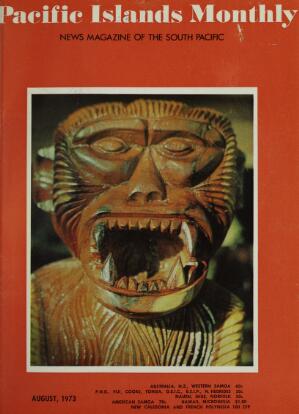
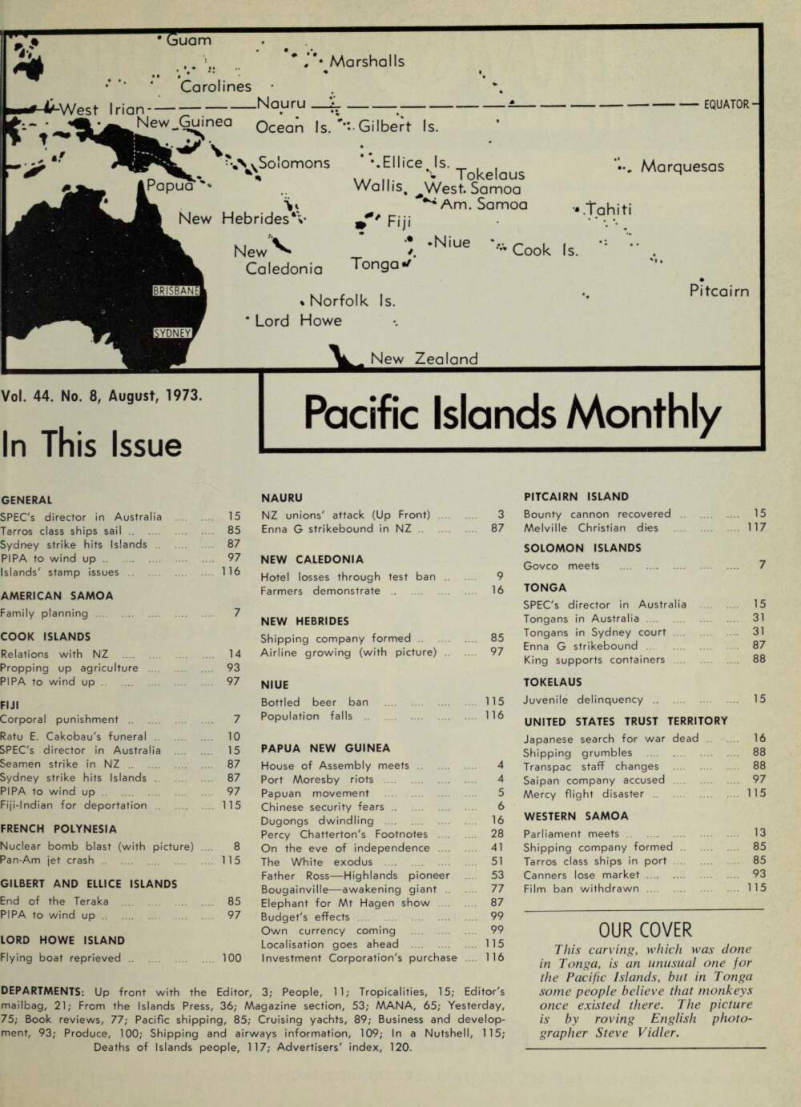
Our Cover
This carving, which was done in Tonga, is an unusual one for the Pacific Islands, but in Tonga some people believe that monkeys once existed there. The picture is by roving English photo grapher Steve Vidler.
Advertisements & other items, p. 2 (1 item)
lightest 35-SLR in the world.
0X1(17 Oo y f
SYS
0* V I * °J-nv
OMI* 1 *
» 1 ♦ i A £sas m
The world’s smallest,
lightest 35-SLR is more than the smallest,
lightest 35-SLR in the world.
m That’s because it is part of the world’s biggest, most comprehensive 35mm photographic system.
Five years ago, when the Olympus OM-1 project started, we had two main design objectives. The first was to create a 35-SLR camera meeting the highest optical and engineering standards, yet easier to handle and above all far smaller, lighter and quieter in operation than existing cameras of this type. Our other target was designing an entire 35mm system of unprecedented versatility.
The measure of our success is a camera 35% lighter, 35% smaller, and with only about half the shutter noise of the average SLR. It is also a 280-piece system including 38 superb lenses, the world’s lightest motor drive and an incomparable selection of macrophoto and photomicro equipment.
The Olympus OM-1 is proof that sometimes less can be more.
OLYMPUS
OM-1
In This Issue
General
SPEC's director in Australia 15 Tarros class ships sail 85 Sydney strike hits Islands 87 PI PA tO' wind up 97 Islands' stamp issues 116
American Samoa
Family planning 7
Cook Islands
Relations with NZ 14
Propping up agriculture 93
PI PA to wind up 97
Fiji
Corporal punishment 7 Ratu E. Cakobau's funeral 10 SPEC's director in Australia 15 Seamen strike in NZ 87 Sydney strike hits Islands 87 PI PA to wind up 97 Fiji-1 ndian for deportation 115
French Polynesia
Nuclear bomb blast (with picture) ... 8 Pan-Am jet crash 115
Gilbert And Ellice Islands
End of the Teraka 85 PIPA to wind up 97
Lord Howe Island
Flying boat reprieved 100
Nauru
NZ unions' attack (Up Front) 3 Enna G strikebound in NZ 87
New Caledonia
Hotel losses through test ban 9 Farmers demonstrate 16
New Hebrides
Shipping company formed 85 Airline growing (with picture) 97
Niue
Bottled beer ban 115 Population falls 116
Papua New Guinea
House of Assembly meets 4 Port Moresby riots 4 Papuan movement 5 Chinese security fears 6 Dugongs dwindling 16 Percy Chatterton's Footnotes 28 On the eve of independence 41 The White exodus 51 Father Ross —Highlands pioneer 53 Bougainville—awakening giant 77 Elephant for Mt Hagen show 87 Budget's effects 99 Own currency coming 99 Localisation goes ahead 115 Investment Corporation's purchase 116
Pitcairn Island
Bounty cannon recovered 15 Melville Christian dies 117
Solomon Islands
Govco meets 7
Tonga
SPEC's director in Australia 15 Tongans in Australia 31 Tongans in Sydney court 31 Enna G strikebound 87 King supports containers 88
Tokelaus
Juvenile delinquency 15
United States Trust Territory
Japanese search for war dead 16 Shipping grumbles 88 Transpac staff changes 88 Saipan company accused 97 Mercy flight disaster 115
Western Samoa
Parliament meets 13 Shipping company formed 85 Tarros class ships in port 85 Canners lose market 93 Film ban withdrawn 115
DEPARTMENTS: Up front with the Editor, 3; People, 11; Tropicalities, 15; Editor's mailbag, 21; From the Islands Press, 36; Magazine section, 53; MANA, 65; Yesterday, 75; Book reviews, 77; Pacific shipping, 85; Cruising yachts, 89; Business and develop ment, 93; Produce, 100; Shipping and airways information, 109; In a Nutshell, 115; Deaths of Islands people, 117; Advertisers' index, 120.
Advertisements & other items, p. 4 (1 item)
Fkenwood
TUNING
MODE
RM uii ■ mu - -I- -»f» i i
MONO
M
OiSCREI
Comparisons Prove
KENWOOD Best
m 9 f m f KR-5340 KR-6340 For audiophiles who feel this is the 2channel stereo receiver era —but want to be ready for 4-channel —we recommend our latest two-four receivers. They are the KR-5340 and KR-6340. They offer the most superb 2-channel reproduction characteristics with no loss of rear speaker amplifier power. Each has a BTL system that is compatible for two-four channel use. To enjoy SQ or RM merely turn the appropriate switch, and for total CD-4 sound reproduction plug in our KCD-2 disc de-modulator (except on the KR- -5340). These are stereo receivers that are ideal for the present or the future. For 2-channel or 4-channel stereo remember KENWOOD'S "two-four" and you will be prepared for either. the sound approach to quality
fKENWOOD
For minute information, write to: P-SECTION, TRIO ELECTRONICS, INC. 6-17, 3-chome, Aobadai, Meguro-ku, Tokyo, Japan
Pacific Islands
Monthly
FOUNDED BY R. W. ROBSON IN 1930
Published Monthly By
Pacific Publications (Aust.) Pty. Ltd.,
29 Alberta St., Sydney, N.S.W., 2000.
Postal Address: G.P.O. BOX 3408, SYDNEY,
N.S.W., 2001.
Telegraphic Address: PACPUB, Sydney.
Telex 25168.
Telephones: 61-9197, 61-7101, 61-4369.
Consulting Directors: R. W. Robson, Judy Tudor.
Chief Executives: Manager: Selwyn Hughes.
Publisher: Stuart Inder.
Director of Advertising: W. A. Gasnier.
Pacific Islands Monthly
Editor: Stuart Inder.
Assistant Editor: John Carter.
Advertising Manager: W. A. Gasnier.
Circulation Manager: Barry Badger.
Subscription Rates;
"Pacific Islands Monthly" is airfreighted to all subscribers and agents in the Pacific Islands and the U.S.A.; copies to other areas go by surface mail.
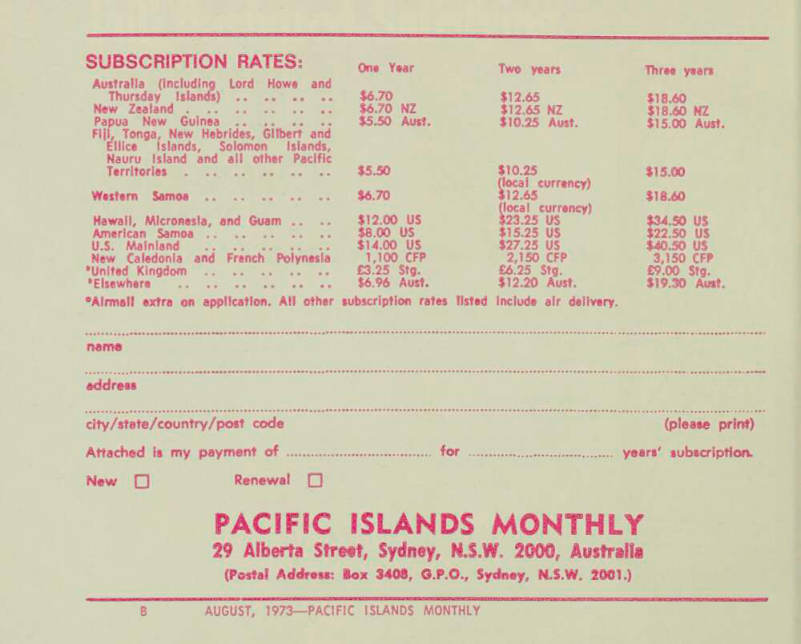
Australia (incl. Lord Howe and Thursday Is.): 56.70 Aust., Papua New Guinea; $5.50 Aust.; Fiji, Tonga, New Hebrides, Gilbert & Ellice Islands, Solomon Islands, Nauru Island and all other Pacific territories: $5.50 (local currency); Western Samoa: $6.70 (local currency); New Zealand: $6.70 NZ; Hawaii, Micronesia and Guam: $12.00 US; US Mainland; $14.00 US; New Caledonia and French Polynesia: 1,100 CFP; United Kingdom; £3.25; Elsewhere: $6.96.
Representatives
Fiji: A. F. Woods, Imex (Pacific) Limited, Suite 2A, Victoria Arcade, Suva, Fiji. P.O. Box 3117, Lami, SUVA. Telephone: 22-502. Telex: 2124, Papua New Guinea: LAE, P.O. Box 227; RABAUL, Mr. Steve Simpson, P.O. Box 433 (c/- Rabaul Photographic. Tel.: 2677.) French Polynesia: Distribution—Hachette Paci fique, 10 Ave Bruat, Papeete.
New Zealand: Pacific Publications, C.P.O. Box 2229, Auckland. 379-494. Representative: John Spedding, Civic House, 291 Queen St., Auckland, Tel.: 379-494.
United Kingdom: I. B. Graham, Park House, 22 Park Street, Croydon, CR9 3NP. Tel.: 01-6884177.
Overseas Newspapers (Agencies) Ltd., Cromwell House, Fulwood Place, London, W.C.I. Tel.: 01-242-0661. Cables: WESNEWS, London, DS4.
Japan: Advertising—Universal Media Corpora tion, C.P.O. Box 46, Tokyo. Tel.: 666-3036.
Victoria: Advertising Pacific Publications (Aust.) Pty. Ltd., 33 Lonsdale Street, Melbourne, Vic. 3006. Telephone: 662-3263.
Queensland: Advertising—Beale Media Services, 232 St. Paul's Terrace, Fortitude Valley, Qld., 4006. Tel.: 52-5827.
Hawaii and U.S. Mainland only: Mrs. W. A.
McGrath, 225 Queen Street, 178, Honolulu, 96813. (Send change of address notices. Form 3579 and new subscriptions to P.O. Box 2193, Honolulu, Hawaii, U.S.A. 96805).
Second class postage paid at Honolulu, Hawaii.
Copyright ©, 1973,
Pacific Publications (Aust.) Pty. Ltd.
August, 1973 Vol. 44, No. 8
Up Front
with the Editor
Nauru’s 9,336-ton passenger and cargo vessel, Erma G, justifiably the pride of the growing Nauruan fleet, is deserted in Wellington, its crew of Islanders paid off, its officers found jobs elsewhere. It’s the end of the line in a shipping dispute which has cost the Republic of Nauru more than $170,000, put 51 Islanders out of work and may have strangled at birth a shipping line on which many islands had built their hopes.
It’s a bitter statement of account, but it has one golden aspect. The Government of Nauru has stood firm on a principle, which will precipitate a showdown that will finally dis tinguish friends from enemies for the South Pacific Islands.
For the Enna G story is no simple shipping dispute. It’s the independent nations of the South Pacific versus the metropolitan powers for a place in the sun.
If you are a regular reader of PlM’s shipping columns you’ll see that the Enna G has been tied up in Wellington since early June, when Nauru agreed to a request from the Tongan Government to use the vessel on a joint venture, for a regular service connecting NZ and the Islands.
The Union Steam Ship Company had just withdrawn the Tofua from such a service, leaving the Islands with out regular means of exporting.
The South Pacific Forum, which includes Australian and NZ Govern ment leaders, had already agreed to the principle of an Islands regional shipping service, and here was an opportunity to get it under way, with Islands ships and crews, carrying for the most part Islands cargoes.
The Enna G had operated out of Sydney.
The Australian waterfront unions did not interfere with a well-run ship that was Islands-registered, owned, operated and crewed.
But the NZ Seamen’s Union, good at paying lip service to the needs of its “brothers” in the Islands, decided that if its own men couldn’t get jobs now that the Tofua was off the run, nobody else would, and it declared the Enna G black. Some other Wellington waterfront unions lent their support to the NZ seamen.
Stripped of all the double-talk, ex planations and counter-explanations, the NZ union attitude is as simple as that—naked self-interest.
It has made use of Fijian unionists for its own selfish purposes, and is certainly no friend of the Islanders.
Meanwhile, the New Zealand Govern ment has also showed itself to be little more than a fair-weather friend by failing to intervene on this clear matter of principle.
The principle is: Do the sovereign South Pacific states not have the right to operate their own ships, to employ their own men on their own con ditions, and to service their own islands—or to call anyplace else whose government gives them authority to call?
The Nauruans and the Tongans know that, and so by now do the rest of the Islands governments who have watched with tight-lipped con cern. The NZ Government presumably professes not to know it, because it would be embarrassing to know it and not to have done anything about it. The NZ union leaders involved wouldn’t know anything, and the 23 Fijian seamen who lost their jobs must now be wondering what their union leadership knows.
What next? As the Nauruan Gov ernment said in a full page NZ news paper advertisement: “The Nauru and Tongan shipping lines place their hopes now on results of the forthcoming regional talks proposed by the Prime Minister of New Zealand to attempt rationalisa tion of shipping and trade in the Pacific.
“Until then we suggest that the NZ waterfront unions would do well to follow the example of their national leader—and encourage rather than attempt to destroy the legitimate hopes and aspirations of their Island neighbours.”
The conference is unlikely to take place before October. I think the Nauruan advertisement is nicer to the NZ Prime Minister than he deserves, but meanwhile President Hammer Deßoburt refuses to back down, despite the financial cost. He deserves the thanks of the South Pacific.
Stuart Inder
Pacific Islands Monthly
Problems And Bitter Pills On Png's
Rocky Trail To Independence
From Percy Chatterton,
in Port Moresby.
Papua New Guinea’s Finance Minister, Julius Chan, sprang a well kept surprise on us by introducing a mini-budget in the June meeting of the House of Assembly.
It came at the end of the second week of the three-week long meet ing.
The main budget is not due till August, but Mr Chan has let one cat out of his bag—we’re not going to get as much in Australian aid in 1973/74 as we hoped we would. So there is foretaste of bitter pills to come.
A bit more revenue is to be squeezed out of those hardy annuals —liquor, tobacco and petrol. To these are added tea, coffee, fireworks and pet food.
Few will disagree with the impost on fireworks, designed not so much to produce revenue as to decrease the nuisance value of this com modity.
One suspects that the slug on pet food is based on emotional rather than financial considerations. It has been a sore point among Paguineans that affluent expatriates spend so much on feeding their pets, more, claim some, than they spend on feed ing their domestic servants.
I do not think that the revenue from this source is likely to build many roads and bridges, but if it soothes ruffled feelings I suppose it is worth it.
As far as this non-affluent expatri ate is concerned, I shall continue to keep my Siamese pussy supplied with her daily ration of ‘Whiskas’ even if it means cutting down on cigarettes.
I’ll probably have to do that anyway.
The increased duties on imported tea and coffee are, no doubt, intended to encourage consumption of the local product. Fair enough. I already drink local tea, and would gladly drink local coffee if someone would set up a factory for producing the “instant” variety. I am an avid but lazy coffee drinker.
Finance Minister Chan has also given notice that Papua New Guinea will have its own currency, but not till the end of next year. (See com merce section).
The June meeting was not a happy experience for Mr Michael Somare’s National Coalition Government. In deed, it was a frustrating one.
There were two reasons for this.
One was the Government’s failure to distribute to members copies of im pending legislation. The other was what appears to have been a break down in communication, not only between Government and Opposition front-benches, but also, and more seriously, between the Government and its own back-benchers.
Government failure to circulate copies of bills in time for members to study them adequately is an old story. In the first and second Houses it was a continuing complaint hurled by elected members at the official members who dominated the Gov ernment. It is ironic that the present elected Government, which includes some of the members who used to fire the bullets, now finds itself a target for bullets fired by the Opposi tion. Mr Somare is in an unfortunate position.
In addition to the normal flow of legislation there is a spate of largely machinery bills which have to be passed in order to regularise formal accession to self-government in December. The legal and clerical services needed to frame, cyclostyle and distribute this mass of legislation are evidently inadequate for the work load, but the Opposition is surely right in claiming that it is entitled to examine even routine bills before it passes them.
The cure for this condition is surely to increase, even if only tem porarily, the legal and clerical ser vices to make them adequate to cope with the work-load, rather than to complain about the “obstructive ness” of the Opposition. If personnel is hard to obtain, as it probably is, then the Commonwealth Govern ment might not unreasonably be asked to come to the party by seconding personnel on a temporary basis.
After all, it is the Australian Gov ernment rather than our own which is in such a hurry to bring on self government and independence.
Responsibility for the breakdown in communication must clearly be borne by the Chief Minister himself,
Student peacemakers in city riots
When angry Papuan villagers and New Guineans clashed on July 23 in one of the worst riots Port Moresby has seen, hundreds of Papua New Guinea University students cooled the tribesmen’s tempers. The students marched for 10 miles around the city appealing for calm and unity.
It was the second day of the riots which were sparked off by a Papuan win in a football match against New Guineans. The students’ march, said Chief Minister Michael Somare, had “turned a time of violence into an
expression of unity and peace.” Blame for the violence, which caused damage to houses, shops and cars, was divided between Josephine Abaijah’s Papua Separatist Movement and the football match. Schools closed and public transport stopped, and Mr Somare, who threatened over the radio that anyone who caused trouble would re gret it, said he was considering im posing a curfew. Miss Abaijah called for the removal of all New Guineans from Port Moresby. For a closer look at the Papua Movement, see page 5.
nd it can be put right by him alone, is a consequence of the breakdown, e has had the unhappy experience uring this meeting of being attacked rom behind by his own back-bench rs as well as from in front by the Opposition.
The trouble began on the first day f the meeting with a nettled House jfusing the Government leave to ring down bills which had not been irculated in time.
It flared up again on the after oon of the last day, when Mr omare belatedly sought the House’s pproval for the appointment of tree additional ministers, to bring le total ministry from 17 to 20. [The three nominees were, Mr ihn Kaputin, member for Rabaul; lr Pita Lus, member for Maprik in le East Sepik, and Mr Yano Belo, lember for Kagua-Erave in the authern Highlands.] The House did not object to the crease, but it did disagree with its vn Nomination Committee’s selec an of members to fill the vacancies, id the Government found itself ?hting off a sustained attack from ath the Opposition and its own ick-benches.
After a long and heated debate a otion to refer the matter back to e Nominations Committee was nar iwly defeated. But by that time the aur of five had been reached, and,
Continued next page.
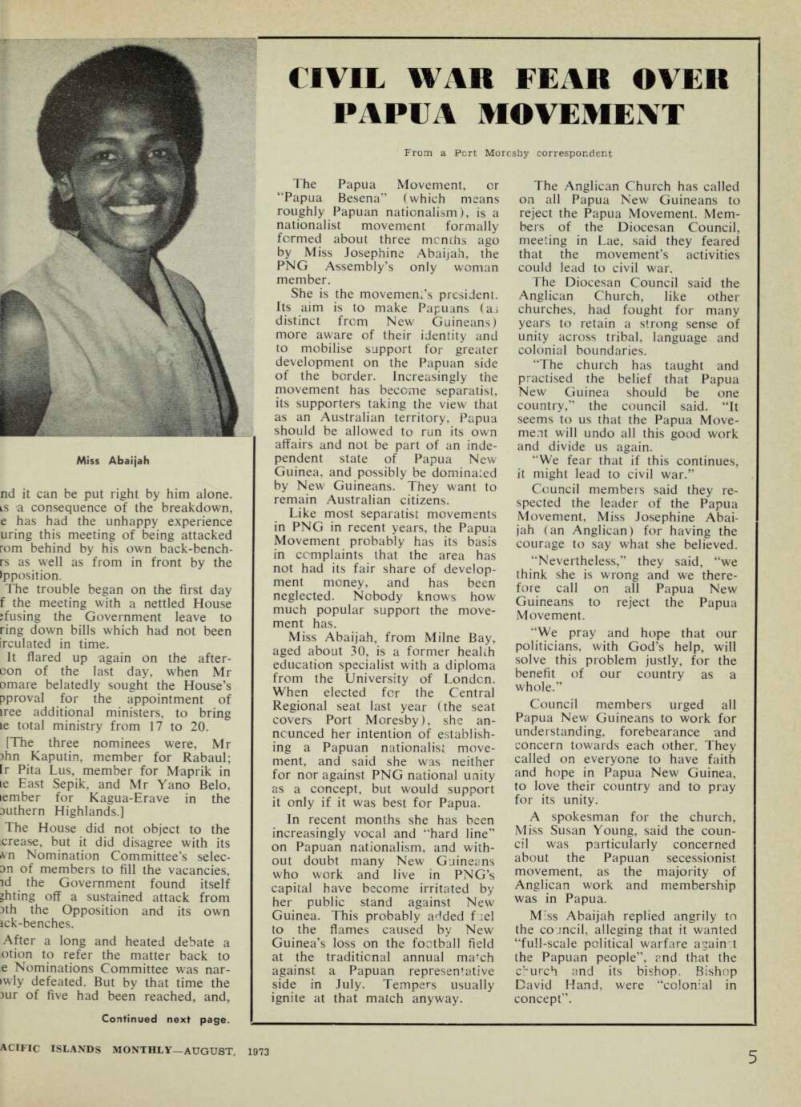
Miss Abaijah
'Rude words hurled^
in accordance with custom, Mr Speaker suspended the sitting till 8 pm. As so often happens on the last day of a meeting, the hour of eight found the House inoperative for lack of a quorum.
So it had to adjourn “to a date to be fixed” without the crucial motion to accept the nominations having been put, and the appointment of new ministers, along with other important business such as a bill to validate the transfer of control over the Public Service from Canberra to Port Moresby, have had to be stood over till the next meeting in August.
It is much to be hoped that Mr Somare can repair the weaknesses that this meeting has revealed.
While 1 have only a muted admiration for some members of his team, I consider Mr Somare himself is the man for the hour. I do not think that there is anyone else in sight who could do as good a job as Chief Minister as he has done, and it would be a tragedy if the coalition he heads were to collapse.
The most far-reaching piece of legislation enacted at this meeting was undoubtedly the bill to set up a National Broadcasting Commission, which as from December 1 next will take over the services at present operated by the Australian Broadcasting Commission at national level,
and by the Administration Depart ment of Information and Extension Services at local levels.
The commission is modelled fairly closely on ABC lines, but, in a fea ture no doubt borrowed from New Zealand, it is authorised to establish and supervise commercial broadcast ing. At another important point also it differs from the ABC model; the functions of chairman and manager will be carried out by one man.
The Opposition was not happy about this arrangement, more especi ally as the chairman/manager will hold office, in effect, at the pleasure of the cabinet. However, its attempt to amend the bill to separate the two jobs was unsuccessful.
Also unsuccessful was its attempt to add to the section dealing with “Function of the Commission” a sub-section requiring the commission to “ensure that the services it pro vides present a balanced outlook and allow for the presentation of views at variance with the mainstream of current political, religious and cultural thought”.
After a lengthy and sometimes heated debate, the bill was passed with only a couple of minor amend ments.
Time will show how justified or unjustified the Opposition’s reserva tions were. It is necessary not only that the commission should be im partial but also that the listening public should have confidence in its impartiality.
This will not happen if the job of chairman/manager is allowed to be come a political plum. It will only
happen if the Government has th( wisdom to appoint to the dual jol someone whose reputation fo integrity and impartiality is unshake able.
Emotion had full play in a “mat ter of public importance” debate oi our latest separatist movement, th Papua Movement, currently bein; spearheaded with truly feminin ferocity by Miss Josephine Abaijai
Mha.
Rude words were hurled, hot ai expelled, mixed metaphors were pei petrated, foes popped up wher friends might have been expectec and vice versa. But the net resu] seems to have been to provide on fiery Papuan nationalist with anothe tub to thump, which was not quit what the promoters of the debate ha planned.
Of the various papers tabled, tw were of special interest. One was a expansion, by Mines Minister Pai Lapun, of an earlier statement of hi on future mining policy. The paper i by way of being a blueprint for mining legislation to be brougl down later in the year.
One thing which seems clear : that never again will mining venture in Papua New Guinea get it as goo as Bougainville Copper Pty has ha it.
The other paper was the report c a committee set up to investigate la' and order problems in the Highland This report gives a quite horrif picture of a situation which is m so much a breakdown of law an order as a total rejection of wester concepts of law and order.
The committee’s recommendatior are drastic and include punishmei inflicted not only on individuals bi on communities, and, in certain ci cumstances, a reversal of the prii ciple that a man is innocent until I is proved guilty.
Finally, as a bonne bouche ar earnest of some good clean fun the August meeting, we have a< vance notice, from Oscar Tammu member for Kokopo and patron < the Mataungan Association, of motion to ban The Pill and disbar the Public Health Departmenl Family Planning Service.
And for good measure, Highlau member Sinake Giregire, who om wanted Papua New Guinea tak< away from Australia and given someone else to administer, now i tends to demand that Austral should pay New Guinea one tho sand million dollars as compensatic for having to take over responsib ity for “the uneconomic Territory Papua”.
A good time should be had by i in the August session.
Civil War Fear Over
Papua Movement
From a Pert Moresby correspondent
The Papua Movement, or “Papua Besena” (which means roughly Papuan nationalism), is a nationalist movement formally formed about three me mbs ago by Miss Josephine Abaijah, the PNG Assembly’s only woman member.
She is the movement’s president.
Its aim is to make Papuans (as distinct from New Guineans) more aware of their identity and to mobilise support for greater development on the Papuan side of the border. Increasingly the movement has become separatist, its supporters taking the view that as an Australian territory, Papua should be allowed to run its own affairs and not be part of an inde pendent state of Papua New Guinea, and possibly be dominated by New Guineans. They want to remain Australian citizens.
Like most separatist movements in PNG in recent years, the Papua Movement probably has its basis in complaints that the area has not had its fair share of develop ment money, and has been neglected. Nobody knows how much popular support the move ment has.
Miss Abaijah, from Milne Bay, aged about 30, is a former health education specialist with a diploma from the University of London.
When elected for the Central Regional seat last year (the seat covers Port Moresby), she an nounced her intention of establish ing a Papuan nationalist move ment, and said she was neither for nor against PNG national unity as a concept, but would support it only if it was best for Papua.
In recent months she has been increasingly vocal and “hard line” on Papuan nationalism, and with out doubt many New Guineans who work and live in PNG’s capital have become irritated by her public stand against New Guinea. This probably added fuel to the flames caused by New Guinea’s loss on the football field at the traditional annual ma f ch against a Papuan representative side in July. Tempers usually ignite at that match anyway.
The Anglican Church has called on all Papua New Guineans to reject the Papua Movement. Mem bers of the Diocesan Council, meeting in Lae, said they feared that the movement’s activities could lead to civil war.
The Diocesan Council said the Anglican Church, like other churches, had fought for many years to retain a strong sense of unity across tribal, language and colonial boundaries.
“The church has taught and practised the belief that Papua New Guinea should be one country,” the council said. “It seems to us that the Papua Move ment will undo all this good work and divide us again.
“We fear that if this continues, it might lead to civil war.”
Council members said they re spected the leader of the Papua Movement, Miss Josephine Abai jah (an Anglican) for having the courage to say what she believed.
“Nevertheless,” they said, “we think she is wrong and we there fore call on all Papua New Guineans to reject the Papua Movement.
“We pray and hope that our politicians, with God’s help, will solve this problem justly, for the benefit of our country as a whole.”
Council members urged all Papua New Guineans to work for understanding, forebearance and concern towards each other. They called on everyone to have faith and hope in Papua New Guinea, to love their country and to pray for its unity.
A spokesman for the church, Miss Susan Young, said the coun cil was particularly concerned about the Papuan secessionist movement, as the majority of Anglican work and membership was in Papua.
Miss Abaijah replied angrily to the council, alleging that it wanted “full-scale political warfare again:! the Papuan people”, and that the c’-urch and its bishop. Bishop David Hand, were “colonial in concept”.
Advertisements & other items, p. 7 (1 item)
5
ACIFIC ISLANDS MONTHLY—AUGUST, 1973
Chinese Fear The Future
Chinese fears for their security after independence in Papua New Guinea were voiced by a Kavieng business man, Mr Philip Fong, to a session of the Constitutional Planning Committee when it visited New Ireland.
Mr Fong, who was defend ing the Chinese community against a charge that it was not helping in the develop ment of PNG, said there was no security for people from other countries and they were afraid they would be forced to leave after self-government.
To back up his claim that the Chinese were helping in development, Mr Fong pro duced a booklet which he had written in Pidgin containing medical advice.
The attack on the Chinese had come earlier in the ses sion from a New Ireland woman, Mrs Aplonia Socho zel of Was aw a, who said that as well as not helping in de velopment, the Chinese were making big profits on PNG land. These types of people, she said, should not become citizens of PNG.
Solomons council meets
Keep spending down in the 1974 udget, emphasised the High Com lissioner for the Western Pacific, Sir llichael Gass, when he opened the rst meeting of the new BSIP Gov ■ning Council in July. Sir Michael ave two warnings; • To avoid being persuaded by rofessional experts, both inside and utside the BSIP, into approving 3Stly and grandiose schemes which le protectorate could not possibly fford and which in many cases, were »tally inappropriate for the country; • The grant-in-aid from the UK i 1974 would make it necessary to rune some of the draft estimates Iready prepared by departments, ouncil members would have to >sess priorities and suggest possible eductions in services and costs.
The grant-in-aid was unlikely to weed the 1973 figure of $l.B dllion. As local revenue was limited * about $6 million, recurrent ex mditure could not be allowed to ex ;ed that of 1973 to any great extent.
One of the main aims of the Sixth
Development Plan was to develop natural resources so that, in time, local revenue could increase, and reduce the dependence of the pro tectorate on external support. It was encouraging to see better prices for copra and timber—even though they might be only temporary —and the first exports of fish. There might be definite news about bauxite mining by the end of 1973.
Sir Michael also spoke of the UK Government review of expatriate staffing in dependent territories. The main conclusion was that there were special long-term requirements which would best be met by setting up a small home-based career group to be known as the Dependent Territories Administrative Branch.
New arrangements for supplement ing other overseas staff were proposed and the UK Government intended to put them into effect towards the end of 1973. The arrangements were de signed so that, wherever possible, they would not affect existing policies of filling posts with local officers.
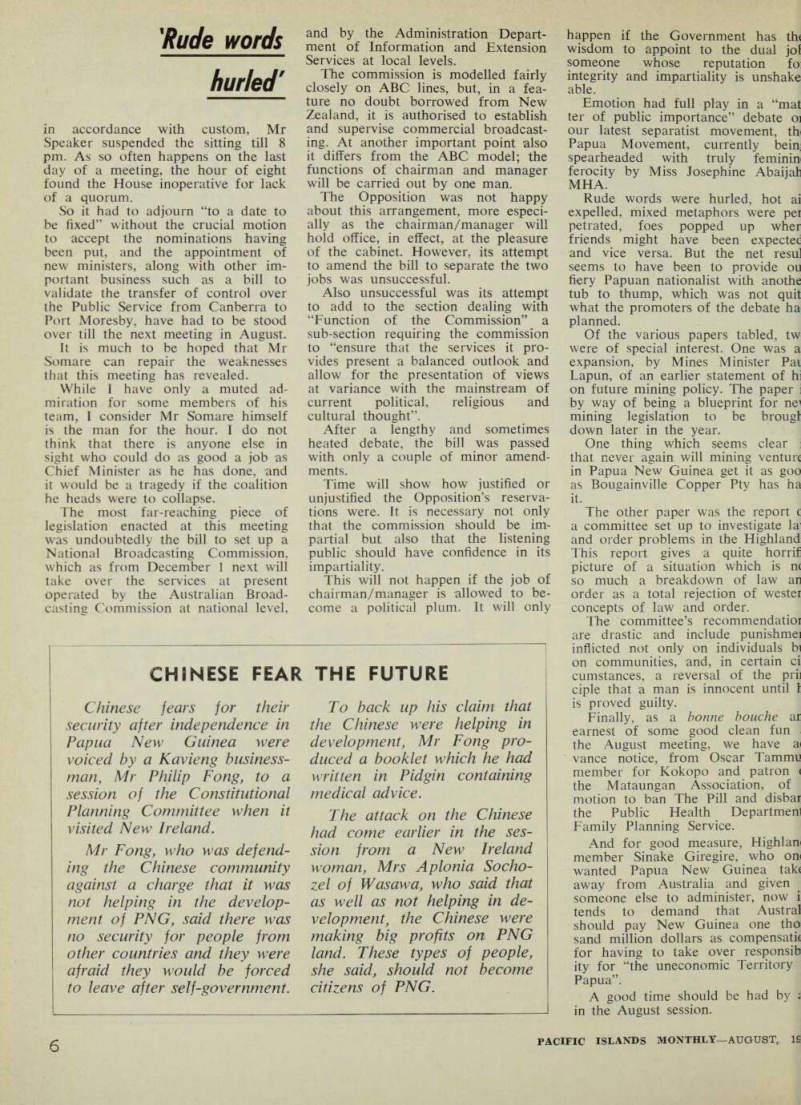
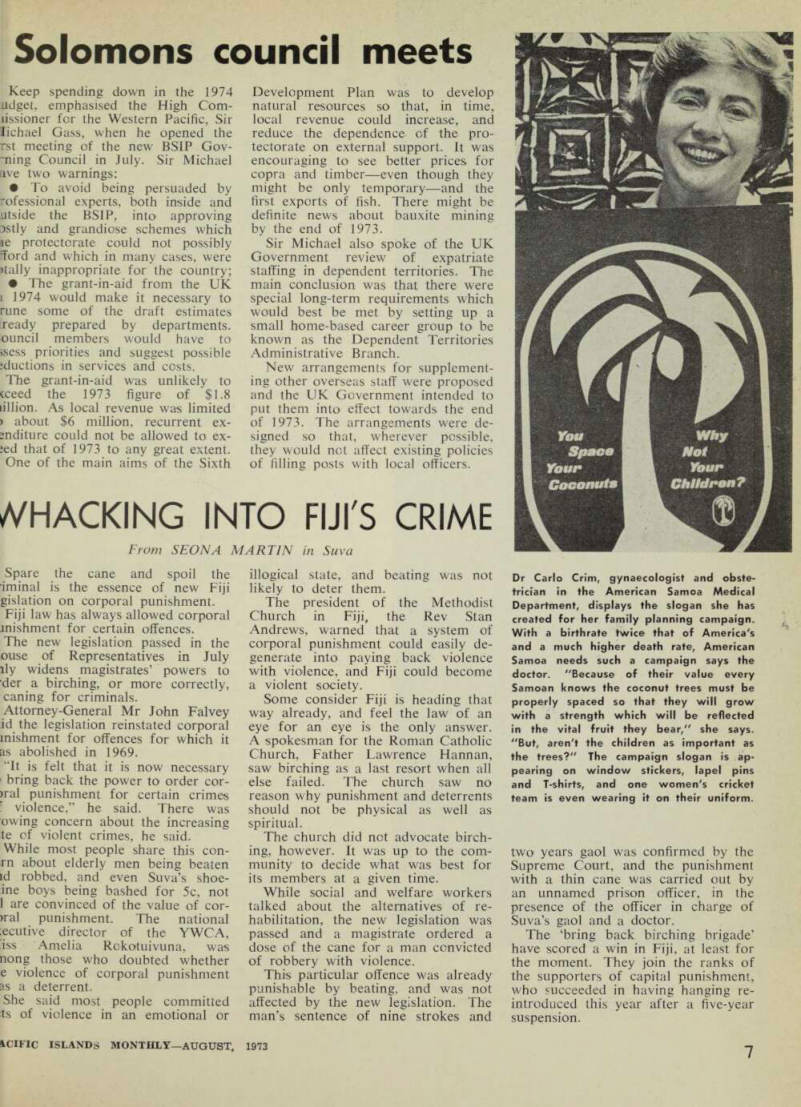
Dr Carlo Crim, gynaecologist and obste trician in the American Samoa Medical Department, displays the slogan she has created for her family planning campaign.
With a birthrate twice that of America's and a much higher death rate, American Samoa needs such a campaign says the doctor. "Because of their value every Samoan knows the coconut trees must be properly spaced so that they will grow with a strength which will be reflected in the vital fruit they bear," she says.
"But, aren't the children as important as the trees?" The campaign slogan is ap pearing on window stickers, lapel pins and T-shirts, and one women's cricket team is even wearing it on their uniform.
Whacking Into Fiji's Crime
From SEONA MARTIN in Suva
Spare the cane and spoil the iminal is the essence of new Fiji gislation on corporal punishment.
Fiji law has always allowed corporal inishment for certain offences.
The new legislation passed in the ouse of Representatives in July ily widens magistrates’ powers to der a birching, or more correctly, caning for criminals.
Attorney-General Mr John Falvey id the legislation reinstated corporal inishment for offences for which it as abolished in 1969.
“It is felt that it is now necessary ' bring back the power to order cor >ral punishment for certain crimes : violence,” he said. There was owing concern about the increasing te of violent crimes, he said.
While most people share this con rn about elderly men being beaten id robbed, and even Suva’s shoe ine boys being bashed for sc, not 1 are convinced of the value of cor >ral punishment. The national :ecutive director of the YWCA, iss Amelia Rokotuivuna, was nong those who doubted whether e violence of corporal punishment as a deterrent.
She said most people committed ts of violence in an emotional or
illogical state, and beating was not likely to deter them.
The president of the Methodist Church in Fiji, the Rev Stan Andrews, warned that a system of corporal punishment could easily de generate into paying back violence with violence, and Fiji could become a violent society.
Some consider Fiji is heading that way already, and feel the law of an eye for an eye is the only answer.
A spokesman for the Roman Catholic Church, Father Lawrence Hannan, saw birching as a last resort when all else failed. The church saw no reason why punishment and deterrents should not be physical as well as spiritual.
The church did not advocate birch ing, however. It was up to the com munity to decide what was best for its members at a given time.
While social and welfare workers talked about the alternatives of re habilitation, the new legislation was passed and a magistrate ordered a dose of the cane for a man convicted of robbery with violence.
This particular offence was already punishable by beating, and was not affected by the new legislation. The man’s sentence of nine strokes and
two years gaol was confirmed by the Supreme Court, and the punishment with a thin cane was carried out by an unnamed prison officer, in the presence of the officer in charge of Suva’s gaol and a doctor.
The ‘bring back birching brigade’ have scored a win in Fiji, at least for the moment. They join the ranks of the supporters of capital punishment, who succeeded in having hanging re introduced this year after a five-year suspension.
Advertisements & other items, p. 9 (1 item)
7
&CIFIC ISLANDS MONTHLY—AUGUST, 1973
Independence!
Tahitian answer to the bomb
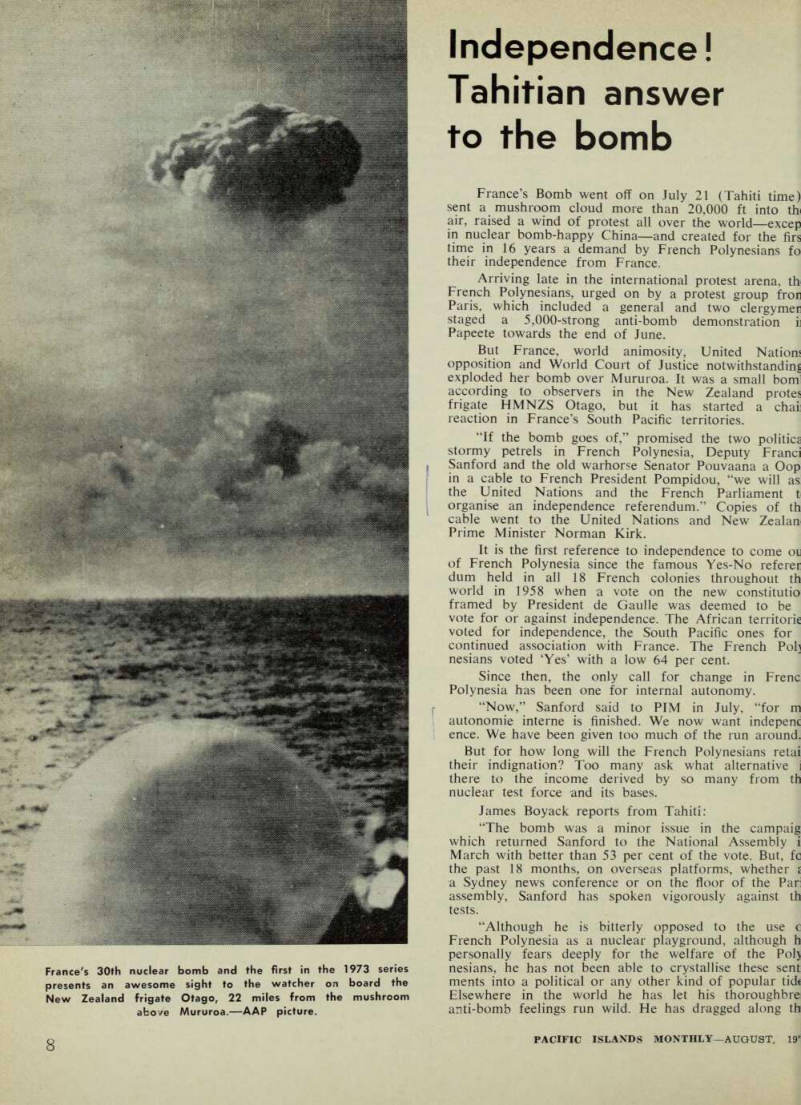
France’s Bomb went off on July 21 (Tahiti time) sent a mushroom cloud more than 20,000 ft into th air, raised a wind of protest all over the world—excep in nuclear bomb-happy China—and created for the firs time in 16 years a demand by French Polynesians fo their independence from France.
Arriving late in the international protest arena, th French Polynesians, urged on by a protest group fron Paris, which included a general and two clergymer staged a 5,000-strong anti-bomb demonstration i: Papeete towards the end of June.
But France, world animosity, United Nations opposition and World Court of Justice notwithstanding exploded her bomb over Mururoa. It was a small bom according to observers in the New Zealand protes frigate HMNZS Otago, but it has started a char reaction in France’s South Pacific territories.
“If the bomb goes of,” promised the two politics stormy petrels in French Polynesia, Deputy Franci Sanford and the old warhorse Senator Pouvaana a Oop in a cable to French President Pompidou, “we will as the United Nations and the French Parliament t organise an independence referendum.” Copies of th cable went to the United Nations and New Zealan Prime Minister Norman Kirk.
It is the first reference to independence to come or of French Polynesia since the famous Yes-No referer dum held in all 18 French colonies throughout th world in 1958 when a vote on the new constitutio framed by President de Gaulle was deemed to be vote for or against independence. The African territorie voted for independence, the South Pacific ones for continued association with France. The French Pob nesians voted ‘Yes’ with a low 64 per cent.
Since then, the only call for change in Frenc Polynesia has been one for internal autonomy.
“Now,” Sanford said to PIM in July, “for m autonomic interne is finished. We now want indepenc ence. We have been given too much of the run around.
But for how long will the French Polynesians retai their indignation? Too many ask what alternative i there to the income derived by so many from th nuclear test force and its bases.
James Boyack reports from Tahiti; “The bomb was a minor issue in the campaig which returned Sanford to the National Assembly i March with better than 53 per cent of the vote. But, fc the past 18 months, on overseas platforms, whether i a Sydney news conference or on the floor of the Par: assembly, Sanford has spoken vigorously against th tests.
“Although he is bitterly opposed to the use c French Polynesia as a nuclear playground, although h personally fears deeply for the welfare of the Polj nesians, he has not been able to crystallise these sent ments into a political or any other kind of popular tide Elsewhere in the world he has let his thoroughbre anti-bomb feelings run wild. He has dragged along th
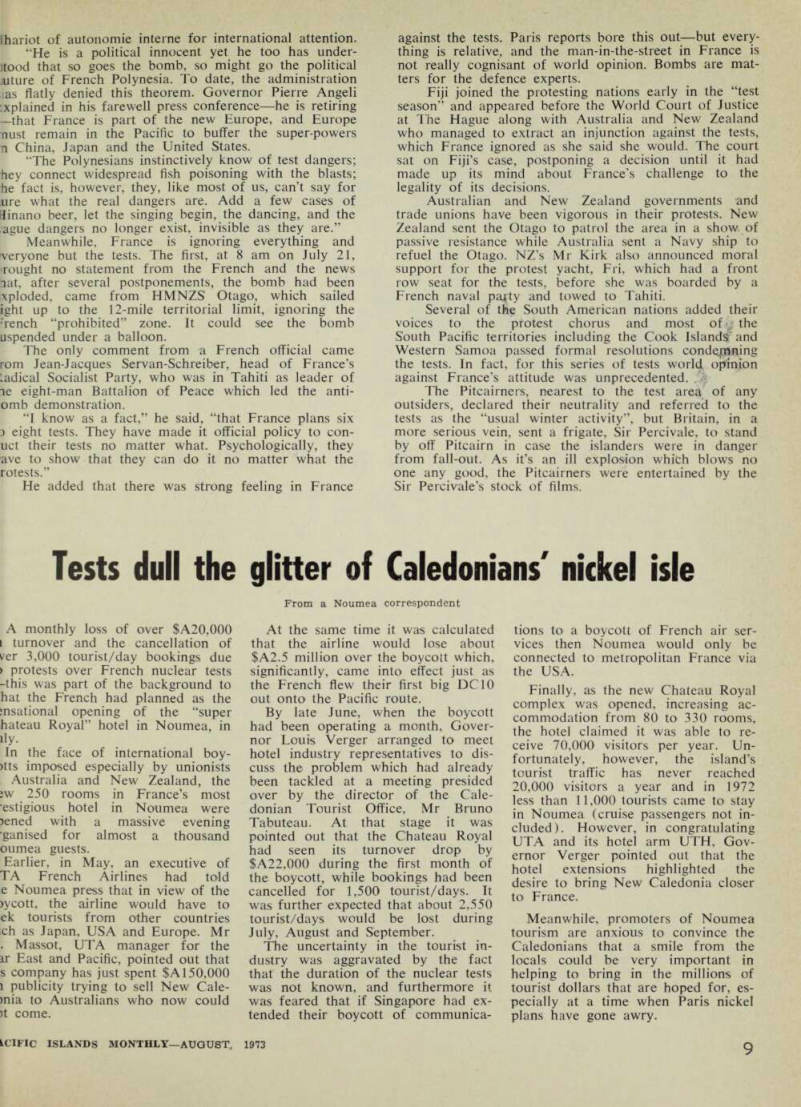
France's 30th nuclear bomb and the first in the 1973 series presents an awesome sight to the watcher on board the New Zealand frigate Otago, 22 miles from the mushroom above Mururoa. —AAR picture.
Ihariot of autonomic interne for international attention.
“He is a political innocent yet he too has under- Jtood that so goes the bomb, so might go the political juture of French Polynesia. To date, the administration ias flatly denied this theorem. Governor Pierre Angeli :xplained in his farewell press conference—he is retiring -that France is part of the new Europe, and Europe mist remain in the Pacific to buffer the super-powers ■a China, Japan and the United States.
“The Polynesians instinctively know of test dangers; hey connect widespread fish poisoning with the blasts; he fact is, however, they, like most of us, can’t say for ore what the real dangers are. Add a few cases of Hinano beer, let the singing begin, the dancing, and the .ague dangers no longer exist, invisible as they are.”
Meanwhile, France is ignoring everything and 'veryone but the tests. The first, at 8 am on July 21, •rought no statement from the French and the news hat, after several postponements, the bomb had been xploded, came from HMNZS Otago, which sailed ight up to the 12-mile territorial limit, ignoring the Tench “prohibited” zone. It could see the bomb uspended under a balloon.
The only comment from a French official came rom Jean-Jacques Servan-Schreiber, head of France’s Ladical Socialist Party, who was in Tahiti as leader of ae eight-man Battalion of Peace which led the anti omb demonstration.
“I know as a fact,” he said, “that France plans six 3 eight tests. They have made it official policy to con uct their tests no matter what. Psychologically, they ave to show that they can do it no matter what the rotests.”
He added that there was strong feeling in France
against the tests. Paris reports bore this out—but every thing is relative, and the man-in-the-street in France is not really cognisant of world opinion. Bombs are mat ters for the defence experts.
Fiji joined the protesting nations early in the “test season” and appeared before the World Court of Justice at The Hague along with Australia and New Zealand who managed to extract an injunction against the tests, which France ignored as she said she would. The court sat on Fiji’s case, postponing a decision until it had made up its mind about France’s challenge to the legality of its decisions.
Australian and New Zealand governments and trade unions have been vigorous in their protests. New Zealand sent the Otago to patrol the area in a show of passive resistance while Australia sent a Navy ship to refuel the Otago. NZ’s Mr Kirk also announced moral support for the protest yacht, Fri, which had a front row seat for the tests, before she was boarded by a French naval pafty and towed to Tahiti.
Several of the South American nations added their voices to the protest chorus and most of v the South Pacific territories including the Cook Islands' and Western Samoa passed formal resolutions condemning the tests. In fact, for this series of tests world opinion against France’s attitude was unprecedented.
The Pitcairners, nearest to the test area of any outsiders, declared their neutrality and referred to the tests as the “usual winter activity”, but Britain, in a more serious vein, sent a frigate, Sir Percivale, to stand by off Pitcairn in case the islanders were in danger from fall-out. As it’s an ill explosion which blows no one any good, the Pitcairners were entertained by the Sir Percivale’s stock of films.
Tests dull the glitter of Caledonians' nickel isle
From a Noumea correspondent
A monthly loss of over $A20,000 i turnover and the cancellation of
ver 3,000 tourist/day bookings due
> protests over French nuclear tests
background to
hat the French had planned as the insational opening of the super hateau Royal hotel in Noumea, in in tr, f f • .• 1K In the face of international boyfits imposed especially by unionists and New Zealand, the w 250 rooms in Frances most estigious hotel in Noumea were dued with a massive evening gamsed for almost a thousand °p“7|- a ,• r TA p„ 1, A V: r ex f u . t,ve ( ?j
I rm
e Noumea press that in view of the >ycott, the airline would have to ek tourists from other countries ich as Japan, USA and Europe. Mr . Massot, UTA manager for the jj East and Pacific, pointed out that s company has just spent SA 150,000 i publicity trying to sell New Calemia to Australians who now could )t come.
At the same time it was calculated that the airline would lose about 5A2.5 million over the boycott which, significantly, came into effect just as the French flew their first big DC 10 out onto the Pacific route.
By late June, when the boycott had been operating a month, Gover nor Louis Verger arranged to meet hotel industry representatives to dis cuss the problem which had already been tackled at a meeting presided over by the director of the Cale donian Tourist Office, Mr Bruno Tabuteau. At that stage it was pointed out that the Chateau Royal had seen its turnover drop by 5A22,000 during the first month of the boycott, while bookings had been cancelled for 1,500 tourist/days. It was further expected that about 2,550 tourist/days would be lost during July, August and September.
The uncertainty in the tourist in dustry was aggravated by the fact that the duration of the nuclear tests was not known, and furthermore it was feared that if Singapore had ex tended their boycott of communica
tions to a boycott of French air ser vices then Noumea would only be connected to metropolitan France via the USA.
Fjnall the new cha|eau R , complex was opened, increasing ac- C ommodation from 80 to 330 rooms, the hote , c aimed i( was ab|e to re ce i ve 70,000 visitors per year. Un fortunate|y> however, the island's , ouHst traffic has never reached 20 000 visitors a ear and in 1972 less than 11,000 tourists came to stay jn Noumea (cruise passengers not in eluded). However, in congratulating UTA and its hote arm Gov ernor Verger pointed out that the hold extensions highlighted the des ire to bring New Caledonia closer t France Meanwhile, promoters of Noumea tourism are anxious to convince the Caledonians that a smile from the locals could be very important in helping to bring in the millions of tourist dollars that are hoped for, es pecially at a time when Paris nickel plans have gone awry.
Advertisements & other items, p. 11 (1 item)
9
LCIFIC ISLANDS MONTHLY—AUGUST, 1973
Custom's rebirth at chiefly funeral
With all the mystery and sym bolism of ancient Fijian custom, Ratu Sir Edward Cakobau, great-grandson of King Cakobau and Deputy Prime Minister of Fiji, was buried on the chiefly island of Bau on June 29, four days after his death in hospital in Suva.
Thousands of mourners—shop keepers, children, Fijians, Indians, Europeans and the hotchpotch of races which is Fiji, prime ministers, politicians and diplomats from over seas, watched the unfolding of an ancient drama—the funeral rites for the Fijians’ great ones.
Even Fijians were mystified over some of the strange ceremonies, the prominent place the women occupied, the carrying out of unwritten rules of precedence and the parts various seg ments of the Fijian social structure played, the blowing of conch shells, with their mournful cadences like the keening of the ancient Celts of the North, and the bizarre role of the traditional gravediggers from Tai-ko bau.
When their part was ended and the grave had been filled in, covered with a fine mat and masi cloth and heaped with flowers, they sat on it for the ceremony which would rid them of any contamination from long-dead chiefs, who were buried there.
As they sat, they ate the bitter fruit of the kura tree, which aided their cleansing, completed when they washed in the sea.
Four nights after the burial there were more ceremonies, all as un familiar as the funeral rites. The women of Bau, garbed in black, sat on the floor of the island’s meeting house for the cutting of their hair.
This was probably the only departure from the old days when, instead of their hair being cut, their little fingers would be severed.
There were mournful chants and then a yaqona (kava) ceremony per formed by three of Ratu Sir Edward’s sons. After the yaqona had been drunk, the air of the chants changed.
They were lively, a sign that some of the mourning was over. But 100 nights will pass before Bau will cease to mourn.
The perfection of the ceremonies marked a return to the past which will have a lasting effect.
“Not for a long, long time has Bau observed such strict adherence to custom,” said Ratu David Togani valu, one of the funeral organisers.
“We trust this could be the start of a revival of a lot more Fijian custom throughout Fiji, performed in the proper manner.”
Not that anyone wanted another chiefly funeral. Ratu Sir Edward, soldier, sportsman, politician, gentle man, was a distinguished Fijian.
Thousands lined the streets of Suva and gathered at the wharf to pay their respects as Ratu Sir Ed ward’s body was conveyed on a gun carriage, with military escort, from
his home in Tamavua to the F Marama, which took it to Ba Thousands of mourners landed on tl island and several overseas gover ments were represented. Mourne from neighbouring island groups pa their tributes according to their ov traditions.
A special memorial service w; held at Wesley Chapel, Sydney c July 1, led by the Rev S. G. ( Cowled, who was the Methodist Mi sion in Fiji from 1937 to 1961, at two other Island ministers, the R< Jone Lagi, of Fiji and the Rev Sioi Langi, of Tonga. The Rev P. I Davis, a former president of tl Methodist Church in Fiji also £ tended, along with many Fijians ai Tongans living in Sydney. The Servi( was conducted in English, Fijian ai Tongan.
Ratu Sir Edward, Ted to his legk of friends throughout the world, h; royalty in his blood —he was a hal brother of the late Queen Salote < Tonga. But he always had the cor mon touch, and an ability to ta freely and fluently with his fellc men. He had an impish sense ■ humour, which resulted in many practical joke, but always witho malice, and he could laugh at h own misfortunes.
He was knighted in 1971, the thi of his race to be so honoured, fc lowering Ratu Sir Lala Sukuna an Ratu Sir Kamisese Mara.
In World War II he served in the Solomons, where he won the MC, and in 1953 and 1954 he was in Malaya, first as second in command, and then as commanding officer of the Fiji battalion fighting against the Com munist terrorists for which he was awarded the OBE. Malaya was an ex plosive place in those days, politi cally and militarily, but his charm and easy manner helped to overcome many difficult political situations.
Many tales are told of Ratu Sir Edward’s ready wit —like the time he was at a Melbourne Cup meeting wearing his battledress, with a sulu replacing the trousers. Asked if he belonged to a Highland regiment, he
replied, “Sure, I am a South Seas ‘highlander’.” Then, while travelling in a ship, a woman at a nearby table made nasty remarks about ‘former cannibals’. Ratu Sir Edward took it but when the steward appeared to take his order, he handed over the menu and demanded, “Bring me the passenger list”. And when he was president of the Fiji Cricket Associ ation he was re-elected, almost unanimously, at an annual meeting.
His was the only nomination, but that did not stop him from cal ling for the “ayes” and “noes” and then solemnly raising a hand as the only “no”.
Calls on his time were legion. After more than 20 years in the old Legis lative Council he became a Council of Chiefs’ nominated member in the new parliament. He went on to the hustings for the first time at the last general election and for the first time by popular vote took his seat in Parlia ment. He held several portfolios and at the time of his death was Deputy Prime Minister.
Ratu Sir Edward was born on the chiefly island of Bau and educated at Queen Victoria School, Wanganui Technical College (NZ), Auckland Technical College, and Wadham Col lege, Oxford, where he took a course in colonial administration. In his younger days he was a schoolteacher. He moved from teaching to the Fijian administration, in which he held a number of senior posts, including that of Deputy Secretary for Fijian Af fairs.
Ratu Sir Edward is survived by his wife, Adi Lady Vasemaca, and four sons.
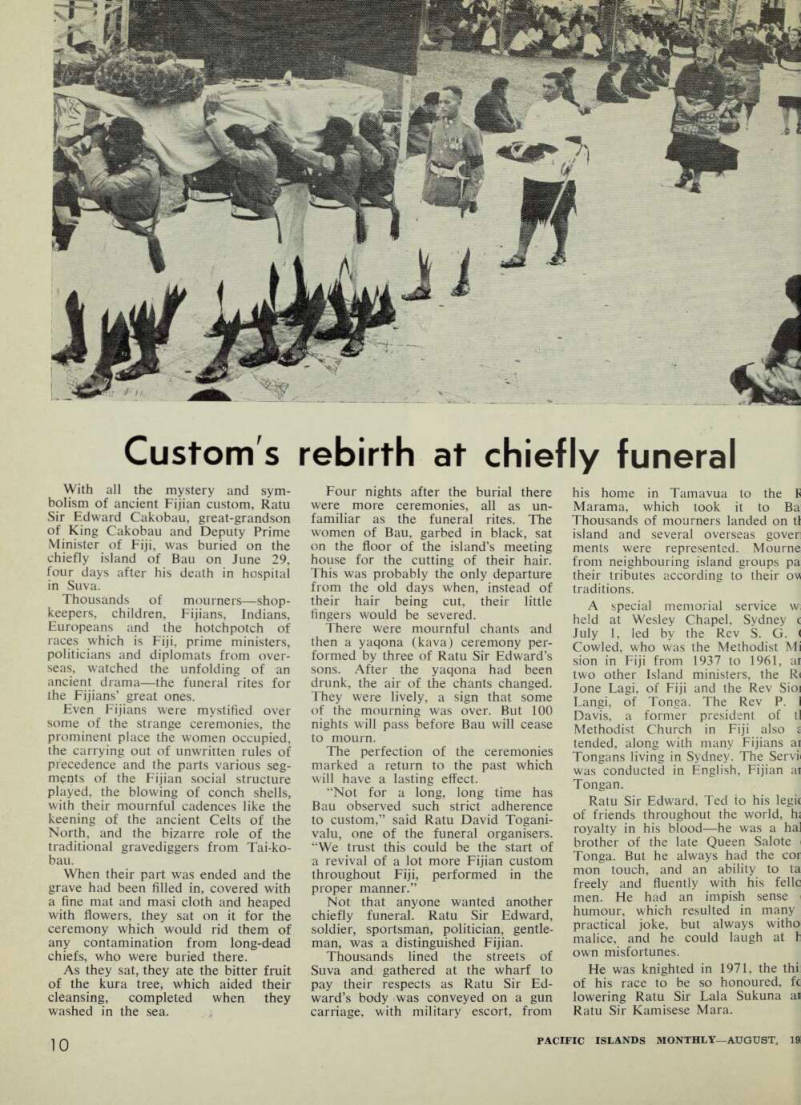
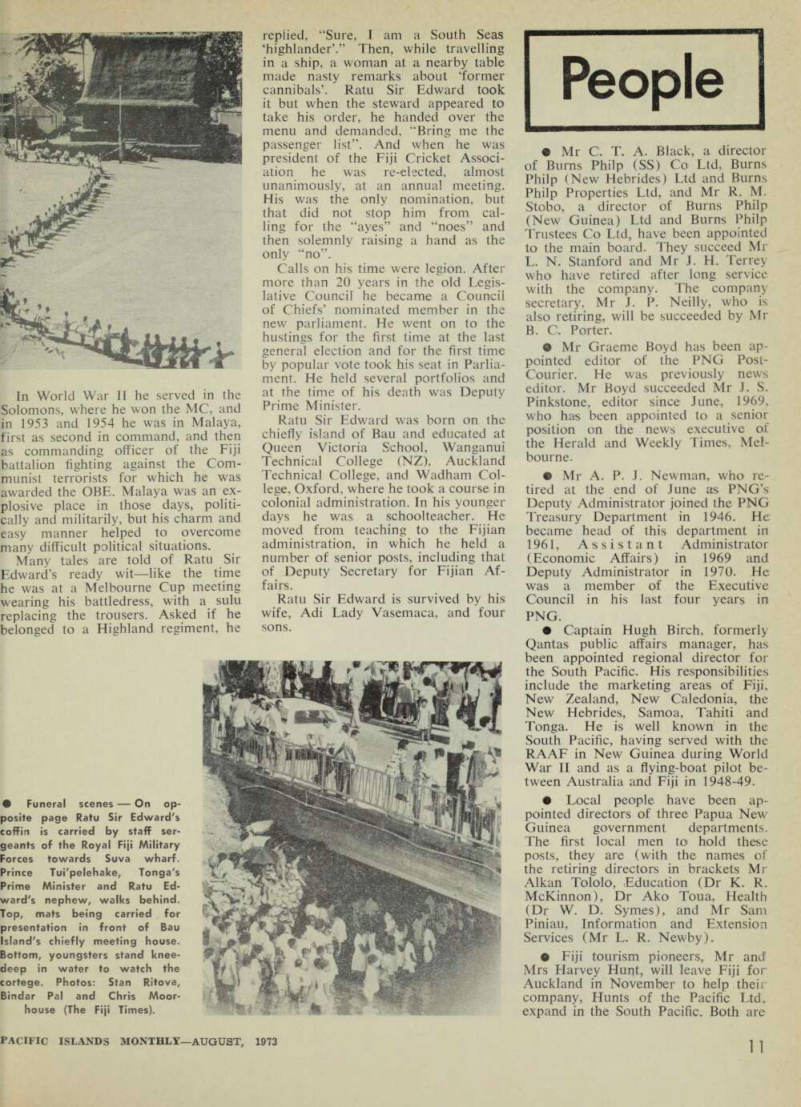
• Funeral scenes—On op posite page Ratu Sir Edward's coffin is carried by staff ser geants of the Royal Fiji Military Forces towards Suva wharf.
Prince Tui'pelehake, Tonga's Prime Minister and Ratu Ed
ward's nephew, walks behind.
Top, mats being carried for presentation in front of Bau Island's chiefly meeting house.
Bottom, youngsters stand knee deep in water to watch the cortege. Photos; Stan Ritova, Bindar Pal and Chris Moor house (The Fiji Times).
People
e Mr C. T. A. Black, a director of Bums Phi Ip (SS) Co Ltd, Burns Philp (New Hebrides) Ltd and Burns Philp Properties Ltd, and Mr R. M.
Stobo, a director of Burns Philp (New Guinea) Ltd and Burns Philp Trustees Co Ltd, have been appointed to the main board. They succeed Mr L. N. Stanford and Mr J. H. Terrey who have retired after long service with the company. The company secretary, Mr J. P. Neilly, who is also retiring, will be succeeded by Mr B. C. Porter. & Mr Graeme Boyd has been ap pointed editor of the PNG Post- Courier. He was previously news editor. Mr Boyd succeeded Mr J. S.
Pinkstone, editor since June, 1969, who has been appointed to a senior position on the news executive of the Herald and Weekly Times, Mel bourne. © Mr A. P. J. Newman, who re tired at the end of June as PNG’s Deputy Administrator joined the PNG Treasury Department in 1946. He became head of this department in 1961, Assistant Administrator (Economic Affairs) in 1969 and Deputy Administrator in 1970. He was a member of the Executive Council in his last four years in
Png.
• Captain Hugh Birch, formerly Qantas public affairs manager, has been appointed regional director for the South Pacific. His responsibilities include the marketing areas of Fiji, New Zealand, New Caledonia, the New Hebrides, Samoa, Tahiti and Tonga. He is well known in the South Pacific, having served with the RAAF in New Guinea during World War II and as a flying-boat pilot be tween Australia and Fiji in 1948-49. • Local people have been ap pointed directors of three Papua New Guinea government departments.
The first local men to hold these posts, they are (with the names of the retiring directors in brackets Mr Alkan Tololo, Education (Dr K. R.
McKinnon), Dr Ako Toua, Health (Dr W. D. Symes), and Mr Sam Piniau, Information and Extension Services (Mr L. R. Newby). • Fiji tourism pioneers, Mr and Mrs Harvey Hunt, will leave Fiji for Auckland in November to help their company, Hunts of the Pacific Ltd, expand in the South Pacific. Both are
Fiji born, and they founded Hunts Travel Service, the first Fiji travel agency, 25 years ago. Hunts of the Pacific Ltd is now established in Australia, New Zealand and the Solomon Islands. In 1969 BOAC- Associated Companies Ltd, joined the enterprise, and the big Hong Kong based group, Jardine Matheson, be came a shareholder in 1972. Mr and Mrs Hunt will visit Fiji regularly. • Captain J. McNeely has been appointed operations manager of Polynesian Airlines. Two other re cent executive appointments are Messrs Murray Robertson as traffic and sales manager, and Arthur Anae, as passenger sales superintendent, Messrs Robertson and Anae were seconded from Air New Zealand. • The board of the Caledonian Association for the Development of Tourism has awarded its first prize to Aloi Pilioko for his collective works, and in particular his “Nativity”.
Pilioko, a Wallis Islander now living in the New Hebrides, has travelled throughout the South Pacific, painting and exhibiting. His work was discussed by well-known artist Nicolai Mich outouchkine and Marjorie Crocombe in the first MANA feature (PIM, March). • Mr G. M. R. (Geoff) Day who spent 35 years in the Fiji sugar in dustry, and rose to the top executive post of managing director of South Pacific Sugar Mills Ltd, has been ap pointed branch manager of CSR Ltd in Adelaide. Mr Day served in most mill areas in Fiji, and took a pro minent part in local affairs. • Mr John Smeeton who opened two PNG Administration broadcast ing stations—Radio Kerema and Radio Milne Bay—and worked in two others, retired early in June. He went from Australia to PNG in 1928, and married there in 1932. He was involved with mission work till he came back to Australia in 1952. He went to PNG again in 1963 to work for the Department of Information and Extension Services in radio stations. • Mr J. M. Thomas succeeds Mr S. C. Warnock as manager of the Vila branch of Bank of New South Wales. Mr Warnock has retired. Mr Thomas has worked for the bank in Papua New Guinea, and NSW and Victorian country areas. ® Toshio Oishi, general manager of Trans-Pacific Development Co Ltd, Apia, recently became the proud father of the first Japanese baby to be born in Western Samoa. The baby, a boy, Kantaro, was premature but he and mother Toyo are doing fine, said a happy Oishi.
Advertisements & other items, p. 14 (1 item)
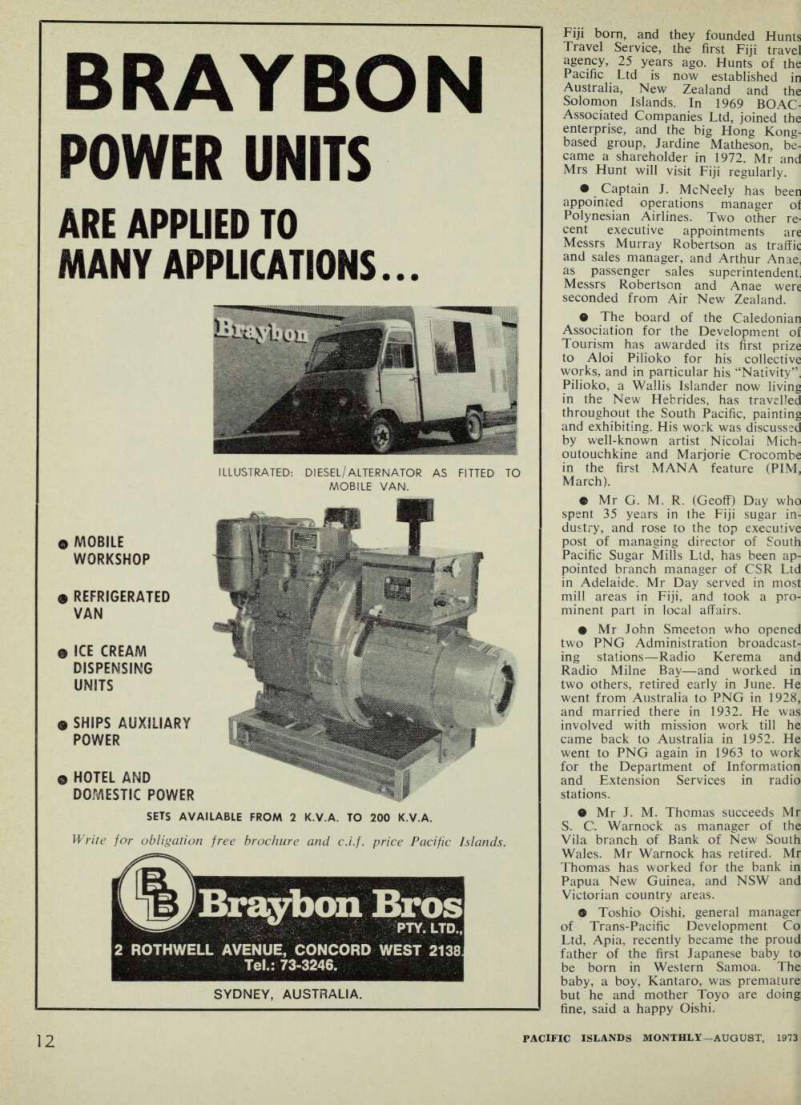
Braybon
POWER UNITS
ARE APPLIED TO
MANY APPLICATIONS...
H
ILLUSTRATED: DIESEL/ALTERNATOR AS FITTED TO
MOBILE VAN.
O MOBILE
WORKSHOP
9 REFRIGERATED
VAN
9 ICE CREAM
DISPENSING
UNITS
9 SHIPS AUXILIARY
POWER
T < m
HOTEL AND
DOMESTIC POWER
SETS AVAILABLE FROM 2 K.V.A. TO 200 K.V.A.
Write for obligation free brochure and c.i.f. price Pacific Islands.
PTY. LTD.,
2 ROTHWELL AVENUE, CONCORD WEST 2138
Tel.: 73-3246.
SYDNEY, AUSTRALIA.
Hard Going

For Mata'afa
From FELISE VA’A in Apia In Western Samoa, never has a new government been so severely criticised in parliament as the present Mata’afa government. When parlia ment opened in June, the govern ment’s nominations for the Business Committee were challenged and in the ballot lost three (75 per cent) of its candidates while the Opposition gained three. Also, its motion for the second reading of the Regional and Town Planning Bill was almost defeated.
When parliament reconvened in the first week of July, the Opposition pulled off a resounding victory, mar shalling enough votes to defeat a motion for the second reading of the Customs Order Amendment.
The amendment had all the appear ances of being an urgent one. At tached to it was a certificate of urgency from the Head of State and the Cabinet did its best to push it through.
If passed, the amendment would have raised the duty on biscuits, con fectionery, soap and detergents, cigarettes, cigars, tobacco, beer, spirits, brandy, wine, chinaware, glass ware, gramophones, jewellery, per fumes, furniture, boats, brooms and so on.
“Government considers that the in crease of import duties on certain commodities would have a two-way benefit in helping to ease our balance of payments situation,” Minister of Finance Sam Saili said.
“This would provide government with additional revenues, and the increases of import duty would act as an incentive towards greater use of certain commodities which are locally produced, such as biscuits, soaps, ornaments, and furniture, while at the same time reducing some of the demand on other luxury items which are making inroads into our overseas reserves.”
But that was all very well, argued the Opposition, but did it justify de priving a lot of Samoans of their jobs? The Samoa Times reported that 20 casual employees of the Transport Pool had to be dismissed because of the Public Works Department’s at tempts to save money. There were reliable reports that many other casual employees in the government had also been affected by the govern ment’s mad scramble to save money.
But was it worthwhile to save at the risk of starving some segments of the Samoan community?
The Opposition also maintained that the Minister of Finance, Sam Saili, before he became a minister, had strongly opposed any govern ment attempt to raise import duties.
Why had he done an about-face?
It argued that the country was no longer capable of absorbing further increases in living costs. Let the government find other measures of earning revenue.
Sail! had been one of the most outspoken critics of the Tamasese government’s increase of import duties (an increase which was nation
ally unpopular and hastened Tama sese’s downfall). Increases in the cost of living were all right if there was a corresponding increase in the people’s income. But, as a rule in Western Samoa income has tended to remain stable while the cost of living has skyrocketed.
The debate just before the final reading of the Supplementary Bill was a heated one with cabinet mem bers being sniped at from right, left and centre. The Minister of Finance was the most hard hit. At times, the exchanges became too personal.
A revolutionary fervour has taken hold of the Western Samoa Parlia ment.
Advertisements & other items, pp. 15-16 (1 item)
r hratţ
KEEP SLIM, TRIM
and HEALTHY . . .
take FORD PILLS
Ford Pills and the Ford Pill diet chart help you to lose that extra weight.
Ford Pills are a mild laxative containing the gentlest of ingredients to rid your body of excess fluids and toxins.
AVAILABLE FROM CHEMISTS AND
STORES EVERYWHERE.
BRITISH MEDICAL LABORATORIES,
BML 115-125 Turrella Street, Turtella, N.S.W. 2205, Australia.
Iff
Dm: I. or ] or Ml or each men ttbo.el reoriar
r hratţ
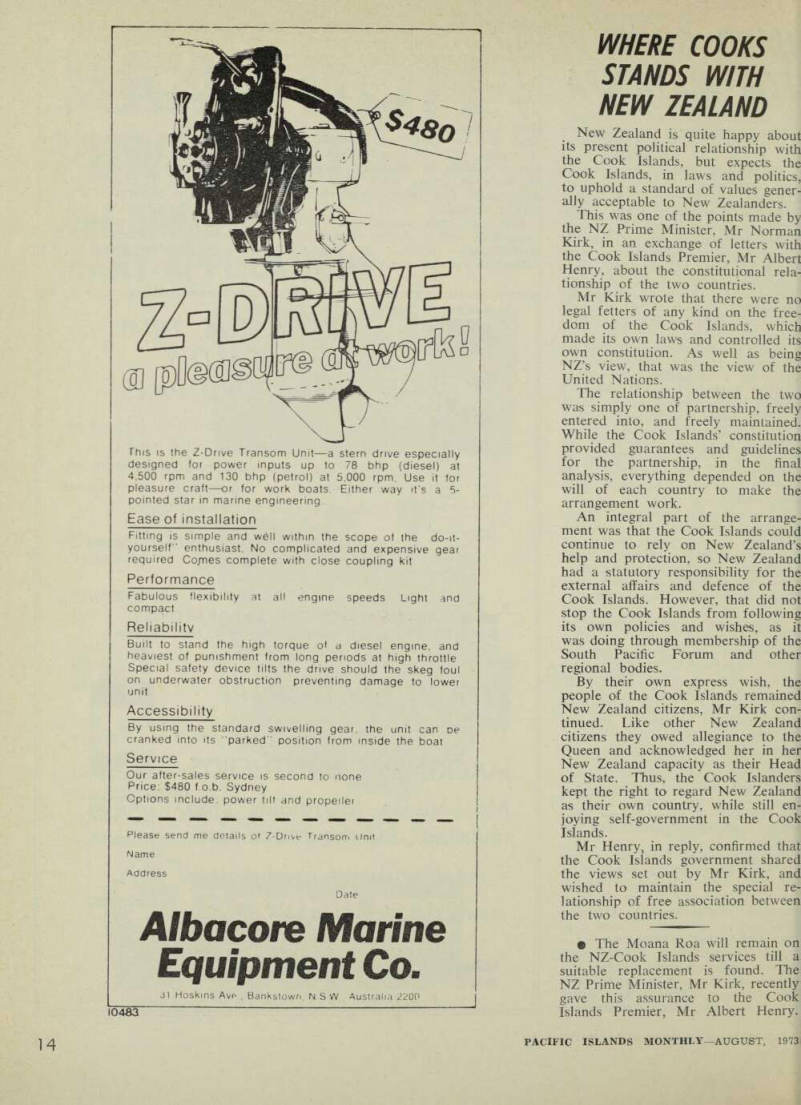
This is the Z-Dnve Transom Unit —a stern drive especially designed for power inputs up to 78 bhp (diesel) at 4,500 rpm and 130 bhp (petrol) at 5,000 rpm. Use it for pleasure craft—or for work boats. Either way it’s a 5pointed star in marine engineering.
Ease of installation Fitting is simple and well within the scope of the do-ityourself" enthusiast. No complicated and expensive gear required Cojnes complete with close coupling kit
Performance
Fabulous flexibility at all engine speeds Light and compact
Reliability
Built to stand the high torque of a diesel engine, and heaviest of punishment from long periods at high throttle Special safety device tilts the drive should the skeg foul on underwater obstruction preventing damage to lower unit
Accessibility
By using the standard swivelling gear, the unit can oe cranked into its ' parked'' position from inside the boat Service Our after-sales service is second to none Price: $4BO f.o.b. Sydney Options include, power tilt and propeller Please send me details or 7-Dnvt* Transom Unit Name Address Date
Albacore Marine
Equipment
Hoskins Ave , Bankstown, N S W . Australia 2200 10483
Where Cooks
Stands With
New Zealand
New Zealand is quite happy about its present political relationship with the Cook Islands, but expects the Cook Islands, in laws and politics, to uphold a standard of values gener ally acceptable to New Zealanders.
This was one of the points made by the NZ Prime Minister, Mr Norman Kirk, in an exchange of letters with the Cook Islands Premier, Mr Albert Henry, about the constitutional rela tionship of the two countries.
Mr Kirk wrote that there were no legal fetters of any kind on the free dom of the Cook Islands, which made its own laws and controlled its own constitution. As well as being NZ’s view, that was the view of the United Nations.
The relationship between the two was simply one of partnership, freely entered into, and freely maintained.
While the Cook Islands’ constitution provided guarantees and guidelines for the partnership, in the final analysis, everything depended on the will of each country to make the arrangement work.
An integral part of the arrange ment was that the Cook Islands could continue to rely on New Zealand’s help and protection, so New Zealand had a statutory responsibility for the external affairs and defence of the Cook Islands. However, that did not stop the Cook Islands from following its own policies and wishes, as it was doing through membership of the South Pacific Forum and other regional bodies.
By their own express wish, the people of the Cook Islands remained New Zealand citizens, Mr Kirk con tinued. Like other New Zealand citizens they owed allegiance to the Queen and acknowledged her in her New Zealand capacity as their Head of State. Thus, the Cook Islanders kept the right to regard New Zealand as their own country, while still en joying self-government in the Cook Islands.
Mr Henry, in reply, confirmed that the Cook Islands government shared the views set out by Mr Kirk, and wished to maintain the special re lationship of free association between the two countries. e The Moana Roa will remain on the NZ-Cook Islands services till a suitable replacement is found. The NZ Prime Minister, Mr Kirk, recently gave this assurance to the Cook Islands Premier, Mr Albert Henry.
Tropicalities
Director’S
Conundrum
Mr Mahe Tupouniua, director of the South Pacific Forum’s Bureau for Economic Co-operation, has a conun drum of the chicken and the egg kind.
He was over in Australia from Suva in July as a guest of the Aus tralian Government, responding to an invitation given to him personally by Prime Minister Gough Whitlam in Apia for the Forum meeting in April.
He did the usual rounds, had talks with trade and Treasury officials in Canberra, saw people and things in Sydney, Melbourne and Brisbane and dined with PIM when he told us that, after his talks, he was sure of one thing—the Islands had to have two things from their more fortunate, developed neighbours, aid and trade.
What he wasn’t sure of was whether trade should follow aid or vice versa. Maybe the two could go together?
He said he was well-satisfied with his talks and the attitudes of govern ment officials although, at the outset of his visit, he complained that Aus tralia’s trade barriers were hamper ing the Islands’ development. Tariffs on sugar, copra and coconut oil were causing him most concern, and moves towards relaxation of the barriers would be welcomed. He also suggested expanding the Forum group into a common market of the type created not so long ago in the Caribbean.
Around the same time came the announcement that Australia will introduce a new system of reduced tariffs for exports from developing countries.
There’s a snag of course. Goods already competitive in Australia or likely to become competitive very soon won’t be included. No doubt, the government was thinking then of the decision announced on July 18 to cut all import tariffs by 25 per cent in an effort to bring down prices in Australia and stem the serious rise in living costs.
It’s a safe bet Island bananas
won’t get in, which is a pity since Australians have forgotten what a real banana tastes like since the Country Party got the Australian market closed to Fiji banana growers through the imposition of a heavy tariff in the early 19205.
Sim abolished
in the Tokelaus
Religion and the philosophy of Theodore Roosevelt—“ Speak softly but carry a big stick”—keep the youngsters in line in the Tokelau Islands to the north of Samoa.
That’s the way American Samoa’s Chief Probation Officer Napoleon E. Tuiteleleapaga sees it after a five day tour of the Tokelau and Swains Island to their south-west.
It all sounds very dull but the crime statistics for Fakaofo, southern most of the Tokelaus, read like a chief constable’s prayer—no crime of any sort; at least, not since 1968, when it was a case of unsuccessful rape by a 16-year-old boy on a 15year-old girl.
And on neighbouring Nukunonu, according to Tuiteleleapaga, life’s not so different. There the teenagers are under such strict church regula tions that they are afraid to do any thing wrong lest their parents be scolded or punished by the priest, a Samoan.
And on Atafu, according to a “spokesman”, there have been no unlawful acts committed by juveniles except trespassing or disobedience to parents. Even these offences, he said, were controlled by close co-operation among the island leaders, the church and the schoolteachers.
On Swains Island, said Tuitelelea paga, “the head schoolteacher re ported no juvenile delinquency except a few children who want to get smart, disobey their parents or the teachers. But there is no stealing.
One can leave his property anywhere and it won’t be touched.”
With populations like 700 (Faka ofo), 360 (Nukunonu), 600 (Atafu) and 34 (Swains Islands) these extra ordinary statistics are going to do little to average down the inter national trend.
But there may be a lesson for non plussed lawmen and around the world in at least the methods which the Tokelauans use to keep their offspring under control. The young chap whose passions got the better of him in 1968 was brought before the Island Council and punished by flog ging. In cases of mischief on Fakaofo, offenders are first given a warning and then spanked if they repeat the offence. On the spiritual side on Fakaofo, the persuasion comes from Catholic and LMS churches.
On Nukunonu, under Roman Catholic control only, the physical resort in case of misdemeanour is not revealed. But on Nukunonu, like Atafu which is under the control of the LMS, there is a law which prevents boys and girls marrying out side their denomination. Tuitelelea paga didn’t spell out the link between this draconian by-law and the good behaviour of the local teenagers.
And for those youngsters who get out of the Tokelaus and visit such sin-ridden spots as Samoa, Hawaii, New Zealand or the US mainland, there’s a firm lecture awaiting them on their return: “When you return to Tokelau, act as a Tokelauan.
Anyone for the Garden of Eden?
Ho ii ii ty gives
Bi|» a eannon Twenty-two-year-old Steve Christian dived to the floor of Bounty Bay, off Pitcairn, early in July and searched among the remains of HMS Bounty, which his famous ancestor and the other nine mutineers de stroyed 180 years ago.
Then Steve and several companions brought up another piece of history, one of the Bounty’s small cannon— the first Bounty relic to be retrieved since the stern anchor was brought up in 1957. The cannon, about three feet long, is in good condition and likely to join the anchor in Adams town’s public square. The rudder, which was found in 1933, is in the Fiji Museum in Suva thanks to the dual role exercised by the then- Governor of Fiji, who was also Gov ernor of Pitcairn and thus able to purloin pieces of the Bounty.
This is the second cannon to be re
covered. The first, brought up on a date unknown, killed one of Tom Christian’s grandfathers, Tom told the Seventh-day Adventist Church’s radio centre in California in July.
“It was the custom to fire it off for special occasions on the island,” he said. “Unfortunately, he made a mistake in loading it and died when it discharged into his chest.”
Steve and the other divers found a larger cannon and have managed to break it loose from the coral, but it was too heavy to bring to the sur face. An attempt will be made with the help of one of the longboats and the crew to bring it up.
It’s no use anyone offering to buy a cannon. The island’s laws ban the sale of Bounty relics.
Killing a
tourist attraction
The Japanese Government’s Graves Commission which, over the last few years, has scoured the Pacific War theatres for the remains of their dead servicemen, was due in Micronesia recently. First area for search was on Saipan and Tinian in the Marianas.
Some of the searchers will dive to the bed of the Truk lagoon in the Carolines to remove remains from a Japanese submarine which went down with all hands in an American air strike. Wherever the mission has been the locals have helped, but there’s a certain amount of luke warmness among the locals on Truk, to say the least, about the submarine operation. The Truk people regard their lagoon, the graveyard of the Imperial Japanese Navy, as their biggest tourist attraction and are loth to see it disturbed. There’s more drama for the tourist if, when he gazes down through the waters of the lagoon, he is looking at a shadowy ship full of bodies rather than at an empty shell.
The same sort of opposition is likely to arise when the mission turns its attention to Koror and Palau in the Western Carolines, especially when the searchers arrive on Peleliu which saw one of the deadliest battles of the war. The American Ist Marine Division lost nearly 4,000 men capturing the Five Sisters, the cluster of peaks on the island. The Japanese lost 9,000 men killed on Peleliu and 2,500 were taken prisoner.
The number of bodies in the caves on the island is unknown. When the
Japanese troops in the caves refused to surrender, oil was poured in and set alight. Now the caves are one of the main attractions.
Percy’s not
that fast!
Percy Chatterton, PlM’s popular PNG columnist, denies that he is as quick off the mark in his translation work as we gave him credit for in the July issue of PIM.
In a People paragraph we had him translating the complete Bible into Motu in 14 months, which was more than slightly under the actual time.
Writes Percy, “Sorry to spoil a nice little story but the fact is that this job took me 15 years on and off.
What Ron Lean and I have been doing since May last year is correct ing the proofs”.
Knowing so well how promptly Percy supplies our wants, turning in his Footnotes and other articles on the dot, we were quite prepared to believe he could do such a monu mental job as translating the Bible in 14 months.
Incidentally, the picture of the winsome Trobriands maiden and her mini-skirt illustrating his Footnotes on page 29 of this issue didn’t come from Percy!
The red cow
of Netche
“Pensions for farmers”, “Buy local produce”, “New election for the Chamber of Agriculture” . . , these were some of the banners carried by Caledonian farmers at a recent public demonstration staged at La Foa, 80 miles out of Noumea.
The protest march was organised by the Farmers and Graziers Defence Union, led by Thierry Schmidt and demanding especially that the island’s recent drought should be treated as a “national disaster”, with assistance provided accordingly.
The orderly procession was ob viously no surprise to the authorities and came with discussions of the farmers’ plight in the Territorial Assembly. Representatives of the French Administration indicated that about $Ai million was necessary to assist farmers, almost one-third of this amount being used to import bales of lucerne from Australia.
During the prolonged drought, New Caledonia’s annual rainfall to June was only a quarter of the amount usually reported. This has resulted in the loss so far of about 15.000 head of cattle, about 15 per cent of the territory’s herds. The result for the Noumea meat board has been a loss of 40 per cent of the availability of local meat this year.
While the authorities have been kept busy providing graziers with imported fodder and as much as 70.000 gallons of water a week, the administration has been urged to pur sue studies of the island’s under ground water resources.
The cattle industry is concentrated on New Caledonia’s dry west coast, with little grazing on the east coast or offshore Loyalty Islands. There is, however, the “Red Cow of Netche”, on Mare island . . . but Caledonians have a special appreciation of English: the “Red Cow of Netche” is the name of a recently-formed sporting club, no doubt inspired by the brand of an imported milk powder.
Mermaids are
getting scarce!
Have you seen a dugong, or a sea cow, or a manate, or a sirenian, may be a mermaid? With the very remote exception of the mermaid, they’re all the same animal. Their habitat in cludes Papua New Guinea but they’re getting scarce and their possible ex tinction is worrying the PNG Agri culture Department’s Wildlife section.
The department has circulated a questionnaire on the dugong, mainly around the coastal villages and the answers, it is hoped, will help the department to establish a conservation programme.
There are 34 questions ranging from sightings of the animal to what is done with the skin and bones when the flesh has been eaten, as eaten the dugong is. It’s an excellent source of protein and in very palatable form.
The animal has a fishlike tail and the upper part of the anthropoid in cluding, in the female, a pair of breasts. It’s safe to say that the stories of mermaid sightings, which go back centuries, were centred round the dugong although, not by any stretch of the imagination, unless it be that of a sex-starved seadog, could anyone see a beautiful mermaid in the dugong.
Advertisements & other items, pp. 19-22 (1 item)
°Unhill
When next you are in London , you are cordially invited to visit The House of Dunhill.
The Dunhill King Size Filter Cigarette created and perfected by our blenders to be the best
Virginia cigarette
in the world.
until
LONDON FfcRS NEWVORK
The most distinguished tobacco house in the L o*donP arig . N m ♦
°UNHILL
worl
mm, m u o o h HL JS % h— or
9 m u n
rro
o
TOMORROW 1/
f artist#
IN THE
CROSSING THIS
WHERE EACH
srjijvem available, at mmmm store wmm *# E* AS Si T! .# ES M#
I #llllllll
Burns Philp helps to achieve the good life From Papua New Guinea to the international date line and beyond, the Burns Philp Group of Companies is helping to add to the quality of life for everyone.
Staff training programmes, sports facilities, modern residential accommodation, scholarship assistance these and many other company efforts are aimed at assisting the greatest possible number of people to achieve the good life.
Each year more and more Pacific people enjoy better transport, better homes, better health and generally better lives through the direct and indirect influence of this wide ranging, highly diversified company. Buying and selling, creating, shipping and serving, the thousands of people who make up Burns Philp are engaged in a continuing effort to make every tomorrow better.
DOING GOOD BUSINESS FOR THE ISLANDS
BURn/ PHILP
GROUP OF COMPANIES
PRINCIPAL OFFICE—7 BRIDGE STREET SYDNEY NSW 2000 AUSTRALIA
Carnation
your cooking
Carnation - ''from contented cow
(amation
A AB At F
Okf
HAMBURGER KEBABS
EVAPORATED
MILK
«T WEiGHT 14v,02. (t3R-{23
INGREDIENTS:
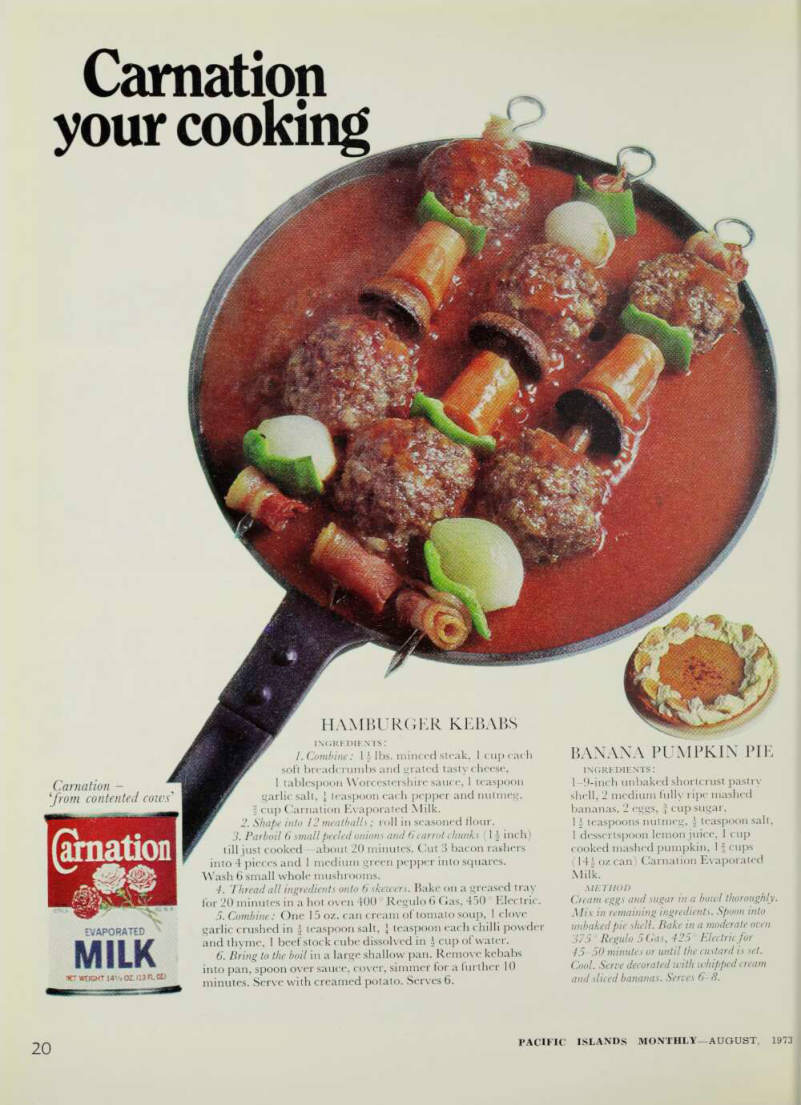
1. Combine: 1 i lbs. minced steak, 1 cup each soft breadcrumbs and grated tasty cheese, tablespoon Worcestershire sauce, 1 teaspoon garlic salt, ] teaspoon each pepper and nutmeg, cup Carnation Evaporated Milk. 2. Shape into 12 meatballs ; roll in seasoned flour. 3. Parboil 6 small peeled onions and 6 carrot chunks ( 1 k inch) till just cooked —about 20 minutes. Cut 3 bacon rashers into 4 pieces and 1 medium green pepper into squares.
Wash 6 small whole mushrooms. 4. Thread all ingredients onto 6 skewers. Bake on a greased tray for 20 minutes in a hot oven 400 Regulo 6 Gas, 450 ° Electric. 5. Combine: One 15 oz. can cream of tomato soup, 1 clove garlic crushed in i teaspoon salt, teaspoon each chilli powder and thyme, 1 beef stock cube dissolved in J cup of water. 6. Bring to the boil in a large shallow pan. Remove kebabs into pan, spoon over sauce, cover, simmer for a further 10 minutes. Serve with creamed potato. Serves 6,
BANANA PUMPKIN PIE
ingredients: 1 -9-inch unbaked shortcrust pastry shell, 2 medium fully ripe mashed bananas, 2 eggs, J cup sugar, J teaspoons nutmeg, J- teaspoon salt, dessertspoon lemon juice, 1 cup cooked mashed pumpkin, 1 f cups (14-J- oz can) Carnation Evaporated Milk.
METHOD
Cream eggs and sugar in a bowl thoroughly .
Mix in remaining ingredients. Spoon into unbaked pie shell. Bake in a moderate oven 375° Regulo 5 Gas, 425 0 Electric for 45-50 minutes or until the custard is set.
Cool. Serve decorated with whipped cream and sliced bananas. Serves 6-8.
The Editor's Mailbag

Solomons History
I read with great interest your (correspondent, Mrs Seton’s letter in tthe March issue of PIM. As a native ISolomon Islander, I’d very much like ito add my voice to hers in what I feel is an opportune warning against ithe apparent laxity with which we Solomon Islanders in particular, view ithe possibility of developing our own history.
One of the reasons for this negli gence, I personally feel, has to do with the way our past and present educational and national planners so far seem to have offered no favour able incentives for the development of this field. Mrs Seton has indeed outlined a great deal, which to my mind provides a rare dish of highly nutritious food for the thinking mind.
Personally, I feel and would hope that our people realise the urgency Df the need to collect and compile ;he unwritten history of our country md its people. Further, I wish our people knew that it was about time ve Solomon Islanders started re jecting our thinking inwards, as far is history is concerned generally, to survey our past, both prior to and since the coming of the white man; md to begin to have serious respon sibility for its documentation and jossible utilisation in the school’s mrriculum.
So far so good. However, my one egret about Mrs Seton’s letter was hat she presumably had entertained i very grim view of the very essential ole which I think we Solomon slanders, particularly our potential listoriographers, could very well play n writing as well as in teaching our >wn history. Thus, to me it was rather infortunate to find both Mrs Seton md the archivist Mr Burne (May, 973) going on to such great length md anxiety about what to them yould be an irrelevant and invalid istory if the natives were allowed a and in its documentation, I am fearful of the fact that the listory so advocated by Mrs Seton yould, in this regard, fall short of he kind of history which I would all, to use her terms, “Solomon His ary”. If one were to be particularly asty about it, one could very well ay: “It is no history of the Solo ion Islands”, as it would be, quite rankly, only the history of the Good Colonial Samaritans in the )ark Solomons”. One of course
should not always believe in the notion that all government reports, missionary documents and the per sonal reminiscences of the expatriate community in the Solomons are necessarily infallible. We do need to know that even the most capable of foreign researchers have their short comings as far as interpreting native beliefs, concepts and actions and other typically Melanesian phe nomena are concerned.
I feel that we Solomon Islanders, who have the necessary foresight, must do all we can to avoid the de velopment of a corruptible, foreign oriented literature which others as sume to be the “History of the Solo mons”. As I said, such history can never be really ours without equal collaboration by native historio graphers in its compilation, especially in this day and age. Gone must be the days in which all we were good for was to act as informants, inter preters or carriers for foreign re searchers.
Develop our history by all means.
But it is high time we Solomon Islanders saw a genuine and unbiased piece of literature about the Solo mons and its people for a change. In many African countries, where the change came about too late, African historiographers have had, and are having, to rewrite the works of their foreign counterparts. We can not afford the time and the money to do the same in the Solomons.
John S. Saunana.
University of Papua New Guinea.
Protest To Protesters
I would like to make a strong pro test to the “protesters” of the French nuclear testing in that we, the British people of the English/French Condo minium of the New Hebrides, are suffering two-fold.
Firstly, we are as close, or perhaps closer than these “protesters” to the testing zone, and secondly being British, we have to put up with the bans on shipping, communications and mail in order that the French people may suffer, Fiji has just recently joined the ranks of these “protesters” and Air Pacific now overflies the New Hebrides. They have refused communi cation with us, and have stopped all passengers, freight and mail both ways.
The only ones suffering are the British people residing in the New Hebrides as the French are well supplied by ships and airlines from France and have no fear of being deprived of any of these items.
Does it not seem a little ridiculous that we, the British population of the New Hebrides, have to come to a grinding halt when the French people, all the while thinking how foolish it all seems, go about their business unhindered by all these pro testations?
Mrs D. Martin
Vila, New Hebrides.
Ulli Beier's Role
Peter Livingston (June PIM, p 78) assures us that he read the Night Warrior and Other Stories from PNG edited by Ulli Beier “right through”.
Yet he finds in these stories by 10 writers only “the vicarious emotions of Ulli Beier”. It is, he says, as though Ulli Beier had himself written them “from beginning to end”: they express Ulli Beier’s “point of view”, “his literary style”, and “the chips on his shoulder”. It is remarkable.
Apparently the Beier emotions so clog the Papua New Guinea air that they possess even someone who has never met him: Goroka student, Wauru Degoba, author of the title story, The Night Warrior, which re cords the emotions of people in volved in a Highland payback killing.
If the stories in this book are a catalogue of Ulli Beier’s emotions, then one is struck by the chameleon like quality of his emotional life.
It moves from the emotion of pay back (The Night Warrior), to that of moral shock at the breaking of a sexual taboo (The Bird Calls), to the loyal devotion of villagers to their Big Man (Our Mouth), to the urban drop-out’s sense of alienation (Por trait of the Odd Man Out), to adolescent sexual longing (Seduction), and schoolboy anger at a referee’s de-
John Saunana.
Letters
cision (Riotous Soccer), to fierce anti white and anti-colonial feeling (Be tel Nut is Bad Magic for Aeroplanes), and so on.
And the point of view. Can anyone who has read Russell Soaba’s very urban stories, with their Camusian discontent, their, at times, almost Swiftian protest against humanity, seriously confuse their point of view with that of a self-conscious Yega traditionalist like Arthur Jawodimbari, whose story, The Bird Calls, is written from within the context of a tribal society with its complex tissue of in terdependence, its taboos, its keen awareness of the presence of the spirits?
As for style, I presume that what makes Peter Livingston doubt whether the stories should be described as “English literature” (whatever that is), is the final story, written by Tro briand Islander, John Kasaipwalova.
John Kasaipwalova said once; “When I think in plestok (Pidgin for ‘mother tongue’) and write in English, that is ‘Niuginian English’.” By using two kinds of English—a some what caricaturish Niuginian English, and a rather highflown, academic English in his story—he is saying some thing about the twofold orientation of the student characters: towards their traditional culture on the one hand, and towards western culture on the other.
It’s unfortunate that Peter Living ston cannot understand these admit tedly artificial languages. However, the language of Kumalau Tawali’s story is less eccentric, but also illustrates the phenomenon, Niuginian English.
In this case, it is, I suspect, a language forged from the idioms of Manus speech. It is not hard to under stand. The plain fact of the matter is of course, that English is now “set loose in the world”, and old colonia lists and paternalists may rant and rage as they will: it’s independent now.
It is difficult in the compass of a short story to express the essence of a personality, a culture, a point of view. The writers of these stories come from eight culturally distinct areas of Papua New Guinea, and from two other parts of Melanesia, namely BSIP and the New Hebrides (although all the stories were actually written in PNG). Collectively, they capture something of traditional life and of colonial life; of village, and of urban life. If one reads them at tentively even small clues can give
insight into the differences (and the similarities) of these diverse back grounds.
Lazarus Hwekmarin, a Sepik, sees the river at sunset turned into “boiled sago floating in a pool of water”.
Arthur Jawodimbari, from the Nor thern District, hears the warning of the spirits in the cry of the Koenana bird. Maurice Thompson’s New Hebri dean English contains fragments of French and of his own mother tongue.
John Saunana’s Solomon Island schoolboys wage their own brand of tribal warfare. Russell Soaba’s Niuginian urban young man plays Simon and Garfunkel and shouts against “blind conformist slobs”.
Peter Livingston says the stories “can by no stretch of imagination . . . be described as Melanesian liter ature.” I think there is beginning to be something which I would be pre pared to call Niuginian literature, and I suspect that something that may come to be called Melanesian literature (written literature, as dis tinct from the literature of oral tradi tion) may be emerging. When the history of Niuginian and of Melanesian literature comes to be written, Ulli Beier’s role will come up for scrutiny.
Should that role be seen as catalytic, or determinative; as a phenomenon of the last days of colonialism, or of the first days of independence? It is not a question to be answered by an emotional broadside; it can only be answered by someone sen sitive to the diverse voices of Melanesians. Peter Livingston reminds us of a deaf man who hears only a confusion of sound, or of the white man who complains that all black men look the same.
Kirsty Powell
University of Papua New Guinea
Gilbertese Writing
And Mana
1 completely accept Te Maunaa Itaia’s reply to my letter (June, PIM, p 29); but I feel that the comments made by Mrs Crocombe and Mr Garrett contain some rather unclear thinking on an important matter of principle, so perhaps you will allow me a short come-back.
No-one would deny that folklore may be treated as common property or that a writer may properly express his own emotional response to some thing he has read. But the matter to which I sought to draw attention— in an inevitably over-long letter— was not folklore (like the legend of Nareau) or even a general discussion of the destruction of bangota, but a specific, personal anecdote of which
Letters
20 sentences appeared without acknowledgement in another man’s 37-line poem, not “reworked” but still in the very distinctive style of their author. In fact, it has now been stated that Maunaa Itaia did originally acknowledge his debt to Grimble; it is a pity, in fairness to him, that this was not made clear at the time.
As to the question of copyright, II should have thought that this was not some nasty, sophisticated, West ern imposition which Pacific writers could not be expected in their in nocence to understand, but rather an internationally-accepted legal guarantee of every man’s right to be credited with his own work, and as such of great value to all writers, Pacific or otherwise.
Finally, I am happy to be corrected an the spelling of bangota since I’m not a Gilbertese. You might be interested to hear that, as a result nf part of my original letter being broadcast in Gilbertese on Radio Parawa, several people have told me ;hat they consider I’m right. (There may well be more who think I’m vrong, but they haven’t said so.) \nd sorry, but your picture really ioesn’t show a bangota. Sacred re gains kept in a basket or shell in iide a house are not bangota accord ng to my informants. I understand he term can only refer to shrines in he open air marked by a circle of :oping stones to warn people from iccidentally desecrating them by reading on them. They are quite :ommon.
(Mrs) Vivienne Hayward.
farawa, GEIC.
Funafuti Cyclone
When I was supercargo in the jilbert and Ellice Islands, 1902-14, ve used to call at Funafuti some four »r five times a year.
While there I used to make a point if walking to look at the grave of ten Hird and nearby the plaque bowing the position where Professor Ldgeworth David (later Sir Edge /orth) drilled down in the coral to rove or disprove some Darwinian heory in or about the year 1898.
Vhat I would like to find out is /ere those “Historical Landmarks”
/ashed away?
Neville Chatfield.
Irafton Nursing Home, 2 Bent Street, ►outh Grafton, NSW 2461.
Changing Society
Congratulations to Tautalatasi Malifa for his thoughtful article, The Change, in Mana (PIM, June, p 69).
It was comprehensive and well pre sented. The issue he considers is crucial to the stabilising of any society in change.
There is a big danger of bi-polarisa tion in Pacific societies: many tradi tional-oriented people fail to see the benefits of even selective change, and many change-oriented people are apparently blind to the beneficial aspects of traditional ways. Obviously what the thinking person is looking for is neither one extreme nor the other, but a judicious balance of the old and the new.
It is also vital that the issues of change and the effects of it should be widely discussed, because it needs more than an educated elite to ensure a satisfying balance of the old and the new. Unfortunately it has to be pointed out that all new things, all Western things are not good per se, nor are all indigenous, old things necessarily bad. And vice versa to the conservative elements.
Perhaps many palangi don’t con sider their cultural arrogance in sweeping aside the old ways as “primitive” and “irrelevant”. No society can stand up when its institu tions are under total attack, with often alien structures offered in place.
Package-deal modernisation is an insult to any society’s culture, and a tolerable impact of modernisation can surely be seen only in terms of
a fusion of ideas. The post-indepen dence political system in Western Samoa is an excellent example of such a fusion.
I hope that Tautalatasi will con tinue to write on the issues of his society today, and that many people will be spurred to thought and action by the contributors of PIM, and MANA in particular.
Roger C. Cowell.
Auckland, NZ.
Reaction To Fiji
I am inspired to write supporting some of the remarks in a letter by Mr M. Batten in PIM (June, p 34).
Like Mr Batten, I recently took my family to Fiji for a holiday and we had a most enjoyable time. It is a truly wonderful place for a vacation and I strongly support Mr Batten’s recommendation of Namale Planta tion Resort. Additionally, Castaway resort, where I have stayed on several occasions, is excellent.
I must, however, join Mr Batten in warning intending visitors to Fiji that if they are looking for moderate priced, duty-free goods, buy them elsewhere than at the Nadi Airport duty-free store. A few months ago I purchased an electronic calculator in Singapore for the equivalent of SAI47. I wished to purchase another of these but was disappointed to find the identical model in the Nadi Air port store for 5F275.
Killara, NSW.
K. L. Colyer.
Advertisements & other items, pp. 23-29 (3 items)
21
’ACIFIC ISLANDS MONTHLY—AUGUST, 1973
Powerful Pea-Beu Insecticide
is Guaranteed to
kill all insect pests...
I mu ... yet it is completely safe to spray
near food, children and pets.
Intensive scientific research into the most powerful insect killing substance known led to the development of safe, powerful Pea-Beu aerosol insecticide Pea-Beu is guaranteed to contain a high concentration of the world’s most powerful insect killing substance, yet it is absolutely safe to spray anywhere in the home, even near food, places where food is stored or in the presence of young children and household pets. Powerful, safe Pea-Beu aerosol insecticide quickly kills flies, mosquitoes, cockroaches, ants and all insect pests that carry infection and cause annoyance and irritation in your home, removing the dangers of disease.
Pea-Beu aerosol insecticide kills all insect pests Pea-Beu is the only household insecticide that will kill all insect pests including flies, mosquitoes, cockroaches, fleas, ants, moths and silverfish. Take immediate steps to eradicate all disease-carrying insect pests in your home by regular spraying with safe, powerful Pea-Beu aerosol insecticide.
Protect your family’s health Pea-Beu aerosol insecticide contains the strongest, most effective insect killing substance known, yet it is guaranteed safe to use anywhere throughout the home because Pea-Beu does not contain any of the poisonous chlorinated hydrocarbons, such as DDT, BHC, Lindane or Chlordane, all of which can irritate and cause damage to delicate nasal tissues and the lungs. The active ingredient in Pea-Beu aerosol insecticide is recognised as the strongest and safest insect killing substance, lethal to insects, but safe to humans and pets. sjs * * Remember, the health of your family depends on your choice of insecticide. Powerful, safe Pea-Beu is guaranteed to kill all disease-carrying insect pests before they have a chance to bring illness into your home and Pea-Beu is safe to use in the presence of your children, near food, or even in the children’s nursery.
Powerful Pea-Beu Guaranteed safe...
Guaranteed strong... Guaranteed to kill all insects.
Keep those “Growing Older
signs at bay
The one possession that no woman would ever think of exchanging is the gift of a smooth flawless complexion.
Yet it is surprising that some women virtually surrender this prize possession as they grow older, in the mistaken belief that the outward signs of age are an inevitable result of the ageing process.
However, with the discovery of a tropically moist oil blend, modern science has provided the means whereby flaky patches and fine lines can be alleviated and the complexion assisted to retain its youthful softness and smoothness.
Everyone is born with a smooth, flawless baby-soft skin which is sustained through the early years by a plentiful supply of natural oil and moisture (sebum). As we grow older the body processes slow down, the glands do not produce sufficient fluids, and unless special care is taken the skin will deteriorate and wrinkle dryness will result.
Restore Skin Radiance How to restore that ‘baby’ bloom and counteract ageing skin? The answer
—use this moist oil blend to supplement the diminishing supply of natural fluids and restore smoothness and radiance to the skin. Known here as Oil of Ulan, the moist oil blend is identical in structure to the skin’s sebum and is thus able to merge readily with it and achieve the ideal level necessary to maintain a soft, naturally fresh complexion beauty.
An inevitable film of this moist oil blend should be smoothed over the face and neck each morning before applying make-up to ensure that your cosmetics will stay matt, and to protect your complexion through the day against the effects of the weather and artificial elements such as airconditioning. At night smooth your Oil of Ulan moist oil blend generously into the complexion for it will then exert its remarkable smoothing and softening influence on your skin while you are asleep.
I —j
Fibreglass Islander 43' and Karitane 29'
especially designed for tropical conditions
Satisfied Customers in the whole of the South Pacific have proven the suitability of “Islander 43” and “Karitane 29” for tropical conditions.
Their fibreglass construction is highly resistant to weathering, rot, corrosion, marine organisms etc., and is easy to clean. Both boats are built to a Lloyds moulding specification. The construction is heavy duty fibreglass laminate equal in strength to an equivalent steel boat.
ISLANDER 43
Length: 42ft. 6in. Beam: 12ft.
Draught: sft. Displacement 16 tons.
KARITANE 29
Length: 29ft. Beam: 9ft, Draught: 2ft. 7in.
Displacement 4j tons.
For further information (including lines drawings) contact:
GEORGE & ASHTON
P.O. Box 2056, South Dunedin, New Zealand. Phones 54-108 & 54-109 or George & Ashton (P. 1.) Ltd., Suva, Fiji. P.O. Box 296. Phone 26-249.
Save hundreds of dollars
on Australia’s most efficient
WALK IN, ALUMINIUM
COOLROOMS AND
FREEZE ROOMS
Hundreds already installed! The most economical supplementary coolrooms for bottles and food, providing the largest storage capacity of any comparable coolrooms of the same exterior dimensions. Five sizes —from 90-360 cu. ft. capacity; 16 models offering normal temp., two temp., deep freeze, or for pastry and ice storage applications. White vinyl interior, embossed rustproof aluminium exterior. • SUPPLIED IN EASY-TO-ERECT, DO-IT-YOURSELF KIT FORM • PETROL AND PETROL-ELECTRIC MODELS ARE AVAILABLE FOR AREAS WHERE POWER IS LIMITED OR NON-EXISTENT Available from: AUSTRALIAN NEW CALEDONIA EXPORTS (SILVER & BARDA), 363 George St., Sydney, 2000 and Branches.
BRECKWOLDT & CO., 276 Pitt St., Sydney, 2000 and Branches.
PETER FISHER TRADING PTY. LTD., 321 Pitt St., Sydney, 2000.
HAGEMEYER (A'SIA), 59 Anzac Pde., Kensington, 2033 and Branches.
Manufactured by:
KERR BROS, 65 York St., Sydney, 2000.
NELSON & ROBERTSON PTY. LTD., 197 Clarence St., Sydney 2000.
RABAUL TRADING CO. PTY. LTD., P.O. Box 219, Rabaul and Branches.
ROY GALLIMORE & ASSOCIATES, P.O. Box 179, Vila, New Hebrides.
C. SULLIVAN (EXPORT) PTY. LTD., 60 Margaret St., Sydney, 2000 and Branches.
W. S. TAIT & CO. PTY. LTD., 31 Macquarie Place, Sydney, 2000 and Branches.
WARBURTON FRANK!
199 Parramatta Road, Cnr. Skarratt Street, Auburn, N.S.W. 2144, Australia. Phone: 648-1711.
Powered by Kelvinator.
Five-year warranty on compressor. Early delivery.
SWIBO
THE NEW 10NGER UFE
KNIVES THAT HAVE THE EDGE
OVER All OTHERS
Swiss design and manufacture
OBTAINABLE
FROM THE
LEADING
BUTCHER
SUPPLIERS
Sole Importers:
PETER FISHER
TRADING PTY.LTD.
321 Pitt Street
SYDNEY
Telephone 26 1109
SWIBO
in ii f J I wm Id# i !*'.
MARINE & GENERAL ENGINEERS, SHIPBUILDERS IN WOOD & STEEL, SHI MAINTENANCE & REPAIR, METALOCK COLD REPAIR PROCESS, STRUCTURAL STEE & SHEETMETAL FABRICATORS, REFRIGERATION & AIRCONDITIONING ENGINEERS ELECTRICAL INSTALLATIONS & SERVICING, COMMERCIAL KITCHEN, COOLSTORE .
BAR INSTALLATIONS, JOINERY, UPHOLSTERY & FURNITURE MANUFACTURERS
1 m- Mml '■ V I \ e « <» <<? ; ' m r murnmm : i ■ ■
IMBER, PLYWOOD, HARDWARE & STEEL STOCKISTS, SEWAGE PURIFICATION PLANT
JSTALLATION, FOUNDRYMEN.
CARPENTERS FIJI LIMITED
.0. BOX 296 CABLES: MILLERS, SUVA, FIJI IS.
25
’ACIFIC ISLANDS MONTHLY—AUGUST, 1973
* Footnotes
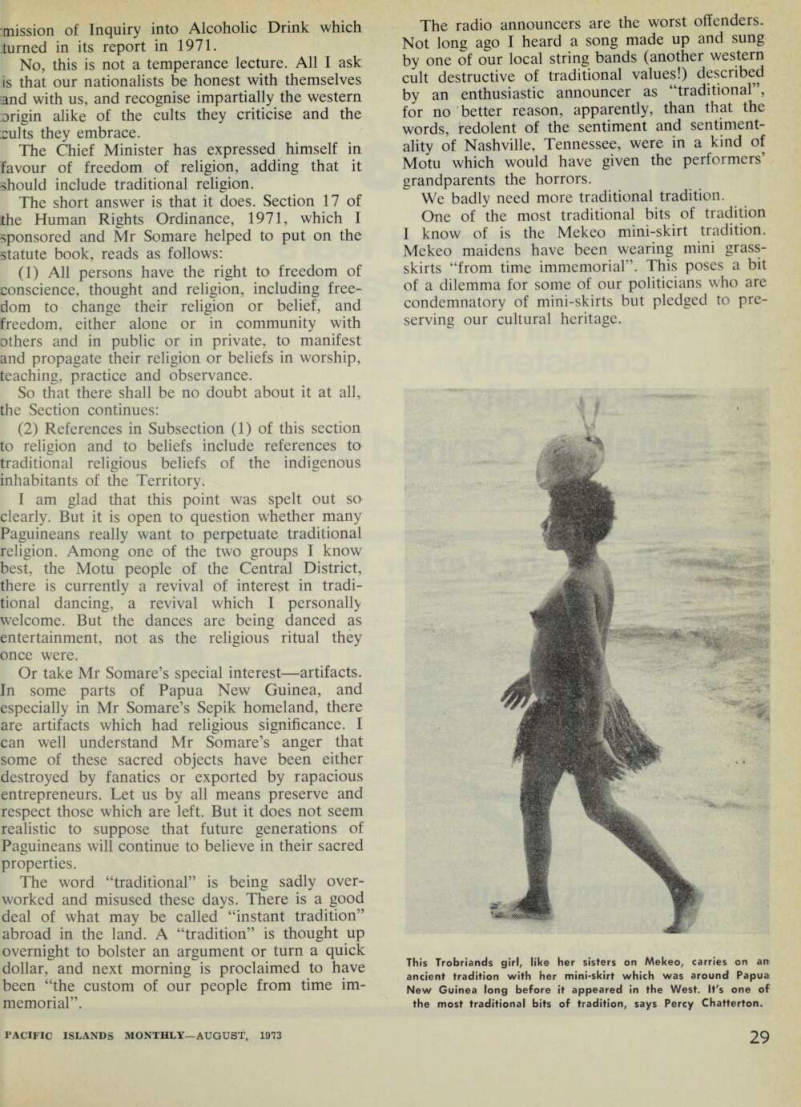
OAPUA New Guinea’s Chief Minister recently A put the cat among the pigeons when, open ing a display of artifacts at the PNG Museum and Art Gallery, he referred to the destruction of traditional values by “a western cult known as Christianity”.
I think that fair-minded readers of PIM will agree that, during almost seven years as a PIM columnist, I have not obtruded religion on this page, though I must admit that 1 have sometimes had a good deal to say about the mission contri bution to education. But a bait as tempting as this one is just too hard to resist. I will try not to be tedious.
The first thing I would say is this: that if the four Galilean fishermen who became Jesus’ first disciples, and for that matter Jesus himself, were to re-appear on earth at this moment, they would find themselves far more at home in a Paguinean fishing village than in London, New York,
Sydney, or even Port Moresby.
And if they did turn up in Port
Moresby, they would probably
make for one of the shanty settle ments rather than for the Gateway Hotel.
Naturally so. For the life-style and the traditional values of Galilean fishermen and carpenters in the first century AD had far more in common with the Mela nesian life-style and traditional values than with those of the 20th
century western technological culture. By the same token, the message of Jesus is more readily understood by, and certainly more acceptable to, Melanesians than to people of the technological West.
Indeed it is not hard to envisage a time in the not-too-distant future when the islands of the Pacific will be the last foothold on earth of Christian values, which most people in the West have either renounced or pay merely lip service to. At that point, one hopes, the Pacific will start sending missionaries to re-christianise the West.
But all this is, of course, not what Mr Somare
With Percy Chatterton
in Port Moresby
Mini-skirts, beer and other cults
was talking about. He was talking about institu tional Christianity, as brought to Papua New Guinea by 19th century European missionaries.
And it is true that their activities did have a destructive effect on traditional values. Some oi these were perhaps values that the missionaries could hardly be expected to live with, and which were not much loss anyway. But others were values that could have been, and should have been, preserved.
It is attractive to speculate on what might have been if the early missionaries had been content
to proclaim Christian beliefs and Christian values, and leave Pagui neans to build their own “cult” around them. Attractive, but nol at this stage very useful.
Substituting drums and conch shells for organs and harmoniums, translating western rites intc Paguinean languages, and build ing churches that look like ham tambaran (ancestral spirit house) are poor palliatives at best.
I think, though, that it is fail
to point out that Christianity is not the only western cult to bring its impact to bear upon traditional Paguinean values. The western cult of individualism, the western cult of affluence and western concepts of law’n’order have all left their mark, as has, above all, the western cult of beer.
This last-named cult, completely foreign tc the Melanesian way of life, has probably wrought more havoc among traditional values in 10 years than Christianity has done in 100. Yet on this destructive western cult our national leaders are strangely silent, and continue to drag their feet in implementing the recommendations of the Com
mission of Inquiry into Alcoholic Drink which ;turned in its report in 1971.
No, this is not a temperance lecture. All I ask is that our nationalists be honest with themselves :and with us, and recognise impartially the western origin alike of the cults they criticise and the suits they embrace.
The Chief Minister has expressed himself in favour of freedom of religion, adding that it ■should include traditional religion.
The short answer is that it does. Section 17 of Ithe Human Rights Ordinance, 1971, which I sponsored and Mr Somare helped to put on the statute book, reads as follows: (1) All persons have the right to freedom of conscience, thought and religion, including free dom to change their religion or belief, and freedom, either alone or in community with others and in public or in private, to manifest and propagate their religion or beliefs in worship,
teaching, practice and observance.
So that there shall be no doubt about it at all, the Section continues: (2) References in Subsection (1) of this section to religion and to beliefs include references to traditional religious beliefs of the indigenous inhabitants of the Territory.
I am glad that this point was spelt out so clearly. But it is open to question whether many Paguineans really want to perpetuate traditional religion. Among one of the two groups I know best, the Motu people of the Central District, there is currently a revival of interest in tradi tional dancing, a revival which I personally welcome. But the dances are being danced as entertainment, not as the religious ritual they once were.
Or take Mr Somare’s special interest —artifacts.
In some parts of Papua New Guinea, and especially in Mr Somare’s Sepik homeland, there are artifacts which had religious significance. I can well understand Mr Somare’s anger that some of these sacred objects have been either destroyed by fanatics or exported by rapacious entrepreneurs. Let us by all means preserve and respect those which are left. But it does not seem realistic to suppose that future generations of Paguineans will continue to believe in their sacred properties.
The word “traditional” is being sadly over worked and misused these days. There is a good deal of what may be called “instant tradition” abroad in the land. A “tradition” is thought up overnight to bolster an argument or turn a quick dollar, and next morning is proclaimed to have been “the custom of our people from time im memorial”.
The radio announcers are the worst offenders.
Not long ago I heard a song made up and sung by one of our local string bands (another western cult destructive of traditional values!) described by an enthusiastic announcer as “traditional”, for no better reason, apparently, than that the words, redolent of the sentiment and sentiment ality of Nashville, Tennessee, were in a kind of Motu which would have given the performers’ grandparents the horrors.
We badly need more traditional tradition.
One of the most traditional bits of tradition 1 know of is the Mekeo mini-skirt tradition.
Mekeo maidens have been wearing mini grass skirts “from time immemorial”. This poses a bit of a dilemma for some of our politicians who are condemnatory of mini-skirts but pledged to pre serving our cultural heritage.
This Trobriands girl, like her sisters on Mekeo, carries on an ancient tradition with her mini-skirt which was around Papua New Guinea long before it appeared in the West. It's one of the most traditional bits of tradition, says Percy Chatterton.
Advertisements & other items, p. 32 (1 item)
Hellaby’s Canned Meats
HELLABY
1873 1973 One Hundred Years in the South Pacific and still the same
consistently
high quality
Hellaby’s Canned Meats
Quay St., Auckland. m At
PACIFIC
m
ARRO
atn
Kerr Bros., the Porker Furniture people.
FOR PACIFIC
ISLANDS
Parker Furniture undoubted leader in Australia's domestic furniture industry Manufacturers of modern dining, lounge, occasional and bedroom furniture.
KERR BROTHERS PTY. LTD.
Island Merchants,
65 York Street, Sydney.
CABLES: CAREFULNESS, SYDNEY.
The Friendly Islanders - An Image

Which The 'Big Smoke' Tarnishes
In this controversial article a Sydney man married to a Tongan girl for the past four years gives his opinion :of the Tongans living in the "Big Smoke". He blows the whistle on some of the antics the Tongans get up Ito, and he also covers tours made by Tongan sporting and cultural groups that have visited Australia. But Tie also makes some constructive suggestions for improving the situation.
From JOHN SLENDER in Sydney
My first contact with the Tongan community really began shortly after our marriage when the Tongan athletic team stayed in Sydney on their way home from the South Pacific Games in Papua New Guinea.
Some of the Tongans, my wife Fatai and I prepared a welcome for the boys, and the lone woman athlete Keta ’longi, who had travelled without a chaperone.
The team arrived in Sydney early in the morning and as soon as they were dumped at the Police Boys Club where they stayed, their guardians disappeared and left them to fend for themselves. Most of us were angered by this. The team was hungry, tired and untidy. Many had complained of poor food while in Port Moresby.
I soon realised that some of the Tongans were treated very poorly by the Europeans and I guess I be came a strong supporter of Tongan Liberation. We became regular at tendee at the Tongan church services held monthly at the Wesley Chapel and as each month went by that Friendly Island charm won me over.
I was warned to beware of the Tongan community, a warning 1 did not heed.
October, 1969, saw the formation of the Tonga Australia Association which elected me as its secretary treasurer. During the months that followed our organisation held many socials so that Tongans could meet in a relaxed atmosphere, have a drink, dance, and swap stories.
But soon the bubble burst. Fights, excessive drinking and disorderly conduct became the regular enter tainment and an embarrassment to the community—those who cared.
This problem continued for another two years. it was soon apparent that, to Tongans, Sydney was the Pot of Gold at the rainbow’s end and that many Tongans would do almost anything to come here to study or for a work ing holiday. As a large city, like most bustling metropolises, Sydney
offers so much, but with it come so many pitfalls.
At present, the Tongan population in Sydney would number somewhere between 100 and 150, comprising students, those married to Europeans and a large percentage of visitors.
Many of the folk back home must wonder what kind of reputation the Tongans are building for themselves and whether they are meeting with success or failure in their ventures in this foreign land.
From my contact with other Aus tralians who had known or as sociated with Tongans I would say that some years ago the Tongans had a name to be extremely proud of, but in recent years their reputations have waned considerably.
Why? Well let’s look at it. There are plenty of case histories.
In July and August, 1970, there was the stowaway crisis when it was estimated that there were more than 40 Tongans illegally in Sydney. But when these chappies hit our shores, did they go into smoke? No. They hung around all the pubs, clubs,
places of ill-repute, and, in no time at all, most of them were caught by the authorities either as drunks or fighters. Some of them were so foolish and knew so little of climatic con ditions in July and August, that they were picked up wearing only trousers and a T shirt. OK if you want to catch pneumonia. It was only a matter of time before most of them were arrested but not before some had attacked women and one had even knifed a police officer.
But not all were bad. Some of the lads were out for a spot of schoolboy adventure. One chap, as soon as he jumped ship, went to the fruit markets and bought a case of apples to send back to the folks at home. A good lad at heart, but a bad stowaway.
He got caught a few days after he arrived.
Some had good endings. A number of the boys did not associate with the hard-boiled, criminal type and earned some worthwhile cash before they were caught. One Immigration officer told me that they had so much work with other matters, that had the Tongans dispersed, and had not caused trouble, many of them would still be running free.
However, towards the end of the year, many of these fellows came before the courts. The sentences wers. light. The judges must have been Huckleberry Finns at heart.
But it did not end there. Some decided to break out of jail, bashing two of the warders and stealing personal property in the process.
With the help of the police, the Army, and helicopters, most of the escapees were recaptured. The last fellow was caught the night after the First Tongan Ball held in Sydney.
In the rounding-up process the police called on nearly every Tongan or Tongan/European household to see if they were harbouring any of the escapees.
A few months later the majority were deported, but think of the time wasted, the cost the Australian
Government had been put to, and, of course, the resultant damage to the Tongan image through press, radio, and TV coverage.
The Tonga Australia Association quickly handed a donation to the Commonwealth Police Mortality Fund and expressed their deepest concern over the incident.
Only recently I was told by a reliable source that about 20 stowa ways arrived in Sydney in June this year.
Tours
During the past four years three official Tongan groups have visited Australia. The first group was the athletic team already mentioned. The second group came in 1970 during the Captain Cook Bi-Centenary celebrations. Now here was a great group of performers. But what a rough deal some of them received!
They stayed in a small private hotel in Coogee and I recall about eight boys living in a room about 10 ft by 10 ft. The girls were a little better off, about four or five to a room.
While some of them had to make their own way back to the hotel after performing at the Royal Easter Show, one official always seemed to have a rental car available.
When the team arrived there was a complete absence of display or a performance, at the airport for instance, to engender some worthwhile publicity. In fact, publicity was virtually non-existent. So different from the Cook Islanders who really shot the works on their arrival!
Only experienced, capable, and thoughtful leaders should handle such tours.
The Tonga Rugby Union team, which had a most successful tour in June in spite of many defeats, was always at a great disadvantage due to the excessive functions organised for it, leaving little time for rest and practice. In one week, prior to one of their main matches, they spent a few hours at practice.
On the organisation side, there ap peared to be a communication gap between Australian and Tongan officials.
On the Saturday night after the first test, a reception was held at the Eastern Suburbs Rugby Union Club.
The beer flowed freely—Sydney hos pitality—and I recall later that evening seeing many of the players well under the weather at a social held in the Paddington Town Hall.
Sunday was a repeat performance.
Barbecued steak and beer, and then off to a service at the Wesley Centre.
City life
It is not only stowaways that cause the trouble. Many of their visiting comrades try their hand at stealing, drug-taking and other social crimes.
Drinking to excess rates high on the list and has forced the association to cancel functions when brawls fol lowed heavy drinking.
So much for the fellas for the time being.
The girls are a different proposition.
There are the half-dozen who have illegitimate children, and the few who try a little premarital living, but then this is not uncommon anywhere in the world.
Basically though, the girls set a good example. The failure rate of the girl students is very low; they are good, hard and conscientious workers, and all in all Tonga can be quite proud of its girls.
The male students have not been so fruitful with their studies. Soon after arrival they learn of the bright spots, and the high living, and it takes its toll. Students, who are spon sored and cared for by Australian families who keep the paternal eye on them, usually meet with success.
Mr Barnes, the former Minister for External Territories, was quoted in the Tonga Chronicle as saying that it is better to train people in their own environment. He was, in my opinion, quite right.
The visitors are a mixed assort ment. Most come with the idea of earning and saving a few dollars.
Some reach this goal, some don’t.
The thrifty Tongan could give a good lesson to the Australians.
Then comes the borrower. Beware of this person. If a Tongan lends money to another person he should not expect to get it back. One Tongan nurse lent about $4OO nearly four years ago to a “New Australian” and even though legal action was taken
and judgment found in her favour she is still waiting for her money.
It will be a long wait.
The girls are easy takes for the smooth-talking salesman. A few years apo three nurses ordered sets of ex pensive saucepans around $2OO.
Fortunately quick action by the matron of the hospital released them from their obligation.
Have a heart for the person who comes for a working holiday, saves hard and then breaks an arm or leg.
Most of his savings are spent on very high medical bills and his trip is wasted. No one told him of the medical benefits organisations.
The number of Tongans who arrive at Sydney airport penniless is quite unbelievable. Only recently, one Tongan entered Australia on a busi ness visa and proceeded to set up shop as a travel agency. He soon ended up heavily in debt. The joke is that he, the “businessman”, had to borrow his fare to come to Aus tralia.
Interfering in the lives of others seems to be one of the Tongan’s favourite pastimes. Most frequently, this is brought on by sheer jealousy of those who have done well. We have experienced this ourselves.
Extending the
There seem to be conflicting de cisions on the time Tongans are per mitted in Australia. Immigration Minister Mr Grassby, in a letter to a sponsor, stated that 12 months was the maximum holiday stay, yet the Sydney officials allow only six months.
Of course there is always an answer to ensure that one has a longer holiday. Some Tongans use the church as a cover to undertake lay preacher instructions and thus extend their stay up to two years.
Only a short while ago I had a letter from a Vavauan who said that one
individual made it quite clear that if an extension of time was required Rev . V . . v . . . could arrange it.
One chappie had headaches; he stayed'nearly three years. It didn’t affect his drinking ability. Another Tongan lad spent 12 months in Aus tralia and then, when his visa had almost expired, decided that he wanted to become an apprentice.
There was the case of a Tongan man who came to Australia to under take an apprenticeship. His wife and daughter accompanied him. He spent over three years trying to pass his English entrance examinations. He failed regularly. Eventually he was told to leave. Naturally, both he and his wife worked during this period.
It’s a pity an opportunity hadn’t been given to a more suitable can didate.
A family, who secured an ap prenticeship in the electrical trades for a Tongan boy, was amazed to find evidence that the fellow was cor responding with another Australian for permission to sponsor him and undertake a commercial course. The first family soon withdrew its spon sorship.
I cannot understand why the Aus tralian Government has allowed some Tongans to stay permanently in Aus tralia after completing their courses when others have been ordered home. Surely all students should be required to return home to Tonga and pass on their knowledge for some years at least before being considered as eligible for residential status? This alone is causing much unrest among the students. Whose fault is this?
Unrest
Many of the Tongans in Sydney tell of hardship in Tonga and favouritism shown to those who hold special position or rank. One Tongan made it quite clear that he believed Tonga was a cross between a democracy and a dictatorship.
Often bandied around is the tale of shortage of land, yet many persons seem to be in custody of more than their share. If this is so, then some thing is wrong.
Some Tongans, after spending a few years in Australia, obviously do not intend to return home. Some engage in hasty marriages to gain residential status. Many marriages have failed. Some students continue to undertake course after course of study trying to prolong D (departure) Day. Many have been successful; many haven’t.
A great deal of unrest was caused some time back when one Tongan boy was allowed to enrol at a well
known boys’ college, while two other boys were refused. Class distinction?
It was to me. - Perhaps I have painted a nasty picture of the Tongans in Sydney, but this is the way I have seen and know it. 1 have the opportunity to visit the Tongan communities in Brisbane and Melbourne and here the situation is entirely different.
There are many fine ambassadors for Tonga in these cities.
A solution
Strangely enough, the solution to most of the problems could be very simple. Some type of diplomatic service should be set up in Australia; someone appointed to keep a watch ful eye on the Tongans. To advise them, guide them and help them.
He could act as a father to all the students by showing a genuine interest in their activities and, when neces sary, take disciplinary action. 1 would also like to see a board set up back home in Tonga to ensure that only those of good background and character ever leave its shores.
Another function that could be per formed back in Tonga would be the setting up of some type of orientation school so that Tongans would know something of the country, its customs and its pitfalls, before arriving in any overseas country.
The Tonga Government must shoulder much of the blame that involves its countrymen in trouble in Australia. During the stowaway crisis three separate letters were sent to a Tonga Government official. Not one was answered.
The Australian officials should also share some of the responsibility. Time after time irresponsible Tongans have been handled with kid gloves.
Co-operation and planning can overcome the problems created by Tongans in Sydney. • The Tongan Rugby team did not have a successful tour of Aust ralia in terms of matches won and lost, but with their refreshing and un inhibited approach to the game they pulled the crowds in. Highlight of the tour was a win over Australia in the second test, after a trouncing a week earlier in the first test. Re suits were: South Australia, 29-6: Vic toria, 10-13; Sydney, 19-14; New South Wales, 0-18; Australian Capital Territory, 6-17; Australia (first test), 12-30; New South Wales Country, 11- Australia (second test), 16-11: Queensland, 10-18; Queensland Country, 12-9. On the way home Tonga played Fiji in Suva and lost, 12-
Tongans charged
A Sydney court, on August 30, is scheduled to hear charges against Tongan brothers, Pauliasi Semi Tau moepeau, 26, an accountant, and Taniela Taumoepeau, 28, also an accountant.
Pauliasi is charged with hav ing maliciously assaulted Sione Niumeitolu, at Peter sham, a Sydney suburb, on March 17. Taniela is charged with having hin dered a policeman in the execution of his duty on the same date at Petersham.
Advertisements & other items, pp. 34-37 (2 items)
Brockhoff
the
htte-size, ctacKßi.
<*> Si m m
BROCKHOff
m .r’d rfi m * i**a & d % d d m % * :* s* & *
OZNET
CRACKER
VERSATILE
THE
Crisp ’n’ golden Brockhoff Salada snaps into action!
Straight from the pack man-size for big healthy sandwiches.
Snap them into two for snack-size savouries and sippets with soup.
Snap them in four, and Salada serves bite-size for quick tasty nibbles. Oven-crisp Brockhoff Salada is three crackers in one.
There’s value, variety and quality in
BROCKHOFF BISCUITS
7913/8 x6 1 /4
SOUTHERN PACIFIC INSURANCE
COMPANY LIMITED
Head Office: Equitable Life Building, 80 Alfred Street, AAilsons Point, N.S.W., 2061.
Specialising in Pacific Island Insurance requirements for over 30 years. • FIRE *FIRE AND VOLCANIC ERUPTION • HOUSEHOLD COMPREHENSIVE • MOTOR VEHICLE • COMPULSORY THIRD PARTY • COMPULSORY WORKERS' COMPENSATION
• PUBLIC LIABILITY • AAARINE
Enauiries invited for all classes of insurance from special representatives at: PORT MORESBY: H. A, K. McKee, Manager for Papua New Guinea, Ist Floor, Carpenter's Supermarket, Champion Parade. P.O. Box 136. RABAUL: Mango Avenue. P.O. Box 123.
LAE: R. H. Meyer—Manager at Lae, Kam Hong's Building, Central Avenue. P.O, Box 758.
SUVA-FIJI: L. M. Rolls—Manager for Fiji, McGowan's Building, Margaret Street, P.O.
Box 521.
FIAT
CONCESSIONAIRES
American Samoa Silver Star Transport Inc., P.O. Box CB-4, Pago Pago.
Fiji Motibhai &Co. Ltd.,
P.0.80x 40, BA.
Nauru Nauru Cooperative Society Nauru Island.
New Caledonia Agence Automobile S.A.,
P.O. 80x842, NOUMEA.
o Territory of Papua and New Guinea New Guinea Motors Pty. Ltd.,
P.O. Box 1027, BOROKO
New Hebrides Societe Bourgeois & Cie.,
P.O. Box2B, PORTVILA.
New Zealand Torino Motors Ltd.,
P.O. Box 6240, AUCKLAND.
Norfolk Island Cascade Motors Ltd.,
P.O. Box 34, NORFOLK.
ISLAND.
Solomon Islands Chan Wing Motors Ltd.,
P.0.80x 820, HONIARA.
Tahiti Societe Tahitienne d'Automobiles S.A.R.L.,
P.O. Box 1723, PAPEETE.
Western Samoa E.A. Coxon & Co. Ltd.,
P.O. Box 38, APIA.
anna
2442 REV
1 I 3T ■i; m
k fiV
MmW.. \ijk- p- 4 ■'>*>
/©f / fy/UStcp/u/f'S
The new 124 Sport Coupe shows its breeding. The lines are unmistakably Italian. The finish is magnificent. The interior ; \f / is luxurious and seats four in comfort. The powerful new < 1800 cc twin OHC engine is engineered in the finest European tradition. It will take you effortlessly up to top speed with the safety of power assisted disc brakes all round. It’s not everybody’s car. But for the few who still like to feel their driving... it’s a revelation.
The return
of the well-bred sports car.
Thenewßatl24
sport coupe 1800
35
I'ACIFIC ISLANDS MONTHLY—AUGUST, 1973
Islands Press
From the Islands Press
From a letter by Matron Vera Stanton, Lord Liverpool Hospital, Niue, in Tohi Tala Niue, about the intrusion of unwanted male visitors to the nurses' home: I have disturbed intruders myself when doing rounds; the last one, about a week or so ago, took off at high speed, skidding all over the place like a dog on slippery lino, clad only in a pair of puce red under pants and clutching his pareu in his hot sweaty hands.
Perhaps this is the latest mode of dress when out visiting at 11.30 p.m. on Niue. He was a weedy looking male specimen too, and certainly not much to arouse any ardent passions in any females around at the time.
Extract from letter by Joseph Mohammed in The Fiji Times: 1 think that there is no sense in keeping the unused land idle for too long. We know that the land belongs to Fijians, and no Indians are going to take it away, and Fijians do not cultivate the land because they are not used to it. Finally, there are hundreds of acres in reserve, which even the Fijians are not using.
They don't want the Indians to use it either, and the result will be jungles.
From the Cook Islands News: The Director of Education, Mr Rangi Moekaa, announced this morning that headteachers in Rarotonga today unanimously supported a motion which recommended that the Director of Education take action to close Ngatangiia School because of danger to the school children from faulty electric wiring in the school. The decision was made after hearing that yesterday a horse was electrocuted after touching a power pole at the school entrance. It was further reported that in wet weather the walls in some classrooms are alive.
From the Norfolk Islander: It came our way this week. Under international law, Norfolk Island is not part of Australia. The definition of a territory is that it is a separate piece of country which has certain forms of government of its own, administered by some other body. Therefore, Norfolk Island complies with that definition and being a territory, it cannot be part of Australia. If Australia or any other country that is administering a territory makes laws which are contrary to the interests of the inhabitants of that territory, those laws are also ultra vires. You'll find the definition of "territory" in Webster's International Dictionary.
From the British Newsletter, New Hebrides: Ambrym Accidents —Copra production is increasing now that the price has gone up, but some people have got out of practice while the price was low. On the day the price went up to $BO, three people on Ambrym cut themselves badly while clearing long grass to find nuts, and a woman using an axe to split nuts, missed and chopped off a toe, according to Mr Damelip Taso, writing from Baiap Junior Primary School.
From a GEIC Legislative Council speech by Mr Sione Tui Kleis about work of civil servants, reported in Atoll Pioneer: Should the time they chat to friends, relatives, wives, girl friends, be taken as working time and what should be allowed? How much shopping time should be allowed? And what about time for
following their personal interests, like reading
newspapers, comics, pornographies, etc?
From a report by the controller and chief auditor in the Samoa Times: ... At the Produce Marketing Division, the auditors found that even though parliament has for years voted funds for the division’s activities it never found the time to enact legislation to legal!- (continued next week) From Tohi Tala Niue: For the average Niuean, he understands little of political campaign intrigues. What he is interested in is what the Labour Government can do for his island. National has given him an airport and a guest house. He is now anxiously waiting to see if Labour will give him electricity.
From the Tonga Chronicle: During the holiday break on Monday, there was a lot of banging and hammering in the Prime Minister’s Office building by MOW workers. We asked one of the workers whether they were pulling the building down and were informed no, they were nailing wire netting against the boarded partitions in readiness for plastering with cement. At that time, we thought these must be security measures. It was only yesterday that we learned that there had been a terrible misunderstanding. What in fact was required was for the stairs up to the first floor of the building to be painted!
From the Atoll Pioneer, GEIC: Mr Sione Tui Kleis agreed with the Acting Governor that Hurricane Bebe had taught us a number of lessons. He was sorry to say that the Acting Governor had intentionally left out the reasons why this disaster took place. He firmly believed that there were reports, in cobwebbed files in Government archives, asking previous administrations to develop Funafuti. These requests had been turned down, till at last the creator of Funafuti, who was also the Creator of the Universe, decided He had to do something about it. By His divine power He destroyed Funafuti, so that people would pay attention to the problem. Had the previous requests been heeded Mr Kleis did not think there would have been any Hurricane Bebe.
Extract of a report in Tohi Tala Niue of the finding of a dead whale: The whale was 10 feet long with no teeth and a high forehead. On Thursday morning an inspection showed that the whale was going rotten. Several youths from Makefu helped in cutting into the whale to allow the sea to break it up easily and the fish to eat it before it became a health hazard. If the whale had been cut up while it was fresh it could have been eaten or fed to pigs and poultry. Anyone finding a whale in future should contact the Agriculture Department straight away in case the meat can be used. Also, the department can use shark meat for its pigs.
Advertisements & other items, pp. 39-44 (1 item)
famous
Jk /a
■>»» f % \ & 4* % Ip * ISt <'■ N / ■ t .# / ' - f ■% fit" i~Jam ■: --y.
There is no Substitute Quality
F
It took time to perfect the
NEW Hyster electrics.
Time to make the best.
Y \i r ±‘
i'mMt
% 1
HYSTER
& We could have added new Hyster electric trucks to our extensive lift truck range some time ago. After all, we knew what people wanted, and we had the dealer and service network to back our sales Australia-wide.
But long after electric lift trucks first hit the market, we were busy perfecting a better hydraulic system to overcome the oil leaks and minimise the battery drain other manufacturers weren't so concerned about.
We wanted to make ours the top performance electric. An easy-handling truck with a short turning radius. Longer life between charges. Smoother deceleration. And single pedal control to keep the drivers happy.
Now we’ve built these advantages into a range of Hyster electric trucks with load capacities of up to 10,000 lbs (5,000 kgs). We believe they’re the world's finest, and they’re available from your Hyster dealer. Ask to see them in action. Or contact Hyster Australia Pty. Ltd., Ashford Avenue, Milperra, N.S.W. 2214. Telephone Sydney 77 0511.
HYSTER AUSTRALIA PTY. LTD.
I i nr* m ' ft ? - V 1
ISW^-W
whgo s
FINEST “
a; *ri
SQp^
ee
BlBlllil
y °ney Australia ■ v* : * i a ra ''‘r ft-SWt H saw**
Flour that's milled fresh
when called for by your shipping agent Milled fresh—when called for—then packed in clean, strong sacks or drums. That's the reason why Mungo Scott's have the largest output of any mill in Australia.
Mungo Scott's skilled laboratory staff put to practice every modern method to ensure you receive the finest quality entoleted flour.
Since 1894 Mungo Scott "a good firm to do business with" We pride ourselves on documentation.
BAKERS FLOUR • SHARPS • MEALS
CAKE FLOUR • BISCUIT FLOUR • SPONGE FLOUR A DIVISION OF ALLIED MILLS INDUSTRIES PTY. LTD.
Summer Hill, N.S.W., Australia Cable & Telegraphic SUPERB Sydney Phone: 797-8333
ITS TIME FOR A SWAN
Australia’s great beer
enjoyed in over 60 countries.
Full flavoured. Satisfying.
m %
SWA®
DRAUGHT
M ■^L
'•£' CONTENT 333"
Now brewed in Papua New Guinea by PNG Brewery Pty. Ltd a subsidiary of San Miguel & Swan Holdings Limited, Spring Garden Road, Hohola, Port Moresby.
Relax with a Swan.
Pacific
Island*
Monllilv
MAGAZINE*
keeps you informed on Pacific happenings
The Pacific is PIM!
For more than 40 years PIM has been reporting on events in the Pacific. Social and political changes, economic development, historical background, regular columnists and commentators, personalities and travel.
You’ll read:— • A big magazine section Extracts from the Islands Press • Fascinating historical articles • Island creative writers Tropicalities Shipping and cruising yachts and views News of sport Letters from readers Shipping, airways' schedules Business and development news Regular big picture section Plus all the latest Pacific news Become a part of PlM’s Pacific and subscribe now.
Rates and subscription form overleaf.
SUBSCRIPTION RATES?
Australia (Including Lord Howe and Thursday Islands) $6.70 New Zealand . .. .. .. .. $6.70 NZ Papua New Guinea .. .. .. .. $5.50 Aust.
Fiji, Tonga, New Hebrides, Gilbert and Ellice Islands, Solomon Islands, Nauru Island and all other Pacific Territories . .. .. .. .. .. $5.50 Western Samoa .. .. .. $6.70 Hawaii, Micronesia, and Guam .. .. $12.00 US American Samoa .. .. .. .. .. $B.OO US U.S. Mainland $14.00 US New Caledonia and French Polynesia 1,100 CFP •United Kingdom .. .. .. .. .. £3.25 Stg. •Elsewhere $6.96 Aust.
Two years $12.65 $12.65 NZ $10.25 Aust. $10.25 (local currency) $12.65 (local currency) $23.25 US $15.25 US $27.25 US
2,150 CFP
£6.25 Stg. $12.20 Aust. •Airmail extra on application. All ether subscription rates listed Include air delivery.
Three years $18.60 $18.60 N 2 $15.00 Aust. 115.00 $18.60 $34.50 US $22.50 US $40.50 US
3,150 CFP
£9.00 Stg, $19.30 Aust, address city/state/country/post code (please print) Attached is my payment of for years' subscription.
New □ Renewal □
PACIFIC ISLANDS MONTHLY
29 Alberta Street, Sydney, N.S.W 2000, Australia (Postal Address: iox 3405, 0.P.0., Sydney, W.S.W. 2001.)
B AUGUST, 1973—PACIFIC ISLANDS MONTHLY
inevitable
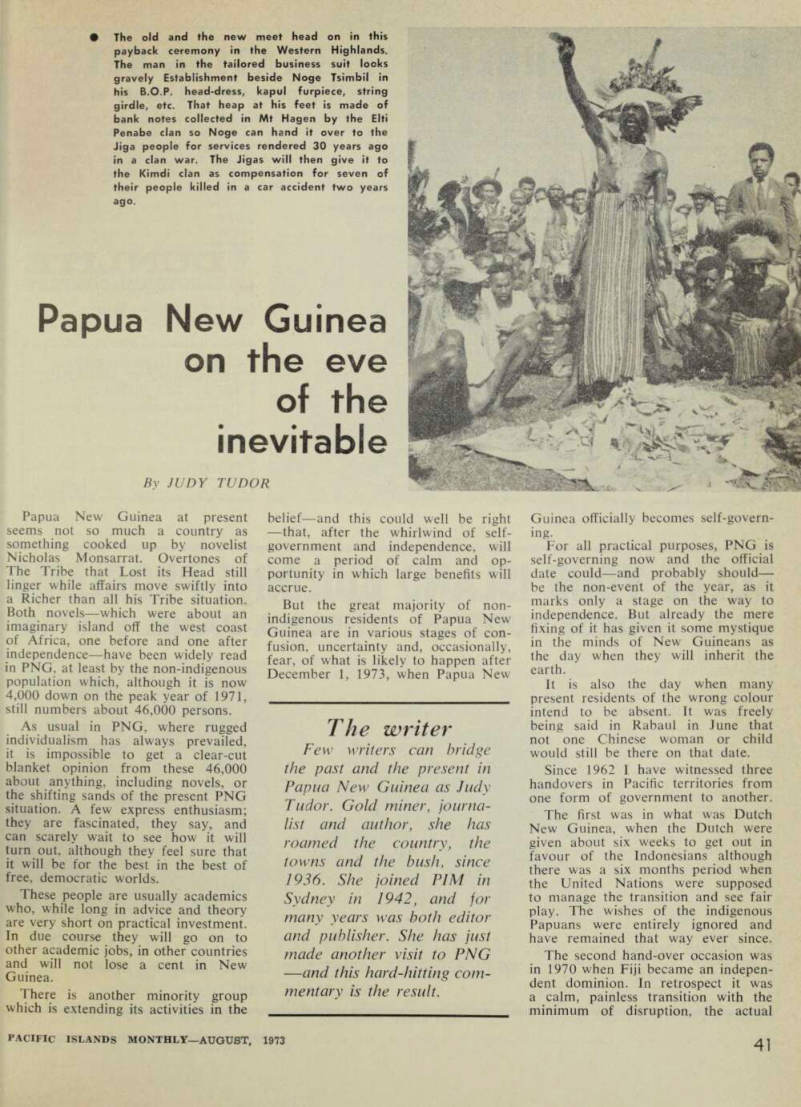

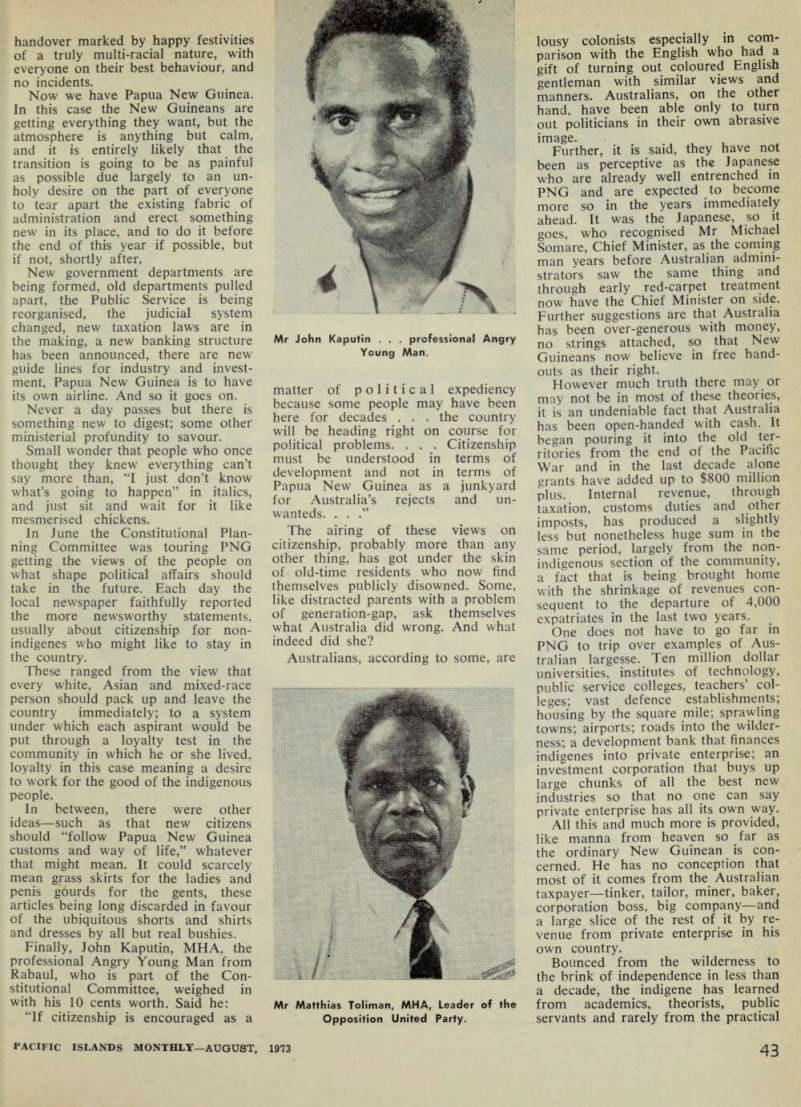
Papua New Guinea on the eve of the inevitable
By Judy Tudor
Papua New Guinea at present seems not so much a country as something cooked up by novelist Nicholas Monsarrat. Overtones of The Tribe that Lost its Head still linger while affairs move swiftly into a Richer than all his Tribe situation.
Both novels—which were about an imaginary island off the west coast of Africa, one before and one after independence—have been widely read in PNG, at least by the non-indigenous population which, although it is now 4,000 down on the peak year of 1971, still numbers about 46,000 persons.
As usual in PNG, where rugged individualism has always prevailed, it is impossible to get a clear-cut blanket opinion from these 46,000 about anything, including novels, or the shifting sands of the present PNG situation. A few express enthusiasm; they are fascinated, they say, and can scarely wait to see how it will turn out, although they feel sure that it will be for the best in the best of free, democratic worlds.
These people are usually academics who, while long in advice and theory are very short on practical investment.
In due course they will go on to other academic jobs, in other countries and will not lose a cent in New Guinea.
There is another minority group which is extending its activities in the
belief—and this could well be right —that, after the whirlwind of self government and independence, will come a period of calm and op portunity in which large benefits will accrue.
But the great majority of non indigenous residents of Papua New Guinea are in various stages of con fusion, uncertainty and, occasionally, fear, of what is likely to happen after December 1, 1973, when Papua New
Guinea officially becomes self-govern ing.
For all practical purposes, PNG is self-governing now and the official date could—and probably should— be the non-event of the year, as it marks only a stage on the way to independence. But already the mere fixing of it has given it some mystique in the minds of New Guineans as the day when they will inherit the earth.
It is also the day when many present residents of the wrong colour intend to be absent. It was freely being said in Rabaul in June that not one Chinese woman or child would still be there on that date.
Since 1962 I have witnessed three handovers in Pacific territories from one form of government to another.
The first was in what was Dutch New Guinea, when the Dutch were given about six weeks to get out in favour of the Indonesians although there was a six months period when the United Nations were supposed to manage the transition and see fair play. The wishes of the indigenous Papuans were entirely ignored and have remained that way ever since.
The second hand-over occasion was in 1970 when Fiji became an indepen dent dominion. In retrospect it was a calm, painless transition with the minimum of disruption, the actual
• The old and the new meet head on in this payback ceremony in the Western Highlands.
The man in the tailored business suit looks gravely Establishment beside Noge Tsimbil in his B.O.P. head-dress, kapul furpiece, string girdle, etc. That heap at his feet is made of bank notes collected in Mt Hagen by the Elti Penabe clan so Noge can hand it over to the Jiga people for services rendered 30 years ago in a clan war. The Jigas will then give it to the Kimdi clan as compensation for seven of their people killed in a car accident two years ago.
handover marked by happy festivities of a truly multi-racial nature, with everyone on their best behaviour, and no incidents.
Now we have Papua New Guinea.
In this case the New Guineans are getting everything they want, but the atmosphere is anything but calm, and it is entirely likely that the transition is going to be as painful as possible due largely to an un holy desire on the part of everyone to tear apart the existing fabric of administration and erect something new in its place, and to do it before the end of this year if possible, but if not, shortly after.
New government departments are being formed, old departments pulled apart, the Public Service is being reorganised, the judicial system changed, new taxation laws are in the making, a new banking structure has been announced, there are new guide lines for industry and invest ment, Papua New Guinea is to have its own airline. And so it goes on.
Never a day passes but there is something new to digest; some other ministerial profundity to savour.
Small wonder that people who once thought they knew everything can’t say more than, “I just don’t know what’s going to happen” in italics, and just sit and wait for it like mesmerised chickens.
In June the Constitutional Plan ning Committee was touring PNG getting the views of the people on what shape political affairs should take in the future. Each day the local newspaper faithfully reported the more newsworthy statements, usually about citizenship for non indigenes who might like to stay in the country.
These ranged from the view that every white, Asian and mixed-race person should pack up and leave the country immediately; to a system under which each aspirant would be put through a loyalty test in the community in which he or she lived, loyalty in this case meaning a desire to work for the good of the indigenous people.
In between, there were other ideas—such as that new citizens should “follow Papua New Guinea customs and way of life,” whatever that might mean. It could scarcely mean grass skirts for the ladies and penis gourds for the gents, these articles being long discarded in favour of the übiquitous shorts and shirts and dresses by all but real bushies.
Finally, John Kaputin, MHA, the professional Angry Young Man from Rabaul, who is part of the Con stitutional Committee, weighed in with his 10 cents worth. Said he: “If citizenship is encouraged as a
matter of political expediency because some people may have been here for decades . . . the country will be heading right on course for
political problems. . . . Citizenship
must be understood in terms of development and not in terms of Papua New Guinea as a junkyard for Australia’s rejects and un wanteds. . . .”
The airing of these views on citizenship, probably more than any other thing, has got under the skin of old-time residents who now find themselves publicly disowned. Some, like distracted parents with a problem of generation-gap, ask themselves what Australia did wrong. And what indeed did she?
Australians, according to some, are
lousy colonists especially in com parison with the English who had a gift of turning out coloured English gentleman with similar views and manners. Australians, on the other hand, have been able only to turn out politicians in their own abrasive image.
Further, it is said, they have not been as perceptive as the Japanese who are already well entrenched in PNG and are expected to become more so in the years immediately ahead. It was the Japanese, so it goes, who recognised Mr Michael Somare, Chief Minister, as the coming man years before Australian admini strators saw the same thing and through early red-carpet treatment now have the Chief Minister on side.
Further suggestions are that Australia has been over-generous with money, no strings attached, so that New Guineans now believe in free hand outs as their right.
However much truth there may or may not be in most of these theories, it is an undeniable fact that Australia has been open-handed with cash. It began pouring it into the old ter ritories from the end of the Pacific War and in the last decade alone grants have added up to $BOO million plus. Internal revenue, through taxation, customs duties and other imposts, has produced a slightly less but nonetheless huge sum in the same period, largely from the non indigenous section of the community, a fact that is being brought home with the shrinkage of revenues con sequent to the departure of 4,000 expatriates in the last two years.
One does not have to go far in PNG to trip over examples of Aus tralian largesse. Ten million dollar universities, institutes of technology, public service colleges, teachers’ col leges; vast defence establishments; housing by the square mile; sprawling towns; airports; roads into the wilder ness; a development bank that finances indigenes into private enterprise; an investment corporation that buys up large chunks of all the best new industries so that no one can say private enterprise has all its own way.
All this and much more is provided, like manna from heaven so far as the ordinary New Guinean is con cerned. He has no conception that most of it comes from the Australian taxpayer—tinker, tailor, miner, baker, corporation boss, big company—and a large slice of the rest of it by re venue from private enterprise in his own country.
Bounced from the wilderness to the brink of independence in less than a decade, the indigene has learned from academics, theorists, public servants and rarely from the practical
Mr John Kaputin . . . professional Angry Young Man.
Mr Matthias Tollman, MHA, Leader of the Opposition United Party.
Hedge Against Utter Confusion
viewpoint of private industry which initially held aloof. Told so often that privately owned industry is another word for exploitation, a large section of New Guineans now believe that the only function the expatriate can legitimately have is to hand on his expertise quickly and then get out.
With hindsight, there are many ways in which Australia might have done better —including an attempt to start localisation earlier and letting the process go on longer into indepen dence and beyond. The last-minute rush into change, often it seems for the mere sake of change, is unnerv ing, and makes the transition into independence far more difficult than it need be.
Anyone who experienced the years leading up to independence in Fiji cannot help but be struck by the fact that, even at this late stage, there are still hundreds of young, unattached, expatriate males and females in PNG.
This wasn’t so in Fiji before indepen dence.
With about 350 jobs now legally reserved to indigenes or restricted to expatriates who are supposed to be teaching an indigene the job, it might be imagined that these would be first to go. However, localisation does not always work like that. It is often the top jobs that are localised, with the second and third stringers kept on as a hedge against utter con fusion. All the District Commis sioners, for example, will have been replaced by indigenes by June, 1974, but it is hoped that Deputy District Commissioners and other expatriate field staff will stay on.
This will work just so long as the second stringers will have it on, and at independence all permanent officers are entitled to take their golden handshake from the Australia Govern ment and go, whether they are re quired in PNG or not.
There are no clear-cut views amongst senior public servants about localisation. Some officers are im patient to be declared redundant; while others are unhappy at the prospect of being dispensed with, even bitter.
Meanwhile the Public Service Board is trying to work out how many ex patriates will be needed, and for how long.
When it all happens, the Austra lian taxpayer will again be doing his best, through his benevolent govern ment, to cushion the worst of the traumas attendant on a return to Australia. It is alleged that some public servants will be able to quit
with vast sums like $BO,OOO or even $120,000.
But the big sums are for the lucky minority and the average handshake will be much less. In any event, even $BO,OOO should be seen in its present Australian context for a man, possibly in his 40s, with a wife and a couple of teenage kids to support. If he has spent 20 years in field work in New Guinea he is not trained for anything else, and after providing himself with a house in Australia he is
obviously in for a thin time if he tries to live on what is left.
The smart ones of course bought Australian property years ago, for just this eventuality. Papua New Guinea has been, and still is, golden pasture for Queensland land developers and property realtors, On the other side of the business of expatriate jobs, are the masses of unemployed, unskilled New Guineans who drift in a never-ending stream from the villages to squatter encampments on the edges of towns.
These are the detritus of the transition period, caught mid-way between the primitive village life and the life of
No gat wok
the smart young indigene who has been educated, urbanised and western ised.
Only time in terms of generations will solve this problem, while in the present there is for these aimless ones only the universal Papua New Guinea message, tacked on the doors of offices, shops and dwellings, that says NO GAT WOK. In Lae there is a whole pile of these notices, in neat two-inch high type, for sale in the airport shop. Whether they are for the convenience of locals or sold as a tourist gimmick I had no time to find out.
But in spite of all the foregoing; in spite of the rapes, bashings, oc casional murders and tribal mayhem that make the daily news, it is still possible to travel right round the county and be completely unaware of any tension simmering below the surface; to be met with nothing but politeness, kindness and courtesy from the people, even in the two trouble spots of the Highlands and Gazelle Peninsula, East New Britain.
After the Highlands districts were thrown open for settlement in the early 1950 s there were 20 years in which Europeans and Highlanders developed coffee and tea plantations or raised stock in perfect harmony, but for the last 18 months murders and tribal brawls have been an almost daily occurrence in one part or other of this area.
Occasionally Europeans are in volved by being in the wrong spot at the wrong time but generally the trouble is inter-tribal, based on pay back, land disputes or occasionally as the outcome of drinking parties.
In June, incidents and full tribal warfare raged through Western High lands and the month ended with a pitched battle in the streets of Kundiawa, headquarters town of Chimbu District.
These often are old type battles with strange modern overtones. The Highlands districts have good road and radio microwave communications so fight leaders can call up their warriors by S.T.D. and have them arrive on cue at the chosen spot, in full battle dress, by belting down the road in hired taxis.
The reasons for the breakdown of law and order in the Highlands are many and complex, but the root cause is uncertainty and a deep-seated vil lage belief that with independence all Europeans will leave the country, making it a case of everyone in for his chop.
Rabaul and the Gazelle Peninsula are a different matter. The local Tolai
people are the most sophisticated in New Guinea and have been in con tact with Europeans for almost 100 years. The early Europeans, however, acquired about 40 per cent of the cultivable land of the Gazelle and this is at the root of and the excuse for most of the problems of the area today.
Since 1945 the population of the area has doubled and this has resulted in some land shortages and con sequent resentment of successful European plantation owners.
But for many years local govern ment institutions prevailed over most of the Gazelle in the framework of administration sanction and, within the Gazelle Local Government Council, existed the successful Tolai Cocoa Project which was held up as a model of successful indigenous enterprise.
All this came to an end when local government legislation was amended to provide for multi-racial councils and the Mataungan Association was founded in 1969 to oppose it. This group of Tolais has since consistently aimed at domination of the social, political and economic life of the Gazelle Peninsula and has as con sistently opposed any local govern ment council, has maintained a policy of non-co-operation with government in any form and has continuously exploited land issues. As a result of the intransigent Mataungans the Gazelle council was disbanded and no tax is collected outside the Rabaul urban area except on a voluntary basis.
It is estimated that 55 per cent of the Tolai population supports the M.A. but it could well be more.
Three of the area’s four members of the House of Assembly are Mataungan office holders and these are also members of the present coalition government led by Chief Minister Somare.
Mr John Kaputin runs the busi ness arm of the M.A., the New Guinea Development Corporation, which has been running for over two years and on the surface, anyhow, appears to be going from strength to strength. It has a nominal capital of $500,000, has acquired a store and cocoa drier at Vunavutung, has bought or is buying Vunapit Planta tion, goes in for cocoa processing, and is said to have the biggest outlet for South Pacific beer in PNG. There is a great deal of conjecture about the corporation in the Gazelle but not much hard fact although, as a com pany, it presumably must make annual reports to the Registrar General.
People are said to work for the corporation and be recompensed in
A major victory
kind rather than in wages and this is given point to by Mr Kaputin himself who said in June that he had “worked his guts out for the corpora tion” for two years and had demanded no salary. [ln late June suggestions that Kaputin would be offered a Cabinet post caused some dissention on Mataungan home ground].
The anti-Mataungan section of the Tolais is fragmented, although official sources give the Greater Toma Council Group, which was pro- Gazelle Council, about 20 per cent of local support. This groui is headed by Mr Matthias Toliman, MHA, Leader of the Opposition United Party in the House of As sembly.
There is also the Warbete Kivung that centres on the Raluana and Navuneram areas, which since 1951 has opposed participation in local government and refused to join the Gazelle LGC when it was formed in 1966. It therefore predates the Mataungans in civil disobedience but although now inclined to give the M.A. moral support, continues to administer its own affairs. The Warbete Kivung is officially believed to have about 5 per cent of local support.
The rest of the inhabitants of the Gazelle are either non-political or foreigners, mostly Highlanders, work ing in the area and concerned mainly with their pay packets.
The House of Assembly in recent times has passed the Gazelle Penin sula Affairs (Temporary Provisions) Bill which proposes the establishment of a loose federation of the three major factions on the Gazelle, each maintaining its right to govern its followers and collect taxes but com bining on major projects.
The Mataungans see this as a major victory; while the Toliman pro- Council group, which feels that it alone tried to uphold law and order in the 1969-73 period, has taken umbrage and wants the Greater Toma Council recognised as a political organisation.
Meantime, as a result of the tur moil of the last few years, plus 18 months of depressed copra and cocoa prices, all Papua New Guinea’s problems seem to come to a focus in Rabaul. Commodity prices were up in June to shed some joy, but half the Chinese stores were closed up, while those which still functioned were depleted in stocks; the local desiccated coconut factory, which employs about 600 people, had an
nounced its imminent closure; the old “Cosmo” Hotel had ceased dispensing beer and cheer; there were empty houses galore on a depressed market—all adding up to general gloom.
But Gazelle gloom and Highlands recalcitrance are only two of the current problems that PNG will carry forward into self-government. Others, not so publicised, are more frightening in their implications.
In mid-1973 no one really knows what independence is going to mean in Papua New Guinea although, judging by current history, it’s an even bet that somehow, in some form, it will manage to survive.
Other fledgling nations with less going for them have done that and come civil wars, economic bankruptcy, crazy dictators and dis illusioned citizens, have not tried to come back under the colonial cloak once the final ties have been cut.
But it is a thousand pities that Papua New Guinea, which has been given so much and has occupied Australian thought, in one form or another, for a century, could not have had a transition that was easy, peace ful and devoid of many of the man made problems that it now has. m • c • u/ ® Next page: Going finish is no
myth.
The writer
Few writers can bridge the past and the present in Papua New Guinea as Judy Tudor. Gold miner, journa list and author, she has roamed the country, the towns and the bush, since 1936. She joined PIM in Sydney in 1942, and for many years was both editor and publisher. She has just made another visit to PNG —and this hard-hitting com mentary is the result.
Advertisements & other items, pp. 46-54 (1 item)
Solve Your Island Building Problems
WINNER OF AWARD FOR
OUTSTANDING EXPORT ACHIEVEMENT
DUNLiTE
PORTABLE
POWER PACKS
Dunlite provides "on-the-job” power for any project! Dunlite 240 volt A.C. Power Packs weigh as little as 80 lbs., have capacities ranging from 500 watts (Va K.V.A.) to 5 K.V.A., and are made by Australia’s largest and most experienced generating set manufacturers. Available with either petrol or diesel engine, Dunlite Power Packs provide the world’s most dependable portable electric power. /
DUNLITE GENERATING SETS
give you totally reliable A.C. power and plenty of it!
Enjoy a'.\ the comforts of a city power supply. Dunlite A.C. generating sets provide full 240 volt power to your home so you can use any electrical appliances at all. Famous Dunlite generating sets are powered by diesel engines of world-wide renown, and have output capacities from 2 K.V.A. to 350 K.V.A. You’ll get years of trouble-free operation from your Dunlite generating set, plus the comfort and convenience of an ample supply of electric power. *BELOW: Dunlite 6 K.V.A. Brushless Alternator Plant, powered by Lister SR2 Diesel Engine.
PAVEYJtXJNUTt
<e DUNLITE
ELECTRICAL COMPANY
DIVISION OF PTE INDUSTRIES
*See your local Dunlite Dealer or mail this coupon.
To: DUNLITE ELECTRICAL COMPANY,
2-22 HARGREAVES ST., HUNTINGDALE,
VICTORIA, 3166, AUSTRALIA.
Please post details of Dunlite Generating Sets.
Name Address --- -
SOLVE YOUR ISLAND BUILDING PROBLEMS
with the GEORGE HUDSON "THERMA-PANEL SYSTEM
The complete building system with virtually no limit to the range of design, purpose and size. Hospitals, offices, schools, shops, homes, any commercial or industrial buildings.
Simple easy erection— no need for skilled labour. * Regd. Trade Name.
For detailed brochure contact:
A. RIETTE (EXPORT) PTY. LIMITED
300 GEORGE STREET, SYDNEY 2000. Cables: Ramaritime, Sydney.
SOLE PACIFIC AGENT
Established 1890 offering merchants in the Pacific, buying service giving prompt, careful and expert attention to all requirements.
For that service with a difference, cable "Success", Sydney.
Representing Manufacturers of: Tilley Lamps, Success Footwear, Del Monte Products, Murray Valley Drinks, etc., Lingman Italian Gas Ranges, Success Petrol Washing Machines, E. W. Pipe Fittings, Sharp Calculators, Success Canned Fish, and other leading Brands.
HIGHEST PRICES OBTAINABLE ON THE WORLD MARKETS
FOR YOUR
SHELL - COCOA - COFFEE - COPRA - ETC.
31 Macquarie Place, Sydney, N.S.W. 2000
G.P.O. BOX 5315, SYDNEY, 2001.
CABLES: "TAITCO", SYDNEY.
TELEX No. AA25030
Seatrans House, Gore St., Auckland, N.Z.
P.O. BOX 2044, AUCKLAND, N.Z.
CABLES: "TAITCO", AUCKLAND.
offers expert
insurance service
throughout
the islands
QUEENSLAND INSURANCE
COMPANY LIMITED
(Incorporated 1886 in Australia)
Head Office: 82 Pitt Street, Sydney FlJl—Branch Office, Suva, Manager for Fiji: F. N. Davies (AAII).
LAUTOKA District Manager: U. Singh.
PAPUA-NEW GUINEA Branch Office, Port Moresby; Manager for Papua-New Guinea: D. J. Granter. District Managers at Rabaul: C. D. Dickings; Lae: R. Jackson; Mt. Hagen: G. F. Donnelly.
HONIARA (8.5.1. P.) Breckwoldt & Company (5.1.) Pty.
Limited.
NOUMEA T. A. Hagen, Ste. W. A. Johnston, S.A.R.L.
VILA, SANTO Resident Officer for New Hebrides: R. J. Allsop.
TAHITI Arthur Chung: Immeuble B. 1., Front de Mer, Papeete.
NIUE, NORFOLK ISLAND, SAMOA, TONGA and other South Sea Islands Burns Philp (South Sea) Co. Limited.
Assets exceed $75,000,000 M 378
*> SX& m
Buy and seii the world
with one phone call
Overseas trips to secure new markets or to investigate new trends may be beyond the financial resources of some companies ... yet the price of a local phone call can put you in touch with the world.
ANZ Banking Group will give you general or specific information about any country . . . it’s yours for the asking.
Get the facts on trade. Currency. Credit. Regulations and Legal Matters. Business transactions. Introductions.
Get through to the world through ANZ.
All enquiries to ANZ Bank, Administrative Headquarters, 351 Collins Street, Melbourne, Australia, 3000, telephone 62 0391, or to any ANZ branch in Fiji, Papua New Guinea, British Solomon Islands and New Hebrides.
▲ MYM AUSTRALIA AND NEW ZEALAND
a A MWa banking group limited IHr. M INCORPORATING ANZ BANK AND ESAA BANK
ANZBSS
save money
on time and labour
with Pyneboard
ys&m m Constructing a Pyneboard built-in, quickly and easily.
Pyneboard is a quality particle board, as easy to work with as softwood.
Panels simply glue and screw together to form strong, rigid panels.
The board can be cut to any shape.
Off-cuts can be butt glued and used, reducing wastage. Choose Standard Pyneboard; Timber Veneered Pyneboard; Gloss Base (pre-finished) Pyneboard; orGlamapyne(melaminesurfaced Pyneboard).
Panel sizes up to 16' x6' in Standard Pyneboard.
PYNEBOARD
FOR FURNITURE AND BUILT-INS
MARKETED BY CSR BUILDING MATERIALS
EXPORT SALES: 4 O’CONNELL ST.. SYDNEY. 2000, AUSTRALIA
025PE322F
These MF distributors
can show you how the
MF2I blade keeps levelling
and grading costs low
No special operating skill is required with this versatile implement. You’ll be amazed at the way the MF2I handles general dirt moving, road building, ditching, back-filling, levelling, cleaning and dozens of other jobs. The MF2I quickly attaches to an MF 135 tractor and depth controlled by the tractors’ hydraulics. Pitch and angle of the blade are adjustable from the tractor seat and blade can be completely reversed for back-filling.
Make a full 6 foot or 8 foot cut with blade extensions.
Grader wheel, side plate and scarifier kits available.
MP
Massey Ferguson
MF 73047 © © s WE
VENTILATING
VRE
LO
ows
IN THE HOME
Add beauty and sunshine to your home by installing Australia's most economical, attractive louvre windows .. f Sandy adjustable all-louvre windows.
Every modern feature is incorporated-in them, and they can be fitted with plain or figured glass blades ... also, temperature reducing folded aluminium blades.
IN INDUSTRY
The most practical answer to provide weather-resistance and controlled ventilation to factories, offices and stores is the use of Sandy Adjustable Aluminium Louvres. They are most economical in installation and offer durability at such low cost!
% % S. E. TATHAM & CO. PTY. LTD.
ASKEW HOUSE, 364 LONSDALE ST.,
MELBOURNE, 3001, AUSTRALIA.
G.P.O. BOX B—CABLES "SET"
TELEPHONE: 601125
Si %
Buyers for the Pacific Islands
AND IN
PAPUA NEW GUINEA: S. E. TATHAM (P.N.G.) PTY. LTD..
LAE: MALEKULA ST. (P.O. BOX 1562).
PORT MORESBY: CNR. GOROA & MUNAHU STS., GORDON
(P.O. BOX 6733, BOROKO).
FIJI: S. E. TATHAM (FIJI) LTD.,
LAUTOKA P.O. BOX 366,
SUVA G.P.O. BOX 671,
YOUR GUARANTEE
SINCE 1924
1
FOR SERVICE
T.l
Papua New Guinea's White Exodus:
'Going Finish' Is No Myth
From a correspondent in Port Moresby
A prominent company director in Papua New Guinea labels as a myth the belief held in many circles that the whites are packing up and getting out of the country.
Managing director of PNG Motors Ltd, Mr A. Morris, in a survey of economic trends in the country, parti cularly in the motor trade, said as self-government and independence ap proached, there were many changes in the economic pattern.
“This includes big changes in the role of the whites,” he said. “But any suggestion that they are packing up and getting out is a myth.”
However much one would very much like to believe that it is a myth, all indications are that it is not a myth. In fact, it is no myth if whites could be termed as including the Chinese and the mixed race com munity of Papua New Guinea.
The most common comments that one hears so often expressed these days are: “Two more months and we’ll be off—going finish” or “We’ll be going finish at the end of Nov ember”, or “It won’t be long now before we are off for good” and many more such statements which are clear indications that come November, there’s going to be a mass exodus from Papua New Guinea.
Apart from this situation, expatriate public servants here are no longer as hardworking as they used to be in the early colonial days—the days of the kiaps. These days, however, ex patriate officers are more or less working to regulations, but some don’t even put in what we might term a full day’s work.
There have been many instances of expatriate officers taking time off to play, squash, say, tennis or golf.
And what’s more they are being paid a full fortnight’s salary despite that these games were played during official hours.
Even though the National Coali tion Government’s policy of accel erated localisation has been spelt out fully most of them just don’t bother about their moral obligation to train
local people to take over responsibilities from them. o . A Some just shrug heir shoulders and dump piles of files in front of the local officers taking over from them, saying, Well you are in the handle h’ a n° r ,> 0 M” handle tt all right .
This attitude of expatriate officers in the public service reflects the knowledge that their time is at hand to pack bags and leave the country come September, October or November.
As regards Papua New Guinea’s other expatriates—the Chinese com munity—they are all set to move off f * he beginning of November, A number o( them, including one of p apua New Guinea’s most wealthy C[ P businessmen. Andrew Chow, are already putting up their shops for sa , e busi|y engaged in quick, short trips to Australia, buy ing up land and making arrangements for the establishment of their busi nesses south. Those with families are also making arrangements for their
children to attend schools in Australia next year.
Reliable sources say that south bound flights in November have been booked out by the Chinese com munity—mostly for women and children. Additionally, three Fokker Friendship aircraft have been chartered by the Chinese to leave Rabaul in November.
A PNG Army officer, recently travelling from Sydney to Papua New Guinea, said he had been told by customs officials in Sydney that travelling South during November this year would be difficult as all the seats on southern-bound flights from the beginning to the end of November or early December have all been booked out by the PNG Chinese.
This all confirms the belief that most whites are packing up and get ting out of the country. If it was a myth, why then are these people making confirmed one-way bookings on southern-bound flights towards the end of the year?
Mr Morris admits there has been a period of great uncertainty about the future. However, he said that this period is now over and that the Papua New Guinea Government’s stated policy, welcoming investment and skills which will provide genuine development, has provided a settling effect on the community and economy.
But the question of Papua New Guinea citizenship is still unresolved and this is very much an indisputable cause of much of the uncertainty which still exists, despite Mr Morris’s assurance.
Several government ministers have also given similar assurances that there’s no need for this uncertainty.
The fact remains, however, that uncertainty is still hovering over the country and is likely to remain there until December I—the1 —the date for the declaration of full, internal self government, and until the question of PNG citizenship is resolved.
Otherwise, why would the country’s mixed race community be in such a hurry to confirm their Australian citizenship and take advantage of it to get to Australia well before Papua New Guinea attains full internal self-government and, later, indepen dence.
Of course, one has to express some form of confidence in the future potential of the economy, but it’s a well known fact that for any newly emerging nation on the thres hold of nationhood there’s going to be a slump and internal trouble that could arise as a result of too rapid a political change.
But Exodus Worries Somare,
Who Offers Guarantees
From an AAP correspondent in Port Moresby
A campaign to convince white public servants to remain in Papua New Guinea after self-government was launched by the government on July 9.
Chief Minister Micheal Somare said letters would be sent to key expatriate personnel asking them to commit themselves to continued employment in Papua New Guinea.
Mr Somare said the selected public servants would be guaran teed up to three and a half years employment, a continuation of Australian standard education for their children and first-class medi cal services.
“I hope these letters will resolve the uncertainties which are worry ing some expatriate officers at this time,” Mr Somare said. “My government has moved as quickly as it could to resolve the inevitable uncertainties which must occur in a time of rapid change. An un happy workman cannot give of his best—and Papua New Guinea needs the best from its public
servants now”, The action reflects the govern ment’s concern over the continu ing white exodus from Papua New Guinea as shown by official statis
tlcs -
The latest figures available from the Government Statistician’s of fice revealed that the white popu lation in March this year was ‘ han £ ° r P The government knew that many expatriate public servants would be needed for many years to come, Mr Somare said. They had made major contributions to Papua New Guinea.!, the past and they would do so n t e f t Mr Somare said his government and the Australian Government realised that to keep skilled and experienced officers in Papua New Guinea, acceptable conditions would have to be offered, The Manpower Planning Commit tee would look into these require ments.
Advertisements & other items, p. 56 (1 item)
m hew mum mm
Import
MIR NimtU
MIR
HIW.
Export
AIR NEW ZEALAND
AIR CARGO
KEEPS ITS COOL
With unique temperature-controlled cargo holds, AIR NEW ZEALAND air-freights cargo faster, fresher, better.
AIR NEW ZEALAND air cargo can handle practically anything: fish or meat or strawberries or flowers or medical vaccines. Each and every one at exactly the right transport temperatures - cool or cold, chilled or frozen. So take a fresh look at your import/export needs.
Talk to your Freight Forwarder today about air cargo by
AIR NEW ZEALAND.
m hew mum mm
The moving part of your marketing arm Regular and frequent air cargo services,to and from New Zealand...
FIJI, SAMOA, TAHITI, NEW CALEDONIA, USA, AUSTRALIA,
HONG KONG, SINGAPORE.
ANZ.GE.B3
Magazine Section
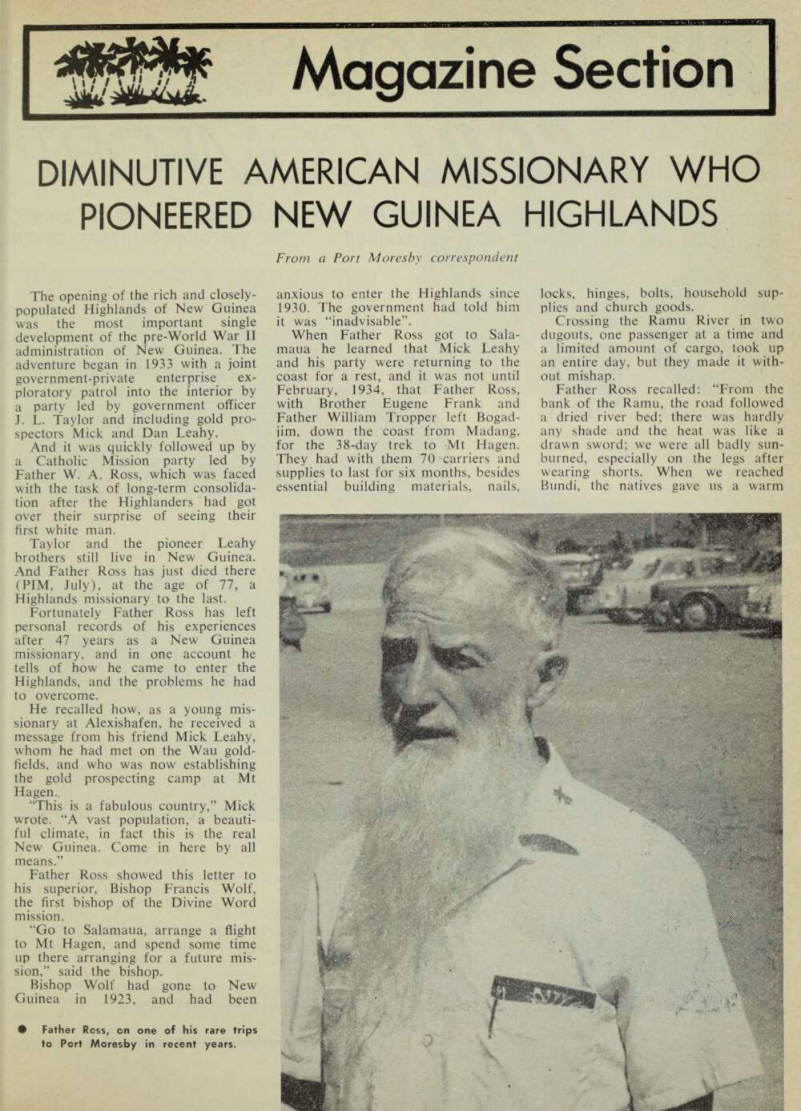

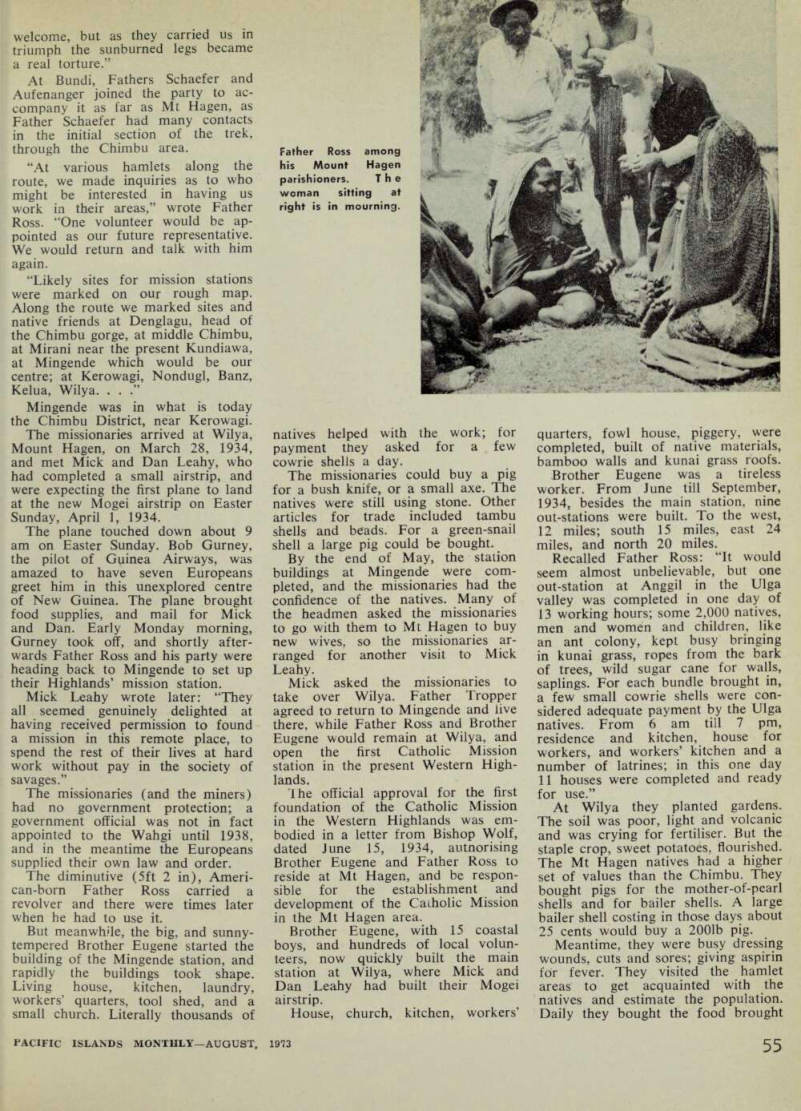
Diminutive American Missionary Who
Pioneered New Guinea Highlands
From a Port Moresby correspondent
The opening of the rich and closely populated Highlands of New Guinea was the most important single development of the pre-World War II administration of New Guinea. The adventure began in 1933 with a joint government-private enterprise ex ploratory patrol into the interior by a party led by government officer J. L. Taylor and including gold pro spectors Mick and Dan Leahy.
And it was quickly followed up by a Catholic Mission party led by Father W. A. Ross, which was faced with the task of long-term consolida tion after the Highlanders had got over their surprise of seeing their first white man.
Taylor and the pioneer Leahy brothers still live in New Guinea.
And Father Ross has just died there (PIM, July), at the age of 77, a Highlands missionary to the last.
Fortunately Father Ross has left personal records of his experiences after 47 years as a New Guinea missionary, and in one account he tells of how he came to enter the Highlands, and the problems he had to overcome.
He recalled how, as a young mis sionary at Alexishafen, he received a message from his friend Mick Leahy, whom he had met on the Wau gold fields, and who was now establishing the gold prospecting camp at Mt Hagen.
“This is a fabulous country,” Mick wrote. “A vast population, a beauti ful climate, in fact this is the real New Guinea. Come in here by all means.”
Father Ross showed this letter to his superior, Bishop Francis Wolf, the first bishop of the Divine Word mission.
“Go to Salamaua, arrange a flight to Mt Hagen, and spend some time up there arranging for a future mis sion,” said the bishop.
Bishop Wolf had gone to New Guinea in 1923, and had been
anxious to enter the Highlands since 1930. The government had told him it was “inadvisable”.
When Father Ross got to Salamaua he learned that Mick Leahy and his party were returning to the coast for a rest, and it was not until February, 1934, that Father Ross, with Brother Eugene Frank and Father William Tropper left Begadjim, down the coast from Madang, for the 38-day trek to Mt Hagen.
They had with them 70 carriers and supplies to last for six months, besides essential building materials, nails,
locks, hinges, bolts, household sup plies and church goods, Crossing the Ramu River in two dugouts, one passenger at a time and a limited amount of cargo, took up an entire day, but they made it with out mishap.
Father Ross recalled: “From the bank of the Ramu, the road followed a dried river bed; there was hardly any shade and the heat was like a drawn sword; we were all badly sun burned, especially on the legs after wearing shorts. When we reached Bundi, the natives gave us a warm
• Father Ross, on one of his rare trips to Port Moresby in recent years.
welcome, but as they carried us in triumph the sunburned legs became a real torture.”
At Bundi, Fathers Schaefer and Aufenanger joined the party to ac company it as far as Mt Hagen, as Father Schaefer had many contacts in the initial section of the trek, through the Chimbu area.
“At various hamlets along the route, we made inquiries as to who might be interested in having us work in their areas,” wrote Father Ross. “One volunteer would be ap pointed as our future representative.
We would return and talk with him again.
“Likely sites for mission stations were marked on our rough map.
Along the route we marked sites and native friends at Denglagu, head of the Chimbu gorge, at middle Chimbu, at Mirani near the present Kundiawa, at Mingende which would be our centre; at Kerowagi, Nondugl, Banz, Kelua, Wilya. . . .”
Mingende was in what is today the Chimbu District, near Kerowagi.
The missionaries arrived at Wilya, Mount Hagen, on March 28, 1934, and met Mick and Dan Leahy, who had completed a small airstrip, and were expecting the first plane to land at the new Mogei airstrip on Easter Sunday, April 1, 1934.
The plane touched down about 9 am on Easter Sunday. Bob Gurney, the pilot of Gqinea Airways, was amazed to have seven Europeans greet him in this unexplored centre of New Guinea, The plane brought food supplies, and mail for Mick and Dan. Early Monday morning, Gurney took off, and shortly after wards Father Ross and his party were heading back to Mingende to set up their Highlands’ mission station.
Mick Leahy wrote later: “They all seemed genuinely delighted at having received permission to found a mission in this remote place, to spend the rest of their lives at hard work without pay in the society of savages.”
The missionaries (and the miners) had no government protection; a government official was not in fact appointed to the Wahgi until 1938, and in the meantime the Europeans supplied their own law and order.
The diminutive (sft 2 in), Ameri can-born Father Ross carried a revolver and there were times later when he had to use it.
But meanwhile, the big, and sunny tempered Brother Eugene started the building of the Mingende station, and rapidly the buildings took shape.
Living house, kitchen, laundry, workers’ quarters, tool shed, and a small church. Literally thousands of
natives helped with the work; for payment they asked for a few cowrie shells a day.
The missionaries could buy a pig for a bush knife, or a small axe. The natives were still using stone. Other articles for trade included tambu shells and beads. For a green-snail shell a large pig could be bought.
By the end of May, the station buildings at Mingende were completed, and the missionaries had the confidence of the natives. Many of the headmen asked the missionaries to go with them to Mt Hagen to buy new wives, so the missionaries arranged for another visit to Mick Leahy.
Mick asked the missionaries to take over Wilya. Father Tropper agreed to return to Mingende and live there, while Father Ross and Brother Eugene would remain at Wilya, and open the first Catholic Mission station in the present Western Highlands. the official approval for the first foundation of the Catholic Mission in the Western Highlands was embodied in a letter from Bishop Wolf, dated June 15, 1934, autnorising Brother Eugene and Father Ross to reside at Mt Hagen, and be responsible for the establishment and development of the Catholic Mission in the Mt Hagen area.
Brother Eugene, with 15 coastal boys, and hundreds of local volunteers, now quickly built the main station at Wilya, where Mick and Dan Leahy had built their Mogei airstrip.
House, church, kitchen, workers’
quarters, fowl house, piggery, were completed, built of native materials, bamboo walls and kunai grass roofs.
Brother Eugene was a tireless worker. From June till September, 1934, besides the main station, nine out-stations were built. To the west, 12 miles; south 15 miles, east 24 miles, and north 20 miles.
Recalled Father Ross: “It would seem almost unbelievable, but one out-station at Anggil in the Ulga valley was completed in one day of 13 working hours; some 2,000 natives, men and women and children, like an ant colony, kept busy bringing in kunai grass, ropes from the bark of trees, wild sugar cane for walls, saplings. For each bundle brought in, a few small cowrie shells were con sidered adequate payment by the Ulga natives. From 6 am till 7 pm, residence and kitchen, house for workers, and workers’ kitchen and a number of latrines; in this one day 11 houses were completed and ready for use.”
At Wilya they planted gardens.
The soil was poor, light and volcanic and was crying for fertiliser. But the staple crop, sweet potatoes, flourished.
The Mt Hagen natives had a higher set of values than the Chimbu. They bought pigs for the mother-of-pearl shells and for bailer shells. A large bailer shell costing in those days about 25 cents would buy a 2001 b pig.
Meantime, they were busy dressing wounds, cuts and sores; giving aspirin for fever. They visited the hamlet areas to get acquainted with the natives and estimate the population.
Daily they bought the food brought
Father Ross among his Mount Hagen
parishioners. The
woman sitting at right is in mourning.
in by the natives, for everyone had more than enough for his own use.
They had a small church at Wilya where, every Sunday, mass was celebrated, but very few of the local natives attended services, not know ing what it was all about. Finally the turning point came.
Father Ross tells it: “In December, 1934, the local paramount chief of the Mogei Nampoga clan came to me and asked what might seem a very blunt question, but a question for which I had been waiting patiently all these months. Six months had passed since we took up residence at Wilya.
“Nindi, the chief, asked me: ‘What do you want from us; when is the pay-off? You have been here six months now, buying our food and pigs, paying us well; you have looked after our sick, attended to our sores, wounds and bruises, now we want to know when you are going to give us the bill, for in our way of life, nothing is given for nothing, and we presume you are the same.’
“I replied to Nindi, ‘That is the question I have been waiting for and here is my answer. We do not want your land, your women or your pigs.
We wish to open a boarding school where your boys from the ages of 10 to 16 will be taught to read and write. You have seen us looking at books, writing on paper. This art we shall teach your boys; they will live at our mission station and go to school each day,’
“Nindi then asked, ‘Will we have to find food for the boys?’ I told him we would take care of the food. ‘We can take 50 boys.’ Nindi said, T can send you 100 boys if you want them.’
“No,' I said, ‘for the beginning 50 is the limit. We shall open the school right after the New Year’.”
By January, 1935, the site for the boarding school and boys’ quarters had been cleared and Brother Eugene decided to go to Bundi for a few weeks for a rest.
Before he left with 10 coastal boys he said to Father Ross, “Please don’t build the school before I get back.
I really want to have that privilege, the first Catholic school in the Western Highlands.”
Brother Eugene did not come back.
Six days later, at Mingende, he learned that Father Carl Morsch heuser had been killed by the natives, and despite warnings by friendly natives not to go through the Chimbu river area, where the clans were at war, he started up the Chimbu gorge.
Soon after, fully-armed natives swarmed down on the party and Brother Eugene was struck eight
times by bone-tipped arrows and most of the carriers fled in panic.
The missionary was stripped and left for dead.
Remarkably, soon after, Brother Eugene, weak and exhausted, was helped to a small mountain hut by a friendly group of natives, where several days later he was found by District Officer Bob Melrose, of Salamaua, who had flown in to Kun diawa to investigate the killing of Father Morschheuser.
Father Morschheuser had died on December 16 from arrow wounds.
Brother Eugene died a week after he was flown to Salamaua.
“Only a man of his magnificent physique and strength could have survived so long,” Father Ross wrote.
Following these murders, the New Guinea Administration came under fire from Australian newspapers, which demanded to know why mis sionaries should be permitted to endanger their lives by entering areas where there was no government pro tection. As a result, the government announced strict restrictions—no more missionaries would be permitted
to enter the Highlands, and those already there would not be permitted to leave their main stations, Father Ross found the station re striction a help, because full time could be given to learning the native language and composing books for the new school, The first classes opened in March, 1935. The boys were taught reading and writing, Pidgin-English and English, arithmetic. There were 50 boys in two classes. The training of these boys continued through 1937 and 1938, for meanwhile, the re strictions on the missionaries were eased to allow missionaries to enter the Highlands after four years coastal experience, and equipped with four rifles to each party.
On Christmas Day, 1938, 28 schoolboys were baptised. This was the first group in the Western High lands to become members of the Catholic Mission—Father Ross had succeeded in bringing the Word, When he died in May he was still in the Highlands, where he had spent almost all of his 47 years in New Guinea, still bringing the Word.
Advertisements & other items, p. 58 (1 item)
Cool Comfori
WILD COLOURS
1973 FRENCH KNIT RANGE OF CAR SEAT COVERS AND BEACH WEAR ARE THE "IN THING"
GIVE YOUR CAR THE BIG LIFT WITH RELAXARIDE ... THE SUPERIOR CAR SEAT COVER
Jt men
Knit
NYLON
RELAXARIDE
... i i ■ ■ ■■■ ■ *vj i P* M m
AVAILABLE FROM:
FRENCH KNIT PTY. LTD., French Knit House, 18 Commonwealth Street, Sydney, 2000. Cable: Knitmills.
TRADE ENQUIRIES:
PETER FISHER TRADING PTY. LTD., 321 Pitt Street, Sydney, 2000. Cable: Fisherion.
Mercedes Benz 300 SL Roadster by courtesy of Mr. Adrian Ashton, Melbourne, Victoria,
A Missionary Who Kept Up
His Diary To The Last
The diaries of a missionary, who spent 35 years in Samoa in the 19th century, are among the latest documents to be microfilmed for the member libraries of the Pacific Manuscripts Bureau, of the ANU in Canberra. The diaries were kept by the Rev Henry Nisbet, who went to Samoa for the London Missionary Society in 1841 and died there in 1876 They have been copied on three reels of microfilm and catalogued as PMB [ , , . 7 070 , Nisbet was born 1818 and became associated with the LMS in his 18th year He had barely reached his ma,ority when he was appointed as a missionary to Tanna. New Hebrides. He sailed from England in August, 1840 and reached Sydney in the following January; but instead of sailing direct to the New Hebrides he went on to Samoa.
In January, 1842 he sailed for Tanna in the mission ship, Camden, but returned to Samoa early in the following year. In 1846 and 1848 Nisbet visited Niue, the New Hebrides and the Loyalty Islands on behalf of his
mission. During his 1848 tour, he chose the island of Aneityum as a suitable site for a mission station, and it was there that the Rev Dr John Geddie of Nova Scotia opened a mission for the Presby terian Church in May of that year.
In 1850, Nisbet took charge of the LMS mission station at Sapapali’i, Samoa, and in 1859 he became head of the seminary at Malua. Eight years later he journeyed to England for his first visit to his homeland in 26 years.
He subsequently paid a long visit to Canada, and returned to Samoa by way of England at the end of 1870. Most of the remaining years of his life were spent in Samoa.
Nisbet kept a daily diary until 10 days before his death, and, although they seldom contain more than brief accounts of his own activities, they will undoubtedly be of considerable value to scholars interested in Samoa and the work of the LMS. Some letters from Nisbet to his second wife, Lydia Lantoret, are included in the microfilms.
Advertisements & other items, pp. 61-68 (1 item)
“So this is a Lamborghini,’
she breathed, as we sped down the autostrada towards l\irin.
“Yes,” I said, offering her a Benson and Hedges. “Five forward gears and 170 in top.’
“Can you prove that?” she demanded.
“Do I really have to? You did say you only wanted a little car to do the
shopping.’
9ft ' -V ; m sM: gn m X X ms V V I >e will do.
Benson & Hedj When only th* m mm 4 016 P 3408 6 73
& oo ,iv . xiM
%| MIO
»v . ■
.jmEYrnw.
*fUCEOF4USTBAtM
EBiai • • --<« ... "
IjP^
guprl Jfe;- ,* X.'
25 KG Wf r
!# ■< A 1 Mißfei
the most important ingredient
BREAD FLOURS:
CAKE FLOURS;
BISCUIT FLOURS;
SPECIALITY FLOURS:
• MAINTOP —high protein bread flour • ANCHOR —bakers flour • 50/50 MEAL —brown bread • MEDIUM —cake and pastry • SPONGE —sponge cakes • SPECIAL CAKE —madeira and cup cakes • STRONG —cracker biscuits • MEDIUM —Shortbreads • SOFT —sweet biscuits • RYE flour • RYE meal • KIBBLED RYE • SHARPS —roti and chapati flour • 100% STONE GROUND
WHOLEMEAL
GILLESPIE BROS. PTY. LTD.
HEAD OFFICE: BRISBANE OFFICE:
52 UNION ST., PYRMONT, SYDNEY, N.S.W. CABLE ADDRESS: ALBION, BRISBANE, QUEENSLAND. (G.P.O BOX 2518, SYDNEY, 2001.) "GILLESPIE", (P.O. BOX 8, ALBION, BRISBANE, 4010.) PHONE: 660-4933. SYDNEY AND BRISBANE. PHONE; 6-1121.
Bacardi
ice and
what else?
... nothing else if you feel so inclined, for there’s no real problem where and how and what you drink Bacardi rum with.
Because Bacardi rum is so light, dry, highly refined and pure it complements every mixer, yet remains distinctively itself. Bacardi and Coke and ice ... Bacardi and ginger... Bacardi and tonic with a zest of lemon or lime ... Bacardi and fruit juice ... Mix up your own Bacardi party.
Because ...
Anything
goes with
Bacardi rum
BACARDI
rum-the mixaUe one. * 4 irdi and the B; Bacard fnd Comp;
m W *1 V m 1i m m %
Half the fun in driving
a Toyota is feeling
how well ifs made.
When Toyota puts a car together, they put it all together.
Like engines that deliver more power and more miles, and do it on less gas. Interiors that seem to shorten the longest trip And styling that keeps heads turning in your direction.
But that's only half the story.
Every Toyota you can buy comes complete with a suspension system that smooths out the roads.
Starting and cruising speeds that leave others behind. Cornering that keeps you glued to the road.
And brakes that stop you dead in your tracks.
That's the fun half Anri it'c all tnnpthpr in each of the To> So put yourself b< of one soon and g that great Toyota PAPUA NEW GUINEA: ELA MOTORS LIMITED, Scratchley Rd., Badili, Papua U.S. TRUST TERRITORY: MICROL CORPORATION, P.O Box 267, Saipan FIJI ISLANDS: AUTOMOTIVE SUPPLIES CO., LTD , G.P.O. Box 355. Suva AMERICAN SAMOA; BURNS PHILP (SOUTH SEA) CO , LTD .Pago Pago WESTERN SAMOA: BURNS PHILP (SOUTH SEA) LTD.. P.O. Box 188, Apia GUAM: RICKY's AUTO CO . PO, Box 1458, Agana NEW HEBRIDES; NEW HEBRIDES MOTORS LTD , P.O. Box 18, Vila SOLOMON ISLANDS: ZEPHYR SERVICE STATION PTY LTD . P.O. Box 174, Honiara NEW CALEDONIA: SOCIETE DTMPORTATION AUTOMOBILE DU PACIFIC, B.P 438, Noumea TAHITI: ETABLISSEMENTS E.A MARTIN & FILS.B.P. 61 Papeete COOK ISLANDS: COOK ISLANDS TRADING CORPORATION LTD , P 0 Box 92. Rarotonga
TOYOTA 1
Corolla
1 ■ % ii
LLLI
V I r r m *
%»iI f » I
I. ♦a* > / * OM . f It N 639
A:* ■ :is> f >1 «• if ■> •• /
rfesw
Efcff iit j® £ fa ,>, ! M ™ v ¥ $ #. *** ■la ■ sa* *'s» t, it ; *? '\ o '' , ; V«l ? t 'ur.'u / -i '
$ IfSp << ';..! ‘.;-^\A -5
f *- M&h&s &{&\* t s?*f\ *A*, h :- ;: J# ,4»%V3 2<‘ v :•: % -“; *% A&x -s-li'.-. -- .: ■>. I.J , :£ ’
MOST EXPERIENCED
"%M
Itotf'M 3,:;
c_*.. * ;vw* ■v3fe ygjg
Swfoli
>m , mjm.
SB 1
' PRODUCERS OF BRUNTONS
>KV J ;>'- FAMOUS
ROrAL.BAKERS' FLOURS
CAKE, BISCUIT AND NOODLE
FLOURS, SHARPS, ETC.
iip *
pfliplp
■/*■' :Sk v rm. \\ mmk- *Wk mmm
Enjoy world-famous
1 Get together over a San Miguel Export or San Miguel Pilsener.
Both have the taste that makes you want another.
No opener needed.
NEW!
Easy open Rip Cap ttLSENiSI
ruU
BEER
SEil Now brewed in Papua New Guinea by PNG Brewery Pty. Ltd. a subsidiary of San Miguel & Swan Holdings Limited, Spring Garden Road, Hohola, Port Moresby.
The taste that makes you want another
Mana
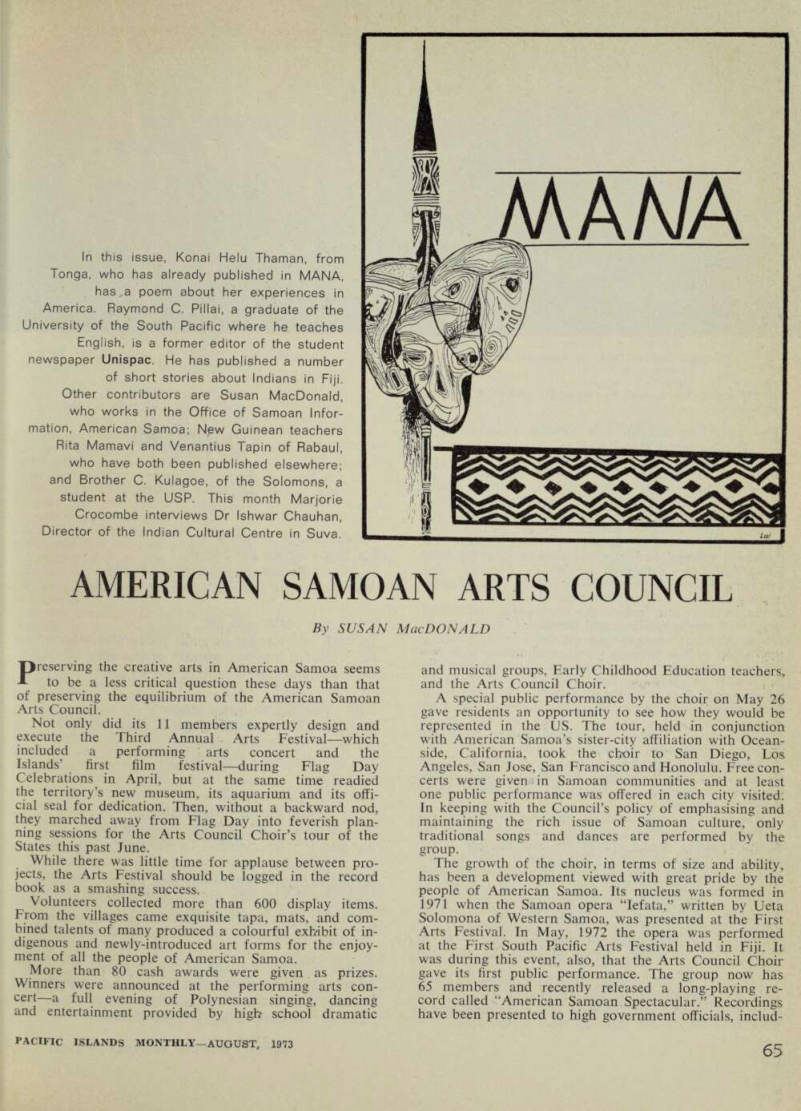
In this issue, Konai Helu Thaman, from Tonga, who has already published in MANA, has.a poem about her experiences in America. Raymond C. Pillai, a graduate of the University of the South Pacific where he teaches English, is a former editor of the student newspaper Unispac. He has published a number of short stories about Indians in Fiji.
Other contributors are Susan MacDonald, who works in the Office of Samoan Infor mation, American Samoa; New Guinean teachers Rita Mamavi and Venantius Tapin of Rabaul, who have both been published elsewhere; and Brother C. Kulagoe, of the Solomons, a student at the USP. This month Marjorie Crocombe interviews Dr Ishwar Chauhan, Director of the Indian Cultural Centre in Suva.
American Samoan Arts Council
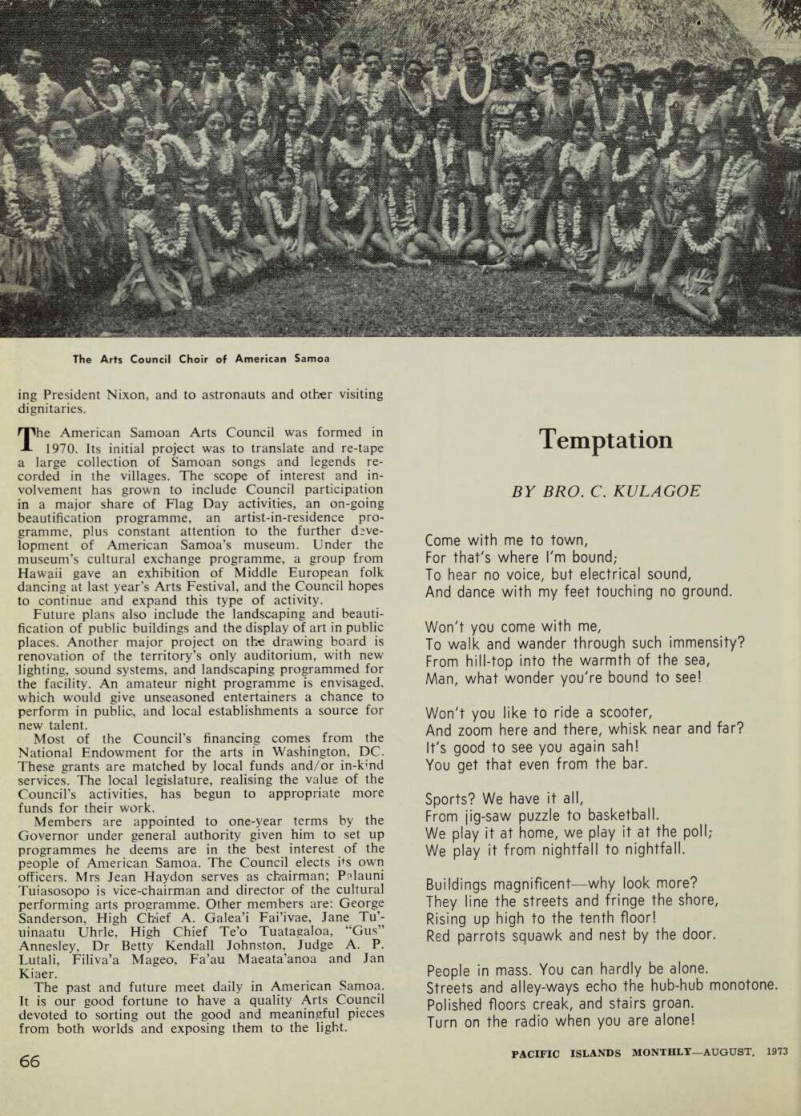
By Susan Macdonald
preserving the creative arts in American Samoa seems A to be a less critical question these days than that of preserving the equilibrium of the American Samoan Arts Council.
Not only did its 11 members expertly design and execute the Third Annual Arts Festival—which included a performing arts concert and the Islands’ first film festival—during Flag Day Celebrations in April, but at the same time readied the territory’s new museum, its aquarium and its offi cial seal for dedication. Then, without a backward nod, they marched away from Flag Day into feverish plan ning sessions for the Arts Council Choir’s tour of the States this past June.
While there was little time for applause between pro jects, the Arts Festival should be logged in the record book as a smashing success.
Volunteers collected more than 600 display items.
From the villages came exquisite tapa, mats, and com bined talents of many produced a colourful exbibit of in digenous and newly-introduced art forms for the enjoy ment of all the people of American Samoa.
More than 80 cash awards were given as prizes.
Winners were announced at the performing arts con cert —a full evening of Polynesian singing, dancing and entertainment provided by high school dramatic
and musical groups, Early Childhood Education teachers, and the Arts Council Choir.
A special public performance by the choir on May 26 gave residents an opportunity to see how they would be represented in the US. The tour, held in conjunction with American Samoa’s sister-city affiliation with Ocean side, California, took the choir to San Diego, Los Angeles, San Jose, San Francisco and Honolulu. Free con certs were given in Samoan communities and at least one public performance was offered in each city visited.
In keeping with the Council’s policy of emphasising and maintaining the rich issue of Samoan culture, only traditional songs and dances are performed by the group.
The growth of the choir, in terms of size and ability, has been a development viewed with great pride by the people of American Samoa. Its nucleus was formed in 1971 when the Samoan opera “lefata,” written by Ueta Solomona of Western Samoa, was presented at the First Arts Festival. In May, 1972 the opera was performed at the First South Pacific Arts Festival held in Fiji. It was during this event, also, that the Arts Council Choir gave its first public performance. The group now has 65 members and recently released a long-playing re cord called “American Samoan Spectacular/’ Recordings have been presented to high government officials, includ-
ing President Nixon, and to astronauts and other visiting dignitaries.
The American Samoan Arts Council was formed in 1970. Its initial project was to translate and re-tape a large collection of Samoan songs and legends re corded in the villages. The scope of interest and in volvement has grown to include Council participation in a major share of Flag Day activities, an on-going beautification programme, an artist-in-residence pro gramme, plus constant attention to the further deve lopment of American Samoa’s museum. Under the museum’s cultural exchange programme, a group from Hawaii gave an exhibition of Middle European folk dancing at last year’s Arts Festival, and the Council hopes to continue and expand this type of activity.
Future plans also include the landscaping and beauti fication of public buildings and the display of art in public places. Another major project on the drawing board is renovation of the territory’s only auditorium, with new lighting, sound systems, and landscaping programmed for the facility. An amateur night programme is envisaged, which would give unseasoned entertainers a chance to perform in public, and local establishments a source for new talent.
Most of the Council’s financing comes from the National Endowment for the arts in Washington, DC.
These grants are matched by local funds and/or in-kmd services. The local legislature, realising the value of the Council’s activities, has begun to appropriate more funds for their work.
Members are appointed to one-year terms by the Governor under general authority given him to set up programmes he deems are in the best interest of the people of American Samoa. The Council elects i f s own officers. Mrs Jean Haydon serves as chairman; Tuiasosopo is vice-chairman and director of the cultural performing arts programme. Other members are: George Sanderson, High Chief A. Galea’i Fai’ivae, Jane Tu’uinaatu Uhrle, High Chief Te’o Tuatagaloa, “Gus”
Annesley, Dr Betty Kendall Johnston, Judge A. P.
Lutali, Filiva’a Mageo, Fa’au Maeata’anoa and Jan Kiaer.
The past and future meet daily in American Samoa.
It is our good fortune to have a quality Arts Council devoted to sorting out the good and meaningful pieces from both worlds and exposing them to the light.
The Arts Council Choir of American Samoa
Temptation
By Bro. C. Kulagoe
Come with me to town, For that's where I'm bound; To hear no voice, but electrical sound, And dance with my feet touching no ground.
Won't you come with me, To walk and wander through such immensity?
From hill-top into the warmth of the sea, Man, what wonder you're bound to see!
Won't you like to ride a scooter, And zoom here and there, whisk near and far?
It's good to see you again sah!
You get that even from the bar.
Sports? We have it all, From jig-saw puzzle to basketball.
We play it at home, we play it at the poll; We play it from nightfall to nightfall.
Buildings magnificent—why look more?
They line the streets and fringe the shore, Rising up high to the tenth floor!
Red parrots squawk and nest by the door.
People in mass. You can hardly be alone.
Streets and alley-ways echo the hub-hub monotone.
Polished floors creak, and stairs groan.
Turn on the radio when you are alone!
The Ass In Lion’S Skin
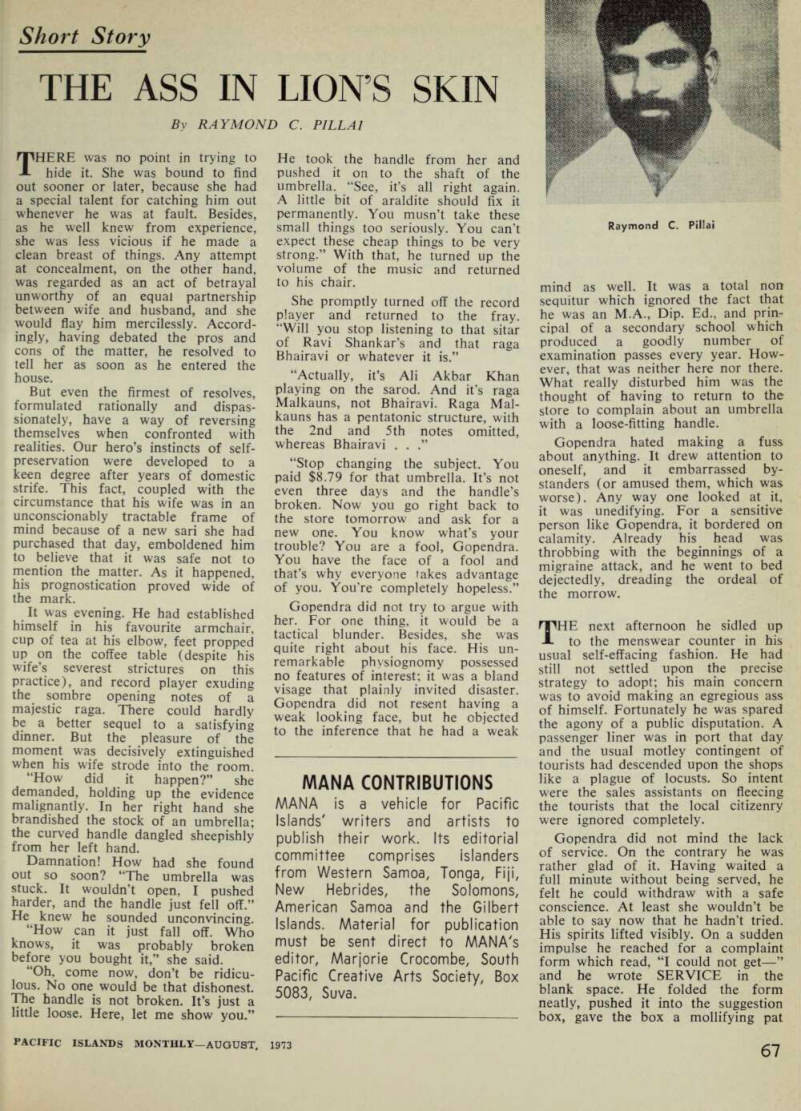
Short Story
By Raymond C. Pillai
THERE was no point in trying to hide it. She was bound to find out sooner or later, because she had a special talent for catching him out whenever he was at fault. Besides, as he well knew from experience, she was less vicious if he made a clean breast of things. Any attempt at concealment, on the other hand, was regarded as an act of betrayal unworthy of an equal partnership between wife and husband, and she would flay him mercilessly. Accord ingly, having debated the pros and cons of the matter, he resolved to tell her as soon as he entered the house.
But even the firmest of resolves, formulated rationally and dispas sionately, have a way of reversing themselves when confronted with realities. Our hero’s instincts of self preservation were developed to a keen degree after years of domestic strife. This fact, coupled with the circumstance that his wife was in an unconscionably tractable frame of mind because of a new sari she had purchased that day, emboldened him to believe that it was safe not to mention the matter. As it happened, his prognostication proved wide of the mark.
It was evening. He had established himself in his favourite armchair, cup of tea at his elbow, feet propped up on the coffee table (despite his wife’s severest strictures on this practice), and record player exuding the sombre opening notes of a majestic raga. There could hardly be a better sequel to a satisfying dinner. But the pleasure of the moment was decisively extinguished when his wife strode into the room.
“How did it happen?” she demanded, holding up the evidence malignantly. In her right hand she brandished the stock of an umbrella; the curved handle dangled sheepishly from her left hand.
Damnation! How had she found out so soon? “The umbrella was stuck. It wouldn’t open, I pushed harder, and the handle just fell off.”
He knew he sounded unconvincing.
“How can it just fall off. Who knows, it was probably broken before you bought it,” she said.
“Oh, come now, don’t be ridicu lous. No one would be that dishonest.
The handle is not broken. It’s just a little loose. Here, let me show you.”
He took the handle from her and pushed it on to the shaft of the umbrella. “See, it’s all right again.
A little bit of araldite should fix it permanently. You musn’t take these small things too seriously. You can’t expect these cheap things to be very strong.” With that, he turned up the volume of the music and returned to his chair.
She promptly turned off the record player and returned to the fray.
“Will you stop listening to that sitar of Ravi Shankar’s and that raga Bhairavi or whatever it is.”
“Actually, it’s Ali Akbar Khan playing on the sarod. And it’s raga Malkauns, not Bhairavi. Raga Mal kauns has a pentatonic structure, with the 2nd and sth notes omitted, whereas Bhairavi . . .”
“Stop changing the subject. You paid $8.79 for that umbrella. It’s not even three days and the handle’s broken. Now you go right back to the store tomorrow and ask for a new one. You know what’s your trouble? You are a fool, Gopendra.
You have the face of a fool and that’s why everyone takes advantage of you. You’re completely hopeless.”
Gopendra did not try to argue with her. For one thing, it would be a tactical blunder. Besides, she was quite right about his face. His un remarkable physiognomy possessed no features of interest; it was a bland visage that plainly invited disaster.
Gopendra did not resent having a weak looking face, but he objected to the inference that he had a weak
mind as well. It was a total non sequitur which ignored the fact that he was an M.A., Dip. Ed., and prin cipal of a secondary school which produced a goodly number of examination passes every year. How ever, that was neither here nor there.
What really disturbed him was the thought of having to return to the store to complain about an umbrella with a loose-fitting handle.
Gopendra hated making a fuss about anything. It drew attention to oneself, and it embarrassed by standers (or amused them, which was worse). Any way one looked at it, it was unedifying. For a sensitive person like Gopendra, it bordered on calamity. Already his head was throbbing with the beginnings of a migraine attack, and he went to bed dejectedly, dreading the ordeal of the morrow.
THE next afternoon he sidled up to the menswear counter in his usual self-effacing fashion. He had still not settled upon the precise strategy to adopt; his main concern was to avoid making an egregious ass of himself. Fortunately he was spared the agony of a public disputation. A passenger liner was in port that day and the usual motley contingent of tourists had descended upon the shops like a plague of locusts. So intent were the sales assistants on fleecing the tourists that the local citizenry were ignored completely.
Gopendra did not mind the lack of service. On the contrary he was rather glad of it. Having waited a full minute without being served, he felt he could withdraw with a safe conscience. At least she wouldn’t be able to say now that he hadn’t tried.
His spirits lifted visibly. On a sudden impulse he reached for a complaint form which read, “I could not get —” and he wrote SERVICE in the blank space. He folded the form neatly, pushed it into the suggestion box, gave the box a mollifying pat
Raymond C. Pillai
The Ass in Lion’s Skin . . .
(Continued from previous page)
to indicate that he bore no personal ill-will, then fled in a rush of relief.
His wife was not particularly im pressed by his defence. “Gopendra, you’re an ass. If you just stand in front of a counter, you’ll end up standing all day. You have to demand to be served nowadays. You should have showed them the broken handle and complained loudly for all the tourists in the shop to hear. If you did that, they would have given you a new umbrella and pushed you out of the place within 10 seconds.”
“If I did that, I would have ended up in The Fiji Times’ with their usual corny headlines—Broken Brolly Brouhaha’ or something like that. I hate making a fuss.”
“You know,” said Gopendra’s wife, her eyes narrowing questioningly.
“I don’t think you really tried. You go back right now and tell them to give you a new one.”
“But they’ll be closed by the time I go back,” bleated Gopendra feebly.
“Well, then, you pick up the phone and complain to the manager right now,”
“Yes, daddy,” his children chorused gleefully. “Tell the manager off properly!”
THIS was appalling. But there was no escape. His whole family were waiting for him to make a move.
Waiting expectantly, almost mali ciously, because they all knew he was incapable of verbal violence.
Fate, however, had a surprise in store for them. It was a strange Gopendra they heard expostulating on the phone, a Gopendra who spoke with alien authority. “Look, Mr Haddock, I know there’s a ship in port but . . . What’s that? . . . Yes, I know it’s busy on such occasions, but that’s no reason for discriminat ing against locals. It’s about time you expatriates go off your high horses and . . . What? . . . No, I’m not a racist, I’m . . . No, I’m not being irrational either. I’m just asking for fair play, which isn’t too much to ask, surely . . .” And so it went. At the end of the conversation Gopendra announced that the merchandise manager would personally hand him a new umbrella. It was an incredible performance which left his family stupefied. How could such a timid man accomplish such marvels?. A
hubbub of disbelief broke about his ears.
Gopendra, savouring the attention he was now getting, explained that he was a peaceable man, but when roused he could be a veritable terror.
Perhaps it did not pay to be too easygoing. He had realised now the value of asserting himself and he was going to develop a more force ful personality, he declared. Mrs Gopendra was not sure she liked the implications of that last remark. But a new era had indisputably begun.
The next afternoon it was a trans mogrified Gopendra who swaggered home from school, jauntily twirling a new umbrella.
THE episode of the umbrella was a turning point in Gopendra’s life. He now ruled over his house in a manner befitting his position. His children gave him respect and his wife submitted to his will. Even at school a new regimen prevailed. The students no longer ignored school regulations. His staff now found him to be a tough administrator. Pre viously his teachers used to exploit him shamelessly, knowing him to be
a hen-pecked husband—jokes about
“petticoat government” and “panti socracy” used to be common in the
teachers’ common room. Now the jokes were about “benevolent auto cracy”. It was, to say the least, a startling transformation. And all at the cost of a humble umbrella. Or should I say two umbrellas?
The fact of the matter is that our hero’s new posture rested on a slight deception. For, you see, he had faked the telephone call to the merchandise manager and had purchased a new umbrella the next day, having thrown away the defective one into some neighbour’s garden. Returning home and finding himself lionised by his family, he was forced to live up to his new role, and he played the part so convincingly that he had fooled himself as well. But in view of the results, who is to say that he acted
unwisely?
Gopendra, it should be admitted, was troubled at first because he had compromised his integrity. But his conscience is troubled no more. Being the pedant that he is, he had con sulted his books to mitigate his actions and was granted an absolute discharge by Plato himself. Plato’s counsel was that a ruler may be permitted to lie for the good of the State. So, if a man might lie for the good of the State, might he not lie for the good of his soul?
Mana Contributions
MANA is a vehicle for Pacific Islands' writers and artists to publish their work. Its editorial committee comprises islanders from Western Samoa, Tonga, Fiji, New Hebrides, the Solomons, American Samoa and the Gilbert Islands. Material for publication must be sent direct to MANA's editor, Marjorie Crocombe, South Pacific Creative Arts Society, Box 5083, Suva.
The Encounter
By Konai Held Thaman
I am showered with voices Glorifying this age of freedom; Of Free Love and Do Your Own Thing; But there is Hate and War.
We are free, they say, to love Whom we please Where we please How we please; But we hate the Communists And are apathetic towards Blacks (Although we invite them to dinner) We are not really free In this great country of Liberty To live with our fellow humans; We are so full of lust and self-centredness Overpowered by our own blindness; And we do not know how to love or receive love; Our hearts are dry and cracked And we drift in the path of Fantasy Across the high-rising buildings Of Moneyland Peering only momentarily Into the windows of Life But refusing to enter; For the entrance fee is high The sacrifice is too much to make — It is death of ourselves And the game we play.
(In Song)
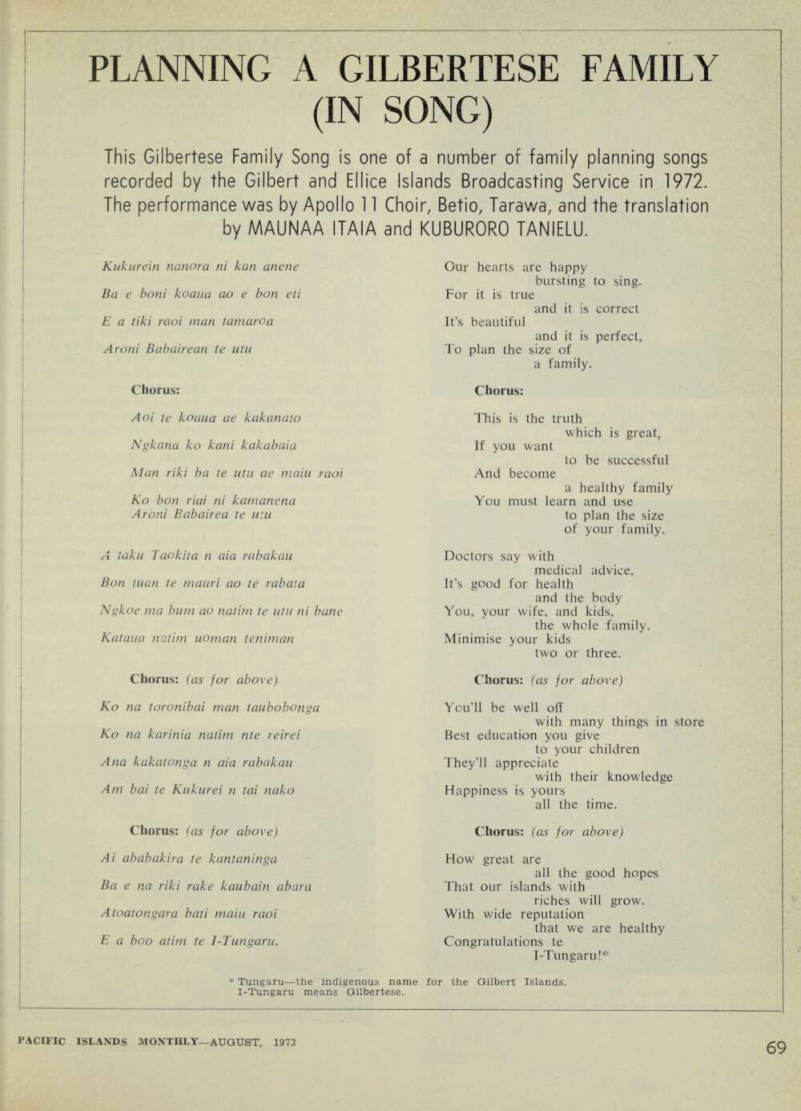
Planning A Gilbertese Family
This Gilbertese Family Song is one of a number of family planning songs recorded by the Gilbert and Ellice Islands Broadcasting Service in 1972.
The performance was by Apollo 11 Choir, Betio, Tarawa, and the translation
By Maunaa Itaia And Kuburoro Tanielu.
Kukurein tianora ni kan anene Ba e boni koaua ao e bon eti E a tiki raoi man tamaroa Aroni Babairean te utu Chorus: Aoi te koaua ae kakanato Ngkana ko kani kakabaia Man riki bate utu ae maiu raoi Ko bon riai ni kamanena Aroni Bab air ea te u:u A taku Taokita n aia rabakau Bon tuan te mauri ao te rabata Ngkoe ma bum ao natim te utu ni bane Katana natim uoman teniman Chorus: (as for above) Ko na toronibai man taubobonga Ko na karinia natim nte reirei Ana kakatonga n aia rabakau Am bai te Kukurei n tai nako Chorus: (as for above) Ai ababakira te kantaninga Ba e na riki rake kaubain abara Atoatongara bati maiu raoi E a boo atim te 1-Tungaru.
Our hearts are happy bursting to sing.
For it is true and it is correct It’s beautiful and it is perfect, To plan the size of a family.
Chorus: This is the truth which is great, If you want to be successful And become a healthy family You must learn and use to plan the size of your family.
Doctors say with medical advice, It’s good for health and the body You, your wife, and kids, the whole family.
Minimise your kids two or three.
Chorus: (as for above) You’ll be well off with many things in store Best education you give to your children They’ll appreciate with their knowledge Happiness is yours all the time.
Chorus: (as for above) How great are all the good hopes That our islands with riches will grow.
With wide reputation that we are healthy Congratulations te I-Tungaru!*
* Tungaru—the indigenous name for the Gilbert Islands.
I-Tungaru means Gilbertese.
Indian Cultural Centre, Suva
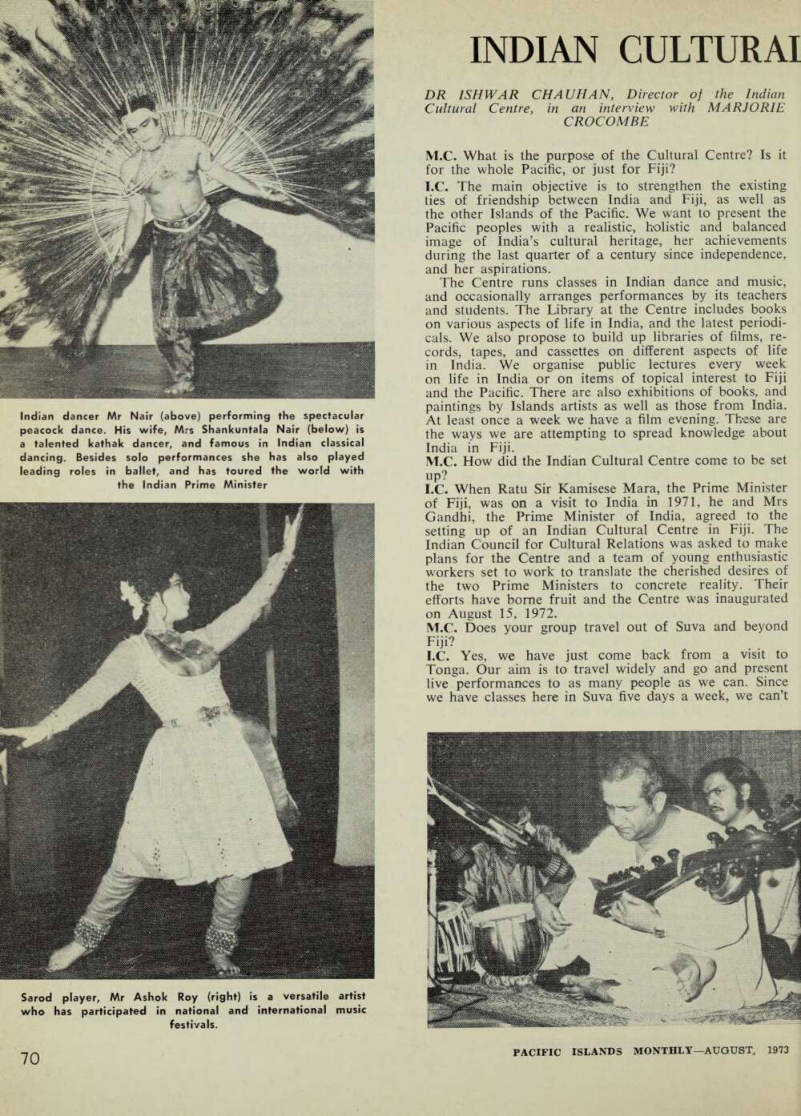
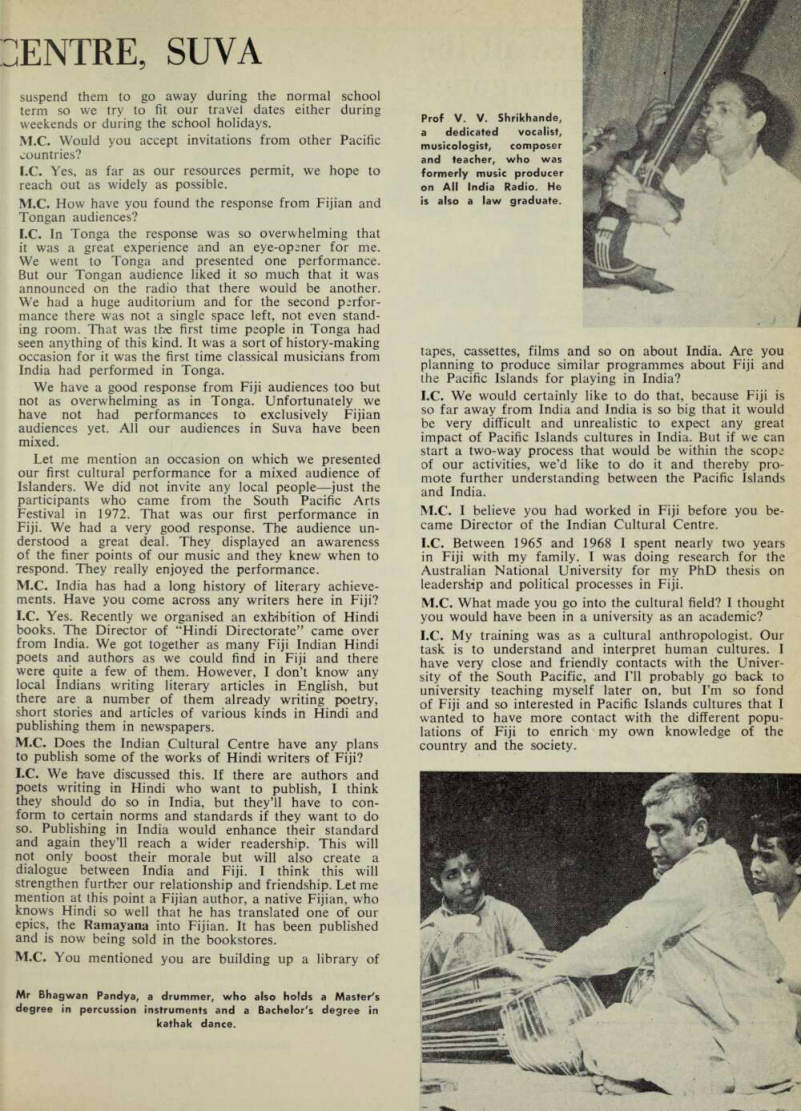
DR ISHWAR CHAUHAN, Director of the Indian Cultural Centre, in an interview with MARJORIE
Crocombe
M.C. What is the purpose of the Cultural Centre? Is it for the whole Pacific, or just for Fiji?
I.C. The main objective is to strengthen the existing ties of friendship between India and Fiji, as well as the other Islands of the Pacific. We want to present the Pacific peoples with a realistic, holistic and balanced image of India’s cultural heritage, her achievements during the last quarter of a century since independence, and her aspirations.
The Centre runs classes in Indian dance and music, and occasionally arranges performances by its teachers and students. The Library at the Centre includes books on various aspects of life in India, and the latest periodi cals. We also propose to build up libraries of films, re cords, tapes, and cassettes on different aspects of life in India. We organise public lectures every week on life in India or on items of topical interest to Fiji and the Pacific. There are also exhibitions of books, and paintings by Islands artists as well as those from India.
At least once a week we have a film evening. These are the ways we are attempting to spread knowledge about India in Fiji.
M.C. How did the Indian Cultural Centre come to be set up?
I.C. When Ratu Sir Kamisese Mara, the Prime Minister of Fiji, was on a visit to India in 1971, he and Mrs Gandhi, the Prime Minister of India, agreed to the setting up of an Indian Cultural Centre in Fiji. The Indian Council for Cultural Relations was asked to make plans for the Centre and a team of young enthusiastic workers set to work to translate the cherished desires of the two Prime Ministers to concrete reality. Their efforts have borne fruit and the Centre was inaugurated on August 15, 1972.
M.C. Does your group travel out of Suva and beyond Fiji?
I.C. Yes, we have just come back from a visit to Tonga. Our aim is to travel widely and go and present live performances to as many people as we can. Since we have classes here in Suva five days a week, we can’t
Indian dancer Mr Nair (above) performing the spectacular peacock dance. His wife, Mrs Shankuntala Nair (below) is a talented kathak dancer, and famous in Indian classical dancing. Besides solo performances she has also played leading roles in ballet, and has toured the world with the Indian Prime Minister
Sarod player, Mr Ashok Roy (right) is a versatile artist who has participated in national and international music festivals.
suspend them to go away during the normal school term so we try to fit our travel dates either during weekends or during the school holidays.
M.C. Would you accept invitations from other Pacific countries?
I.C. Yes, as far as our resources permit, we hope to reach out as widely as possible.
M.C. How have you found the response from Fijian and Tongan audiences?
I.C. In Tonga the response was so overwhelming that it was a great experience and an eye-opener for me.
We went to Tonga and presented one performance.
But our Tongan audience liked it so much that it was announced on the radio that there would be another.
We had a huge auditorium and for the second perfor mance there was not a single space left, not even stand ing room. That was the first time people in Tonga had seen anything of this kind. It was a sort of history-making occasion for it was the first time classical musicians from India had performed in Tonga.
We have a good response from Fiji audiences too but not as overwhelming as in Tonga. Unfortunately we have not had performances to exclusively Fijian audiences yet. All our audiences in Suva have been mixed.
Let me mention an occasion on which we presented our first cultural performance for a mixed audience of Islanders. We did not invite any local people—just the participants who came from the South Pacific Arts Festival in 1972. That was our first performance in Fiji. We had a very good response. The audience un derstood a great deal. They displayed an awareness of the finer points of our music and they knew when to respond. They really enjoyed the performance.
M.C. India has had a long history of literary achieve ments. Have you come across any writers here in Fiji?
I.C. Yes. Recently we organised an exhibition of Hindi books. The Director of “Hindi Directorate” came over from India. We got together as many Fiji Indian Hindi poets and authors as we could find in Fiji and there were quite a few of them. However, I don’t know any local Indians writing literary articles in English, but there are a number of them already writing poetry, short stories and articles of various kinds in Hindi and publishing them in newspapers.
M.C. Does the Indian Cultural Centre have any plans to publish some of the works of Hindi writers of Fiji?
I.C. We have discussed this. If there are authors and poets writing in Hindi who want to publish, I think they should do so in India, but they’ll have to con form to certain norms and standards if they want to do so. Publishing in India would enhance their standard and again they’ll reach a wider readership. This will npt only boost their morale but will also create a dialogue between India and Fiji. I think this will strengthen further our relationship and friendship. Let me mention at this point a Fijian author, a native Fijian, who knows Hindi so well that he has translated one of our epics, the Ramayana into Fijian. It has been published and is now being sold in the bookstores.
M.C. You mentioned you are building up a library of
tapes, cassettes, films and so on about India. Are you planning to produce similar programmes about Fiji and the Pacific Islands for playing in India?
I.C. We would certainly like to do that, because Fiji is so far away from India and India is so big that it would be very difficult and unrealistic to expect any great impact of Pacific Islands cultures in India. But if we can start a two-way process that would be within the scope of our activities, we’d like to do it and thereby pro mote further understanding between the Pacific Islands and India.
M.C. I believe you had worked in Fiji before you be came Director of the Indian Cultural Centre.
I.C. Between 1965 and 1968 I spent nearly two years in Fiji with my family. I was doing research for the Australian National University for my PhD thesis on leadership and political processes in Fiji.
M.C. What made you go into the cultural field? I thought you would have been in a university as an academic?
I.C. My training was as a cultural anthropologist. Our task is to understand and interpret human cultures. I have very close and friendly contacts with the Univer sity of the South Pacific, and I’ll probably go back to university teaching myself later on, but I’m so fond of Fiji and so interested in Pacific Islands cultures that 1 wanted to have more contact with the different popu lations of Fiji to enrich my own knowledge of the country and the society.
Mr Bhagwan Pandya, a drummer, who also holds a Master's degree in percussion instruments and a Bachelor's degree in kathak dance.
Prof V. V. Shrikhande, a dedicated vocalist, musicologist, composer and teacher, who was formerly music producer on Ail India Radio. He is also a law graduate.
Advertisements & other items, p. 75 (1 item)
Centre, Suva
Where have all the young men gone?
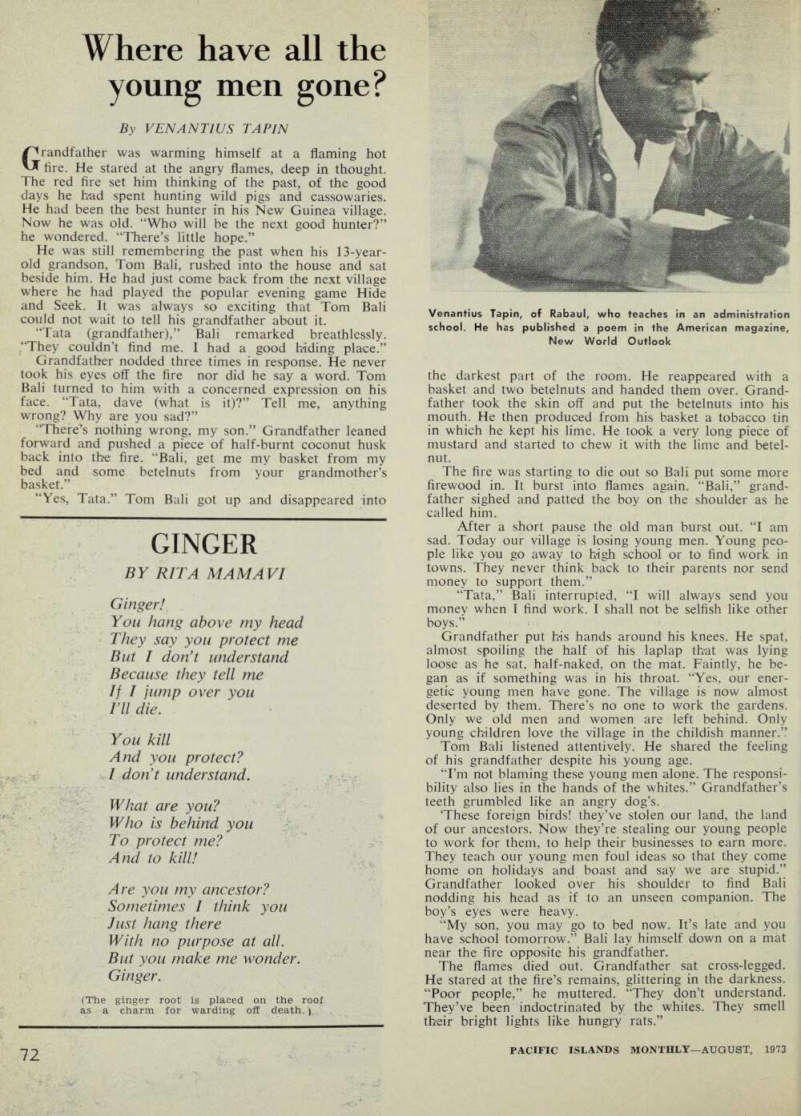
young men gone?
By Venantius Tapin
Grandfather was warming himself at a flaming hot fire. He stared at the angry flames, deep in thought.
The red fire set him thinking of the past, of the good days he had spent hunting wild pigs and cassowaries.
He had been the best hunter in his New Guinea village.
Now he was old. “Who will be the next good hunter?” he wondered. “There’s little hope.”
He was still remembering the past when his 13-year old grandson, Tom Bali, rushed into the house and sat beside him. He had just come back from the next village where he had played the popular evening game Hide and Seek. It was always so exciting that Tom Bali could not wait to tell his grandfather about it.
“Tata (grandfather),” Bali remarked breathlessly.
“They couldn’t find me. I had a good hiding place.”
Grandfather nodded three times in response. He never took his eyes off the fire nor did he say a word. Tom Bali turned to him with a concerned expression on his face. “Tata, dave (what is it)?” Tell me, anything wrong? Why are you sad?”
“There’s nothing wrong, my son.” Grandfather leaned forward and pushed a piece of half-burnt coconut husk back into the fire. “Bali, get me my basket from my bed and some betelnuts from your grandmother’s basket.”
“Yes, Tata,” Tom Bali got up and disappeared into
the darkest part of the room. He reappeared with a basket and two betelnuts and handed them over. Grand father took the skin off and put the betelnuts into his mouth. He then produced from his basket a tobacco tin in which he kept his lime. He took a very long piece of mustard and started to chew it with the lime and betel nut.
The fire was starting to die out so Bali put some more firewood in. It burst into flames again. "Bali,” grand father sighed and patted the boy on the shoulder as he called him.
After a short pause the old man burst out. “I am sad. Today our village is losing young men. Young peo ple like you go away to high school or to find work in towns. They never think back to their parents nor send money to support them.”
“Tata,” Bali interrupted, “I will always send you money when I find work. I shall not be selfish like other boys.”
Grandfather put his hands around his knees. He spat, almost spoiling the half of his laplap that was lying loose as he sat, half-naked, on the mat. Faintly, he be gan as if something was in his throat. “Yes, our ener getic young men have gone. The village is now almost deserted by them. There’s no one to work the gardens.
Only we old men and women are left behind. Only young children love the village in the childish manner.”
Tom Bali listened attentively. He shared the feeling of his grandfather despite his young age.
“I’m not blaming these young men alone. The responsi bility also lies in the hands of the whites.” Grandfather’s teeth grumbled like an angry dog’s. ‘These foreign birds! they’ve stolen our land, the land of our ancestors. Now they’re stealing our young people to work for them, to help their businesses to earn more.
They teach our young men foul ideas so that they come home on holidays and boast and say we are stupid.”
Grandfather looked over his shoulder to find Bali nodding his head as if to an unseen companion. The boy’s eyes were heavy.
“My son, you may go to bed now. It’s late and you have school tomorrow.” Bali lay himself down on a mat near the fire opposite his grandfather.
The flames died out. Grandfather sat cross-legged.
He stared at the fire’s remains, glittering in the darkness.
"Poor people,” he muttered. “They don’t understand.
They’ve been indoctrinated by the whites. They smell their bright lights like hungry rats.”
Venantius Tapin, of Rabaul, who teaches in an administration school. He has published a poem in the American magazine, New World Outlook
Ginger
By Rita Mamavi
Ginger!
You hang above my head They say you protect me But I don't understand Because they tell me If I jump over you Til die.
You kill And you protect?
I don’t understand.
What are you?
Who is behind you To protect me?
And to kill!
Are you my ancestor?
Sometimes I think you Just hang there With no purpose at all.
But you make me wonder.
Ginger. (The ginger root' is placed on the roof as a charm for warding off death.}
Advertisements & other items, pp. 77-78 (1 item)
Immits I
“Whatever did you do
on a diet before?”
Now you have Limmits, the perfect formula dietary food, all ready to eat as a controlled 300 calorie meal. Limmits provide vitamins and minerals and a sense of satisfaction. Enjoy a Limmits lunch and it will keep you going until dinner, without snacking.
Limmits help limit your weight because it’s the delicious square meal diet in a feast of flavours.- With more than a dozen different flavours in Limmits, you’ll find a favourite. Limmit’s goodness makes good dieting sense. Isn’t it time you changed your dieting life? With Limmits.
IMMITS I
the delicious square meal diet
Vv /'' wk *■ •' * * a V\ ■ '-/s*% Whatever the job to hand, KlinUi J A \ “«Ss „
a jSS^K-sS“
>A n
count on
KLINRII
Yesterday
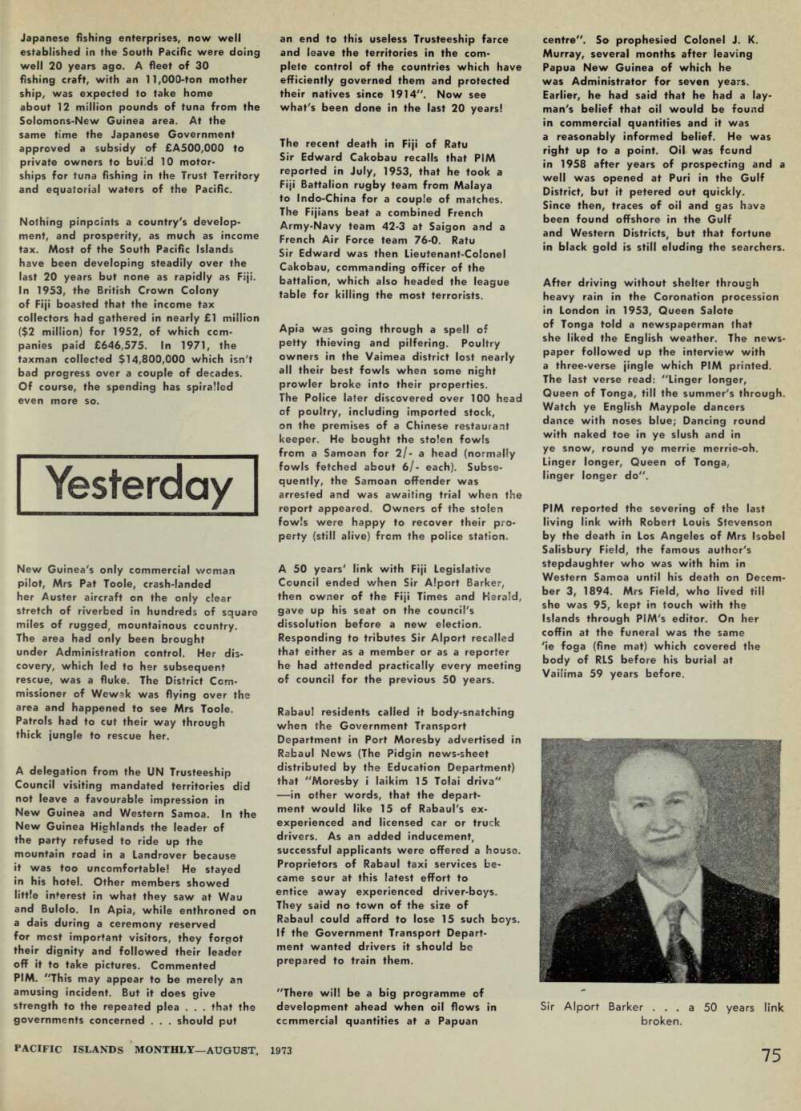
Japanese fishing enterprises, now well established in the South Pacific were doing well 20 years ago. A fleet of 30 fishing craft, with an 11,000-ton mother ship, was expected to take home about 12 million pounds of tuna from the Solomons-New Guinea area. At the same time the Japanese Government approved a subsidy of £A500,000 to private owners to buLd 10 motor ships for tuna fishing in the Trust Territory and equatorial waters of the Pacific.
Nothing pinpoints a country's develop ment, and prosperity, as much as income tax. Most of the South Pacific Islands have been developing steadily over the last 20 years but none as rapidly as Fiji.
In 1953, the British Crown Colony of Fiji boasted that the income tax collectors had gathered in nearly £1 million ($2 million) for 1952, of which com panies paid £646,575. In 1971, the taxman collected $14,800,000 which isn't bad progress over a couple of decades.
Of course, the spending has spiralled even more so.
New Guinea's only commercial woman pilot, Mrs Pat Toole, crash-landed her Auster aircraft on the only clear stretch of riverbed in hundreds of square miles of rugged, mountainous country.
The area had only been brought under Administration control. Her dis covery, which led to her subsequent rescue, was a fluke. The District Com missioner of Wewak was flying over the area and happened to see Mrs Toole.
Patrols had to cut their way through thick jungle to rescue her.
A delegation from the UN Trusteeship Council visiting mandated territories did not leave a favourable impression in New Guinea and Western Samoa. In the New Guinea Highlands the leader of the party refused to ride up the mountain road in a Landrover because it was too uncomfortable! He stayed in his hotel. Other members showed little interest in what they saw at Wau and Bulolo. In Apia, while enthroned on a dais during a ceremony reserved for most important visitors, they forgot their dignity and followed their leader off it to take pictures. Commented PIM. "This may appear to be merely an amusing incident. But it does give strength to the repeated plea . . . that the governments concerned . . . should put
an end to this useless Trusteeship farce and leave the territories in the com plete control of the countries which have efficiently governed them and protected their natives since 1914". Now see what's been done in the last 20 years!
The recent death in Fiji of Ratu Sir Edward Cakobau recalls that PIM reported in July, 1953, that he took a Fiji Battalion rugby team from Malaya to Indo-China for a couple of matches.
The Fijians beat a combined French Army-Navy team 42-3 at Saigon and a French Air Force team 76-0. Ratu Sir Edward was then Lieutenant-Colonel Cakobau, commanding officer of the battalion, which also headed the league table for killing the most terrorists.
Apia was going through a spell of petty thieving and pilfering. Poultry owners in the Vaimea district lost nearly all their best fowls when some night prowler broke into their properties.
The Police later discovered over 100 head of poultry, including imported stock, on the premises of a Chinese restaurant keeper. He bought the stolen fowls from a Samoan for 2/- a head (normally fowls fetched about 6/- each). Subse quently, the Samoan offender was arrested and was awaiting trial when the report appeared. Owners of the stolen fowls were happy to recover their pro perty (still alive) from the police station.
A 50 years' link with Fiji Legislative Council ended when Sir A!port Barker, then owner of the Fiji Times and Herald, gave up his seat on the council's dissolution before a new election.
Responding to tributes Sir Alport recalled that either as a member or as a reporter he had attended practically every meeting of council for the previous 50 years.
Rabaul residents called it body-snatching when the Government Transport Department in Port Moresby advertised in Rabaul News (The Pidgin news-sheet distributed by the Education Department) that "Moresby i laikim 15 Tolai driva" —in other words, that the depart ment would like 15 of Rabaul's ex experienced and licensed car or truck drivers. As an added inducement, successful applicants were offered a house.
Proprietors of Rabaul taxi services be came sour at this latest effort to entice away experienced driver-boys.
They said no town of the size of Rabaul could afford to lose 15 such boys.
If the Government Transport Depart ment wanted drivers it should be prepared to train them.
"There will be a big programme of development ahead when oil flows in ccmmercial quantities at a Papuan
centre". So prophesied Colonel J. K.
Murray, several months after leaving Papua New Guinea of which he was Administrator for seven years.
Earlier, he had said that he had a lay man's belief that oil would be found in commercial quantities and it was a reasonably informed belief. He was right up to a point. Oil was found in 1958 after years of prospecting and a well was opened at Puri in the Gulf District, but it petered out quickly.
Since then, traces of oil and gas have been found offshore in the Gulf and Western Districts, but that fortune in black gold is still eluding the searchers.
After driving without shelter through heavy rain in the Coronation procession in London in 1953, Queen Salote of Tonga told a newspaperman that she liked the English weather. The news paper followed up the interview with a three-verse jingle which PIM printed.
The last verse read: "Linger longer, Queen of Tonga, till the summer's through.
Watch ye English Maypole dancers dance with noses blue; Dancing round with naked toe in ye slush and in ye snow, round ye merrie merrie-oh.
Linger longer, Queen of Tonga, linger longer do".
PIM reported the severing of the last living link with Robert Louis Stevenson by the death in Los Angeles of Mrs Isobel Salisbury Field, the famous author's stepdaughter who was with him in Western Samoa until his death on Decem ber 3, 1894. Mrs Field, who lived till she was 95, kept in touch with the Islands through PlM's editor. On her coffin at the funeral was the same 'ie foga (fine mat) which covered the body of RLS before his burial at Vailima 59 years before.
Sir Alport Barker ... a 50 years link broken.
Advertisements & other items, p. 80 (1 item)
Slide Projector.
♦ ♦ V- ?!» «* Sft 87 V
With a I
Kodak Carousel S
Slide Projector.
, lf you iike to just sit. ; ,» The unique gravity ■ > back'and enjoy your owri ftSßdd will allow slide show or perhaps just with : '‘j Impress your friends a - confidence and finesse.little, you needfocal photo's,- KODAK CAROUSEL ‘S’. : dealer. He’ll be glad to Slide Projector. ' S : ■ give ; , Kodak KODAK <Austmfcsla}m. LTD; J Sge your focal Islartd iefoafor;* ; K6l/4267
Book Reviews
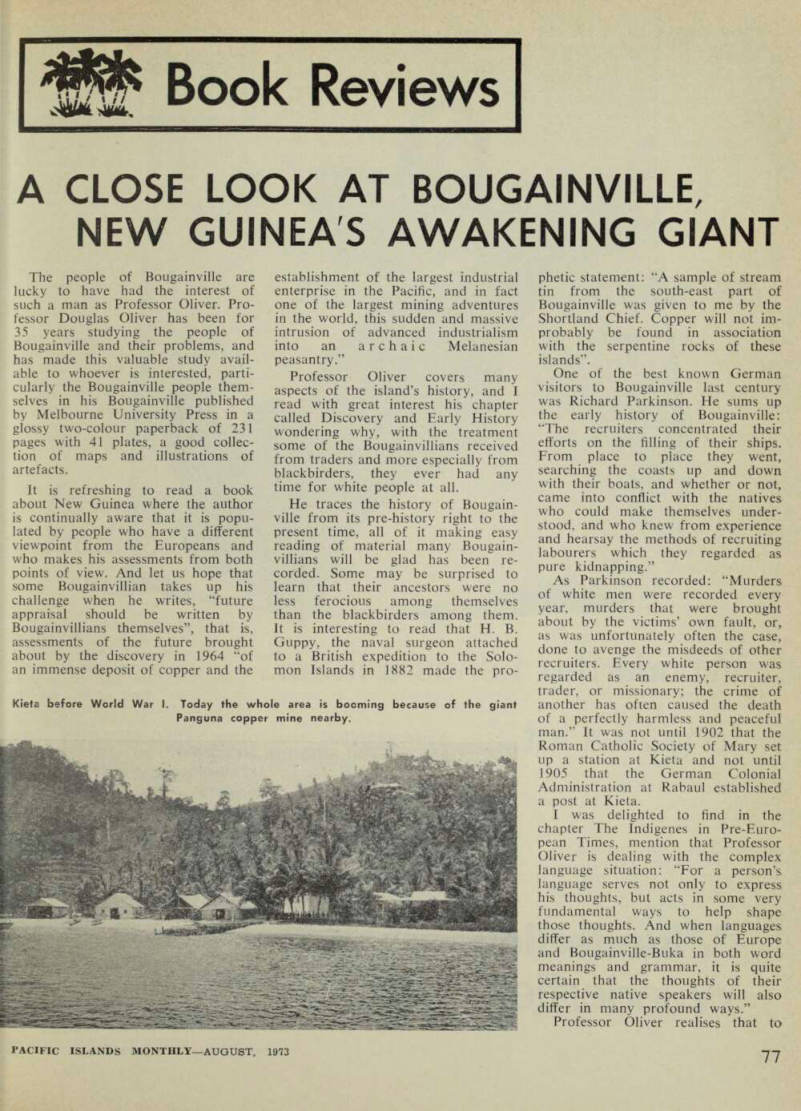

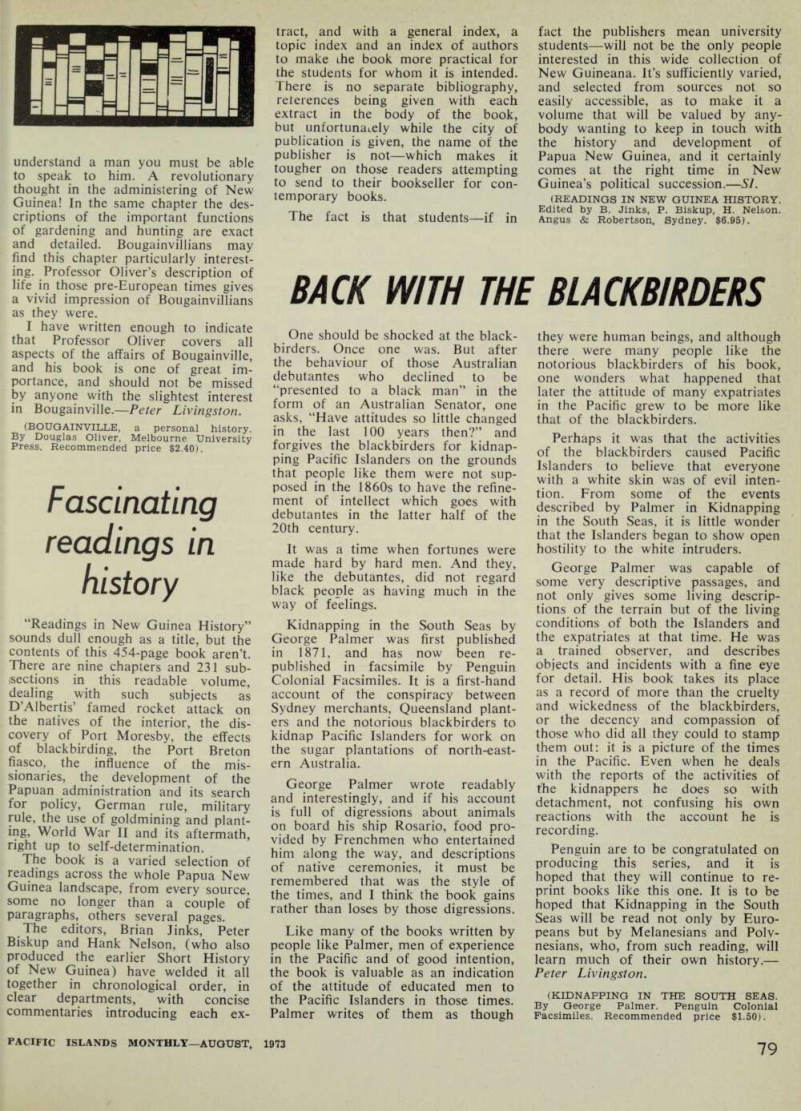
A Close Look At Bougainville,
New Guinea’S Awakening Giant
The people of Bougainville are lucky to have had the interest of such a man as Professor Oliver. Professor Douglas Oliver has been for 35 years studying the people of Bougainville and their problems, and has made this valuable study available to whoever is interested, particularly the Bougainville people themselves in his Bougainville published by Melbourne University Press in a glossy two-colour paperback of 231 pages with 41 plates, a good collection of maps and illustrations of artefacts.
It is refreshing to read a book about New Guinea where the author is continually aware that it is populated by people who have a different viewpoint from the Europeans and who makes his assessments from both points of view. And let us hope that some Bougainvillian takes up his challenge when he writes, “future appraisal should be written by Bougainvillians themselves”, that is, assessments of the future brought about by the discovery in 1964 “of an immense deposit of copper and the
establishment of the largest industrial enterprise in the Pacific, and in fact one of the largest mining adventures in the world, this sudden and massive intrusion of advanced industrialism into an archaic Melanesian peasantry.”
Professor Oliver covers many aspects of the island’s history, and I read with great interest his chapter called Discovery and Early History wondering why, with the treatment some of the Bougainvillians received from traders and more especially from blackbirders, they ever had any time for white people at all.
He traces the history of Bougain ville from its pre-history right to the present time, all of it making easy reading of material many Bougain villians will be glad has been re corded. Some may be surprised to learn that their ancestors were no less ferocious among themselves than the blackbirders among them.
It is interesting to read that H. B.
Guppy, the naval surgeon attached to a British expedition to the Solo mon Islands in 1882 made the pro-
phetic statement: “A sample of stream tin from the south-east part of Bougainville was given to me by the Shortland Chief. Copper will not im probably be found in association with the serpentine rocks of these islands”.
One of the best known German visitors to Bougainville last century was Richard Parkinson. He sums up the early history of Bougainville: “The recruiters concentrated their efforts on the filling of their ships.
From place to place they went, searching the coasts up and down with their boats, and whether or not, came into conflict with the natives who could make themselves under stood, and who knew from experience and hearsay the methods of recruiting labourers which they regarded as pure kidnapping.”
As Parkinson recorded: “Murders of white men were recorded every year, murders that were brought about by the victims’ own fault, or, as was unfortunately often the case, done to avenge the misdeeds of other recruiters. Every white person was regarded as an enemy, recruiter, trader, or missionary; the crime of another has ofien caused the death of a perfectly harmless and peaceful man.” It was not until 1902 that the Roman Catholic Society of Mary set up a station at Kieta and not until 1905 that the German Colonial Administration at Rabaul established a post at Kieta.
I was delighted to find in the chapter The Indigenes in Pre-Euro pean Times, mention that Professor Oliver is dealing with the complex language situation: “For a person’s language serves not only to express his thoughts, but acts in some very fundamental ways to help shape those thoughts. And when languages differ as much as those of Europe and Bougainville-Buka in both word meanings and grammar, it is quite certain that the thoughts of their respective native speakers will also differ in many profound ways.”
Professor Oliver realises that to
Kieta before World War I. Today the whole area is booming because of the giant Panguna copper mine nearby.
understand a man you must be able to speak to him. A revolutionary thought in the administering of New Guinea! In the same chapter the des criptions of the important functions of gardening and hunting are exact and detailed. Bougainvillians may find this chapter particularly interest ing. Professor Oliver’s description of life in those pre-European times gives a vivid impression of Bougainvillians as they were.
I have written enough to indicate that Professor Oliver covers all aspects of the affairs of Bougainville, and his book is one of great im portance, and should not be missed by anyone with the slightest interest
in Bougainville.
Peter Livingston.
(BOUGAINVILLE, a personal history.
By Douglas Oliver, Melbourne University Press. Recommended price $2.40).
Fascinating
readings in
history
“Readings in New Guinea History” sounds dull enough as a title, but the contents of this 454-page book aren’t.
There are nine chapters and 231 sub sections in this readable volume, dealing with such subjects as D’Albertis’ famed rocket attack on the natives of the interior, the dis covery of Port Moresby, the effects of blackbirding, the Port Breton fiasco, the influence of the mis sionaries, the development of the Papuan administration and its search for policy, German rule, military rule, the use of goldmining and plant ing, World War II and its aftermath, right up to self-determination.
The book is a varied selection of readings across the whole Papua New Guinea landscape, from every source, some no longer than a couple of paragraphs, others several pages.
The editors, Brian Jinks, Peter Biskup and Hank Nelson, (who also produced the earlier Short History of New Guinea) have welded it all together in chronological order, in clear departments, with concise commentaries introducing each ex
tract, and with a general index, a topic index and an index of authors to make the book more practical for the students for whom it is intended.
There is no separate bibliography, references being given with each extract in the body of the book, but unfortunately while the city of publication is given, the name of the publisher is not —which makes it tougher on those readers attempting to send to their bookseller for con temporary books.
The fact is that students—if in
fact the publishers mean university students—will not be the only people interested in this wide collection of New Guineana. It’s sufficiently varied, and selected from sources not so easily accessible, as to make it a volume that will be valued by any body wanting to keep in touch with the history and development of Papua New Guinea, and it certainly comes at the right time in New
Guinea’s political succession.-
SI.
(Readings In New Guinea History.
Edited by B. Jinks, P. Biskup, H. Nelson.
Angus & Robertson, Sydney. $6.95).
Advertisements & other items, p. 82 (1 item)
Wunderflex
bends a little...
to give a lot.
It gives versatility—use it inside or outside; for the whole house, garages, extensions, etc.
It gives flexibility—practically eliminates on-site breakages handles easily; cuts and fixes simply.
Wunderflex gives performance —it's fire and water resistant —vermin proof too.
In sheets 3 ft. x 1 ft. to jumbo 10 ft. x 4 ft., all at lowest cost for building board, bend Wunderflex to your needs now.
LViunderlich
Wunderflex
MADE IN AUSTRALIA. MARKETED BY C.S.R. BUILDING MATERIALS EXPORT SALES: 4 O'CONNELL STREET, SYDNEY. AUSTRALIA 2000
AVAILABLE FROM
Papua and New Guinea:
Steamships Trading Company Ltd.
Norfolk Island;
Irvine's Building Supply Centre
E3238C
Back With The
One should be shocked at the black birders. Once one was. But after the behaviour of those Australian debutantes who declined to be “presented to a black man” in the form of an Australian Senator, one asks, “Have attitudes so little changed in the last 100 years then?” and forgives the blackbirders for kidnap ping Pacific Islanders on the grounds that people like them were not sup posed in the 1860 s to have the refine ment of intellect which goes with debutantes in the latter half of the 20th century.
It was a time when fortunes were made hard by hard men. And they, like the debutantes, did not regard black people as having much in the way of feelings.
Kidnapping in the South Seas by George Palmer was first published in 1871, and has now been re published in facsimile by Penguin Colonial Facsimiles. It is a first-hand account of the conspiracy between Sydney merchants, Queensland plant ers and the notorious blackbirders to kidnap Pacific Islanders for work on the sugar plantations of north-east ern Australia.
George Palmer wrote readably and interestingly, and if his account is full of digressions about animals on board his ship Rosario, food pro vided by Frenchmen who entertained him along the way, and descriptions of native ceremonies, it must be remembered that was the style of the times, and I think the book gains rather than loses by those digressions.
Like many of the books written by people like Palmer, men of experience in the Pacific and of good intention, the book is valuable as an indication of the attitude of educated men to the Pacific Islanders in those times.
Palmer writes of them as though
they were human beings, and although there were many people like the notorious blackbirders of his book, one wonders what happened that later the attitude of many expatriates in the Pacific grew to be more like that of the blackbirders.
Perhaps it was that the activities of the blackbirders caused Pacific Islanders to believe that everyone with a white skin was of evil inten tion. From some of the events described by Palmer in Kidnapping in the South Seas, it is little wonder that the Islanders began to show open hostility to the white intruders.
George Palmer was capable of some very descriptive passages, and not only gives some living descrip tions of the terrain but of the living conditions of both the Islanders and the expatriates at that time. He was a trained observer, and describes objects and incidents with a fine eye for detail. His book takes its place as a record of more than the cruelty and wickedness of the blackbirders, or the decency and compassion of those who did all they could to stamp them out: it is a picture of the times in the Pacific. Even when he deals with the reports of the activities of the kidnappers he does so with detachment, not confusing his own reactions with the account he is recording.
Penguin are to be congratulated on producing this series, and it is hoped that they will continue to re print books like this one. It is to be hoped that Kidnapping in the South Seas will be read not only by Euro peans but by Melanesians and Poly nesians, who, from such reading, will learn much of their own history.—
Peter Livingston.
(Kidnapping In The South Seas.
By George Palmer. Penguin Colonial Facsimiles. Recommended price $1.50).
Sensible safety
Hawaiian chant, rich in poetic power
The Kumulipo (Beginning in deep darkness), a Hawaiian creation chant translated and edited with a com mentary by Martha Warren Beck with, is a genealogical prayer chant linking a family of Hawaiian alii not only to the primary god but to the stars, heavens, plants and animals within the cycle of birth, life and death.
In pre-European Hawaii, the Kumulipo was composed and trans mitted from generation to generation in the oral tradition. This chant, 2,000 lines in length, provides an extended family genealogy tracing the family history from the world’s beginning and the gods.
It is a rare find in ancient Hawaiian literature, a Hawaiian composition not only rich in its poetic power but as an authentic source of information concerning pre-European Hawaiian religion, politics, mythology, and way of life. It offers us a unique view of the Hawaiian mind and world before it was utterly changed by the Euro pean. As a poetic composition, Martha Beckwith rightly compares it to the Greek creation chants and Genesis in the bible.
From a manuscript belonging to King Kalakaua, the original text of the Kumulipo was first published in 1889. Other translations were made later. None of these translations was available in English when Martha Beckwith made her own translation and detailed study of the Kumulipo, and published it in 1951. This 1972 edition is a reprint of the 1951 one.
Beckwith’s study and translation is an extremely scholarly and detailed work. It is also well-written and documented. Her study is divided into three parts. The first part gives us the social and historical back ground concerning the discovery of the Kumulipo and studies interpreting it. (This section contains a fascinating chapter on Captain Cook as the gold Lono). She also relates the Kumulipo to an all-over picture of Hawaiian life and history out of which it emerged.
The second part deals with the Kumulipo chant itself. This is the most fascinating section of the book.
The Hawaiian creation, translated and studied line by line, passage by passage, comes alive again. The power and beauty of the poetry (of the images and the philosophy behind the images weaving them into a cohensive unity) takes on a universal
appeal transcending its particular set ting, Hawaii.
The third part deals with other Polynesian accounts of creation in relation to the Kumulipo.
In the appendices, the full Kala kaua text of the Kumulipo is provided for us. Not only does Beckwith’s book provide students of pre- European Hawaii with the most authoritative text and translation of the Kumulipo, it also brings to any one interested in Polynesia a pro found glimpse into the creative depths of the pre-European Hawaiian mind.
Albert Wendt.
(The Kumulipo, A Hawaiian
CREATION CHANT, translated and edited by Martha Warren Beckwith.
University Press of Hawaii. Price un available.
Sensible safety
for seamen
Far be it from me to suggest that commonsense and seamanship can be had from the pages of a book, or that it can ensure a safe, uneventful cruise. But it can, if properly written with authority, supply all the information to make that cruise as safe and idyllic as you allow it to become.
Such a book then, is Richard Henderson’s Sea Sense, a book written from the experience of a man who has obviously spent many years on many different types of craft.
All kinds of offshore boats are covered, mono and multi-hull, power and sail, open and closed, with hints on safety and how to get the most out of your boat, without thumbing your nose at Davy Jones.
Mr Henderson manages to impart his information without resorting to hard and fast rules that leave one either bored stiff or worried that he’s forgotten something. Rather he tends to stick to causes and effect, with plenty of explanation and illustration through photographs and line drawings executed by the author himself.
Throughout, Henderson uncovers information and methods, so far unique. Of these there is a way to right a large catamaran from a 90 deg capsize by flooding and pumping;
and rescuing a man overboard single handed.
One set of eight photographs will be quite enough to chill the blood of the average armchair skipper.
These illustrate just what happens to a husky wooden keelboat that is caught on a lee shore in a big wind; from graceful lines to matchwood (and I mean matchwood) inside an hour!
If you want to find out how to cook a cheese omelette in a force 9 gale, then this is not the book for you. Nor is it meant for the runabout and water-ski set, or the dreamer, but rather a textbook for the relatively inexperienced offshore cruising man.
Sea Sense is one way to learn what reaction to expect for a given action, before you cast-off, and in imparting this knowledge, Richard Henderson must be considered an eminently
qualified teacher.-
John Collins.
(SEA SENSE. By Richard Henderson.
International Marine Publishing Company, Elm St., Camden, Maine, USA. Price un available).
The news from.
Pitcairn
Each week, Tom Christian, descen dant of Fletcher Christian of HMS Bounty and Pitcairn Island, contacts by short-wave radio from the island the Seventh-day Adventist Church’s international radio-broadcast centre in California. In his talks he repeats the island’s gossip, incidents, births, deaths, and accidents encountered by Pitcairners. The radio centre, The Voice of Prophecy, retails the stories to the world.
Now, Mr Herbert Ford, the station’s public information officer, has collected many of Tom Christian’s reports and published them in an attractive 126-page paperback.
Thirty-five pages of pictures unveil modern Pitcairn, probably the most famous but most inaccessible island in the world. (PITCAIRN. By Herbert Ford. Anchor Titles, 9349 Belvoir Avenue. La Crescenta, California 91214, USA. $U52.00.)
Advertisements & other items, pp. 85-90 (1 item)
Port Moresby
Revised for Port Moresby's Centenary
Yesterday and Today law Stuart
(Soft cover edition) In this book, Port Moresby—yesterday and today, lan Stuart has put together, in an entertaining fashion, the authentic and exhaustive account of the first 97 years of Papua New Guinea’s capital, its people and the material creations of those people.
There were wars, depressions, royal commissions, scandals, witch-hunts, pioneering fortitude, acts of self-sacrifice, self-reliance and bravery—all the normal behaviour of people thrown together in an isolated, tropical outpost.
Port Moresby is a mine of information for those seeking knowledge of the town or the Territory of Papua.
Available in bookshops throughout New Guinea or direct from The Publishers. Order form overleaf.
"PORT MORESBY" sells in Australia and P N.G for $3.95 Aust., plus 37c posted; Pacific Islands and overseas countries $3.95 Aust,, plus 70c posted; U.S.A., $B,BO U.S., posted.
Please send copy(ies) "Port Moresby'' to name address
city/state/country/post code
for which payment of is enclosed.
Pacific Publications (Aust.) Pty. Ltd., 29 Alberta Street, Sydney, N.S.W. 2000. (Postal address Box 3408, G.P.0., Sydney, N.S.W. 2001) When ordering ask for our Pacific book catalogue
0 AUGUST, 1973—PACIFIC ISLANDS MONTHLY
Pioneer’s cassette sounds...
they leap at you like they’re live!
Notes with the purity of a nightingale’s call or the depth of a bullfrog’s complaint. This mag- . the name Pioneer and extra quality features nificent little cassette deck reproduces all, and better, because it has Dolby.'Dolby: An incredibly effective noise reduction system that makes natural sounds leap from the deck, especially with new chromium dioxide tape. It makes everything you record seem super-realistic like looking through a highly polished mirror.
Other sets have Dolby. But other sets don’t have that go with the name. On the CT-4141 there’s a selector for your special chrome tapes. There’s automatic stop at tape-end in all tape travel functions. And there’s an ultra-smooth ferrite solid head (it just lasts and lasts).
We could go on and on. but your best bet is to flip on the CT-4141 at the nearest Pioneer dealers. g o A & & © ■On
M PIONEER
P.O, Brijlal & Company, G.P.O. Box No. 362, Suva, Fiji Islands Tel: 222 58 Astronics Australasia Pty. Ltd. 161-173 Sturt Street, South Melbourne, Victoria 3205 Australia Hagemeyer (Australasia) N.V. P.O. Box No. 90, Lae, New Guinea Tel: 2718 P.O. Box No. 63, Rabaul, New Guinea Tel; 2633 P.O. Box No. 673, Madang, T.P.N.G. Tel: 2445 Box 1428, Boroko, Port Moresby, New Guinea Tel: 5784 Tee Vee Radio Ltd. P.O. Box No. 5029, Auckland. New Zeal Tel: 763-064 Burns Philp (South Sea) Co. Ltd. Norfolk Islands, South Pa< Jacob Enterprises, P.O. Box No. 4, Nauru Island Ets. PERFECT, B.P. 594, Papeete,Tahiti Tel; 20 407 Menard Freres, B.P. 123, Noumea, New Caledonia Tel: 52- Transpac Corporation, P.O. Box 1477, Pago Pago, American Samoa 96799 Tel; 2227 “DOLBY” is a trade mark of DOLBY LABORATORIES INC.
Sound has "heart”...
rP^.ZssmJl
TDK
r pK
CAs se-rr e
H
ITV
You can feel it with TDK SO Cassette True High-Fidelity Sound Reproduction in cassettes has never been achieved until TDK SD cassettes. TDK, specialist in tape technology, developed SD cassettes only 4 years ago, and now they are favoured by audiophiles in as many as 93 countries. SD cassettes give the people such a true sound emotion as no other tape could. True High-Fidelity— that's what TDK has! • SD Cassettes are offered in both the popular C-60, C-90 and the C-30 type, as well as reel type 1800-SD and 1200-SD. *Also available low noise cassettes in C-30, C-40, C-60, C-90 and C-120. &'
TDK ELECTRONICS CO., LTD.
2-14-6, Uchikanda, Chiyoda-ku, Tokyo, Japan
TDK
DISTRIBUTORS WANTED FOR:
New Caledonia, New Hebrides, Tonga, West Samoa, American Samoa, Marquesas Nauru, Cook Islands, British Solomon Islands.
TDK Authorised distributors; Australia
CONVOY INTERNATIONAL PTV. LTD.
Cnr. Plunkett and Maclean Sts.
Woolloomooloo 2011 Sydney, Australia New Guinea & Papua Turner & Davey Electrical Pty. Ltd.
P.O. Box 255, Lae, P.N.G.
Tahiti
Ets. WIKING
132 Rue du Marechal Foch Papeete, Tahiti Fiji C. Maganlal & Co. 119 Vitogo Parade Lautoka, Fiji
Cable; TDK CORE TOKYO
Telex: TODENKA J 24270
The blue beyond. The earth below.
A path between the two. That only youth may
Making the endless blue and
bleach-white sands one...
... HONDA.
A young man whose desire to roach the summit of success knows no limits. At work or at play, he thrives on new challenges new ways to satisfy his zest for the active life. Every day more people are finding themselves in HONDA. Leader in motorcycles. Holder of the title of having of the world’s market. With sales in more than 15( countries. By offering the right combination of power, performance, and ride in a wide range to suit every individual, ft’s all of what it takes to be a world leader in motorcycles
... HONDA{
:v- -* \ 1 % s >r ' W \ Wood's La-gest Motorcycle*VanwfBcra^er %*:•>*
MO'Sfim Cp,LTD.’TOKYO. JAPA£„
& * >ApOA NEW Cor. Ltd. P Q&»o* ' Fjfc LAN DS*«sra 1 WyorsKO / Gilbert fi.l SAMOA; NWbr Q»Mtf b«tdf I Samoa) Ltd - . P.O. Box / AwERCCAN JE M. Jonos £td. P.C Box .54 listabtjssjjments Batiande, Noumea f TAHITfr.Ets.
P 0 Box 92 Rarotonga •' NAURU tSLAND Nauru ■ BITORY: J.C. Tenorio Enterprise P.O. Box 137.5»j}>3~ / standi £&elpsrpeat,Auftf<>r*Y / S/ytfO/'pjMa* Haleck lf(c. P.O Box 99. Pa g&P ago’m’ONGA; SOLOMON JSLANDST Salopian/Trading Co.. L% P O Box 9*. Honiara ANEW s COMfMPBX p O BorSiOO, s ßap#Bte / s COC3K fStANDS; CoOk (stands trading Corporation Ltd.
' If / T „ ' • 0
HP-219A Stereo Center It's a receiver, a cassette deck, a record player all in a single, compact; quality unit SS-210 Speaker System % 'it w t II
Sony presents
total home stereo entertainment
Into this compact music system Sony has packed performance and quality to a degree that is nothing short of amazing.
Performance. It's an FM stereo FM-AM tuner.
It's a stereo cassette deck. It records programs direct from tuner to cassette with no recording cable necessary. It's a 4-speed auto/manual record changer that handles a stack of up to 5 records.
Quality. The distortion-free, all silicon-transistor stereo amplifier delivers a total of 36 watts of music power. The dynamic, 2-way speakers have wide-range frequency-response. The record changer features a high-compliance cartridge for high fidelity pickup.
Sony gives you style, too, with elegant, wood cabinetry for the center unit and speakers. And the HP-219A has a special monitor switch which gives it genuine 4-channel adaptability!
How does Sony manage to give you so much in such a compact system? Research Makes the Difference.
Research Makes the Difference
SONY
' : , I
Pacific Shipping
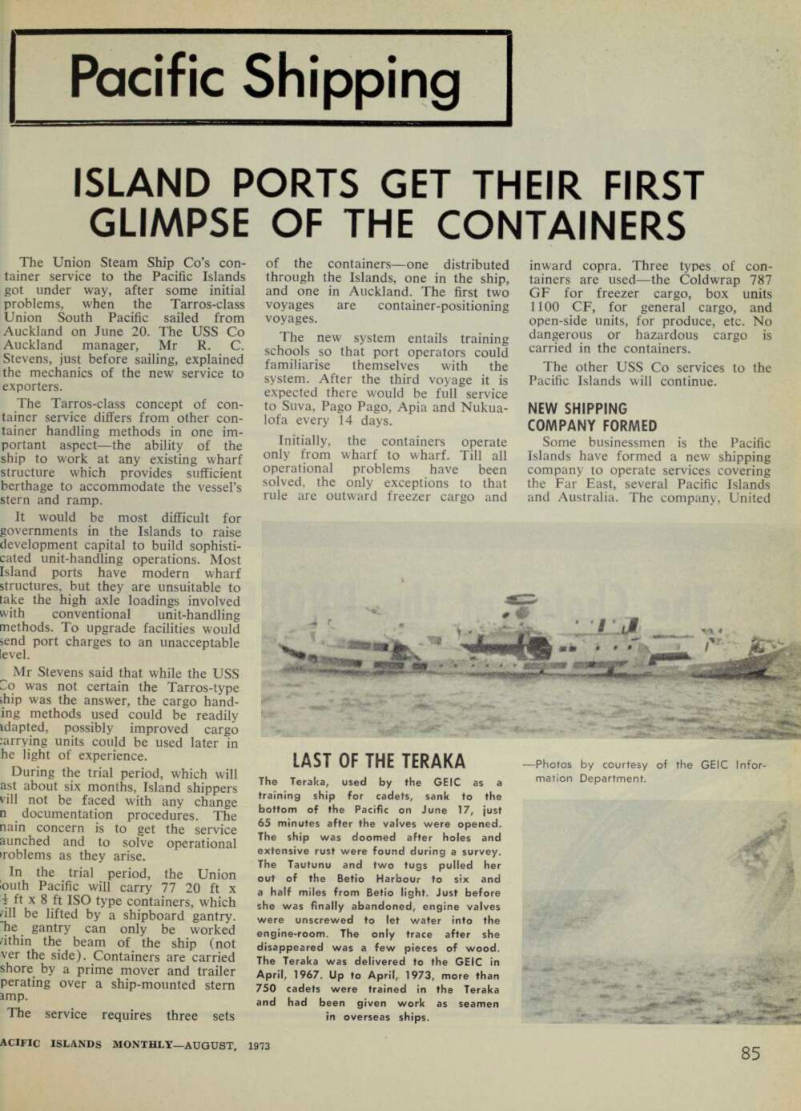
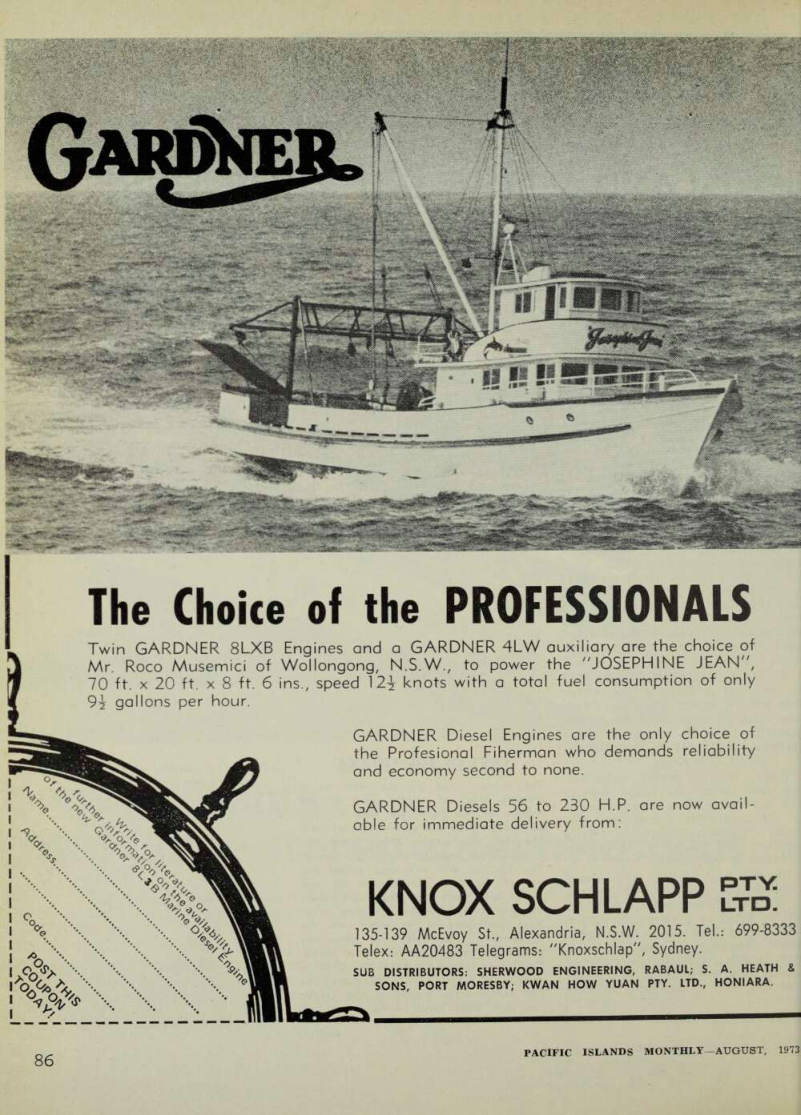
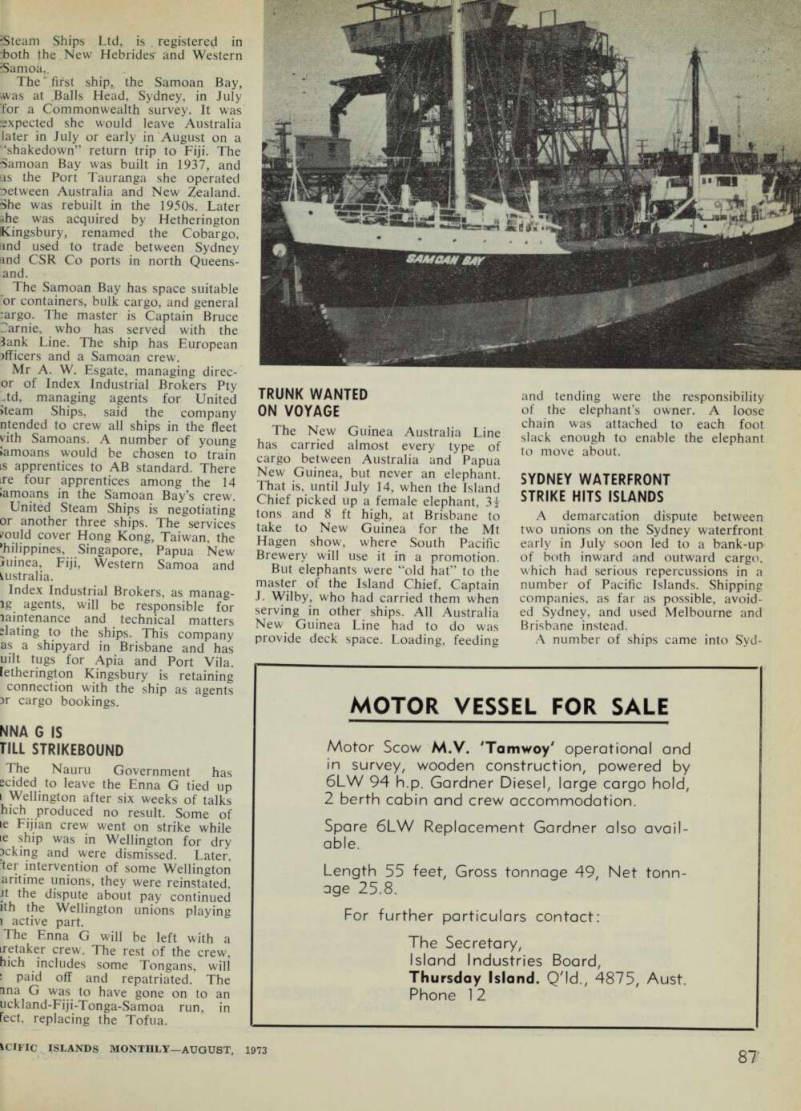
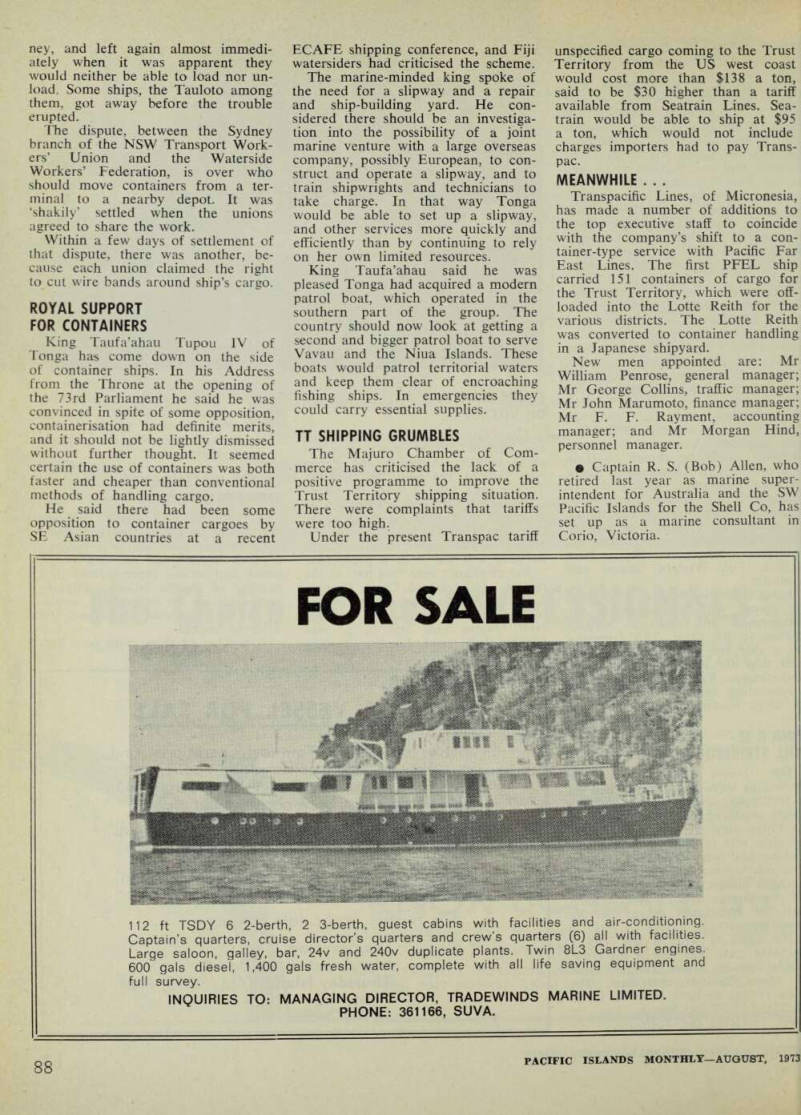
Island Ports Get Their First
Glimpse Of The Containers
The Union Steam Ship Co’s con tainer service to the Pacific Islands got under way, after some initial problems, when the Tarros-class Union South Pacific sailed from Auckland on June 20. The USS Co Auckland manager, Mr R. C.
Stevens, just before sailing, explained the mechanics of the new service to exporters.
The Tarros-class concept of con tainer service differs from other con tainer handling methods in one im portant aspect—the ability of the ship to work at any existing wharf structure which provides sufficient berthage to accommodate the vessel’s stern and ramp.
It would be most difficult for governments in the Islands to raise development capital to build sophisti cated unit-handling operations. Most Island ports have modern wharf structures, but they are unsuitable to take the high axle loadings involved with conventional unit-handling methods. To upgrade facilities would send port charges to an unacceptable level.
Mr Stevens said that while the USS 2o was not certain the Tarros-type ship was the answer, the cargo hand ing methods used could be readily adapted, possibly improved cargo carrying units could be used later in he light of experience.
During the trial period, which will ast about six months, Island shippers vill not be faced with any change n documentation procedures. The train concern is to get the service aunched and to solve operational iroblems as they arise.
In the trial period, the Union louth Pacific will carry 77 20 ft x \ ft x 8 ft ISO type containers, which /ill be lifted by a shipboard gantry, 'he gantry can only be worked /ithin the beam of the ship (not ver the side). Containers are carried shore by a prime mover and trailer perating over a ship-mounted stem amp.
The service requires three sets
of the containers—one distributed through the Islands, one in the ship, and one in Auckland. The first two voyages are container-positioning voyages.
The new system entails training schools so that port operators could familiarise themselves with the system. After the third voyage it is expected there would be full service to Suva, Pago Pago, Apia and Nukua lofa every 14 days.
Initially, the containers operate only from wharf to wharf. Till all operational problems have been solved, the only exceptions to that rule are outward freezer cargo and
inward copra. Three types of con tainers are used —the Coldwrap 787 GF for freezer cargo, box units 1100 CF, for general cargo, and open-side units, for produce, etc. No dangerous or hazardous cargo is carried in the containers.
The other USS Co services to the Pacific Islands will continue.
New Shipping
Company Formed
Some businessmen is the Pacific Islands have formed a new shipping company to operate services covering the Far East, several Pacific Islands and Australia. The company, United
Last Of The Teraka
The Teraka, used by the GEIC as a training ship for cadets, sank to the bottom of the Pacific on June 17, just 65 minutes after the valves were opened.
The ship was doomed after holes and extensive rust were found during a survey.
The Tautunu and two tugs pulled her out of the Betio Harbour to six and a half miles from Betio light. Just before she was finally abandoned, engine valves were unscrewed to let water into the engine-room. The only trace after she disappeared was a few pieces of wood.
The Teraka was delivered to the GEIC in April, 1967. Up to April, 1973, more than 750 cadets were trained in the Teraka and had been given work as seamen in overseas ships.
—Photos by courtesy of the GEIC Infor mation Department.
'Steam Ships Ltd, is . registered in :both the New Hebrides and Western Samoa,, The " first ship, the Samoan Bay, was at Balls Head, Sydney, in July :for a Commonwealth survey. It was expected she would leave Australia later in July or early in August on a ‘shakedown” return trip to Fiji. The Samoan Bay was built in 1937, and sas the Port Tauranga she operated between Australia and New Zealand.
She was rebuilt in the 19505. Later ;>he was acquired by Hetherington Kingsbury, renamed the Cobargo, and used to trade between Sydney and CSR Co ports in north Queens and.
The Samoan Bay has space suitable 'or containers, bulk cargo, and general :argo. The master is Captain Bruce Sarnie, who has served with the 3ank Line. The ship has European >fficers and a Samoan crew.
Mr A. W. Esgate, managing direc or of Index Industrial Brokers Pty Ad, managing agents for United >team Ships, said the company ntended to crew all ships in the fleet vith Samoans. A number of young ►amoans would be chosen to train is apprentices to AB standard. There ire four apprentices among the 14 ►amoans in the Samoan Bay’s crew.
United Steam Ships is negotiating or another three ships. The services /ould cover Hong Kong, Taiwan, the 'hilippines, Singapore, Papua New Juinea, Fiji, Western Samoa and Australia.
Index Industrial Brokers, as manag ig agents, will be responsible for laintenance and technical matters slating to the ships. This company as a shipyard in Brisbane and has uilt tugs for Apia and Port Vila, [etherington Kingsbury is retaining connection with the ship as agents )r cargo bookings.
Nna G Is
Till Strikebound
The Nauru Government has ecided to leave the Enna G tied up i Wellington after six weeks of talks hich produced no result. Some of le Fijian crew went on strike while ic ship was in Wellington for dry >ckmg and were dismissed. Later, ter intervention of some Wellington aritime unions, they were reinstated, it the dispute about pay continued ith the Wellington unions playing i active part.
The Enna G will be left with a iretaker crew. The rest of the crew, hich includes some Tongans, will s paid off and repatriated. The nna G was to have gone on to an uckland-Fiji-Tonga-Samoa run, in Feet, replacing the Tofua.
Trunk Wanted
On Voyage
The New Guinea Australia Line has carried almost every type of cargo between Australia and Papua New Guinea, but never an elephant.
That is, until July 14, when the Island Chief picked up a female elephant, 3i tons and 8 ft high, at Brisbane to take to New Guinea for the Mt Hagen show, where South Pacific Brewery will use it in a promotion.
But elephants were “old hat” to the master of the Island Chief, Captain J. Wilby, who had carried them when serving in other ships. All Australia New Guinea Line had to do was provide deck space. Loading, feeding
and tending were the responsibility of the elephant’s owner. A loose chain was attached to each foot slack enough to enable the elephant t 0 move a f out .
Sydney Waterfront
u.tc .c. amhc
Strike Hits Islands
A demarcation dispute between two unions on the Sydney waterfront early in July soon led to a bank-up of both inward and outward cargo. which had serious repercussions in a number of Pacific Islands. Shipping companies, as far as possible, avoid ed Sydney, and used Melbourne and Brisbane instead, A number of ships came into Syd
ney, and left again almost immedi ately when it was apparent they would neither be able to load nor un load. Some ships, the Tauloto among them, got away before the trouble erupted.
The dispute, between the Sydney branch of the NSW Transport Work ers’ Union and the Waterside Workers’ Federation, is over who should move containers from a ter minal to a nearby depot. It was ‘shakily’ settled when the unions agreed to share the work.
Within a few days of settlement of that dispute, there was another, be cause each union claimed the right to cut wire bands around ship’s cargo.
Royal Support
For Containers
King Taufa’ahau Tupou IV of Tonga has come down on the side of container ships. In his Address from the Throne at the opening of the 73rd Parliament he said he was convinced in spite of some opposition, containerisation had definite merits, and it should not be lightly dismissed without further thought. It seemed certain the use of containers was both faster and cheaper than conventional methods of handling cargo.
He said there had been some opposition to container cargoes by SE Asian countries at a recent
ECAFE shipping conference, and Fiji watersiders had criticised the scheme.
The marine-minded king spoke of the need for a slipway and a repair and ship-building yard. He con sidered there should be an investiga tion into the possibility of a joint marine venture with a large overseas company, possibly European, to con struct and operate a slipway, and to train shipwrights and technicians to take charge. In that way Tonga would be able to set up a slipway, and other services more quickly and efficiently than by continuing to rely on her own limited resources.
King Taufa’ahau said he was pleased Tonga had acquired a modern patrol boat, which operated in the southern part of the group. The country should now look at getting a second and bigger patrol boat to serve Vavau and the Niua Islands. These boats would patrol territorial waters and keep them clear of encroaching fishing ships. In emergencies they could carry essential supplies.
Tt Shipping Grumbles
The Majuro Chamber of Com merce has criticised the lack of a positive programme to improve the Trust Territory shipping situation.
There were complaints that tariffs were too high.
Under the present Transpac tariff
unspecified cargo coming to the Trust Territory from the US west coast would cost more than $l3B a ton, said to be $3O higher than a tariff available from Seatrain Lines. Sea train would be able to ship at $95 a ton, which would not include charges importers had to pay Trans pac.
Meanwhile . . .
Transpacific Lines, of Micronesia, has made a number of additions to the top executive staff to coincide with the company’s shift to a con tainer-type service with Pacific Far East Lines. The first PFEL ship carried 151 containers of cargo for the Trust Territory, which were off loaded into the Lotte Reith for the various districts. The Lotte Reith was converted to container handling in a Japanese shipyard.
New men appointed are: Mr William Penrose, general manager; Mr George Collins, traffic manager; Mr John Marumoto, finance manager; Mr F. F. Payment, accounting manager; and Mr Morgan Hind, personnel manager. e Captain R. S. (Bob) Allen, who retired last year as marine super intendent for Australia and the SW Pacific Islands for the Shell Co, has set up as a marine consultant in Corio, Victoria.
Advertisements & other items, pp. 91-94 (3 items)
85
CIFIC ISLANDS MONTHLY—AUGUST, 1973
The Choice of the PROFESSIONALS
' ' >?;V'» * < ' . .
SS '- II F.-'W IP * |l J I J ' Z. s ■ .< '■■ *•> W 55 y '^9&m fe*** ■&<%?&&&» mmum , > •"' •; .--. ...■ ■ *-■*■ «3* ... sp
Twin GARDNER BLXB Engines and a GARDNER 4LW auxiliary are the choice of Mr. Roco Musemici of Wollongong, N.S.W., to power the "JOSEPHINE JEAN , 70 ft. x 20 ft. x 8 ft. 6 ins., speed 1 2\ knots with a total fuel consumption of only 9i gallons per hour.
GARDNER Diesel Engines are the only choice of the Profesional Fiherman who demands reliability and economy second to none.
GARDNER Diesels 56 to 230 H.P. are now avail able for immediate delivery from:
KNOX SCHLAPP
PTY
LTD
135-139 McEvoy St., Alexandria, N.S.W. 2015. Tel.: 699-8333
Telex; AA20483 Telegrams; "Knoxschlap", Sydney.
SUB DISTRIBUTORS: SHERWOOD ENGINEERING, RABAUL; S. A. HEATH & SONS, PORT MORESBY; KWAN HOW YUAN PTY. LTD., HONIARA.
MOTOR VESSEL FOR SALE
Motor Scow M.V. 'Tamwoy' operational and in survey, wooden construction, powered by 6LW 94 h.p. Gardner Diesel, large cargo hold, 2 berth cabin and crew accommodation.
Spare 6LW Replacement Gardner also available.
Length 55 feet, Gross tonnage 49, Net tonnage 25.8.
For further particulars contact: The Secretary, Island Industries Board, Thursday Island. Q'ld., 4875, Aust.
Phone 12
FOR SALE
RM H II m m mmm 112 ft TSDY 6 2-berth, 2 3-berth, guest cabins with facilities and air-conditioning.
Captain’s quarters, cruise director’s quarters and crew’s quarters (6) all with facilities.
Large saloon, galley, bar, 24v and 240 v duplicate plants. Twin BL3 Gardner engines. 600 gals diesel, 1,400 gals fresh water, complete with all life saving equipment and full survey.
INQUIRIES TO: MANAGING DIRECTOR, TRADEWINDS MARINE LIMITED.
PHONE: 361166, SUVA.
87
ICIFIC ISLANDS MONTHLY—AUGUST, 1973
Cruising
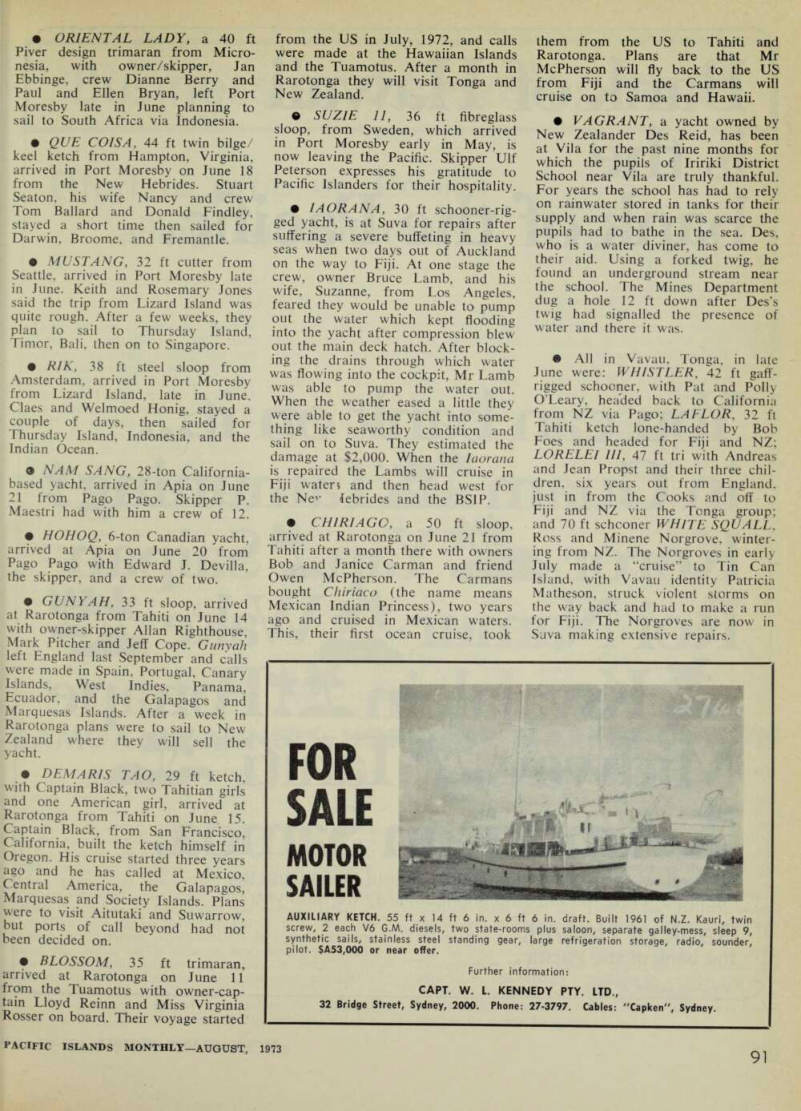
Yachts
• SAMBURAN, 35 ft yawl arrived at Rarotonga on July 1 from Tahiti with Mr Wade Swoboda and Miss Connie Columbus, both from San Diego, California. They left San Diego three and a half years ago on what was to be a six months cruise.
Ports of call were in Mexico, the Caribbean, Venezuela, Curacao, Panama and the Galapagos and Mar quesas Islands. Plans were to leave after a fortnight in Rarotonga for Fiji and New Zealand. • HISPANIA, 50 ft ketch, arrived at Rarotonga on July 3 with single hander owner-captain Max Grave leau, who is sailing the yacht from Marseilles to New Zealand. He left France two and a half years ago and called at Gibraltar, Tangier, the Canary Islands, Colombia and Pan ama. Pacific ports of call were the Galapagos, Pitcairn, the Gambier and French Society Islands and the Marquesas. He will call at Tonga and Fiji en route to NZ. • CLIPPER, a 28 ft yacht, arrived at Rarotonga from Tahiti on June 24 with owner-skipper R. C. Rouse and Miss Margaret Worthington. They left South Africa on a circumnaviga tion in January, 1972, and planned to remain a fortnight in Rarotonga before sailing to New Zealand and Australia. ® ALISIO, a 40 ft sloop, arrived at Rarotonga from Tahiti on June 23 with owner-captain Frank MacCarthy of Santa Barbara, Miss Coco Ryan and Peter Coider, also from the US,
and Mr Teremoana Davis, a Raro tangan, on board. They will cruise through the Fiji Group before return ing to California.
O FREY A, 38 ft ketch from Los Angeles, is on a return visit to Fiji, carrying owners Peter Oehmen and his wife, Sandy. They left Fiji in October, 1972, for New Zealand, and waited there for the hurricane season.
They went back to NZ via the Kermadecs and Nukualofa. They will go back to NZ again in October.
The Freya left Los Angeles two years ago. • WAKAYA, 40 ft cutter, arrived in Suva in June from Whangarei, NZ, carrying owner, Ted Hay, and Chris Onial and Jan Hurrell, Mel bourne University students, as crew.
Mr Hay worked in Fiji in the 1940 s and named his yacht after Wakaya Island. His future plans are indefinite.
O JAHAMA, 36 ft sloop, built in Hong Kong, was in Suva at the end of June. Her owner, Jack Ross, an American, was on his third visit to Fiji in the yacht. She arrived from New Zealand, and will stay in Fiji till October. ® HANBRI, 32 ft sloop, arrived in Suva in June on its second visit, carrying owner-skipper Hans Schmidt, Gerhard Kiesel and Deborah Smith, of New York, as crew. Mr Schmidt, formerly of Germany is a naturalised Canadian. The sloop was scheduled to leave Suva late in July for the New Hebrides, the BSIP and Papua New Guinea. • DULCINEA, 37 ft sloop, arrived in Fiji recently after a cruise which started in Europe two years ago. Her owner, Ilmari Hiilivirta, a Finnish chemical engineer, has since cruised extensively in French Polynesian, Samoan and Futuna waters. Judy Erickson, of Colorado, joined the Dulcinea in Pago Pago. The sloop was to leave Suva about the end of July for the New Hebrides.
• EQUINOX, 33 ft sloop, carry ing owner-skipper, Jorg Zimmer man, was an arrival in Fiji in June.
Mr Zimmerman has been sailing the sloop in the Caribbean and the Pacific for the last five years. He spent about a year in New Zealand. Next on his itinerary are either New Caledonia or the New Hebrides. • TUFF lE, 35 ft ketch, at present in Fiji, will leave about October for New Zealand and eventually Aus tralia. She is carrying Red Brooke, formerly a USAF jet pilot and his wife, Ruth. They are from West Palm Beach, Florida, and have been sailing for about two and a half years. • SHAYLENE, 50 ft steel cutter, from NZ, arrived in Fiji recently, carrying owner Russell Foley, his wife, Maureen, and their three children, Sheryl, 9, Wayne, 7, and Mark, 4. • CLAYMORE, 36i ft ketch, skippered by owner Neil Lamont, from Western Skye, Scotland, was a recent arrival in Fiji from Tasmania via New Zealand. • LONE BEAVER, yacht, sailed by George Adams, recently arrived in Suva.
The Shaylene, Claymore and Lone Beaver , plan at some indefinite date, to cruise together. • FIA, 40 ft Alden design cutter arrived in Port Moresby from Vila in early June. After a few weeks’ stay, Swedish skipper Carl Seipel, and crew Hans Bernwall sailed for Thursday Island. They plan to cross the Indian Ocean after visiting Indonesia. • ELIZABETH , 34 ft steel gaff rigged ketch from Alkmaar, Holland, arrived in Port Moresby from Fiji in early June. Adriaan Hoekmeyer, his wife Margaretha and daughter Katja, stayed a couple of weeks, then sailed for Indonesia and eventually on to Holland.
• Oriental Lady, A 40 Ft
Piver design trimaran from Micro nesia, with owner/skipper, Jan Ebbinge, crew Dianne Berry and Paul and Ellen Bryan, left Port Moresby late in June planning to sail to South Africa via Indonesia. • QUE COISA, 44 ft twin bilge/ keel ketch from Hampton, Virginia, arrived in Port Moresby on June 18 from the New Hebrides. Stuart Seaton, his wife Nancy and crew Tom Ballard and Donald Findley, stayed a short time then sailed for Darwin, Broome, and Fremantle. • MUSTANG, 32 ft cutter from Seattle, arrived in Port Moresby late in June. Keith and Rosemary Jones said the trip from Lizard Island was quite rough. After a few weeks, they plan to sail to Thursday Island, Timor, Bali, then on to Singapore. • RIK, 38 ft steel sloop from Amsterdam, arrived in Port Moresby from Lizard Island, late in June.
Claes and Welmoed Honig, stayed a couple of days, then sailed for Thursday Island, Indonesia, and the Indian Ocean. o NAM SANG, 28-ton California based yacht, arrived in Apia on June 21 from Pago Pago. Skipper P.
Maestri had with him a crew of 12. • HOHOQ, 6-ton Canadian yacht, arrived at Apia on June 20 from Pago Pago with Edward J. Devilla, the skipper, and a crew of two. • CUNY AH, 33 ft sloop, arrived at Rarotonga from Tahiti on June 14 with owner-skipper Allan Righthouse, Mark Pitcher and Jeff Cope. Gunyah left England last September and calls were made in Spain, Portugal, Canary Islands, West Indies, Panama, Ecuador, and the Galapagos and Marquesas Islands. After a week in Rarotonga plans were to sail to New Zealand where they will sell the yacht. • DEMARIS TAO, 29 ft ketch, with Captain Black, two Tahitian girls and one American girl, arrived at Rarotonga from Tahiti on June 15.
Captain Black, from San Francisco, California, built the ketch himself in Oregon. His cruise started three years ago and he has called at Mexico, Central America, the Galapagos, Marquesas and Society Islands. Plans were to visit Aitutaki and Suwarrow, but ports of call beyond had not been decided on. • BLOSSOM, 35 ft trimaran, arrived at Rarotonga on June 11 from the Tuamotus with owner-cap tain Lloyd Reinn and Miss Virginia Rosser on board. Their voyage started
from the US in July, 1972, and calls were made at the Hawaiian Islands and the Tuamotus. After a month in Rarotonga they will visit Tonga and New Zealand. ® SUZIE 11, 36 ft fibreglass sloop, from Sweden, which arrived in Port Moresby early in May, is now leaving the Pacific. Skipper Ulf Peterson expresses his gratitude to Pacific Islanders for their hospitality. • lAORANA, 30 ft schooner-rig ged yacht, is at Suva for repairs after suffering a severe buffeting in heavy seas when two days out of Auckland on the way to Fiji. At one stage the crew, owner Bruce Lamb, and his wife, Suzanne, from Los Angeles, feared they would be unable to pump out the water which kept flooding into the yacht after compression blew out the main deck hatch. After block ing the drains through which water was flowing into the cockpit, Mr Lamb was able to pump the water out.
When the weather eased a little they were able to get the yacht into some thing like seaworthy condition and sail on to Suva. They estimated the damage at $2,000. When the laorana is repaired the Lambs will cruise in Fiji waters and then head west for the Ne' T lebrides and the BSIP. • CHIRIAGO, a 50 ft sloop, arrived at Rarotonga on June 21 from Tahiti after a month there with owners Bob and Janice Carman and friend Owen McPherson. The Carmans bought Chiriaco (the name means Mexican Indian Princess), two years ago and cruised in Mexican waters.
This, their first ocean cruise, took
them from the US to Tahiti and Rarotonga. Plans are that Mr McPherson will fly back to the US from Fiji and the Carmans will cruise on to Samoa and Hawaii. • VAGRANT, a yacht owned by New Zealander Des Reid, has been at Vila for the past nine months for which the pupils of Iririki District School near Vila are truly thankful.
For years the school has had to rely on rainwater stored in tanks for their supply and when rain was scarce the pupils had to bathe in the sea. Des, who is a water diviner, has come to their aid. Using a forked twig, he found an underground stream near the school. The Mines Department dug a hole 12 ft down after Des’s twig had signalled the presence of water and there it was. © All in Vavau, Tonga, in late June were: WHISTLER , 42 ft gaff rigged schooner, with Pat and Polly O’Leary, heacled back to California from NZ via Pago; LAFLOR, 32 ft Tahiti ketch lone-handed by Bob Foes and headed for Fiji and NZ; LORELEI 111, 47 ft tri with Andreas and Jean Propst and their three chil dren, six years out from England, just in from the Cooks and off to Fiji and NZ via the Tonga group; and 70 ft schooner WHITE SQUALL , Ross and Minene Norgrove, winter ing from NZ. The Norgroves in early July made a “cruise” to Tin Can Island, with Vavau identity Patricia Matheson, struck violent storms on the way back and had to make a run for Fiji. The Norgroves are now in Suva making extensive repairs.
Advertisements & other items, pp. 95-98 (1 item)
Brooker Boat Trailer
• Suitable all types of boats. ® Ease of operation—winch and wire included. • Fully galvanised for long life.
Distributors: NOUMEA: Pacific Motors.
DISTRIBUTORS OTHER AREAS WELCOMED.
Individual direct shipments can be arranged.
SEND NAME AND
ADDRESS TO:
ARDNEIL TRADING PTY. LTD
KIRRAWEE, N.S.W. 2232. PHONE: 521-2909.
U,, 428 PRESIDENT AVENUE,
CABLE: "ANSTRADE" SYDNEY.
DAIWA BANK SERVING YOU IN THE PACIFIC BASIN r Head Office ; Osaka,Japan With 137 Branches throughout Japan Los Angeles Agency 555 South Flower St. Suite 4040 Los Angeles, Calif. 90071 Affiliated Bank P.T. BANK PERDANIA Djalan Raya Mangga Besar 7&9 Djakarta Our Correspondent Banks are in city— Apia, Suva, Lae, Madang Port Moresby, Rabaul, Wewak. Guam, all Principal cities in Australia and New Zealand Contact your banker or our office.
Sydney Representative Office Bth Floor Prudential Building 39-49, Martin Place, Sydney
THE DAIWA BANK LTD.
Head Office ; 21. Bingomachi 2-chome, Higashi-ku, Osaka, Japan Overseas : London, New York, Los Angeles, Frankfurt, Sydney
PROJECTS ANY FLAT IMAGE (4" wide or less)
UP TO 6 FEET WIDE TSffi'”'
AMAZING HOME THEATRE
Actual photo of this high quality projector — Size 12" x 8"
FULL GUARANTEE WITH EVERY PROJECTOR
Now project a modest 4" wide illustration—and enlarge it monumentally up to 324 times its original picture area . . . breathtakingly sharp and clear! A 3i" x 3" illustration enlarges to 35 x 30" if screen is ft away from projector—larger picture it screen is further away. No films or negatives required. Protects anything flat—magazine or book pages, photos, diagrams, draw-
FOR ONLY $l9
FOR ONLY $37
(plus 90c post and pack) (post free) ings, charts, coins, snapshots, postcards, stamps, etc. in crisp black-and-white or beautiful true-to-life color! Has adjustable professional-type lenses. Great fun for all ages—educational—sate and simple to operate. But hurry! Special prices for limited time only! Agents who can stock a minimum of 6 of these protectors are required in ail areas. Enquiries welcome.
TO: R. HALL, 19 MARK STREET, NEW FARM, BRISBANE, QUEENSLAND, 4005.
Please rush to me - □ I Home Theatre Projector (I enclose $19,90) □ 2 Home Theatre Projectors (I enclose $37).
ADDRESS
PIM 8/73
NAME
PMWB
FOR
SALE
MOTOR
SAILER
i —<iucc:r
MM AUXILIARY KETCH. 55 ft x 14 ft 6 in. x 6 ft 6 in. draft. Built 1961 of N.Z. Kauri, twin screw, 2 each V 6 G.M. diesels, two state-rooms plus saloon, separate galley-mess, sleep 9, synthetic sails, stainless steel standing gear, large refrigeration storage, radio, sounder, pilot. $A53,000 or near offer.
Further information:
CART. W. L. KENNEDY PTY. LTD.,
32 Bridge Street, Sydney, 2000. Phone: 27-3797. Cables: "Capken", Sydney.
Bank of Hawaii is the bank of the Pacific.
You can bank on it... in Guam 3&Tamuning f Koror -dllt Yap Jf Saipan Roi Namur ifett JL Kwajalein JltPonape Tahiti*-2L*- % American Samoa.
All in all, we have 70 branches throughout Hawaii and the Pacific offering full banking services. May we help you?
Bank of Hawaii the bank of the Pacific® * affiliate of Banque de Tahiti
Business and Development
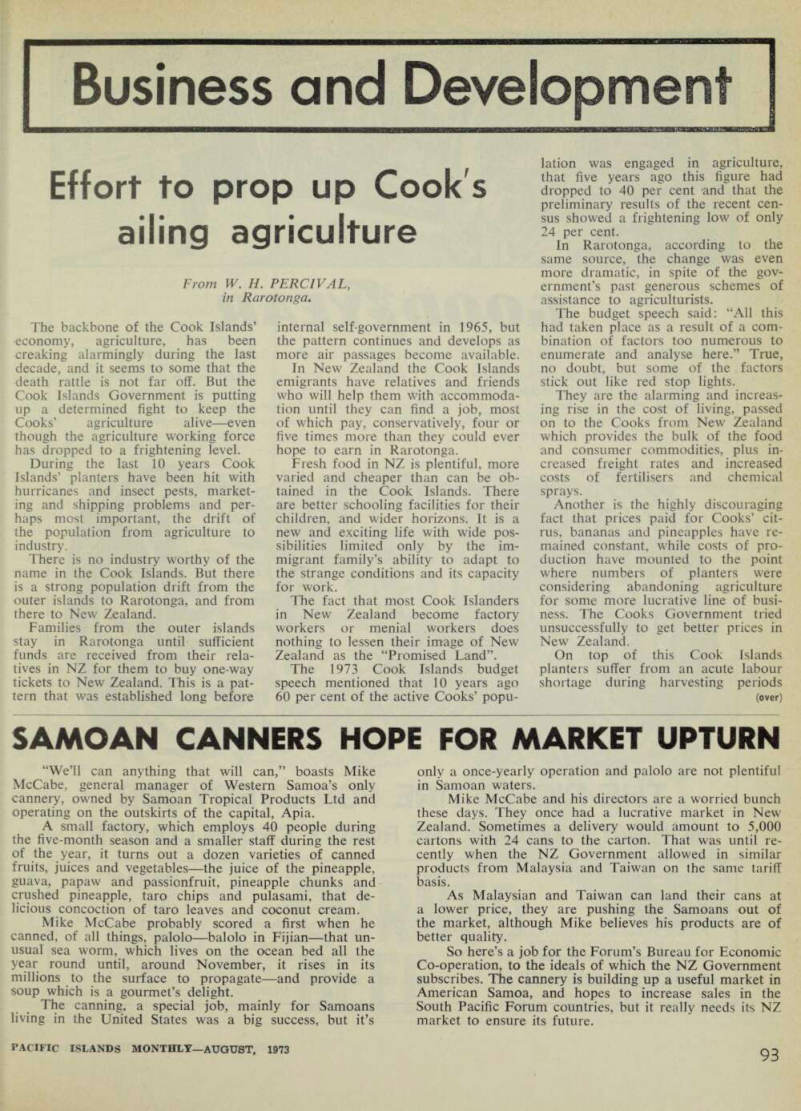


Effort to prop up Cook's ailing agriculture
From W. H. Percival,
in Rarotonga.
The backbone of the Cook Islands’ economy, agriculture, has been creaking alarmingly during the last decade, and it seems to some that the death rattle is not far off. But the Cook Islands Government is putting up a determined fight to keep the Cooks’ agriculture alive—even though the agriculture working force has dropped to a frightening level.
During the last 10 years Cook Islands’ planters have been hit with hurricanes and insect pests, marketing and shipping problems and perhaps most important, the drift of the population from agriculture to industry.
There is no industry worthy of the name in the Cook Islands. But there is a strong population drift from the outer islands to Rarotonga, and from there to New Zealand.
Families from the outer islands stay in Rarotonga until sufficient funds are received from their relalives in NZ for them to buy one-way tickets to New Zealand. This is a pattern that was established long before
internal self-government in 1965, but the pattern continues and develops as more air passages become available.
In New Zealand the Cook Islands emigrants have relatives and friends who will help them with accommoda tion until they can find a job, most of which pay, conservatively, four or five times more than they could ever hope to earn in Rarotonga.
Fresh food in NZ is plentiful, more varied and cheaper than can be ob tained in the Cook Islands. There are better schooling facilities for their children, and wider horizons. It is a new and exciting life with wide pos sibilities limited only by the im migrant family’s ability to adapt to the strange conditions and its capacity for work.
The fact that most Cook Islanders in New Zealand become factory workers or menial workers does nothing to lessen their image of New Zealand as the “Promised Land”.
The 1973 Cook Islands budget speech mentioned that 10 years ago 60 per cent of the active Cooks’ popu
lation was engaged in agriculture, that five years ago this figure had dropped to 40 per cent and that the preliminary results of the recent cen sus showed a frightening low of only 24 per cent.
In Rarotonga, according to the same source, the change was even more dramatic, in spite of the gov ernment’s past generous schemes of assistance to agriculturists.
The budget speech said: “All this had taken place as a result of a com bination of factors too numerous to enumerate and analyse here.” True, no doubt, but some of the factors stick out like red stop lights.
They are the alarming and increas ing rise in the cost of living, passed on to the Cooks from New Zealand which provides the bulk of the food and consumer commodities, plus in creased freight rates and increased costs of fertilisers and chemical sprays.
Another is the highly discouraging fact that prices paid for Cooks’ cit rus, bananas and pineapples have re mained constant, while costs of pro duction have mounted to the point where numbers of planters were considering abandoning agriculture for some more lucrative line of busi ness. The Cooks Government tried unsuccessfully to get better prices in New Zealand.
On top of this Cook Islands planters suffer from an acute labour shortage during harvesting periods (over)
due to the population drift to New Zealand. For some years past, the only citrus and banana planters who have beaten the labour shortage are those with large families. They put their families to work, including the children, thus breaking one of the Cooks’ numerous laws, the one for bidding the use of child labour.
The coup de grace for the despair ing food producers must have been the recent five per cent import levy tax which includes everything im ported into the Cook Islands, plus the new income tax law that hits everybody, especially those in the lower income group. The new tax law, which became effective on Janu ary 1 this year, abolished the former copra, welfare, pearl shell and export produce taxes, and drastically re duced special exemptions, hitting married men with large families to support. (Former tax exemptions of S4OO personal allowance, $4OO wife allowance, and $lOO for each child were abolished, as was that on life insurance).
When copra prices fell some months ago the production of Cooks’ copra fell with them. The copra pro ducers of the northern islands felt that the prices they received were just not worth the effort involved, especi ally with the new tax charges. In an effort to keep the industry alive, the Cooks Government subsidised the price so that local producers received not less than $6O per ton. Since then, copra prices have improved and it’s expected that the Cooks’ copra pro duction will rise accordingly.
In early April the Government an nounced its plans to help and encour age the struggling growers. The main points of the programme are: • A big prize incentive pro gramme for citrus, banana and pine apple growers. The prizes range from $4OO to $25 and are in the form of planting material awarded on the basis of the best kept plots and pro duction. • A free pest control spray ser vice provided by the Agriculture De partment. New Zealand financial help will largely meet this cost. • The provision of free citrus
seedlings and banana planting
material to growers. Again NZ will
help.
• A government subsidy of 0.4 cent per lb for citrus produced this year, effective from April 6. • $20,000 in loans will be made available to growers from the Economic Development Fund.
It is estimated that citrus pro duction for 1973 will be 139,000 cases. Aid to growers, direct and in direct, will amount to over a quarter million dollars this year.
Growing, and
aspiring
Growing unobtrusively and, per haps, aspiring to become a regional airline is Air Melanesiae, owned by New Hebrides Airways and UTA-Air France. The airline came into exis tence in 1960 as New Hebrides Air ways, operating a small Rapide. Lay ing its own airstrips on a number of islands it extended its services and now operates four Britten-Norman Islanders and recently added a Tris lander to the fleet.
The Trislander is on the Vila- Santo and Vila-Tanna services, on regular schedules. It is capable of carrying 17 passengers, but on flights to Santo the number is cut to 15 be cause it carries baggage over water.
Unfortunately, the Trislander soon af ter it was introduced to the service was affected by bans against French aircraft and shipping transport with fewer people going to the New Hebrides.
However, this is a temporary situ ation, and when normal conditions re turn it is conceivable Air Melanesiae will look at the possibility of buying another Trislander because it firmly be lieves that if aircraft are available they will generate traffic. Anyway, the New Hebrides people are air travel-minded, and Air Pacific and UTA-Air France call at Vila with passengers for most parts of the condominium.
The airline feels that the New' Hebrides is the best air-serviced archi pelago in the Pacific. It employs seven pilots and has a staff of more than 40, which is growing as the airline grows. Many of the ground support staff are New Hebrideans.
Air Melanesiae services now cover Vila, Santo, Malekulu, Aoba, Pente
cost, Erromanga, Tongoa, Anaityum and Tanna. A new service will soon be opened to the Banks’ Group.
The airline is a good example of Anglo-French co-operation. The in terests in the part-owner, New Hebri des Airways, are Qantas, BOAC, Burns Philp, Mr and Mrs R. Paul, a nursing sister and some New Hebri deans. The New Hebrideans were of fered a share each time a strip was laid. Mr Paul is chairman of Air Melanesiae.
Japanese 'front'
in Saipan
A Micronesian corporation, South Park Hotel Corp, is a “front” for direct Japanese investment, according to a finding by the Ponape District Economic Development Board. The board, after an inquiry, recommended revocation of the work permit for the hotel and of the entry permit of Japanese national Koshizawa Takuro.
The company contended that be tween $lOO,OOO and $200,000 Takuro invested in the hotel was a gift, “with absolutely no special condition or strings attached”. It was not a loan and not foreign investment where Takuro sought any form of return or claimed ownership.
The board found, however, that Takuro’s investment did have “strings”. The company should have secured the appropriate permits to do business as a foreign corporation.
The company officials had admitted that Takuro was manager of the cor poration, but said he had been given the position in consideration for his “goodwill”.
The board also contended that Takuro’s investment was in breach of Trust Territory law, and the com
pany had “aided, abetted, encouraged, permitted and conspired with” Takuro in breach of the law.
At present it is TT Government policy to allow foreign investment only by US citizens under the “most favoured nation” clause of the trustee ship agreement.
No future
tor PI PA
The Pacific Islands Producers As sociation (PIPA) has just about exhausted its usefulness and will close in a year. By then its functions will have been absorbed by the South Pacific Bureau for Economic Co-operation (SPEC), created by the South Pacific Forum.
PIPA recently held its eighth session at Apia when it reviewed the present position of the banana and coconut industries. It noted, “with concern”, that unless a substantial price in crease was secured for bananas, future production in the Islands was in jeopardy. The interests of PIPA members at the probe into the operations of Fruit Distributors Ltd in New Zealand, will now be watched by SPEC. SPEC will try to get a price giving sufficient inducement to growers to stay in the banana industry.
PIPA will probably ask the British Overseas Development Administra tion for help to investigate setting up a regional copra crushing mill, and the prices it could offer to producers.
The Apia meeting also discussed a number of other matters for primary producers, including inter island shipping, bulk purchasing and quarantine regulations. SPEC is already investigating some of these matters. SPEC will be asked to give
Air Melanesiae's new Trislander stretches its wings over the waterways of Vila.
high priority to these issues as they are of vital importance to regional trade.
PIPA was formed in 1964 mainly because of dissatisfaction in several groups at the poor prices they were getting from Fruit Distributors Ltd, which has the sole NZ rights to import and distribute fresh citrus fruits, bananas and pineapples from the Islands.
Late that year a Fiji delegation visited New Zealand to negotiate prices and quotas with Fruit Dis tributers Ltd. Fiji’s then Member for Natural Resources, Ratu K. K. T.
Mara, soon discovered there was a need for closer co-operation among the Island groups supplying fruit to New Zealand.
From there it was but a step to Western Samoa to discuss co-opera tion. Fiji and Western Samoa set up the Pacific Islands Produce Secre tariat, which was soon renamed Pacific Islands Producers Associa tion. Membership grew to six—Fiji, Western Samoa, Tonga, Cook Islands, Niue and the GEIC. PIPA will cancel itself out at a session, its last, on Niue in June, 1974.
When the question of PIPA’s demise was first considered, there were protests that the interests of two members, Niue and the GEIC, not being eligible for membership of the Forum, would be affected, but it’s now likely that by June, 1974, both will be able to join the Forum.
In any case, the Forum has promised that SPEC’s services will be avail able to all Island territories.
The dear good
life in PNG
In Papua New Guinea one pays for one’s pleasures these days. The customs duty on grog and smokes has gone up twice since 1971, the last time in the so-called mini-bud get introduced at the June meeting of the House of Assembly.
Even imbibers of instant tea and coffee will pay more. Strangely, for a country that produces excellent varieties of both brews, the instant and prepackaged imports are very popular. They were duty free but the duty is now 10 per cent ad valorem.
But if PNG residents drink any thing harder they will really be hit to leg. Sparkling wines which two years ago had a duty of $4.50 a gal lon now attract a duty of $6.50. Still wines which were 50c a gallon are now $2.50; beer has gone up from $1.15 per gallon to $2, and if you are misguided enough to drink Sake or Samshu that exceeds the strength of proof, then what was $5.60 in
1971 now attracts duty of $9.10.
Spirits, dutiable at $l4 per gallon in 1971. are $18.50 and for cigarettes at $4.03 now read $7.18 per lb.
Pre-European Papua New Guinea doesn’t seem to have had anything alcoholic or soporific in the drink line—no coconut toddy, no bush beer, no yaqona (or kava). Betel-nut chewing, once much more prevalent than it is today, had about the same effect as kava but for moderns it is an unattractive habit and is unlikely to be regarded as any substitute for the beer and spirits.
However, if it’s any consolation to drinkers and cigarette smokers, even those with less sinful hobbies don’t escape the tax gatherers. Since the
June mini-budget, all imported cat and dog foods attract duty of 40 per cent ad valorem.
PNG will have
own currency
Papua New Guinea will have its own currency “as soon as is practical . . . but not before December,” said Finance Minister Julius Chan early in July.
He told the House of Assembly that there would be a dual currency period with Australian and PNG dol lars—if PNG uses that term —circulating together. There will be no devaluation and PNG’s currency will be at par with Australia’s.
“The decision that Papua New Guinea should have its own currency is a logical one in the context of the stage of development which we have now reached,” Mr Chan said. “There is nothing sinister about it, it is merely one stage in a logical se quence of events.” The Cabinet has decided that there were many com plex technical and policy issues in volved. Two points emerged clearly.
The first was that under the existing arrangement by which Papua New Guinea used Australian currency there were limitations on the Papua New Guinea Government’s ability to implement certain policies.
The second was that so long as Papua New Guinea remained a part of the Australian currency area, there was always the possibility that it would be subject to policy decisions taken in Australia to suit that country’s situation, but which could be contrary to the best interests of Papua New Guinea.
Emphasising that Cabinet had only taken “an in-principle decision,” Mr Chan said he wanted it clearly un derstood that the introduction of a PNG currency was not imminent so that there would be no room for ill informed and mischievous specula tion.—AAP.
Reprieve for
Lord Howe link
The Lord Howe Island flying-boat service from Sydney has been given another reprieve. Instead of ending in November it will continue to May, 1974. On February 14, Mr G.
Steadman, general manager of Air lines of NSW, said to PIM the service would be discontinued in 1973, and added: “This is the first positive statement we have made so far. Previously we have said ‘may be discontinued’, or it was possible it would be discontinued”.
Sir Reginald Ansett, chairman of Ansett Transport Industries, of which Airlines of NSW is a subsidiary, agreed to continue the service after a conference with the NSW Chief Secretary, Mr Griffith. Mr Griffith will recommend that a 3,000 ft airstrip be built at Lord Howe. A feasibility study would start im mediately and would be completed in two or three months. • Solomon Islands Investments Ltd, having sold all the 250,000 Si shares it offered last year, will now buy a half-share in the Mendana Hotel from Guadalcanal Plains Ltd.
The issue was oversubscribed. Naviti Investments Ltd, of Fiji, holds the other half of the investment in the hotel.
Samoan Canners Hope For Market Upturn
“We’ll can anything that will can,” boasts Mike McCabe, general manager of Western Samoa’s only cannery, owned by Samoan Tropical Products Ltd and operating on the outskirts of the capital, Apia.
A small factory, which employs 40 people during the five-month season and a smaller staff during the rest of the year, it turns out a dozen varieties of canned fruits, juices and vegetables—the juice of the pineapple, guava, papaw and passionfruit, pineapple chunks and crushed pineapple, taro chips and pulasami, that de licious concoction of taro leaves and coconut cream.
Mike McCabe probably scored a first when he canned, of all things, palolo—balolo in Fijian—that un usual sea worm, which lives on the ocean bed all the year round until, around November, it rises in its millions to the surface to propagate—and provide a soup which is a gourmet’s delight.
The canning, a special job, mainly for Samoans living in the United States was a big success, but it’s
only a once-yearly operation and palolo are not plentiful in Samoan waters.
Mike McCabe and his directors are a worried bunch these days. They once had a lucrative market in New Zealand. Sometimes a delivery would amount to 5,000 cartons with 24 cans to the carton. That was until re cently when the NZ Government allowed in similar products from Malaysia and Taiwan on the same tariff basis.
As Malaysian and Taiwan can land their cans at a lower price, they are pushing the Samoans out of the market, although Mike believes his products are of better quality.
So here’s a job for the Forum’s Bureau for Economic Co-operation, to the ideals of which the NZ Government subscribes. The cannery is building up a useful market in American Samoa, and hopes to increase sales in the South Pacific Forum countries, but it really needs its NZ market to ensure its future.
Advertisements & other items, pp. 100-105 (1 item)
good/tear
V-.
V, 7 >
TRACTION HI-MILER HI-MILER G 8
TRACTION 100
SUPER ROAD LUG
ALL SERVICE
For rugged 'stop-go' de- Round shoulder tire With 3-T cord, Abrasion resistant ex- A non-directional livery work. Gives long- for highway trucks, stronger than steel, tra-thick tread and mud and snow tire, er mileage and easier Assures extra trac- developed for bus deep-grooved, sharp an- Reduces skidding steering. tion on all surfaces, and highway trucks, gle lugs assure positive and weaving. wet and dry. traction on all types of road surfaces. * £ IS I s p.
I IS m X i M * 'wi I m m Wi 'H v.
THE RIGHT TIRE FOR EVERY JOB
HIGHWAY - ON/OFF THE ROAD - CROSS COUNTRY
FIJI ISLANDS
NEW HEBRIDES
. . , International Hotel Group Development of Hotels at Fiji . . . Nadi, Suva, Coral Coast New Hebrides . . . Port Vila . . . Investment possibilities available . . . To receive our free Brochure
SOUTH PACIFIC FINANCIAL AND
MANAGEMENT LTD.,
167 MACQUARIE STREET,
14TH FLOOR,
SYDNEY, 2000, AUSTRALIA.
Three ★
★★★ * A. i Leading
SOUTH
AMERICAN
Brand
CORNED
BEEF
Sole Exporters to the Pacific Islands:
PETER FISHER TRADING PTY. LTD.
321 PITT STREET, SYDNEY, 2000, AUSTRALIA.
Telephone: 26 1109. Cables "FI SHERI ON", Sydney.
is R pp £ m
more lime on Ihe job!
Com more per hour!
It's a fact. You get more out of Cat-built equipment as contractors have proved for years. Other earthmoving equipment may have similar features. But machine for machine . . . hour for hour . . .
Cat-built equipment is more productive . . . more reliable . . . more profitable . . . than any other. Reasons include the more advanced design features. The more rugged construction. The more rigorous testing. Factors that make Cat-built machines the most reliable of all. And when a repair is needed. Cat-built equipment is back on the job again in next to no time, thanks to the reliable daily airfreight Parts Backup Service available to our neighbouring Pacific Islands.
CARPENTERS
TRACTOR E EQUIPMENT
VOUR
DEALER
TELEX: CARPTRAC FJ2190 SUVA. PHONE: 24051-4
CABLES: CARPTRAC, SUVA
SERVICING THE SOUTH PACIFIC ISLANDS A 849
SULLIVANS
MELBOURNE
AUCKLAND
SYDNEY
C. SULLIVAN (EXPORT) PTY. LTD.,
4TH FLOOR. KEMBLA BUILDING,
60 MARGARET STREET, SYDNEY
(G.P.O. BOX 3373).
CABLES AND TELEGRAMS: “CHASULL 1
BRISBANE
LONDON
OFFERS A COMPREHENSIVE AND EFFICIENT
BUYING SERVICE TO THE PACIFIC ISLANDS
OFFICES AT:
PORT MORESBY
® SUVA
> LAE • RABAUL • KIETA • MOUNT HAGEN • BULUMA • LAUTOKA • NOUMEA • HONIARA • PORT VILA
SULLIVANS for SERVICE
11
w i p
AUSTRALIA’S FOREMOST
GLASS MERCHANTS AND
MIRROR MANUFACTURERS
• SHEET, FIGURED ROLLED & PLATE
GLASS
• "ARMOURPLATE” GLASS
• ANTI-GLARE & HEAT ABSORBING
GLASS
• LAMINATED & TOUGHENED
AUTOMOTIVE GLASS
• GLASS LOUVRE BLADES
• GLAZING BARS
• "COPPERBAK” MIRROR—
CUT-TO-SIZE & STOCK SIZES
• FRAMED & UNFRAMED
DECORATIVE WALL MIRRORS
• CHEVAL MIRRORS
e VANITY TABLE MIRRORS
• ONE-WAY VISION MIRRORS
• SHOP FRONTS
• ENTRANCE DOORS & SCREENS
• “ARMOURPLATE” DOORS
• "AQUALITE” SHOWER SCREENS
• "U-RECT-IT” STORE EQUIPMENT
• “COWDROY” & "LIDCO” SLIDING
GLASS DOORS & WINDOWS
• WINDSCREENS. TRUCK & CAR
LAMINATED OR TOUGHENED
ORDERS AND ENQUIRIES THROUGH THE GENERAL MERCHANTS IN YOUR AREA
FRANK G. O’BRIEN LTD.
FG50.44
General Glass Enquiries
45 Davies Road, Padstow, N.S.W. 2211.
Motor Glass Division
634 Botany Road, Alexandria, N.S.W. 2015.
Cable: FOBRON, Sydney.
GLASS-JUG WASHERS
• HYGIENIC • LIFT OFF DOOR • HEAVY DUTY
• RELIABLE • CHANGEOVER COMPONENT SERVICE
We also manufacture: • S.S. URINALS • TANKS, VATS • SPECIAL PURPOSE EQUIPMENT • FOOD PROCESSING EQUIPMENT • S.S. BAIN MARIE UNITS • S.S.
FOOD TROLLEYS • JAFFLE COOKERS • PORTABLE S.S. BAR-B-Qs.
James Gready Pty. Ltd.
Pentex St., Salisbury North, Brisbane, Qld. 4107. Ph. 47-3966
Produce Prices
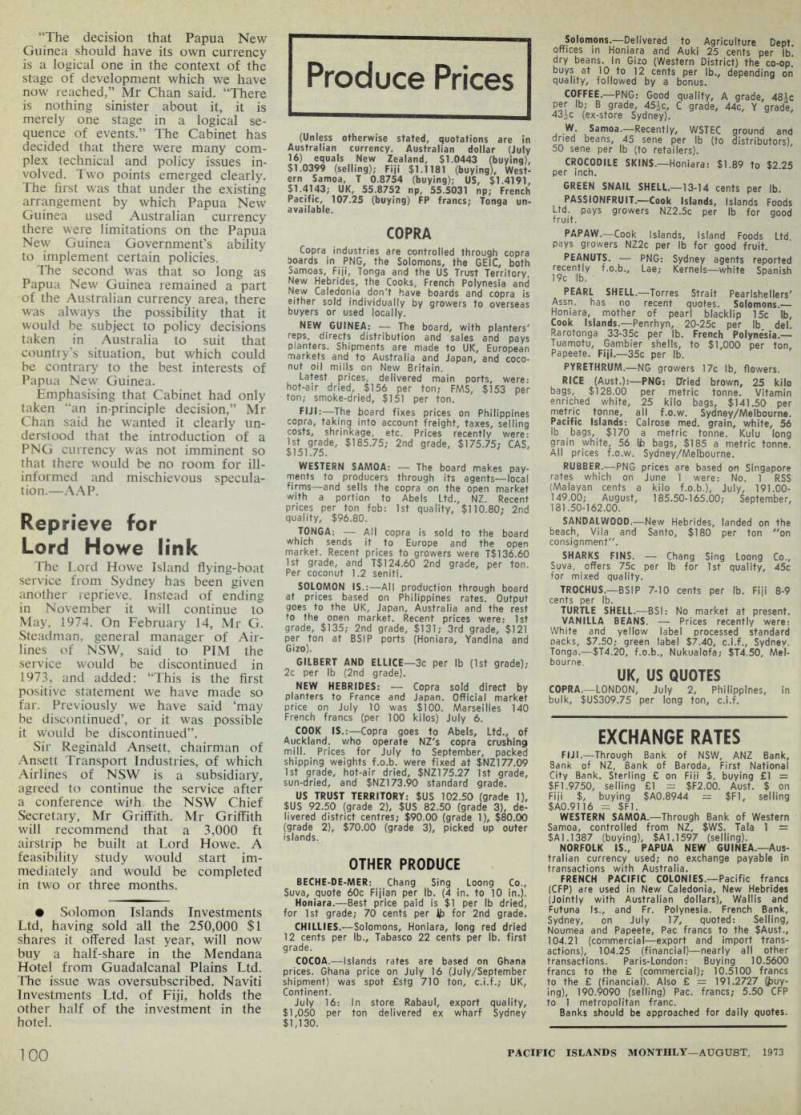
(Unless otherwise stated, quotations are in Australian currency. Australian dollar (July 16) equals New Zealand, $1.0443 (buying), $1.0399 (selling); Fiji $l.llBl (buying), West ern Samoa, T 0.8754 (buying); US, $1.4191, $1.4143; UK, 55.8752 np, 55.5031 np; French Pacific, 107.25 (buying) FP francs; Tonga un available.
Copra
Copra industries are controlled through copra boards in PNG, the Solomons, the GEIC, both Samoas, Fiji, Tonga and the US Trust Territory New Hebrides, the Cooks, French Polynesia and New Caledonia don't have boards and copra is either sold individually by growers to overseas buyers or used locally.
NEW GUINEA: The board, with planters' reps, directs distribution and sales and pays planters. Shipments are made to UK, European markets and to Australia and Japan, and coco nut oil mills on New Britain.
Latest prices, delivered main ports, were: hot-air dried, $156 per ton; FMS, $153 per ton; smoke-dried, $l5l per ton.
FIJI: —The board fixes prices on Philippines copra, taking into account freight, taxes, selling costs, shrinkage, etc. Prices recently were: Ist grade, $185.75; 2nd grade, $175.75; CAS, $151.75.
WESTERN SAMOA: The board makes pay ments to producers through its agents—local firms—and sells the copra on the open market with a portion to Abels Ltd., NZ. Recent prices per ton fob: Ist quality, $110.80; 2nd quality, $96.80.
TONGA: All copra is sold to the board which sends it to Europe and the open market. Recent prices to growers were T 5136.60 Ist grade, and T 5124.60 2nd grade, per ton.
Per coconut 1.2 seniti.
SOLOMON IS.: —All production through board at prices based on Philippines rates. Output goes to the UK, Japan, Australia and the rest to the open market. Recent prices were: Ist grade, $135; 2nd grade, $131; 3rd grade, $l2l per ton at BSIP ports (Honiara, Yandina and Gizo).
GILBERT AND ELLICE— 3c per lb (Ist grade); 2c per lb (2nd grade).
NEW HEBRIDES: Copra sold direct by planters to France and Japan. Official market price on July 10 was $lOO. Marseilles 140 French francs (per 100 kilos) July 6.
COOK IS.; —Copra goes to Abels, Ltd., of Auckland, who operate NZ's copra crushing mill. Prices for July to September, packed shipping weights f.o.b. were fixed at $NZ177.09 Ist grade, hot-air dried, $NZ175.27 Ist grade, sun-dried, and $NZ173.90 standard grade.
US TRUST TERRITORY: SUS 102.50 (grade 1), SUS 92.50 (grade 2), SUS 82.50 (grade 3), de livered district centres; $90.00 (grade 1), $BO.OO (grade 2), $70.00 (grade 3), picked up outer islands.
Other Produce
BECHE-DE-MER: Chang Sing Loong Co., Suva, quote 60c Fijian per lb. (4 in. to 10 in.).
Honiara.—Best price paid is $1 per lb dried, for Ist grade; 70 cents per ib for 2nd grade.
CHILLIES. —SoIomons, Honiara, long red dried 12 cents per lb.. Tabasco 22 cents per lb. first grade.
COCOA. —Islands rates are based on Ghana prices. Ghana price on July 16 (July/September shipment) was spot £stg 710 ton, c.i.f.; UK, Continent.
July 16: In store Rabaul, export quality, $1,050 per ton delivered ex wharf Sydney $1,130.
Solomons—Delivered to Agriculture Dept, offices in Honiara and Auki 25 cents per lb dry beans. In Gizo (Western District) the co-op. buys at 10 to 12 cents per lb., depending on quality, followed by a bonus.
COFFEE. —PNG: Good quality, A grade, 48ic per lb; B grade, C grade, 44c, Y grade, 43£c (ex-store Sydney).
W. Samoa.—Recently, WSTEC ground and dried beans, 45 sene per lb (to distributors), 50 sene per lb (to retailers).
CROCODILE SKlNS. —Honiara; $1.89 to $2 25 per inch.
GREEN SNAIL SHELL—I 3-14 cents per lb.
PASSIONFRUIT. — Cook Islands, Islands Foods Ltd. pays growers NZ2.5c per lb for good fruit.
PAPAW.— Cook Islands, Island Foods Ltd pays growers NZ2c per lb for good fruit.
PEANUTS. PNG; Sydney agents reported recently f.0.b., Lae; Kernels—white Spanish 19c lb.
PEARL SHELL.— Torres Strait Pearlshellers' Assn, has no recent quotes. Solomons.— Honiara, mother of pearl blacklip 15c lb, Cook Islands.— Penrhyn, 20-25 c per lb. del.
Rarotonga 33-35 c per lb. French Polynesia. — Tuamotu, Gambier shells, to $l,OOO per ton.
Papeete. Fiji.— 3sc per lb.
PYRETHRUM. —NG growers 17c lb, flowers.
RICE (Aust.): — PNG; Dried brown, 25 kilo bags, $128.00 per metric tonne. Vitamin enriched white, 25 kilo bags, $141.50 per metric tonne, all f.o.w, Sydney/Melbourne.
Pacific Islands; Calrose med. grain, white, 56 lb bags, $l7O a metric tonne. Kulu long grain white, 56 lb bags, $lB5 a metric tonne.
All prices f.o.w. Sydney/Melbourne.
RUBBER.—PNG prices are based on Singapore rates which on June 1 were: No, 1 RSS (Malayan cents a kilo f.0.b.), July, 191.00- 149.00; August, 185.50-165.00; September, 181.50-162.00.
SANDALWOOD.—New Hebrides, landed on the beach, Vila and Santo, $lBO per ton "on consignment".
SHARKS FINS. Chang Sing Loong Co., Suva, offers 75c per lb for Ist quality, 45c for mixed quality.
TROCHUS.— BSIP 7-10 cents per lb. Fiji 8-9 cents per lb.
TURTLE SHELL. —BSI: No market at present.
VANILLA BEANS. Prices recently were: White and yellow label processed standard packs, $7.50; green label $7.40, c.i.f., Sydnev.
Tonga.—sT4.2o, f.0.b., Nukualofa; $T4.50, Mel bourne.
Uk, Us Quotes
COPRA. LONDON, July 2, Philippines, in bulk, $U5309.75 per long ton, c.i.f.
Exchange Rates
FlJl.—Through Bank of NSW, ANZ Bank, Bank of NZ, Bank of Baroda, First National City Bank. Sterling £ on Fiji $, buying £1 = $F1.9750, selling £1 = $F2.00. Aust. $ on Fiji $, buying $A0.8944 = SFI, selling
$A0.9116 = Sfi,
WESTERN SAMOA.—Through Bank of Western Samoa, controlled from NZ, SWS. Tala 1 = $A1.1387 (buying), $A1.1597 (selling).
Norfolk Is., Papua New Gulnea.—Aus
tralian currency used; no exchange payable in transactions with Australia.
FRENCH PACIFIC COLONIES.—Pacific francs (CFP) are used in New Caledonia, New Hebrides (Jointly with Australian dollars), Wallis and Futuna Is., and Fr. Polynesia. French Bank, Sydney, on July 17, quoted: Selling, Noumea and Papeete, Pac francs to the sAust., 104.21 (commercial —export and import trans actions), 104.25 (financial) —nearly all other transactions. Paris-London: Buying 10.5600 francs to the £ (commercial); 10.5100 francs to the £ (financial). Also £ = 191.2727 (buy ing), 190.9090 (selling) Pac. francs; 5.50 CFP to 1 metropolitan franc.
Banks should be approached for daily quotes.
Advertisements & other items, pp. 107-110 (1 item)
Minolta
Hi-matic '"'Wt.X# minolfa minolta T •W rT 101
AT 1C P
1 OH 5
PERFECT PERFECTER PERFECTEST
Minolta has the perfect camera.
It’s called the 16 QT “Spyfinder” subminiature. Or the electronic exposure Hi-matic F. Or the full system SR-TlOl.
Whatever, wherever, whenever, you want to shoot...
Minolta has the perfect camera.
The SR-TlOl offers perfection in depth. A precision 35mm SLR, the 101 is backed by the Minolta system of over 150 accessories and fine Rokkor Lenses.
With the SR-TlOl you can do anything you want to do —perfectly.
The Hi-matic F is perfection with speed. Automatic exposure and automatic flash ensure electronic accuracy at computer speed. Full 35mm format in a palm sized, speedy package.
The 16 QT is perfectly secret.
Shoot anywhere, anytime without being detected or carrying a lot of equipment. Just drop in a film cartridge and shoot.
Attach the “Spyfinder” eye piece and you can even shoot around comers.
The perfect camera...by Minolta.
What we call it depends on how you use it.
Minolta
Minolta Camera Co.. Ltd.. 30. 2-Chome, Azuchi-Machi. Hlgashi-Ku. Osaka. Japan.
mIL
TJL
Rowenta:
available in London, Paris,
NewVbrkand Sydney.
And now in New Guinea,
Fiji, Noumea and Honiara.
Rowenta lighters are sold at fine shops throughout the world. They are now available in Australia and the South Pacific.
Craftsmen-styled lighters for men and women.
In silver, gold and leather for the pocket or handbag or for the table.
A Rowenta will cost you less than most quality lighters and you get a 12 months’ guarantee and many years of pleasure. Rowenta lighters are guaranteed and serviced by the Sunbeam Corporation in Australia and by Sunbeam in the South Pacific.
Rowenta L 83.3203
Our business is cargo.
Your cargo: to anywhere in our Pacific.
Two paddle steamers on the Yangtse River in 1873 marked the beginning of the China Navigation Company. Today, the same flag flies above eighteen modern motor ships plying an extensive network of cargo routes between Papua New Guinea and Pacific Island ports (as far East as Tahiti) and Japan, New Zealand, Australia and Thailand.
For 100 years, the flag of the China Navigation Company has meant experience, reliability and speed across the sea. Today, it’s flying as strong as ever.
For further details and all enquiries there are Agents at the following ports: Papua New Guinea; Steamships Trading Co. Ltd., Port Moresby, Samarai, Lae, Madang, Rabaul, Kieta. Burns Philp (New Guinea) Ltd., Wewak, Kavieng. Fiji: Morris Hedstrom Ltd., Suva, Lautoka. Western Samoa: Morris Hedstrom Ltd., Apia.
Tonga: Morris Hedstrom Ltd., Nukualofa and Vava’u. Tahiti; Etablissements Donald Tahiti, Papeete. New Caledonia: Etablissements Ballande, Noumea. 8.5.1. P.: British Solomons Trading Co. Ltd., Honiara. New Hebrides: Les Comptoirs Francais desNouvelles-Hebrides, Vila and Santo. AUSTRALIA—Sydney: Interocean Swire Pty. Ltd. Melbourne: Interocean Australia Services Pty. Ltd. Brisbane; Wills, Gilchrist & Sanderson Pty. Ltd. NEW ZEALAND— P. &O. (N.Z.) Ltd.
Auckland, Wellington, Christchurch, Dunedin, Bluff, Napier. Japan: Swire McKinnon, Tokyo, Yokohama, Osaka, Kobe and Nagoya. Eastern Managers; Butterfield & Swire, 9 Connaught Rd., Central, Hong Kong.
CN CO JOHN SWIRE & SONS PTY. LTD. General Agents in Australia, 8 Spring Street, Sydney, Phone: 27 9351.
THE CHINA NAVIGATION CO LTD
MEMBER OF THE SWIRE GROUP.
A little time in
portsaves
you a lot more money.
All our ships spend little time in port.
The reason? Side-port unit-loading. And
because we spend so
little time in port, we
can pass the bonus
savings on to you. If
you’ve cargo coming to
our corner of the
Pacific, send it with the
line that saves you
money on the side.
Our ships: Papuan
Chief, New Guinea
Chief, Island Chief,
Coral Chief.
Registered Office Port Moresby, Papua New Guinea.
General Agents: PORT MORESBY—Steamships Trading Co. Ltd. SYDNEY —John Swire & Sons Pty. Ltd. Agents: SYDNEY —Interocean Swire Pty.
Ltd. BRISBANE —Wills, Gilchrist & Sanderson Pty. Ltd. PAPUA NEW GUlNEA—Steamships Trading Co. Ltd. (for New Guinea Chief at Rabaul and Island Chief at Kavieng—Burns Philp (N.G.) Ltd.)
BRISBANE
•t. i
f KAVIENG
MADANG f kIFTA
\RABAUL !K,ETA
LAEi^
PORT MORESBY^
\ \ \ \ \ I
HONIARA
* \ \ \ I I I )/ IS s
SYDNEY
New Guinea
Australia Line
MEMBER OF THE SWIRE GROUP.
News
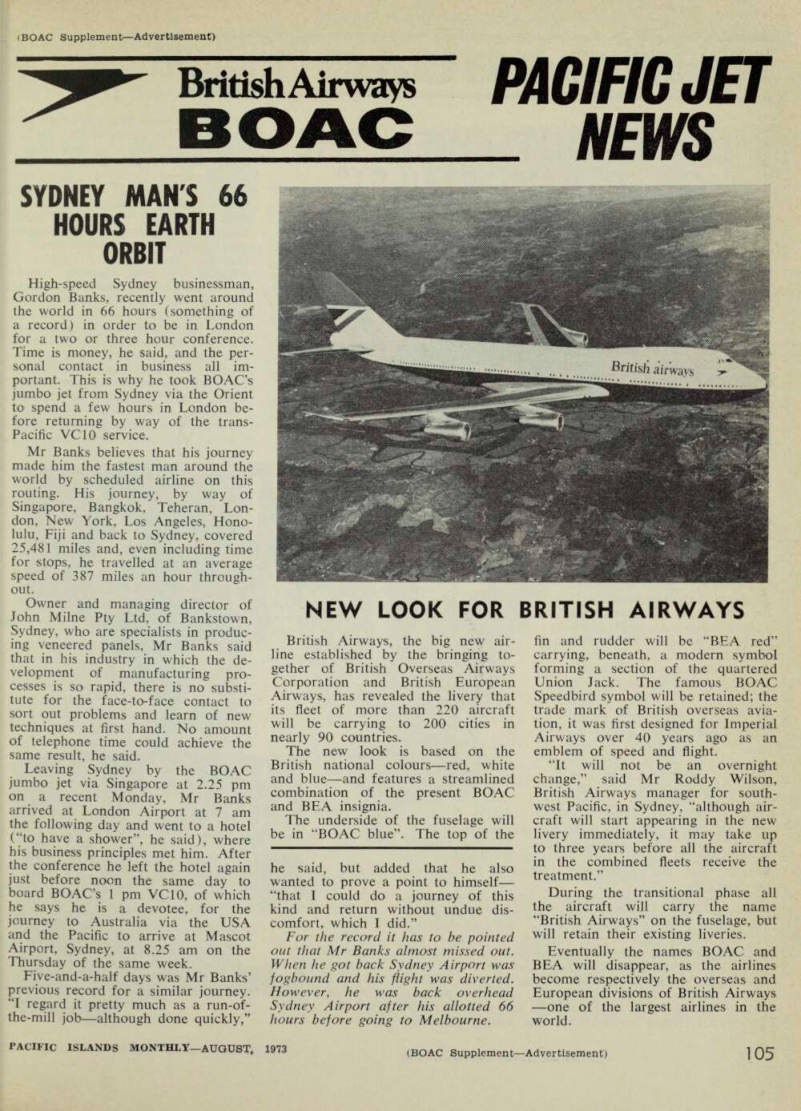
British Airways
Boac
Pacific Jet
News
Sydney Man's 66
Hours Earth
Orbit
(BOAC Supplement—Advertisement)
High-speed Sydney businessman, Gordon Banks, recently went around the world in 66 hours (something of a record) in order to be in London for a two or three hour conference.
Time is money, he said, and the per sonal contact in business all im portant. This is why he took BOAC’s jumbo jet from Sydney via the Orient to spend a few hours in London be fore returning by way of the trans pacific VC 10 service.
Mr Banks believes that his journey made him the fastest man around the world by scheduled airline on this routing. His journey, by way of Singapore, Bangkok, Teheran, Lon don, New York, Los Angeles, Hono lulu, Fiji and back to Sydney, covered 25,481 miles and, even including time for stops, he travelled at an average speed of 387 miles an hour through out.
Owner and managing director of John Milne Pty Ltd, of Bankstown, Sydney, who are specialists in produc ing veneered panels, Mr Banks said that in his industry in which the de velopment of manufacturing pro cesses is so rapid, there is no substi tute for the face-to-face contact to sort out problems and learn of new techniques at first hand. No amount of telephone time could achieve the same result, he said.
Leaving Sydney by the BOAC jumbo jet via Singapore at 2.25 pm on a recent Monday, Mr Banks arrived at London Airport at 7 am the following day and went to a hotel (“to have a shower”, he said), where his business principles met him. After the conference he left the hotel again just before noon the same day to board BOAC’s 1 pm VCIO, of which he says he is a devotee, for the journey to Australia via the USA and the Pacific to arrive at Mascot Airport, Sydney, at 8.25 am on the Thursday of the same week.
Five-and-a-half days was Mr Banks’ previous record for a similar journey.
“I regard it pretty much as a run-of the-mill job—although done quickly,”
he said, but added that he also wanted to prove a point to himself— “that I could do a journey of this kind and return without undue discomfort, which I did.”
For the record it has to be pointed out that Mr Banks almost missed out.
When he got back Sydney Airport was fogbound and his flight was diverted, However, he was back overhead Sydney Airport after his allotted 66 hours before going to Melbourne.
New Look For British Airways
British Airways, the big new air line established by the bringing to gether of British Overseas Airways Corporation and British European Airways, has revealed the livery that its fleet of more than 220 aircraft will be carrying to 200 cities in nearly 90 countries.
The new look is based on the British national colours—red, white and blue—and features a streamlined combination of the present BOAC and BEA insignia.
The underside of the fuselage will be in “BOAC blue”. The top of the
fin and rudder will be “BEA red” carrying, beneath, a modern symbol forming a section of the quartered Union Jack. The famous BOAC Speedbird symbol will be retained; the trade mark of British overseas avia tion, it was first designed for Imperial Airways over 40 years ago as an emblem of speed and flight. ‘‘lt will not be an overnight change,” said Mr Roddy Wilson, British Airways manager for south west Pacific, in Sydney, “although air craft will start appearing in the new livery immediately, it may take up to three years before all the aircraft in the combined fleets receive the treatment.”
During the transitional phase all the aircraft will carry the name “British Airways” on the fuselage, but will retain their existing liveries.
Eventually the names BOAC and BEA will disappear, as the airlines become respectively the overseas and European divisions of British Airways —one of the largest airlines in the world.
(BOAC Supplement—Advertisement)
"Look Out Over The
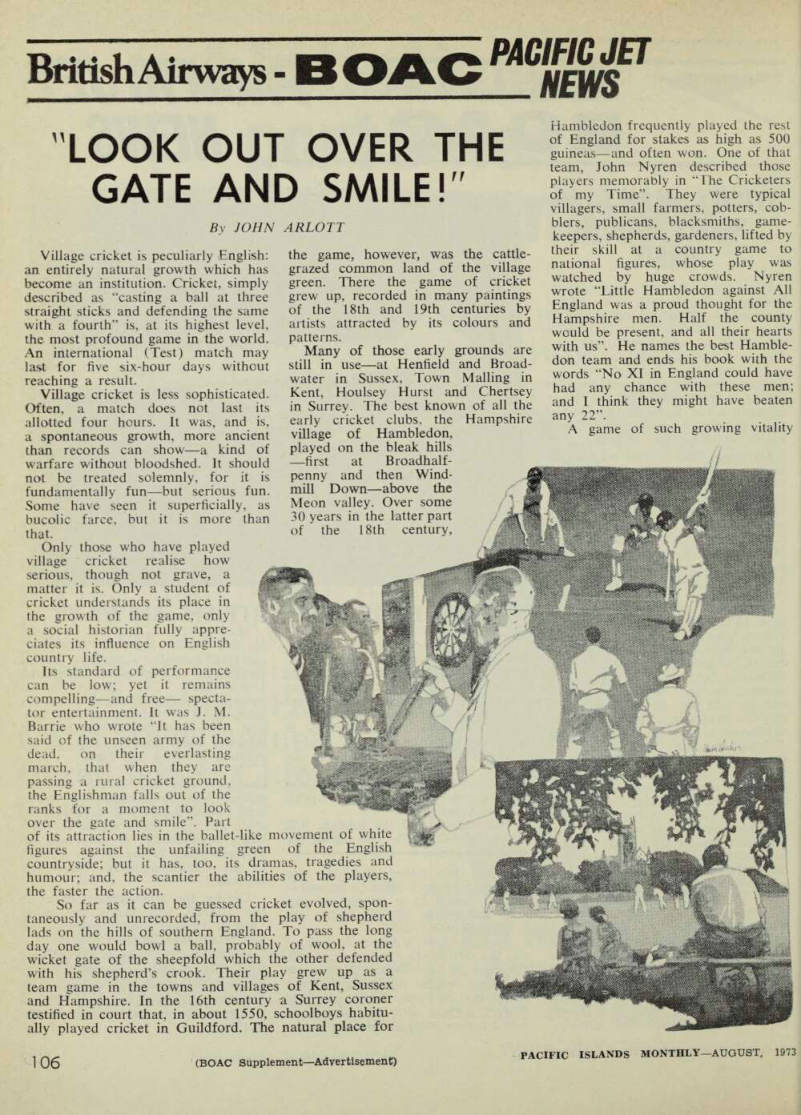
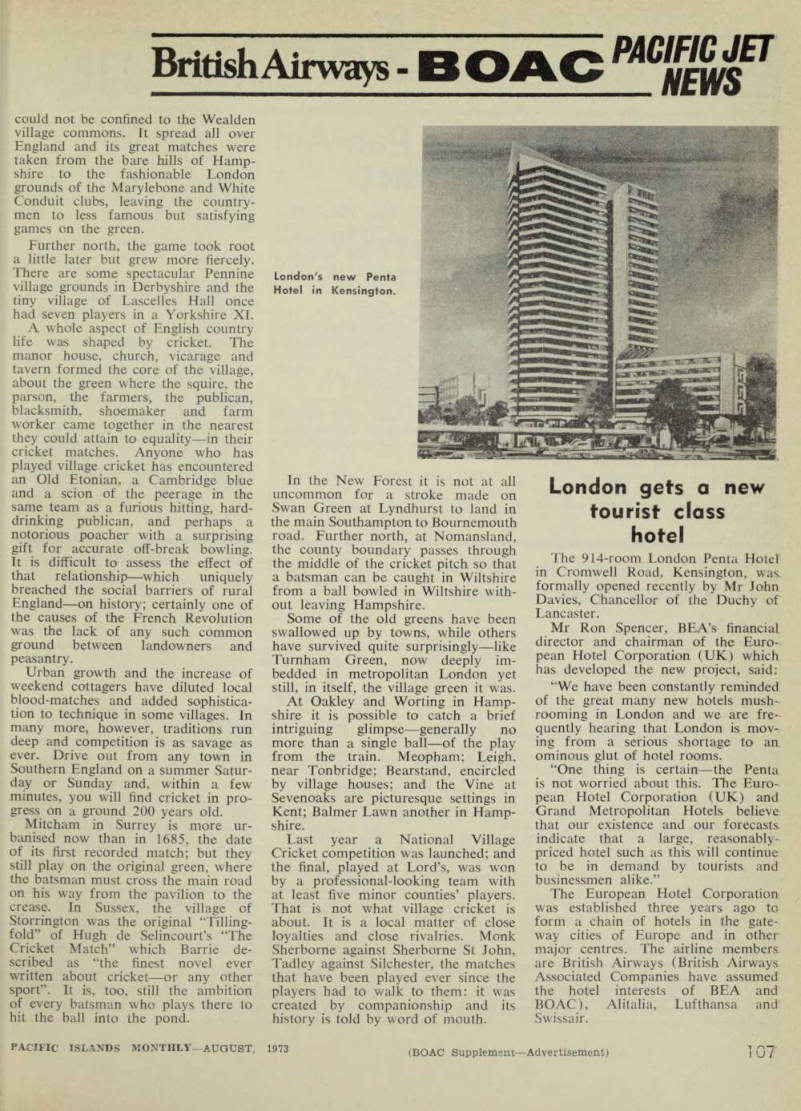
Gate And Smile!"
By John Arlott
Village cricket is peculiarly English: an entirely natural growth which has become an institution. Cricket, simply described as “casting a ball at three straight sticks and defending the same with a fourth” is, at its highest level, the most profound game in the world.
An international (Test) match may last for five six-hour days without reaching a result.
Village cricket is less sophisticated.
Often, a match does not last its allotted four hours. It was, and is, a spontaneous growth, more ancient than records can show—a kind of warfare without bloodshed. It should not be treated solemnly, for it is fundamentally fun—but serious fun.
Some have seen it superficially, as bucolic farce, but it is more than that.
Only those who have played village cricket realise how serious, though not grave, a matter it is. Only a student of cricket understands its place in the growth of the game, only a social historian fully appre ciates its influence on English country life.
Its standard of performance can be low; yet it remains compelling—and free— specta tor entertainment. It was J. M.
Barrie who wrote “It has been said of the unseen army of the dead, on their everlasting march, that when they are passing a rural cricket ground, the Englishman falls out of the ranks for a moment to look over the gate and smile”. Part
of its attraction lies in the ballet-like movement of white figures against the unfailing green of the English countryside; but it has, too, its dramas, tragedies and humour; and, the scantier the abilities of the players, the faster the action.
So far as it can be guessed cricket evolved, spon taneously and unrecorded, from the play of shepherd lads on the hills of southern England. To pass the long day one would bowl a ball, probably of wool, at the wicket gate of the sheepfold which the other defended with his shepherd’s crook. Their play grew up as a team game in the towns and villages of Kent, Sussex and Hampshire. In the 16th century a Surrey coroner testified in court that, in about 1550, schoolboys habitu ally played cricket in Guildford. The natural place for
the game, however, was the cattle grazed common land of the village green. There the game of cricket grew up, recorded in many paintings of the 18th and 19th centuries by artists attracted by its colours and patterns.
Many of those early grounds are still in use—at Henfield and Broad water in Sussex, Town Mailing in Kent, Houlsey Hurst and Chertsey in Surrey. The best known of all the early cricket clubs, the Hampshire
village of Hambledon, played on the bleak hills —first at Broadhalf penny and then Wind mill Down—above the Meon valley. Over some 30 years in the latter part of the 18th century.
Hambledon frequently played the rest of England for stakes as high as 500 guineas—and often won. One of that team, John Nyren described those players memorably in ‘The Cricketers of my Time”. They were typical villagers, small farmers, potters, cob blers, publicans, blacksmiths, game keepers, shepherds, gardeners, lifted by their skill at a country game to national figures, whose play was watched by huge crowds. Nyren wrote “Little Hambledon against All England was a proud thought for the Hampshire men. Half the county would be present, and all their hearts with us”. He names the best Hamble don team and ends his book with the words “No XI in England could have had any chance with these men; and I think they might have beaten any 22”.
A game of such growing vitality
(BOAC Supplement—Advertisement)
could not be confined to the Wealden village commons. It spread all over England and its great matches were taken from the bare hills of Hamp shire to the fashionable London grounds of the Marylebone and White Conduit clubs, leaving the country men to less famous but satisfying games on the green.
Further north, the game took root a little later but grew more fiercely.
There are some spectacular Pennine village grounds in Derbyshire and the tiny village of Lascelles Hall once had seven players in a Yorkshire XL A whole aspect of English country life was shaped by cricket. The manor house, church, vicarage and tavern formed the core of the village, about the green where the squire, the parson, the farmers, the publican, blacksmith, shoemaker and farm worker came together in the nearest they could attain to equality—in their cricket matches. Anyone who has played village cricket has encountered an Old Etonian, a Cambridge blue and a scion of the peerage in the same team as a furious hitting, hard drinking publican, and perhaps a notorious poacher with a surprising gift for accurate off-break bowling.
It is difficult to assess the effect of that relationship—which uniquely breached the social barriers of rural England—on history; certainly one of the causes of the French Revolution was the lack of any such common ground between landowners and peasantry.
Urban growth and the increase of weekend cottagers have diluted local blood-matches and added sophistica tion to technique in some villages. In many more, however, traditions run deep and competition is as savage as ever. Drive out from any town in Southern England on a summer Satur day or Sunday and, within a few minutes, you will find cricket in pro gress on a ground 200 years old.
Mitcham in Surrey is more ur banised now than in 1685, the date of its first recorded match; but they still play on the original green, where the batsman must cross the main road on his way from the pavilion to the crease. In Sussex, the village of Storrington was the original “Tilling fold” of Hugh de Selincourt’s “The Cricket Match” which Barrie de scribed as “the finest novel ever written about cricket—or any other sport”. It is, too, still the ambition of every batsman who plays there to hit the ball into the pond.
In the New Forest it is not at all uncommon for a stroke made on Swan Green at Lyndhurst to land in the main Southampton to Bournemouth road. Further north, at Nomansland, the county boundary passes through the middle of the cricket pitch so that a batsman can be caught in Wiltshire from a ball bowled in Wiltshire with out leaving Hampshire.
Some of the old greens have been swallowed up by towns, while others have survived quite surprisingly—like Tumham Green, now deeply im bedded in metropolitan London yet still, in itself, the village green it was.
At Oakley and Worting in Hamp shire it is possible to catch a brief intriguing glimpse—generally no more than a single ball—of the play from the train. Meopham; Leigh, near Tonbridge; Bearstand, encircled by village houses; and the Vine at Sevenoaks are picturesque settings in Kent; Balmer Lawn another in Hamp shire.
Last year a National Village Cricket competition was launched; and the final, played at Lord’s, was won by a professional-looking team with at least five minor counties’ players.
That is not what village cricket is about. It is a local matter of close loyalties and close rivalries. Monk Sherborne against Sherborne St John, Tadley against Silchester, the matches that have been played ever since the players had to walk to them: it was created by companionship and its history is told by word of mouth.
(BOAC Supplement—Advertisement)
London's new Penta Hotel in Kensington.
Advertisements & other items, p. 112 (1 item)
British Airways - BO AC MC mSsP
106
PACIFIC ISLANDS MONTHLY —AUGUST, 1973
tourist class
London gets a new tourist class hotel
The 914-room London Penta Hotel in Cromwell Road, Kensington, was. formally opened recently by Mr John Davies, Chancellor of the Duchy of Lancaster.
Mr Ron Spencer, BEA’s financial director and chairman of the Euro pean Hotel Corporation (UK) which has developed the new project, said: “We have been constantly reminded of the great many new hotels mush rooming in London and we are fre quently hearing that London is mov ing from a serious shortage to an ominous glut of hotel rooms.
“One thing is certain —the Penta is not worried about this. The Euro pean Hotel Corporation (UK) and Grand Metropolitan Hotels believe that our existence and our forecasts indicate that a large, reasonably priced hotel such as this will continue to be in demand by tourists and businessmen alike.”
The European Hotel Corporation was established three years ago to form a chain of hotels in the gate way cities of Europe and in other major centres. The airline members, are British Airways (British Airways Associated Companies have assumed the hotel interests of BEA and BOAC), Alitalia, Lufthansa and Swissair.
British Airways wins Pan Am
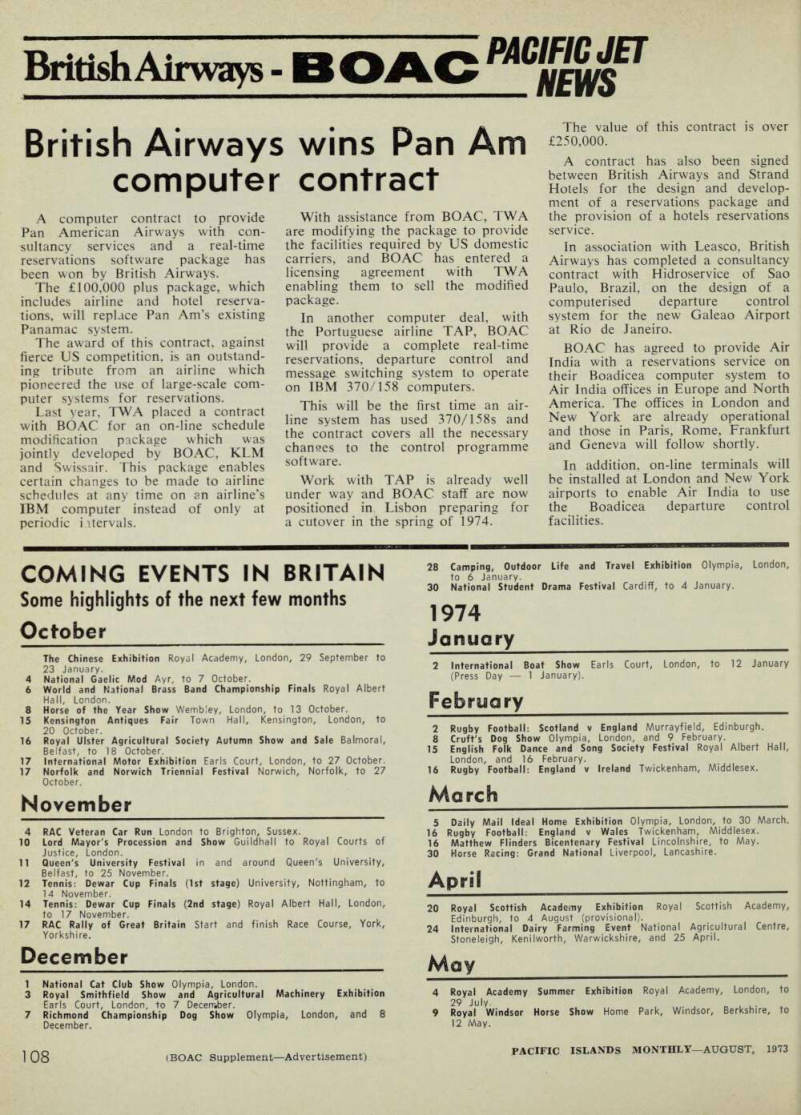
computer contract
A computer contract to provide Pan American Airways with consultancy services and a real-time reservations software package has been won by British Airways.
The £lOO,OOO plus package, which includes airline and hotel reservalions, will replace Pan Am’s existing Panamac system.
The award of this contract, against fierce US competition, is an outstanding tribute from an airline which pioneered the use of large-scale com- P T e a r s. Sy ye^ m TOA r plSed tl a n contract modification! iTmiy developed by BOAC KLM and Swissair. This package enables certain changes to be made to airline schedules at any time on an airline’s IBM computer instead of only at periodic intervals.
With assistance from BOAC, TWA are modifying the package to provide the facilities required by US domestic carriers, and BOAC has entered a licensing agreement with TWA enabling them to sell the modified package.
Xn another computer deal, with the Portuguese airline TAP, BOAC will provide a complete real-time reservations, departure control and message switching system to operate 0 n IBM 370/158 computers. .. ™ s » iU * the fi f s ‘ “ air . = h ?, n “ s to the control programme software.
Work with TAP is already well under way and BOAC staff are now positioned in Lisbon preparing for a cutover in the spring of 1974.
The value of this contract is over £250,000.
A contract has also been signed between British Airways and Strand Hotels for the design and develop ment of a reservations package and the provision of a hotels reservations service.
In association with Leasco, British Airways has completed a consultancy contract with Hidroservice of Sao Paulo, Brazil, on the design of a computerised departure control system for the new Galeao Airport at Rio de Janeiro.
BOAC has agreed to provide Air India with a reservations service on their Boadicea computer system to Air India offices in Europe and North America. The offices in London and New York are already operational and those in Paris, Rome, Frankfurt and Geneva will follow shortly.
In addition, on-line terminals will be installed at London and New York airports to enable Air India to use the Boadicea departure control facilities.
January
Coming Events In Britain
Some highlights of the next few months
October
The Chinese Exhibition Royal Academy, London, 29 September to 23 January. 4 National Gaelic Mod Ayr, to 7 October. 6 World and National Brass Band Championship Finals Royal Albert Hall, London. 8 Horse of the Year Show Wembley, London, to 13 October. 15 Kensington Antiques Fair Town Hall, Kensington, London, to 20 October. 16 Royal Ulster Agricultural Society Autumn Show and Sale Balmoral, Belfast, to 18 October. 17 International Motor Exhibition Earls Court, London, to 27 October. 17 Norfolk and Norwich Triennial Festival Norwich, Norfolk, to 27 October.
November
4 RAC Veteran Car Run London to Brighton, Sussex. 10 Lord Mayor's Procession and Show Guildhall to Royal Courts of Justice, London. 11 Queen's University Festival in and around Queen's University, Belfast, to 25 November. 12 Tennis; Dewar Cup Finals (1st stage) University, Nottingham, to 14 November. 14 Tennis: Dewar Cup Finals (2nd stage) Royal Albert Hall, London, to 17 November. 17 RAC Rally of Great Britain Start and finish Race Course, York, Yorkshire.
December
1 National Cat Club Show Olympia, London. 3 Royal Smithfield Show and Agricultural Machinery Exhibition Earls Court, London, to 7 December. 7 Richmond Championship Dog Show Olympia, London, and 8 December.
28 Camping, Outdoor Life and Travel Exhibition Olympia, London, to 6 January. 30 National Student Drama Festival Cardiff, to 4 January. 1974
January
2 International Boat Show Earls Court, London, to 12 January (Press Day 1 January).
February
2 Rugby Football: Scotland v England Murrayfield, Edinburgh. 8 Cruft's Dog Show Olympia, London, and 9 February. 15 English Folk Dance and Song Society Festival Royal Albert Hall, London, and 16 February. 16 Rugby Football: England v Ireland Twickenham, Middlesex.
March
5 Daily Mail Ideal Home Exhibition Olympia, London, to 30 March. 16 Rugby Football: England v Wales Twickenham, Middlesex. 16 Matthew Flinders Bicentenary Festival Lincolnshire, to May. 30 Horse Racing: Grand National Liverpool, Lancashire.
April
20 Royal Scottish Academy Exhibition Royal Scottish Academy, Edinburgh, to 4 August (provisional). 24 International Dairy Farming Event National Agricultural Centre, Stoneleigh, Kenilworth, Warwickshire, and 25 April.
May
4 Royal Academy Summer Exhibition Royal Academy, London, to 29 July. , , , , 9 Royal Windsor Horse Show Home Park, Windsor, Berkshire, to 12 May.
Advertisements & other items, p. 114 (1 item)
British Airways - BO AC rAB jSS£ T
Shipping & Airways Information
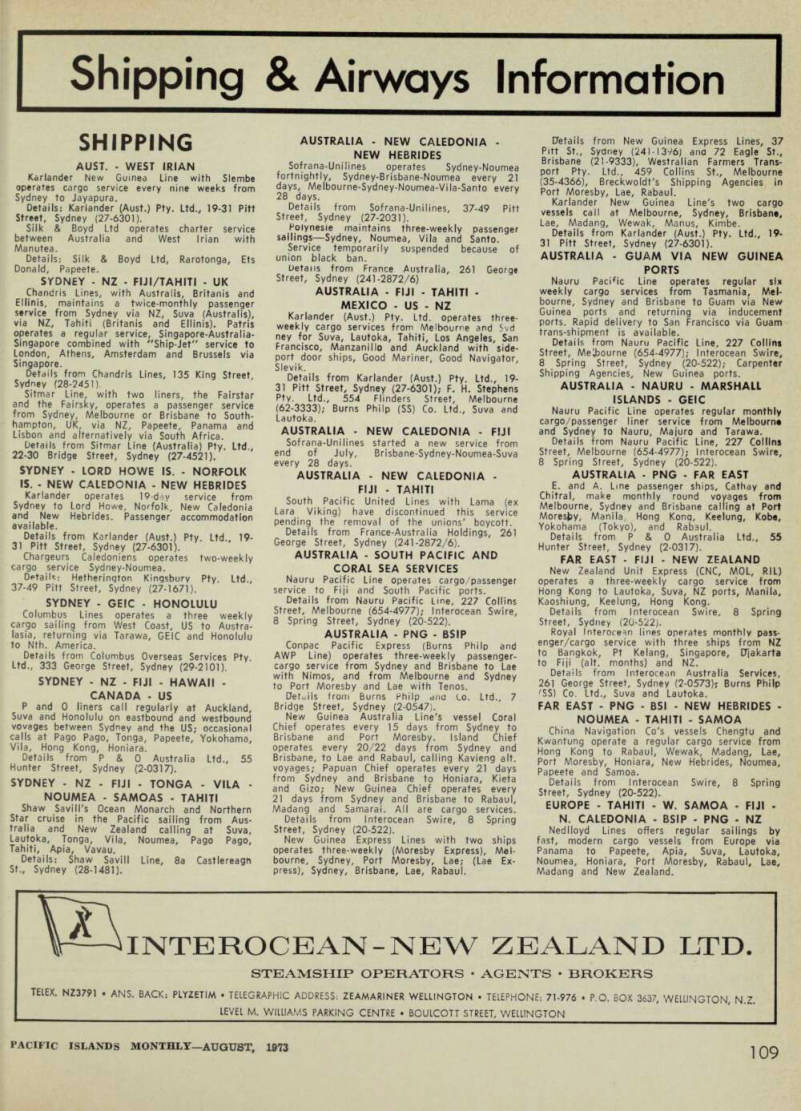
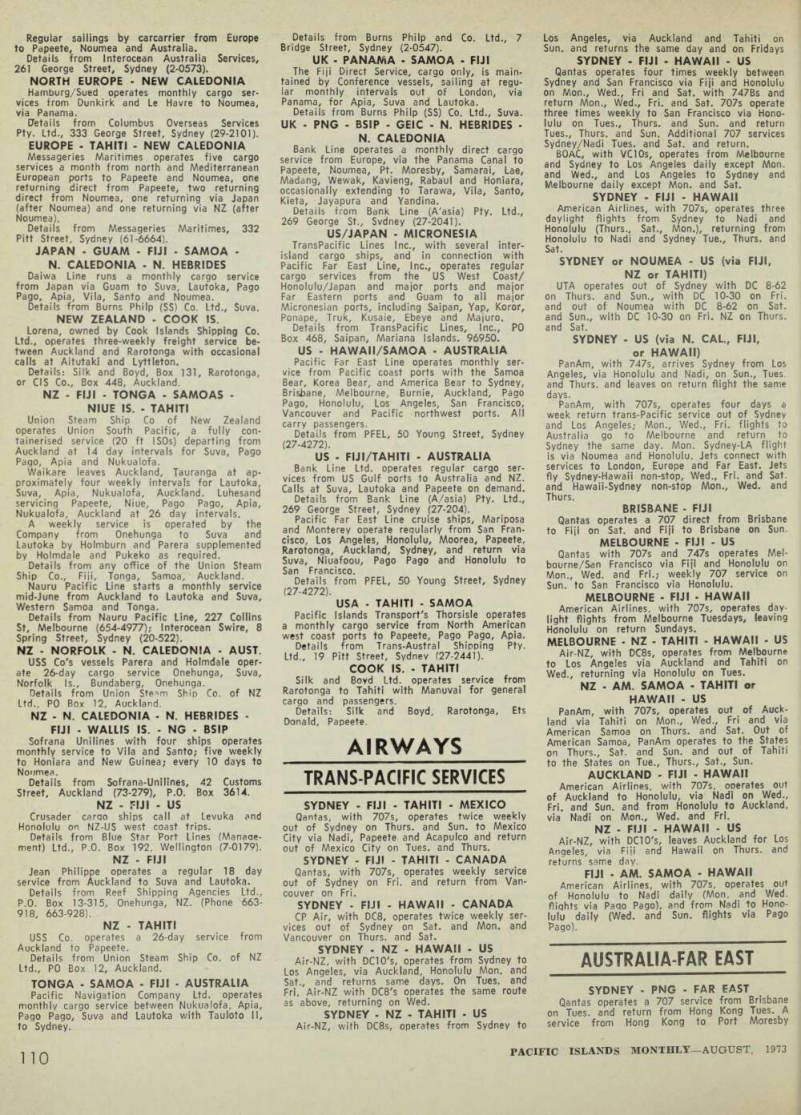
Shipping
Aust. - West Irian
Karlander New Guinea Line with Slembe operates cargo service every nine weeks from Sydney to Jayapura.
Details: Karlander (Aust.) Pty. Ltd., 19-31 Pitt Street, Sydney (27-6301).
Silk & Boyd Ltd operates charter service between Australia and West Irian with Manutea.
Details: Silk & Boyd Ltd, Rarotonga, Ets Donald, Papeete.
SYDNEY - NZ - FIJI/TAHITI - UK Chandris Lines, with Australis, Britanis and Ellinis, maintains a twice-monthly passenger service from Sydney via NZ, Suva (Australis), via NZ, Tahiti (Britanis and Ellinis). Patris operates a regular service, Singapore-Australia- Singapore combined with "Ship-Jet” service to London, Athens, Amsterdam and Brussels via Singapore.
Details from Chandris Lines, 135 King Street, Sydney (28-2451).
Sitmar Line, with two liners, the Fairstar and the Fairsky, operates a passenger service from Sydney, Melbourne or Brisbane to South hampton, UK, via NZ, Papeete, Panama and Lisbon and alternatively via South Africa.
Details from Sitmar Line (Australia) Pty. Ltd., 22-30 Bridge Street, Sydney (27-4521).
SYDNEY - LORD HOWE IS. - NORFOLK IS. - NEW CALEDONIA - NEW HEBRIDES Karlander operates 19-day service from Sydney to Lord Howe, Norfolk, New Caledonia and New Hebrides. Passenger accommodation available.
Details from Karlander (Aust.) Pty. Ltd., 19- 31 Pitt Street, Sydney (27-6301).
Chargeurs Caledoniens operates two-weekly cargo service Sydney-Noumea.
Details: Hetherington Kingsbury Pty. Ltd., 37-49 Pitt Street, Sydney (27-1671).
Sydney ■ Geic - Honolulu
Columbus Lines operates a three weekly cargo sailing from West Coast, US to Austra lasia, returning via Tarawa, GEIC and Honolulu to Nth. America.
Details from Columbus Overseas Services Pty Ltd., 333 George Street, Sydney (29-2101).
SYDNEY - NZ - FIJI - HAWAII -
Canada - Us
P and 0 liners call regularly at Auckland, Suva and Honolulu on eastbound and westbound vovages between Sydney and the US; occasional calls at Pago Pago, Tonga, Papeete, Yokohama, Vila, Hong Kong, Honiara.
Details from P & 0 Australia Ltd., 55 Hunter Street, Sydney (2-0317).
SYDNEY - NZ - FIJI - TONGA - VILA -
Noumea - Samoas - Tahiti
Shaw Savill's Ocean Monarch and Northern Star cruise in the Pacific sailing from Aus tralia and New Zealand calling at Suva, Lautoka, Tonga, Vila, Noumea, Pago Pago, Tahiti, Apia, Vavau.
Details: Shaw Savill Line, 8a Castlereagn St., Sydney (28-1481).
Australia - New Caledonia -
New Hebrides
Sofrana-Unilines operates Sydney-Noumea fortnightly, Sydney-Brisbane-Noumea every 21 days, Melbourne-Sydney-Noumea-Vila-Santo every 28 days.
Details from Sofrana-Unilines, 37-49 Pitt Street, Sydney (27-2031).
Polynesia maintains three-weekly passenger sailings—Sydney, Noumea, Vila and Santo.
Service temporarily suspended because of union black ban.
Details from France Australia, 261 George Street, Sydney (241-2872/6)
Australia - Fiji - Tahiti -
Mexico - Us - Nz
Karlander (Aust.) Pty. Ltd. operates three weekly cargo services from Melbourne and Svd ney for Suva, Lautoka, Tahiti, Los Angeles, San Francisco, Manzanillo and Auckland with side port door ships. Good Mariner, Good Navigator, Slevik.
Details from Karlander (Aust.) Pty. Ltd., 19- 31 Pitt Street, Sydney (27-6301); F. H. Stephens Pty. Ltd., 554 Flinders Street, Melbourne (62-3333); Burns Philp (SS) Co. Ltd., Suva and Lautoka.
Australia ■ New Caledonia - Fiji
Sofrana-Unilines started a new service from end of July, Brisbane-Sydney-Noumea-Suva every 28 days.
Australia - New Caledonia -
Fiji - Tahiti
South Pacific United Lines with Lama (ex Lara Viking) have discontinued this service pending the removal of the unions' boycott.
Details from France-Australia Holdings, 261 George Street, Sydney (241-2872/6).
Australia ■ South Pacific And
Coral Sea Services
Nauru Pacific Line operates cargo/passenger service to Fiji and South Pacific ports.
Details from Nauru Pacific Line, 227 Collins Street, Melbourne (654-4977); Interocean Swire, 8 Spring Street, Sydney (20-522).
Australia - Png - Bsip
Conpac Pacific Express (Burns Philp and AWP Line) operates three-weekly passenger cargo service from Sydney and Brisbane to Lae with Nimos, and from Melbourne and Sydney to Port Moresby and Lae with Tenos.
Details from Burns Philp and Lo. Ltd., 7 Bridge Street, Sydney (2-0547).
New Guinea Australia Line's vessel Coral Chief operates every 15 days from Sydney to Brisbane and Port Moresby. Island Chief operates every 20/22 days from Sydney and Brisbane, to Lae and Rabaul, calling Kavieng alt. voyages; Papuan Chief operates every 21 days from Sydney and Brisbane to Honiara, Kieta and Gizo; New Guinea Chief operates every 21 days from Sydney and Brisbane to Rabaul, Madang and Samarai. All are cargo services.
Details from Interocean Swire, 8 Spring Street, Sydney (20-522).
New Guinea Express Lines with two ships operates three-weekly (Moresby Express), Mel bourne, Sydney, Port Moresby, Lae; (Lae Ex press), Sydney, Brisbane, Lae, Rabaul.
Details from New Guinea Express Lines, 37 Pitt St. ( Sydney (241-1396) and 72 Eagle St., Brisbane (21-9333), Westralian Farmers Trans port Pty. Ltd., 459 Collins St., Melbourne (35-4366), Breckwoldt's Shipping Agencies in Port Moresby, Lae, Rabaul.
Karlander New Guinea Line's two cargo vessels call at Melbourne, Sydney, Brisbane, Lae, Madang, Wewak, Manus, Kimbe.
Details from Karlander (Aust.) Pty. Ltd., 19- 31 Pitt Street, Sydney (27-6301).
Australia - Guam Via New Guinea
Ports
Nauru Pacific Line operates regular six weekly cargo services from Tasmania, Mel bourne, Sydney and Brisbane to Guam via New Guinea ports and returning via inducement ports. Rapid delivery to San Francisco via Guam trans-shipment is available.
Details from Nauru Pacific Line, 227 Collin* Street, Melbourne (654-4977); Interocean Swire, 8 Spring Street, Sydney (20-522); Carpenter Shipping Agencies, New Guinea ports.
Australia - Nauru - Marshall
Islands - Geic
Nauru Pacific Line operates regular monthly cargo/passenger liner service from Melbourne and Sydney to Nauru, Majuro and Tarawa.
Details from Nauru Pacific Line, 227 Collins Street, Melbourne (654-4977); Interocean Swire, 8 Spring Street, Sydney (20-522).
Australia ■ Png - Far East
E. and A. Line passenger ships, Cathay and Chitral, make monthly round voyages from Melbourne, Sydney and Brisbane calling at Port Moresby, Manila, Hong Konq, Keelung, Kobe, Yokohama (Tokyo), and Rabaul.
Details from P & 0 Australia Ltd., 55 Hunter Street, Sydney (2-0317).
FAR EAST - FIJI - NEW ZEALAND New Zealand Unit Express (CNC, MOL, RIL) operates a three-weekly cargo service from Hong Kong to Lautoka, Suva, NZ ports, Manila, Kaoshiung, Keelung, Hong Kong.
Details from Interocean Swire, 8 Spring Street, Sydney (20-522).
Royal Interocean lines operates monthly pass enger/cargo service with three ships from NZ to Bangkok, Pt Kelang, Singapore, Djakarta to Fiji (alt. months) and NZ.
Details from Interocean Australia Services, 261 George Street, Sydney (2-0573); Burns Philp f SS) Co. Ltd., Suva and Lautoka.
FAR EAST - PNG - BSI - NEW HEBRIDES •
Noumea - Tahiti - Samoa
China Navigation Co's vessels Chengtu and Kwantung operate a regular cargo service from Hong Kong to Rabaul, Wewak, Madang, Lae, Port Moresby, Honiara, New Hebrides, Noumea, Papeete and Samoa.
Details from Interocean Swire, 8 Spring Street, Sydney (20-522).
EUROPE - TAHITI - W. SAMOA - FIJI - N. CALEDONIA - BSIP - PNG - NZ Nedlloyd Lines offers regular sailings by fast, modern cargo vessels from Europe via Panama to Papeete, Apia, Suva, Lautoka, Noumea, Honiara, Port Moresby, Rabaul, Lae, Madang and New Zealand.
Regular sailings by carcarrier from Europe to Papeete, Noumea and Australia.
Details from Interocean Australia Services, 261 George Street, Sydney (2-0573).
North Europe • New Caledonia
Hamburg/Sued operates monthly cargo ser vices from Dunkirk and Le Havre to Noumea, via Panama.
Details from Columbus Overseas Services Pty. Ltd., 333 George Street, Sydney (29-2101).
Europe - Tahiti - New Caledonia
Messageries Maritimes operates five cargo services a month from north and Mediterranean European ports to Papeete and Noumea, one returning direct from Papeete, two returning direct from Noumea, one returning via Japan (after Noumea) and one returning via NZ (after Noumea).
Details from Messageries Maritimes, 332 Pitt Street, Sydney (61-6664).
JAPAN ■ GUAM - FIJI - SAMOA -
N. Caledonia - N. Hebrides
Daiwa Line runs a monthly cargo service from Japan via Guam to Suva, Lautoka, Pago Pago, Apia, Vila, Santo and Noumea.
Details from Burns Philp (SS) Co. Ltd., Suva.
New Zealand - Cook Is.
Lorena, owned by Cook Islands Shipping Co.
Ltd., operates three-weekly freight service be tween Auckland and Rarotonga with occasional calls at Aitutaki and Lyttleton.
Details: Silk and Boyd, Box 131, Rarotonga, or CIS Co., Box 448, Auckland.
NZ - FIJI - TONGA - SAMOAS -
Niue Is. - Tahiti
Union Steam Ship Co of New Zealand operates Union South Pacific, a fully con tainerised service (20 ft ISOs) departing from Auckland at 14 day intervals for Suva, Pago Pago, Apia and Nukualofa.
Waikare leaves Auckland, Tauranga at ap proximately four weekly intervals for Lautoka, Suva, Apia, Nukualofa, Auckland. Luhesand servicing Papeete, Niue, Pago Pago, Apia, Nukualofa, Auckland at 26 day intervals.
A weekly service is operated by the Company from Onehunga to Suva and Lautoka by Holmburn and Parera supplemented by Holmdale and Pukeko as required.
Details from any office of the Union Steam Ship Co., Fiji, Tonga, Samoa, Auckland.
Nauru Pacific Line starts a monthly service mid-June from Auckland to Lautoka and Suva, Western Samoa and Tonga.
Details from Nauru Pacific Line, 227 Collins St, Melbourne (654-4977); Interocean Swire, 8 Spring Street, Sydney (20-522).
NZ - NORFOLK - N. CALEDONIA - AUST.
USS Co's vessels Parera and Holmdale oper ate 26-day cargo service Onehunga, Suva, Norfolk Is., Bundaberg, Onehunga.
Details from Union Ship Co. of NZ Ltd., PO Box 12, Auckland.
NZ - N. CALEDONIA - N. HEBRIDES - FIJI - WALLIS IS. - NG - BSIP Sofrana Unilines with four ships operates monthly service to Vila and Santo; five weekly to Honiara and New Guinea; every 10 days to Noumea.
Details from Sofrana-Unilines, 42 Customs Street, Auckland (73-279), P.O. Box 3614.
Nz - Fiji ■ Us
Crusader cargo ships call at Levuka and Honolulu on NZ-US west coast trips.
Details from Blue Star Port Lines (Manaae ment) Ltd., P.O. Box 192, Wellington (7-0179).
Nz - Fiji
Jean Philippe operates a regular 18 day service from Auckland to Suva and Lautoka.
Details from Reef Shipping Agencies Ltd., P.O. Box 13-315, Onehunga, NZ. (Phone 663- 918, 663-928).
Nz - Tahiti
USS Co. operates a 26-day service from Auckland to Papeete.
Details from Union Steam Ship Co. of NZ Ltd., PO Box 12, Auckland.
TONGA - SAMOA - FIJI - AUSTRALIA Pacific Navigation Company Ltd. operates monthly cargo service between Nukualofa, Apia, Pago Pago, Suva and Lautoka with Tauloto 11, to Sydney.
Details from Burns Philp and Co. Ltd., 7 Bridge Street, Sydney (2-0547).
UK - PANAMA - SAMOA - FIJI The Fiji Direct Service, cargo only, is main tained by Conference vessels, sailing at regu lar monthly intervals out of London, via Panama, for Apia, Suva and Lautoka.
Details from Burns Philp (SS) Co. Ltd., Suva.
UK - PNG - BSIP ■ GEIC - N. HEBRIDES -
N. Caledonia
Bank Line operates a monthly direct cargo service from Europe, via the Panama Canal to Papeete, Noumea, Pt, Moresby, Samarai, Lae, Madang, Wewak, Kavieng, Rabaul and Honiara, occasionally extending to Tarawa, Vila, Santo, Kieta, Jayapura and Yandina.
Details from Bank Line (A'asia) Pty. Ltd., 269 George St., Svdney (27-2041).
Us/Japan - Micronesia
Transpacific Lines Inc., with several inter island cargo ships, and in connection with Pacific Far East Line, Inc., operates regular cargo services from the US West Coast/ Honolulu/Japan and major ports and major Far Eastern ports and Guam to all major Micronesian ports, including Saipan, Yap, Koror, Ponape, Truk, Kusaie, Ebeye and Majuro.
Details from Transpacific Lines, Inc., PO Box 468, Saipan, Mariana Islands. 96950.
Us - Hawaii/Samoa - Australia
Pacific Far East Line operates monthly ser vice from Pacific coast ports with the Samoa Bear, Korea Bear, and America Bear to Sydney, Brisbane, Melbourne, Burnie, Auckland, Pago Pago, Honolulu, Los Angeles, San Francisco, Vancouver and Pacific northwest ports. All carry passengers.
Details from PFEL, 50 Young Street, Sydney (27-4272).
Us ■ Fiji/Tahiti - Australia
Bank Line Ltd. operates regular cargo ser vices from US Gulf ports to Australia and NZ.
Calls at Suva, Lautoka and Papeete on demand.
Details from Bank Line (A/asia) Pty. Ltd., 269 George Street, Sydney (27-204).
Pacific Far East Line cruise ships, Mariposa and Monterey operate regularly from San Fran cisco, Los Angeles, Honolulu, Moorea, Papeete, Rarotonga, Auckland, Sydney, and return via Suva, Niuafoou, Pago Pago and Honolulu to San Francisco.
Details from PFEL, 50 Young Street, Sydney (27-4272).
Usa - Tahiti - Samoa
Pacific Islands Transport's Thorsisle operates a monthly cargo service from North American west coast ports to Papeete, Pago Pago, Apia.
Details from Trans-Austral Shipping Pty.
Ltd., 19 Pitt Street, Sydney (27-2441).
Cook Is. - Tahiti
Silk and Boyd Ltd. operates service from Rarotonga to Tahiti with Manuvai for general cargo and passengers.
Details: Silk and Boyd, Rarotonga, Ets Donald, Papeete.
Advertisements & other items, p. 115 (1 item)
Interocean-New Zealand Ltd.
STEAMSHIP OPERATORS • AGENTS • BROKERS
TELEX. NZ3791 . ANS. BACK: PLYZETIM • TELEGRAPHIC ADDRESS: ZEAMARINER WELLINGTON • TELEPHONE: 71-976 • P.O. BOX 3637, WELLINGTON, N.Z.
LEVEL M. WILLIAMS PARKING CENTRE • BOULCOTT STREET. WELLINGTON
Airways
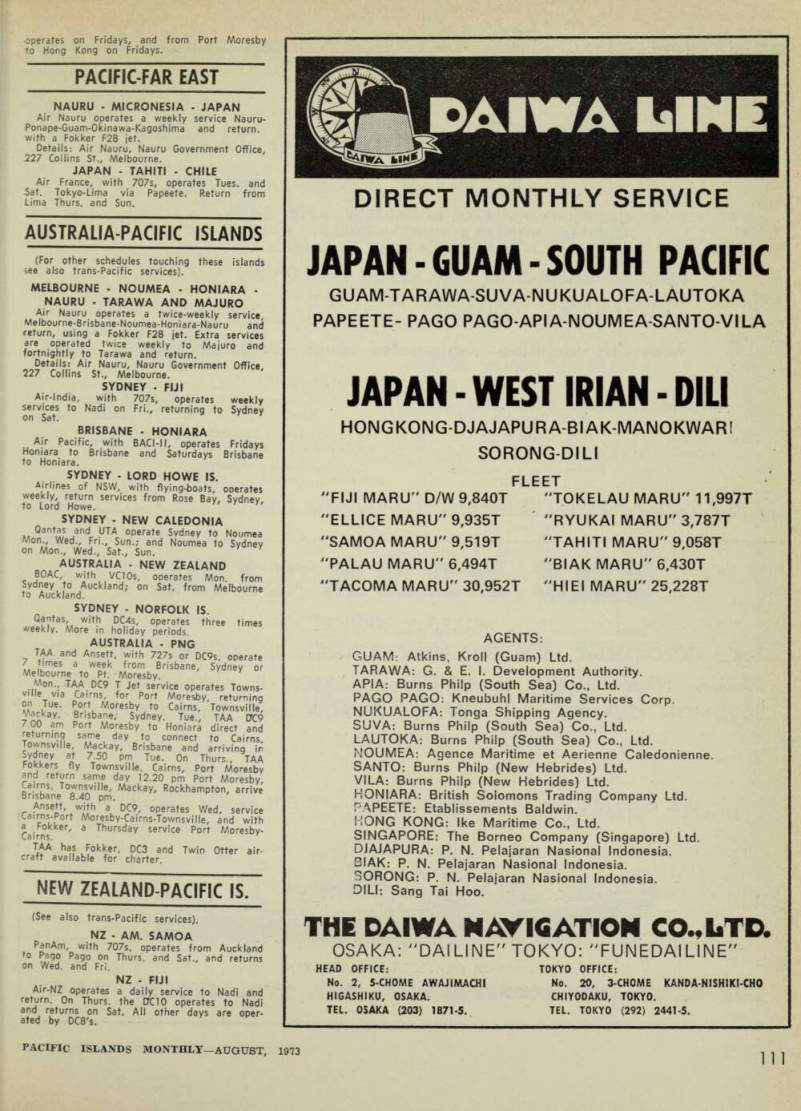
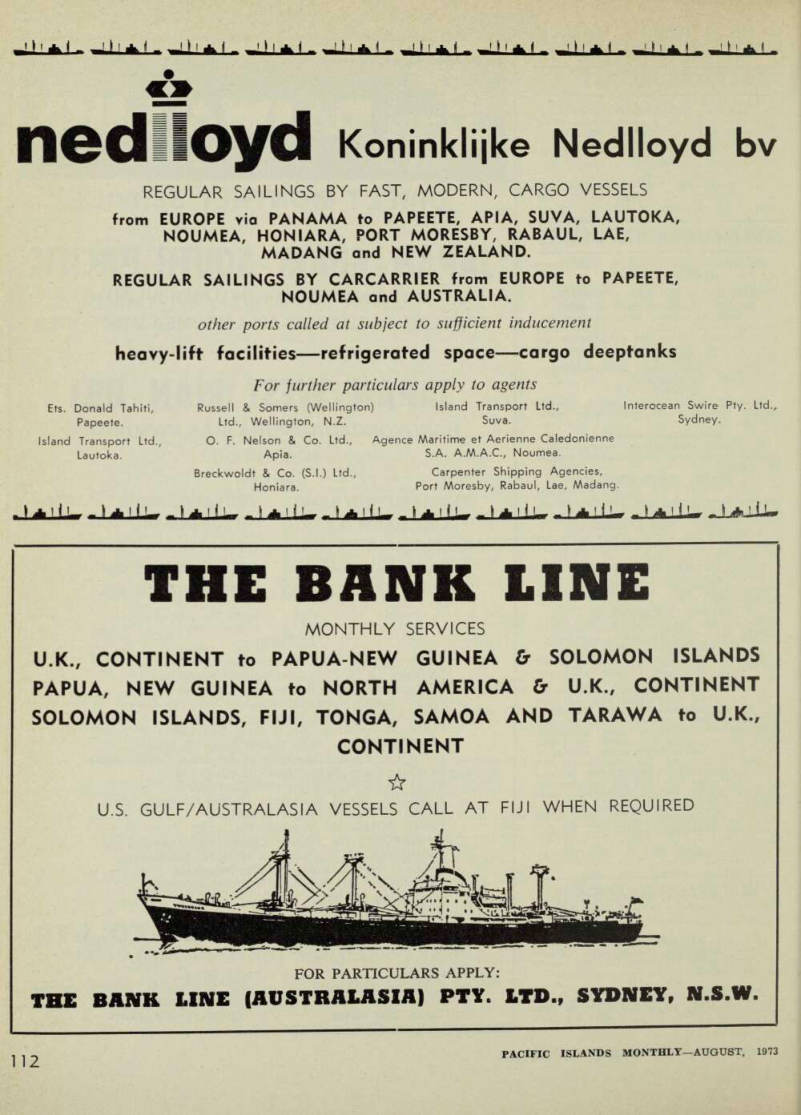
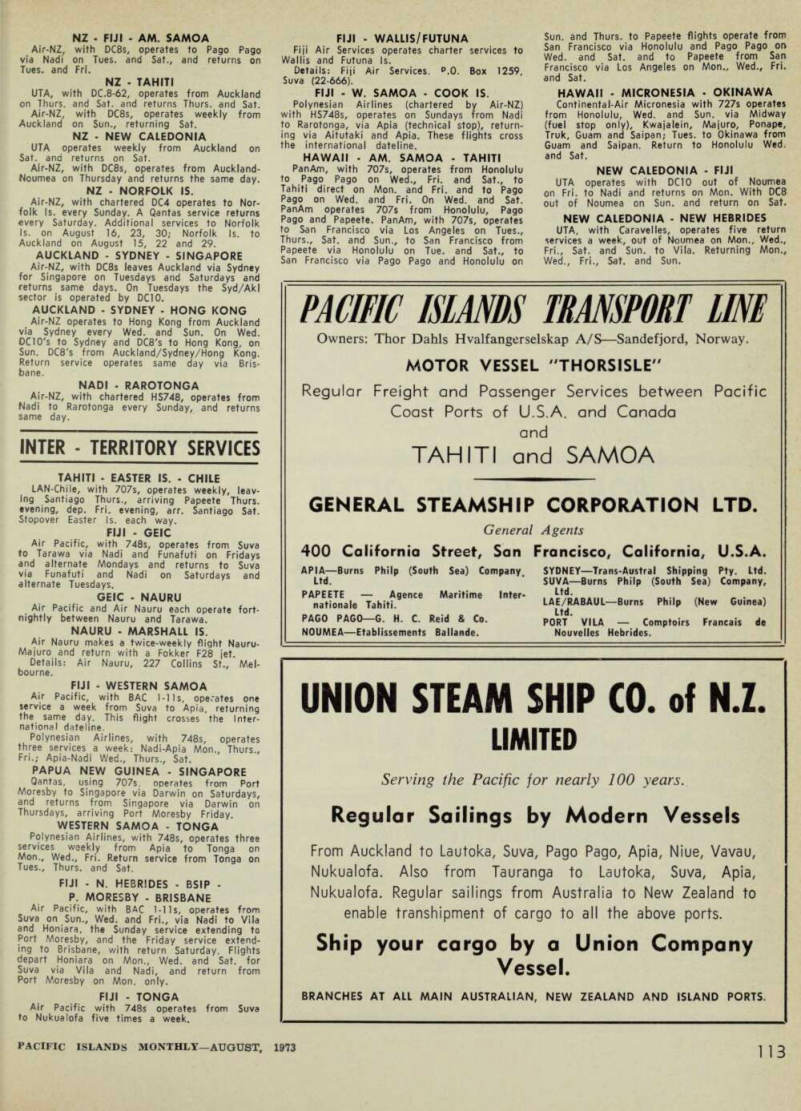
Trans Pacific Services
SYDNEY ■ FIJI - TAHITI - MEXICO Qantas, with 7075, operates twice weekly out of Sydney on Thurs. and Sun. to Mexico City via Nadi, Papeete and Acapulco and return out of Mexico City on Tues. and Thurs.
SYDNEY - FIJI ■ TAHITI - CANADA Qantas, with 7075, operates weekly service out of Sydney on Fri. and return from Van couver on Fri.
SYDNEY - FIJI - HAWAII - CANADA CP Air, with DCS, operates twice weekly ser vices out of Sydney on Sat. and Mon. and Vancouver on Thurs. and Sat.
SYDNEY - NZ - HAWAII - US Air-NZ, with DClO's, operates from Sydney to Los Angeles, via Auckland, Honolulu Mon. and Sat., and returns same days. On Tues. and Fri, Air-NZ with DCB's operates the same route as above, returning on Wed.
SYDNEY - NZ - TAHITI - US Air-NZ, with DCBs, operates from Sydney to
Los Angeles, via Auckland and Tahiti on Sun. and returns the same day and on Fridays SYDNEY - FIJI - HAWAII - US Qantas operates four times weekly between Sydney and San Francisco via Fiji and Honolulu on Mon., Wed., Fri and Sat. with 7478 s and return Mon., Wed., Fri. and Sat. 707 s operate three times weekly to San Francisco via Hono lulu on lues., Thurs. and Sun. and return lues., Thurs. and Sun. Additional 707 services Sydney/Nadi Tues. and Sat. and return.
BO AC, with VClOs, operates from Melbourne and Sydney to Los Angeles daily except Mon. and Wed., and Los Angeles to Sydney and Melbourne daily except Mon. and Sat.
Sydney - Fiji - Hawaii
American Airlines, with 7075, operates three daylight flights from Sydney to Nadi and Honolulu (Thurs., Sat., Mon.), returning from Honolulu to Nadi and Sydney Tue., Thurs. and Sat.
SYDNEY or NOUMEA - US (via FIJI,
Nz Or Tahiti)
UTA operates out of Sydney with DC 8-62 on Thurs. and Sun., with DC 10-30 on Fri. and out of Noumea with DC 8-62 on Sat. and Sun., with DC 10-30 on Fri. NZ on Thurs. and Sat.
SYDNEY - US (via N. CAL, FIJI,
Or Hawaii)
PanAm, with 7475, arrives Sydney from Los Angeles, via Honolulu and Nadi, on Sun., Tues. and Thurs. and leaves on return flight the same days.
PanAm, with 7075, operates four days a week return trans-Pacific service out of Sydney and Los Angeles; Mon., Wed., Fri. flights to Australia go to Melbourne and return to Sydney the same day. Mon. Sydney-LA flight is via Noumea and Honolulu. Jets connect with services to London, Europe and Far East. Jets fly Sydney-Hawaii non-stop. Wed., Fri. and Sat. and Hawaii-Sydney non-stop Mon., Wed. and Thurs.
Brisbane - Fiji
Qantas operates a 707 direct from Brisbane to Fiji on Sat. and Fiji to Brisbane on Sun.
Melbourne - Fiji - Us
Qantas with 707 s and 747 s operates Mel bourne/San Francisco via Fiji and Honolulu on Mon., Wed. and Fri.; weekly 707 service on Sun. to San Francisco via Honolulu.
Melbourne - Fiji - Hawaii
American Airlines, with 7075, operates day light flights from Melbourne Tuesdays, leaving Honolulu on return Sundays.
MELBOURNE - NZ - TAHITI - HAWAII - US Air-NZ, with DCBs, operates from Melbourne to Los Angeles via Auckland and Tahiti on Wed., returning via Honolulu on Tues.
NZ - AM. SAMOA - TAHITI or
Hawaii - Us
PanAm, with 7075, operates out of Auck land via Tahiti on Mon., Wed., Fri and via American Samoa on Thurs. and Sat. Out of American Samoa, PanAm operates to the States on Thurs., Sat. and Sun. and out of Tahiti to the States on Tue., Thurs., Sat., Sun.
Auckland - Fiji - Hawaii
American Airlines, with 7075, operates out of Auckland to Honolulu, via Nadi on Wed., Fri. and Sun. and from Honolulu to Auckland, via Nadi on Mon., Wed. and Fri.
NZ - FIJI ■ HAWAII - US Air-NZ, with DClO's, leaves Auckland for Los Angeles, via Fiji and Hawaii on Thurs. and returns same day.
Fiji ■ Am. Samoa - Hawaii
American Airlines, with 7075, operates out of Honolulu to Nadi daily (Mon. and Wed. flights via Pago Pago), and from Nadi to Hono lulu daily (Wed. and Sun. flights via Pago Pago).
Australia-Far East
Sydney - Png - Far East
Qantas operates a 707 service from Brisbane on Tues. and return from Hong Kong Tues. A service from Hong Kong to Port Moresby
operates on Fridays, and from Port Moresby to Hong Kong on Fridays.
Pacific-Far East
Nauru - Micronesia - Japan
Air Nauru operates a weekly service Nauru- Ponape-Guam-Okinawa-Kagoshima and return, with a Fokker F2B jet.
Details: Air Nauru, Nauru Government Office, -227 Collins St., Melbourne.
Japan - Tahiti - Chile
Air France, with 7075, operates Tues. and Sat. Tokyo-Lima via Papeete. Return from Lima Thurs. and Sun.
Australia-Pacific Islands
(For other schedules touching these islands see also trans-Pacific services).
Melbourne - Noumea - Honiara ■
Nauru - Tarawa And Majuro
Air Nauru operates a twice-weekly service, Melbourne-Brisbane-Noumea-Honiara-Nauru and return, using a Fokker F2B jet. Extra services are operated twice weekly to Majuro and fortnightly to Tarawa and return.
Details: Air Nauru, Nauru Government Office, 227 Collins St., Melbourne.
Sydney - Fiji
Air-1 ndia, with 7075, operates weekly services to Nadi on Fri., returning to Sydney on Sat. 1
Brisbane - Honiara
Air Pacific, with BACI-11, operates Fridays Honiara to Brisbane and Saturdays Brisbane to Honiara.
Sydney - Lord Howe Is.
Airlines of NSW, with flying-boats, ©Derates weekly, return services from Rose Bay, Sydney, to Lord Howe. 1
Sydney - New Caledonia
Q antas and UTA operate Sydney to Noumea Mon., Wed., Fri., Sun.; and Noumea to Sydney on Mon., Wed., Sat., Sun.
Australia - New Zealand
BOAC with VCIOs, operates Mon. from Sydney to Auckland; on Sat. from Melbourne to Auckland.
Sydney - Norfolk Is.
wit h , d C4s, operates three times weekly. More in holiday periods.
Australia - Png
TAA and Ansett, with 727 s or DC9s, operate 7 times a week from Brisbane, Sydney or Melbourne to Pt. Moresby.
Mon., T/U DC9 T Jet service operates Towns ville via Cairns, for Port Moresby, returning on Tue. Port Moresby to Cairns, Townsville, tackay, Brisbane, Sydney. Tue., TAA CTC9 7,00 am Port Moresby to Honiara direct and returning same day to connect to Cairns, Townsville, Mackay, Brisbane and arriving in Sydney at 7.50 pm Tue. On Thurs., TAA Fokkers fly Townsville, Cairns, Port Moresby and return same day 12.20 pm Port Moresby, Cairns, Townsville, Mackay, Rockhampton, arrive Brisbane 8.40 pm.
Ansett, with a DC9, operates Wed. service Cairns-Port Moresby-Cairns-Townsville, and with a Fokker, a Thursday service Port Moresby- Cairns. 1 ™ A . l ; okker / DC3 and Twin Otter air craft available for charter.
New Zealand-Pacific Is.
(See also trans-Pacific services).
Nz - Am. Samoa
PanAm, with 7075, operates from Auckland to Pago Pago on Thurs. and Sat., and returns on Wed. and Fri.
Nz - Fiji
Air-NZ operates a daily service to Nadi and return. On Thurs. the CTCIO operates to Nadi and returns on Sat. All other days are oper ated by DOS's.
Nz - Fiji • Am. Samoa
Air-NZ, with DCBs, operates to Pago Pago via Nadi on Tues. and Sat., and returns on Tues. and Fri.
Nz - Tahiti
UTA, with DC.B-62, operates from Auckland on Thurs. and Sat. and returns Thurs. and Sat.
Air-NZ, with DCBs, operates weekly from Auckland on Sun., returning Sat.
Nz - New Caledonia
UTA operates weekly from Auckland on Sat. and returns on Sat.
Air-NZ, with DCBs, operates from Auckland- Noumea on Thursday and returns the same day.
Nz - Norfolk Is.
Air-NZ, with chartered DC4 operates to Nor folk Is. every Sunday. A Qantas service returns every Saturday. Additional services to Norfolk Is. on August 16, 23, 30; Norfolk Is. to Auckland on August 15, 22 and 29.
Auckland - Sydney - Singapore
Air-NZ, with DCBs leaves Auckland via Sydney for Singapore on Tuesdays and Saturdays and returns same days. On Tuesdays the Syd/Akl sector is operated by DCIO.
Auckland - Sydney - Hong Kong
Air-NZ operates to Hong Kong from Auckland via Sydney every Wed. and Sun. On Wed.
OClO's to Sydney and DCB's to Hong Kong, on Sun. DCB's from Auckland/Sydney/Hong Kong.
Return service operates same day via Bris bane.
Nadi - Rarotonga
Air-NZ, with chartered HS74B, operates from Nadi to Rarotonga every Sunday, and returns same day.
Inter - Territory Services
Tahiti - Easter Is. - Chile
LAN-Chile, with 7075, operates weekly, leav ing Santiago Thurs., arriving Papeete Thurs. evening, dep. Fri. evening, arr. Santiago Sat.
Stopover Easter Is. each way.
Fiji • Geic
Air Pacific, with 7485, operates from Suva to Tarawa via Nadi and Funafuti on Fridays and alternate Mondays and returns to Suva via Funafuti and Nadi on Saturdays and alternate Tuesdays.
Geic • Nauru
Air Pacific and Air Nauru each operate fort nightly between Nauru and Tarawa.
Nauru - Marshall Is.
Air Nauru makes a twice-weekly flight Nauru- Majuro and return with a Fokker F2B jet.
Details: Air Nauru, 227 Collins St., Mel bourne.
Fiji - Western Samoa
Air Pacific, with BAC 1-1 Is, operates one service a week from Suva to Apia, returning the same day. This flight crosses the Inter national dateline.
Polynesian Airlines, with 7485, operates three services a week: Nadi-Apia Mon., Thurs., Fri.; Apia-Nadi Wed., Thurs., Sat.
Papua New Guinea - Singapore
Qantas, using 7075, operates from Port Moresby to Singapore via Darwin on Saturdays, and returns from Singapore via Darwin on Thursdays, arriving Port Moresby Friday.
Western Samoa - Tonga
Polynesian Airlines, with 7485, operates three services weekly from Apia to Tonga on Mon., Wed., Fri. Return service from Tonga on Tues., Thurs. and Sat.
FIJI - N. HEBRIDES - BSIP •
P. Moresby - Brisbane
Air Pacific, with BAC 1-1 Is, operates from Suva on Sun., Wed. and Fri., via Nadi to Vila and Honiara, the Sunday service extending to Port Moresby, and the Friday service extend ing to Brisbane, with return Saturday. Flights depart Honiara on Mon., Wed. and Sat. for Suva via Vila and Nadi, and return from Port Moresby on Mon. only.
Fiji - Tonga
Air Pacific with 748 s operates from Suva to Nukualofa five times a week.
Fiji - Wallis/Futuna
Fiji Air Services operates charter services to Wallis and Futuna Is Details: Fiji Air Services. 0.0. Box 1259 Suva (22-666). ' FIJI - W. SAMOA - COOK IS Polynesian Airlines (chartered by Air-NZ) with HS74Bs, operates on Sundays from Nadi to Rarotonga, via Apia (technical stop), returning via Aitutaki and Apia. These flights cross the international dateline.
Hawaii - Am. Samoa - Tahiti
PanAm, with 7075, operates from Honolulu I°. .P. ag o. Pa 9° °n Wed., Fri. and Sat., to Tahiti direct on Mon and Fn and to Pago Pago on Wed, and Fri. On Wed. and Sat.
PanAm operates 707 s from Honolulu, Pago Pago and Papeete. PanAm, with 7075, operates to San Francisco via Los Angeles on Tues., Thurs., Sat. and Sun., to San Francisco from Papeete via Honolulu on Tue. and Sat., to San Francisco via Pago Pago and Honolulu on
Sun. and Thurs. to Papeete flights operate from San Francisco via Honolulu and Pago Pago oa Wed. and Sat. and to Papeete from San Francisco via Los Angeles on Mon., Wed., Fn. and Sat -
Hawaii - Micronesia - Okinawa
Continental-Air Micronesia with 727 s operates from Honolulu, Wed. and Sun. via Midway (fuel stop only), Kwajalein, Majuro, Ponape, Truk, Guam and Saipan; Tues. to Okinawa from Guam and Saipan. Return to Honolulu Wed. and Sat.
New Caledonia - Fiji
UTA operates with DCIO out of Noumea on Fri . t 0 Nadi and returns on Mon. With DCS o ut 0 f Noumea on Sun. and return on Sat.
New Caledonia • New Hebrides
UTA, with Caravelles, operates five return services a week, out of Noumea on Mon., Wed., Fri., Sat. and Sun. to Vila. Returning Mon., Wed., Fri., Sat. and Sun.
NEW CAL. - WALLIS IS. - NEW CAL.
UTA, with Caravelles, operates on the first, second and third Tues. of each month from Noumea.
New Guinea - Irian/Jaya
TAA operates DC3s Madang to Jayapura and return alt. Tues.
Merpati DCS Jayapura-Lae alternate Tues days, returning Lae-Jayapura 10 am Wednes days.
Png - Solomons
Air Pacific, with BAC 1-11, operates Sundays Honiara to Port Moresby and Mondays Port Moresby to Honiara.
TAA operates DC9 and DCS aircraft three times weekly. Tuesday aircraft leaves Port Moresby 7.00 am for Honiara returning same day for Port Moresby and continues to Cairns, Townsville, Mackay, Brisbane and Sydney. Wed nesday and Saturday aircraft leave Rabaul for Honiara via Buka, Kieta, Munda and Yandina, returning Thursday and Sunday.
TAA Fokker Friendship leaves Port Moresby direct for Kieta Mon., Wed., Fri. and Sat. returning Wed., Fri. and Sat. direct and via Buka, Rabaul and Lae on Tue. and Thurs.
Kieta, Moresby via Rabaul Sunday.
Tahiti ■ Us
UTA, with DCIO, operates from Papeete on Fri. and Sat., returning same days; and with DCS operates on Thurs. and Sun., returning Tues. and Thurs.
PanAm with 7075, operates to San Francisco, via Los Angeles on Mon., Wed, and Fri.; to San Francisco, via Honolulu on Thurs.
Sat.; and to San Francisco, via Pago Pago and Honolulu, on Sat. and Thurs.; from San
Francisco via Honolulu and Pago Pago, to Tahiti on Wed. and Sat., and from San Fran cisco, via Los Angeles, to Tahiti on Mon., Wed, Fri. and Sat.
W. Samoa - Am. Samoa
Polynesian Airlines, with 7485, operates between Apia and Pago Pago (four services, Fri.; three Mon., Tues., Thurs., Sat.; two Wed., Sun.).
Tonga - Niue - W. Samoa
Polynesian Airlines, with 7485, operates weekly service from Tonga to Niue, leaving Thurs., arriving Niue Wed., leave Niue Wed., arrive Apia same day.
Tahiti - Cook Is.
Air Tahiti with Piper Aztec, operates char ter service from Papeete to Rarotonga.
Details from Air Polynesie, P.O. Box 314, Quai Bir Hakeim, Papeete, and UTA offices.
Internal Services
A . „ Air Pacific, with HS74Bs, BAC 1-1 Is and Herons operates regular services to Labasa, Taveuni, Nadi, Suva and Savusavu.
Fiji Air Services, with Britten-Norman Islander and Beechcraft Baron aircraft, operates services to Castaway and Plantation village resorts (twice daily); The Fijian hotel, Korolevu Beach hotel and the Flagship Beachcomber hotel (twice daily Monday to Saturday); Levuka (twice daily Monday to Saturday); Lakeba (twice weekly, Mondays and Fridays); Vatukola (twice weekly). Charter flights operate to anywhere in the Pacific.
Details: Fiji Air Services, P.O. Box 1259,.
Suva (telephone 22-666).
French Polynesia
Air Polynesie, with Fokker F 27 Friendship, DC4s, Twin Otters and Islanders, operates to Bora Bora, Huahine, Moorea, Rangiroa, Raiatea, Manihi, Marquesas, Maupiti and Tubuai, Austral Islands.
Details from Air Polynesie, P.O. Box 314 Quai Bir Hakeim, Papeete, and UTA offices.
Air Tahiti, with light aircraft operates shuttle service from Papeete to Moorea and charter service to Raiatea, Bora Bora, Huahine, Rangiroa and Manihi.
Gilbert And Ellice Islands
Air Pacific, with Herons, operates regular services between Tarawa, Butaritari, North Tabiteuea and Abemama.
Guam - Us Trust Territory
Continental-Air Micronesia with 727 s and DC6s operates regular service connecting Hono lulu, Okinawa and Guam with Saipan, Rota, Yap, Palau, Truk, Ponape, Kwajalein and Majuro.
Details from Air Micronesia, Saipan.
Air Pacific Inc. (not connected with the Fiji based Air Pacific) with Piper Navajo and a deHavilland Heron, operates regular services linking Guam, Saipan, Tinian, and Rota, and charter services are available to other Trust Territory islands.
Details, Air Pacific Inc., P.O. Box 7689, Tamuning, Guam, 96911, U.S.A.
Lagoon Aviation Inc. with Grumman Wid geons, operates charter services for the Mar shalls district, based on Majuro.
Papua New Guinea
TAA and Ansett operate throughout Papua New Guinea.
Aerial Tours operates in Central, Western, Gulf and Sepik districts.
T.A.L. (GV) —Territory Airlines Pty Limited operates scheduled services and charter flights from Goroka, Kundiawa, Madang, Wewak, Vanimo, Mt. Hagen, Mendi to Highlands, Sepik and Coastal areas. Talco Territory Travel Ser vice of Papua New Guinea —Twin Otter Tourist flights throughout Papua New Guinea.
Further details from T.A.L., P.O. Box 108, Goroka, Papua New Guinea.
Macair throughout Papua New Guinea.
Bougainville Air Services operates daily throughout Bougainville. There are now Mon., Wed. and Fri. services Kieta-Buin. Details: Arawa, Phone 956-159; Buka, Phone 16. Box 298, PO, Kieta.
New Caledonia
Air Caledonie, with Twin Otters, and Is landers operates regular services to Houai lou, Isle of Pines, Isle Ouen, Kone, Koumac, Lifou, Mare, Noumea, Ouvea Touho, Mueo, Belep, Tiga.
Details from Air Caledonie, Noumea.
New Hebrides
Air Melanesiae with Britten-Norman Islanders and Trislander operates to Santo, Malekula Norsup and Lamap), Aoba (Walaha and Longana), Pentecost (Lonorore), Erromanga, Tongoa, Aneityum, Tanna and Vila. Direct connections are available to and from Santo for all inter national flights arriving in Vila.
Details from Air Melanesiae, P.O. Box 72, Vila.
Solomon Islands
Snhir, with Beech Barons and Islanders operates to Auki, Avu Avu, Babanakira, Bara koma Bellona Is., Fera Is., Gizo, Honiara, Kira Kira, Marau, Munda, Parasi, Sege, Yandina, Santa Cruz, Mono, Rennell Is., Choiseul Bay, Ballalae and Ring! Cove.
Details from Solomon Islands Airways Ltd., Box 23, Honiara, BSIP.
Tonga
Tonga Tourist and Development Co, with Britten-Norman Islanders, operates between Fua'amotu, (airport for Nukualofa) and Vava'u Monday to Saturday. From August 1, service will commence between Fua'amotu and Eua.
Aircraft available for charter.
Details from Tonga Tourist and Development Co, PO Box 91, Nukualofa, Tonga. (Cables:
Tongair).
To Be Deported.—Mr Satyen
dra Pratap Sharma, member of a Nadi, Fiji, family, who had been living in Sydney since 1969, was ar rested in Sydney on July 24 and was being held in custody until he could be deported. Immigration Minister Mr Grassby said he had personally signed the deportation order, commenting, “The man is in Australia illegally and therefore must go.” Sharma, who mar ried an Australian woman, and separ ated from her a year later, has been living with an Indian woman, who has had a child by him.
DISASTERS. —Disaster followed dis aster as a mercy flight turned into tragedy in the Eastern Ponape District of Micronesia late in June. The plane, a US Navy Hu-16 amphibian was taking off from Lelu Harbour, carry ing a seriously ill woman, her husband, crew, and a medical team when the right wingtip dropped sharply, catch ing a wingtip pontoon in the water.
The aircraft spun sharply, and crashed.
Rescuers in a number of small craft and a hospital boat, had to abandon their boats and take to the water when aviation gas, spewing from the wreck age, caught fire. The fire destroyed three boats. Killed in the crash were the sick woman, Kenye Abraham, and her husband, Osamu, and a petty officer, missing in the crash, was pre sumed drowned. Eight others survived.
Advertisements & other items, pp. 117-120 (1 item)
Daiwa Line
DIRECT MONTHLY SERVICE
JAPAN • GUAM - SOUTH PACIFIC
GUAM-TARAWA-SUVA-NUKUALOFA-LAUTOKA
PAPEETE- PAGO PAGO-APIA-NOUMEA-SANTO-VILA
JAPAN - WEST IRIAN - DILI
HONGKONG-DJAJAPURA-BIAK-MANOKWARf
SORONG-DILI
"FIJI MARU" D/W 9,840 T
"ELLICE MARU" 9,935 T
"SAMOA MARU" 9,519 T
"PALAU MARU" 6,494 T
"TACOMA MARU" 30,9521
"TOKELAU MARU" 11,997 T
' "RYUKAI MARU" 3,787 T
"TAHITI MARU" 9,058 T
"BIAK MARU" 6,430 T
"HIEI MARU" 25,228 T
AGENTS:
GUAM: Atkins, Kroll (Guam) Ltd.
TARAWA: G. & E. I. Development Authority.
APIA: Burns Philp (South Sea) Co., Ltd.
PAGO PAGO: Kneubuhl Maritime Services Corp.
NUKUALOFA; Tonga Shipping Agency.
SUVA: Burns Philp (South Sea) Co., Ltd.
LAUTOKA: Burns Philp (South Sea) Co., Ltd.
NOUMEA; Agence Maritime et Aerienne Caledonienne.
SANTO: Burns Philp (New Hebrides) Ltd.
VILA: Burns Philp (New Hebrides) Ltd.
HONIARA: British Solomons Trading Company Ltd.
PAPEETE: Etablissements Baldwin.
HONG KONG: Ike Maritime Co., Ltd.
SINGAPORE: The Borneo Company (Singapore) Ltd.
DJAJAPURA: P. N. Pelajaran Nasional Indonesia.
BIAK: P. N. Pelajaran Nasional Indonesia.
SORONG; P. N. Pelajaran Nasional Indonesia.
DILI: Sang Tai Hoo.
THE DAIWA NAVIGATION CO.* LTD.
OSAKA: "DAILINE" TOKYO: "FUNEDAILINE"
HEAD OFFICE: TOKYO OFFICE:
No. 2, 5-CHOME AWAJIMACHI No. 20, 3-CHOME KANDA-NISHIKI-CHO
HIGASHIKU, OSAKA. CHIYODAKU, TOKYO.
TEL. OSAKA (203) 1871-5. TEL. TOKYO (292) 2441-5.
nedliOyd Koninklijke Nedlloyd bv
REGULAR SAILINGS BY FAST, MODERN, CARGO VESSELS from EUROPE via PANAMA fo PAPEETE, APIA, SUVA, LAUTOKA,
NOUMEA, HONIARA, PORT MORESBY, RABAUL, LAE,
MADANG and NEW ZEALAND.
REGULAR SAILINGS BY CARCARRIER from EUROPE to PAPEETE,
NOUMEA and AUSTRALIA.
other ports called at subject to sufficient inducement
heavy-lift facilities—refrigerated space—cargo deeptanks
For further particulars apply to agents
Ets. Donald Tahiti, Papeete.
Island Transport Ltd., Lautoka.
Russell & Somers (Wellington) Ltd., Wellington, N.Z.
O. F. Nelson & Co. Ltd., t- Apia.
Breckwoldt & Co. (5.1.) Ltd., Honiara.
Island Transport Ltd., Suva.
Interocean Swire Pty. Ltd., Sydney.
Agence Maritime et Aerienne Caledonienne S.A. A.M.A.C., Noumea.
Carpenter Shipping Agencies, Port Moresby, Rabaul, Lae, Madang.
THE BANK LINE
MONTHLY SERVICES
U.K., CONTINENT to PAPUA-NEW GUINEA & SOLOMON ISLANDS PAPUA, NEW GUINEA to NORTH AMERICA & U.K., CONTINENT SOLOMON ISLANDS, FIJI, TONGA, SAMOA AND TARAWA to U.K.,
CONTINENT
☆ U.S. GULF/AUSTRALASIA VESSELS CALL AT FIJI WHEN REQUIRED &
FOR PARTICULARS APPLY:
BANK LINE (AUSTRALASIA) PTY. LTD., SYDNEY, N.S.W.
PACIFIC ISLANDS TRANSPORT LINE
Owners: Thor Dahls Hvalfangerselskap A/S —Sandefjord, Norway.
MOTOR VESSEL "THORSISLE"
Regular Freight and Passenger Services between Pacific
Coast Ports of U.S.A. and Canada
and
TAHITI and SAMOA
GENERAL STEAMSHIP CORPORATION LTD.
General Agents
400 California Street, San
APIA —Burns Philp (South Sea) Company Ltd.
PAPEETE Agence Maritime Internationale Tahiti.
PAGO PAGO—G. H. C. Reid & Co.
NOUMEA—Etablissements Ballande.
Francisco, California, U.S.A.
SYDNEY —Trans-Austral Shipping Pty. Ltd.
SUVA —Burns Philp (South Sea) Company, Ltd.
LAE/RABAUL —Burns Philp (New Guinea) Ltd.
PORT VILA Comptoirs Francais de Nouvelles Hebrides.
UNION STEAM SHIP CO. of N.Z.
LIMITED
Serving the Pacific for nearly 100 years.
Regular Sailings by Modern Vessels
From Auckland to Lautoka, Suva, Pago Pago, Apia, Niue, Vavau, Nukualofa. Also from Tauranga to Lautoka, Suva, Apia, Nukualofa. Regular sailings from Australia to New Zealand to enable transhipment of cargo to all the above ports.
Ship your cargo by a Union Company Vessel.
BRANCHES AT ALL MAIN AUSTRALIAN, NEW ZEALAND AND ISLAND PORTS.
MORE PORTS / MORE OFTEN
with
t€A HLJUUOER
KARLANDER NEW GUINEA LINE: Serving; Pt. Moresby, Samarai, Lae, Madang, Rabaul, Wewak, Manus Is., Kieta, Honiara, Yandina, Gizo, Vila, Norfolk Is., and Lord Howe Is.
KARLANDER KANGAROO LINE: Serving: Los Angeles, San Francisco,
Auckland, Melbourne, Suva, Lautoka.
AUSTRALIAN TERRITORY LINER SERVICES: Serving,- Melbourne,
Sydney, Newcastle, Brisbane, Weipa, Gove, Thursday Is.
Managing Agents
KARLANDER (AUSTRALIA) PTY. LIMITED
19-31 Pitt Street, Sydney
General Agents Brisbane: F. H. Stephens Pty. Ltd.
Melbourne: F. H. Stephens (Vic.) Pty. Ltd.
Pt. Moresby: Carpenter Shipping Agencies.
Samarai: Burns Phi Ip (N.G.) Ltd.
San Francisco: Transpacific Transportation Co.
Los Angeles: Transpacific Transportation Co.
Madang: B. J. Back Pty. Ltd.
Yandina: Levers Pacific Plantations Co. Ltd.
Santo; Burns Philp (N.H.) Ltd.
Lord Howe Is.: R. Wilson Leanda Lei.
Thursday Is.: Torres Industries Ltd.
Manus Is.: Edged & Whiteley Ltd.
Rabaul: Rabaul Trading Co. Ltd.
Honiara; E. V. Lawson Pty. Ltd.
Kieta: Breckwoldt & Co. Pty. Ltd.
Lae: N.G.G. Trading Company.
Wewak: Burns Philp (N.G.) Ltd.
Fiji: Burns Philp (S.S.) Ltd.
Gizo: British Solomon Trading Co.
Vila: Burns Philp (N.H.) Ltd.
Norfolk Is.: Burns Philp (S.S.) Ltd.
Nutshell
In a Nutshell
JET CRASH.—A Pan-Am Boeing 'O7 crashed shortly after take-off from Papeete on July 22 (Tahiti time) and 78 of 79 passengers and crew were killed. The plane, on its way from Auckland to Los Angeles, plunged into the sea a mile outside the port . Cop A n. r. r breakwater. Seconds after take-off, the pi r J p 9 rt f ed a smashed windscreen for an emergency landing The plane did a tight turn and then
bodied were *re
afterwards covered shortl y afterwards.
Censors Relent.—The West-
ern Samoan Films Censorship Committee has shown itself rather generous to the Savalalo Grand Theatre in Apia. Previously, it had banned The Body and Flesh in Fire but recently it has withdrawn the bans after further showings. The Body represented a significant decision, permitting nudity for “scientific and educational” purposes. The ban on Stop has not been lifted because of scenes of lesbianism and male homosexuality.
NIUE’S BAN. —In Melbourne, it is “ban the can”. On Niue Island it is “ban the bottle”. Niue will not allow any more bottled beer in after July because of broken glass pro blems. But canned beer will be al lowed. Personal injury, punctured tyres and broken bottles on the boat wharf, which cost the government $l,OOO a year, are the reasons for the ban. But exporters, two breweries in New Zealand are unworried. One already exports to the Pacific only in cans, and for the second a change from bottles to cans will not present a problem.
Localisation. Papua New
Guineans will hold all District Com missioner posts by July, 1974. Four of them are already DCs, and a further seven are expected to be ap pointed by the end of 1973. Current expatriate DCs have been asked if they would like alternative positions in the PNG public service.
SEAMEN SUNK.—The Fiji Regi strar of Trade Unions, Mr Raman Ku rup, has suspended the registration of the Fiji Dockworkers’ and Seamen’s Union. The registrar alleged that the union had infringed the Trade Unions Ordinance by not keeping account books at its registered office and had failed to submit annual returns to him.
Niue Population.— The Popu
lation of Niue Island has fallen by 11.4 per cent since the 1971 census.
Justice Department figures show a population of 4,419 (2,259 males and 2,160 females). In the 1971 census there was a population of 4,990 (2,507 males and 2,483 females). The net natural increase was 140, but the net loss from migration was 711. More than half the population, 2,377, is in the 0-14 age group. Other groupings are: 15-29, 815; 30-44, 554; 45-59, 349; over 60, 324.
NEW STAMPS. —New stamp is sues are coming thick and fast in the Pacific Islands. Six territories will have issued stamps in 28 different denomin ations by the end of the year. The GEIC has four to commemorate the centenary of the World Meteorological Organisation in 3c, 10c, 35c and 50c denominations, scheduled for release on November 26. Pitcairn had a set featuring five flowers issued late in June in 4c, Bc, 15c, 20c and 35c values. Western Samoa released a $2 “green turtle” stamp on June 18, and on August 20 will follow it up with four more of 2,8, 20 and 22 sene. Fiji showed development in a series released on July 23 in sc, Bc, 10c and 25c denominations. Papua New Guinea shows familiar scenes of life, culture or natural beauty in a series of six released on June 13 in Ic, 7c, 9c, 15c, 25c and 40c de nominations. The final issue from Nauru, late in July, shows aspects of life on the island in 7c, 25c, 30c and 50c denominations.
Png Buys More Bp Shares.—
The Investment Corporation of Papua New Guinea took up a further 13.5 per cent of the paid capital of Burns Philp (New Guinea) Ltd, in July to give it a total of 26 per cent of the issued capital. Consider ation was $1.7 million.
Burns Philp (NG) Ltd, is the big gest subsidiary of Burns Philp and Co Ltd. The Investment Corporation latest buy gives it the right to nomin ate a second member of the board of Burns Philp (NG) Ltd, to join its first nominee, Mr L. G. C. Moyle.
The corporation also bought a 20 per cent interest in Territory Glass and Aluminium Pty Ltd and TGA Pty Ltd, two Australian-controlled com panies with links with Pilkington ACT Ltd. They make glass, aluminium win dow frames and doors. When formed in 1972, Territory Glass and Alumin ium was given pioneer status, exempt ing it from taxation for five years.
Advertisements & other items, pp. 121-122 (1 item)
Hand
z / /
i a /
IRON
Australia's best selling non-electric Iron! For reliability, ease of handling, and excellence of quality at a low price, you can't beat the HANOI. It's simplicity itself to operate—NO PUMPING IS REQUIRED. IT'S IMPOSSIBLE TO OVERFILL THE FUEL TANK and one filling does approximately 2 hours effortless ironing. Attractively finished in nickel plate. Spare parts always available.
THE PORTABLE OUTDOORS COOKER at a sensible price!
Twin independent burners for fast cooking. Twin tanks for double capacity. Steel case, when opened, acts as triple-wind shield. Rustproof. Noisy or silent burners as required. Small or large porcelain enamel ovens also available separately. HANOl—the lowest priced QUALITY Twin Burner Portable! -yWM ,11, -- —ywyMap i MBl inn. y- ■ ’ ■ ■ - i ■ 4 I i I jI j H /91 • J ¥ iL. Compo Rd., Salisbury North, Ph. 47 2121
BRISBANE ' QUEENSLAND, AUSTRALIA
THE
YORKSHIRE INSURANCE
CO. LTD.
(Incorporated in England)
A MEMBER OF THE GENERAL ACCIDENT GROUP OF COMPANIES
ALL CLASSES OF INSURANCE
AUSTRALIAN HEAD OFFICE: 10-12 Spring Street, Sydney.
General Manager for Australia: J. Adam.
PAPUA AND NEW GUINEA BRANCH: Douglas Street, Port Moresby Manager; H. M. Harvey.
CHIEF ISLAND REPRESENTATIVES
Rabaul, A.S.P. (N.G.) Ltd.; Lae, Radio Cabs (Lae) Pty. Ltd.; Madang, W. Stokes; Manus, Edgell & White ley Ltd.; Honiara, 8.5.1. P., E. V. Lawson Ltd.; Suva, Williams & Gosling Ltd.; Noumea, R. Laubreaux; Norfolk Island, Martin's Agencies; Apia, E. A. Coxon & Co.; Vila, C. Sullivan (INI) Pty. Ltd.
PETER FISHER TRADING
PTY. LTD.
321 PITT STREET, SYDNEY, 2000, AUSTRALIA
TELEPHONE; 26-1109 CABLES: "FISHERION", SYDNEY
EXPORTERS TO THE PACIFIC
ISLANDS
Some of the firms and products we represent: GREENLITES waterproof matches LUCKY STAR tinned fish REDHEADS safety matches RENA vegetables in glass jars
MAURI BROS, yeast FOREMOST DAIRY
PMU food products TOOHEYS beer
CARLTON UNITED beer
CLUB RUM
ROGOVI VODKA
FRENCH KNIT car seat covers THREE STAR corned beef CRAVEN confectionery BROWNBUILT office furniture ADVANCE containers HARDIE'S building products SEBEL furniture BEARD beds and mattresses HUNTER DOUGLAS furniture KLINKII plywood STERLING bakery machinery WHITE ABBEY Scotch whisky BATA shoes SRC tinned fruit LIFESAVERS confectionery CHILTONIAN biscuits
MACHETTES
ATLAS plastic ware POLARIS stainless steel ware FOSTER LAGER—Beer in bottles or cans.
VICTORIA BITTER—Beer in
bottles or cans.
BOND'S underwear BOND'S outerwear ANDY spotlights COUNTRY CLUB shirts WILLOW metal ware FILLETTA tinned fish PAULCALL tools ASTRA razor blades WENGER quality knives GLYNGORE tinned fish VAN DER LAAN tinned meat DEROPA gift paper WARBURTON FRANKI coolrooms DURABUILT prefabricated houses THREE X (XXX) tinned hake BRONTE tinned meat HEINEKEN beer
SHEATH KNIVES
GOLDEN STATE evaporated milk
AND MANY MORE
Islands People
Deaths of Islands People
Mr M. Christian Mr Melville Christian, fifth genera tion descendant of Fletcher Christian, leader of the Bounty mutineers, died on Pitcairn Island in June, aged 77.
He had been ill for some months.
He is survived by his wife.
The entire population of Pitcairn attended Mr Christian’s funeral at the SDA Church, the only church on the island, and the subsequent grave side service. Seventy-two of them were direct descendants of the muti neers. The remaining nine “out siders” were the island pastor and his wife, the schoolteacher, his wife and three children, and two RAF “monitors” who were on the island to check for possible fallout from the French nuclear tests.
Mr L. W. Harwood A well-known former resident of Fiji, Mr Leonard William Harwood, died in NSW on June 2, aged 68.
Graduating from Hawkesbury Agri
cultural College, NSW, he joined the CSR Co and served in Fiji for 11 years. In 1935 he began dairy farming on Viwa estate at Tailevu. He was recruited into the Agriculture Dept in 1936 as a specialist in rice, bananas and copra. In 1952 Mr Harwood went to the Imperial College of Tropical
Agriculture, Trinidad, and gained his DTA. He returned to Fiji with cocoa cuttings from Trinidad and Kew (UK) and in the following six years did much to foster the infant cocoa-grow ing industry. He retired to Australia in 1959. He is survived by his widow and daughter, Caroline.
Mr A. R. Rourke Mr A. R. (Barney) Rourke, a former chief manager of the CSR Co Ltd in Fiji, died in Sydney on May 28. He joined the company in 1918 as a junior chemist and went to Fiji in 1923. In the next 34 years he served at all the company’s mills in Fiji and in January, 1957, became chief manager. He returned to Aus tralia in December, 1957, as Fiji inspector, and held that position till he retired in 1960. Mr Rourke leaves a widow and two daughters.
Mr Tsang Yan Fatt A respected member of the Chinese community of Madang, Mr Tsang Yan Fatt has died at the age of 51.
He was known simply to local people as Tam Yan. He came first to PNG in 1938 and settled with his family in Rabaul.
Mrs H. S. Evans Mrs Helen Susan Evans died re cently on Norfolk Island, where she was born in 1898. She spent all her life on the island, apart from a few years in Australia. She was the daughter of Fletcher Christian Nobbs and Gertrude Emily Nobbs. Mrs Evans is survived by her husband and a daughter.
Advertisements & other items, pp. 123-126 (1 item)
Design Award
Why Naco
Louvre
Windows won
the Good
Design Award
■ ‘.J □ Sunsash Louvre Windows conform to Australian CAS3 (1970) and U.S. Standard A. 134.1 (1968) Residential Window Code requirements in terms of water penetration, airfiltration, structural sufficiency and stiffness requirements. □ Proven features —Trouble-free operation becausetheheavy gauge paired operating bars are protected within the channels.
Double riveted assembly provides life-long strength and reliability.
Precision hotforged special alloy bearings ensure that there is no friction between clips and channels.
PILLAR NACO PTY LIMITED
BOX 715 G.P.O.
BRISBANE, 4001
AUSTRALIA
D <3.
naco
(e
PIM3
FOR SALE BY TENDER
QUEENSLAND GOVERNMENT VESSEL
MELBIDIR 111
The above vessel, at present in service in the Torres Strait, will become surplus to requirements in approximately two (2) to three (3) months and will be offered for sale by tender. It is intended that the vessel will be made available on slip Cairns for inspection by prospective tenderers.
Details of dates for closing of tenders and inspection will be advertised at a later date.
Brief details are; Timber vessel built 1941. Length 102 feet. Breadth 24 feet. Maximum draught loaded 8 feet 6 inches. Full load 130 tons (DW). Propulsion engine Allen 232 BHP, Further details may be obtained from— (a) The Director, Department Aboriginal and Island Affairs, 135/147 George Street, Brisbane, Queensland 4000. (b) The Manager, Department Aboriginal and Island Affairs, Thursday Island, Queensland 4875.
Interested parties will be advised by letter when tenders close.
§s) [nnJ §s) InnJ F 3 (s) i i 'bg) InnJ n m
For Warm and Friendly
Samoan Hospitality
Apia, Western Samoa Phone: 880. Cable: 'Aggies'.
Tariff includes all meals.
/%■ r v. % tekm lss*~
C «*4ti
NAMALE PLANTATION
ESCAPE
FROM THE ORDINARY
Here is an idyllic paradise where you can enjoy the unspoiled beauty and serenity of a working coconut plantation. This privatelyowned Pacific retreat has been designed for a maximum of 16 people. Gracious surroundings, friendly service, relaxed 'Bure' accommodation overlooking the sea with individual balconies and private facilities. Licensed cocktail bar. Entire plantation available to groups of 14-16 people.
Activities available include; Deep sea fishing, reef and shell hunting, skin diving, snorkelling, water skiing, hiking, turf tennis court, badminton, horse riding, croquet course and a beautiful tropical garden to relax in. Sports equipment available on a complimentary basis include aquascopes, snorkelling and fishing equipment, inflatable rafts, tennis racquets etc. Coastal tours by boat or mini-bus on request. Boats for hire. Baby sitting service also available.
Write for a Free Brochure to:
THE MANAGER,
NAMALE PLANTATION,
SAVUSAVU, FIJI.
Or: Namale Plantation, P.O. Box 64, Suva, Fiji.
ALL BOOKS AND JOURNALS ON AUST-
RALASIA AND THE PACIFIC BOUGHT
AND SOLD. Catalogues issued and sent free on application. Correspondence invited. Berkelouw, 15-19 Boundary St., Rushcutters Bay, Sydney, 2011. Phone: 31-8215.
BODEN’S BOAT DESIGNS PTY. LTD.,
695 George St., Sydney, 2000. Get your Eodens Boat Designs and Boat Building Book from newsagents everywhere. Posted direct 5A2.20 surface mail.
YOUNG ITALIAN MAN would appreciate friendly correspondence and, eventually, stamp exchange with residents in any independent Island. Write to: Giovanni de Santis, Casella Postale 97, 70100 Bari, Italy.
FLEETS. Trawlers: 36 ft. $11,500; 50 ft.
S 30.000: 55 ft. refrigerated $40,000. Also pleasure launches from 21 ft. to 60 ft.
Fleets, Rowe’s Bldg., Edward St., Brisbane, 4000. Cable: “Fleet's”, Brisbane. r ARGO/PASSENGER FOR SALE. 75 ft. X 18 ft. x 8 ft., ex Navy GPV, in full survey.
Passenger carrying Qld, coastal waters.
Blackstone diesel, 160 H.P., BV2 knots, 3 aux. diesels, cargo winch, derrick.
Suitable for copra and passenger carrying. $40,000. Full parts. K. Horbury, C/- Post Office, Townsville, Qld. Australia 4810.
CONCRETE BLOCK MACHINE FOR SALE.
Makes blocks, flags, edgings, screen-blocks, garden stools —up to 8 at once and 96 an hour. SAI2O c.i.f. main ports. Send for leaflets. Forest Farm Research, Londonderry, N.S.W., 2753.
LAGOONSIDE PROPERTY FOR SALE
POLYNESIA. Mod. furn. home, all convs., tropical garden, Sterling area. Available now, Rarotonga, Cook Islands. Details and photo. Write: Gelntle, 1698 Aro St., Wellington, N.Z.
CANADIAN STAMPS for exchange on stamps of South Pacific Islands, Australia and New Zealand. H. Killins, Mainohana, Bereina, C.D., Papua New Guinea.
SPERM WHALES teeth for sale. Suitable for the tourist, handicraft and carving industry. Kampf & Co, 27 Urawa Rd., Duncraig, W.A., 6023, Australia.
beachcomber
hotel
PACIFIC HARBOUR, FIJI
Sophistication in the midst of uninhabited natural beauty.
Nestled snugly in a reef-protected bay on 5 miles of classical palm fringed Deuba beach. Far enough from Fiji's capital, Suva, to forget the worries of city life. Near enough to take in the colour and the Duty Free Bazaars.
Every suite is self-contained and airconditioned. The cuisine is as the service, superb.
PO Box 216, Suva. Telephone: Navua 43.
Telex 2324. Cables: FLAGTELS, Fiji. For reservations or information contact your travel agent.
RAMBLER'S GUIDE
NORFOLK ISLAND
MERVAL HOARE
All you'll want to know
about Norfolk Island,
including maps and
illustrations.
PRICE: Australia, P-NG, and overseas countries, $l.OO Aust., plus 15c to posted; USA, $1.40 U.S. posted.
PACIFIC PUBLICATIONS
(AUST.) PTY. LTD.
29 Alberta St., Sydney,
NSW, 2000.
(G.P.0., Box 3408, Sydney, 2001)
Turners Supply Co
FRESH FRUIT & VEGETABLES
9813
GENEALOGY. Family histories traced through authentic authorities, British and European. Send airmail letter, in first instance, for details of charges together with name and all known details. Confidential. Heraldic Arts, c/- Kunua Plantation, via P.O. Buka, Bougainville, P.N.G.
mana
lAAOD
Mana Island: 300 acres of lush, tropical vegetation surrounded by miles of palm fringed beach and sheltered lagoons.
Recreation: Snorkelling, scuba, skiing, spear, bottom and deep sea fishing, swimming excursions. Modest charges.
Accommodation: Resort hotel, secluded accommodation in 60 individual Fijiantype cottages. Self-contained bures with shower, toilet, refrigerator, tea and coffee facilities and exhaust fans.
International Standard Restaurant: Fijian and Continental cuisine. Terrace dancing to Fijian Band. Beach Bars Feast Nights.
Facilities: Island shop, travel agent, hairdresser, child minding and first aid.
Tariff: Single occupancy: $F 18.00 Double occupancy; $F22.00 Triple occupancy: $F26.00 Children under 12: Half Rate Babies in cot; Free Duplex Bure from: $F42.00 Rates subject to change.
Pre paid tours through agents.
Transport: Bus or taxi Nadi to Lautoka (Bus fare 80c). SFB.OO return by fast 90' cruiser Lautoka to Mana Island.
Schedule: Dep. Lautoka 9.30 a.m. Arr.
Mana 11.20 a.m. Dep. Mana 3.30 p.m.
Arr. Lautoka 5.20 p.m. Water Taxi subject to reservations; $F6.00 per person one way, a minimum $F45.00 per trip.
CHECK OUT TIME - 1 1.00 a.m.
CANCELLATION NOTICE - 48 hours.
DEPOSITS - Groups and ITX Prepaid.
Individual bookings, one night deposit required.
Bookings: Aust. & N.Z.: C.J. Henry & Associates.
Offices: Mana Island Resort (FIJI) Limited P.O. Box M 94, Sydney Mail Exchange 2012 69.5061 or P.O. Box 610, Lautoka, FIJI 61.210; 61.455 Telegrams and Telex: Mana Island, Lautoka, FIJI
PARK VIEW MOTEL—BRISBANE
Quiet location —opp. Botanic Gardens.
Single, double, family suites, all with refrig., air conditioning, phone, TV, radio, tea making facilities, from $lO. Pool and restaurant.
Phone 31-2695—Telex 40270.
Write for coloured brochure— Perk View Motel, 128 Alice St, BRISBANE, Old., 4000.
Turners Crow< and rowers
FRESH FRUIT & VEGETABLES
9828
For Riflemen
6TH PAPUA NEW GUINEA QUEEN'S
PRIZE MEETING — in Port Moresby September 15 and 16, 1973. Group of both shooters and non-shooters departing Sydney 14th, returning 18th September. $260 EACH BED AND
BREAKFAST, RETURN AIR AND TRANS-
FERS AND TOUR TO KOKODA TRAIL.
1973 Pilgrimage to Fatima
Departing Sydney September 28 returning November 4. BED, BREAK-
FAST, TRANSFERS, RETURN AIR, $1,448
EACH IN GROUP, $1,542 INDIVIDUAL.
Visit Shrines throughout the world, in Rome, Pompei, Assisi, Fatima (October 13), Paris, Lourdes, Walsingham and Guadalupe. Also tours in Singapore, Athens, London, etc. □ Please send me details of New Guinea. |"~1 Pilgrimage.
NAME
ADDRESS
ATLANTIC & PACIFIC TRAVEL,
G.P.O. Box 3711, Sydney, N.S.W. 2001.
WANTED
FREEHOLD LAND
Am interested in buying a large tract of freehold land in the South Pacific.
Might pay cash. Please write: "PAM", c/- G.P.O.
Box 3408, Sydney, N.S.W. 2001, Australia.
suncourt
real
estate
mreinz estate as an investment, for vacations or retirement.
Anywhere in New Zealand/ Write us: P.O. Box 22, Taupo. Phone 674 New Zealand
$ & oV ffif iij. & $ usS twaes
JACK
SONS
GOOD FLAVOUR FOODS
available through our agents:
C. SULLIVAN EXPORT PTY. LTD.
W. H. GROVE & SONS LTD.
ESTABLISHED 1896
ISLAND MERCHANTS
Exporters to the Pacific of Dairy Products and all New Zealand consumer and manufactured goods.
ENTRUST YOUR REQUIREMENTS TO THE
ESTABLISHED FIRM
P.O. Box 3718, Cables
AUCKLAND GROVE AUCKLAND
D apua new guinea
printing co. ply. ltd.
Serving the Country from Aitape to Alotau, Manus to Moresby.
Leaders in Commercial Offset and Letterpress Printing. • Stationery • Office Supplies © Office Equipment © Rubber Stamps © Self-Adhesive Labels • In Fact:— Everything For The Office.
P.O. Box 633, Port Moresby P.O. Box 759, Lae P.O. Box 30, Mt Hagen P.O. Box 1239, Rabaul P.O. Box 466, Kieta
Index to Advertisers
Adams Ind 22, 23 Aggie Grey 118 Air New Zealand 52 Ardneil 89 Arnott's Biscuits 37 A. Bank 46 Bacardi 59 Bank of Hawaii 92 Bank Line 112 Beachcomber Hotel 118 B. 105-108 Braybon 12 British Med Lab 13 Brockhoff's 32, 73 Brunton 63 Burns Philp 18, 19 Carnation 20 Carpenter 26, 27, 96 Clae Engine 14 Colgate 62 Com. N. G. Timbers 74
C.S.R. 47
Daiwa Bank 90 Daiwa Line 111 Davey Dunlite 42 Fiat 34, 35 Fisher, Peter 25,95,116 French Knit 54 George & Ashton 24 Gillespie Bros 58 Goodyear 94 Grove, W. H. 120 Hall, R. 90 Handi Works 115 Hellaby, R. & W. 30 Honda 83 Hudson, George 42 Hyster 38
Ibc/Esca 24
Interocean-N.Z. 109 Jacksons Corio 120 Karlander Line 114
Knox Schlapp 86 Kennedy, Capt 91 Kerr Bros 30 Kodak 76 Mana Island Resort 119 Massey-Ferguson 48 Minolta 101 Mungo Scott 39 Namale Plantation 118
Nedlloyd 112
Nissan cov. iv O'Brien, Frank 98 Olympus cov. ii Pacific Line 113 Pillar Naco 117 Pioneer Electric 81 PNG Printing 120 Qld Insurance 46 Ring Rolling 99 Rothmans 17 Sandy, James 49
Sony 84 Southern Pac Ins 33 South Pacific Financial 95 Sullivan, C. 98 Sunbeam 102 Suncourt 119 Suzuki cov. iii Swan Brewery 4Q, 64 Swire & Gilchrist 103, 104 Tait, W. S. 44 Tatham, S. E. 50 T.D.K. Electronics 82 Toyota 60, 61 Trade Winds Marine 88 Trio Electronics 2 Turners Supply 118, 119 Union S.S. Co 113 Warburton Franki 24 Wills, W. D. &H. 0. 57 Wunderlich 78 Yorkshire Insurance 116
Advertisements & other items, pp. 126-128 (2 items)
Published by PACIFIC PUBLICATIONS (AUST.) PTY. LTD., 29 Alberta Street, Sydney, 2000. (Telephone: 61-9197). Wholly set up
and printed in Australia by The Sydney and Melbourne Publishing Co. Pty. Ltd., 29 Alberta Street, 2OOO.
REGISTERED AT THE GPO SYDNEY FOR TRANSMISSION BY POST AS A NEWSPAPER CATEGORY B.
Australian price given on the front cover is recommended Australian retail price only.
What makes Suzuki bikes the popular choice of fun-loving people
everywhere? A tradition of excellence. In the performance that characterizes going with a Suzuki. In the engineering that has made and continues to make Suzuki a choice of Grand Prix and pleasure-day champions. And in safety.
There’s no more sure, nor safer — nor more pleasurable way to get close-up to the fun in life. The same holds true for our other products. Rough-terrain, 4-wheel drive vehicles and outboard motors. On land and water, quality UnCOmpromised When it’s Suzuki. P.O. Box 116, Hamamatsu 430, Japan $
SUZUKI
SUZUKI MOTOR CO,LTD
■■■ - GUAM ISLAND CYCLERY • PONAPE LEO ETSCHEIT • YAP YAP COOPERATIVE ASSOCIATION • TARAWA GILBERT & ELLICE ISLANDS DEVELOPMENT AU- THORITY • NAURU CAPELLE & PARTNER • FIJI MOTIBHAI & CO., LTD. ■ TONGA MORRIS HEDSTROM LTD. • NIUE BURNS PHILP (SOUTH SEA) COMPANY, LTD. • WESTERN SAMOATRANS-PACIFIC DEVELOPMENT CO.. LTD. • NEW GUINEA & PAPUATUTT BRYANT PACIFIC LTD. • BRITISH SOLOMON CHAN WING MOTORS LTD. • NEW HEBRIDES HENRI LEROUX • NEW CALEDONIA SUPERCAL • TAHITI ETS. EMILE A. MARTIN & FILLS • NORFOLK MARTIN’S AGENCIES LTD.
* l»»i> m » i :■ I r i"
S»‘. \ * I .*** '.<r V. •- ■ And wherever you’ll go in over 120 nations throughout the world you’ll find proud DATSUN drivers.
Perhaps the main reason is that DATSUN was designed to meet a wide variety of conditions —moun* tain roads and super highways, blistering suns and freezing temperatures. DATSUN is indeed the international car that has precision engineering and a stunning string of rally victories behind it.
Its superb handling, safety features and high speed efficiency make DATSUN the choice of young and old alike. DATSUN—the car that really satisfies the world over.
DATSUN
NISSAN
DATSUN distributor network covers the following arena: Fiji • T.P.N.G. *W. Samoa* New Caledonia-New Hebrides- 8.5.1. P. *Ti»nor* Norfolk - A. Samoa*T»hitl*Cook*Nauru*Tonga*Saipan*Guam-Australia-New Zealand