Magazine Section
pp. 55-57 · Read in the full issue

Rotuma, Where Giants Lived And
The Dead Sleep In Luxury
From BRUCE WALKLEY in Suva
Rotuma is a place few people in the world had heard of before Hurricane Bebe swept across it last October, causing enormous devasta tion, while on its way to wreak havoc in the main part of the Fiji group.
Yet this tiny eight-by-two-mile island that lies 300 miles from its nearest neighbour is one of the most fascinating in the South Pacific.
The island is 12 deg, 30 min south and 176 deg 40 min east, and west erners first learned of its existence in
1791, when HMS Pandora, on a voy age in search of the Bounty mutineers chanced upon it.
In the intervening 180-odd years Rotuma has managed to stay remote and unspoiled in an age of ever increasing destruction of the peace and quiet of the South Seas.
But those who have visited tjie island have found a fascinating web of myth, legend and custom that has held sociologists enthralled.
Giants . . . death-worship . . .
strange marriage rituals . . . religious wars ... a colony of cut-throats who escaped from Australia’s early convict settlements—Rotuma has seen all these and more.
Today the islanders are Christians —a high proportion of the 3,000-odd inhabitants is Roman Catholic.
So strong is the Roman Catholic influence on the island that there are enough churches to house comfort ably more than twice the population.
Which is another illustration of the maxim that sometimes the side that loses the war comes out best in the peace.
Rotuma’s religious war broke out in 1878, about 40 years after Metho dist and Catholic missionaries went to the island. The Methodists arrived first, but made little headway and few converts in their first 10 years on the island. A Father Verne who landed from a French man o’ war in 1847 found the going little easier, and soon left for the Wallis and Futuna Islands, where the people proved easier to convert.
The next Catholic missionaries did not arrive on Rotuma until 1868, by which time the Methodists had gained a firm foothold. Both churches, naturally, needed land on which to build their churches, and this was a source of much friction. The island’s chiefs once refused a Catholic re quest for land on the ground that they already had two churches within half a mile of the spot.
About this time the Rev W. Moore arrived to spread the Methodist be liefs, and by all accounts he man aged to spread some pretty strong
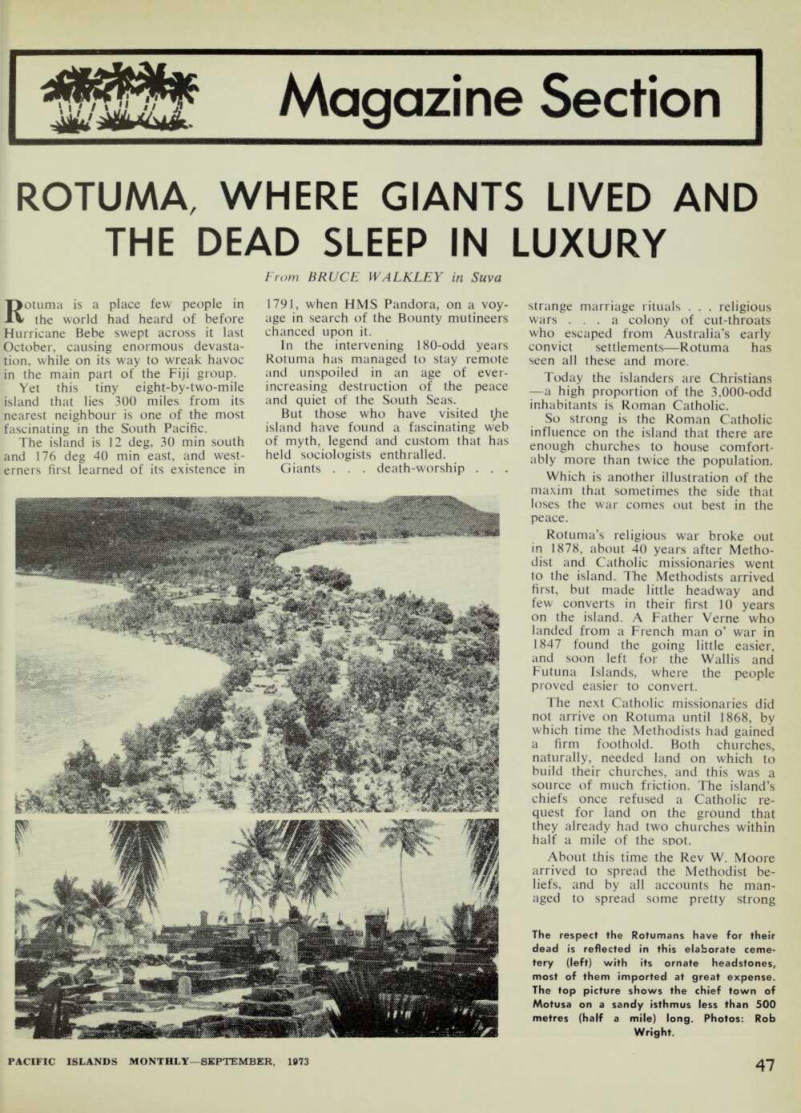
The respect the Rotumans have for their dead is reflected in this elaborate ceme tery (left) with its ornate headstones, most of them imported at great expense.
The top picture shows the chief town of Motusa on a sandy isthmus less than 500 metres (half a mile) long. Photos: Rob Wright.
Rotuman bachelors' quarters
inti-Catholic feeling through his ser nons, too.
Two chiefs took sides and event ally, with the aid of Moore’s fire md-brimstone haranguing, they went ;o war. The Methodist side won ands down after fierce fighting for lonths. The fighting had British v 'Tench undertones as well as Metho ds! v Catholic, and around this time le island’s wiser chiefs got together nd decided that the only way to md the fighting was to cede Rotuma 0 Britain in the same way as the hiefs of Fiji had done in 1874.
Fiji’s first Governor, Sir Arthur jordon, made the long sea trip from diva in 1879 to investigate, and, /hen Britain annexed Rotuma in 881 and made it officially part of 7 iji, he insisted that the Catholics got ull protection and as much encour gement as the Methodists.
After this the Catholic influence pread wider and wider, and by the 930 s had built up a strong ollowing. The Catholic mission ries built churches of almost inbelievable grandeur for such a emote place. Using stone imported it great cost they put up such impres ive structures as the mission at Sumi, »n the south of the island, which, omplete with the beautiful marble tatues that grace its facade, sur ived Hurricane Bebe intact.
The church has a beautiful grave ard with impressive tombstones, ilso imported at great cost. The lodern crosses and impressive tatuary above the graves fit in well /ith the Rotumans’ tradition customs. r or centuries each village has had its wn impressive cemetery, and years go mourners even slept alongside the rave for weeks after a relative died.
Religion has changed some of the ther customs on the island, though.
An English visitor to Rotuma in le 1840 s described the wedding 1 vogue then. Virgins used to colour leir heads with green and red pow er, and the wedding ceremony itself '■as surrounded with strange rituals.
The bridegroom’s friends used to eat their heads until they inflicted ;rious wounds on themselves, when le older women of the village would itervene and stop them.
The bridegroom’s relatives super ised while he took his bride’s virgin y, with one of the older women on le sidelines giving advice. But before lis could happen the couple had to eep together for two nights under ipervision to prevent “beating the un”.
If, despite all these precautions, the irl proved not to be a virgin, she ad to go home to her parents in
disgrace, and after that would become a public woman for any man in the village to sleep with.
But if the observers were satisfied she was a virgin the woman was allowed the privilege of deciding whether she wanted to make the mar riage permanent. Sometimes she would leave her husband for two or three months while she made up her mind.
If she went back to him a strict code of conduct came into force. A woman who committed adultery was punished by being clubbed into in sensibility by the other women of the village. A man who strayed was set adrift tied to a canoe.
The Rotumans have usually wel comed Europeans who have visited them, and there is no evidence of cannibalism, as there was in the main Fiji grou;- as late as the 1860 s. But the visitor had to prove himself be fore being really welcome.
In 1820, two officers and five crewmen from a British ship deserted during a visit to Rotuma, and for several months they got rough treat ment and were forbidden to mix with any of the island’s women.
When the chiefs were convinced the men would stay on the island and become worthwhile members of the community they lined up all the vir gins on the island and gave the men a free choice.
Ten years later another group of European visitors did not fare so well. There were about 70 of them, and apparently some had found their way to the island after escaping from the penal settlements at Botany Bay and in Van Diemen’s Land.
They did little except brawl and get drunk on the island’s “home brew”—coconuts from which the liquid had been drained and replaced with sea water, then left to foment for a week.
Gradually they killed each other off in drunken brawls or antagonised the Rotumans enough to get mur dered.
Forty years later no Europeans were left on the island apart from missionaries.
There is evidence that once big men lived on Rotuma, although the people now are of average size.
In 1927 workmen putting in a new road found bones which in dicated that the people had been around 7 ft tall. Historians theorise that they were on the island long before the smaller Polynesian and Micronesian people arrived to give the present average height.
The Rotuman people now differ markedly from those in the rest of Fiji. Their hair is straight, and they have their own language. There are three different ways of writing it, although only the 3,000 on the island and about another 2,000 Rotumans in the rest of Fiji speak it.
But the people still remember the “giants” in their legends. One tells of a girl called Kumaku who went down to the sea to collect water for cook ing, and followed a path her mother had forbidden her to walk. The giants grabbed her and were set to kill her when she called up winds from Fiji and Tonga to help her, and they blew up the sand which blinded the giants and she escaped.
Hurricane Bebe’s winds were not so benevolent, and the island suffered damage that will put its copra-based economy back 10 years because the coconut trees were flattened or had the tops ripped off.
But even so the Rotumans are showing great fortitude. When the first relief ship from Suva reached the island with emergency rations they sent them back, saying others needed them more urgently and they had enough food for a month.
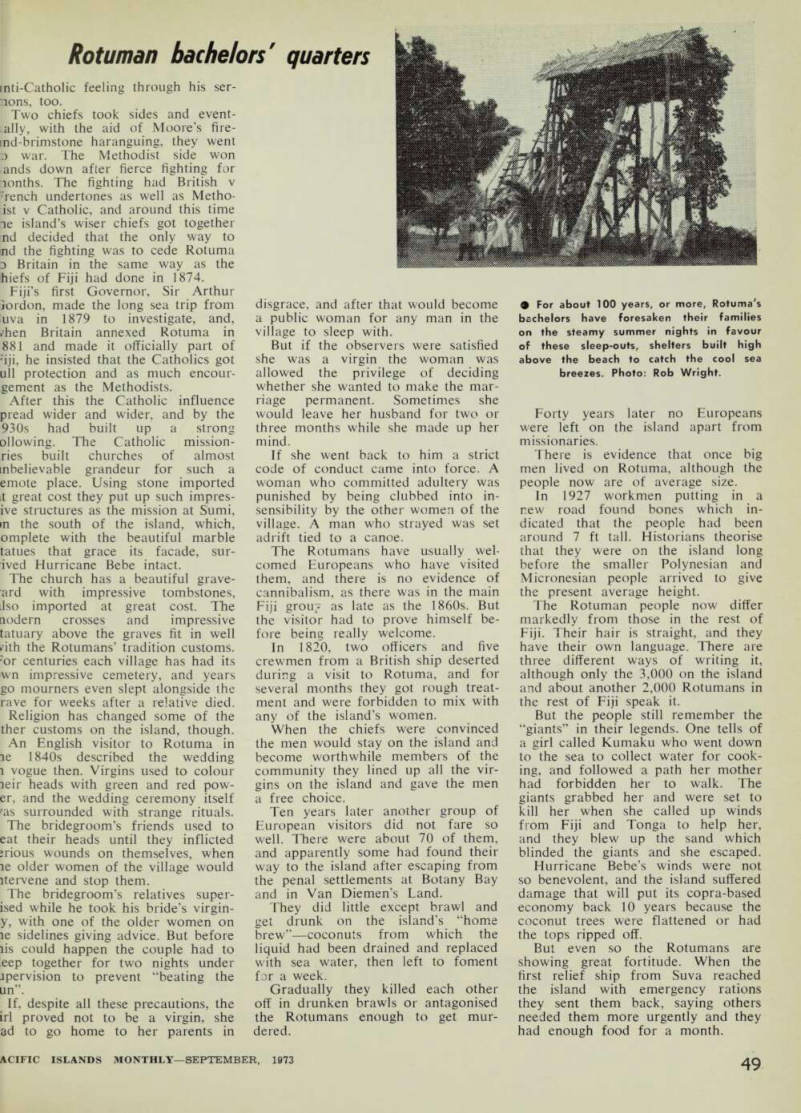
For about 100 years, or more, Rotuma's bachelors have foresaken their families on the steamy summer nights in favour of these sleep-outs, shelters built high above the beach to catch the cool sea breezes. Photo: Rob Wright.