Yesterday
p. 60 · Read in the full issue
The Islands, which, 20 years ago, were almost a closed book to the world press —except for PIM, of course, which had then been around for 24 years —got into overseas headlines with two tragedies, a murder on Niue, with the Resident Commissioner, Mr C. H. W.
Larsen, as the victim, and the loss of a New Caledonian wooden motor ship with about 120 people on board.
The murder on Niue, which one could hardly imagine happening these days, sparked off a five-day search of the densely wooded and rugged island for three men who had escaped from the prison farm and were the prime suspects. Mr Larsen had been killed with a machete while asleep in bed and his wife was seriously injured. The men were caught, brought to trial and sentenced to hang—all this inside 20 days. But, it took months to decide their fate. They were reprieved in May, 1954, and sentenced to life imprisonment.
Gloom descended over New Caledonia, about to celebrate its 100th anniversary as a French possession, when at least 120 people disappeared on the Monique, a wooden motor-ship of 240 tons. She left Mare late one afternoon and expected to arrive in Noumea about noon the next day. She was not seen again in spite of intensive air and sea searches. The finding of wreckage some time later dashed any hopes that the Monique had survived.
The first visit of Queen Elizabeth to the South Pacific was still three months away in September, 1953, but little was being left to chance to ensure a memorable three days— two in Fiji and one in Tonga. The broad outline of the programme was out of the way, and it was simply a matter of working out the details. In charge was Mr J. W.
Sykes, son-in-law of the late Sir Hugh Ragg, now chairman of the Fiji Public Service Commission.
Did a super type of ape live in French Polynesia eons ago? The Australian press reported that anthropologists in Tahiti believed that what might be the remains of the world's oldest ape-man
had been found on Makatea phosphate island. It was thought that the bones belonged to a "superior type of ape", and preceded Peking Man.
The remains were sent to a Paris museum, from where experts were ex pected to make a pronouncement.
Port Moresby's commercial sector was happy in September, 1953, when the first section of a new wharf was ready for general shipping. It cost about $300,000, plus another $60,000 for excavation and reclamation. The work was one of the biggest public projects under taken since World War 11.
Fiji is now under rigid price and wage control while the authorities try to combat inflation. Twenty years ago, price control on three vital commodities, flour, sharps and bread, ended follow ing the withdrawal of the UK and colonies from the International Wheat Agreement. Prices then were controlled, not to meet inflation but because world shortage of wheat, extended over several years, could lead to local exploitation.
Auckland hot-house tomato growers set up a howl when it was reported that the Cook Islands would export to New Zealand increasing quantities of good quality winter tomatoes. They claimed that the arrival of Cl tomatoes at a time when supplies were short would depress the market and rob them of fair profits. Whether the NZ con sumers, who had to pay about 60c a pound at that time of the year, would see things in the same light was doubtful.
Tasman Empire Airways (now Air New Zealand) was extending its flying-boat services in the Pacific. PIM, in September, 1953, recorded the inaugural flight from Laucala Bay, Suva, to Nukualofa. Among those who made this flight were Sir Alport Barker, then proprietor of The Fiji Times and Herald, Mr W. G. Johnson, managing director of W. R. Carpenter and Co (Fiji) Ltd, now living in Queensland, Mr L. G. Usher, then the Fiji Government Public Relations Officer, and Mr G. N.
Roberts, general manager of TEAL.
Tahiti hotly debated the granting of French naturalisation to two Chinese couples. One couple was born in Canton 70 years earlier, and the other in Tahiti in the early 20s. Twenty years ago, there was a "tight little com munity" of nearly 10,000 Chinese in Tahiti. Critics said it was the thin edge of the wedge as others would press for the same privileges and become exempt from foreigners' taxation, and permitted to buy lands, obtain
business licences in their own rights, etc.
Though the Chinese have few rights and may be deported at any time, they are already well established in business in French Oceania, RIM said. They appeared to be generally law-abiding citizens—outside the smuggling and black marketing spheres—activities which were not restricted to Chinese.
Prominently displayed in that September RIM was a story of the invention of a coconut splitting and extracting machine by French-Tahitian Henri D. Rey who, naturally, had called it after himself.
The machine was being manufactured in California and was reported to be effective, so effective, in fact that on Tahiti alone 100 firm orders had been put in. An un skilled operator could put 5,000 nuts through the machine in eight hours.
The machine "cleanly split coconuts longitudinally into halves in the first operation" then gouged out the flesh in the second operation. It had to be a French invention because, said the report, the splitting was done by a simple type of guillotine "which is hoisted to the upper extremity of its guide-rails by a clutch-operated windlass and flexible steel cable."
The French guillotine operated in the same way as that tragic Queen, Marie Antoinette, could have testified.
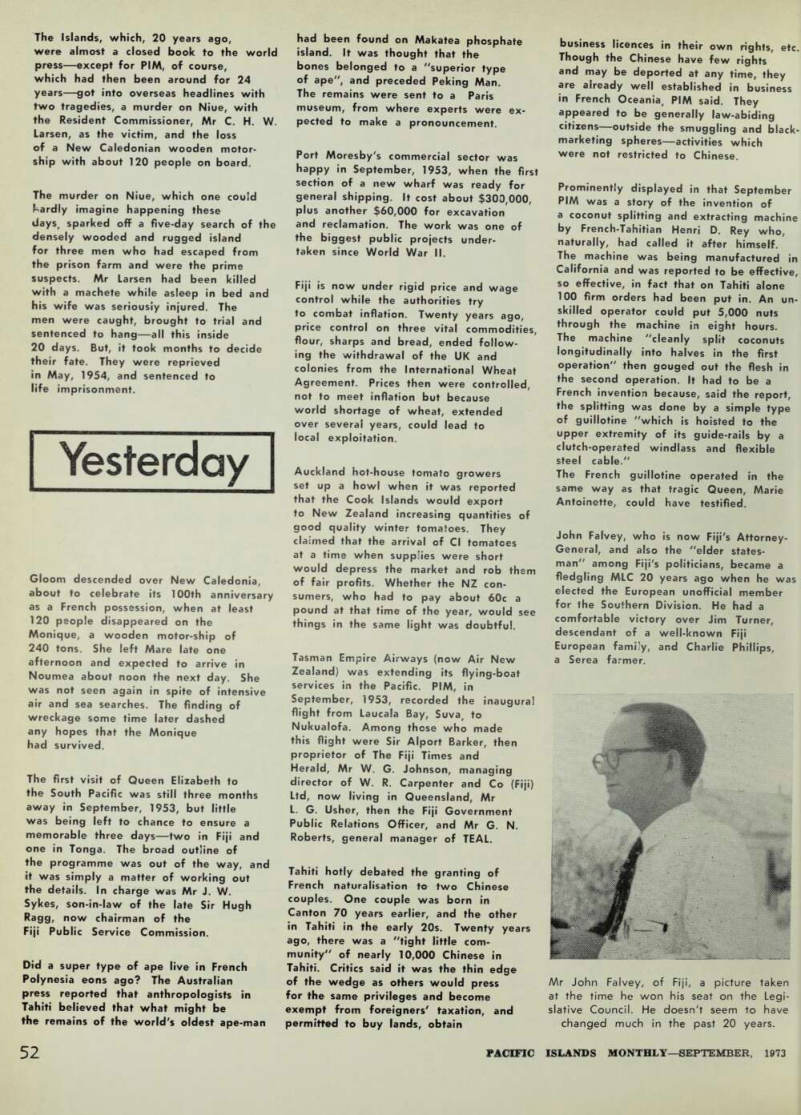
John Falvey, who is now Fiji's Attorney- General, and also the "elder states man" among Fiji's politicians, became a fledgling MLC 20 years ago when he was elected the European unofficial member for the Southern Division. He had a comfortable victory over Jim Turner, descendant of a well-known Fiji European family, and Charlie Phillips, a Serea farmer.
Mr John Falvey, of Fiji, a picture taken at the time he won his seat on the Legi slative Council. He doesn't seem to have changed much in the past 20 years.