Pacific Islands Monthly
pp. 9-10 · Read in the full issue
SUN ECLIPSED BY A NEW STAR IN
Solomons' Election Carve-Up
From a Honiara correspondent
The big question at the end of the general elections in the Solomons was: Who is to govern these rapidly-awakening islands? 6
, .With the last result known on June 14, alter a dragged-out three weeks of votmg beginning on May 22, the old guard had been carved up by a thorough cross-section of the community. The only publicly announced political party (Solomons United National, or SUN, party) appeared to have only its parliamentary leader HJ -f Governing Council, although David Kausimae was keeping quiet about the future. The campaigning m Honiara especially had shown that
there are many in the Solomons who passionately care who goes to the Governing Council for the next four years.
At the end of the last meeting of the Solomons’ first Governing Council in April, the Chief Secretary, Mr Tom Russell, said he hoped that a good proportion of the members would be returned in the general elections to provide continuity in the next House.
Six members—or 35 per cent—is
hardly a good proportion, especially when one member is undergoing a very strong challenge through a petition to the High Court for a re election. If he loses, the proportion would be 29 per cent.
The general elections dragged on for three weeks—from May 22 to June 12, with the last result not known until late on June 14. There were 24 electorates this time, in place of 17, which only made the performance by sitting members appear that much worse.
The six returned included two of the five chairmen of Governing Council committees which have served in place of the more usual ministers. The sixth, Sam Kuku, who stood this time for the Marovo and Kusaghe electorate in the Western District, was being challenged on quite valid grounds. He won by only two votes, and the candidate who came second says he has found nine registered voters who were re fused a vote by the Returning Officer because their names were not on his list of voters. Obviously, enough to tip the balance.
The only possible answer to the question posed at the beginning is that a new group of younger, better educated, more idealistic (to begin with, at least) and far more aggres sive Solomon Islanders is going to bid unbeatably for the reins of gov ernment. Its nucleus is in a small, tight group, largely civil servants, who spent months before the elections working out a coherent set of policies to present to most of the 24 electo rates.
The initial group and its later sup porters were staggeringly successful in that they appear to have gained an absolute majority in the House.
The crunch will come with a “caucus” meeting when members gather at the end of June before the first meeting of Governing Council
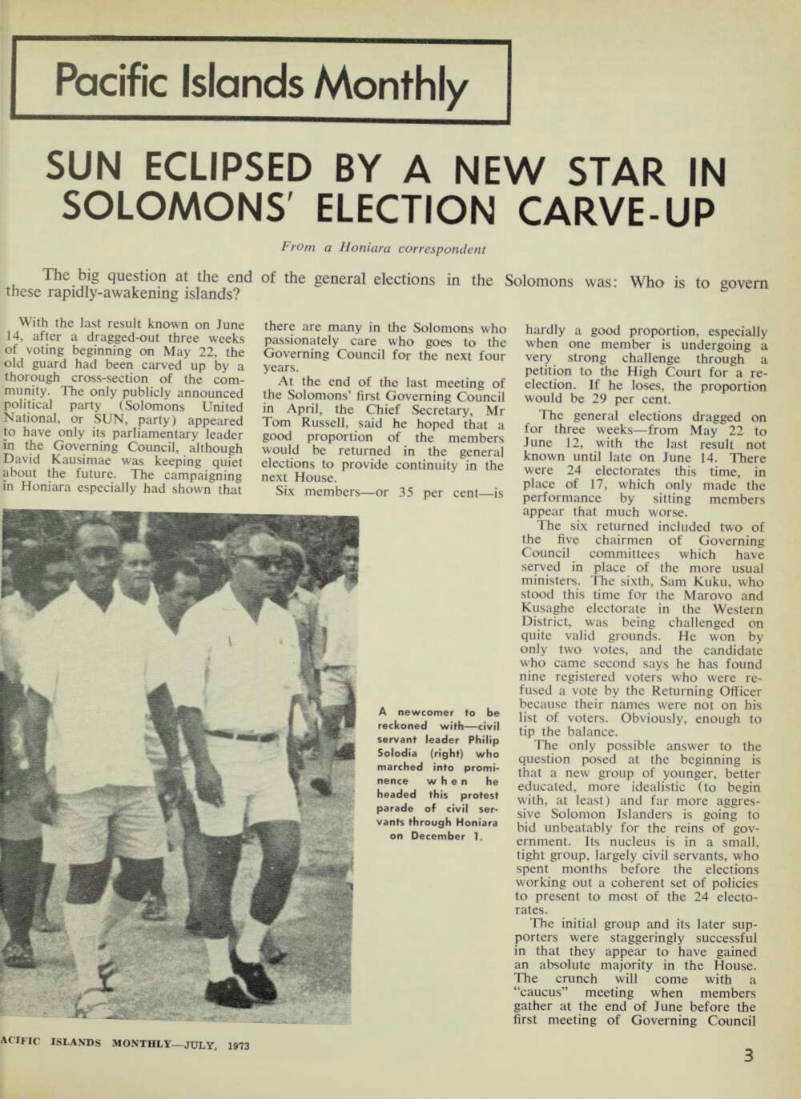
A newcomer to be reckoned with—civil servant leader Philip Solodia (right) who marched into promi nence when he headed this protest parade of civil ser vants through Honiara on December 1.
in July. Loyalty will be tested in the as-yet carefully obscured choice of a leader should the group govern.
In mid-June, the obvious contender was labour inspector, Philip Solodia, who tipped out the longest serving member of the two previous legisla tures, Mariano Kelesi, Chairman of Internal Affairs Committees, in the newly named Lau and Mbaelelea electorate at the extreme north end of Malaita, the Solomons’ most populous island. Mr Kelesi had served since 1961, first appointed and later elected.
Solodia is 35, born in the Lau Lagoon on north-east Malaita. After secondary schooling, he did what many of Melanesia’s past and poten tial leaders have done, he at first decided to enter the church. After training for the priesthood in Rabaul, New Guinea, he decided against it to join the Solomon Islands’ Labour Department in 1968 where he was reputed to be on an equal footing with another civil servant as the most senior local man.
It may be too early to look so closely at Solodia, but his quiet in tensity, the planning he put into the group which he and others formed last year in preparation for the elec tions, his activity as president of the Civil Servants Association, and the fire in his belly made him a logical choice.
Of the experienced men, perhaps the only opponent for Solodia would be Willie Betu, the Chairman of the Social Services Committee, a mode rate man of the same age from the sparsely-populated and rather back ward island of Santa Ysabel. Mr Betu, who at the beginning of the Governing Council’s three-year term was an unimpressive performer very much feeling his way, grasped the nettle later in its public meetings to speak with fervour and ability both on behalf of his electorate and in defence of his “ministry”. He was formerly an inspector of Anglican schools in the Solomons, has studied in Australia, and was first elected to the Legislative Council in 1967.
He now represents the West Ysabel electorate.
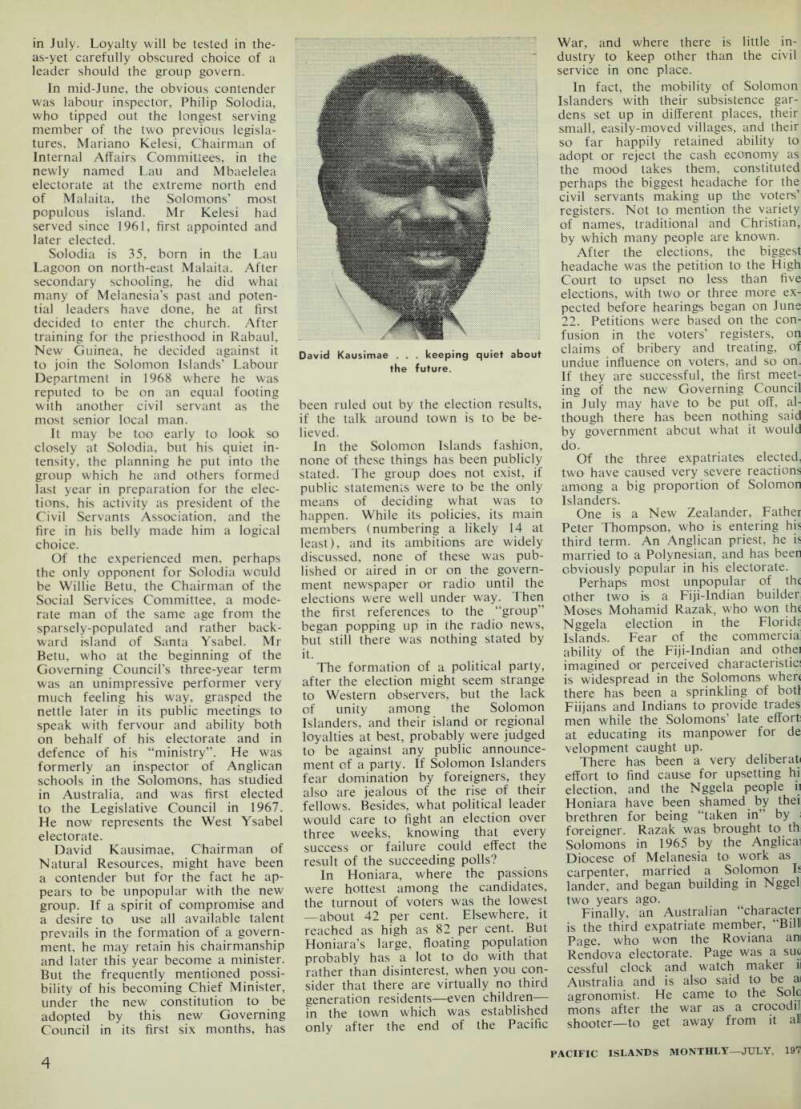
David Kausimae, Chairman of Natural Resources, might have been a contender but for the fact he ap pears to be unpopular with the new group. If a spirit of compromise and a desire to use all available talent prevails in the formation of a govern ment, he may retain his chairmanship and later this year become a minister.
But the frequently mentioned possi bility of his becoming Chief Minister, under the new constitution to be adopted by this new Governing Council in its first six months, has
been ruled out by the election results, if the talk around town is to be be lieved.
In the Solomon Islands fashion, none of these things has been publicly stated. The group does not exist, if public statements were to be the only means of deciding what was to happen. While its policies, its main members (numbering a likely 14 at least), and its ambitions are widely discussed, none of these was pub lished or aired in or on the govern ment newspaper or radio until the elections were well under way. Then the first references to the “group” began popping up in the radio news, but still there was nothing stated by it.
The formation of a political party, after the election might seem strange to Western observers, but the lack of unity among the Solomon Islanders, and their island or regional loyalties at best, probably were judged to be against any public announce ment of a party. If Solomon Islanders fear domination by foreigners, they also are jealous of the rise of their fellows. Besides, what political leader would care to fight an election over three weeks, knowing that every success or failure could effect the result of the succeeding polls?
In Honiara, where the passions were hottest among the candidates, the turnout of voters was the lowest —about 42 per cent. Elsewhere, it reached as high as 82 per cent. But Honiara’s large, floating population probably has a lot to do with that rather than disinterest, when you con sider that there are virtually no third generation residents —even children — in the town which was established only after the end of the Pacific
War, and where there is little in dustry to keep other than the civil service in one place.
In fact, the mobility of Solomon Islanders with their subsistence gar dens set up in different places, their small, easily-moved villages, and their so far happily retained ability to adopt or reject the cash economy as the mood takes them, constituted perhaps the biggest headache for the civil servants making up the voters’ registers. Not to mention the variety of names, traditional and Christian, by which many people are known.
After the elections, the biggest headache was the petition to the High Court to upset no less than five elections, with two or three more ex pected before hearings began on June 22. Petitions were based on the con fusion in the voters’ registers, on claims of bribery and treating, of undue influence on voters, and so on.
If they are successful, the first meet ing of the new Governing Council in July may have to be put off, al though there has been nothing said by government about what it would do.
Of the three expatriates elected, two have caused very severe reactions among a big proportion of Solomon Islanders.
One is a New Zealander, Father Peter Thompson, who is entering his third term. An Anglican priest, he is married to a Polynesian, and has been obviously popular in his electorate.
Perhaps most unpopular of the other two is a Fiji-Indian builder.
Moses Mohamid Razak, who won the Nggela election in the Florida Islands. Fear of the commercial ability of the Fiji-Indian and othei imagined or perceived characteristics is widespread in the Solomons where there has been a sprinkling of both Fiijans and Indians to provide trades men while the Solomons’ late efforts at educating its manpower for de velopment caught up.
There has been a very deliberate effort to find cause for upsetting hi election, and the Nggela people ii Honiara have been shamed by thei brethren for being “taken in” by ; foreigner. Razak was brought to th Solomons in 1965 by the Anglicai Diocese of Melanesia to work as carpenter, married a Solomon Is lander, and began building in Nggell two years ago.
Finally, an Australian “character is the third expatriate member, “Billi Page, who won the Roviana am Rendova electorate. Page was a suo cessful clock and watch maker ii Australia and is also said to be ai agronomist. He came to the Solo mons after the war as a crocodil shooter —to get away from it all
David Kausimae . . . keeping quiet about the future.