Unearths 'Skeletons' In The Closet
pp. 11-12 · Read in the full issue
Only ghosts on San Jorge . . .
.. But Search For Japanese Soldiers
Prom a Honiara correspondent
The Pacific War has far from lost ;s power to hurt, to cause pain and d cost money as well as continuing is a source of regret to some of its ;articipants—as witness the solution 3 the riddle of the lost soldiers of an Jorge.
The visit in May and June to the olomon Islands by a mission of 70 apanese to search for war survivors n San Jorge or other islands was lore than the bit of a giggle some bservers might see it as, 31 years fter the event.
The Japanese Government took it sry seriously indeed—to the tune of A 100,000, give or take a few yen, duch was the official, estimated )st of the air, sea and land search >read over three weeks and a day.
The finding early in June at Mufhu □int, on Santa Ysabel, about 20 tiles west of San Jorge, of mass •aves of some 20 or 25 Japanese as the then expected but hoped ;ainst evidence the Japanese officials ere looking for.
They were politely and very dis jointed indeed, and dismayed at e cost to the Japanese taxpayers— cording to unofficial comments om the mission—when it was dis ►vered in the final week that the ission to find live soldiers still dng in the bush was probably
doomed to failure from the start.
The cost of gathering some 1,600 individual remains which were dug up as part of the mission, but finding no live bodies, was apparently reckoned to be too much.
Two Solomon Islander members of the Defence Force during the war, Geoffrey Kuper and Bill Bennett, were forced by the visit to dredge up unhappy memories and to em barrass themselves and the country’s Japanese guests by recalling at last that they had personally, or through units of irregulars, killed most or all of the 37 men left on San Jorge in 1942.
The story goes that twice that number were in a flotilla of Japan ese craft doing damage where they might in September of that year.
Caught in Thousand Ships Bay, between San Jorge and the major island, Santa Ysabel, they took re fuge on San Jorge from three Ameri can air raiders which made a number of passes at the craft.
Seventy-five men were left with a leaking landing craft able to take only half of them, and the craft set off into the darkness leaving behind the sounds of sobbing, abandoned men. Despite promises by their comrades as they sailed away, no opportunity to return arose, and the
fate of the men was never known, until the beginning of June this year.
An ex-NCO, encouraged by the finding of a live Japanese soldier on Guam in the US Trust Territory last year, persuaded a Japanese tele vision crew to visit San Jorge late in 1972. They found enough relief to have the matter raised in the, Japanese Diet (parliament) and to’ induce the government to mount an expedition which arrived in Honiara on May 19 and 20 in two waves.
There were 70 of them, including a television filming crew and reporters from the three major Japanese news papers and the Kyodo newsagency, two high-ranking officials, former combatants and relatives of the dead, and university students as inter preters. In the Japanese way, the Honiara-based management of the Mitsui Mining and Smelting Co, the Taiyo Fishery Co, and the British Solomons Trading Co were heavily involved in organising the logistics.
The Solomons Government remained uninvolved, but for doubting co operation, and when the final mourn ing ceremony was held on June 9 at Tambea on Guadalcanal.
There are no written records of any incidents which followed the San Jorge “occupation”. Early in the search there were tales of foreign people having been “tamed” and used as labour on Santa Ysabel, and of gardens raided in quite recent times. But investigating parties, largely communicating by signs with villagers, could find only one old man who recalled a strange man living at the south-eastern end of Ysabel until 1952. It’s possible he was a lone survivor, but no proof was found.
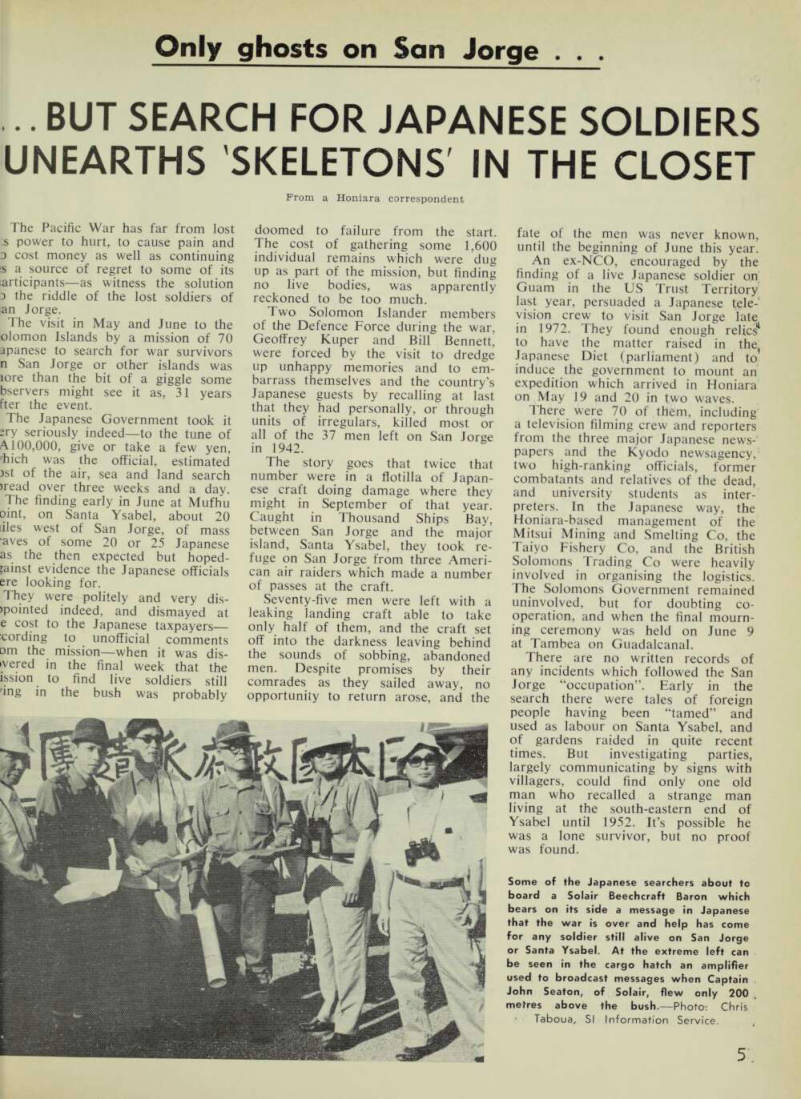
Some of the Japanese searchers about to board a Solair Beechcraft Baron which bears on its side a message in Japanese that the war is over and help has come for any soldier still alive on San Jorge or Santa Ysabel. At the extreme left can be seen in the cargo hatch an amplifier used to broadcast messages when Captain John Seaton, of Solair, flew only 200 metres above the bush. —Photo: Chris Taboua, SI Information Service.
Then, on June 1, way off the general search tracks, came the first break in the silence when a small Japanese party flew to Kira Kira on San Cristobal to see former local coastwatcher, Geoffrey Kuper. He re called about 20 men being seen landing late in 1942 at Kumaibusi Bay, a small islet of Santa Ysabel directly across Thousand Ships Bay from San Jorge. He said they were killed “by local people”.
More revelations came from broad casting officer Bill Bennett, who, in 1942, was second-in-command to coastwatcher Donald Kennedy at Sege on New Georgia, 120 miles from San Jorge. He told an Aus tralian television team that he was operating the radio at Sege when Kuper’s report came in, but his re collection was of 25 men who were killed by one of Kuper’s Defence Force parties as they ate breakfast provided by “friendly” islanders.
He also recalled that seven Japan ese landed in a whaleboat at the southern end of New Georgia and were wiped out as they slept by a party he led around the end of 1942.
None of these incidents is part of any war history. Bennett also remembered how afraid his party was of the Japanese with their relatively-plentiful arms while his men had the odd .303 police rifle and a variety of traditional and imported hand weapons including the head hunting axes famed in recent New Georgia history. These axes were used to dispose silently of the whale boat party, an episode which Bennett related with a mixture of pride and unwillingness.
He also said how unlikely it was there would be any Japanese alive undetected for so long in the Solo mons bush because, unlike Guam with its very sophisticated society, most Solomon islanders still used the bush extensively for building materials, gardening and hunting.
Few areas of bush, even on sparsely populated Santa Ysabel, were able to hide evidence of strangers.
Relating these events set Bennett’s mind working later, and he resurrect ed memories of another raid on New Georgia he led which probably did away with the last but one of the San Jorge group. Early in 1943, a makeshift canoe with four Japanese entered the Marovo Lagoon. Using a single paddle and rough sail they moved about 20 miles northward to a small island where they were seen to land.
The locals were already warned to treat them well, and Bennett and a party infiltrated a congenial group which eventually charmed the only weapons from the Japanese—a .22
pistol and an officer’s sword—by admiring them and passing them around until they were spirited away.
Bennett shot the men as they tried to flee in their canoe after retrieving his party’s only rifle from its nearby hiding place.
Six days after Kuper had told his story in Kira Kira last month, a Japanese search party found the two mass graves at Mufhu Point, by a small stream where their whaleboat had been beached or wrecked. It was at this stage that the searchers lost hope.
Their leaflet drops from the air over San Jorge and Santa Ysabel, their broadcasts of messages from a low-flying aircraft with the sign in Japanese on the side, the messages left on trees such as that by a pre viously-hopeful brother of one soldier, and the food and drink caches, all were apparently a waste of time.
On June 7, the several hundred rice and copra bags full of bones were burned at Tambea, 20 miles from Honiara, and the ashes packed in boxes for return to Japan. Two days later, a shrine with an elaborate semi-circle of purple cloth was erected near the remains of a war time aircraft and adjoining Japanese timber monument at Tambea.
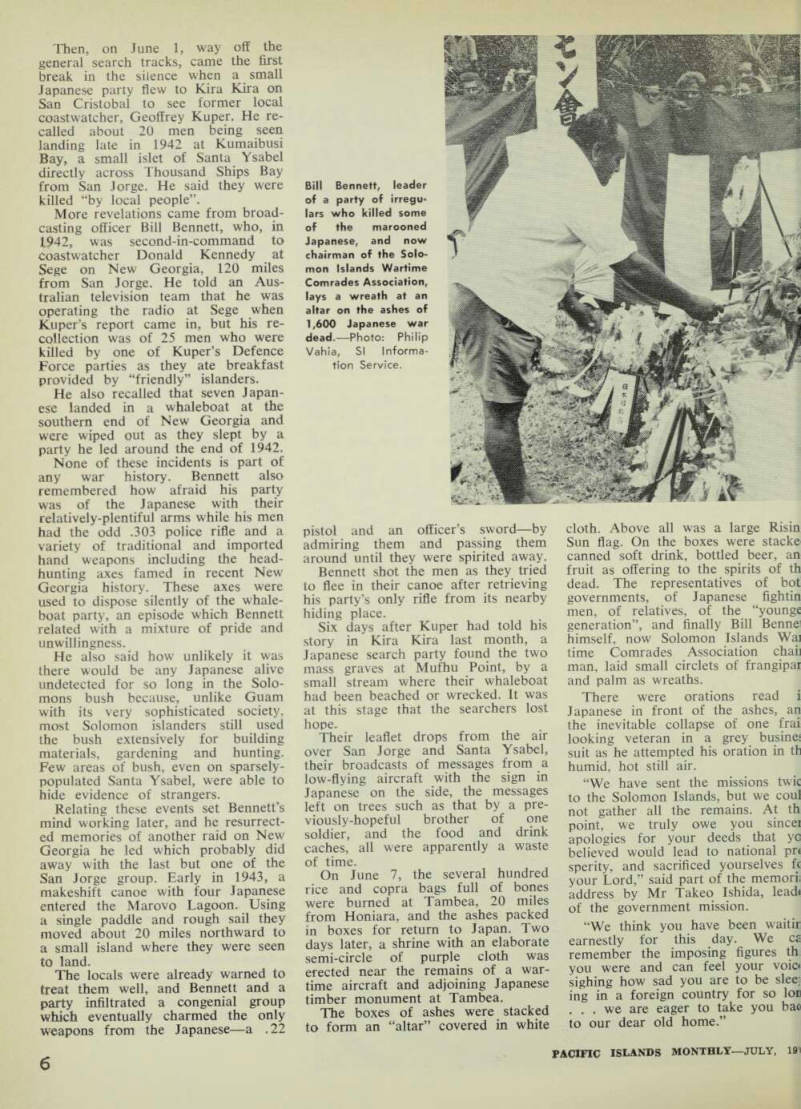
The boxes of ashes were stacked to form an “altar” covered in white
cloth. Above all was a large Risin Sun flag. On the boxes were stacke canned soft drink, bottled beer, an fruit as offering to the spirits of th dead. The representatives of bot governments, of Japanese fightin men, of relatives, of the “younge generation”, and finally Bill Bennei himself, now Solomon Islands Wai time Comrades Association chan man, laid small circlets of frangipai and palm as wreaths.
There were orations read i Japanese in front of the ashes, an the inevitable collapse of one frai looking veteran in a grey busines suit as he attempted his oration in th humid, hot still air.
“We have sent the missions twic to the Solomon Islands, but we coul not gather all the remains. At th point, we truly owe you sincei apologies for your deeds that yo believed would lead to national pr< sperity, and sacrificed yourselves fc your Lord,” said part of the memori: address by Mr Takeo Ishida, lead* of the government mission.
“We think you have been waitir earnestly for this day. We ca remember the imposing figures th you were and can feel your voio sighing how sad you are to be slee] ing in a foreign country for so lon ... we are eager to take you bao to our dear old home.”
Bill Bennett, leader of a party of irregu lars who killed some of the marooned Japanese, and now chairman of the Solo mon Islands Wartime Comrades Association, lays a wreath at an altar on the ashes of 1,600 Japanese war dead. —Photo: Philip Vahia, SI Informa tion Service.