Up Front
with the Editor
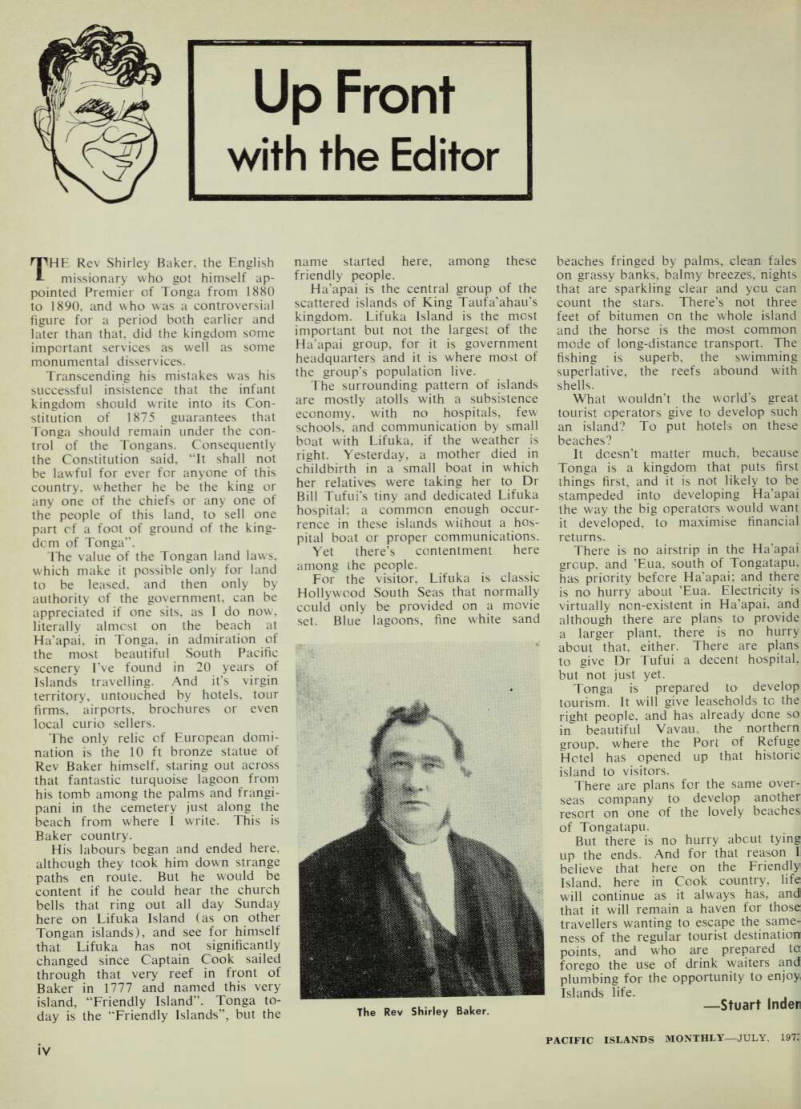
THE Rev Shirley Baker, the English missionary who got himself ap pointed Premier of Tonga from 1880 to 1890, and who was a controversial figure for a period both earlier and later than that, did the kingdom some important services as well as some monumental disservices.
Transcending his mistakes was his successful insistence that the infant kingdom should write into its Con stitution of 1875 guarantees that Tonga should remain under the con trol of the Tongans. Consequently the Constitution said, “It shall not be lawful for ever for anyone of this country, whether he be the king or any one of the chiefs or any one of the people of this land, to sell one part of a foot of ground of the king dom of Tonga’’.
The value of the Tongan land laws, which make it possible only for land to be leased, and then only by authority of the government, can be appreciated if one sits, as I do now, literally almost on the beach at Ha’apai, in Tonga, in admiration of the most beautiful South Pacific scenery I’ve found in 20 years of Islands travelling. And it’s virgin territory, untouched by hotels, tour firms, airports, brochures or even local curio sellers.
The only relic of European domi nation is the 10 ft bronze statue of Rev Baker himself, staring out across that fantastic turquoise lagoon from his tomb among the palms and frangi pani in the cemetery just along the beach from where I write. This is Baker country.
His labours began and ended here, although they took him down strange paths en route. But he would be content if he could hear the church bells that ring out all day Sunday here on Lifuka Island (as on other Tongan islands), and see for himself that Lifuka has not significantly changed since Captain Cook sailed through that very reef in front of Baker in 1777 and named this very island, “Friendly Island”. Tonga to day is the “Friendly Islands”, but the
name started here, among these friendly people.
Ha’apai is the central group of the scattered islands of King Taufa’ahau’s kingdom. Lifuka Island is the most important but not the largest of the Ha’apai group, for it is government headquarters and it is where most of the group’s population live.
The surrounding pattern of islands are mostly atolls with a subsistence economy, with no hospitals, few schools, and communication by small boat with Lifuka, if the weather is right. Yesterday, a mother died in childbirth in a small boat in which her relatives were taking her to Dr Bill Tufui’s tiny and dedicated Lifuka hospital; a common enough occur rence in these islands without a hos pital boat or proper communications.
Yet there’s contentment here among the people.
For the visitor, Lifuka is classic Hollywood South Seas that normally could only be provided on a movie set. Blue lagoons, fine white sand
beaches fringed by palms, clean fales on grassy banks, balmy breezes, nights that are sparkling clear and you can count the stars. There’s not three feet of bitumen on the whole island and the horse is the most common mode of long-distance transport. The fishing is superb, the swimming superlative, the reefs abound with shells.
What wouldn’t the world’s great tourist operators give to develop such an island? To put hotels on these beaches?
It doesn’t matter much, because Tonga is a kingdom that puts first things first, and it is not likely to be stampeded into developing Ha’apai the way the big operators would want it developed, to maximise financial returns.
There is no airstrip in the Ha’apai group, and ’Eua, south of Tongatapu, has priority before Ha’apai; and there is no hurry about ’Eua. Electricity is virtually non-existent in Ha’apai, and although there are plans to provide a larger plant, there is no hurry about that, either. There are plans to give Dr Tufui a decent hospital, but not just yet.
Tonga is prepared to develop tourism. It will give leaseholds to the right people, and has already done so in beautiful Vavau, the northern group, where the Port of Refuge Hotel has opened up that historic island to visitors.
There are plans for the same over seas company to develop another resort on one of the lovely beaches; of Tongatapu.
But there is no hurry about tying up the ends. And for that reason I believe that here on the Friendly Island, here in Cook country, life will continue as it always has, and! that it will remain a haven for those travellers wanting to escape the same ness of the regular tourist destination points, and who are prepared ta forego the use of drink waiters and plumbing for the opportunity to enjoy Islands life.
Stuart Inder
The Rev Shirley Baker.