Magazine Section
pp. 61-63 · Read in the full issue
When Coloured Calico Saved The
Cooks From A French Takeover
From W. H. Percival
in Rarotonga
Charles James Ward, aged 25, was relaxing with his European friends on the verandah of Henry Nicholas’s house in Avatiu, Rarotonga, one Sunday afternoon in April, 1881.
He had no inkling that this particular Sunday was to be any different from all the others, or that he was soon to play a major part in saving the Cook Islands from the French.
The few European residents of Rarotonga used Henry Nicholas’s house as an unofficial club, meeting there for discussions and social even ings. Mr Nicholas was part-English, part-New Zealand Maori, had settled in Rarotonga and married there. A popular and energetic man, he traded in cotton and coffee and operated his own cotton gin—a machine for separating cotton from its seeds. He also operated his own blacksmith’s business when horses and buggies were the most popular mode of trans port on the island.
As Charlie Ward and his friends talked of current topics the schooner Nassau was sighted. It anchored off Avatiu. The vessel was out of Papeete and had come for a cargo of Raro tongan cotton for the Societe Com
merciale, a Tahiti-based German firm, reputed owner of the Nassau and the trading store on Avatiu now known as Avatiu General Traders.
In the uneasy ’Bos France and Germany were consolidating their hold on Pacific territories, but the British were strangely backward in this respect. The Panama Canal was under construction and some British strategists were alarmed by the fact that in the event of a war with France or Germany, British ships, Panama bound to New Zealand or Australia would be without intermediate coaling stations.
The Cook Group, which could possibly have provided such a station, was unclaimed by any major power, and the Cook Islanders had had the fear of the French driven deeply into them by the stories of LMS mission aries who had not been well received by the Roman Catholic French authorities in Tahiti. So the Cook Islanders were anxious to be placed under the protection of the British flag, and relieved of the fear of one day being compelled to become French or German citizens.
A petition from the arikis (high
chiefs) of Rarotonga to the London Missionary Society’s headquarters in London praying for British protection in the event of French aggression came to nothing. In 1865 the Raro tonga arikis , the resident missionary and about a dozen European residents sent another petition through the NZ Governor-General, Sir George Grey.
This was passed on to the British authorities, who ignored it.
This was the political situation worrying the islanders that Sunday afternoon in April, 1881, when Captain Elliot of the schooner Nassau strode on to Henry Nicholas’s verandah to greet his friends. After the usual preliminaries had been ex changed, Elliot startled them all into silence with a question.
“Do you fellows want to become French?”
First to speak was Mr Exham, a trader, who was also the British Consul. “What are you getting at, skipper?”
“A French man-o-war is on its way here from Papeete,” Elliot said, “and if you fellows want to remain British you’d better act pretty quickly.”
This shook them all, especially Charlie Ward, a short but broad shouldered and powerful man from Lancashire. The son of Thomas Ward, a Bolton brass founder, he was born in Bolton on January 4, 1856.
After his father died an uncle looked after Charlie and did his best to make a “solid citizen” of him. But Charlie wanted to become a seaman and see the world, so his uncle allowed him to make a voyage round Cape Horn in a sailing ship, thinking that this
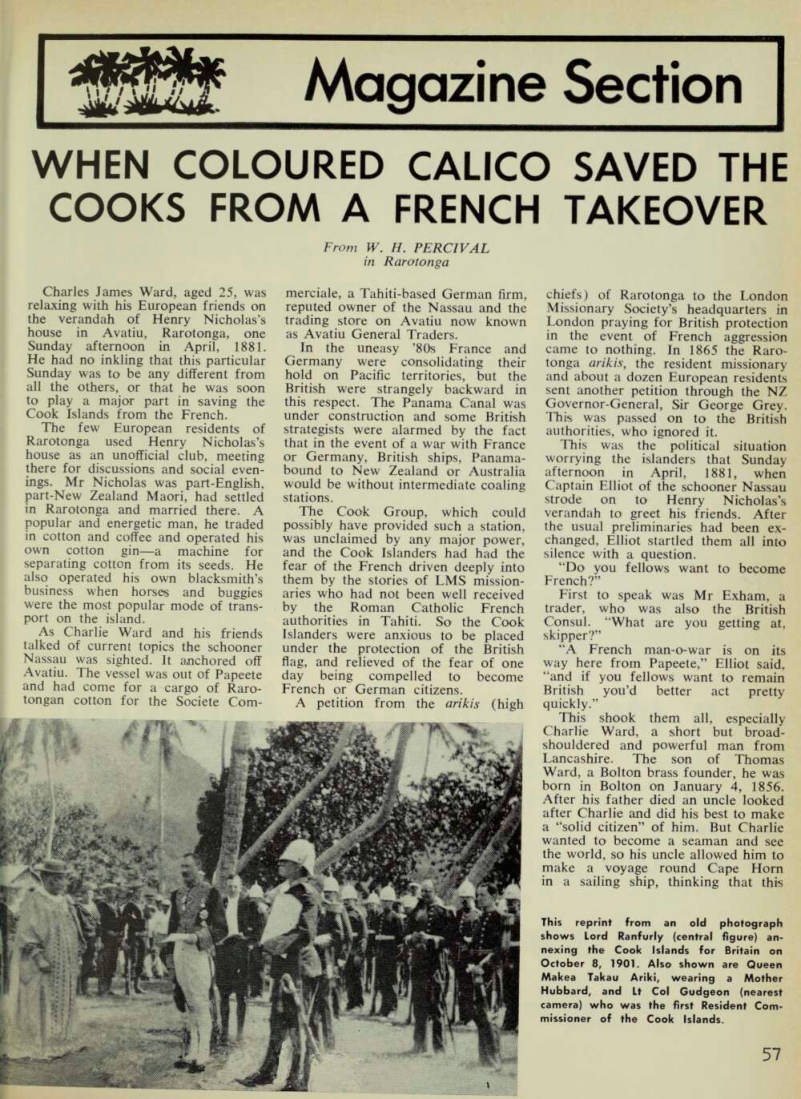
This reprint from an old photograph shows Lord Ranfurly (central figure) an nexing the Cook Islands for Britain on October 8, 1901. Also shown are Queen Makea Takau Ariki, wearing a Mother Hubbard, and Lt Col Gudgeon (nearest camera) who was the first Resident Com missioner of the Cook Islands.
would change his mind. He then ap prenticed Charlie to the printing trade, but Charlie ran away and tried to find a ship in Hull. His uncle sent the police after him and they took him back to Bolton. Then his well-meaning uncle tried to make a cotton broker out of him, but with out success, and Charlie returned to sea, serving several years before the mast. He had heard many tales of the South Seas and, after a visit to Rarotonga, decided to make the island his home.
Like his friends, Charlie Ward had nothing against the French, but did not wish to lose his British citizen ship.
“We’ll have to tell the Makea about this at once,” he said. “Let’s go and arrange an interview with her.” The others agreed and the whole party set off at once.
Makea Takau Ariki of the Raro tongan tribe of Te-au-o-Tonga, and her husband, Ngamaru, who was the virtual ruler of the islands of Atiu, Mauke and Mitiaro, were then the most powerful people in the Cook Islands.
Some years later, in 1885, Makea paid a visit to Auckland with the unanimous request of her people that the islands become a British Protecto rate. No immediate action was taken on this, but she was acclaimed the Queen of Rarotonga.
When Ward and his friends started their interview with Makea she was cautious, suspecting a trick to wrest her power from her, but finally they won her over by their obvious sin cerity and she gave them permission to do what they thought fit.
There are eight islands in the southern Cook Group and only two Union flags were available. Charlie Ward suggested that Captain Elliot take the two flags and raise them on the larger islands of Mangaia and Aitutaki. He argued that the French
captain would call there first after Rarotonga and would conclude from the flags that all the islands had already become British. In the mean time he would make up a Union flag from trade cotton in the stores and have it ready to be raised when the French warship was sighted.
The plan was accepted and Elliot made sail immediately. Ward ob tained bolts of coloured calicos and cottons and set to work. In his youth he had worked among the cotton looms of Lancashire, and it seemed a bizarre link with those days that these same cottons should now play an important part in preserving a tiny part of the Empire. He pinned the red and white crosses on the blue background and Miss Nicholas finished the work on her sewing machine. Ward then furled the flag in the correct man-o-war style and had it hoisted to the top of the flag pole. He then showed Makea Takau Ariki how to unfurl it.
Two days later the French warship appeared and Ward, Exham and the others watched it from their position near the flag pole. When the vessel was two or three miles off Avarua’s coast Makea jerked the lanyard and the home-made Union flag fluttered over Rarotonga’s soil.
The man-o-war sailed past without giving any signals and later called at Mangaia, to find Elliot’s flag already flying. It then returned to Tahiti without calling at any of the other islands. The islands discovered by Captain James Cook had been saved by a very narrow margin.
This event, and a petition from Makea in 1888, convinced the British authorities that a French invasion of the Hervey Islands (as the Cooks were then called), was imminent.
Consul Exham was ordered by the Colonial Office formally to proclaim a British Protectorate over the Cook
Group. Captain Bourke, RN (later Rear Admiral Bourke), commanding HMS Hyacinth was ordered to sail from Honolulu to Rarotonga. Bourke arrived at Rarotonga on October 27, 1888, and read out a proclamation to Makea Ariki and the assembled islanders in the palace grounds in Avarua, thus claiming the Cooks for Queen Victoria.
A Federal Government of the Cook Islands was formed in 1901, when the islands were formally annexed by and proclaimed part of New Zealand under the Colonial Boundaries Act of 1895 by Lord Ranfurly.
During his time in the Cooks, Charlie Ward became a mate on inter islands trading schooners, and when he grew too old for that ran a small store in Ngatangiia village, Rarotonga, in partnership with schooner captain Fred Rennie.
He was penniless in his old age and a group of European residents con tributed money to keep him alive.
His old friend, Fred Rennie, used to look after him when he lived alone in Ngatangiia, an aged and lonely man with a thatch of silver hair and a heavy moustache. In his later years Ward became a regular church-goer.
Then, in 1934, his luck changed for the better when the NZ Govern ment granted him a pension of £4O/9/- a year in recognition of his services to the Crown.
Shortly before he died in Rarotonga Hospital on March 6, 1936, in his 80th year, Charles James Ward said: “I see how much has been done in education, medical, and other services for the Cook Islands people, and I am indeed proud that I was associated in the succession of the Islands to my native country. To my mind, the islands have been wisely administered and are a credit to the British Crown”. He was given a ceremonial burial.
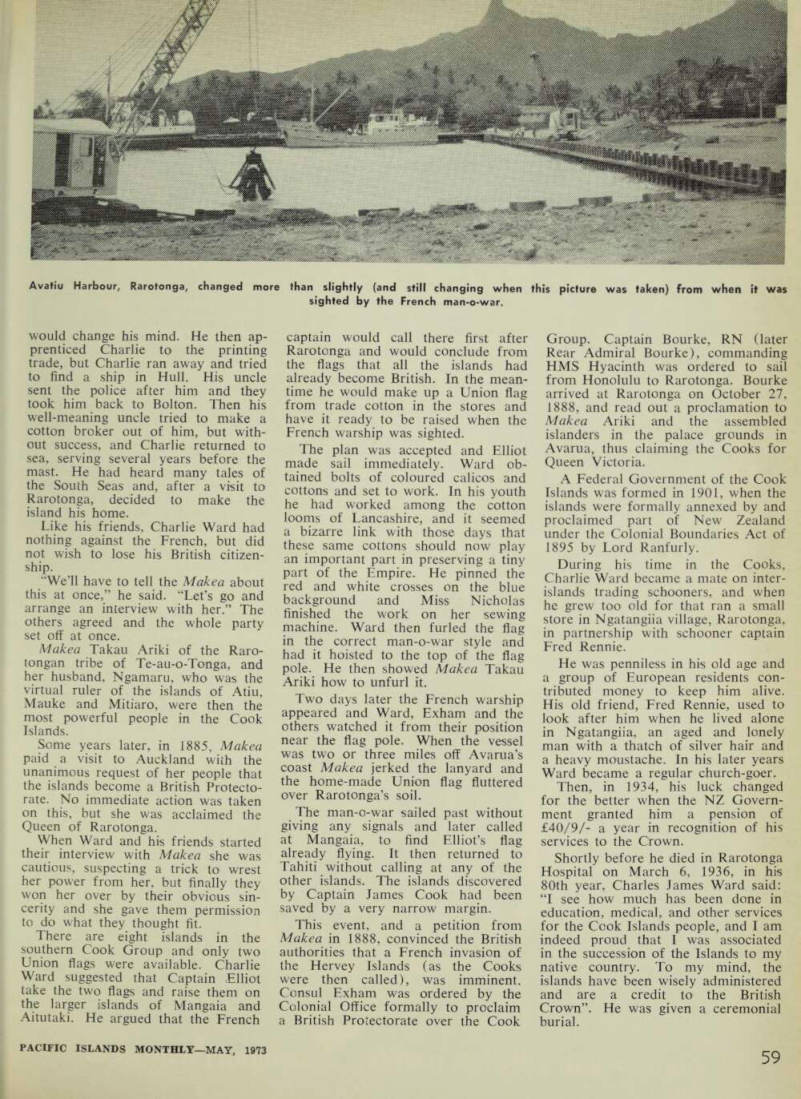
Avatiu Harbour, Rarotonga, changed more than slightly (and still changing when this picture was taken) from when it was sighted by the French man-o-war.