Yesterday
p. 64 · Read in the full issue
Australia's immigration regulations are in the news once again with their expected liberalisation by the Laoour Government and cerise-suited Mr Grassby, the Minister for Immigration, who grandstanded the return to Australia of Fiji's Nancy Prasad, seven years after she was deported. Today, Fiji thinks the door should be opened wider but 20 years ago, according to PIM of May, 1953, the Fiji Government wanted the door closed on Fijians.
Said the report, "As far as Fijians are concerned, the Commonwealth Government's restrictions on immigration are fully endorsed by the Fiji Government and also by the leaders of the Fijian people. In fact the immigration of Fijians from the Colony is also very strictly controlled." The reason for control, said the government was to protect unsophisticated Fijians from being exploited overseas and also to ensure that their families and dependants were not neglected.
Around the same time newspapers all over the South Pacific, PIM said, were getting hysterical over a Force-7 earthquake which rocked Rabaul but left its inhabitants unmoved—after the shake, that is. Newspapers contemplated large-scale rescue operations but the locals went about their work wondering what all the fuss was about. There was a little damage but no deaths were reported. There were those who said that Rabaul should have been transferred to Rapopo as the former Administrator Colonel J. K. Murray wanted, but most Rabaul inhabitants preferred the status quo, earthquakes or no earthquakes. Anyway, Rapopo was as badly shaken as Rabaul on this occasion.
One page in the 20-year-old PIM carried a panel, a sort of resurrection notice. The previous month, explained PIM, it had reported the death of Mr E. W. Oakley, formerly of the New Guinea District Services Department.
Mr Oakley telephoned to tell PIM that his death had been grossly exaggerated, he was very much alive. So PIM apologised. An English newspaper made a similar mistake some years before but explained to the indignant "obituarian" that it never published corrections. However, it would make amends by putting him in the births column!
PIM reported that the second Pacific schooner lost in 1953 in French Oceania was the 161-tons Moana. It was destroyed by fire six miles off Anna atoll in the Tuamotus. The vessel was not burnt completely and the schooner Paraita, 78 tons, was sent to locate the hulk and sink it or tow it ashore.
However, she failed to find the derelict but she managed to take the Moana's company to Papeete. Moana was launched in San Francisco in 1911 for Societe Commerciale de L'Oceanie (an affiliate of the German DHPG firm) and was commanded on her maiden voyage to Tahiti by Captain William Berude.
Moana was the third sizable inter-island craft of French Oceania lost in the early 19505. In 1952 Ruahatu, 138 tons, was wrecked on Tubui. In February, 153, Artemise, 133 tons, was burned completely at Raroia.
A famous American artist of Tahiti, Edgar Leetag, was killed in Papeete 20 years ago. According to the executor of the will, French Admiral du Saint Front the value of the estate was estimated to be 250 million francs— about $A700,000 plus. The beneficiaries included Leetag's mother and his children Laverne (13), Edgar (11) and Ropati (4). Mr Leetag was killed on a motor cycle on his way to his friend's place after having dined at the Les Tropikues with friends. The driver ot
the motor cycle, ship's engineer Herbert Case, was arrested and charged with being intoxicated while in charge of the machine.
Under the headlines "Rich and idle Nauruans", RIM reported that the islanders were a rich but unhappy community, all crying out against their opulent idleness. "Use our accumulated funds to buy us another island somewhere" was their ceaseless cry to the government, said RIM. What they were really in need of was regular work. Thanks mainly to their President Hammer Deßoburt they've come a long way since then. Now, as citizens of the smallest republic in the world, they own all they are sitting on, and more beside including a valuable chunk of real estate in Melbourne. There's no more talk of buying another homeland.
"Governors come and governors go" said RIM, noting a change in the top position in American Samoa, a change of governors occasioned by a change of presidents in America, which is how it went then and, usually, how it goes now. The outgoing governor was James Arthur Ewing who was succeeded by Lawrence Judd, of Honolulu, who'd already been a governor—of Hawaii as well as director of the Molokai Leper Colony and director of the Bishop Museum.
Another appointment noted by RIM was that of Mr Alfred Poroi, re-elected Mayor of Papeete by a very large majority. It was his third triumph in a few weeks, the report said. He had been made manager of the Union Steam Ship Co in Tahiti and leader of the moderates in the new Territorial Assembly.
There was another report, on a later page, of French Polynesian politics.
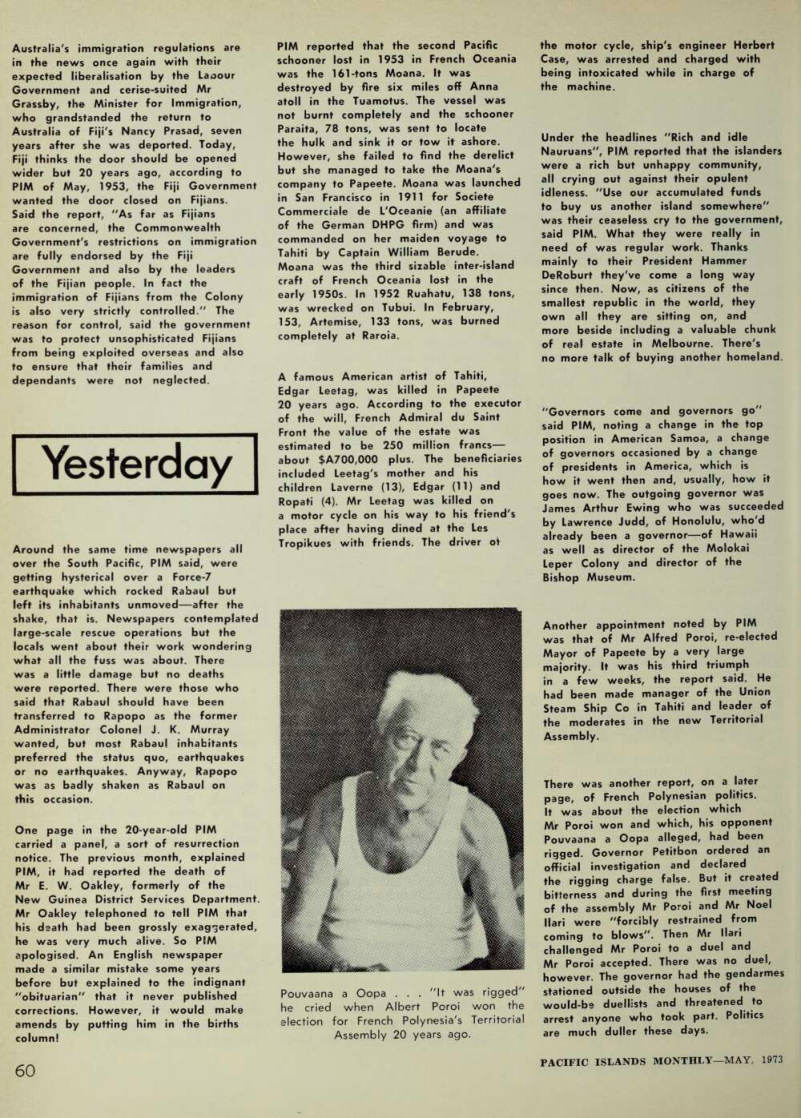
It was about the election which Mr Poroi won and which, his opponent Pouvaana a Oopa alleged, had been rigged. Governor Petitbon ordered an official investigation and declared the rigging charge false. But it created bitterness and during the first meeting of the assembly Mr Poroi and Mr Noel Hari were "forcibly restrained from coming to blows". Then Mr Hari challenged Mr Poroi to a duel and Mr Poroi accepted. There was no duel, however. The governor had the gendarmes stationed outside the houses of the would-be duellists and threatened to arrest anyone who took part. Politics are much duller these days.
Pouvaana a Oopa . . . "It was rigged" he cried when Albert Poroi won the election for French Polynesia's Territorial Assembly 20 years ago.