Malaita,
pp. 57-59 · Read in the full issue

the island with the mostest
By Denis Fisk
I woke to the sound of a deep Malaita voice rattling on in Pidgin, almost in a monotone. In a few seconds I realised it was the president of the Malaita local government council Nelson Kifo—a strict South Seas Evangelical Church member— saying his morning prayers.
His voice seemed to come from directly beneath me, through the cabin roof of the MV Havule, although in the first faint light of dawn I could not have seen where he was nor for that matter my sleeping com panions spread over the deck, hatch cover and cabin roof where we were anchored off Dalus’u village in the still waters of the Langa Langa lagoon.
The brightest light at that time was the low burning hurricane lamp at the bow which competed more than successfully with the grey streaks killing the starlight in the east. It was deliciously cool in the morning breeze, as I rolled stiffly over and cast aside the sheet, to rub my kinked neck where it had been lying on a rolled-up towel in place of a pillow. With a fleshless build I’m not made for sleeping on boards, and not used to it anyway, but I amazed myself by sleeping at least six hours straight. That I did was due to the very rapid familiarisation tour I was doing of Malaita Island which was taxing but fascinating, and which, it occurred to me even then, should entice any energetic and fit traveller in the Solomons who did not have a lot of time to spare.
As the sun showed itself and the perfectly flat lagoon bordered by man groves and fringed with a string of palm leaf villages, a tiny canoe was the only thing to disturb the water as it was propelled slowly towards us by a single paddler. He came from
Laulasi, probably the best known place on Malaita for travellers, where the villagers have their traditions organised into an authentic and colourful display. Their specialty is the making of shell money, necklaces of white and red shell discs smaller than the old English threepence and individually beaten into shape with a rock.
The paddler was a very old man with sparse white hairs on his lined face, smiling up at us as he chattered in the Lau language to those on board he knew and passed up two parcels of whole fish wrapped in coconut leaves, freshly roasted from an earth oven. As on the previous night, the fish was a welcome addition with some taro to the rice cooked in coconut milk, tinned corned meat and stale bread, and the always welcome enamel mug of sweet black tea, spread on the Havule’s canvas hatch cover.
That day, the third day, I was to be first taken upstream through the mangroves by an outboard-powered canoe, which eventually had to be poled to where a giant tree had fallen
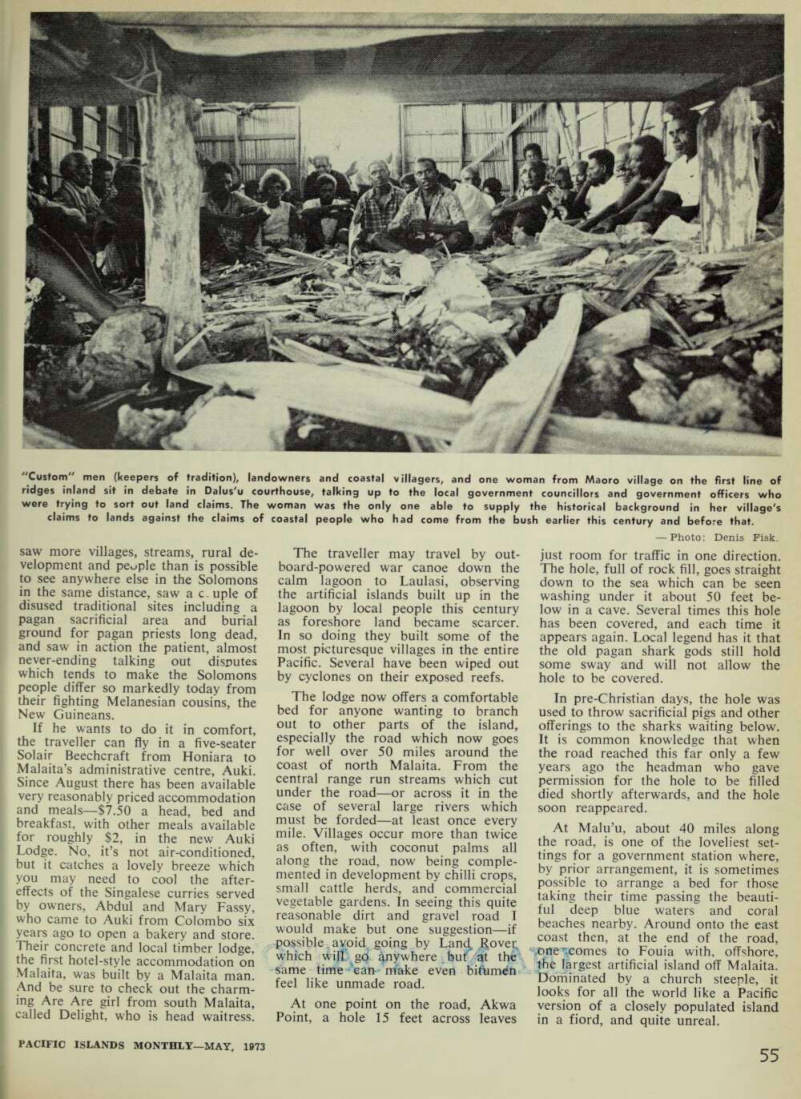
and blocked the way, then to walk —or perhaps squidge—another half hour across the remainder of the flats to the foot of the first line of ridges which rise to Malaita’s mountain backbone. I was to climb the ridge at a good 35 to 40 degree angle, pretending not to be gasping for wind, and spend the rest of the day “bush bashing” while committees of Malaita men tried to sort out the historical background to a vital land dispute which could mean everything to the future of people living on the Langa Langa lagoon, Why might a traveller be interested in repeating this, and other excursions 1 made with these local government councillors, “custom” men (keepers of traditions), government officers, and concerned Malaita men? Because, if he wants to know a little of the Solomons way, he might expose him self to similar varied experiences fitted into just 58 hours of travelling, beginning and ending in the capital, Honiara.
I travelled the full length of the Solomons’ longest road, cruised one of its loveliest and biggest lagoons,
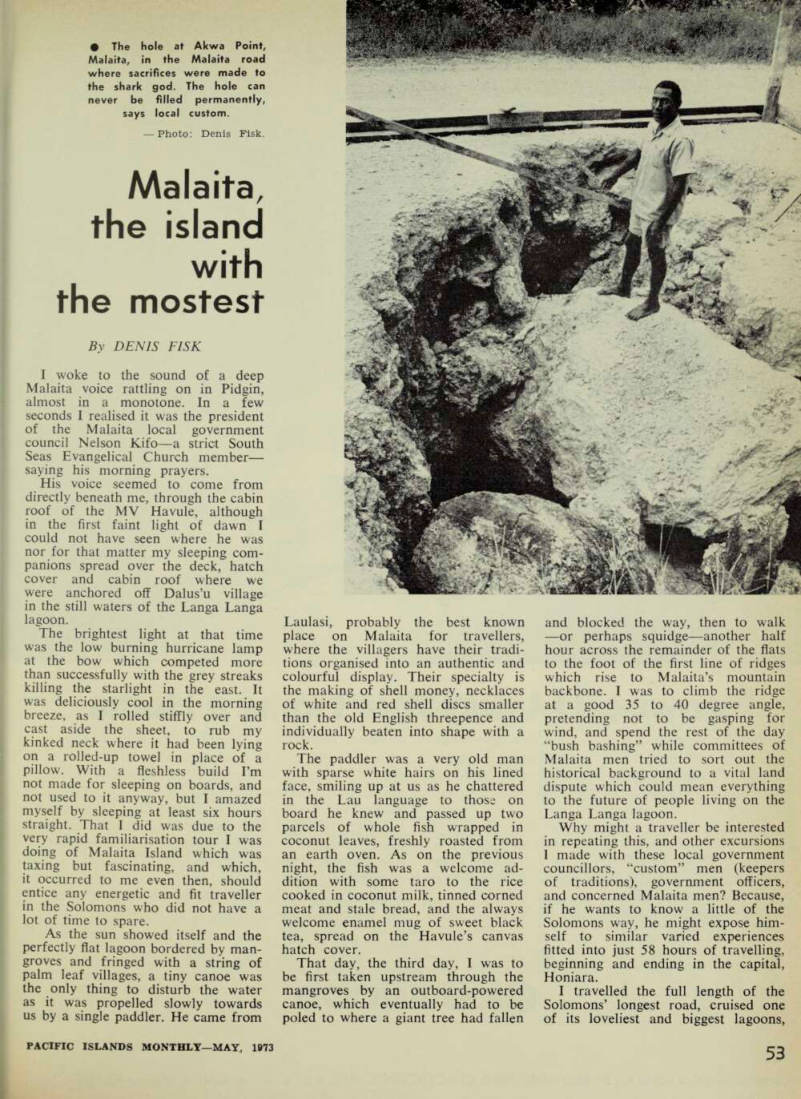
The hole at Akwa Point, Malaita, in the Malaita road where sacrifices were made to the shark god. The hole can never be filled permanently, says local custom.
Photo: Denis Fisk.
saw more villages, streams, rural development and people than is possible to see anywhere else in the Solomons in the same distance, saw a c. uple of disused traditional sites including a pagan sacrificial area and burial ground for pagan priests long dead, and saw in action the patient, almost never-endmg talking out disputes which tends to make the Solomons people differ so markedly today from their fighting Melanesian cousins, the New Guineans.
If he wants to do it in comfort the traveller can fly in a five-seater Solair Beechcraft from Honiara to Malaita’s administrative centre Auki Since August there has been available very reasonably priced accommodation and meals—S7.so a head, bed and breakfast, with other meals available for rouchlv IS2 in tbp n P «, AnVi iur rougniy 3>z, in the new Auki Lodge. No, it s not air-conditioned, but it catches a Invelv hrp P7P w b.Vb dui u caicnes a lovely breeze which you may need to cool the aftereffects of the Sinpalpsp rnrripc cprvpH cuecis or rne Cingalese curries served by owners, Abdul and Mary Fassy, who came to Anki fmm rnlnmhn civ wno came to Auki irom Colombo six years ago to open a bakery and store.
Their concrete and local timber lodge, the first hotel-style accommodation on Malaita was built bv a Malaita man mdiaiia, was built by a Malaita man.
And be sure to check out the charmm f. r< L Are girl from south Malaita, called Delight, who is head waitress.
The traveller may travel by out board-powered war canoe down the calm lagoon to Laulasi, observing the artificial islands built up in the lagoon by local people this century as foreshore land became scarcer.
In so doing they built some of the most picturesque villages in the entire Pacific. Several have been wiped out by cyclones on their exposed reefs.
The lodge now offers a comfortable bed for anyone wanting to branch out to other parts of the island, especially the road which now goes for well over 50 miles around the coast of north Malaita. From the central range run streams which cut under the road—or across it in the case of several large rivers which must be forded—at least once every mile. Villages occur more than twice as often, with coconut palms all along the road, now being comple mented in development by chilli crops, small cattle herds, and commercial vegetable gardens. In seeing this quite reasonable dirt and gravel road I would make but one suggestion—if possible. avoid going by Land J&oveL which will go anywhere but at the same time can make even bitumen feel like unmade road.
At one point on the road, Akwa Point, a hole 15 feet across leaves
just room for traffic in one direction.
The hole, full of rock fill, goes straight down to the sea which can be seen washing under it about 50 feet be low in a cave. Several times this hole has been covered, and each time it appears again. Local legend has it that the old pagan shark gods still hold some sway and will not allow the hole to be covered.
In pre-Christian days, the hole was used to throw sacrificial pigs and other offerings to the sharks waiting below.
It is common knowledge that when the road reached this far only a few years ago the headman who gave permission for the hole to be filled died shortly afterwards, and the hole soon reappeared.
At Malu’u, about 40 miles along the road, is one of the loveliest set tings for a government station where, by prior arrangement, it is sometimes possible to arrange a bed for those taking their time passing the beauti ful deep blue waters and coral beaches nearby. Around onto the east coast then, at the end of the road, -.onencomes to Fouia with, offshore, the largest artificial island off Malaita.
Dominated by a church steeple, it looks for all the world like a Pacific version of a closely populated island in a fiord, and quite unreal.
"Custom" men (keepers of tradition), landowners and coastal villagers, and one woman from Macro village on the first line of ridges inland sit in debate in Dalus'u courthouse, talking up to the local government councillors and government officers who were trying to sort out land claims. The woman was the only one able to supply the historical background in her village's claims to lands against the claims of coastal people who had come from the bush earlier this century and before that.
Photo: Denis Fisk.