Morrison spells
pp. 49-113 · Read in the full issue

out PNG's future— without apologies
ON the subject of self-government and independence for Papua New Guinea, there has been much ill-informed comment. I would, there fore, like to clear the air of miscon ceptions in Australia and Papua New Guinea about self-government and independence.
Public discussion on these matters is most important. It is true that public reference to independence gives rise to fears in parts of PNG, but PNG’s Chief Minister and I agree that public debate is one of the best ways to clear up any misconceptions and banish fears. For its part PNG has mounted a political education campaign for this very purpose.
Labor’S Policy: The Labor
Party has been accused of striving to impose self-government and independence on PNG and of dis regarding the wishes of the people.
I accept the proposition that the Labor Party has been the front runner—the innovator. I make no apologies for the initiatives we took.
Our position is easily compre hensible in terms of the philoso phical basis of the Labor Party.
For those who argue that there is no real difference between the Liberal Party and the Labor Party, the attitude towards political develop ment in PNG is an interesting test case. As a social democratic party we start from the fundamental position that no man should be the overlord of another and similarly no country should be the overlord of another country. In 1971, following a visit to PNG, Mr Whitlam related this approach: “An Australian Labor Government will not be blackmailed into accepting an unnatural role of rulers over those who have had no say, and can have no say, in elect ing us.”
Whilst it is generally accepted that colonies should have a right to self determination and independence, it is equally true, although admittedly novel, that a colonial power cannot be forced to continue to rule its
colonies. In short we have the right to say that we don’t want to be rulers; nobody can force us to do it against our will.
The history of decolonisation—for the most part a very modern pheno menon dating from World War ll— has been one of marked reluctance by the metropolitan powers to divest themselves of their colonies. The implacability of many metropolitan powers encouraged the growth of national liberation movements and resort to subversive activities and insurrection. Algeria, India, Kenya, Vietnam, Indonesia, to name a few, record the bloody struggles against a colonial power reluctant to lose its pre-eminent position.
From the ideological viewpoint,
What does the Australian Labor Government plan for Papua New Guinea? Australian Minister for External Territories, Mr W. L.
Morrison, summed it all up in April in an address to the Victorian State branch of the Australian Institute of International Affairs. It is published here in its entirety because of its significance.
the role of colonial master was foreign to the Labor Party. From a pragmatic viewpoint we had no wish to repeat the distressing lessons of history. For those of us who had observed the struggles for indepen dence in other parts of the world we were determined that the unity to be achieved in PNG was not to be a unity based on Australia as a com mon enemy.
A unity formed from hostility is not particularly enduring. The more enduring unity comes from the habit, indeed the necessity of having to work together in running a country. In short the Labor Party in its ap proach to PNG reversed the con ventional practice—it was rare for the colonial power to force the pace
and for the colony to express a reluctance to being forced.
There were many other strands woven into our attitude towards PNG. The arguments advanced and still advanced about the inability of the Papua New Guineans to govern themselves seemed and seems to us to smack of racial superiority. We emphatically reject such arguments.
We were also concerned that delaying self-government and indepen dence would only serve to promote separatism. The implicit danger was that various groups could make Aus tralia a scapegoat if developments didn’t turn out as well as hoped or if particular groups didn’t get what they wanted. They could afford the
luxury of irresponsibility because they
weren’t responsible.
No emerging country can afford this sort of luxury. Nor can any country be expected to relish being cast in the role of a scapegoat.
Turning Point—Self Gov
ERNMENT 1973: Up to 1970 there was on the part of the then govern ment an assumption that PNG would eventually become self-governing and independent. Pressu e on the govern ment had been applied at the United Nations. But there was no apparent sense of urgency and little effort to get the people of PNG around to comprehending the meaning of self government and independence.
There were some expatriates who sought to retain the status nuo n PNG and who deliberately planted and nourished false fears and .needless anxieties.
It was at this stage that Mr Whitlam visited PNG. His visits in January 1970 and 1971 broke the nexus. His proposals for early self government and independence were met with official hostility and public dismay. But the course and flow of events in PNG were dramatically and
irrevocably changed.
Despite the public stance of op position to a definite timetable for
self-government and independence.
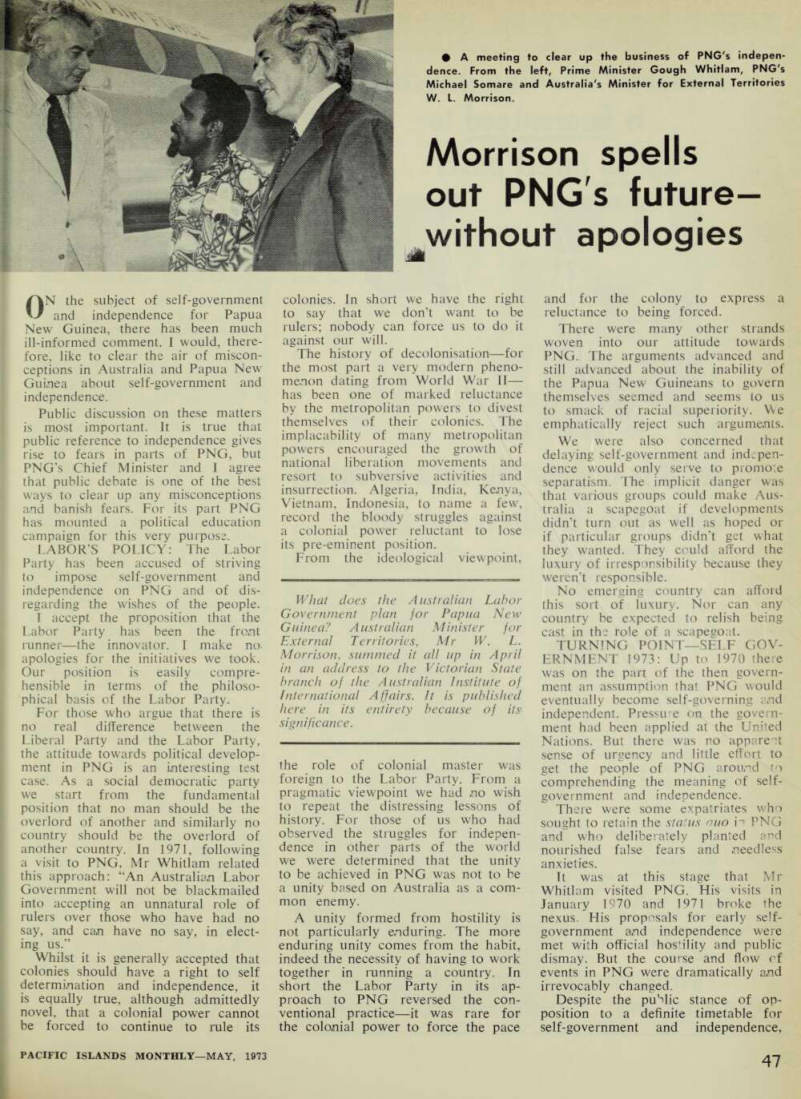
A meeting to clear up the business of PNG's indepen dence. From the left. Prime Minister Gough Whitlam, PNG's Michael Somare and Australia's Minister for External Territories W. L. Morrison.
the Liberal-Country Party Govern ment began to step up the transfer of authority to PNG.
The process was both hastened and became more enlightened when the portfolio of External Territories was extracted from the grip of the Country Party. With the transfer of the Ministry from Mr Barnes to Mr Peacock, PNG was removed as an issue from the Australian political arena.
Prior to the 1972 Australian elec tions Mr Peacock and the Chief Minister, Mr Somare (whose party had openly campaigned for early self-government) announced Dec ember 1, 1973 as the date for self government. The policy towards PNG became bi-partisan—the pro positions long put forward by the Labor Party had become official policy.
The Future Towards
INDEPENDENCE; Now let us look to the future. The Australian Govern ment is not only working towards self-government but each action is deliberately related to the indepen dence of PNG.
The process is a continuing one.
Neither the formal achievement of self-government nor independence will be marked by an abrupt step.
Australia has sought to involve the PNG Government progressively in the full spectrum of government activities—not just in those areas over which final authority has passed.
In this way the formal achievement of self-government will merely be the final step in a series of steps. By this smooth and gradual transition the status of self-government will be achieved.
Self-government is a most important step but it will be achieved as the last step in a long process and not as a sudden break from one status and set of responsibilities to another.
The PNG Government already exercises full authority on such vital spheres as education, health services, internal finance, transport and public works, trade and industry, agri cultural development. Recently I authorised the transfer of powers over District Administration to ensure that the policies of the PNG Govern ment are implemented in the field.
Powers which are to be transferred shortly include authority over the public service. Papua New Guinea ministers, during my first visit in January, expressed justifiable concern about a public service which is not responsible to the elected government of PNG but to a minister of another country.
In tandem with the transfer of powers over domestic matters, steps are being taken in advance of self-
Morrison spells out PNG'S future
government which are beginning to assume for PNG a separate inter national identity. Representatives of the PNG Government participated in the border agreement with Indonesia and the Chief M mister formally signed the agreement in Djakarta.
As Chief Minister, Mr Somare has travelled to Japan, Indonesia and Singapore and will shortly be visiting New Zealand. Papua New Guinea is an associate member of the Asian Development Bank, ECAFE and WHO. It is a member of the South Pacific Conference and is attending the April South Pacific Forum as an observer.
We are actively assisting PNG to build up the nucleus of its own foreign service. PNG foreign service trainees are currently attached to Australian overseas posts. Discussions between Australia and PNG covering the functions, size and shape of PNG’s post-independence defence forces are under way.
Independence will be achieved when PNG assumes control over all functions of its government, both external and internal and the trustee ship is discharged. Australia will then cease to have any authority in the affairs of the PNG Government.
The powers gained by a number of former colonies at self-government have been effectively exercised by PNG since mid-1970, when final decision-making in many areas of government was transferred to elected ministers. The Administrator has been instructed to accept the advice of the PNG ministry in the areas of its final responsibility.
At self-government, PNG will be exercising most of the powers of an independent state. The Australian Government has made it clear that it will exercise its reserved powers only after close consultation with and advice from the PNG Govern ment. At self-government, therefore, the PNG Government, through a programme of progressive involve ment beginning in 1970, will be fully responsible for its internal affairs. It will also have by then a wide degree of responsibility for and involvement in its defence and external affairs.
The difference between self-govern ment and independence for PNG will be of little practical consequence.
The formal achievement of self government is important but the transition to independence will flow readily from it.
This is because self-government represents the culmination of a smooth step-by-step transition to that status over a number of years.
Independence will follow but as far as PNG is concerned it will be little more than a tidying-up exercise. By that time there will be no area ef government in which a newly indepen dent PNG will be unfamiliar or lack experience.
Australia’S Continuing
ASSISTANCE: Nor will the Govern ment of PNG at self-government or after independence be abandoned by Australia. Those opposed to the rapid progress towards self-government and independence have sought to create such fears. The fears are groundless.
The Australian Government has no intention of leaving PNG isolated a,nd without aid. We have pledged to continue to assist PNG with aid and manpower after independence and undertake that it will have the first call on our foreign aid programme.
As the Prime Minister said in Port Moresby on February 18: “The Australian Government has decided to give the Papua New Guinea Government an assurance of con tinuing aid over the period of the three year improvement programme beginning in 1974-75. The detailed arrangements to give effect to this assurance will be formulated in con-
Continued on p 107
nection with the preparation of the improvement programme. These ar rangements will, of course, need to provide for review during the period of the programme as necessary in the light of changing circumstances.”
As this message is understood and accepted in PNG so will the fear of independence lessen. Australian policy is not directed towards occupying an exclusive position in PNG after independence, as an aid donor or in any other sense. PNG will develop its own relations with the rest of the world and is already taking steps to diversify its aid sources.
But both countries have indicated that they look forward to close and friendly ties. There will be a special relationship between them going beyond normal diplomatic channels, with access at the highest ministerial levels.
Between Self - Govern
Ment And Independence:
Those who argue that there should be a long gap between self-govern ment and independence are more than anything else misinformed about the essential character of each con cept. Self-government means indepen dence of action on all domestic matters. This is the great step. With independence of action on all domestic matters, the absence of independence of action in the residual areas of foreign affairs and defence could prove both frustrating for the PNG Government and em barrassing for the Australian Govern ment.
Independence flows on readily from self-government. It is admittedly a major step in international protocol but a minor step compared with self government in the exercise of power and authority.
Under the terms of the UN Trusteeship, Australia will be formally responsible for law, order and good government of PNG until indepen dence. After self-government this formal responsibility will place Aus tralia in an increasingly anomalous position which can only be resolved at independence.
How can we legitimately be held responsible for the actions of a govern ment to whom we have, through the act of self-government, given respon sibility over domestic matters? How can we accept responsibility for law and order when the day-to-day administration of justice and control of police is not in our hands? How could any Australian government, whether it be Liberal or Labor, for long accept the invidious situation of
continuing responsibility for the defence forces when the PNG Government may request their use in aid of the civil power in a crisis due to events not of our making?
It is only natural that PNG will want to assert itself in foreign affairs. International attitudes arise from domestic considerations. No two countries share an identity of interest over the whole range of foreign policy issues. The longer Australia retains responsibility for PNG foreign rela tions the more likely it is that dis
trust of actions and suspicion of motives will arise.
You will have deduced from what I have said that the Australian Government does not favour a long interval between self-government and independence. There is a good deal of controversy over this issue. How ever, I believe that when the impli cations and consequences are fully recognised, particularly in PNG, the stated policy of the Australian Government as expressed in the Governor-General’s speech at the opening of Parliament “to move with all due speed towards the creation of an independent united Papua New Guinea” will be accepted.