Fiji Government Could Be Taking
pp. 45-47 · Read in the full issue

Anti-strike legislation
On Worlds Trade Unions
By Ray Turner
The Australian Council of Trade Unions and the New Zealand Federa tion of Labour, governing bodies of the trade union movement in those countries, are almost certain to sup port the Fiji trade unions in their fight against the Trades Dispute Bill which, among other things, will out law strikes by certain unions and provide gaol sentences for union officials inciting certain categories of workers to strike.
There has been swift reaction by Fiji Government leaders to any pos sible boycott of Fiji-bound ships by waterside workers in Australia and New Zealand. Ministers have objected to outside involvement and have said that Fiji could cut out Australian im ports, which in many cases were too dear, and obtain supplies from the United States and other countries.
The general secretary of the Fiji Trade Union Congress, Mr James Raman, made a special visit to Aus tralia recently for talks with the ACTU leader Mr Bob Hawke.
Mr Hawke is understood to have told Mr Raman that the New Zealand Federation of Labour is also sympa thetic to the Fiji trade union cause.
Mr Hawke recently visited New Zea land and the Fiji issue was raised then.
The heavily trade union-influenced Labor Government in Canberra is also being alerted to the situation.
Just what action the trade unions in Australia and New Zealand, or for that matter the Labor governments of both countries, will take is not yet clear.
There seems to be some sympathy for the new government of an emerg ing independent nation, but the union movements in both Australia and New Zealand will consider they have a duty to protect their trade union brothers in Fiji, The question of trade sanctions and shipping boycotts has been hinted at but such drastic action is not likely to eventuate at this stage. The most likely course seems to be behind-the scenes negotiations with the Fiji Government to get it to set aside its controversial bill to enable a cooling off period.
The legislation has been described by some Australian trade union leaders as akin to that applying in
Rhodesia, South Africa, Greece, Spain and Portugal. The Whitlam Labor Government in Canberra is viewing the legislation most distaste fully particularly as it is in the process of wipi.ng from its own statutes all legislation involving penalties against trade unions for strike action.
Charges that Australian trade unions are interfering in the internal affairs of Fiji are also not likely to carry much weight in Australia. What the trade unions in Australia are saying is that all that has happened so far is fraternal assistance that is part of the world-wide trade union movement.
World-wide trade union liaison is growing with dozens of trade union delegations arriving in Australia in past months and reciprocal visits be ing returned. The unions point out that not only is there an International Labour Organisation involving inter national trade union liaison, but individual area organisation is grow ing.
Recently Indonesian trade union leaders visited Australia and had close talks with among others, the right-wing Federated Ironworkers
Association and Federated Clerks Union.
Nations such as Fiji will inevitably be drawn into the Pacific trade union bloc, Sydney union officials say.
The Australian Waterside Workers Federation formed the first trade union link between Australia and Fiji. The federation is clearly in sympathy with its counterpart union in Fiji.
On April 3, the general secretary of the WWF, Mr Charles Fitzgibbon, sent the following urgent cable to Prime Minister Ratu Sir Kamisese Mara, “In cause of international trade union solidarity Waterside Workers Federation of Australia pro tests at attack by your government on universally-recognised trade union rights of Fiji workers and infringe ments of human liberties involved in Trade Disputes Bill 1973. Such actions by your government not conducive to amity of family of nations in South Pacific area and endanger traditional goodwill of Australian workers to wards Fiji.
“Urge your government to with draw bill and approach industrial re lations problems in more constructive
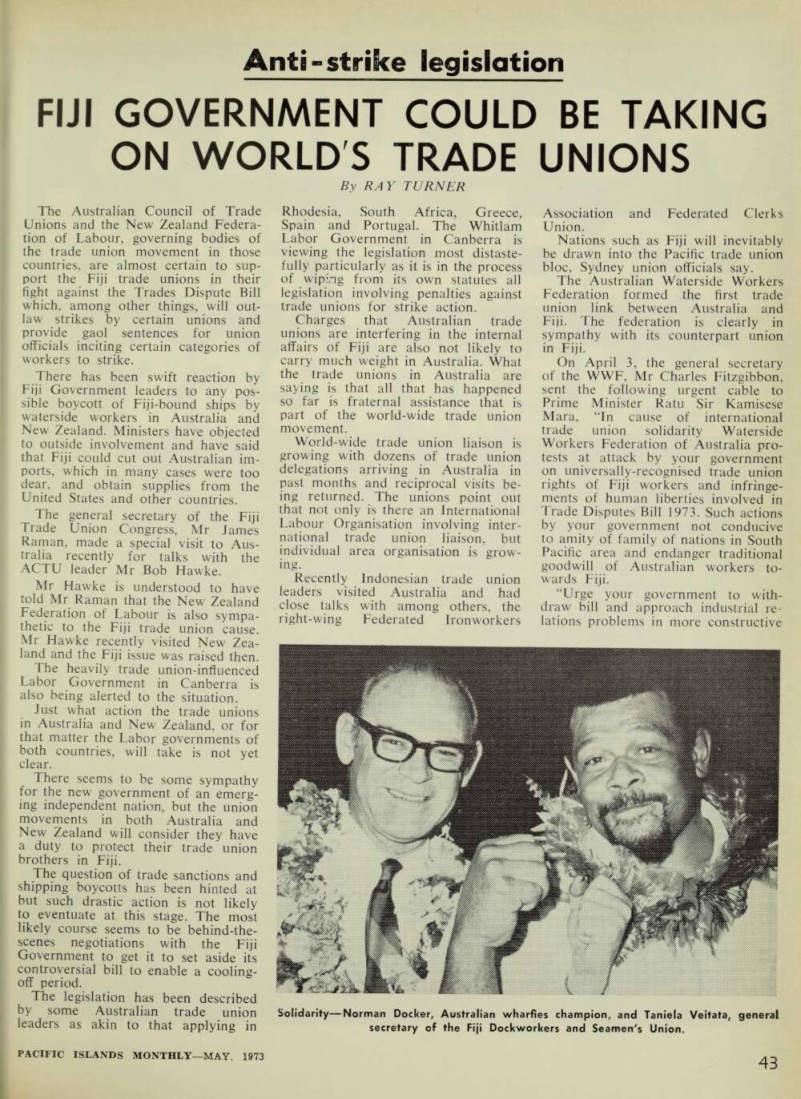
Solidarity—Norman Docker, Australian wharfles champion, and Taniela Veitata, general secretary of the Fiji Dockworkers and Seamen's Union.
Fiji’S Ant!-Strike Legislation
way after adequate consultations with Fiji trade unions and on basis of full preservation of fundamental trade union rights of Fiji workers”.
In the centre of the storm as far as Fiji public reaction to the Aus tralian trade union movement in volvement in the Fiji constitutional crisis is concerned is mild-mannered, bespectacled Norman Docker, indus trial advocate for the Australian wharfies since 1951.
Mr Docker strenuously denies charges published in Fiji that he went to that country to deliberately stir up trouble.
He said he had gone to Fiji for a holiday when the crisis blew up. “One of its effects was an airline strike which left me stranded at Nadi. I knew nothing about the strike until the engines cut out just before the plane was due to take off. I was blamed for causing the strike,” Mr Docker said on the first day back at work in his Sydney office, Mr Docker said Fiji trade union leaders sought him out after he arrived in Fiji and at their request he had several conferences with them. He made public statements on the crisis while in Fiji but only after being pre vailed on to do so by Fiji union leaders.
Mr Docker says he has only been acting as a representative of the Aus tralian Waterside Workers Federation and under instructions from that organisation.
The Fiji Dockworkers and Seamens Union initiated the first contact be tween the two unions, a contact which resulted in the Australian union be coming an ally in an advisory capa city.
“But there is nothing we have done that has not been accepted trade union principle and practice at the inter national level. There is an accepted commitment of trade unions in all advanced countries to help the emerg ing trade unions in the newly de veloping nations,” he said. “This assistance will be essential if the unions in these countries are to grow and fulfil their role of improving wages and general living standards of their peoples.”
Mr Docker said the Fiji Dock workers and Seamens Union asked the Australian Waterside Workers Federa tion for assistance in arbitrating a wage case late in 1971.
Later the dockworkers unions in the South Pacific organisation was formed representing dockworkers in Fiji, New Zealand, Australia, Tahiti,
the Gilbert and Ellice Islands and Papua-New Guinea.
Messages of greetings and support were received from dockworkers unions in Chile and New Caledonia.
Mr Docker said this organisation was similar to one which operated in the Asian area and included such countries as Japan and China a few years ago.
The first conference of the South Pacific organisation was held at Suva in February this year. It was attended
by 18 delegates representing nine unions from the six countries.
“All participants felt that their common interests extended beyond the fact that they were all dock workers in the South Pacific region— employed, in many cases, by the same international shipping cartels—to their united desire and determination to improve living standards and work ing conditions of dockworkers throughout the area,” Mr Docker said.
“In line with these sentiments, the Fiji trade union legislation will have effects outside that country.”