Magazine Section
pp. 59-63 · Read in the full issue
Murderer's Descendant Bridges The
Gaps In The Thomas Baker Story
One of the most famous, or infamous, murders in the Islands was perpetrated in Fiji on Sunday, July 22, 1869. The victims were the Wesleyan missionary Thomas Baker, the last missionary to be murdered in Fiji, and three of his companions. The bodies, and even Baker's boots, went into the oven, but the Fijians found the foot wear poor eating and discarded them. They are now in the Fiji Museum. R. A. Derrick, in his History of Fiji, and other writers have related the story of the murder but with out the wealth of detail in the story told below by Fijian journalist Manoa Rasigatale, who heard it from the lips of the great-great-grandson of the man who wielded the axe.
For the first time that man is named in this story.
By staff writer MANOA RASIGATALE of Fiji
There are many stories written about the murder of the Wesleyan missionary, the Rev Thomas Baker at Nubutautau in the Colo of Navosa in the Fiji Islands, on Sunday, July 22, 1869. But the story you read here is one that I researched myself, given to me by Ratu Jope Nawawabalavu, the present Tui Navatusila (king of the Navatusila people), the descendent of the actual tui who killed the Rev Thomas Baker. His name was Ratu Filimoni Nawawabalavu No 1.
Three other Fijians accompanied me on this three-day journey to the village, which lies right in the centre of Viti Levu, the main island of Fiji.
They were Netava Vunivalu, of Yavulo village in Nasigatoka, who works with me as a journalist on the Fijian newspaper, Nai Lalakai; Ratu Alipate Vuidreketi (my cousin) who is the manager of the Valley Industries Co-operative branch at Keiyasi, Nadroga, and Alipate Lumelume of Namoli village, a village about five miles from Nubutautau. He acted aS n Ur u ’ de ' iQ7 a Sun . da y a / tern oon in August, 1972, I interviewed Ratu Jope Nawawabalavu in the bare (house) or one of his sons at their village in Nubutautau.
The tui was away in the garden— only his five sons and their wives and children were around, so we waited for his arrival. When he
entered the house he welcomed us with a rich warm voice: Don sa bua vinaka mai na noqu gone, “Welcome home my sons”. His stature and the variety of tones in his voice could only belong to a person who had the blood of one of the strongest lines of chiefs in his veins. This was in his own right. Before the interview started, our guide Alipate Lumelume presented a yaqona ( sevusevu ) on our behalf according to Fijian custom asking permission to enter the village.
We were well received by the tui who opened the interview with, “I’m ready, if you want to ask anything, do so”. My first question was, “Did anybody ever come here to research the murder of the late Rev Baker?”
He looked at me as if he was very pleased at the idea of the interview and reflected; “You are the first man to come and gather the whole story at our doorstep”.
I was very surprised when he told me this, and I was also pleased. I said to myself, “Thank God for that”.
The Rev Thomas Baker and five Fijian missionaries were spreading the word of the Bible in the Naitasiri province.
When they came to Navuso and asked the turaga-na-qaranivalu (overall chief of the Navuso people) to stop being savage and become Christian, Qaranivalu accepted it. But he found out later that this was the idea of
Ratu Seru Cakobau, who ceded Fiji to Great Britain. Ratu Cakobau said that Qaranivalu and his people were on his side because they had accepted Christianity.
Qaranivalu did not like this idea, and he sent a message to Cakobau that if this were true they were betrayed and wouldn’t accept Chris tianity.
So Qaranivalu ordered some of his people to dress as warriors and they followed the missionaries who had left in the morning and tried to kill them. Instead of letting his man do the killing, he decided to trap someone into committing the murder by giving him a white tabua (whale’s tooth).
He told the warriors they must present the tabua to any village they passed and explained the plot, that whoever accepted the tabua would have to kill Thomas Baker, The missionaries who were preach ing along the Waimanu River, knew nothing of what was going on. The tabua was rejected everywhere, all saying, “We are now Christian and it is wrong in the eyes of the Lord if we kill and eat somebody again”.
But in the village of Nadr?u on a Saturday morning, the tui (king) was delighted to do the killing and received the tabua.
By then the missionaries had already left for Delaigaganivatu, the home of Tui Navatusila.
When we reached this point in the
story Ratu Jope stopped, . . . smiled and said; “Tui Nadrau accepted the tabua, because he enjoyed eating white man’s flesh. It is soft and tasty like that of a white pig”.
They were welcomed at Dalaigaga nivatu by Tui Navatusila (Ratu Filimoni Nawawabalavu No. 1) and one bure (house) was given to them for the night. But in Nadrau, the tui examined the tabua and thought it would be a good idea if he changed the one brought by the Qaranivalu messengers and replaced it with a small one he had.
Before dawn, Tui Nadrau gave his tabua to his messenger and sent him to Tui Navatusila, asking if he would join him in the killing of Thomas Baker. Tui Navatusila didn’t agree and repeated what the other villagers had told the Qaranivalu’s messengers. Tui Nadrau was worried, because he had already accepted the tabua. He wanted to return it back to the messengers, but it was too late—they had already started on their journey back to Navuso.
In the evening, at Delaigaganivatu, Ratu Filimoni (Tui Navatusila) visited the visitors in their bure. He was fascinated by Baker’s comb while he was combing his hair, and asked him if he could try it. He did so, and Baker promised that he would send one to him when he returned to Davuilevu, the Wesleyan mis sionaries’ headquarters, near Nausori, which is still there.
Ratu Filimoni forgot to give back the comb to Thomas Baker and went into his chiefly bure (Vale Levu) with the comb in his hair. Baker also forgot the comb.
In those days suitcases made out of tin were commonly used and were known to the Fijians as kato kava.
The missionaries had one each in which they carried their belongings wherever they went.
Next morning (Sunday) the mis sionaries packed up to continue their journey. Before they left they were taken by the Matanivanua ni Turaga (chief spokesman) to Vale Levu (tui’s house) and he went to waken the chief.
The first thing Rev Baker saw when he met Tui Navatusila, was his comb still in the chief’s hair. He didn’t hesitate but pointed to it and said: “That’s my comb, I have told you that I will send one when I reach home”.
Tui Navatusila was muddled as the words were spoken in English and turned around thinking that the mis sionary was talking to someone behind him. Baker stepped forward and pulled the comb out of the chief’s hair. The tui was shocked when he felt that somebody had touched his
head from his back. He turned around suddenly, looked at Baker and said to himself, “I’ll kill you today”.
Knowing that none of the missionaries would understand his dialect, he smiled at the missionary to hide his annoyance and said, O iko ke o a tabu mase, ia na lemu dereia ’qu ulu i na tabu dania na dromu ni higa nikua. ’Qu ulu o’kwe hequ ro ni vulu a hi dereia ga o Nene, e hukai hila tale.
This is a Korolevu-Navosa dialect.
It means, “I wouldn’t have killed you, but now you have touched my head I promise that you will never see the sunset again. Nobody in this world has touched my hair or my head except my mother”. (Touching someone’s head is tabu, a supreme insult in Fijian custom). Tui Navatu sila set a quick trap and told five of his warriors to carry the missionaries’ tin suitcases and show kindness to them until they reached the village boundary.
The tui led the procession with his axe Mi Bure on his shoulder. He was followed by Thomas Baker.
They walked in single file, with a warrior in front and behind each missionary. A few chains outside the village boundary on a flat surface, after they crossed a little creek, Tui Navatusila called out to his warriors, Du vi laba, which means, “Time to kill”. The terrible sound of the kato kava landing on the missionaries’ heads shocked Baker who turned round and saw his fellow missionaries on the ground. He stretched his hands out to try to stop the murders and shouted, “Hey . . .”. That was his
last word for the tui swung Mi Bure hard at his head. The first blow landed on the right side, and as it didn’t connect properly he swung another one right across the left side of Baker’s neck.
Baker fell dead at his feet. Only one missionary escaped. His name was Waisea who was believed to have come from Burebasaga village in the Rewa Province. He was also the first man to spread the news about Baker’s murder, A mile away on top of a hill, near the boundary of the Ba district, the tui’s only child, a son, Ratu Waisea Maka, saw the killing and ran down with some of his warriors who were on duty guarding the village.
He asked his father why he killed Baker. His father explained and ordered him to send a messenger to the Tui Nadrau telling him that he had carried out the killing. Tui Nadrau was delighted when he heard the news and sent some of his people to Delaigaganivatu for his share.
“Don’t carry the dead bodies on your shoulders, lift them like pigs—two on each hand and two on each leg”. Tui Navatusila commanded his warriors when they took the bodies to the village.
The bodies were placed on a huge, flat volcanic rock in the village. The tui then brought his wife and ordered three men to slice her breast until it bled and her blood dropped on the dead bodies. Two women cried when they saw the murder. One of them was called Lewatovu. The bodies were then distributed to Nadrau and to all the people under Tui Navatusila’s
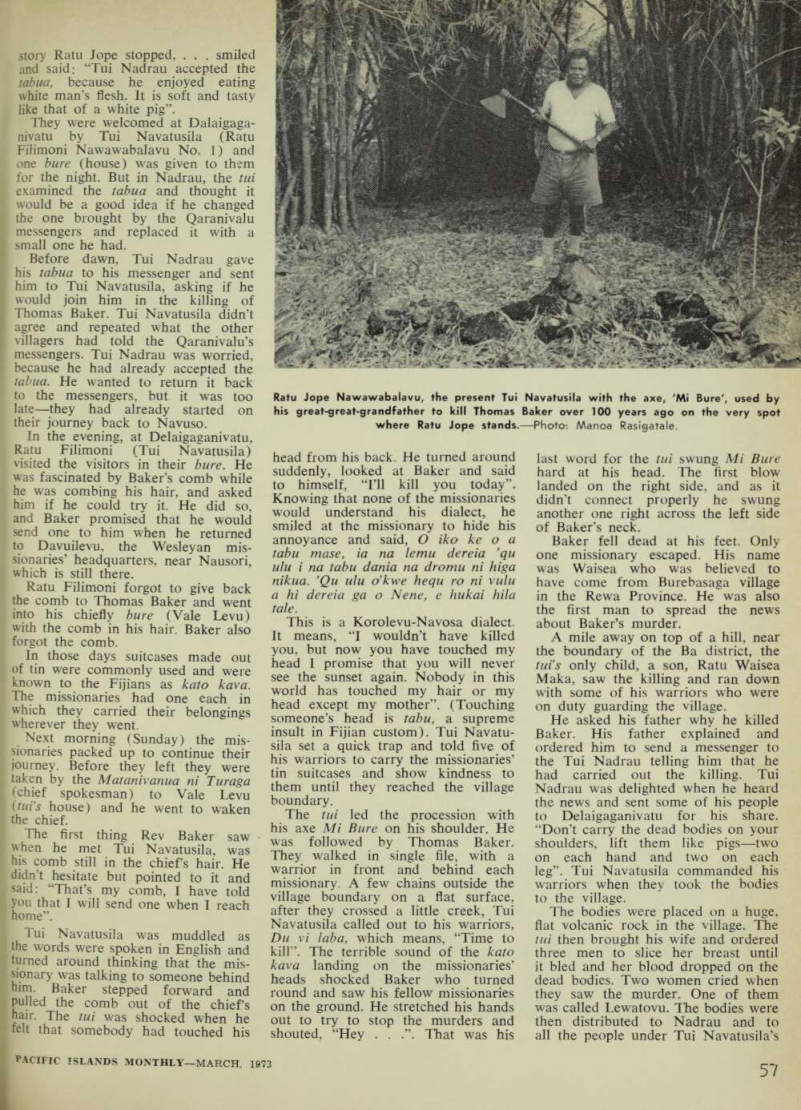
Ratu Jope Nawawabalavu, the present Tui Navatusila with the axe, 'Mi Bure', used by his great-great-grandfather to kill Thomas Baker over 100 years ago on the very spot where Ratu Jope stands. Photo: Manoa Rasigatale.
rule. Baker’s boots were cooked also.
Ratu Maka’s village is called Naduguivalu, and was occupied only by the great warriors who guarded the chiefly village of Delaigaganivatu.
Today both Naduguivalu and Delaigaganivatu are covered with bush but we still can see the foundations of the old houses.
These are some of the stories about Ratu Filimoni Nawawabalavu No. 1 (Tui Navatusila): He had two axes —one called Mi Bure , the one that killed Rev Baker and the other called Teve Driu. Mi Bure is still in Nubutautau today (home of the present tui, Ratu Jope), but the Teve Driu was given by Ratu Jope to the Credit Union League Associa tion in Fiji when they came to Nubutautau a few years ago to establish a new credit union branch there.
The two axes were brought to Delaigaganivatu (old village) by some of Ratu Filimoni’s warriors after a great battle at Naloto, which is known to the Fijians as Na i valu mai Naloto. The charred soles of Baker’s boots were given to the Fiji Museum in 1972.
Ratu Filimoni was famous whenever he opened his mouth and used his tooth pick, it meant that he was looking for somebody in the village to eat. A second sign that showed his longing for human flesh was when he carried one of his axes around. Ratu Jope said that he was a very tall broad-shouldered man. His height was said to be about the same as his bure.
The bure had two solid rock steps, each about 3 ft high 6 in. wide and
3 ft long. When I measured the foundation of this bure it was 10 ft by 61 ft. Outside this foundation, stood four great black rock walls about 20 to 30 ft high and 2i in. thick. They still stand there today.
Ratu Jope said the bure had only one door and the walls were strong.
This meant that if somebody was seen inside the compound threatening the tui, he couldn’t escape—he was sure to die.
Ratu Filimoni Nawawabalavu No. I had one child, Ratu Waisea who also had one named after his father, Ratu Filimoni Nawawabalavu No. 2; Ratu Nawawabalavu No. 2 had a son, Ratu Viliame Katoloaloa, who is the father of Ratu Jope, the present Tui Navatusila, and two other boys.
Their mother was called Adi Losana Naimasi from Narokorokoyawa in Ra. But Ratu Jope had seven children —five boys and two girls.
Nubutautau today, a new village built after they moved from Delai gaganivatu before the turn of the century, is occupied only by Ratu Jope’s family.
They have a shop and live happily.
Ratu Jope’s wife (Adi Alisi Viai, the sister of the present Tui Nadrau) died in 1970 and was buried at Nadarivatu village, a few miles from Nubutautau.
All are Christian and belong to the Seventh-day Adventist Church, Before Ratu Jope finished his story he smiled and said, “My son, go and publish this story so that people should read the true story about the murder of the Rev Baker that has been passed down to me by my father and his fathers.
This is one of the four great black solid rock walls which surrounded the fortress-like bure (house) of Ratu Filimoni Nawawabalavu No 1, which stood more than 20 ft high with walls 2½ inches thick. Ratu Jope points to the bullet marks made when the tribesmen shot at Ratu Filimoni's Bete ni i valu (war priest) to test his supernatural powers. According to the story handed down to this day, the bullets went through his body without causing him any injury. Photo: Manoa Rasigatale.