Yesterday
p. 64 · Read in the full issue
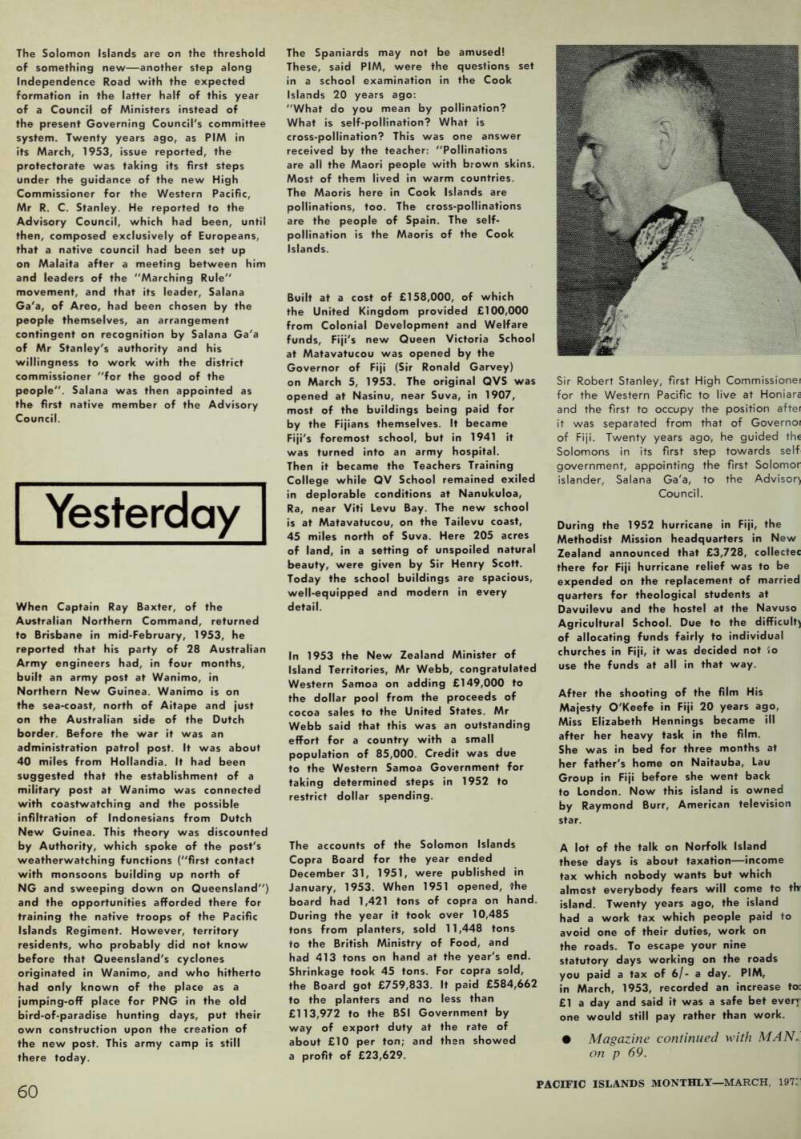
The Solomon Islands are on the threshold of something new —another step along Independence Road with the expected formation in the latter half of this year of a Council of Ministers instead of the present Governing Council's committee system. Twenty years ago, as PIM in its March, 1953, issue reported, the protectorate was taking its first steps under the guidance of the new High Commissioner for the Western Pacific, Mr R. C. Stanley. He reported to the Advisory Council, which had been, until then, composed exclusively of Europeans, that a native council had been set up on Malaita after a meeting between him and leaders of the "Marching Rule" movement, and that its leader, Salana Ga'a, of Areo, had been chosen by the people themselves, an arrangement contingent on recognition by Salana Ga'a of Mr Stanley's authority and his willingness to work with the district commissioner "for the good of the people". Salana was then appointed as the first native member of the Advisory Council.
When Captain Ray Baxter, of the Australian Northern Command, returned to Brisbane in mid-February, 1953, he reported that his party of 28 Australian Army engineers had, in four months, built an army post at Wanimo, in Northern New Guinea. Wanimo is on the sea-coast, north of Aitape and just on the Australian side of the Dutch border. Before the war it was an administration patrol post. It was about 40 miles from Hollandia. It had been suggested that the establishment of a military post at Wanimo was connected with coastwatching and the possible infiltration of Indonesians from Dutch New Guinea. This theory was discounted by Authority, which spoke of the post's weatherwatching functions ("first contact with monsoons building up north of NG and sweeping down on Queensland") and the opportunities afforded there for training the native troops of the Pacific Islands Regiment. However, territory residents, who probably did not know before that Queensland's cyclones originated in Wanimo, and who hitherto had only known of the place as a jumping-off place for PNG in the old bird-of-paradise hunting days, put their own construction upon the creation of the new post. This army camp is still
there today.
The Spaniards may not be amused!
These, said PIM, were the questions set in a school examination in the Cook Islands 20 years ago: "What do you mean by pollination?
What is self-pollination? What is cross-pollination? This was one answer received by the teacher: "Pollinations are all the Maori people with brown skins.
Most of them lived in warm countries.
The Maoris here in Cook Islands are pollinations, too. The cross-pollinations are the people of Spain. The self pollination is the Maoris of the Cook Islands.
Built at a cost of £158,000, of which the United Kingdom provided £lOO,OOO from Colonial Development and Welfare funds, Fiji's new Queen Victoria School at Matavatucou was opened by the Governor of Fiji (Sir Ronald Garvey) on March 5, 1953. The original QVS was opened at Nasinu, near Suva, in 1907, most of the buildings being paid for by the Fijians themselves. It became Fiji's foremost school, but in 1941 it was turned into an army hospital.
Then it became the Teachers Training College while QV School remained exiled in deplorable conditions at Nanukuloa, Ra, near Viti Levu Bay. The new school is at Matavatucou, on the Tailevu coast, 45 miles north of Suva. Here 205 acres of land, in a setting of unspoiled natural beauty, were given by Sir Henry Scott.
Today the school buildings are spacious, well-equipped and modern in every detail.
In 1953 the New Zealand Minister of Island Territories, Mr Webb, congratulated Western Samoa on adding £149,000 to the dollar pool from the proceeds of cocoa sales to the United States. Mr Webb said that this was an outstanding effort for a country with a small population of 85,000. Credit was due to the Western Samoa Government for taking determined steps in 1952 to restrict dollar spending.
The accounts of the Solomon Islands Copra Board for the year ended December 31, 1951, were published in January, 1953. When 1951 opened, the board had 1,421 tons of copra on hand.
During the year it took over 10,485 tons from planters, sold 11,448 tons to the British Ministry of Food, and had 413 tons on hand at the year's end.
Shrinkage took 45 tons. For copra sold, the Board got £759,833. It paid £584,662 to the planters and no less than £113,972 to the BSI Government by way of export duty at the rate of about £lO per ton; and then showed a profit of £23,629.
During the 1952 hurricane in Fiji, the Methodist Mission headquarters in New Zealand announced that £3,728, collectec there for Fiji hurricane relief was to be expended on the replacement of married quarters for theological students at Davuilevu and the hostel at the Navuso Agricultural School. Due to the difficulty of allocating funds fairly to individual churches in Fiji, it was decided not io use the funds at all in that way.
After the shooting of the film His Majesty O'Keefe in Fiji 20 years ago, Miss Elizabeth Hennings became ill after her heavy task in the film.
She was in bed for three months at her father's home on Naitauba, Lau Group in Fiji before she went back to London. Now this island is owned by Raymond Burr, American television star.
A lot of the talk on Norfolk Island these days is about taxation —income tax which nobody wants but which almost everybody fears will come to tb island. Twenty years ago, the island had a work tax which people paid to avoid one of their duties, work on the roads. To escape your nine statutory days working on the roads you paid a tax of 6/- a day. PIM, in March, 1953, recorded an increase toe £1 a day and said it was a safe bet every one would still pay rather than work. • Magazine continued with MAN „ on p 69.
Sir Robert Stanley, first High Commissioner for the Western Pacific to live at Honiara and the first to occupy the position after it was separated from that of Governor of Fiji. Twenty years ago, he guided the Solomons in its first step towards selfs government, appointing the first Solomon islander, Salana Ga'a, to the Advisory Council.