Letter
pp. 49-51 · Read in the full issue

Tahiti
If you're zany you can do it
From James Boyack
IT is rumoured that some marriages are made in heaven, and, come hell or high water, the partner ship enacted on Rangiroa atoll last week must be considered in the realm of such blessed unions.
Freelance photographer Martin Jeffrey, 27, could not relax in the Fokker Friendship prop-jet speeding him to Rangiroa, largest of the Tuamotu atolls. He had no time to spare because he should have been there the day before. He did not know that he was already too late.
Pat Gotten, 30, a self-taught naval architect, standing in the coconut frond hut which is Rangiroa’s airline terminal building, was in no hurry at all. If anything, he was hoping that there would be no space on Martin’s plane returning to Papeete immediately. Pat had just called it quits with the most ambitious project of his young life, and he had not yet fully come to grips with his decision. He had just spent several days with the owner-builders of the Kia Ora Hotel, about to be come the first atoll hostelry in French Polynesia. Serge and Yannis, particularly the latter, had been very good to him. They had sheltered him after he decided to leave the Moksha, a 71-foot, 120-ton, ferro-cement hippie community which, as he waited for the plane back to Papeete, was under stiff breeze off the atoll headed for Honolulu. Serge and Yannis had taken him into their home and they had offered exactly the right amount of sympathy and disinterested logic which enabled him to leave his “family” with a relatively clear conscience.
As Pat mused over the possibility that he would never again see the Moksha, Martin was desperately searching the lagoon surface below him for the craft’s black shape. Martin had travelled from Japan to Tahiti to get to Pitcairn Island, and the Moksha was his last hope. Greatly dismayed, Martin had learned that information obtained in Honolulu was false. There were no freighters leaving Papeete for Pitcairn. And, the few yachts in port which might have taken him 1,200 miles to the island, had offered this service for a minimum of $3OO a day. Just as he was going to give up getting to Pitcairn from Tahiti, Martin met Bernard Moitessier, the renowned French single-handed sailor.
Moitessier had become good friends with the Moksha commune in Tahiti and he told Martin the luxurious craft was probably still in Rangiroa, its first port of
call on a voyage to Peru. Martin was not overly worried that he had not seen the Moksha from the air.
He knew Rangiroa's lagoon was gigantic. As his Air Polynesie flight touched down on the island, Martin was lost in the imagined dialogue which would oblige the captain to take him aboard. The ambitious photo journalist had already decided to pay whatever sum was required.
OAT had just been informed there would definitely * be no space for him on the return flight. He was relieved. The vast peace of the atoll and the warm counsel of his new friends were very important to him at this juncture in his life. He needed more time to reflect on his next move. Papeete’s hubbub could only distract and depress him. He would return to Tiputa, one of the two island villages, in Yannis’ outboard.
Martin alighted from the plane and walked right over to Pat. He had neither broken stride nor spoken to anyone else when he asked the bearded American, “Say, man, you don’t know where the Moksha is, do you?”
“The Moksha, are you kidding?” Pat laughed. “The Moksha's 40 miles due north by now.” The Moksha had left that morning. “It’s headed for Easter Island,” he added, mistakenly. “We’ve got to get it back here,”
Martin, breathlessly, half-implored and half-ordered. “I have to get to Pitcairn.”
“But you don’t understand,” Pat said. “It’s on its way to Hawaii.” Pat had confused Easter with Christ mas Island, an error which, once explained, ended Martin’s hopes of reaching Pitcairn from French Poly nesia, or at least that’s what Martin had decided as he was fruitlessly badgering the ticket agent to allow him to fly immediately back to Papeete.
Martin, like Pat, was stuck on Rangiroa for another three days. For this reason, Pat and Martin will sail to Pitcairn at the beginning of March.
YANNIS, an ebullient, big-hearted Greek (whose hobby of soaring beneath kites has earned him world acclaim and several distance records) invited Martin along to his Tiputa home. Conversation was animated that Sunday evening. The two castaways had to wait until Wednesday to catch the next flight to Papeete. Martin explained that he and his $4,000 of camera equipment (two Nikons, assorted lenses and a Bronica 2i square) were going to Pitcairn no matter
how. He had contemplated the voyage for a year after reading the Nordhoff and Hall Bounty trilogy, and his second reading of Pitcairn Island the month before in a Tokyo hotel room had ignited the jets that propelled him to Tahiti. His goal was to produce the best photo illustrated book on Pitcairn ever attempted.
Pat detailed the circumstances which had brought him to Rangiroa. He had been designing and building cement pleasure yachts in San Diego when a hippie family asked him to build them the ark which would allow them to flee the American police state. This was in early 1970. Pat accepted the commission and poured the Moksha mould in May of that year in Los Angeles. This task accomplished, he set off for Canada with his wife Linda in his own yacht, the 35-foot Barbary. He maintained telephone contact with the Los Angeles commune, offering advice as the boat pro gressed.
In October, Pat was invited to join the family and help complete the Moksha. He sold Barbary to a friend for $20,000 and invested the entire amount in the sailing community project.
His decision to become involved with the Moksha opened up two new horizons for him. It freed him from the workaday world of high finance boat building. Pat had no formal training as a boat builder. While in the Navy in 1965 he converted a $25 navy whaleboat carcass into an eminently seaworthy 26 ft gaff-rigged cutter. He sailed with Linda to Tahiti—where I met him in 1967—and then to New Zealand. He sold that Spirit of Barbary in Auckland and with two snapshots of it he got a job which permitted him to design 25 yachts in the following three years. The decision also allowed him to see through his most daring design to its fruition.
THE Moksha was certainly big and bold in con ception. Pat reeled off a number of statistics: 71 feet in length on deck, 23 feet across, gross weight 120 tons, main mast 87 feet tall (3,200 lb), 38 tons of ballast, 20-ton cargo hold, carries 3,000 gallons of water (14 tons) and 1,000 gallons of fuel for a 200 hp motor with 1,500 mile autonomy; dining room table seats 18, sleeps 27 in eight double beds and 11 singles; main cabin 26 by 23 ft; three miles of chicken wire, 200 sacks of cement, 900 lb of glue, 350 sheets of ply wood and five tons of i in. steel rod were used.
Yannis and Martin, and I afterwards, were left with mouths agape at the details of this wonderful example of Americana, which also had wall-to-wall carpeting, a full-sized piano and an electric organ on board, along with a ton of berries and vegetables the family canned on the beach one day in Billingsham, Washington, in two mornings of picking.
The Moksha heeled six degrees under full sail in a 35-knot wind and was equipped with charts of all the oceans. It was built by Pat to sail non-stop comfortably from any port on the globe to any other. Two years’ provisions were aboard.
The boat sailed from the West Coast to Tahiti a few weeks ago, the first example, to my knowledge, of a floating hippie commune. It was very exciting to observe life on the Moksha and to realise here was the first of what will probably be many such boats to sail away from the polluted continents.
For the second time, I couldn’t believe my eyes, there was my friend Pat, who suddenly turned up with Martin in Papeete, headed in a completely different direction than when he left here the previous week in the Moksha.
Social pressures in the vessel had forced him to quit the family in Rangiroa and had obliged the family to
change its own plans. Instead of a leisurely cruise to South America, up the coast and over to Europe, the Moksha, while in the Rangiroa lagoon, decided to return to the Hawaiian part of the United States. The 11 re maining members of the family needed more time “to get their heads together”, as they explained their dilemma to themselves. They were headed back to America for several years of introspection, their exciting experiment temporarily abandoned.
WITH the Moksha sailing out of their lives, Pat and Martin took about two hours to come up with the zaniest, most exciting and natural idea that could unite two people who had known each other for about 100 minutes —for Pat to build a boat to sail Martin and himself to Pitcairn. Yannis was in the discussion too, in the atoll home of Serge Arnoux, famous for his part in the round-the-world Moana sailing expedition.
Pat, with Martin’s prodding, decided to build the cheapest, fastest-to-construct and most practical sailboat in which to get to Pitcairn and back to Tahiti. Because there is no harbour or lagoon at Pitcairn, and because it would be very dangerous, if not impossible, to anchor off shore, it was decided that Pitcairn, the name of the boat now being built at Arue, Tahiti, will ride the waves on to the rocks ashore —the first-ever foreign vessel to do so. Pitcairn, therefore, will have a draft of 21 ft and a relatively flat keel. As Pat explained, it will be “as strong as a battleship, framed like a 40 ft sailboat ... a little machine, designed to go to wind (the 1,200 miles between Tahiti and Pitcairn are swept by an east wind), built to sail into the wind and into the seas” which are reportedly among the world’s more turbulent, Pitcairn will be 18 ft long, 7 ft 3 in. wide, of ply wood, weighing 900 lb—the weight of the turnbuckles on the Moksha. Less than a week after the idea was born, the first two-by-two frame ribs had been cut.
The new boat is coming along well. It will be built by March 1. Pat said so.
If Pat is the builder, Martin the journalist is an equal visionary. He understood that to arrive in Pitcairn on a French military helicopter would be, well, nice but innocuous. He realised that the Pitcairn Islanders would be thrilled to see a Pitcairn built for them, by two people whose only intention in sailing was to visit them.
The size of the boat and the way in which it runs up on the island will be an introduction no other journalist could hope for. It will be the perfect calling card for someone whose goal is to see and feel and record all of life as it is today in Pitcairn. The islanders will know the hardship he suffered to meet them. They will appreciate with friendship.
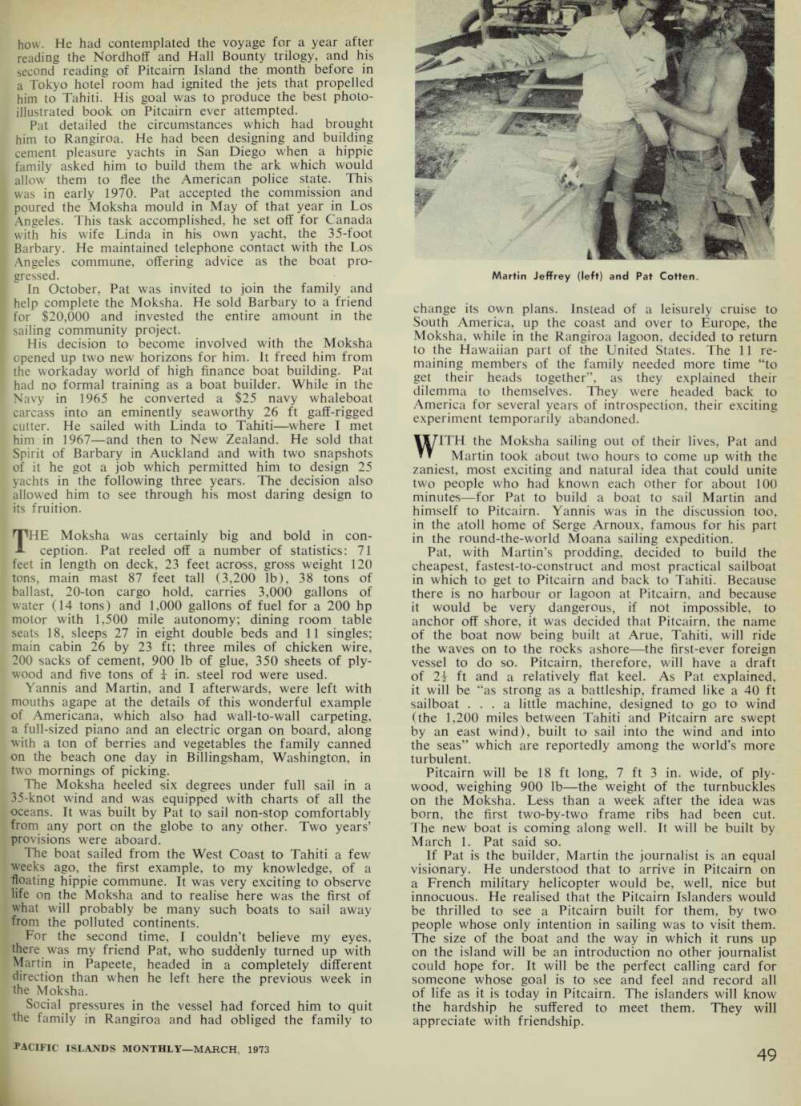
Martin Jeffrey (left) and Pat Gotten.