The Chesterfields
pp. 43-47 · Read in the full issue
A Dozen Do Their
Own Thing In
By Sheila Hunter
The 79 ft Coralita is a luxury job and so well-known in Queensland Barrier Reef waters that she was chosen when Mr Pierre Trudeau, Canada’s Prime Minister, made his tour of the Reef in 1972. But out on the open ocean, Coralita goes pitch pitch-pitch-pitch-roll-roll, over and over again, and does disastrous things to my stomach. It also affects my husband, Norman; but he feels that he can put up with it if a full blooded adventure is in the offing.
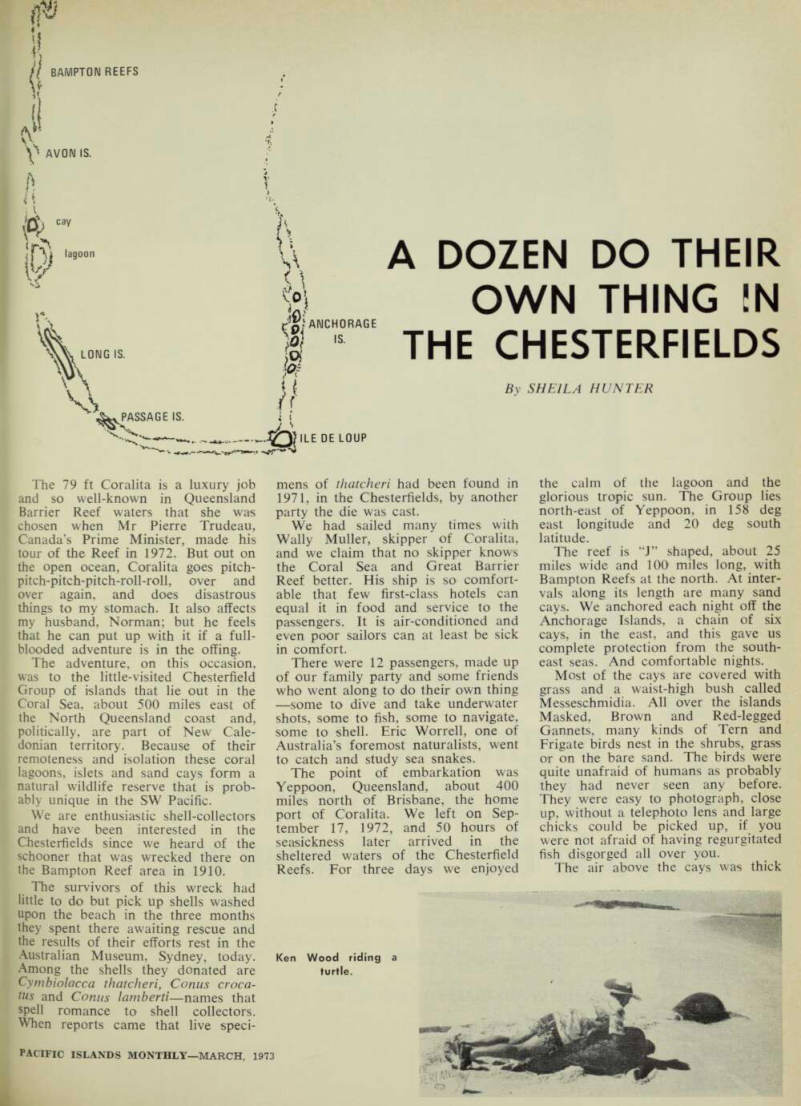
The adventure, on this occasion, was to the little-visited Chesterfield Group of islands that lie out in the Coral Sea, about 500 miles east of the North Queensland coast and, politically, are part of New Cale donian territory. Because of their remoteness and isolation these coral lagoons, islets and sand cays form a natural wildlife reserve that is prob ably unique in the SW Pacific.
We are enthusiastic shell-collectors and have been interested in the Chesterfields since we heard of the schooner that was wrecked there on the Bampton Reef area in 1910.
The survivors of this wreck had little to do but pick up shells washed upon the beach in the three months they spent there awaiting rescue and the results of their efforts rest in the Australian Museum, Sydney, today.
Among the shells they donated are Cymbiolacca thatcheri, Conus croca tus and Conus lamberti —names that spell romance to shell collectors.
When reports came that live speci
mens of thatcheri had been found in 1971, in the Chesterfields, by another party the die was cast.
We had sailed many times with Wally Muller, skipper of Coralita, and we claim that no skipper knows the Coral Sea and Great Barrier Reef better. His ship is so comfort able that few first-class hotels can equal it in food and service to the passengers. It is air-conditioned and even poor sailors can at least be sick in comfort.
There were 12 passengers, made up of our family party and some friends who went along to do their own thing —some to dive and take underwater shots, some to fish, some to navigate, some to shell. Eric Worrell, one of Australia’s foremost naturalists, went to catch and study sea snakes.
The point of embarkation was Yeppoon, Queensland, about 400 miles north of Brisbane, the home port of Coralita. We left on Sep tember 17, 1972, and 50 hours of seasickness later arrived in the sheltered waters of the Chesterfield Reefs. For three days we enjoyed
the calm of the lagoon and the glorious tropic sun. The Group lies north-east of Yeppoon, in 158 deg east longitude and 20 deg south latitude.
The reef is “J” shaped, about 25 miles wide and 100 miles long, with Bampton Reefs at the north. At inter vals along its length are many sand cays. We anchored each night off the Anchorage Islands, a chain of six cays, in the east, and this gave us complete protection from the south east seas. And comfortable nights.
Most of the cays are covered with grass and a waist-high bush called Messeschmidia. All over the islands Masked, Brown and Red-legged Gannets, many kinds of Tern and Frigate birds nest in the shrubs, grass or on the bare sand. The birds were quite unafraid of humans as probably they had never seen any before.
They were easy to photograph, close up, without a telephoto lens and large chicks could be picked up, if you were not afraid of having regurgitated fish disgorged all over you.
The air above the cays was thick
Ken Wood riding a turtle.
with flying birds, their sounds and the smell they left behind.
As there are few such nesting places like these in the Coral Sea, it would be a shame if these magnifi cent colonies were ever disturbed for the mining of the small amounts of guano that are there but which have not been worked for more than half a century.
When not on the islands beach combing, all except the divers and the sea snake experts were helping to dredge for the shell thatcheri. This latter proved to be very hard work for very little reward; however, we were able to get some and also ob serve this beautiful shell as it crawled around the shelling bucket.
Eric collected many varieties of sea snakes and soon the decks were strewn with buckets containing choice specimens. Eric said he learned a lot, but so did the rest of us. We even got used to them crawling here and there in unexpected places on the
ship.
It was soon obvious that damage was done to the snakes when caught by hand, and thenceforth they were always caught in a net, so that they could regulate their own breathing as they were brought to the surface.
Probably more than 100 snakes were caught on the trip, and many are still alive and well, at Eric’s Aus tralian Reptile Park near Gosford,
Nsw.
Each morning as we came on deck it was the thing to turn towards whatever island we were near and count the turtles. Along the sandy beaches there were always a number of female turtles and on one occasion a pair, in the act of mating, were found stranded by the tide. All the party found turtle riding, especially in the water, a fascinating pastime.
On one of the islands, He de Loup, there is a French automatic weather station and here we found birds in an even heavier concentration than
elsewhere. I was able to record their bird calls, which were deafening.
To the south-east of the main Chesterfield Group are the Bellona Reefs, marked on the Admiralty chart as “uncharted waters unsafe for ship ping” but which our skipper wanted to explore. It took us an hour, one early morning, to clear the lagoon and reefs and get into the open sea, and another 4i hours before we sighted the northern extremity of Bellona. It gave no protection and no anchorage and for five hours we skirted it and successive stretches of half-submerged coral and anchored at last in the lee of an atoll in the making—circular reef, with a pale
Messeschmidia bush which was the home for gannets, frigate birds and terns on Anchorage Island.
Old-Man Turtle Attacks
blue, still lagoon and one green islet.
Our skipper manoeuvred his big boat skilfully through the tiny en trance to the mirror-like lagoon which had a depth of up to nine feet at low tide.
The two dinghies were over the side almost before the anchor. Several green glass Japanese floats were found on the island, dozens of bottles and thousands of birds wheeling in the sky or nesting in the shrubs and the grass.
Dozens of live sea snakes were found high and dry on the tide line. Groups of turtles played around in the shallows, looking so tame that Norman swam out and grabbed the nearest, which took off with his 13i stone weight like an aquaplane. An old-man turtle, incensed by one of his harem being removed in this fashion, made a vicious attack and knocked Norman clean off his vehicle.
In spite of the bottles and floats the tiny island had a new and fresh look, as though it had only just been created; as though no man had walked there before. Whether this was true or not I do not know, but it seems entirely likely that the women of our party were the first of their sex to step ashore there. The church service held on board that Sunday night was also probably a “first”.
At the Bellona Reefs and also at Kenn Reef, on the return journey, fishing really began. Huge turrum, coral trout, red-mouthed sweetlips, sharks and other varieties abounded in the waters close to the reefs and sent the fishermen of our party into transports.
At a point about 500 miles from the Queensland coast Coralita turned for home, setting off one dusk on the first 18 hour leg to Kenn Reef.
Twelve hours later dawn appeared and so did a Russian ship of about 20,000 tons, right on a collision course. Obviously feeling that they were alone in the ocean, the watch must have been asleep but at the last moment we were sighted and the Russians shot off to starboard in a hurry.
Kenn Reef, 350 miles east of Coralita’s home port, looked beautiful in the late morning sun. The blue waves were topped with white-lace crests, breaking on the very long reef and to complete the picture there is a sand cay in the centre of the semi submerged coral. We had been there before, in 1966, with Skipper Wally and anticipated good shelling but since that trip the reef had been lashed by storms and cyclones and damage was everywhere evident.
One of the cays that we had ex plored on the previous visit had dis appeared; of the thousands of birds that once nested there, less than 100 remained; and huge coral boulders, sitting on top of the reef, had been crushed and broken.
This reef is marked on the charts as “strewn with wrecks”, most of them having occurred in the days of sail in the last century. Bonavista, in March 1828; the Dutch barque Doelwych and the Hester, in April 1854; the Oliver van Noort and the Rodney in January 1858 were all cyclone-season victims of this patch of treacherous coral. Their remains are still visible—huge anchors, en crusted with rust and coral, chains, keels and other bits and pieces.
Good fishing compensated a little for lack of shells on the beaten-up reef, then it was back to Yeppoon, via Saumarez Reef where the Australian authorities have recently erected an automatic beacon and where, a little further south, an American Liberty ship still sits high on the reef where she went when being chased by a Japanese submarine in 1945.
Wally Muller, skipper (left) and "snake man" Eric Worrell on Coralita.