Potential of Your Skin
pp. 32-41 · Read in the full issue
Discover the Beauty Potential of Your Skin
Now your complexion can benefit from luxury living every day of your life because the unique beauty fluid virtually helps to simulate the conditions under which the human skin will thrive and blossom best.
The difference between a “young” skin and an “old” skin is primarily a question of oil and moisture.
Many complexions lose their beauty early, simply because they are half-starved and thirsty. In these modern days, when the “climate” in which you live can be changed at the twist of a dial, it is easy to overlook the depletory effects on your skin of air conditioning. Such environ ments, together with the outdoor elements of wind and sun, the notorious oil-and-moisture snat chers, can dry out a fresh, smooth complexion in double quick time.
Oil of Ulan moist oil blend, how ever, helps maintain your own built-in oil wells, bringing the natural young bloom softly to your skin.
An invisible film of this moist oil blend applied daily to the face and neck and used as a sub-found ation for make-up ensures that your cosmetics will stay matt with out any signs of streakiness, whilst your complexion is protected against the drying effects of harsh weather and artificial elements.
At night this unique beauty fluid should be lavishly smoothed over the complexion, for it will then have an excellent opportunity to exert its remarkable softening and
smoothing properties whilst your skin is relaxed during sleep.
Available from chemists and beauty counters, Oil of Ulan, is the precious means of obtaining a smooth, youthful, radiant com plexion.
Beauty cleansing
for a lovelier skin The exceptional beauty benefits derived from moist oiling your complexion should be complemen ted by an equally beneficial clean sing routine. There is no finer way to support the nurtured soft ness and smoothness of your skin than to use a gentle effective beauty milk night and morning to cleanse away dust, dirt and stale make-up. Soap and water cleansing for the complexion is often rather drastic, making the skin taut and dry because it has a detergent action that removes too great a quantity of the natural oil that nature provides to pro tect the skin. However, this non detergent cleansing milk patted on the face and neck will gently lift stale make-up, dust and other im purities from the skin. The dis solving action of Delph Cleansing Milk means that you merely have to tissue or rinse it of, and your skin is left absolutely clean, and youthful soft, without being dried out.
pany in 1896. This site was trans ferred to Hernsheim & Co in 189' and sold by that firm to H. F Wahlen in 1903. The remainder c the island was purchased by thi German Government in 1906. I 1907, the government ceded t Wahlen 817 hectares which he de veloped as adjoining plantatior Agita and Tumuvali, and the goven ment retained 547 hectares as nativ reserves, Onne (147 ha) and Aun (150 ha) in the west and Ruvurau (250 ha) in the east. The Germa Government had strict laws at ths time for the protection of nativ interests; land needed for their home and subsistence could not be cede« The 1907 cession contained standar conditions which had been laid dow by Governor Hahl in 1904. The lan ceded was subject to the obligatio to allow any person to use the sej shore as a landing place and to alio' natives to use the foreshore fc fishing purposes. Also, Wahlen we obliged to sell to the government i cost price any land required fc roads, railways, telegraphs, landir places or other public purposes, bi he would be paid for any improvi ments he had made.
The island was undoubtedly a mone spinner for Wahlen—his two plan ations contained 36,000 native pain and he planted 83,000 more —and : May, 1912, he persuaded the Germa Government to cede Ruvuraue 1 him. The government ceded this are of 250 hectares which, as noted, hs been retained in 1907 as a nati T reserve, on the condition that a encumbrance go on the title for Agii and Tumuvali giving the governme;; the right to call for a transfer “< those portions of the property whio comprise the taro plantations of t! natives, the so called hula fields The hula fields comprised an esu
One of the most rewarding aspects of skin care is that the complex ion has a constant potential for improvement—there is always the promise that tomorrow your skin can look even lovelier than it does today.
This knowledge has become more and more appreciated by women the world over, particularly since the discovery of a tropically moist oil blend with the remarkable ability to help give the skin a smooth, youthful radiance.
Letters
mated 300 hectares (Dr R. Cilento, Causes of the Depopulation of the Western Islands (1928) p 4). Ruvuraue itself, was ceded without the hula fields encumbrance but otherwise subject to the similar conditions to the 1907 cession: the right of any person to use the seashore as a land ing place, the right of natives to use the foreshore for fishing, and the obli gation to cede to the government free of charge land required for roads, railways, telegraphs and other public purposes subject to pay ment for improvements. The slightly different wording of this public purpose encumbrance (“free of charge”) from the 1907 one (“at cost price”) is explained by the fact that just prior to the 1912 cession the government had issued new model conditions for the cession of land which altered the wording of this condition.
Thus, when the German properties in New Guinea were expropriated in 1920, the encumbrances of benefit to the natives were the hula fields encumbrance on Agita and Tumuvali (817 ha) and the landing place and foreshore fishing encumbrance on that property and Ruvuraue (250 ha).
The public purpose encumbrance on each title probably would not have benefited the natives as it would be hard to establish that native reserves were a public purpose of the same kind as roads, railways, telegraphs, etc.
The property was sold by the Custodian of Expropriated Property in 1927 for £60,100 to L. F. Howard whom the Commonwealth Auditor General declared to be a dummy for W.R. Carpenter & Co Ltd (1928-29 report, p 31). It was perhaps unique of the several hundred expropriated properties sold at that time in that it was worked by the Wuvulu is landers as free labour rather than by indentured labour.
In 1928, the Registrar of Titles commenced the process of bringing the land under the Torrens system of registration by issuing two draft certificates of title which faithfully reproduced the German encum brances. But the registrar required a re-survey which was not completed until 1941 when the advent of war prevented registration occurring.
In June, 1958, the Commissioner of Titles, Mr C. P. McCubbery, visited the island for the purpose of restor ing titles. The islanders claimed title to Ruvuraue on the ground that it
was never properly alienated from them, but this claim was dismissed by the commissioner. The commis sioner’s files may contain a record of the evidence given by both sides and the reasons for this decision.
At law, the Groundbook entry was prima facie evidence that the German Government had bought the island and ceded Ruvuraue to Wahlen in 1912, but this could have been re butted by strong native evidence that there was no sale. The commissioner found that the taro pits scattered throughout the plantation comprised 32 hectares. Rather than restore the hula fields encumbrance in its German form covering all of Agita and Tumu vali, he cancelled it and excised two areas totalling 32 hectares which he added to the two native reserves. The islanders may have consented to this decision; at any rate they did not appeal against it.
The company’s plans for the island seem almost fantastically ambitious —the one acre foreshore blocks are to be offered for sale at $30,000 each —for such a remote but undoubtedly beautiful island populated by fine people and it is hoped that PIM will give future reports on the progress of this venture.
Theo Bredmeyer
Rabaul.
Solomons History
I read recently in your magazine that a young German who visited Honiara last year is thinking of writ ing a history of the British Solomon Islands.
I am curious as to what sources he will find for his information. No doubt there is a large quantity of writing available from the govern ment, and from various missions.
Possibly there may be some detail of recent matters from the natives. But I feel that it will be difficult to com pile a valid history from these sources.
For instance, 1 would lik 3 to know if there is any detailed account of the
murders at Sinarango, Malaita, in th late ’twenties, of the District Office; Bell, his cadet Lillies, and 25 polio If there is no detailed account c these in present archives, I feel th; something should be done to try an ascertain facts from responsible pe; sons around Tulagi at the time.
Paul Mason, recently deceased, tol me he had visited the murder spe A number of sailors had been lande from the battleship Adelaide and we] encamped there.
It might be possible to gain a account from Eray Palmer who won have been in the Solomons then. Pe haps Colin Allan (now resident the New Hebrides) may have heai some accounts from the Malaitam* when he was on his tour of duty the: in the mid-century. Martin and 0< Johnston had seen Bell and knew the threats.
K. W. Seto[?]
Kangaroo Point, Queensland. • The bibliography of the Sot mons is quite extensive, and one the best lists we’ve seen is in ti Search for the Islands of Solomo 1567-1838 by Colin Jack-Hinton, pu lished by Oxford in 1969. There a several histories, although none rig up to date. Dr C. E. Fox’s small h tory, The Story of the Solomons, , of special interest. We have sa various accounts of the killing of E trict Officer Bell and others in Oc: her, 1927. As PIM reported in F ruary, Paul Mason was a member the civilian “army” which went out\ arrest the murderers. Jack Me Lav told the murder story in a book pi < lished in London before World W 11, Gentlemen of Empire. We ag\ with Mrs Set on that every scrap ■ information on the recent history < the Solomons, or any other grot should be collected from conta porary sources while the sources still contemporary.
9 More letters on p. 37
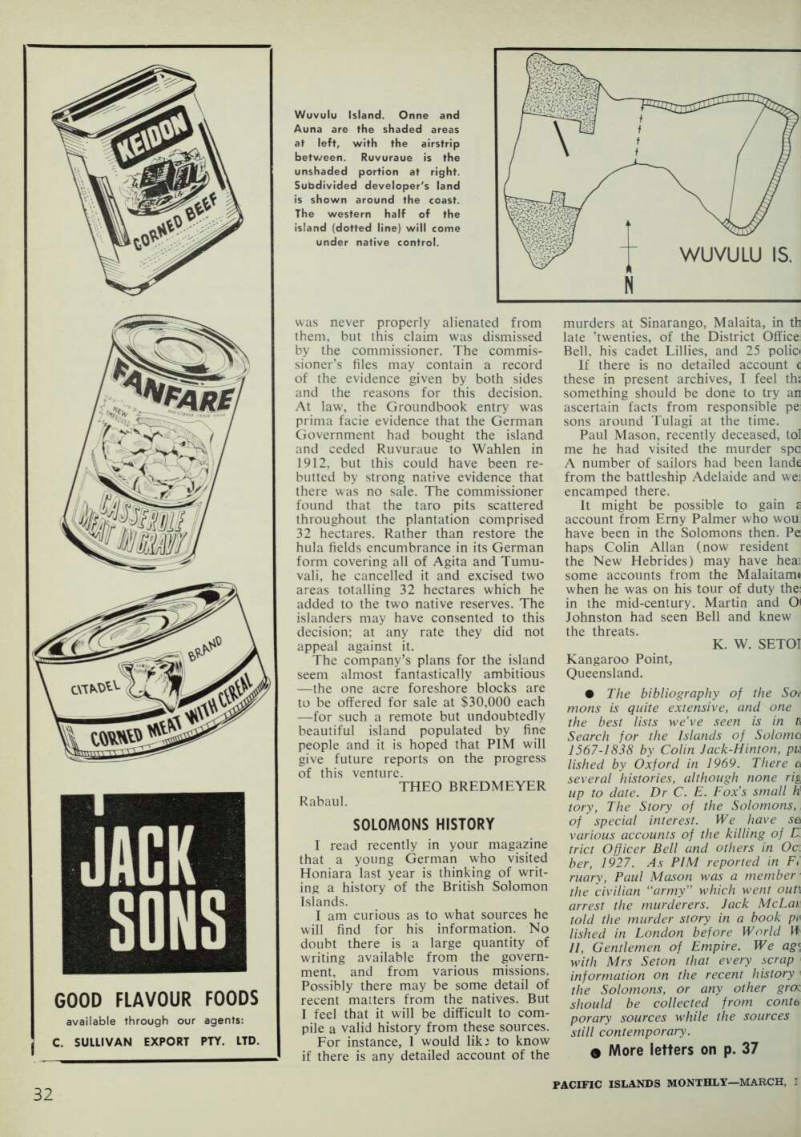
Wuvulu Island. Onne and Auna are the shaded areas at left, with the airstrip between. Ruvuraue is the unshaded portion at right.
Subdivided developer's land is shown around the coast.
The western half of the island (dotted line) will come under native control.
Letters
West Irian
I must agree with Mr A. Fraser (Letters, PIM, Jan, p 10) concerning West Irian. Despite being an “integral province of Indonesia”, West Irian, unlike Hawaii, is populated primarily by Pacific Islanders. For understand able reasons, Mr Somare chooses to overlook the ethnic and cultural con nections between the people of PNG and West Irian, but PIM is not under the same pressures. I sincerely hope one of the changes you have promised for 1973 is the freeing of myself and many other readers of our ignorance of the most neglected people in the
Pacific.
Neal Engledow.
University of the South Pacific, Suva.
Minervans, Again
The following letter was sent to. Mr Robert D. West, of Chillicote, Ohio, United States by Miss Ruth E. Lechte, of Suva.
For 200 years, people from other areas of the world have, more often by foul means than fair, been pinch ing bits of our Pacific, or messing about with it. If, as you say in your letter (PIM, Dec, p 49), you have made an “in depth study of the his tory of the Islands”, you must know that. It’s quite a story and includes the Japanese attempts of 20 years ago, and the present outrageous French pollution of our environment with nuclear testing.
To understand our attitude you might study our cultures, as well as our history, and you will understand that we do not “own” our land, we hold it in trust for our descendants.
Apart from your personal abuse of King Taufa’ahau Tupou IV and the Kingdom of Tonga (a strange way to “win friends and influence people”), did it not occur to you and the “Minervans” that the people of the Pacific might have had about enough of Western affluence using its resources to acquire what is ours, rather than helping us develop it in our own ways? As well as an “in depth study of history” Fd suggest you might find proof of this with an “in depth study” of recent legislation in the New Hebrides Condominium and the Dominion of Fiji seeking at last to contain acquisition of South Pacific resources from outside.
Or maybe you’d exchange an equivalent area in Ohio to that the “Minervans” laid claim to in the Pacific, equal in distance from Chil licote to that of Minerva Reef from Nukualofa, for the same number of Pacific Islanders as there are Minervans, to settle? Perish the thought! We’d never make it! p ur nationalities preclude us as prohibited immigrants!
The great thing about your letter is that it’s so insulting and abusive that it has probably effectively rallied the whole Pacific on the side of Tonga against the “Minervans”. I take your word for it that they are sincere and honest (though one wonders about their threatening responses to setbacks) but they need your type of apologist for their cause like a hole in the head!
Pacific Islanders being what they are I think the “Minervans” would have no trouble obtaining a reef similar to Minerva and setting it up as they wish —if they ask properly.
You just don’t go round anymore in this part of the world, laying claim to areas out of the blue, regardless of what the law of the sea or any
thing else says.
Ruth E. Lechte.
4 Macgregor Rd, Suva.
The "Aggrieved" Banabans
In an interesting review of Miss Sheree Tipton’s new book on Fiji, Mrs Judy Tudor suggested in the January issue of Pacific Islands Monthly (p 73) that readers might not see the Banabans as outraged victims of exploitation.
Well, I am NOT sure that the Bana bans feel outraged. In the three years that I have worked among them I have sensed that they feel aggrieved rather than outraged.
But they do believe that they have been exploited. And, having been present when Miss Lipton delved into Banaban history and the story of the phosphate mining on Ocean Island, I think she believed it, too.
Supposing your readers were told how, in the year 1900, when the Banabans were living typical, un sophisticated South Sea lives, a smart operator from the civilised world found that their remote island was almost entirely made of phosphate and —knowing full well that they had not the slightest idea of its enormous value —persuaded them to let his company have a 999-year ex clusive right to dig it out and ex port it, in return for £5O a year?
Supposing your readers learned now that the British Government, to protect the concession thus dubiously acquired, issued the company with a
licence to work the phosphate, defining the island as “belonging to Her Majesty,” when it belonged to nobody but the Banabans?
Supposing your readers were to learn that after the island was brought under British administration (a one sided action to which the Banabans never agreed because they were never asked) Britain saw fit to bend its own Pacific laws and legalise illegal purchases of Banaban land by the company so that it could get its hands on the quick easy phosphate it was after?
Supposing your readers were shown official records disclosing that from land for which the company paid the Banabans such paltry sums as £2O or less, with £6O an acre as top price, it dug phosphate worth at a conservative estimate £37,500 to £45,000 an acre, so that its profits were soon colossal and its lucky shareholders were drawing dividends of 50 per cent?
Supposing your readers were offered proof that the company charged the Banabans 200 per cent more than it charged Europeans for goods in its trade store (having nicely arranged things so that nobody else was allowed to open a store on the island) and was quite prepared, during drought, to charge them four times as much for drinking-water dis tilled from sea-water?
Supposing your readers were as sured that, although the authorities were more than once advised by competent officials that the com pany’s so-called concession from the Banabans had no legal validity, the company’s men brandished it as if it were Holy Writ every time they were hungry for more phosphate bearing land that the Banabans were unwilling to let them have —and the Government and local administration let them get away with it?
Supposing that it now came to your readers’ knowledge that when the Banabans refused to part with more land more than 40 years ago because their island was being destroyed before their eyes (and because they wanted a better share of its wealth) 150 acres were seized compulsorily as a matter of Colonial need, on terms against which they protested, and the phosphate sold at rock-bottom prices chiefly for the benefit of farmers in Australia and New Zealand?
Supposing I were to say—as I now do—that although a British Secretary of State for the Colonies clearly decreed that the land and phosphate on Ocean Island belonged to the Banabans a High Commissioner for the Western Pacific (wanting as much money as he could get for the
administration of the Gilbert and Ellice Islands) told the Banaban landowners a few years later that they had not planted the phosphate and were not responsible for its being there and that therefore it belonged to the Crown?
Let us suppose that some of these things—which really did happen and which tell only a small part of the story—are new to many people. Will they, do you think, cause your readers to agree with Miss Lipton’s tacitly expressed opinion that the Banabans have been exploited?
I believe they will. And I hope that Mrs Tudor, for whom I have the highest regard, will think so, too.
Bertram Jones.
Secretary to the Rabi Council of Leaders, Suva.
Much-Travelled Pim
I received on November 30, at Cairns, where 1 retired after 20 happy years in New Guinea, the April copy of PIM. It is not the fault at all, I must say, of the magazine admini strative section or Post Offices ser vices, but at the contrary, a good demonstration of the persistence in following up the movements of a travelling reader.
The envelope shows that it arrived at Goroka (PNG) on April 26, when I had just left for Europe. It was forwarded to France and reached Neauphle le Chateau, near Paris by surface mail, on August 28, when I had already returned to New Guinea.
The French Post Office sent it back to Goroka where it landed on November 20. 1 was, of course, already in Queensland and the faithful copy found me at last in Cairns, after seven months of a round-the-world trip without much damage to the wrapping paper.
John Huon
Machans Beach, Queensland
Recollections Wanted
I am compiling an account of the travels and adventures of certain writers in the Pacific with emphasis upon their sojourns in Australia.
Among recent travellers in the Pacific I am interested in Somerset Maugham, Rupert Brooke, Jack London and Errol Flynn.
It occurs to me that some of PlM’s older readers might have personal recollections of these gentlemen, or could put me on the track of long forgotten newspaper reports.
I would appreciate any such memoir, either as a confidential source or as an acknowledged anecdote.
Robert Travers.
11/35 Roslyn Street, Potts Point, NSW.