Footnotes
pp. 20-21 · Read in the full issue
r J' EN years have passed since I last taught in a classroom, but having spent most of the pre vious 40 teaching Papuan children, not in frequently Fm afraid the wrong things, my ears start flapping when educational issues are in the news. And here in Papua New Guinea they’ve really been hitting the headlines of late.
The most contentious issue to arise has been the fiat, on the eve of the re-opening of the schools for the 1973 school year, that, while Paguinean children already attending Primary “A” schools will be allowed to continue their studies there, no new enrolments of such children in these schools will be allowed.
This decision has caused an outcry on several grounds.
First, no prior notice had been given of the government’s intention to impose this ban, which caught some parents with their children already lined up for entry into “A” schools, uniforms
bought, etc. Second, that the de cision was taking hieratically without reference to or discussion with school boards of manage ment, those recent creations of the national education system.
Third, that the decision amounts to re-imposition of the colour bar of earlier years. And, lastly and oddly, that parents are entitled to secure for their children the edu cation of their choice “provided that they can pay for it.”
I consider the first two objections to be valid, but I take a poor view of the other two.
But before going any further I had better do a bit of explaining for the benefit of readers in other parts of the Pacific.
Papua New Guinea has two types of primary school, “A” schools which follow an Australian style curriculum and “T” schools (an embarras sing label now that the word “Territory” has be come taboo) which follow a locally devised and orientated curriculum. The outstanding difference between the two curricula has been that whereas in “A” schools English is taught as the mother tongue, in “T” schools it is taught as a second language, with the aid of all the techniques which
With Percy Chatterton
in Port Moresby
Assembly Lini
For Brovw
Australian!
have been worked out in recent years for tl teaching of second languages. On the basis < this difference, I have always advised Paput parents to send their children to “T” schoo unless they have made English the language i their homes, as indeed some have.
Originally, places in “A” schools were reserve for the children of expatriates. Later, in an effo to remove the stigma of racism, a limited numb of local children began to be admitted.
The criteria for such admission should ha^
been that the child came from home where English was hab tually spoken, and that his like! future, insofar as it could be for* seen, would be such that an Au tralian oriented education woul better fit him or her for that futui than a PNG oriented one.
In practice I suspect that all tc often the criteria were that th parents had an ingratiatin manner which made a favourab! impression on the headmaste:
that they had the dough needed to pay the appro priate fees and other charges, buy school uiu forms and so on, and sometimes, perhaps, ths dad knew the right people.
The whole problem has been given a ne T dimension by an important change in the “T school programme. In stages over the last two c three years the entry age for these schools hs been raised to seven. Concomitantly preparaton classes have been abolished and the length c the primary course has been reduced to six years Our Minister for Education, Mr Ebia Olewale cannot be blamed for this development. He in herited it. I think, however, that he might dJ well to take a hard look at his inheritance. Tht
whole situation was well summed up for me by one Primary “T” school headmaster, who said, “We are now being asked to do in six years what we have so far not been able to do properly in seven.”
In the meantime, the entry age for “A” schools remains at five minus; children who will be five before or on March 31 are admitted. So Paguinean parents who are fortunate enough, well lined enough or well connected enough to get their offspring into “A” schools secure for them a start of two years or more over the children of their less fortunate compatriots.
The minister has been wise in bowing to the storm and postponing the implementation of the proposed change in policy for 12 months. He would be wise too to take such action as may be necessary to ensure that the newly established school boards of management are allowed to take a meaningful part in Papua New Guinea’s education system and not to become a mere piece of administrative window dressing.
But, as I see it, Mr Olewale’s new policy is basically sound. When some claim that parents are entitled to secure for their children the edu cation of their choice “provided that they can pay for it”, I do not know what they mean and I suspect that they don’t know either. It is true that parents of “A” school pupils pay more, in fees and other charges, than do parents of “T” school pupils. But in both cases the sums paid are mere token payments, a small fraction of the cost to the government of the pupils’ schooling.
As to the “colour bar” argument, PNG’s first Director of Education, the late W. C. Groves, was surely right when he claimed that the dif ference between the two curricula was one of differentiation rather than discrimination, though the strength of his argument was somewhat diminished by the glaringly obvious fact that “A”
schools were generally better housed and equipped than “T” schools.
I hope that no one is going to accuse me of racism, but I consider it regrettable and ana chronistic that in 1973 there should be Paguinean parents who want their children to be educated to be brown Australians; and deplorable that we should, at primary level, give the children of our so-called elite a special kind of education, more expensive and of longer duration than that pro vided for the children of the non-elite.
What are we up to? Are these kids going to become our Platonic “guardians”? If so, we had better go the whole hog and breed them for the job, as Plato recommended.
The problem of what to do with “A” schools is one which the government of an independent Papua New Guinea will have to face up to.
Clearly, if the expatriate skills which this country will still need are to be attracted to it, some provision will have to be made for the education of expatriate children. I do not think that sensible Paguineans will object to this. But they may well object to such children receiving, at government expense, a more expensive education than that provided for their own children. Perhaps a solu tion will be found along the lines of a uniform per capita expenditure on all primary school pupils, leaving parents to meet the actual cost of the more expensive varieties of schooling by the payment of real rather than token fees. Then if some Paguinean parents want to buy a “foreign” education for their children, I suppose that they will have to be allowed to do so.
Most of the opposition to Mr Olewale’s new policy has come from predictable sources. But Mr John Kaputin has sprung a surprise on us, as he so often does. Who would have expected that passionate protagonist of Paguinean negri tude to declare himself, as he appears to have done, in favour of an assembly line for brown Australians?
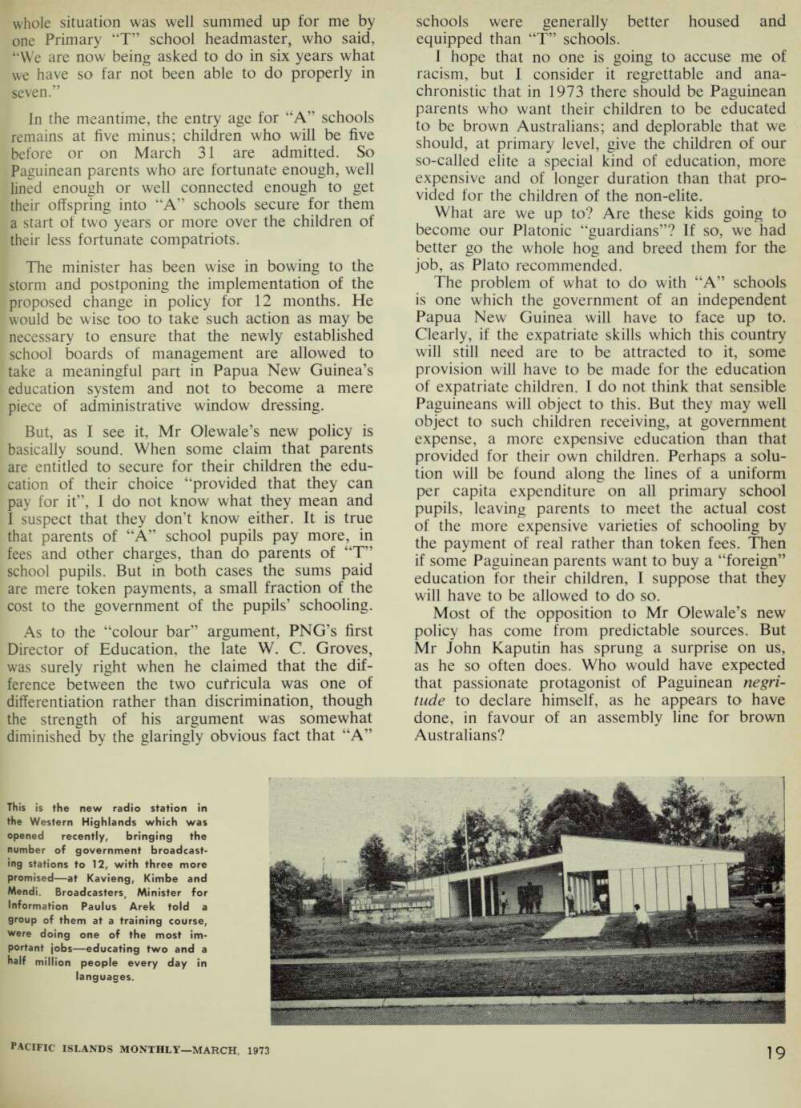
This is the new radio station in the Western Highlands which was opened recently, bringing the number of government broadcast ing stations to 12, with three more promised— at Kavieng, Kimbe and Mendi. Broadcasters, Minister for Information Paulus Arek told a group of them at a training course, were doing one of the most im portant jobs—educating two and a half million people every day in languages.