Tropicalities
pp. 16-19 · Read in the full issue
Norfolk
salvages some
Australiana
Another piece of Australian history, an anchor from Sirius, flagship of the First Fleet wrecked off Kingston on Norfolk Island on March 19, 1790, was hoisted on February 10 from its resting place on the seabed 20 feet below, carried by lighter to a spot only a few yards from the Kingston jetty and dropped to the bottom again —to await the arrival of a metal pre servative. After 183 years under water corrosion could be rapid and the Norfolk Islanders want the two-ton, 18 ft long anchor for their museum.
They might have a fight on their hands.
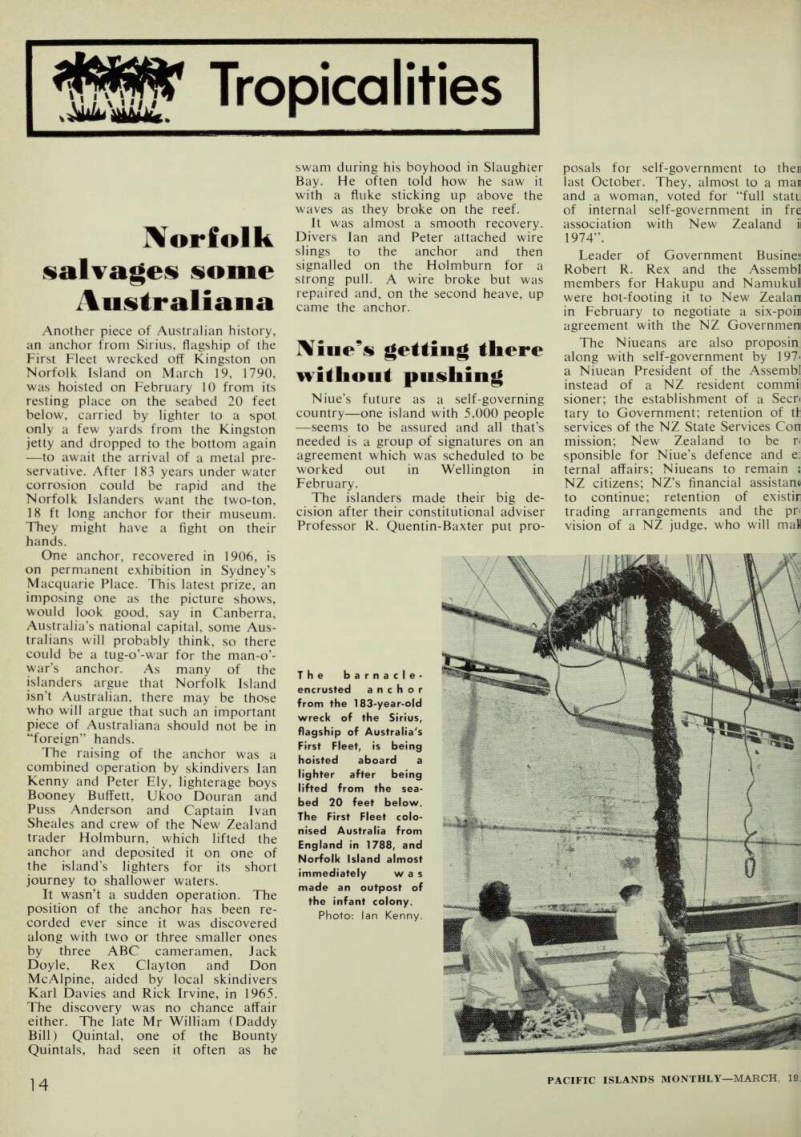
One anchor, recovered in 1906, is on permanent exhibition in Sydney’s Macquarie Place. This latest prize, an imposing one as the picture shows, would look good, say in Canberra, Australia’s national capital, some Aus tralians will probably think, so there could be a tug-o’-war for the man-o’war’s anchor. As many of the islanders argue that Norfolk Island isn’t Australian, there may be those who will argue that such an important piece of Australiana should not be in “foreign” hands.
The raising of the anchor was a combined operation by skindivers lan Kenny and Peter Ely, lighterage boys Booney Buffett, Ukoo Douran and Puss Anderson and Captain Ivan Sheales and crew of the New Zealand trader Holmburn, which lifted the anchor and deposited it on one of the island’s lighters for its short journey to shallower waters.
It wasn’t a sudden operation. The position of the anchor has been re corded ever since it was discovered along with two or three smaller ones by three ABC cameramen, Jack Doyle, Rex Clayton and Don McAlpine, aided by local skindivers Karl Davies and Rick Irvine, in 1965.
The discovery was no chance affair either. The late Mr William (Daddy Bill) Quintal, one of the Bounty Quintals, had seen it often as he
swam during his boyhood in Slaughter Bay. He often told how he saw it with a fluke sticking up above the waves as they broke on the reef.
It was almost a smooth recovery.
Divers lan and Peter attached wire slings to the anchor and then signalled on the Holmburn for a strong pull. A wire broke but was repaired and, on the second heave, up came the anchor.
Niue’s getting there
without pushing
Niue’s future as a self-governing country—one island with 5,000 people —seems to be assured and all that’s needed is a group of signatures on an agreement which was scheduled to be worked out in Wellington in February.
The islanders made their big de cision after their constitutional adviser Professor R. Quentin-Baxter put pro
posals for self-government to then last October. They, almost to a man and a woman, voted for “full statu of internal self-government in fre association with New Zealand ii 1974”.
Leader of Government Busines Robert R. Rex and the Assembl members for Hakupu and Namukull were hot-footing it to New Zealan in February to negotiate a six-poii agreement with the NZ Governmeni The Niueans are also proposin, along with self-government by 197* a Niuean President of the Assembl instead of a NZ resident commii sioner; the establishment of a Seen tary to Government; retention of tf services of the NZ State Services Con mission; New Zealand to be n sponsible for Niue’s defence and e; ternal affairs; Niueans to remain ; NZ citizens; NZ’s financial assistant to continue; retention of existin trading arrangements and the pn vision of a NZ judge, who will mall
The barnacle encrusted anchor from the 183-year-old wreck of the Sirius, flagship of Australia's First Fleet, is being hoisted aboard a lighter after being lifted from the sea bed 20 feet below.
The First Fleet colo nised Australia from England in 1788, and Norfolk Island almost immediately was made an outpost of the infant colony.
Photo: Ian Kenny.
periodic visits to the island. It is also proposed that New Zealand should continue to be represented in Niue.
Tolu Tala Niue, the governments weekly newsletter, told the people in a message, probably from Mr Rex’s pen, “We have had pressure from certain quarters to push us along just that little bit faster on the road to self-government, and always, the answer has been —thank you for your concern, but we’ll do it our way. Now we have done it our way. What lies in the future remains to be seen.”
So it looks as if the Niueans will get the best of both worlds —masters in their own house and full New Zealand citizenship. The latter is likely to continue as a headache for the stay-at-home people. Niue’s biggest problem is the brain and youth drain to New Zealand and how to stem it.
Captain Hugh nil!
sail the Cooks again
That old salt Captain Hugh Williams, who complained bitterly in PIM last May that he couldn’t get a licence to operate a ship in the Cook Islands—“nobody else can compete against the present monopoly”, he said—has finally done it. He’s got a licence to operate his I recent acquisition, the Moana, on a passenger-cargo service from Raro tonga.
And the Cook Islands Government, which gave him the licence, has in curred the wrath of shippers Silk and Boyd Ltd, who had the monopoly which stymied Captain Hugh’s plans last year. Mr Don Silk charges that the government has “dishonoured” an agreement made in 1970 giving his company the monopoly to operate three ships out of Rarotonga for 10 ■years.
The Shipping Ministry replies with an allegation that the company hasn’t kept its side of the bargain because it has been operating with only two ships. Silk and Boyd prophesy i financial disaster if Captain Hugh i runs his service but the government isn’t worried, Minister Mr William lEstall observing that it wasn’t likely that Captain Williams, who had evidently been successful in past ship ping operations in the Cooks, would risk entering that field again if it threatened financial disaster.
The captain’s not dismayed either.
He’s sure that his Moana, which he bought from Sofrana for 540,000, will keep her end up. He’s not par ticularly interested in profits, he says, and it’ll be much better than playing
bowls over in Australia. He plans a cargo-passenger service, a package deal for tourists and, for local deck passengers, mattresses, tea and biscuits —something they’ve never had before.
He’ll be back in the Cooks with his family and his dog Smacker about April’s end.
Tonga opens the
door a little
Tonga is becoming a little bolder in its approach to tourism. It still eyes Hawaii with pity over the damage tourism has done, and it shakes its head a little over the dangers to which Fiji is exposed but it feels it should have some of the cake—although not enough to cause cultural bellyache.
It decided in February to go after a little more of the cake with a “Come and see Tonga” campaign which was floated in Sydney by Peter Wallace, chief of the Tonga Visitors Bureau, with the help of Geoffrey Lee-Martin and wife Jan, of Hutchin son Public Relations. Which shows that the Kingdom is really planning expansion.
Top tourist agencies and writers were invited to a party in Sydney’s Carlton-Rex Hotel where Peter ex patiated over Tonga’s attractions with the help of a set of colour trans parencies. The result is likely to be an influx of tourists, but Peter won’t see the result of his drive. Around the time this appears Peter and his wife will be on their way home to the Irish Republic. Peter, who did a lengthy spell in the colonial service in Africa, has completed his contract.
Publicity will come Tonga’s way when its singers and dancers along with groups from Fiji, New Zealand, Western Samoa, Cook Islands, New Hebrides, BSIP and Papua New Guinea appear in performances at the Sydney Opera House to mark its opening on October 20 by the Queen.
The first of two performances by the teams who took part in last year’s Festival of Arts in Suva will be on October 23. After further appearances in Sydney, all organised by Victor Carell, who was executive director of the Festival of Arts, the groups — totalling 250—will perform in Can berra and Melbourne, and possibly at Flemington racecourse on Melbourne Cup Day.
Spades shovels
on the dirt
It was really shovelling the dirt thick on to a vanishing breed when a World Council of Churches con ference, known as SPADES (South Pacific Action for Development Strategy) met in Vila. Delegates from 15 nations and territories of the South Pacific, expressed their belief that “all people under colonial gov ernments in the South Pacific are oppressed and exploited”. Two dele gates from French Polynesia ab stained, or dissociated themselves from that “belief”.
In attendance was an African, Apollinarus Macha, Tanzanian con sultant to the conference, who made an observation, “Without indepen dence you cannot have development”.
It would be interesting to know if he told the conference he regarded the violence which has occurred in so many parts of Africa, as “De velopment with independence”.
Some of the observations of the delegates were startling, to say the least, so much so that the British Residency issued a statement criticis ing statements made by some dele gates, and making it clear it had no connection with organising the con ference.
The Sessions of Paton Memorial Church (Presbyterian) in Vila, pub licly disagreed with the statements of some delegates, in particular state ments which, it said, might provoke racial hatred in the New Hebrides.
The Residency statement said some remarks, especially by delegates from other Pacific territories, were racist and could cause bad feeling between
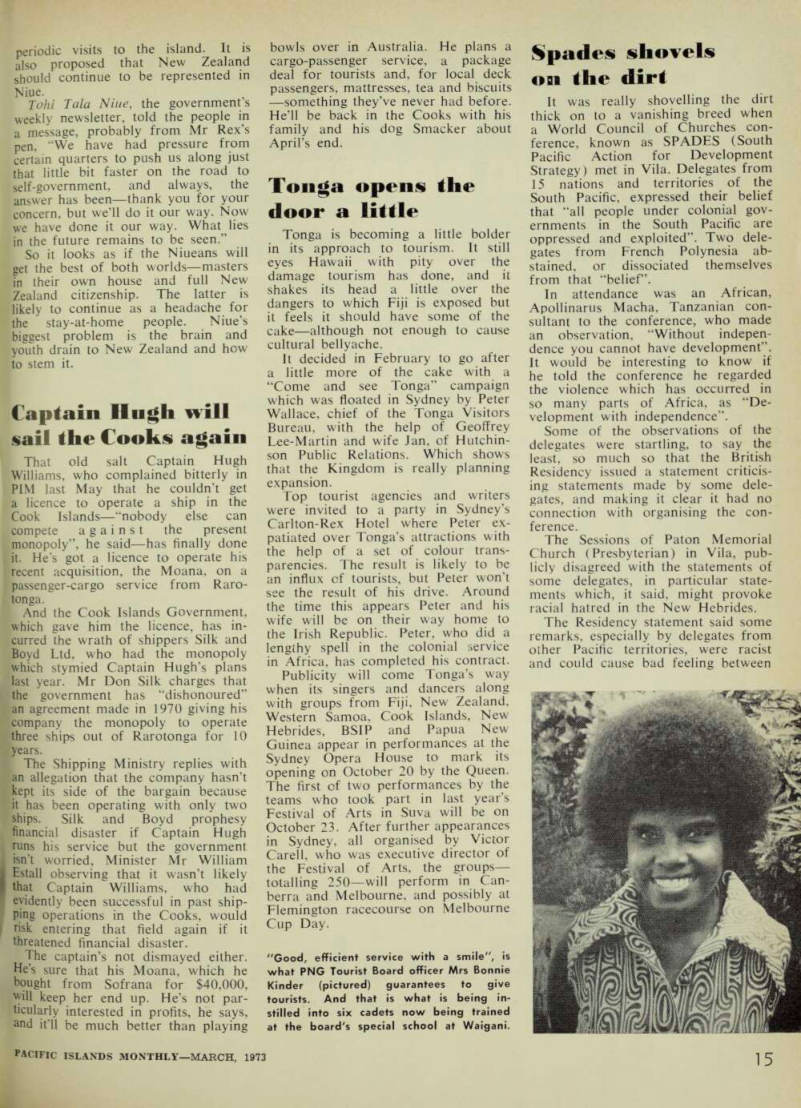
"Good, efficient service with a smile", is what PNG Tourist Board officer Mrs Bonnie Kinder (pictured) guarantees to give tourists. And that is what is being in stilled into six cadets now being trained at the board's special school at Waigani.
New Hebrideans and Europeans. The organisers were allowed to use British premises as the Residency understood the conference was to concern itself with church affairs in the Pacific. It regretted that a conference held on its premises “. . . should have been the occasion for extremist and racialist public statements”.
These were some of the delegates’ statements: Hafe Vilitana, Niue: Colonialism affects development of indigenous people because ideas are western ideas and not the way people think; it is not necessary to wait any longer for local people to handle their own affairs.
Pelak Sapul, Papua New Guinea: Colonialism creates an inferiority complex in the minds of people being colonised. In decision-making, people fear they are inferior, then they let imperialists make the decisions.
Rev Ropati Tiatia, Western Samoa (an independent country): I have an obligation to my brother; I’m not completely free when I know my brother is oppressed. Pacific Islanders must do away with colonialism to be full men.
Donald Jonah, US Trust Territory: People of Micronesia are pleading with the US to be in free association with them so that everything will be decided by our people, but the US is trying to keep authority over us to get our land.
Jane Raid, Cook Islands: . . . We are colonised, we are depending on New Zealand to help us financially.
Fr Walter Lini, New Hebrides: If colonialism continues it will create classes of people in the society. Some will be poor and some will be rich and the rich will always exploit the poor.
Wai Nine, New Caledonia: When people of our country want to act, they are unable to demonstrate be cause of colonial domination. This external domination is a real prob lem for countries that are developing.
Braving the
litter bugs
While the authorities in Noumea are becoming increasingly concerned with building up the island’s tourist industry to offset the current nickel recession, the local press has been trying to make its readers more litter conscious.
A recent newspaper editorial point ed out that Caledonians might be proud of their standard of living but visitors could well consider the locals poor types of citizens and compare their city to the markets in Ouaga dougou or some Arab quarters.
Last year the Noumea City Council installed the first fixed refuse bins, of most attractive design, in prominent places.
More recently the council again treated the litter problem and seriously considered a proposal to empower certain agents to impose on-the-spot fines on persons throwing refuse in the streets. This seemed to be a very efficient solution, until one thought ful soul calmly inquired who would be brave enough to march up to impose such a fine upon a rebellious citizen when he might be surrounded by a group of 20 persons?
Pay Islanders
to stay at home
Dollars flowing out would do more to help Pacific Islanders than migrants from the Pacific flowing into New Zealand, according to a report on population and migration published by the NZ National Development Council.
The report says that, properly ad ministered, “direct financial assistance can aid a far larger number of people in their homelands per million dollars spent than the same outlay on capital and other costs of absorbing a migra tion inflow of people without ade quate education or skills.”
The report, noting that in general the Pacific Islander looking for the chance to migrate to New Zealand is young, emphasises that this is the type of person island societies need to maintain their fabric.
The NDC paper argues that a cut in the number of Pacific migrants to New Zealand would help reduce social problems in the Islands and in New Zealand. While acknowledging that because some Polynesians— Tokelaus, Niue and Cook Islanders — have New Zealand citizenship they cannot be prevented from entering New Zealand, the report stresses that many Islanders suffer problems of ad justment if they migrate.
Special assistance is often required in housing and education if they are not to fall behind the New Zealand average.
About 1,500 Western Samoans emi grate to New Zealand each year, des pite the fact that New Zealand has no special responsibility for this country. But the report says that this is no way in which to solve Samoa’s economic and population problems.
It recommends that part of the answer lies in allowing Western Samoa greater access to trade, even if it means opening New Zealand to products already produced domes tically.
For those Islanders already in New
Zealand the report suggests that greatly increased financial assistance should be poured in to help them.
It would be “very expensive”, it admits, but “increased assistance to Islanders within New Zealand would seem to be necessary if the social problems of having an underprivileged minority in our midst are to be avoided.”
But, in the years to come, the re port’s emphasis is on helping Islan ders to stay where they are.
Rare birds
became rarer
Hopes that the Baiyer River Sanctuary in Papua New Guinea’s Western Highlands might one day become a “plume factory” suffered a setback when nine rare birds disap peared in a matter of days. Miss ing were four eclectus parrots— the male is bright green, the female bright red —and five Pesquet’s parrots which have spectacular red and black plumage, much coveted for tribal head-dresses. An official of the Wild life Section of the Department of Agriculture said that the theft had interrupted studies aimed at breeding the birds in captivity. If this had been achieved, he said, it could have meant the production of plumes and a resultant cutback in the slaughter of wild birds for their plumage.
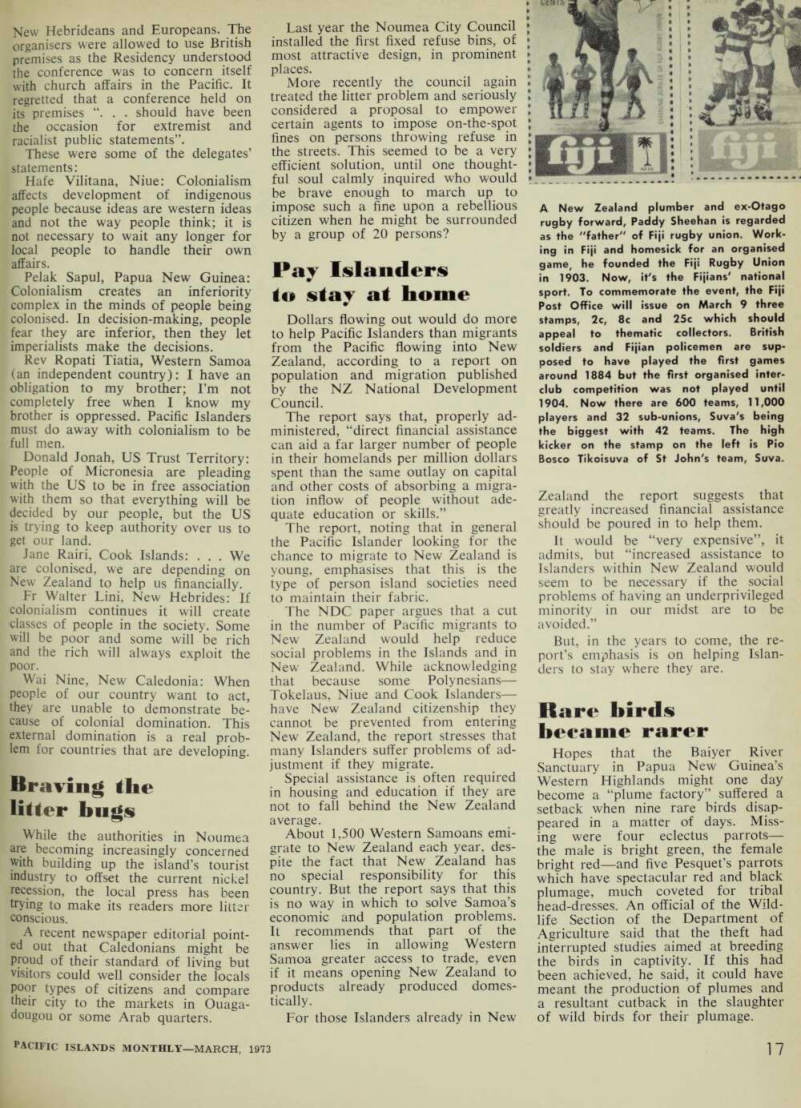
A New Zealand plumber and ex-Otago rugby forward, Paddy Sheehan is regarded as the "father" of Fiji rugby union. Work ing in Fiji and homesick for an organised game, he founded the Fiji Rugby Union in 1903. Now, it's the Fijians' national sport. To commemorate the event, the Fiji Post Office will issue on March 9 three stamps, 2c, 8c and 25c which should appeal to thematic collectors. British soldiers and Fijian policemen are sup posed to have played the first games around 1884 but the first organised inter club competition was not played until 1904. Now there are 600 teams, 11,000 players and 32 sub-unions, Suva's being the biggest with 42 teams. The high kicker on the stamp on the left is Pio Bosco Tikoisuva of St John's team, Suva.