People
p. 15 · Read in the full issue
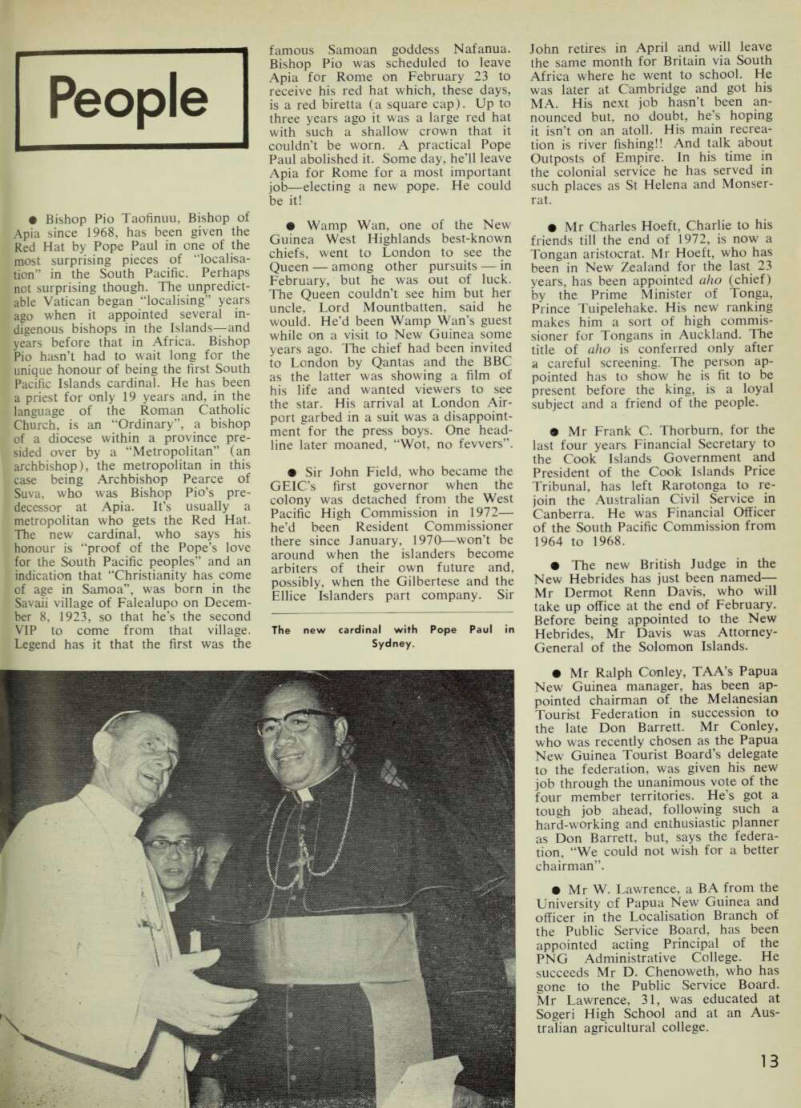
• Bishop Pio Taofinuu, Bishop of Apia since 1968, has been given the Red Hat by Pope Paul in one of the most surprising pieces of “localisa tion” in the South Pacific. Perhaps not surprising though. The unpredict able Vatican began “localising” years ago when it appointed several in digenous bishops in the Islands—and years before that in Africa. Bishop Pio hasn’t had to wait long for the unique honour of being the first South Pacific Islands cardinal. He has been a priest for only 19 years and, in the language of the Roman Catholic Church, is an “Ordinary”, a bishop of a diocese within a province pre sided over by a “Metropolitan” (an archbishop), the metropolitan in this case being Archbishop Pearce of Suva, who was Bishop Pio’s pre decessor at Apia. It’s usually a metropolitan who gets the Red Hat.
The new cardinal, who says his honour is “proof of the Pope’s love for the South Pacific peoples” and an indication that “Christianity has come of age in Samoa”, was born in the Savaii village of Falealupo on Decem ber 8, 1923, so that he’s the second VIP to come from that village.
Legend has it that the first was the
famous Samoan goddess Nafanua.
Bishop Pio was scheduled to leave Apia for Rome on February 23 to receive his red hat which, these days, is a red biretta (a square cap). Up to three years ago it was a large red hat with such a shallow crown that it couldn’t be worn. A practical Pope Paul abolished it. Some day, he’ll leave Apia for Rome for a most important job—electing a new pope. He could be it! e Wamp Wan, one of the New Guinea West Highlands best-known chiefs, went to London to see the Queen among other pursuits in February, but he was out of luck.
The Queen couldn’t see him but her uncle, Lord Mountbatten, said he would. He’d been Wamp Wan’s guest while on a visit to New Guinea some years ago. The chief had been invited to London by Qantas and the BBC as the latter was showing a film of his life and wanted viewers to see the star. His arrival at London Air port garbed in a suit was a disappoint ment for the press boys. One head line later moaned, “Wot, no fevvers”. • Sir John Field, who became the GEIC’s first governor when the colony was detached from the West Pacific High Commission in 1972 he’d been Resident Commissioner there since January, 1970—won’t be around when the islanders become arbiters of their own future and, possibly, when the Gilbertese and the Ellice Islanders part company. Sir
John retires in April and will leave the same month for Britain via South Africa where he went to school. He was later at Cambridge and got his MA. His next job hasn’t been an nounced but, no doubt, he’s hoping it isn’t on an atoll. His main recrea tion is river fishing!! And talk about Outposts of Empire. In his time in the colonial service he has served in such places as St Helena and Monser rat. • Mr Charles Hoeft, Charlie to his friends till the end of 1972, is now a Tongan aristocrat. Mr Hoeft, who has been in New Zealand for the last 23 years, has been appointed aho (chief) by the Prime Minister of Tonga, Prince Tuipelehake. His new ranking makes him a sort of high commis sioner for Tongans in Auckland. The title of aho is conferred only after a careful screening. The person ap pointed has to show he is fit to be present before the king, is a loyal subject and a friend of the people. 9 Mr Frank C. Thorbum, for the last four years Financial Secretary to the Cook Islands Government and President of the Cook Islands Price Tribunal, has left Rarotonga to re join the Australian Civil Service in Canberra. He was Financial Officer of the South Pacific Commission from 1964 to 1968. • The new British Judge in the New Hebrides has just been named— Mr Dermot Renn Davis, who will take up office at the end of February.
Before being appointed to the New Hebrides, Mr Davis was Attorney- General of the Solomon Islands. • Mr Ralph Conley, TAA’s Papua New Guinea manager, has been ap pointed chairman of the Melanesian Tourist Federation in succession to the late Don Barrett. Mr Conley, who was recently chosen as the Papua New Guinea Tourist Board’s delegate to the federation, was given his new job through the unanimous vote of the four member territories. He’s got a tough job ahead, following such a hard-working and enthusiastic planner as Don Barrett, but, says the federa tion, “We could not wish for a better chairman”. • Mr W. Lawrence, a BA from the University of Papua New Guinea and officer in the Localisation Branch of the Public Service Board, has been appointed acting Principal of the PNG Administrative College. He succeeds Mr D. Chenoweth, who has gone to the Public Service Board.
Mr Lawrence, 31, was educated at Sogeri High School and at an Aus tralian agricultural college.
The new cardinal with Pope Paul in Sydney.