You Learn
p. 23 · Read in the full issue
No More
Pay As
From SEONA MARTIN in Suva Youngsters going to Fiji schools for the first time in their short lives at the start of the 1973 schoolyear clutched no money in their hot little hands as their elders had done in their time. Their parents weren’t billed for fees either. It was a mile stone in the dominion’s educational history—free schooling, or as free as schooling can be. Somebody has to pay!
Responding to calls—made in vain in colonial days—for “free” school ing, the Fiji Government has abolished fees for all Class 1 primary pupils in a long-term, easy stages “free” education plan. Next year Class 2 will be fee free and by 1978 all six primary grades will be free.
In place of fees, the government will pay a $lO grant for each pupil in a free class.
Fees are possibly the smallest cost a Fiji parent has to contend with.
The Fiji Education Department esti mates that the average primary school fee is $8.50 a year.
Most Fiji schools are run by com munity committees, religious organ isations, or, in the Fijians’ case, by Fijian Provincial Councils, so there is a wide discrepancy in charges, from nothing to about $lB a year. These fees do not take into account contri butions required for school equip ment and building funds, which amount to an average of $7.50 a year. Secondary school costs are at least three times as high. Textbooks, like anywhere else, are expensive and many children cannot buy them.
Next year the government plans to spend $70,000 on its free textbook scheme to try to overcome the prob
lem. This works out at about 50cworth of books per child.
Uniforms are another requirement at most schools. They can cost up to about $9 for a single outfit. Then there are bus fares. A conservative estimate is 8c per child per day. Some who can walk pay no transport costs, others pay up to 30c a day. If the government provided free transport for all its students it is estimated it would cost $lO,OOO a day.
Money for education is a constant problem for the rural family man who leads a predominantly subsistence life and has little cash income.
Even for a wage-earner, education costs are a strain on the family budget.
Although government already subsidises many free and partly-free places in schools and some committees award free places to needy children, there are always some students each term who suffer the humiliation of being sent home from class because their fees have not been paid.
Then there are those who struggle for years without books, uniforms or essential equipment.
Government already pours more money into education than anything else. Last year it spent more than S 9 million, this year an even larger slice of the budget amounting to more than $lO million was allocated.
About $1 million went to the highly expensive—for Fiji anyway—University of the South Pacific which is supported by governments in the region.
The cost of providing free places in primary schools is expected to be another $4 million.
What the pupil gets for all this money varies. Most communities are
eager and able to build schools. The number of junior secondary build ings alone is far outstripping the total recommended in the most recent edu cation commission report which stressed quality rather than quantity.
Education authorities find it difficult to stick sternly to the “quality” rule and prevent parents providing edu cational institutions for their child ren. The problems come when the buildings have to be equipped and staffed.
Almost a quarter of all primary teachers are unqualified and the per centage is growing, in spite of in tensive efforts in teacher training.
There are more of these “licensed teachers” in secondary schools. More and more students are taking the major public examinations but an ever larger proportion are failing to make satisfactory grades. Repeatedly the Education Department is faced with the quality v quantity spectre throughout the school system.
About 92 per cent of Fiji’s children are already in primary classes and of the 12,500 or so who are not, some have not yet begun their formal edu cation and others are drop-outs. Most have or will have some schooling.
The percentage going on to secon dary schools has more than doubled in the past six years, to more than 18,000. By 1978, a school attendance of 97i per cent or more is expected.
This is possibly the reason the Minister for Education, Mr Jone Naisara, told parliament there was no need to make education compul sory as well as fee free. He said the thirst for education was so wide spread he did not feel Fiji would have to resort to compulsion.
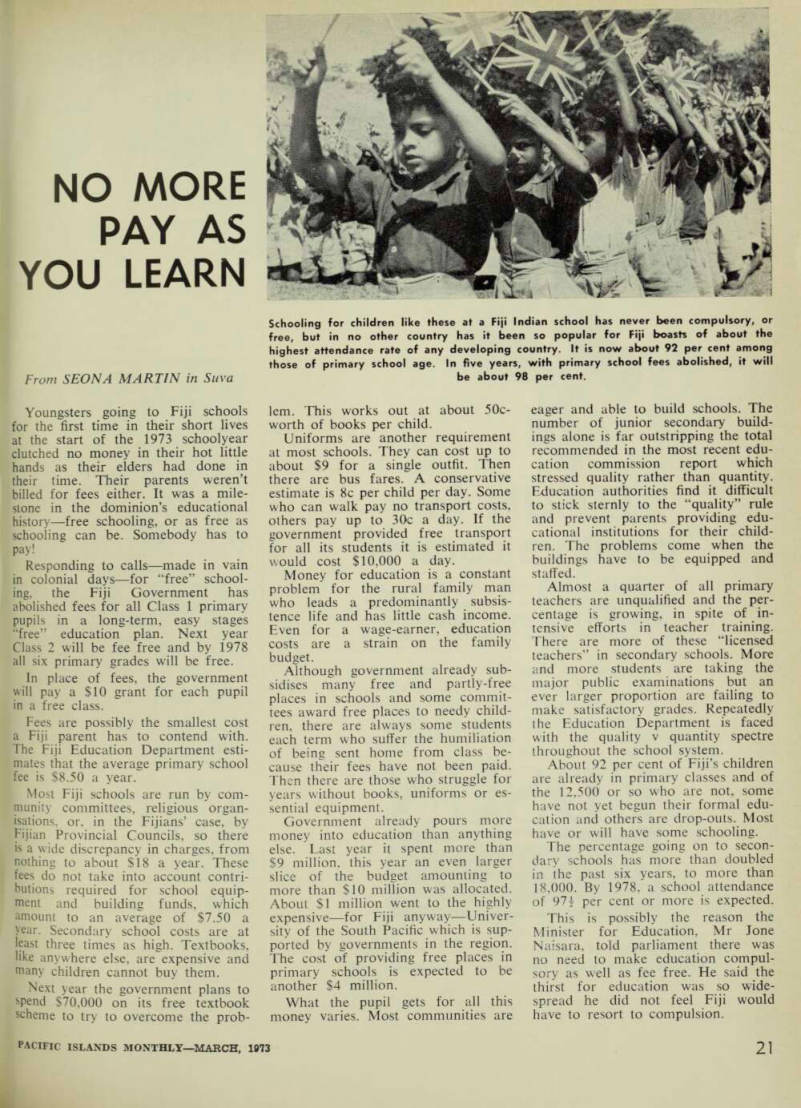
Schooling for children like these at a Fiji Indian school has never been compulsory, or free, but in no other country has it been so popular for Fiji boasts of about the highest attendance rate of any developing country. It is now about 92 per cent among those of primary school age. In five years, with primary school fees abolished, it will be about 98 per cent.