Soft music for Caledonians
p. 10 · Read in the full issue
From a Noumea correspondent
Administrative and political per sonalities in New Caledonia have been making frequent island tours on the eve of the French national elec tions, while island voters have also been wooed by masses of electoral propaganda from Paris television broadcasts.
Well before polling days, fixed for March 4 and 11, it appeared that the running favourite as new Deputy to represent the island in Paris was the Gaullist Administration’s chief sup porter—Jean Leques, representing the anti-autonomist camp.
The autonomists had lost all prob able chances once two separate candi dates had been nominated from their ranks—outgoing deputy Roch Pidjot (Union Caledonienne party) and Yann Celene Uregei (Union Multi raciale). Both men being Melanesians, their candidacy was bound to split the loyalty of fellow-Melanesians, who make up almost 50 per cent of the island’s population. Jean Leques, on the other hand, succeeding in winning the combined support of his own Mouvement Liberal Caledonien party, besides George Chatenay’s Union Democratique and the Entente Demo cratique et Sociale led by Lafleur and Laroque.
The arguments put forward for both sides of the autonomy issue differed little from past debates. For the pro-Paris Administration, anti autonomist side, the campaign was designed to emphasise the need for continued close collaboration with Paris to ensure economic security for the island (a convincing appeal in times of uncertainty, caused by the present nickel recession). On the other hand, the Union Caledonienne denounced increasing local reliance on loan funds from Paris. They claimed
that a build-up of debts to Paris could only result in putting the islanders in a “hand-outstretched” attitude, where they would be more than ever de pendent on Paris decisions and subject to greater Paris controls.
On the position of the third candi date, Yann Celene, some opponents have challenged his sincerity over de mands for autonomy and charged him with actually being a staunch sup porter of the present Paris Adminis tration.
Since the deputy for New Caledonia also represents French voters in the New Hebrides, Jean Leques flew to Port Vila and contacted neighbouring cousins to register his support for French interests there.
Governor Louis Verger and his collaborators in the French Adminis tration have meanwhile been busy touring island communes (muni cipalities) highlighting new town hall or bridge openings. The governor has emphasised the increased benefits since the municipalities have obtained their own developments fund, with mayors working more through the governor’s local representative (sub division chief or district officer) rather than being dependent on the Territorial Assembly for funds, as in the past.
This by-passing of elected members J is, of course, reinforcing the power of the public servant decision-makers in the French Administration. A very skilful handling of the local press, radio and television is building up the prestige image of the generous hand-outs through the various branches of the French Public Ser vice, even if the funds involved are from local sources and voted by the Territorial A>»semblv, This form of benevolent paternal
ism, of responsibility being assure by an elite group, seems to be comfortable arrangement for 1 Caledonians, even if they might tempted to make harsh criticis occasionally. Of course, no one wot hint that censorship is applied in pi moting the French officials. It simply that any writer reporting false note is likely to incur the wr; of the conductor and not be indue in future performances of the Offic Orchestra.
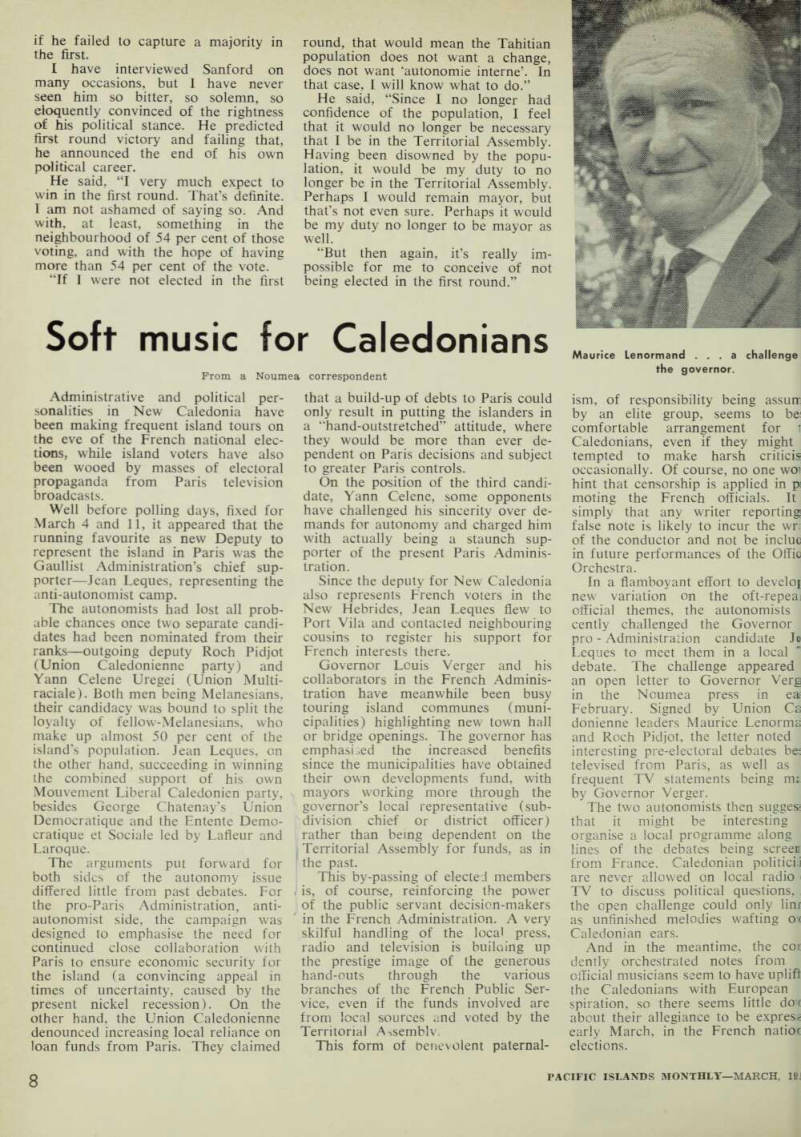
In a flamboyant effort to develoi new variation on the oft-repeai official themes, the autonomists cently challenged the Governor pro - Administration candidate Je Leques to meet them in a local debate. The challenge appeared an open letter to Governor Verg in the Noumea press in eat February. Signed by Union Ca donienne leaders Maurice Lenorma and Roch Pidjot, the letter noted interesting pre-electoral debates televised from Paris, as well as frequent TV statements being ms by Governor Verger.
The two autonomists then suggest that it might be interesting organise a local programme along lines of the debates being screen from France. Caledonian politiciJ are never allowed on local radio ij TV to discuss political questions, the open challenge could only lim as unfinished melodies wafting o:< Caledonian ears.
And in the meantime, the cor dently orchestrated notes from official musicians seem to have uplift the Caledonians with European spiration, so there seems little do’( about their allegiance to be express early March, in the French natioc elections.
Maurice Lenormand ... a challenge the governor.