independence
pp. 11-130 · Read in the full issue
Selling independence to the New Guineans
From a Port Moresby correspondent.
AT no time in the past has Papua New Guinea been host to SO many political Visiting Firemen as in the new Australian Government’s first two months in office.
Minister for External Territories Morrison, Defence Minister and Deputy Prime Minister Barnard and finally Prime Minister Whitlam, have all been here with their entourages.
The purpose of all visits was to persuade Papua New Guinea not only to become independent as soon as possible but that the country would thoroughly enjoy the sensation when it happened.
After his arrival in Port Moresby for a two-day visit on February 18, Mr Whitlam said that independence for PNG would come within the “lifetime of the present Australian parliament—by the end of 1975.”
This looks like one more year of grace from the 1974 deadline set by External Territory Minister Morrison, although most observers believe that the 1974 date is still a matter of mutual agreement between Chief Minister Somare of PNG and Prime Minister Whitlam.
Mr Whitlam made it clear in Port Moresby that the wishes of the Papua New Guinea people made up only one side of the plan.
“I cannot stress too often,” he said, “that the decision for independence is not only a decision about Papua New Guinea, it is about Australia and Australia’s role in the world. Australia is no longer willing
to be the ruler of a colony.”
The sugar to help that piece of medicine go down was an assurance by the Prime Minister of continuing Australian financial aid over the three-year period beginning with 1974-75, Mr Whitlam’s visit was obviously made with the purpose of allaying local fears. From Port Moresby he took the good word to Goroka, in the New Guinea Highlands, where a great deal of the anti-independence fear is generated, Australia would always remain a good neighbour to an independent Papua New Guinea, Mr Whitlam told a gathering of village leaders and elders. But some still had their doubts. Mr Sinake Gire Gire, a local member in the House of Assembly, presented the Prime Minister whh a petition signed by 2,000 Highlands leaders opposing early independence.
Earlier in February, on the other side of the country, Mr Matthias Toliman, leader of the opposition United Party in the House, a.tacked the PNG Government for appearing ready to accept independence “arbit rarily and unilaterally imposed”, In the end, this current elastic sided date for independence may
cause Mr Somare’s government more embarrassment than a clear-cut date somewhere at the end of 1974 — which really isn’t far removed from 1975. Already he has done some fancy stepping to try to be on both sides of the fence at once, and will be doing some more before the current session of the PNG Assembly ends.
At the time of Mr Whitlam’s visit he said, in a speech of welcome, that anyone who faced the facts would know that independence would quickly follow self-government.
“However, my government feels we should not set a date for in dependence until we have achieved self-government and have had time to adjust to it.”
All the pros and cons, doubts about and fears of independence are, at present, doing everything but weld the country into an integrated nation, although Australia has made it clear that it is determined to deliver it, in one whole piece, at independence.
Would-be secessionists are to be warned that they may expect none of the Australian largesse that is to be poured into PNG coffers.
Several important matters must be resolved before Papua New Guinea becomes independent. One is the Torres Strait - Queensland border; another is defence; and the third, in ternal security. Under the terms of the Trusteeship Agreement with the UN so far as the New Guinea half of Papua New Guinea is concerned,
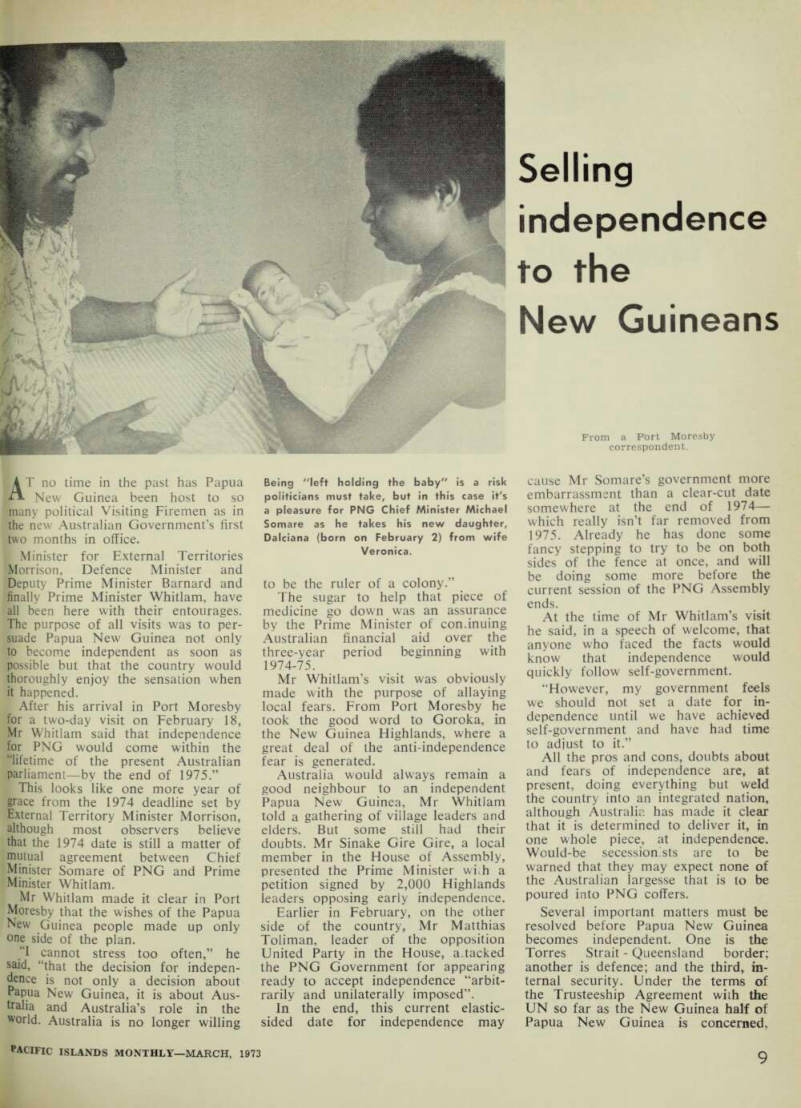
Being "left holding the baby" is a risk politicians must take, but in this case it's a pleasure for PNG Chief Minister Michael Somare as he takes his new daughter, Dalciana (born on February 2) from wife Veronica.
Australia is responsible for both de fence and internal security until independence.
Papua New Guinea appears in no hurry to assume responsibility for defence until it has to, but it has been reported that Mr Somare has now asked Australia to hand over control of the police force as soon as possible.
The Australian Government has made no commitment on this.
It could be that the request arises
out of nothing more than the recent suggestions and counter suggestions about reorganisation of PNG’s police force. Mr Somare is said to be an noyed by reports that Mr Morrison wants to establish a para-military division of the police which would be able to handle serious internal dis orders as well as performing border surveillance, without involving the Army, which at present is under Aus tralian control.
On February 19 Mr Somare den that it had been agreed to set such a force. He said that two sti groups are considering the defe: force and the relationship betw. this and the police force. The sti groups had not finished their work Australian Defence Minister B nard put in five days in PNG in 1 January. The burden of his song to urge Papua New Guinea to “ velop guidelines for the developm of its defence forces.”
On the matter of cost alone it see pretty obvious that, at independer Papua New Guinea will be in position to do much about a defei force, in the modern sense.
It has been suggested that A tralia will weigh in with about 1 million p.a. to keep the forces at th present level in return for use of “Manus base”, which Mr Barn: says is part of the Labor Gove ment’s defence plan. The Manus b was an important American b during the Pacific War but the v installations were then allowed crumble away by the post-war A tralian Labor Government and Liberal Governments that followed It is now little more than a gloril refuelling depot and not worth 3 million per year.
The horse-trading probably me; that the present government this $2O million a modest price to pay keep PNG within the Australian fence orbit. If, at independence, Paj New Guinea decided to do nothi about defence it could create dangerous vacuum and an Australl embarrassment.
The Australians weren’t the oi politicians on tour in February.
February 4, Mr Somare left on two-weeks tour that took him Japan, Indonesia, Malaysia and Sin pore and got him back to F Moresby two hours before the arri of Prime Minister Whitlam.
His tour was designed to “ere an image abroad for Papua N Guinea” and, according to Somare, there was no question of seeking foreign aid while he T doing it.
However, sources close to the g ernment said that he sounded out possibility of raising funds for PNI 1972-73 loan programme which ! failed by a long way to bring in $27 million sought at home and!
Australia.
Mr Somare’s finance minister, Julius Chan did not go with him. left for Geneva to try to raise money to meet the target set in year’s budget.
In Kuala Lumpur on February
Continued on p
Mr So mare said his country, when independent, cduM be a good bridge between ihe Association of South East Asid N<_iions (ASEAN) and the Pacific Speal !ng to reporters after a three-day -Tit to Malaysia he said: “We don i km w whether to go Pacific or Asian. V/c can be a good bridge between ASLaN and the Pacific, Australia and New Zealand.”
Meanwhile, politics being in the air with a vengeance, the Speaker of Papua New Guinea’s House of Assembly, Mr Barry Holloway, has
called for the abolition of the party system of government.
He will send his views on the need for “a one-party, all-party or no-party government” to the con stitutional planning committee which will decide how Papua New Guinea should be run after self-government in December this year.
The Deputy Chairman of the com mittee, Father John Momis, said the committee had planned to consider a one-party or no-party State but had not done so yet.
Mr Holloway believes that recent events have made it clear that what divides the people of Papua New Guinea is not parties or policies but regional differences and inter-tribal tensions.
He said that on the major problems all the parties were united.
He said the problems that members see are not altered by party allegiance,, nor are they affected by minor changes in the emphasis of policies.
“Our problems are objective, our aspirations are very similar, and yet we are divided so that a disagreement between the members from one area and their leaders could split the gov ernment or the Opposition apart. In these circumstances, party politics seem to me to be expensive, unneces sary, troublesome and an alien luxury—if not an obstruction to de velopment and an expression of our peoples’ true aspirations.”
He said party politics had helped goad the Australian administration into altering the status quo but now Papua New Guinea should return to* Papua New Guinea ways—planning the future through “discussion to con census and united action.”