Pacific Islands Monthly
pp. 9-10 · Read in the full issue
It's All Or Nothing For Sanford
In French Polynesia's Elections
From James Boyack, in Papeete
It’s double or nothing for Francis Sanford in the National Assembly election which will take place throughout the 120-island French Polynesian group on March 4. The autonomist leader is seeking re election to the Paris legislative body in what will probably prove to be one of the most important elections in local history.
Hanging in precarious balance is not only his entire political career, but the future of, 1 dare say the very existence of, the 30-year move ment which has aimed to give Poly nesia greater management of its own political affairs. On the firing line is the concept of “autonomic interne” in the person of Deputy Sanford, who until now has been the most powerful champion of self-government for French Polynesia.
A Sanford victory will confirm authenticity of a substantial desire here for the loosening of political ties with Metropolitan France.
A victory for either of the pro- Paris candidates will force Sanford into retirement, despite his Te E’A
Api Party and strike a death blow at the autonomist coalition which once lorded over local politics.
Three candidates are seeking this most important political post avail able locally.
Riding the top of the wave is the President of the newly-elected Terri torial Assembly, Gaullist luminary Gaston Flosse. He is the man who engineered the pro-Paris sweep of the
local legislative body last September.
He is tne political man of the hour and if he grabs off Sanford’s seat in the National Assembly, he will be in the driver’s seat of a fully consoli dated French presence and status quo in Polynesia. His victory would be the culmination of a year-long swing to the right, and utter renunciation by the electorate of its option for self government short of independence (PIM, Feb, p 12).
Youthful Charles Taufa, head of the largest labour union confederation here, is the centrist candidate in this hotly contested election. He is doing a balancing act. His agility on the high wire of political artistry could land him in the National Assembly by default. He is conducting a cam paign which appeals to the moderate elements of both the left, repre sented by Sanford, and the swelling right of the Tahiti Union UDR. On the one hand Taufa is pushing “National Union” —close if not remote-controlled links to Paris—at the same time he is calling for a renovation (although not transforma tion) of the political statute. He blasts the Sanfordian concept of im mediate substitution of one political structure for another, at the same time he lures autonomist voters with the mirage of “oceanising” the power structure. His “Te Autahoeraa” Inde pendent group is an up-and-coming political movement. Under legislative contract it shares the majority role with the stronger UDR in the Terri torial Assembly.
Public opinion polls in France
indicate that the historic Socialist- Communist coalition may be able to unseat the Gaullist assembly majority.
While Polynesian issues will un doubtedly govern the local vote, there is no doubt that Sanford is conducting a strangely unPolynesian campaign to the extent he is hammering away on two fronts. He sought and received sponsorship of the French “Reform Movement” led by leftist news maga zine publisher Jean Jacques Servan- Schreiber. The pictures of the two “reformateur” leaders figure more prominently on Sanford campaign posters than his own.
In France both the left-leaning but centrist “reformateurs” and the leftist coalition in principle oppose ex penditures for the “force de frappe” nuclear tests in Polynesia. While their conceivable victory would not mean an immediate halt to Pacific nuclear tests, the future of the test programme would be left in doubt. Their attitude towards French overseas departments and territories is equally ambivalent.
They tend to favour fewer colonial ties than the present Gaullist majority.
Whatever happens in France, how ever, does not minimise the impor tance of this election at a purely Polynesian level. Local issues will predominate here, and one local issue, “autonomie interne”, once again will be the reason why people will vote for or against Sanford.
This is the way Sanford wants it.
He was elected in 1967, and after the National Assembly was dissolved in 1968, he was re-elected based on his one campaign promise that he will bring self-government to French Polynesia. Recent political trends to the right have forced Sanford up against the wall. Cornered, he is fighting like a wildcat for his political life. 1 had an exclusive interview with the deputy-mayor in his Faaa com munity City Hall office two weeks before the election. He told me that he would not run in the second round
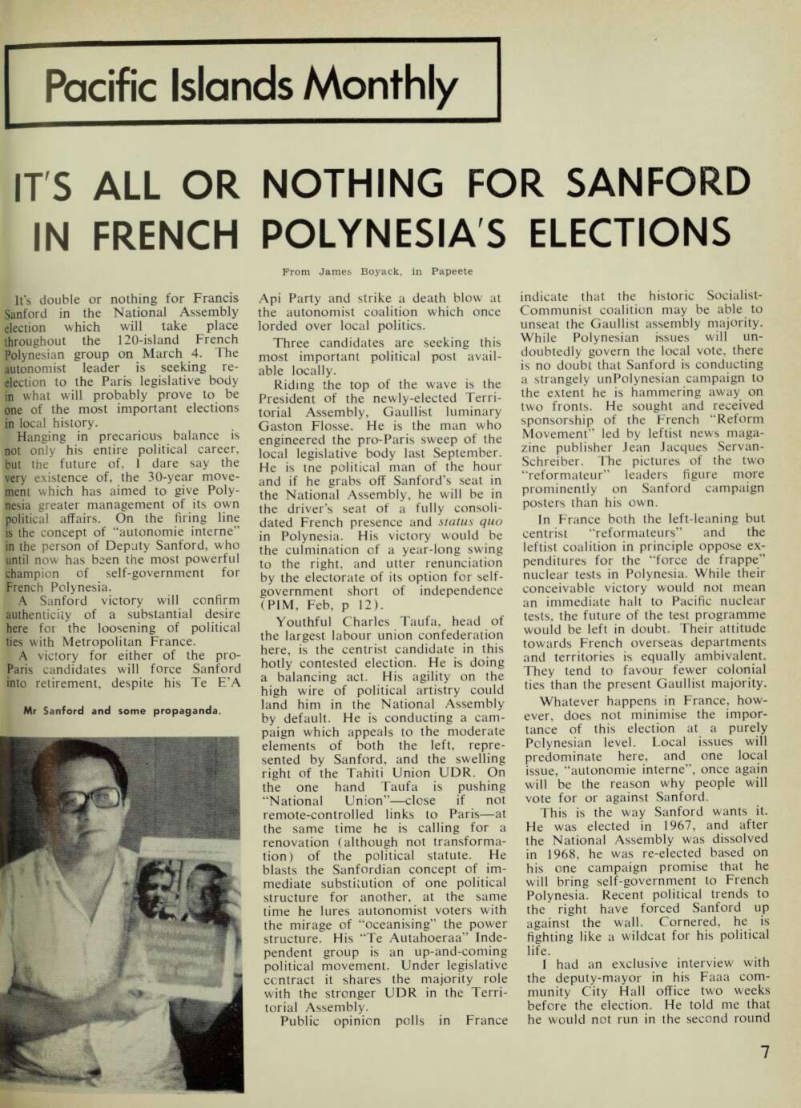
Mr Sanford and some propaganda.
if he failed to capture a majority in the first.
I have interviewed Sanford on many occasions, but I have never seen him so bitter, so solemn, so eloquently convinced of the rightness of his political stance. He predicted first round victory and failing that, he announced the end of his own political career.
He said, “I very much expect to win in the first round. That’s definite.
I am not ashamed of saying so. And with, at least, something in the neighbourhood of 54 per cent of those voting, and with the hope of having more than 54 per cent of the vote.
“If I were not elected in the first
round, that would mean the Tahitian population does not want a change, does not want ‘autonomic interne’. In that case, I will know what to do.”
He said, “Since I no longer had confidence of the population, I feel that it would no longer be necessary that I be in the Territorial Assembly.
Having been disowned by the popu lation, it would be my duty to no longer be in the Territorial Assembly.
Perhaps I would remain mayor, but that’s not even sure. Perhaps it would be my duty no longer to be mayor as well.
“But then again, it’s really im possible for me to conceive of not being elected in the first round.”