Yesterday
p. 85 · Read in the full issue
The first live rhinoceros beetle in Fiji was found in February, 1953, under a hatch tarpaulin in the ship Thorsisle.
It was recognised as the dreaded enemy of the copra industry throughout the South Pacific, and taken to the Agriculture Department by Tomasi Guvu, who was praised by Government officials, press and public. The Thorsisle had come to Suva from Apia, where she had been loading cocoa beans. After a few weeks, another live beetle was found by a Fijian in his house at Suvavou village, near Suva, and it led to a thorough ran sacking of the area at the head of Suva Harbour by an Agriculture Department team. Today rhinoceros beetles can be found nearly everywhere in Fiji.
Twenty years ago when haircuts in Rarotonga cost anything from half a crown to a dollar and a half—depending on the length—an item from the Rarotonga (Cook Is) official news made pleasant reading: "An interesting ceremony was held in the Avatiu Pack ing Shed when a boy, Tearii Fuller Henry, aged 7, adopted son of Tearii Toru, had his hair cut for the first time. The boy's hair, which reached his shoulders, was neatly tied with ribbon in 36 locks. The ceremony commenced when each of the boy's 36 relations cut off one lock of hair, at the same time presenting the boy with a monetary gift.
The remainder of the 150 invited guests presented their gifts and after a barber had trimmed the boy's hair, all sat down to a big umukai."
Tahitians will never forget the storm that struck at Christmas, 1952. Our correspondent said that there was a hurricane scare in Papeete three days before Christmas. The MM liner Caledonian, homeward bound on her maiden voyage, was in port and due to sail seven days after, but did not get away until the weather moderated on January 2. No damage was done in the Port, but rivers were heavily flooded.
Heavy logs, sweeping down the rivers r °m the mountains, fouled the harbour and made it unsafe for the TEAL (Air New Zealand) aircraft to land on her scheduled flight. The verandah roof of what had been the famous Tahiti Yacht Club (before it became the Yacht Club Restaurant) was torn off the building unng a gale towards the end of January.
Fiji's bunch of bananas of record size which was shipped to New Zealand in January that year, in a special container had gained fame for the Colony far and wide. News of it spilled into Australian radio and newspapers. One Melbourne daily said that since recover ing from the 1952 hurricane, Fiji banana plantations were producing bunches of bananas of such size that they could not be shipped. In fact there was one OS bunch of bananas—it was of 10 hands, was three feet high, two feet across, weighed 145 pounds and each of the bananas was 11 to 12 inches in length.
When General Sir Gerald Templer, High Commissioner for Malaya, returned to Singapore after a tour of Johore State in January, 1953, he was asked whether he required any more troops to defeat the bandits. The General declared that he had enough men but indicated that he would be happy to exchange some of his present team for another battalion of Fijians.
A gentleman arrived in Auckland from Papeete 20 years ago, telling of an episode involving one of the well-known Tahiti schooners of that time, Tagua, which was layed off the Tatakoto reef, Tuamotu, when a serious fire broke out on board. The crew abandoned ship
but Captain Voirin and his chief engineer remained aboard and success fully fought the fire—the captain being seriously burned. He was later awarded the Merite Maritime—similar to the Lloyds Medal—by the Governor of French Oceania. In the panic of abandoning the ship the Supercargo lost his valise containing a large sum of money for trade purposes. This sum he claimed from the insurance com pany and the claim was about to be settled for the stated sum when a parcel and a letter arrived in Papeete from Rev Father Victor, of Tatakoko, addressed to the appropriate authorities. It con tained the valise which the priest had himself found lying on the reef with the money still inside.
Rabaul and Kokopo had an earth tremor on January 27, 1953. Its strength was 5-6, and it lasted 105 seconds. This was enough to cause a land slide on the Rabaul-Kokopo coast road, and in some houses heavy furniture was shifted.
Our own correspondent in American Samoa sent an article to PIM on February 6, 1953, about the sentencing of a Samoan Chief to gaol. Mauga, District Governor of Eastern District and County Chief of Mauputasi, and highest hereditary chief of American Samoa, had been charged in Pago Pago Court with smuggling two bottles of whisky, and was sentenced to three months' gaol and $5O fine. Mauga accompanied the retiring governor of American Samoa, Mr John C. Elliott, together with other chiefs, to Apia, whence Mr Elliott was to fly back to America. He was presented with two bottles of whisky by Apia friends, and when they were found in his luggage he was charged before Chief Judge Arthur A. Morrow with illegal possession and importation of alcoholic liquor, and sentenced. The new Governor, Mr James Arthur Ewing, deprived Mauga of his office as District Governor and County Chief, but he granted a stay of execution for 60 days so that a new title-holder could be chosen from the Mauga family and avoid disgrace to the title. In granting the stay of execution, the Governor ex plained that the plea of forgiveness, and the traditional ceremony of "Ifoga" (or voluntary humiliation of the chiefs and people of Pago Pago) could not be acceded to, as no man is immune before the law. A suggestion was made to send Mauga to exile on the island of Manua, instead of to gaol. The liquor question in American Samoa was a sore problem, as some full and some part-Samoan government officials were allowed to buy and consume "hard" liquor, while, in the case of Mauga, the full force of the law was used for a comparatively minor offence.
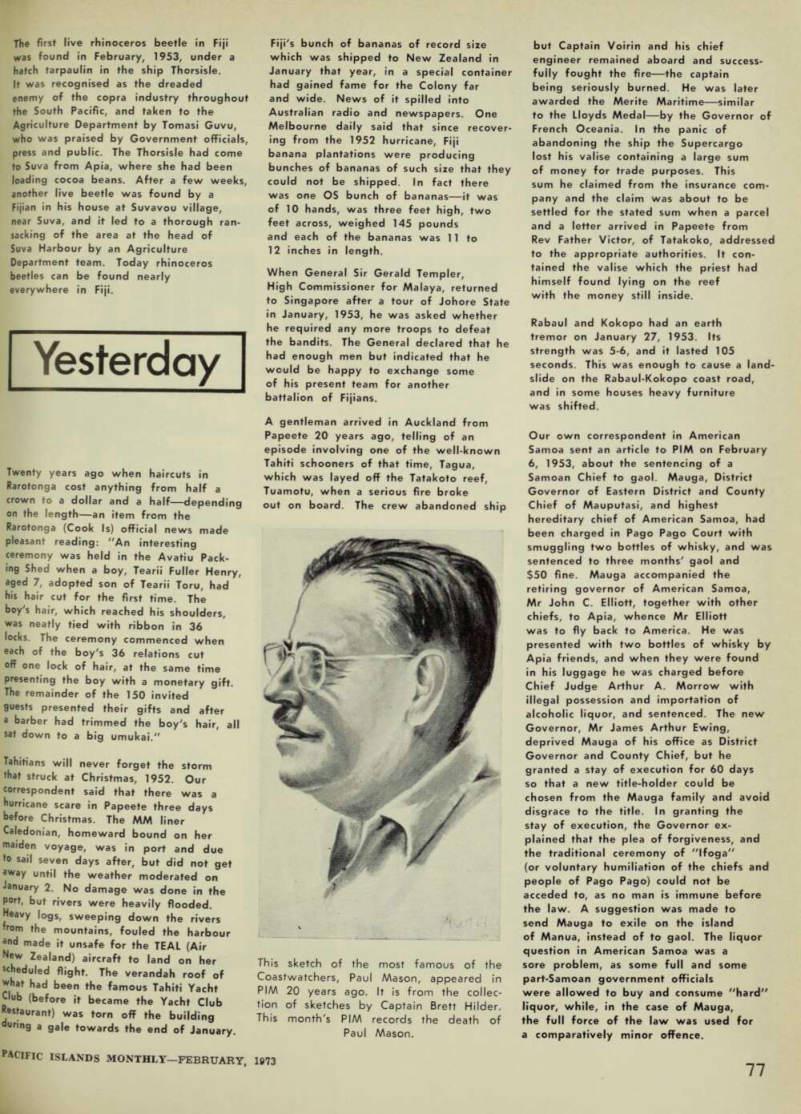
This sketch of the most famous of the Coastwatchers, Paul Mason, appeared in PIM 20 years ago. It is from the collec tion of sketches by Captain Brett Hilder.
This month's PIM records the death of Paul Mason.