Book Reviews
pp. 87-88 · Read in the full issue
How necessary are necessary evils?
The enemies of the 18th century slave trade, says Richard West, in River of Tears, have their modern counterparts in the conservationists.
Mr West is a conservationist; he is also a journalist, ex Manchester Guardian, a specialist on black Africa, Vietnam, the public relations business and, now, on the ramifica tions of the Rio Tinto Zinc Corpora tion. That’s what this book is all about —RTZ, and all its subsidiaries.
Why RTZ—when it could equally have been international oil, auto mobiles, or a dozen other things?
Probably because it is, according to the author, the biggest mining com pany in the world; because, in spite of its name, it’s British, which the author, as an Englishman, seems to find abhorrent; because it plays its cards close to its corporate chest and doesn’t go about advertising its activities, which seems to irritate him; and because it engages in un-United Nations activities by having vast enterprises in South Africa, South- West Africa and Rhodesia.
In order to get the information for this 200 page book, Mr West must have been a very busy bloke, engaging in long and expensive journeys and, one suspects, oc casionally partaking of the hospitality of RTZ itself. It is significant that the book is published by Earth Island Ltd, founded in London in 1971. It is an “independent British publishing house which specialises in the inter national co-publishing of books devoted to the conservation, restora tion and rational use of the eco sphere. Earth Island has strong links with Friends of the Earth and its profits support conservation action and publishing in Britain.”
As the book says, the British public generally does not know that RTZ, the parent company with the foreign sounding name, is British. It derives its name from a river in SW Spain hut gets only a tiny fraction of its income from this source today.
The Rio Tinto is the oldest surviving copper mine in the world, the metal was mined there by
Neanderthal man; it was exploited by the Phoenicians in 750 BC and by the Romans after that. When the Romans withdrew, the mine ceased operations and remained idle during the Moorish period and for centuries after. Its modem history began in the 18th century when foreign interests once more became interested in the area and in 1873, the Spanish National Assembly sold the Rio Tinto mine to a group of mostly British financiers for £3.850,000. The results from the mine thereafter con tinued profitable, if unspectacular, and the company weathered recurrent political troubles. World War I, the Spanish Civil War and World War II that came after it. In 1954 the Rio Tinto Company formed its Spanish interests into a local company selling two-thirds of it to Spanish banks and the Spanish public. The Rio Tinto Co which subsequently merged
with Zinc Corporation and became RTZ, still owns one-third of the Spanish company and also supplies managers and mining personnel to it, if required.
“The £8 million received by RT from the Spanish consortium,” says West, “was used to establish a mining empire stretching across five con tinents.”
It is doubtful if it were as simple as that sentence implies but it is true enough that RTZ now has huge interests in England, in Southern Africa, in Australia, in Canada and much later than that—this would have been regarded as truly romantic.
Empire-building at its best. Today, a matter for attack, at least by Mr West and even by Robert Graves, the English poet, who for reasons not explained has got into the author’s act by calling RTZ “obscene”.
The largest section of the book
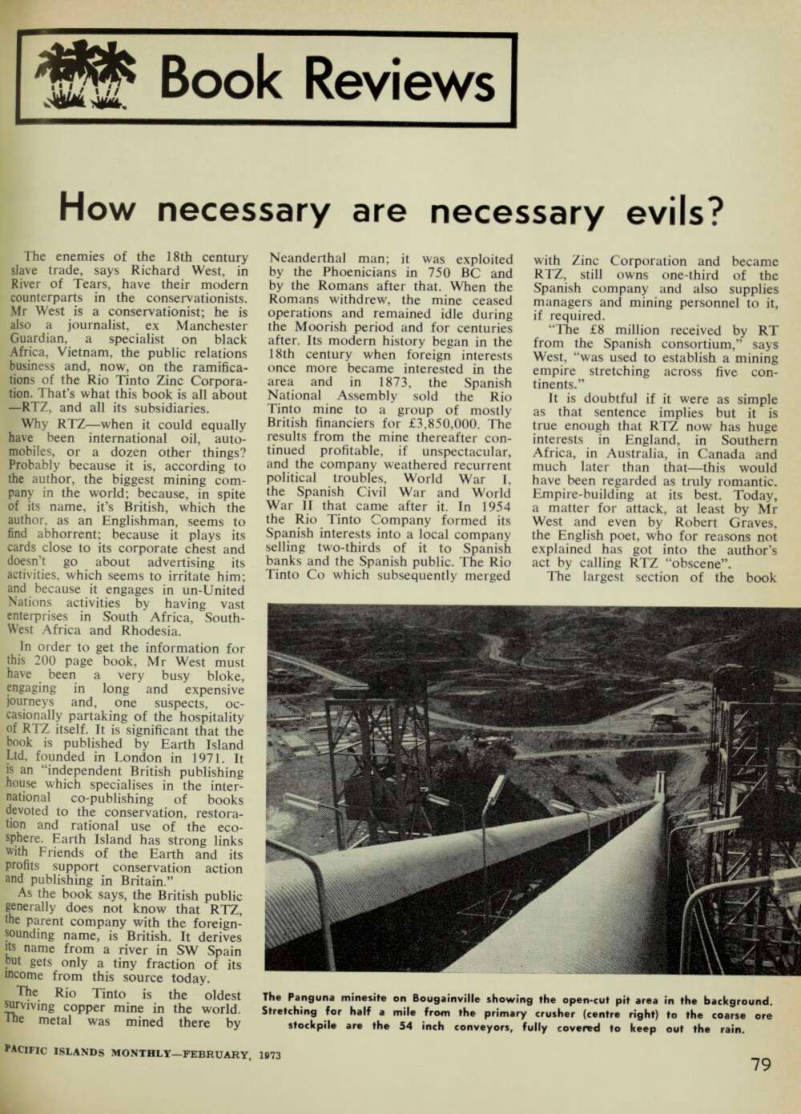
The Panguna minesite on Bougainville showing the open-cut pit area in the background.
Stretching for half a mile from the primary crusher (centre right) to the coarse are stockpile are the 54 inch conveyors, fully covered to keep out the rain.
is given to a description and criticism of RTZ’s interests in Australia where it operates as Conzinc Riotinto of Australia—uranium at Mary Kathleen; bauxite at Weipa; iron ore at Mt Tom Price; and copper in Bougain ville. If one may believe Mr West, all of these enterprises have come about in the wrong way, for the worst reasons, performed by the wrong people and that Australia (and New Guinea) would be better off if they had had never happened.
He makes a case against the big company and the government that allowed it to happen in Bougainville by employing the sentiments of Uncle Tom's Cabin, preconceived ideas, personal bias and enough fact to bamboozle a lot of people.
He had a poor opinion of Aus tralians as colonists in PNG. Ac cording to him they carried on from the Germans with harsh treatment of the people whom they “coerced” and were so unpopular that when the Japanese invaded in 1942 some Bougainvilleans joined the enemy.
After he had visited Kieta-Panguna in 1971 at the height of the construc tion period, he went on to Honiara, BSIP, where he was charmed with what the UK government had been able to do there, including “. . . hand some housing estates . . . with garbage cans and well tended gardens.”
However, if he talked to anyone in Honiara for more than five minutes, Mr West must also now know that for years the BSIP government has been bursting a seam attempting to find minerals and someone willing to exploit them; and that it would give its figurative eye-teeth for a prospective Panguna so that it could get the Solomons off the British tax payers’ back.
It is true, of course, that the world
could have done without Bougs ville’s copper a little longer; that natives who have been relocated not want to move, that Mr McKill did not want to leave his beaut: plantation to make way for the ui town of Arawa; that the whole isle could have remained the sleepy bat water it has always been; and tl the new towns are ugly in tt utilitarian newness.
But it is also true that emergi nations have to have something sustain them in the manner to whi they aspire and in spite of the autho direst predictions Bougainville copi looks like helping out handsomely that department.
Reformers must of necessity be soi part fanatic and fanatics are giv to seeing things in plain black white, ignoring the fact that most us have to live in the grey in-betwe zone of compromise. As a c« servationist some of Richard We; points are well taken, but stric from one side of the fence. I book, which sets out to criticise big company, mostly on the sc« that it is big, offers no practii solution to the very real troubles Western man in the last quarter the 20th century —Judy Tudor. (RIVER OF TEARS. Distributed Angus & Robertson. $2.95).
• You’re stuck over a word; you can’t spell it. The purpose of Web ster’s Instant Word Guide is to pro vide a convenient, quick-reference aid to word division, spelling and often confused words.
The book contains an alphabetical list which indicates word division and spelling for more than 35,000 words, plus examples of words which are often wrongly used; a list of some 1,500 abbreviations; a table of some readers' marks and symbols; a de tailed explanation of punctuation usage and an up-to-date list of weights and measures. This 370-page guide is pocket size, strongly bound with hard cover and is well worth the
price.-
Marie Shannon.
(Webster’S Instant Word Guide,
distributed by the Britannica Trade Centre, Sydney. $4.00).