Magazine Section
pp. 77-135 · Read in the full issue

Moresby the amateur not so much a discoverer as a surveyor
• A century ago on February 20, 1873, Captain John Moresby RN, after sailing his ship HMS Basilisk into a natural harbour, which he had discovered while exploring the Papuan coastline in the ship's boat, named the inner reaches of the harbour Fairfax Harbour and the outer Port Moresby, after his father * la ' r^ax Moresby. His discovery of the harbour and his adventures in Basilisk are recounted for PIM by Canon lan Stuart, author of the book "Port Moresby, Yesterday and Today".
By Ian Stuart
“What have these people to gain from civilisation?” John Moresby asked himself of the Papuans of eastern New Guinea and, remember ing the fate of other aboriginal people after their contact with the Western world, he confessed, “I was ready to wish that their happy homes had never been seen by us.”
Such doubts are interesting, coming as they do from a man who spent a lifetime in dedicated service to British imperialism and even though Moresby was able to dismiss these subversive thoughts by recalling his duty, dis claiming any responsibility for the use to which his discoveries might be put, and trussing in the ultimate working for good of divine nrovi dence, they give some insight into the character of the man.
A brief glance at Moresby’s career suggests that he was a typical product of his age, class and nation, with a firm conviction of the superiority of w .^ e races and their moral obligation to impose their civilising will upon lesser breeds of men. . As gunnery lieutenant of the Thetis in 1853, he commanded her small arm men in a punitive expedition against the Indians of Vancouver Island; he was involved in the two Baltic campaigns of the Russian War of 1854-5; helped to suppress the laipmg rebellion in Shanghai, pro tect English ships involved in the opium trade against Chinese pirates n . to °k P ar t in the international attack on Japan which opened the Inland Sea to foreign shipping.
While on his first cruise in the Basilisk in 1871, he detached three ot his officers and twelve of his men
to assist the Queensland Native Police in exacting retribution from a tribe of aborigines who had attacked and killed several survivors of a wrecked ship.
In the course of this career, Moresby witnessed many acts of in humanity on the part of his fellow men. When he joined the navy in 1842 at the age of 12 years, the officers tended to regard the men of the lower decks, often the press ganged scourings of the slums of Britain’s seaport cities, as little better than brute beasts. Floggings were common and, by many, preferred to the alternative punishment of black listing which involved the offender in carrying 68 lb of lead shot around the decks for two hours each day for a month.
His experiences gave him great
compassion and sympathy for the underdog and strengthened his aver sion to cruelty and injustice. He had. in his early years, been a victim of brutality himself. Of his time at a small private school he says that he was “ill fed, ill taught and treated with ill-judged severity”. As a mid shipman he had lived in the gunroom mess with much older youths who bullied and abused the small boys unmercifully. But the young Moresby was not made of the stuff which seeks revenge in meting out similar treatment to that received when pro motion affords the opportunity.
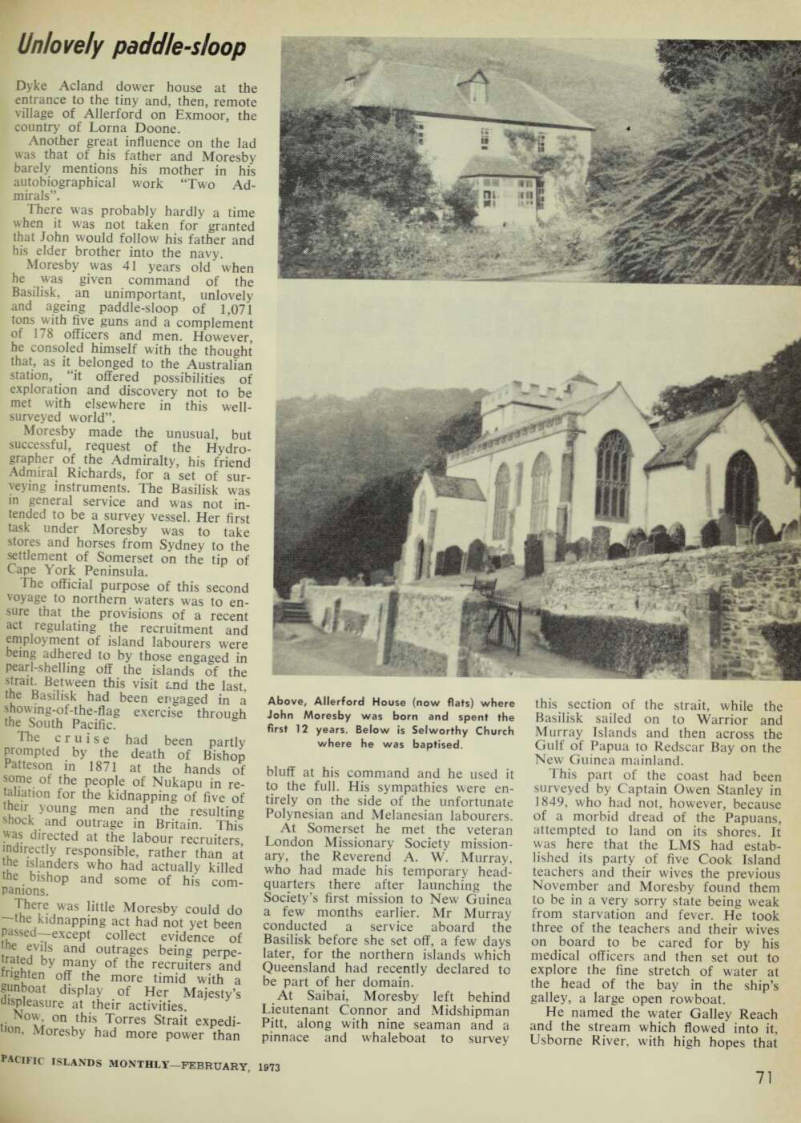
Moresby’s father, a commander at this stage of his naval career, was on half-pay and renting a farm on the estate of Sir Thomas Dyke Acland in Devon when John was born in 1830. The family were living in the
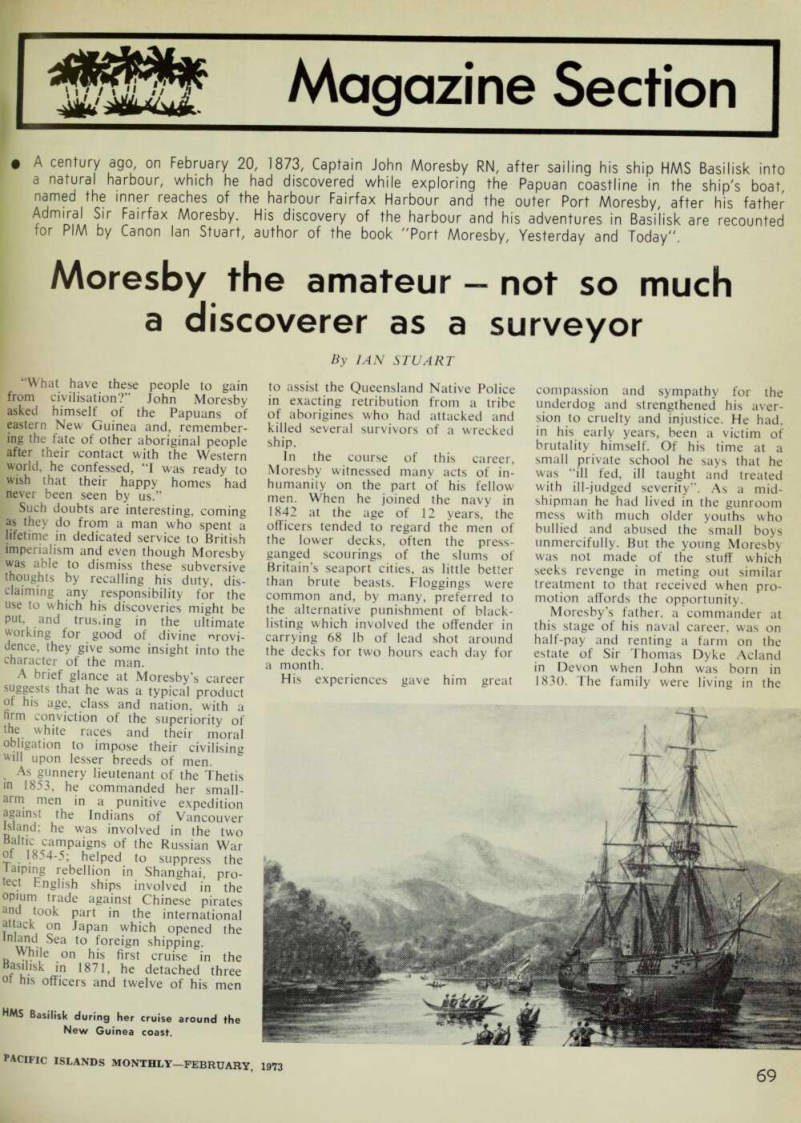
HMS Basilisk during her cruise around the New Guinea coast.
Unlovely paddle-sloop
Dyke Acland dower house at the entrance to the tiny and, then, remote village of Allerford on Exmoor, the country of Lorna Doone, Another great influence on the lad was that of his father and Moresby barely mentions his mother in his autobiographical work “Two Ad mirals”.
There was probably hardly a time when it was not taken for granted that John would follow his father and his elder brother into the navy.
Moresby was 41 years old when he was given command of the Basilisk, an unimportant, unlovely and ageing paddle-sloop of 1,071 tons with five guns and a complement of 178 officers and men. However, he consoled himself with the thought that, as it belonged to the Australian station, “it offered possibilities of exploration and discovery not to be met with elsewhere in this well surveyed world”.
Moresby made the unusual, but successful, request of the Hydro grapher of the Admiralty, his friend Admiral Richards, for a set of sur veying instruments. The Basilisk was in general service and was not in tended to be a survey vessel. Her first task under Moresby was to take stores and horses from Sydney to the settlement of Somerset on the tip of Cape York Peninsula.
The official purpose of this second voyage to northern waters was to en sure that the provisions of a recent act regulating the recruitment and employment of island labourers were being adhered to by those engaged in pearl-shelling off the islands of the strait. Between this visit and the last, the Basilisk had been engaged in a showing-of-the-flag exercise through the South Pacific.
The cruise had been partly prompted by the death of Bishop Patteson in 1871 at the hands of some of the people of Nukapu in re taliation for the kidnapping of five of their young men and the resulting shock and outrage in Britain. This was directed at the labour recruiters indirectly responsible, rather than at the islanders who had actually killed the bishop and some of his com panions.
There was little Moresby could do —the kidnapping act had not yet been passed—except collect evidence of V i! S and outra ges being perpe trated by many of the recruiters and inghten off the more timid with a gunboat display of Her Majesty’s dlS xr a sure at their activities.
Now on this Torres Strait expedi tion, Moresby had more power than
bluff at his command and he used it to the full. His sympathies were en tirely on the side of the unfortunate Polynesian and Melanesian labourers.
At Somerset he met the veteran London Missionary Society mission ary, the Reverend A. W. Murray, who had made his temporary head quarters there after launching the Society’s first mission to New Guinea a few months earlier, Mr Murray conducted a service aboard the Basilisk before she set off, a few days later, for the northern islands which Queensland had recently declared to be part of her domain.
At Saibai, Moresby left behind Lieutenant Connor and Midshipman Pitt, along with nine seaman and a pinnace and whaleboat to survey
this section of the Strait, while the Basilisk sailed on to Warrior and Murray Islands and then across the Gulf of Papua to Redscar Bay on the New Guinea mainland, This part of the coast had been surveyed by Captain Owen Stanley in 1849, who had not, however, because of a morbid dread of the Papuans, attempted to land on its shores. It was here that the LMS had estab lished its party of five Cook Island teachers and their wives the previous November and Moresby found them to be in a very sorry state being weak from starvation and fever. He took three of the teachers and their wives on board to be cared for by his medical officers and then set out to explore the fine stretch of water at the head of the bay in the ship’s galley, a large open rowboat.
He named the water Galley Reach and the stream which flowed into it Usborne River, with high hopes that
Above, Allerford House (now flats) where John Moresby was born and spent the first 12 years. Below is Selworthy Church where he was baptised.
it might prove to be a highway to the interior of the country. A night spent in the labyrinth of streams through the vast sago and nipa palm swamp at the mouth of what is now known as the Vanapa River, convinced him that his hopes were unfounded.
A day or two later, Monday, Feb ruary 17, 1873, two parties set out from the Basilisk which was left anchored in Redscar Bay under the charge of Lieutenant Hayter. Moresby himself took the galley while Navigat ing Lieutenant Mourilyan was in charge of the cutter. The men were well-armed, had with them a week’s provisions and intended to explore the country to the east of the bay.
Haidana Island, opposite Porebada village, was reached in the afternoon and the sailors received a very friendly welcome from the Papuans whose curiousity was such that Moresby sup posed that they were probably the first white men they had ever seen.
The villagers helped the men track the galley through the shallow water between the island and the shore to rejoin the cutter which had remained on the outer side. The two boats then took a series of soundings until they reached Fishermans Island which Stanley had named.
Mr Mourilyan in the cutter ex plored a bay on the mainland oppo site the island while Moresby went in the galley along the edge of the reef, looking for a safe passage through to the ocean beyond. He was unsuccess ful in this search and arrived about noon at Taurama, the prominent cone-shaped bluff on the coast about eight miles east of Fishermans Island which he called Pyramid Point.
He climbed to the summit of the hill, nearly 600 ft high, and from it obtained a superb view of the coast line for several miles in either direc tion. The reef stretched away like a green ribbon until lost to sight, its outer edge fringed by the line of surf.
But at one point it was broken by a stretch of dark blue untroubled water and Moresby felt sure that this was the passage he sought.
In the bay below the point on the opposite side floated several small islands and the captain honoured the young seaman with him by calling them Head Islands. There is a curious omission in Moresby’s account of the events of the day. He says of the view from Taurama that “the whole scene was lovely; the sea was studded with green islets, beautiful bays ran into the land, villages came clustering down to the brink of the calm water”, but he fails to mention that below him was a deep inlet which forms a hne harbour and which, in fact, was used as such by a copper-mining company in the 19205.
Part of Port Moresby harbour is visible to the west from Moresby’s vantage point, across the saddle be tween Paga and Touaguba Hills. He can hardly have been very surprised when Mourilyan met him the next day with the news “that an opening existed at the head of the bay, which might lead to a landlocked harbour”.
His response to this news is de cidedly odd, coming as it does from one who has already looked down on Bootless Inlet. He says “we earnestly desired that our hope of finding a harbour here might be realised, as up to this time the wild exposed an chorage of Redscar Bay had been the only known shelter for ships on the entire south coast of New Guinea”.
Moresby nowhere mentions Boot less Inlet or the origin of the in triguing name he bestowed upon it, yet it is included in the sections of his map marked in red to signify it is one of the features he discovered and named. Later, Lieutenant Hayter was sent from Port Moresby to ex plore the coast to the east as far as Hood Point and Moresby says that “he diligently examined over 50 miles of coast in which neither harbour nor river were to be seen” even though the inlet is included in the area covered by this survey. One wonders
“We earnestly de sired that our hope of finding a harbour here might be real ised, as up to this time the wild exposed anchorage of Redscar Ray had been the only known shelter for ships on the entire south coast of New Guinea”
if this is a deliberate omission, de signed to exaggerate the importance of Port Moresby by giving his readers the impression that it is the only harbour between the Torres Strait and Hood Point.
When the two men descended from Taurama to the beach, they found that the Papuans from nearby Pari village had come around the beach and struck up a friendship with the
sailors, bartering their feathers and coconuts for strings of red beads and managing at the same time to pilfer a few small articles lying about in the boat.
It was now late afternoon and Moresby anchored the galley in the lee of a nearby island, probably Manubada, for the night. Apparently they were joined here by Mourilyan and his party in the cutter.
The next morning Moresby set off early for the gap he had seen in the reef from the top of the point and his expectations were fully realised when he found a passage about three quarters of a mile wide with a bot tom beyond the reach of his men’s lines.
Meanwhile, the cutter had gone to continue the exploration of the bay and it was when Moresby went across to it that Mourilyan reported the “opening . . . which might lead to a landlocked harbour”.
Again, there is something uncon vincing about this account. It seems very surprising, almost incredible in fact, that Mourilyan and his men had not seen the harbour the day before when they made their way across its entrance. Surprising also that Moresby had not seen it himself as he travelled along the reef, rather less than three miles from the shore. Had Mourilyan actually discovered the harbour the previous day and Moresby suppressed the fact, preferring to convert his confirmation of his officer’s find into the actual discovery?
Moresby says that both boats went at once to investigate the opening and that they were highly delighted when they found a deep water passage leading into a broad sheet of calm water, two miles by one-and-a-half in extent and deep enough in most places to provide a haven for the largest ships.
The boats landed on Tatana Island where the Papuans, men, women and children, were “as friendly as pos sible” and helped the sailors to fill their water barrels from a well near the beach. The villagers seemed to have had no knowledge of the uses to which hoop-iron might be put but they were willing to trade their green stone adzes and axes for beads. The friendly exchange completed, the boats headed back for Fishermans Island and at sunset had reached the first camping place.
In the morning the boats began their journey back to the ship and, on passing Porebada, were dismayed to see the Basilisk about five miles away sailing slowly out to sea. After an anxious hour, the boats were sighted by the watch and when Moresby reached the ship, he found
that it was surrounded by reefs in an open bay with barely enough water to keep it afloat.
Lieutenant Hayter had become con cerned for the safety of the boat parties and had brought the Basilisk along the coast to look for them. With difficulty they managed to bring the ship safely out of the maze of reefs and Moresby named the place Caution Bay as a warning to future mariners.
By ten o’clock, the Basilisk was off the opening in the reef and from the foretop Moresby conned her through the passage which he named in honour of his vessel. The bay through which they now sailed he called after his only son Walter, and Tatana Island, behind which he anchored in five fathoms of water, he named Jane for his wife. At the same time he “deter mined that the outer and inner harbours would bear these names of my father, the venerable admiral of the fleet, Fairfax Moresby”.
Hundreds of Papuans came out from the nearby villages in their canoes and flocked aboard the ship, examin ing everything with many expressions of surprise and wonder. The next few days Moresby and Mourilyan spent surveying the harbour while Lieutenant Hayter with a fresh crew went off on his expedition to Hood Point in the galley. The sailors also climbed the hills around the harbour and visited the valleys beyond.
Moresby was surprised at the absence of any substantial streams and surmised the rainfall was absorbed by porous soil and flowed underground into the mangrove swamps at the head of the harbour.
Actually, the large rivers of the area flow into Redscar Bay and he had already seen their mouth during his visit there.
He was also misled into thinking the valleys behind the harbour were rich and productive by the luxuriant growth of rank grasses which appears during the short wet season. Had he arrived two or three months earlier his impressions would have been very different.
Everywhere they went the sailors were well-received and Moresby thought “nothing could exceed the kindness of the natives”. The visitors soon lost any feelings of apprehension they might have had and went about singly or in small groups, inspecting me village activities of pot-making, net-weaving, gardening and fishing and enjoying the hospitality of the people.
Hie Papuans were as curious of heir visitors as the sailors were of their hosts and groups of villagers j, ® as,^ on °ne occasion with bundles of rushes which they ied together and used to measure
the length and breadth of the ship with many expressions of wonder ment.
Moresby described the people as being “of the Malay type—small, lithe, copper-coloured people with clean, well-cut features, and pleasing expressions of countenance”. He thought them very much more attrac tive than the darker Papuans and islanders to the west although, sur prisingly, he considered the women to be “ill-made and slovenly looking as compared with the men”. He seemed to harbour some kind of prejudice with regard to the female sex as in a number of other places, both in New Guinea and elsewhere, he compared the women unfavourably with the men he met.
On April 24, 1873, the sailors cut the leaves off a coconut tree on Hayter (now called Sariba) Island and fitted a block to the top of the trunk to convert it into a flagstaff.
The ship’s company having assembled around the staff. Moresby read a proclamation he had prepared and took formal possession of the islands
“Discoveries, Cap tain Moresby?” asked the new Hydro grapher of the Ad miralty. “I was not aware that you had made any. I suppose New Guinea was dis covered before you went there? We have work like yours com ing in every day ”
while the flag was run up, three cheers given and a feu-de-joie fired.
Returning to London after ex ploring more New Guinea waters in December, 1874, Moresby met a mixed reception. The Times, in a leading article, remarked: “The Basilisk has explored and surveyed about 1,200 miles of coastline in the archipelago of which New Guinea is the centre and added many first class harbours, navigable rivers, and more than 100 islands, large and small, to the chart. But this is not the best part of the work. The Admiralty are able to announce that the discoveries of the Basilisk have revealed the existence of a new and
shorter route between Australia and China”.
The Army and Navy Gazette was also complimentary: “We doubt if any man-of-war not a surveying ship had ever such results to show. We congratulate the Basilisk on her splendid achievement. Honour and promotions have deservedly been won by the officers and men of the ship”.
However, there was a decidedly less warm response from other quarters: “Discoveries, Captain Moresby?” asked the new Hydrographer of the Admiralty, “I was not aware that you had made any. I suppose New Guinea was discovered before you went there? We have work like yours coming in every day”.
Moresby’s work was appreciated by geographers and acclaimed by the general public when he published the account of his New Guinea voyages in 1876, but Admiralty suspicion has never been assuaged. The word “dis covery” was eliminated from official reports of the Basilisk’s activities and the phrase “a valuable and useful survey” substituted. As recently as 1967, Admiral G. S. Ritchie in his book The Admiralty Chart, dismisses Moresby as an amateur, along with his achievements, in a few lines^ For its part, the government - was not at all anxious to act on Moresby’s proclamation of possession and it was to be another ten years before the Protectorate of British New Guinea was declared.
Moresby seems to have been popular with his officers and men and there are many indications that Basilisk was a happy ship under a captain with a lively concern for the welfare of his men. The vessel had a bad reputation with regard to the health of her crew during earlier commissions in tropical waters and Moresby believed that this was due to the poor ventilation of the lower decks. He remedied this by cutting a large scuttle to admit fresh air into the crew’s quarters and engine room.
He also provided a tank of fresh water to which the men had free access at all times and encouraged them to bath daily and wash their clothes regularly. He saw to it that the food issued was as nourishing and as varied as circumstances allowed and shore leave was granted as often as possible.
The officers were encouraged to arrange regular entertainments and recreation on board and the*e included “penny readings”, along with songs, recitations, games and competitions.
Moresby was able to boast at the end of his service on the Basilisk that he had lost only three of his men out of the complement of 178; two had
Continued on p 125
died from accidental causes and one had succumbed to consumption in Sydney.
It is also apparent that Moresby regarded most of the Papuans he met with affection. “I am conscious” he wrote, when arguing the case for New Guinea’s annexation by Britain, “that these races have so touched my heart that I have become their partisan and perhaps partial reasoner”.
He mentions on many occasions the friendliness and kindly treatment shown to him and his men by the Papuans and this was no doubt prompted by the considerate and sensitive behaviour of the sailors towards the people they met.
There was unconscious racial arrogance on Moresby’s part in his unvarying habit of bestowing his own choice of names upon the geographical features of the New Guinea coastline.
It never seems to have occurred to him to inquire from the Papuans their own place names and instead he covered his charts with the names of imperial and colonial states and naval dignitaries, along with, more endearingly, those of his female relatives. His two sisters as well as his wife and four daughters were all commemorated in the naming of rivers, bays and islands. However, the unsympathetic Hydrographer, while allowing the notables to stand, seems to have removed from the New Guinea map the more personal designations.
Moresby certainly enjoyed ex ploring and making new discoveries but we are rather disconcerted by his ability one moment piously to declare his strong sense of duty to God, Queen, country and service and the next casually to disregard his orders when there was an opportunity to make fresh discoveries. He got away with this because he was successful but what, one wonders, would have been his fate if, during his first New Guinea visit, he had put the Basilisk on a reef?
In putting forward his view that Britain ought to annexe New Guinea, he argues that this action would in some sense atone for the aboriginal races who had perished “because of our weakness, ignorance and sin”. He says that “they have seen so much of our heathenism that we are bound in fairness to show them something of our Christianity”—and sees an nexation as the opportunity for his countrymen to act as “tutors of the island races” so that they might “lead
them to moral and intellectual man hood”.
This argument assumes that in some mysterious way a British colonial government of New Guinea would be different from other such govern ments and that new attitudes free from “weakness, ignorance and sin” would save the Papuans from the evils suffered by other aboriginal races.
Despite these high-minded senti ments, when a controversy developed over the suggested colonisation of New Guinea, Moresby supported those who hoped for a rich return from the exploitation of the island’s natural resources. This was in op position to the Reverend Samuel MacFarlane who warned against colonisation on practical rather than moral grounds.
Subsequent experience has shown MacFarlane to have been mostly right and Moresby mostly wrong with his optimistic visions of rice, cotton and sugar plantations, cultivated by Chinese “whose importation would be a matter of time”, along with “millions of sheep and cattle”. Even allowing for the spirit of the age and the popular beliefs of the time of the benefits colonisation bestowed upon non-Western societies, one is surprised that Moresby did not recognise the dangers the commercial schemes he supported had for the Papuan people.
In 1917 the government over came its earlier coolness and reluc tance to recognise his achievements and bestowed upon him the unique distinction of naming a destroyer after him in honour of his discoveries.
It was the first time that a Royal Navy ship had been given the name of a living admiral.
Just before his death on July 13, 1922, at the age of 92 years, he wrote to a friend “my recall is up”, an allusion to the naval signal which summons a ship home. He is com memorated by a simple plaque in the parish church with the text “God is Love” and is buried in the town cemetery. His headstone bears an un usual epitaph, almost certainly, one would think, chosen by himself: “I believe in the forgiveness of sins”.
Cleaning After Be B E.—
The NZ Government has agreed after consultation with the British Govern ment and the GEIC Government to restore Funafuti, devastated by hurricane Bebe. Equipment has been flown to Funafuti in five flights by Hercules transports. It is expected that the work will take eight weeks.