More On Polynesian Origins
p. 68 · Read in the full issue
Where did the Polynesians come from? Prof.
W. W. Howells wrote last year for PIM an article in which he expounded his belief, albeit with some hesitation, in an original migration of the Polynesians via Micronesia. He was followed later by Dr Roger
Green and Dr Janet Davidson of Auckland, who advanced a strong argument for Melanesia as the migratory path. The discussion is continuing, but as Professor Howells says below, revelation of the full true story is probably not far off.
By Professor W. W. HOWELLS, Harvard University, Department of Anthropology
I was pleased that my article on Polynesian origins (PIM, May, 1972) drew comments from Roger Green and Janet Davidson (PIM, September), who are two of the primary authorities in Pacific archaeology. I know that they and I actually agree as to much of the reconstructed history. We disagree in that they believe the Lapita potters were present in central Melanesia before reaching the east, and so represent the parental Polynesians moving along a Melanesian route from the west, while I suggest that this was a later spread, out of the eastern region moving west, after the original voyagers had already reached Fiji and New Caledonia, probably via Micronesia. There is much to be said for the Melanesian route, as they make clear. In casting a hesitant vote for Micronesia I faced up to some of the points they made, and other loose ends, but I did not spell out all my reasons in a brief article.
Physical differences are one of them. If parental Polynesians, making Lapita pottery and speaking Eastern Oceania languages, were the first arrivals in all of eastern Melanesia (not Fiji only), this occupation should have been rather thorough, especially if they were equipped with the same foods as later, including pigs. I cannot agree that “gene flow” from New Guinea, ie a leisurely hybridisation, could have produced the present “racial” picture in the east (though Roger Green and I have long been in agreement that this is the probable explanation for Fiji specifically). Some popu lations of the New Hebrides, and northern New Caledonia, are just as “Melanesian” as those of the most western islands of Melanesia.
Such groups give a strong impression of having arrived just as they are now, not by gene flow. At the same time, following a further visit to the Solomons in July, I feel more than before that the eastern Solomons—just that part which speaks languages of the Fasten Oceanic group of some authors—have been strongly affected by a Poly nesian-like admixture.
Here I may seem simply to be turning the position of Drs Green and Davidson around, but the whole thing looks to me not like “gene flow” from west to east but rather like an intrusion of such non- Melanesian influence between the more solidly “Melanesian” populations of the western Solomons and the parts of the New Hebrides and New Cale donia already mentioned. I would suggest that this influence could have been mainly the Lapita-makers, occupying the various offshore islands of the region, for some centuries, before being absorbed and dis appearing as an entity.
Dr Green’s striking recent finds, showing a wider spread and older dates for the Lapita-making people
navigating and trading along Melanesia’s northern fringe, had not been announced when I wrote the article. I am not sure that the argument for this as the Polynesian route has been strengthened thereby.
The dates still fall in the time after 1,000 BC, and archaeology still indicates that the main islands were occupied by Melanesians; while the Fiji-New Caledonia dates remain earlier, at nearly 1,300 BC (One astonishing Capita date of 2,000 BC from the Isle of Pines has been announced), I agree that there is great difficulty in supposing a pottery-making people coming down out of eastern Micronesia. On language, I hesitate to say anything.
To take one aspect of the evidence, however, the lexicostatistical figures (measuring vocabulary like ness) of I. Dyen do indeed argue that linguistic diversity is greater in eastern Micronesia than within the Eastern Oceanic group which appears to have been associated with the Capita people. This is contrary to the view of Drs Green and Davidson; and the simplest deduction (usually made by linguists) is therefore that the movement was from eastern Micronesia outward, not the other way.
So, even to a physical anthropologist, the archaeo logical and linguistic evidence seems equivocal.
But I write again not to argue but to point out how various people are closing in on one of the most absorbing problems in all of anthropology just now.
It is astonishing, as I said in my article, what progress has been made compared to a few years ago. Physical anthropologists and linguists can give some boundaries in reconstructing history, but it is archaeologists like Drs Green and Davidson who will finally get the true story. It is likely to come in a few years’ time, especially if untouched areas like eastern Micronesia are worked, and readers of PIM will find attention to this rewarding.
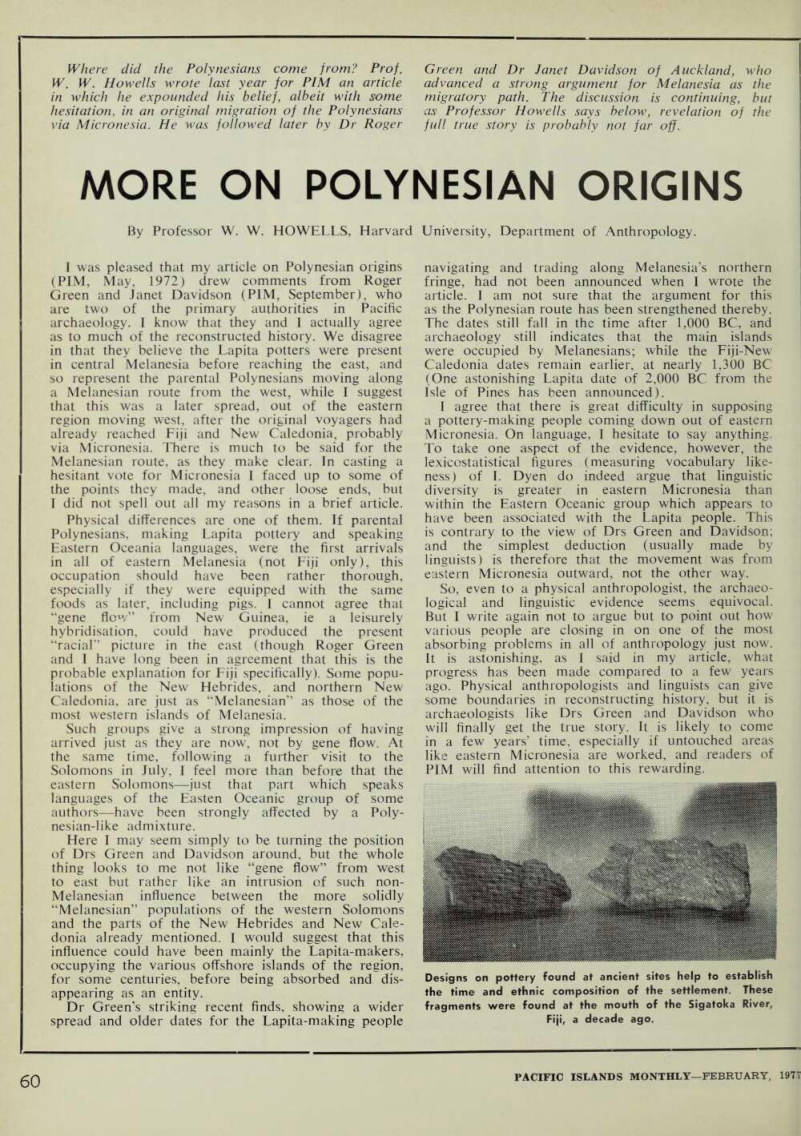
Designs on pottery found at ancient sites help to establish the time and ethnic composition of the settlement. These fragments were found at the mouth of the Sigatoka River, Fiji, a decade ago.