Spc And Forum
pp. 65-67 · Read in the full issue

Ratu Mara Talks Of
Relationships
PIM put several questions recently to Fiji's Prime Minister, Ratu Sir Kamisese Mara, on the relationship between the South Pacific Con ference and the South Pacific Forum. Will they amalgamate? Is a federation of Island territories feasible? The Prime Minister was cautious in all his replies which are given below.
Q: Now that the meetings of the South Pacific Forum and the South Pacific Conference have ended for another year, have you, in the light of the discussions and decisions at those meetings, any comment to make regarding their future respective roles?
Could you conceive an amalgamation of the two?
A: The South Pacific Forum was established to fill a gap which the South Pacific Conference left. In the South Pacific Conference established under the Canberra Agreement, the matters considered are social and economic. Politics are not included.
Of course, we always did discuss politics but it was in the corridors and informally. Furthermore, those discussing them did not always have the authority to speak for their countries, nor to implement any agreements of understanding reached.
In the Forum these outstanding criteria are met. Politics are openly discussed and decisions reached among people who speak as leaders of independent states. For instance, after only three meetings of the rorum we actually have an agree ment open for signature in Suva to establish the South Pacific Bureau for economic Co-operation, and the Director and his Deputy are appointed and have begun work in Suva.
There is a continuing role for the „uth Pacific Conference, which after ail embraces a much wider number 0 countries, but only if its finances ar ? be made commensurate to its tasks. At present a large proportion ctlff S f T ds are spent ° n Paying its staff rather than pressing on with Projects that members want. fJ/ ” difficult to see an amalgama tion between the two bodies while one is an association of independent sovereign Pacific states, and the other a combination of metropolitan K e I s > -* nd mde P ende nt and depen dent Pacific countries. There is already
an undefined link between the two bodies in that it has been decided that the Forum should normally meet just in advance of the South Pacific Con ference each year.
Q: When all the territories of the South Pacific Commission area be come independent or self-governing, there will obviously be a change in the SPC set-up, with all members meeting as independent nations and the present metropolitans having no further reason to continue member ship as they will have no depen dencies. What sort of re-organisation would you like to see?
A: This is perhaps looking some way ahead, and I would prefer not to speculate. It would perhaps be more apposite to draw attention to the fact that it is open to countries as they become independent to join the South Pacific Forum.
Q: What chances are there for a limited type of federation of South Pacific countries with a Customs and political union, but with each country retaining its internal sovereignty, much as the states in the USA and Aus tralia? Would not such a federation strenghten the Islands’ bargaining power vis-a-vis the EEC or individual countries like Australia?
A: Again, this is looking rather far ahead and there would need to be very careful studies of the political and economic implications of such a proposal. However, there is already very considerable scope for regional co-operation in many fields and much can be do n e within the present frame work. Indeed, at the last meeting of the Forum we set the Bureau a number of tasks in this very area.
Q: Would a common currency and a common monetary policy assist the Island countries in their trade?
Continued on p 59
A: I do not think currency and monetary policies are primary ob stacles to developing Island trade.
Communications are a much bigger problem; quarantine and tariff barriers must also be examined; the question of bulk buying has been raised; joint ventures in our countries to make components for products for which there is already a market in Aus tralia and New Zealand is another way to help the realisation of our wish to change the pattern of trade.
Q: As regards Fiji itself, in an earlier interview, you suggested modification of the Westminster type of govern ment; eg a coalition and no Opposi tion as such, commenting that the party system had encouraged racial divisions as there were no European style political parties in the country.
Recently, the Deputy Speaker of the House of Representatives, Ratu David Toganivalu, was quoted in the Fiji V mes . (Nov 21, page 2) as saying that the Malawi Government was a benevolent dictatorship” and “felt such a system might be appropriate tor countries like Fiji ” Can you envisage a major change in Fiji’s system of government? Papua New Oumea, I think will, at independence, examine the merits and demerits of the Westminster system?
A: Although I did indeed float the idea of a coalition for Fiji as a Personal viewpoint, I did not receive very much support either from my own party or the Opposition. In a democracy I had a right to express y view, and again in a democracy must abide by the wishes of the majority. Similarly. Ratu David toganivalu has a right to his view. tw S t 0 tJ ? e future > my own view is we should keep an open view
on the matter and be ready to adapt existing models to suit our own requirements.
Q: Common roll elections have been held in connection with the Suva City Council and Lautoka Town Council.
Do you think the results proved, one way or another, arguments for or against Common Roll in parliamen tary government elections? When is the Royal Commission on this question likely to sit?
A; A cynical reply might be that it worked well in Suva and badly in Lautoka!
However, one needs to look more deeply into it than that. The major difficulty is that the system does not guarantee representation of the various communities. In fact, the Alliance Party took particular care to put up candidates of various races. The NFP either would not or could not.
But there is the danger in the Com mon Roll system that communities may find themselves unrepresented with all the frustration and resent ment that can bring. It is interesting that the first person to complain of the result was Mr K. C. Ramrakha, the Opposition Chief Whip.
The Royal Commission is due to be set up at some time after the 1972 election and before the next election (due in 1977). It is for the Prime Minister to arrange in consultation with the Leader of the Opposition.
There has not yet been any consulta tion.
From a Suva correspondent The Prime Minister’s view of the last Forum meeting, as expressed in his New Year message to the Fiji people, was: “Of course, we have differing interests in a number of spheres, but we found ourselves able to discuss matters in a tolerant and harmonious way.
“All views were given close and sympathetic attention and the whole atmosphere was one of mutual tolerance, respect and friendship.”
He also appealed for peace in com mercial and industrial circles, saying.
“There are still some areas in our national life where we could have more of the spirit of goodwill and give and take—labour relations come to mind.
“Let us accept the challenge in this sphere, and do what we can, where we can, to help. What is perhaps needed above all is a readi ness to show confidence in the good faith of the other side.
“This is the surest way to promote that good faith and evoke confidence in return,”
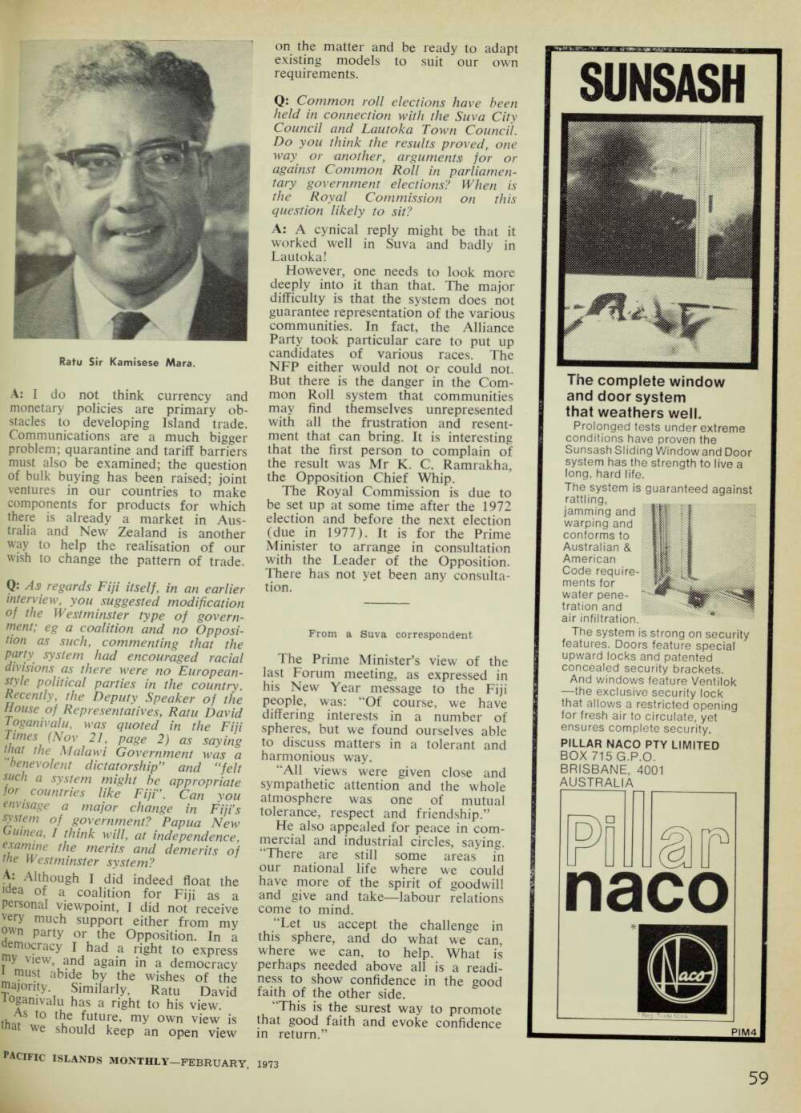
Ratu Sir Kamisese Mara.