on Fiji's
pp. 49-50 · Read in the full issue
Bebe, it's springtime on Fiji's Coral Coast
From Judy Tudor in Fiji
For maybe the first time ever, it’s spring-time along the Coral Coast of Fiji, according to Dr Cecily Hands who lives here.
What she really means is that the trees, which have looked completely dead for two months following hur ricane Bebe in October, are at last putting out a few green shoots and leaves. But the coconuts—those that didn't lose their tops entirely—have more dead fronds than green and will probably take months before they begin again to look like decorating the tropical scene.
This coast, where a lot of the tourist industry of Fiji is centred, took a pounding from the October blow.
Although there was a great song and dance about damage in Lautoka, the Sigatoka Valley etc, this area got little publicity. Possibly it was delibe rate, for fear potential tourists would be scared off. Everywhere it’s a tale of ruined carpets, swimming pools full of muck, beaches blown away, lawns covered with a foot of sand and immediately after the hurricane, uprooted trees, branches everywhere days without power and light and consequently, devastated deep-freezers.
Bebe was a capricious female. Whip ping in to pulverise an area here; missing one there. Local villages, usu ally located on the edge of the lagoon, took a hiding. Collapsed bures have neen replaced here and there with nnght blue tents from some relief Jund; some coconuts still look as though a fire had been through tnem; gardens were flattened or flooded out.
In the hotels and motels, everyone worked to clear away and be back |n business for the expected Christ mas rush but in most cases the rush
didn’t eventuate. Cancellations started commg m right after the hurricane Cd 1 f th u immed,ate P re j P f e -[ OC J. whe u n 9 nionists in the oil distribution business “went te* C “^ ing , off no ;™ al petrol dehvenes and slowing down plane rethe M P £ mt where SOme P Rn f Nadh , But hope springs eternal. This whole coast is pock-marked by gashes m the landscape where someone is building a hotel/motel, plans to build nnp’ Z p a^ ned (past-tense) to build U^ a, a, ’f a J eW . mileS 2 n the Nadi side of Korolevu, the owner B of Suva s Outrigger and Nad s Gateway are building an S ° e " orm T that ! hey 11 P r °p , ;i y s a bus . * erv,ce to B et Hhfina f t? th o r bedr 9 oms to , the dining room. Reclamation work is f a o pnnn° a n t lu*™ 3 f?’ ? ght mt ,° lagoon at the mouth of a creek. It s f pn g . reat interest l ° i! he loCal £ ogn 9‘ scenti who takes the view that if a ! Ure xj W * ntS an n an u a P romon tory, Nature will build one but that men who get into the act a re askmg for trouble.
Meantime, not all is gloom. Bebe did a great job of pruning and the flamboyants put on the greatest show ot orange-red flowers for years. In January the tourists started to come irffamrf nd work on converting the D Sl f°f ka ' Nadl l eC , tlon °. f Queens Road from pot-holes and mud or a sea of fine dust (according to the weather) into a bitumen-sur- St C pr d n hl !^ Wa i y at f S n S° t 11 under way > after a decade of dilly-dallying.
Expatriate personnel of the overseas consortium which will build it, towards the end of the year, moved
into vacant cottages usually let to tourists at Korotogo They will £ main there until February when it is expected that houses for 32 families and a score or so of single men will have been completed near The Fijian Hotel at Cuvu.
This section of the road is expected to be finished by October, 1974 and should be a pushover for the en gineering firms involved, who have been building roads in Papua New Guinea. About 12 miles in length will be lopped off the Sigatoka-Nadi sec tion by eliminating the present in funatmg loops and bends which fol low the contours of this dried-up un dulating country. The old road was built in the days before aerial sur veys, by man labour using nothing m °re advanced than picks and shovels, It also took due concern to wander around every rice patch and strip of sugar-cane.
According to official plans, the im mediate project in the rebuilding of the wh ole of Queens Road were the two end sections—Nadi-Sigatoka and Deuba-Suva, leaving the difficult Sigatoka-Deuba section for posterity to worry about. However, having got all their good gear assembled in Fiji for the initial section, the local feel ing is that, unless Fiji suffers an un precedented economic recession in the next few years, the operating com panies will be retained to eventually finish the whole job.
The new road village near The Fijian, which will include a soil laboratory and other works installations, will have for its area the highest concentration of expatriate residents at present in Fiji. The new village is to have its own school and.
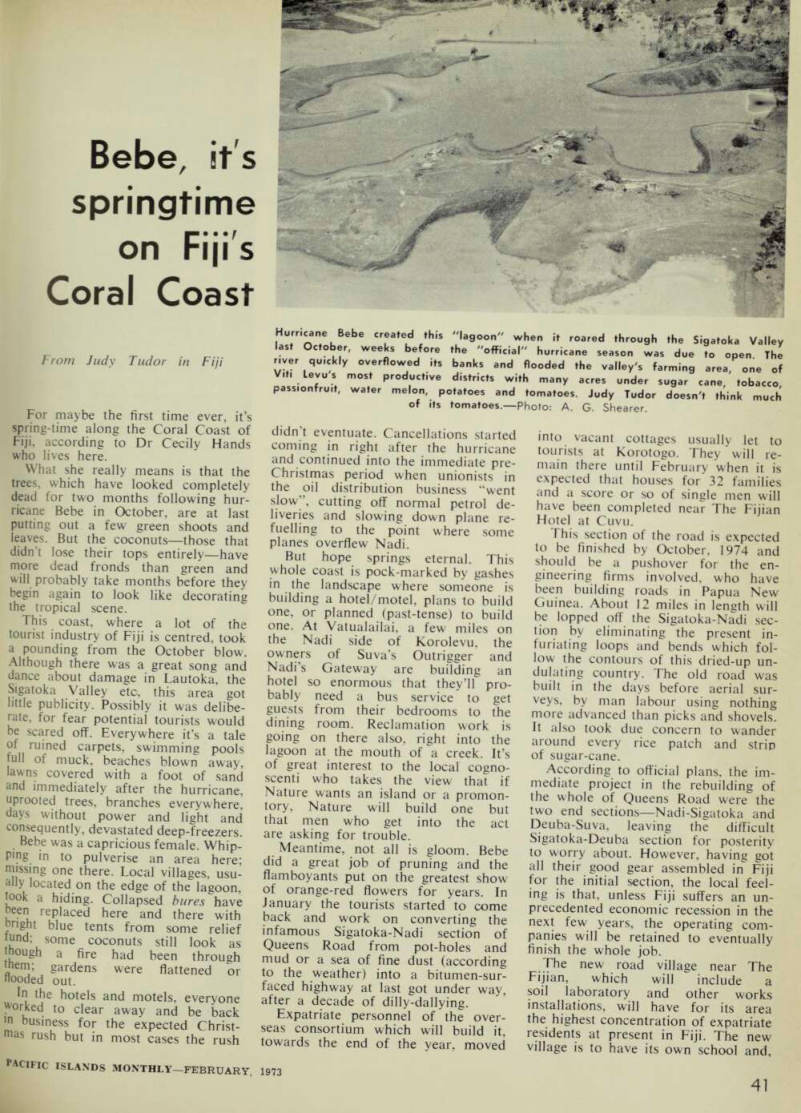
Hurricane Bebe created this "lagoon" when it roared through the Sigatoka Valley last October, weeks before the "official" hurricane season was due to open The river quickly overflowed its banks and flooded the valley's farming area, one of Viti Levu's most productive districts with many acres under sugar cane, tobacco, passionfruit, water melon, potatoes and tomatoes. Judy Tudor doesn't think much of Its tomatoes.—Photo: A. G. Shearer.
No Place For Tired Shoppers
if it has any sense, will also have its own shopping facilities. Although the Sigatoka township, eight miles away, is the natural centre, nothing that has happened there in the last six years indicates that its facilities for the retailing of food have done any thing but slide backwards.
The road and the influx of over seas personnel could do a great deal for the Sigatoka-Coral Coast area if local traders can now switch their minds off selling duty-free goods long enough to invest in a few other commodities. Sigatoka town, situated as it is on a very lovely stretch of river, could be made a beautiful spot but, although it has visibly swollen in size in the last half dozen years, not one thing has been done to re lieve it of its hot, drab, utilitarian Bombay-bazaar appearance.
It has become a target for tourist shoppers from the hotels along the coast and some of its merchants must be profiting mightily. But there is not one place where the same tourists can sit in air-conditioned comfort, away from the heat, the mud, the dust, the flies and the glare and have a cup of tea in comfort.
In fact there isn’t anywhere where a shopper can sit, inside or out. Ex cept the pub, of course, which hasn’t changed either in the last generation.
It remains almost the sole country pub left in Fiji, having done nothing to get into the tourist swim.
The road is also expected to employ several hundred local people and will thus take up any slack in the labour market for some time to come—all good news for keepers of village shops and stall holders in Sigatoka market who sell to the local populace what re mains after supplying the hotel in dustry and the Big Smoke of Suva.
The Fiji Times euphemistically calls the Sigatoka Valley the “salad bowl of Fiji” but obviously no one on the Fiji Times has ever had to make a salad out of what finds its way out of the valley and into Sigatoka market. Endless vistas of cucumbers and egg-plants, garnished with gnarled roots of yaqona, cer tainly. But even in the best of times, the tomatoes usually come button sized, wizened and wrinkled products of some tired, despairing plant, and would be condemned by an agri cultural inspector anywhere else.
The only edible lettuce are air freighted from New Zealand and iso lated specimens occasionally appear
down here in the emporiums of Burns Philp or Morris Hedstrom, at from 50c to 75c each.
Following Bebe, Sigatoka market is an even sorrier sight than usual. Paw paw trees went with the wind, so there is no fruit. Pineapples, which are usually in glut supply at this time of the year, are scarce and cost 40c a throw. The few bananas offered are green, tiny and inedible. Root crops, the staple of Fijian diet, are scarcer and dearer even than usual.
The dalo shortage is a hardy perennial; so much so, you would think that some enterprising Fijian would have planted acres of the high priced stuff. But Fijian enterprise doesn’t blossom in that direction.
They are always at the buying end, being charged exorbitant prices for what’s offered. Indians would probably give you the old spiel about not having land but are, in fact, as in different as Fijians when it comes to market gardening.
The French territories are better at this sort of thing. The fruit and vege table market in Dakar, West Africa, is a pleasure to visit; so are the mar kets in Tahiti—supplied there largely by Chinese market-gardeners.
There are abundant signs of pro gress in some parts of the Fiji econ omy—projected hotels and resorts and a proliferation of the cement block, box like shops all selling duty free goods, in small towns like Siga toka. But increasingly Fiji depends on imports from other countries—food to feed its tourists and its own people, cars for transport, petroleum to run them, radios, tape recorders, French perfume, watches, and the works, to be sold duty-free as an added in ducement to tourists. It all adds up to one of the reasons why Fiji’s economy remains highly precarious.
One hurricane or a strike and the country totters on the brink of disaster.
Add to it the fact that Australia has lately revalued its currency upwards and every tin-pot politician is howling for the government to subsidise food imports from Australia or to lead retaliatory trade delegations all over the place to find cheaper sources supply and thus figuratively spit in the eye of the big neighbour, never the most popular country hereabouts.
Most of the large enterprises in Fiji are Australian, and successful.
To be successful in an ex-colonial country is apt to bring retribution of one sort or another.