new look for Carpenters
pp. 52-53 · Read in the full issue
A new look for Suva may follow the new look for Carpenters
By A Staff Writer
Sixty years ago the man who founded what became the Pacific trading empire of W. R. Carpenter put his trust in people. Sir Walter Carpenter, as he became, was an entrepreneur—active and energetic— who built his business because he was not frightened to back planters and small traders with goods and credit. In time he acquired his own plantations and developed his own stores and businesses, and directed them to prosperity until his death in 1954.
Between the wars, and just after, the Carpenter organisation had so many investments that people could be forgiven for getting the impres sion that all it had to do was sit on what it had got, and not use any further initiative, and it could go on forever. It couldn’t of course, and it never thought it could, but the interesting thing is that in recent years it has become publicly obvious that the big group has not been suffering from hardening of the arteries. The entrepreneurial spirit that built it is a driving force that
has sent the company in new direc tions.
“Today”, says W. R. (Randolph) Caipenter, managing director of the major Carpenter company, W. R.
Carpenter Holdings Ltd, and a grandson of Sir Walter, “we are financing people into business. We are financing Island developments with local participation. There’s a new air, new needs, in the Islands— there’s accelerated growth, and we are meeting these changed conditions.”
To help meet the new conditions the old organisation that was dominated from Sydney headquarters has been swept away. The Papua- New Guinea and Suva-based South Pacific operations have recently be come virtually autonomous. They make their own development decisions, financing them from their own resources, and the days have gone when headquarters was involved in all matters.
“The Carpenter companies are nationally oriented”, explains Randolph Carpenter. “They deal with their own governments. Fiji of
course is a self-governing dominion Western Samoa and Tonga an independent; Papua New Guinea : virtually self-governing. Those govem ments make their own decisions.
“The changes in our own structun have been developing over recen years, just as the changes have bee occurring in the Islands. But they’v recently been accelerated”.
The fact that the Island companie are financing their activities froi their own operations doesn’t mea that they will not have new funo injected if they can use them, say Mr Carpenter.
In fact, one gets the impression th; the entrepreneurial spirit is probabl strongest in Sydney, where funds ca be made available for worthwhL activities wherever they may be either in or out of Australia. Th group is not following a policy o withdrawal from the Islands, no does it plan to, and what M Carpenter would like to see is balance of development, with invest ments where they can do the mox good—and that means where invest
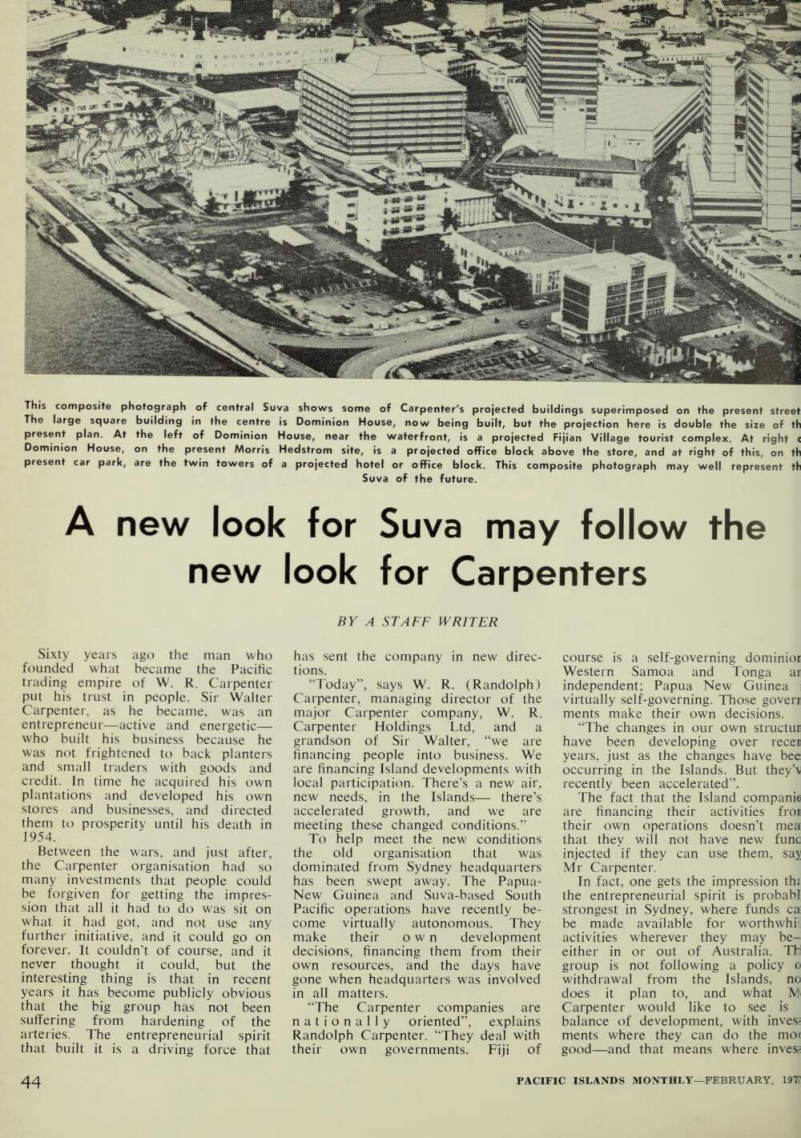
This composite photograph of central Suva shows some of Carpenter's projected buildings superimposed on the present street The large square building in the centre is Dominion House, now being built, but the projection here is double the size of th[?] present plan. At the left of Dominion House, near the waterfront, is a projected Fijian Village tourist complex. At right c[?] Dominion House, on the present Morris Hedstrom site, is a projected office block above the store, and at right of this, on th[?] present car park, are the twin towers of a projected hotel or office block. This composite photograph may well represent th[?] Suva of the future.
ment can work, not sit around.
The Carpenter organisation is in fact embarked on a policy liquidating its very large portfolio investments in Australia, and using the funds for reinvestment to expand direct com pany business—anywhere. Returns from shares sold in the Ansett trans port empire last year, for instance, were put to use by the W. R.
Carpenter Finance Corporation Ltd, which has now become a major arm of group expansion. Its name was recently changed from Austral Pacific Finance Company, and its operations will extend more and more into the Islands as finance is required by ex panding Island economies, and especially by expanding indigenous participation in business activity.
A sample of the kind of develop ment potential that Randolph Car penter foresees is in the photograph opposite page. It shows the possible Suva of the future. Dominion House (see details under the picture) is now being built, and will probably be expanded to the size shown. But in addition central Suva could pos sibly get a bigger department store cum office block, a large hotel or apartment complex, or perhaps both, and an international Fijian Village tourist complex on the waterfront— all of them on existing Carpenter sites. The only firm commitment at the moment is the first stage of the big Dominion House building, but planning is proceeding for the other sites, including another one near the CWM hospital not in the picture.
“These are developments which can be built as the need for them arises and the finance becomes pro gressively available,” says Mr Car penter. “We are doing the same thing in Australia—and we will continue to be interested in this type of development.
“We are not simply store owners and planters any more. We are all sorts of things to all sorts of people.”
In the following pages, PIM takes a more detailed look at the South Seas company that Sir Walter Carpenter pioneered and the changes that have taken place.