New Battle For Solomons
pp. 45-47 · Read in the full issue
Fate Of War Relics Launches
From a Honiara correspondent
Guadalcanal in the Solomon Islands was a battleground in World War 11.
And a fiercely contested one, too, along with other parts of the Solomons.
Now, there’s a little fight over those very battlegrounds and their remains which promises to descend into a guerilla war, following the first pitched battle in the Solomons’ High Court.
The battle has been over the re mains of a Japanese Zero aircraft shot down into Iron Bottom Sound in 1943. The locals have lost it to wealthy Americans, who have carted off their spoils, with the aid of a judgment by the Chief Justice, Sir Jocelyn Bodilly, There were only inches between a win and a loss. But the loss could mean a lot to the Tambea village tourist resort and the Gaumbata Line, or tribe, of Solomon Islanders who are shareholders in Tambea. They now face a payout of perhaps thousands of dollars in costs being claimed by the salvage company which winched the Zero from the sea.
Tambea Village had run a glass bottomed boat for tourists to view the wreck below, and for that reason, at least, wanted it to remain where it was.
In the Solomons, it is possible to tender for salvage rights to any wrecks at a depth greater than five fathoms (30 feet). In the case of this Zero, it was lying a good 600 metres off shore. That was agreed.
But how far down it was became the disputed point. Olle Torling, who runs Tambea village, and has an agreement so that the resort reverts to the Gaumbata Line eventually, tried to prove on their behalf that the Zero was in 30 feet of water precisely. A five fathom line, “not an inch more or less”—to quote Sir Jocelyn—and measured by a local man, Joachim, was produced as the measure of the distance from the sea’s surface to the bottom.
But Sir Jocelyn was not impressed, and upheld the measurements of two experienced divers commonly engaged m salvage work, who found their nve-fathom line would not touch bottom, and then measured the depth
with two depth gauges at 35 feet (nearly six fathoms). At dead low water, in this cas*% the wreck would lie in 33 feet 9 inches of water.
So, the Americans from “Yester day’s Air Force” at Los Angeles International Airport and Chino Air port, both in California, were able to crate their now partly spoiled spoils, and to ship them off in January.
Parts of the craft deteriorated during the court case heard after an in junction delayed the plane’s export.
“Yesterday’s Air Force” is said to be a very wealthy organisation indeed which has salvaged and restored and rebuilt some 300 old wartime aircraft so they can be flown.
Two Zeros are reputed, for instance, to have been pieced together for the spectacular film “Tora, Tora” about the Pearl Harbour attack.
The pieces of the Tambea Zero, which were found to be particularly useful, were the engine and pro pellers with engine cowling, some instruments, two 20 millimetre can
non with some ammunition and two 7.9 millimetre machine guns, one of which had jammed with a lot of ammunition left. As well, there was the folding wing tips, in good con dition after nearly 30 years sub mersion, and this discovery apparently makes the aircraft a carrier-based Zero and a likely survivor of the Pearl Harbour attack.
The folding wing Zeros were rare in the Solomons campaigns, according to Mike Laurent, the director of International Salvage and Submarine Association Limited, which was the subject of the High Court injunction by the Tambea plaintiffs.
There are a number of wartime aircraft in Solomons waters, including four that Laurent claims to be able to lift legally, as well as an un counted number of others from both sides of the Pacific conflict which are on dry land.
The problem with those on land is that the land belongs to someone, and without legal consent the wrecks
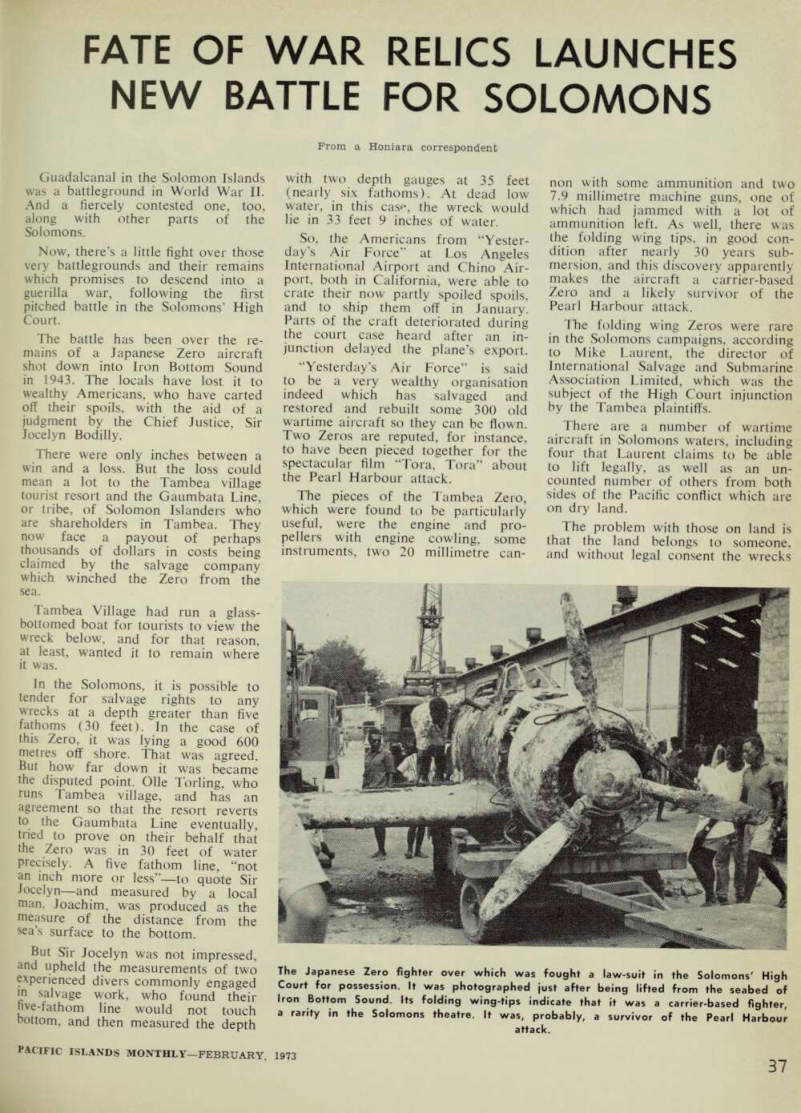
The Japanese Zero fighter over which was fought a law-suit in the Solomons' High Court for possession. It was photographed just after being lifted from the seabed of Iron Bottom Sound. Its folding wing-tips indicate that it was a carrier-based fighter, a rarity in the Solomons theatre. It was, probably, a survivor of the Pearl Harbour attack.
Stealing Betty Bombers
cannot be removed. Not that this stops people thieving some well preserved Betty Bombers and Zeros piece by piece.
In the Shortland Islands, in the Western Solomons, there is one island largely occupied by an airstrip, but covered elsewhere by heavy bush.
In the bush lie numerous craft which are being raided by what are tech nically smugglers from Bougainville, the largest of the geographical Solomons chain, in New Guinea.
A recent visitor from Honiara, who was to be shown a readily-accessible Zero by her guide and who was as sured that the craft still was com plete, was brought to —a very lonely propeller!
The District Commissioner, Eddie Brooks, came upon a group of industrious looters who assured him before he identified himself that they “had the DC’s permission”. So far few Solomon Islanders, including those prominent in public life, have awakened to the fact that they are giving away money-earning “arti facts” by not guarding these remains.
People like Mike Laurent have a legal right to salvage. They have tendered, and paid for their right.
People in Honiara, such as the recently appointed chairman of the British Solomon Islands Tourist Authority, Jim Tedder, have reacted adversely to the export of the Tambea Zero. They have said that the Solomons have a greater right to the short-term benefits of having the wartime wrecks rot where they sit to earn tourist dollars, than wealthy Americans have to take the pieces away to play war games or create expensive flying museums.
Laurent, as you would expect, says it’s better to retrieve the wrecks for permanent memorials, and anyway, he’s a salvage operator.
But only a change in the law or the Government caring for local enterprise and not cold cash can help to stop the increasing exodus.
It seems that the longer the war is behind us, the more demand there is for the dwindling supply of genuine relics. Japanese nowadays make two or three trips a year to Solomon Island battlegrounds to find remains of their soldiers and to hold Shinto ceremonies beside newly-erected memorials on once bloody ridges and beaches. Americans come, less formally, to look up the places where relatives fought, or to see the island
in the Western District where John Kennedy was saved, Laurent says that if anyone in the Solomons could restore and maintain one of the aircraft he knows are in the sea, he would salvage it and donate it as a goodwill gesture. It’s probably a safe offer, as it’s highly unlikely there is anyone with the knowledge or the money to do this, but at least the offer is there.
In the meantime, as long as the government calls for tenders there will be those who raise wrecks from beyond the five fathom mark, although the Crown has relinquished rights (since 1971) to any wartime scrap on the seabed in water of a depth less than 10 metres “which for practical purposes may be interpreted as five fathoms”.
According to Sir Jocelyn Bodilly’s judgment, in December, by English law the Crown is entitled to all un claimed wreck “including flotsam, jetsam, lagan and ligan and derelict found in or on the shores of the sea and any tidal waters in any part of the dominions of the Crown except in places where the right has been granted to any other person”.
The Chief Justice found that this law applied in the Protectorate.
Olle Torling, appearing for Tambea village and the Gaumbata Line claimed ownership of the seabed of Tambea Bay to a depth at which the seabed may be seen under favourable conditions from the surface, and of anything on the seabed since the Zero wreck could be seen from the surface.
Sir Jocelyn found that custom— a law or right not written which is established by long usage—did not apply to the claim, because custom had to be of great antiquity. The Gaumbata Line proved they had taken the produce of the sea from the area for sufficient time, but the taking of wrecks had happened only since the war. A practice since time immemorial, necessary in this case, was not there.
It is interesting to note that Tambea village was told only in May, 1972, by a driver belonging to Laurent’s company that the Zero was where it lay (until the end of November and Laurent’s salvage operation). One of Laurent’s men, working on other salvage, had been shown it by an old Gaumbata man, and according to Laurent’s evidence in court this was the first time Torling knew of it.